Chapter 2 Corporations:  Introduction and Operating Rules Copyright ©2009 Cengage Learning Corporations, Partnerships,  Estates & Trusts
Various Business Forms Sole proprietorships Partnerships Trusts and estates S corporations  Regular corporations (also called C corporations)
Sole Proprietorship Not a separate taxable Income reported on owner’s Sch. C
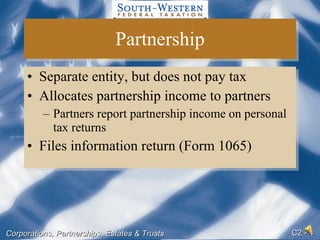
Partnership Separate entity, but does not pay tax Allocates partnership income to partners Partners report partnership income on personal tax returns Files information return (Form 1065)
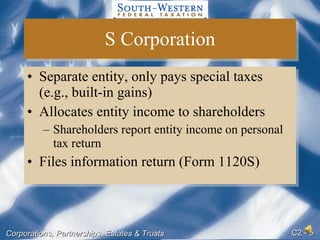
S Corporation Separate entity, only pays special taxes (e.g., built-in gains) Allocates entity income to shareholders Shareholders report entity income on personal tax return  Files information return (Form 1120S)
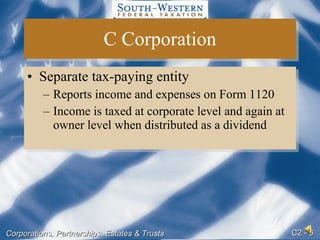
C Corporation Separate tax-paying entity Reports income and expenses on Form 1120 Income is taxed at corporate level and again at owner level when distributed as a dividend
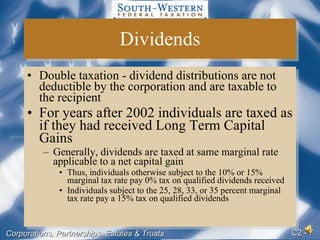
Dividends Double taxation - dividend distributions are not deductible by the corporation and are taxable to the recipient For years after 2002 individuals are taxed as if they had received Long Term Capital Gains Generally, dividends are taxed at same marginal rate applicable to a net capital gain Thus, individuals otherwise subject to the 10% or 15% marginal tax rate pay 0% tax on qualified dividends received Individuals subject to the 25, 28, 33, or 35 percent marginal tax rate pay a 15% tax on qualified dividends
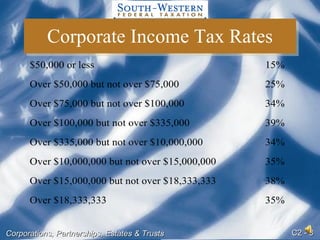
Corporate Income Tax Rates
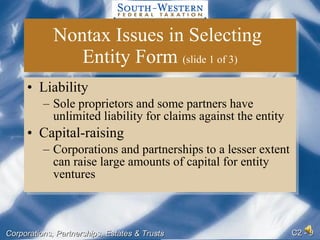
Nontax Issues in Selecting  Entity Form  (slide 1 of 3) Liability Sole proprietors and some partners have unlimited liability for claims against the entity Capital-raising Corporations and partnerships to a lesser extent can raise large amounts of capital for entity ventures
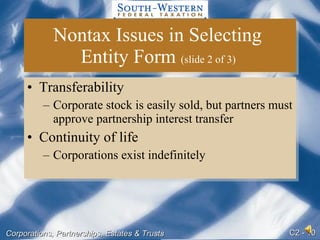
Nontax Issues in Selecting  Entity Form  (slide 2 of 3)   Transferability Corporate stock is easily sold, but partners must approve partnership interest transfer Continuity of life Corporations exist indefinitely
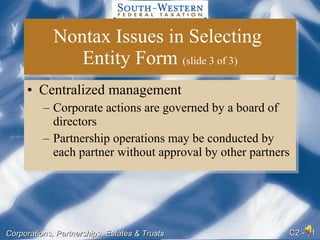
Nontax Issues in Selecting  Entity Form  (slide 3 of 3) Centralized management Corporate actions are governed by a board of directors Partnership operations may be conducted by each partner without approval by other partners

Chapter 2 Part 1

  • 1.
    Chapter 2 Corporations: Introduction and Operating Rules Copyright ©2009 Cengage Learning Corporations, Partnerships, Estates & Trusts
  • 2.
    Various Business FormsSole proprietorships Partnerships Trusts and estates S corporations Regular corporations (also called C corporations)
  • 3.
    Sole Proprietorship Nota separate taxable Income reported on owner’s Sch. C
  • 4.
    Partnership Separate entity,but does not pay tax Allocates partnership income to partners Partners report partnership income on personal tax returns Files information return (Form 1065)
  • 5.
    S Corporation Separateentity, only pays special taxes (e.g., built-in gains) Allocates entity income to shareholders Shareholders report entity income on personal tax return Files information return (Form 1120S)
  • 6.
    C Corporation Separatetax-paying entity Reports income and expenses on Form 1120 Income is taxed at corporate level and again at owner level when distributed as a dividend
  • 7.
    Dividends Double taxation- dividend distributions are not deductible by the corporation and are taxable to the recipient For years after 2002 individuals are taxed as if they had received Long Term Capital Gains Generally, dividends are taxed at same marginal rate applicable to a net capital gain Thus, individuals otherwise subject to the 10% or 15% marginal tax rate pay 0% tax on qualified dividends received Individuals subject to the 25, 28, 33, or 35 percent marginal tax rate pay a 15% tax on qualified dividends
  • 8.
  • 9.
    Nontax Issues inSelecting Entity Form (slide 1 of 3) Liability Sole proprietors and some partners have unlimited liability for claims against the entity Capital-raising Corporations and partnerships to a lesser extent can raise large amounts of capital for entity ventures
  • 10.
    Nontax Issues inSelecting Entity Form (slide 2 of 3) Transferability Corporate stock is easily sold, but partners must approve partnership interest transfer Continuity of life Corporations exist indefinitely
  • 11.
    Nontax Issues inSelecting Entity Form (slide 3 of 3) Centralized management Corporate actions are governed by a board of directors Partnership operations may be conducted by each partner without approval by other partners

Editor's Notes

  • #4 entity (1040, schedule C)