13.2.2 Peripheral
nervous system
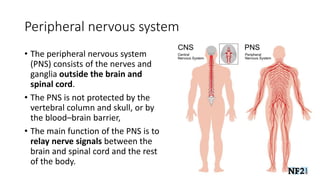
Peripheral nervous system
• The peripheral nervous system
(PNS) consists of the nerves and
ganglia outside the brain and
spinal cord.
• The PNS is not protected by the
vertebral column and skull, or by
the blood–brain barrier,
• The main function of the PNS is to
relay nerve signals between the
brain and spinal cord and the rest
of the body.
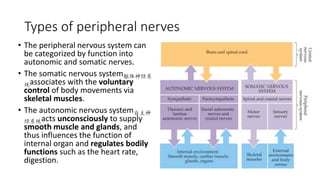
Types of peripheral nerves
• The peripheral nervous system can
be categorized by function into
autonomic and somatic nerves.
• The somatic nervous system躯体神经系
统associates with the voluntary
control of body movements via
skeletal muscles.
• The autonomic nervous system自主神
经系统acts unconsciously to supply
smooth muscle and glands, and
thus influences the function of
internal organ and regulates bodily
functions such as the heart rate,
digestion.
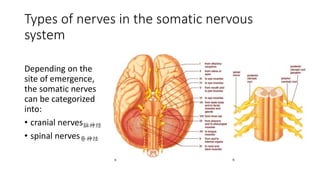
Types of nerves in the somatic nervous
system
Depending on the
site of emergence,
the somatic nerves
can be categorized
into:
• cranial nerves脑神经
• spinal nerves脊神经
Cranial nerve
• Greek kranion ‘skull’
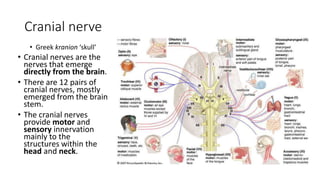
• Cranial nerves are the
nerves that emerge
directly from the brain.
• There are 12 pairs of
cranial nerves, mostly
emerged from the brain
stem.
• The cranial nerves
provide motor and
sensory innervation
mainly to the
structures within the
head and neck.
Spinal nerve
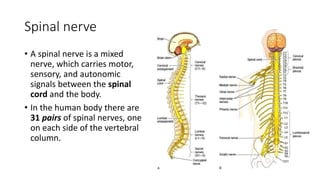
• A spinal nerve is a mixed
nerve, which carries motor,
sensory, and autonomic
signals between the spinal
cord and the body.
• In the human body there are
31 pairs of spinal nerves, one
on each side of the vertebral
column.
Types of spinal nerves
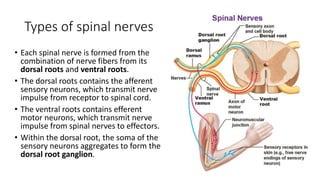
• Each spinal nerve is formed from the
combination of nerve fibers from its
dorsal roots and ventral roots.
• The dorsal roots contains the afferent
sensory neurons, which transmit nerve
impulse from receptor to spinal cord.
• The ventral roots contains efferent
motor neurons, which transmit nerve
impulse from spinal nerves to effectors.
• Within the dorsal root, the soma of the
sensory neurons aggregates to form the
dorsal root ganglion.
13.2.3 Autonomic
nervous system
Autonomic nervous system
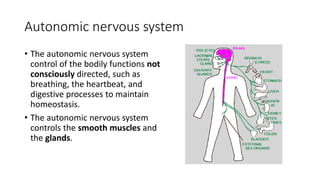
• The autonomic nervous system
control of the bodily functions not
consciously directed, such as
breathing, the heartbeat, and
digestive processes to maintain
homeostasis.
• The autonomic nervous system
controls the smooth muscles and
the glands.
Types of autonomic nerves
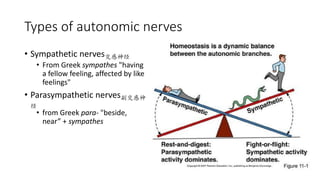
• Sympathetic nerves交感神经
• From Greek sympathes "having
a fellow feeling, affected by like
feelings"
• Parasympathetic nerves副交感神
经
• from Greek para- "beside,
near” + sympathes
Effects of autonomic nerves
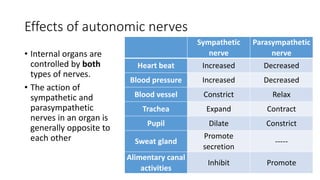
• Internal organs are
controlled by both
types of nerves.
• The action of
sympathetic and
parasympathetic
nerves in an organ is
generally opposite to
each other
Sympathetic
nerve
Parasympathetic
nerve
Heart beat Increased Decreased
Blood pressure Increased Decreased
Blood vessel Constrict Relax
Trachea Expand Contract
Pupil Dilate Constrict
Sweat gland
Promote
secretion
-----
Alimentary canal
activities
Inhibit Promote
Sympathetic nerves
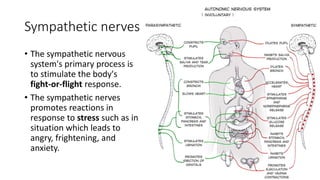
• The sympathetic nervous
system's primary process is
to stimulate the body's
fight-or-flight response.
• The sympathetic nerves
promotes reactions in
response to stress such as in
situation which leads to
angry, frightening, and
anxiety.
Parasympathetic
nerves
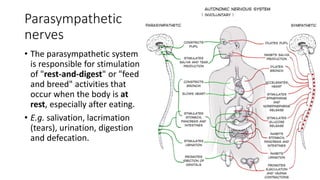
• The parasympathetic system
is responsible for stimulation
of "rest-and-digest" or "feed
and breed" activities that
occur when the body is at
rest, especially after eating.
• E.g. salivation, lacrimation
(tears), urination, digestion
and defecation.
Summary
• The peripheral nervous system (PNS) consists of the nerves and
ganglia outside the brain and spinal cord that relays nerve signals
between the brain and spinal cord and the rest of the body.
• The somatic nervous system associates with the voluntary control of
body movements via skeletal muscles.
• The autonomic nervous system unconsciously regulates bodily
functions to supply smooth muscle and glands.
• Sympathetic nerves dominates during “fight-or-flight” situation while
the parasympathetic nerves dominates during “rest-and-digest”
situation.
13.3 The
mechanism
of nervous
system
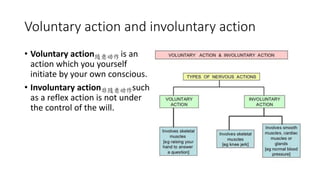
Voluntary action and involuntary action
• Voluntary action随意动作 is an
action which you yourself
initiate by your own conscious.
• Involuntary action非随意动作such
as a reflex action is not under
the control of the will.
13.3.1 Voluntary
action
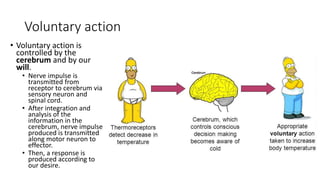
Voluntary action
• Voluntary action is
controlled by the
cerebrum and by our
will.
• Nerve impulse is
transmitted from
receptor to cerebrum via
sensory neuron and
spinal cord.
• After integration and
analysis of the
information in the
cerebrum, nerve impulse
produced is transmitted
along motor neuron to
effector.
• Then, a response is
produced according to
our desire.
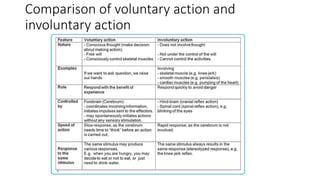
Comparison of voluntary action and
involuntary action
13.3.2 Reflex action
Reflex action反射作用
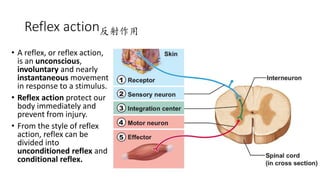
• A reflex, or reflex action,
is an unconscious,
involuntary and nearly
instantaneous movement
in response to a stimulus.
• Reflex action protect our
body immediately and
prevent from injury.
• From the style of reflex
action, reflex can be
divided into
unconditioned reflex and
conditional reflex.
13.3.2.1
Unconditioned
reflex
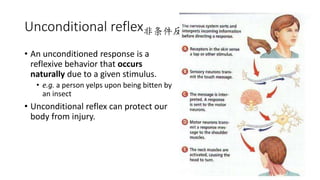
Unconditional reflex非条件反射
• An unconditioned response is a
reflexive behavior that occurs
naturally due to a given stimulus.
• e.g. a person yelps upon being bitten by
an insect
• Unconditional reflex can protect our
body from injury.
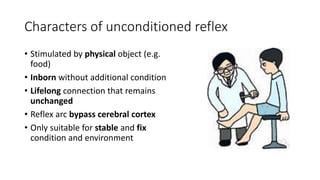
Characters of unconditioned reflex
• Stimulated by physical object (e.g.
food)
• Inborn without additional condition
• Lifelong connection that remains
unchanged
• Reflex arc bypass cerebral cortex
• Only suitable for stable and fix
condition and environment
Types of unconditioned reflex
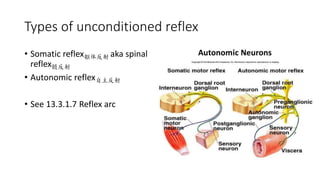
• Somatic reflex躯体反射 aka spinal
reflex髓反射
• Autonomic reflex自主反射
• See 13.3.1.7 Reflex arc
13.3.2.2
Conditioned reflex
Conditioned reflex
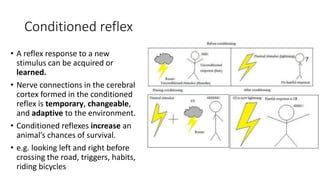
• A reflex response to a new
stimulus can be acquired or
learned.
• Nerve connections in the cerebral
cortex formed in the conditioned
reflex is temporary, changeable,
and adaptive to the environment.
• Conditioned reflexes increase an
animal’s chances of survival.
• e.g. looking left and right before
crossing the road, triggers, habits,
riding bicycles
Pavlov’s experiment
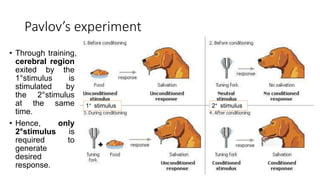
2° stimulus1° stimulus
• Through training,
cerebral region
exited by the
1°stimulus is
stimulated by
the 2°stimulus
at the same
time.
• Hence, only
2°stimulus is
required to
generate
desired
response.
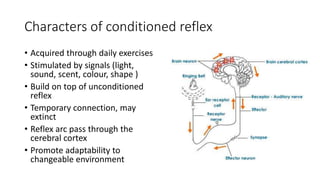
Characters of conditioned reflex
• Acquired through daily exercises
• Stimulated by signals (light,
sound, scent, colour, shape )
• Build on top of unconditioned
reflex
• Temporary connection, may
extinct
• Reflex arc pass through the
cerebral cortex
• Promote adaptability to
changeable environment
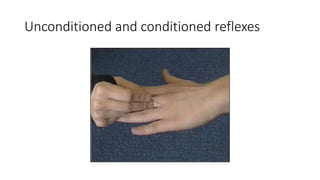
Unconditioned and conditioned reflexes
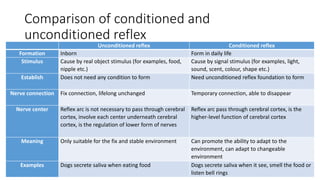
Comparison of conditioned and
unconditioned reflex
Unconditioned reflex Conditioned reflex
Formation Inborn Form in daily life
Stimulus Cause by real object stimulus (for examples, food,
nipple etc.)
Cause by signal stimulus (for examples, light,
sound, scent, colour, shape etc.)
Establish Does not need any condition to form Need unconditioned reflex foundation to form
Nerve connection Fix connection, lifelong unchanged Temporary connection, able to disappear
Nerve center Reflex arc is not necessary to pass through cerebral
cortex, involve each center underneath cerebral
cortex, is the regulation of lower form of nerves
Reflex arc pass through cerebral cortex, is the
higher-level function of cerebral cortex
Meaning Only suitable for the fix and stable environment Can promote the ability to adapt to the
environment, can adapt to changeable
environment
Examples Dogs secrete saliva when eating food Dogs secrete saliva when it see, smell the food or
listen bell rings
Summary
• Voluntary action is an action which you yourself initiate by your own
conscious.
• Involuntary action such as a reflex action is not under the control of
the will.
• An unconditioned response is a reflexive behavior that occurs
naturally due to a given stimulus.
• A conditioned response is acquired through training.

独中高中生物Chapter 13 Part 3 Peripheral nervous syste,

  • 1.
  • 2.
    Peripheral nervous system •The peripheral nervous system (PNS) consists of the nerves and ganglia outside the brain and spinal cord. • The PNS is not protected by the vertebral column and skull, or by the blood–brain barrier, • The main function of the PNS is to relay nerve signals between the brain and spinal cord and the rest of the body.
  • 3.
    Types of peripheralnerves • The peripheral nervous system can be categorized by function into autonomic and somatic nerves. • The somatic nervous system躯体神经系 统associates with the voluntary control of body movements via skeletal muscles. • The autonomic nervous system自主神 经系统acts unconsciously to supply smooth muscle and glands, and thus influences the function of internal organ and regulates bodily functions such as the heart rate, digestion.
  • 4.
    Types of nervesin the somatic nervous system Depending on the site of emergence, the somatic nerves can be categorized into: • cranial nerves脑神经 • spinal nerves脊神经
  • 5.
    Cranial nerve • Greekkranion ‘skull’ • Cranial nerves are the nerves that emerge directly from the brain. • There are 12 pairs of cranial nerves, mostly emerged from the brain stem. • The cranial nerves provide motor and sensory innervation mainly to the structures within the head and neck.
  • 6.
    Spinal nerve • Aspinal nerve is a mixed nerve, which carries motor, sensory, and autonomic signals between the spinal cord and the body. • In the human body there are 31 pairs of spinal nerves, one on each side of the vertebral column.
  • 7.
    Types of spinalnerves • Each spinal nerve is formed from the combination of nerve fibers from its dorsal roots and ventral roots. • The dorsal roots contains the afferent sensory neurons, which transmit nerve impulse from receptor to spinal cord. • The ventral roots contains efferent motor neurons, which transmit nerve impulse from spinal nerves to effectors. • Within the dorsal root, the soma of the sensory neurons aggregates to form the dorsal root ganglion.
  • 8.
  • 9.
    Autonomic nervous system •The autonomic nervous system control of the bodily functions not consciously directed, such as breathing, the heartbeat, and digestive processes to maintain homeostasis. • The autonomic nervous system controls the smooth muscles and the glands.
  • 10.
    Types of autonomicnerves • Sympathetic nerves交感神经 • From Greek sympathes "having a fellow feeling, affected by like feelings" • Parasympathetic nerves副交感神 经 • from Greek para- "beside, near” + sympathes
  • 11.
    Effects of autonomicnerves • Internal organs are controlled by both types of nerves. • The action of sympathetic and parasympathetic nerves in an organ is generally opposite to each other Sympathetic nerve Parasympathetic nerve Heart beat Increased Decreased Blood pressure Increased Decreased Blood vessel Constrict Relax Trachea Expand Contract Pupil Dilate Constrict Sweat gland Promote secretion ----- Alimentary canal activities Inhibit Promote
  • 12.
    Sympathetic nerves • Thesympathetic nervous system's primary process is to stimulate the body's fight-or-flight response. • The sympathetic nerves promotes reactions in response to stress such as in situation which leads to angry, frightening, and anxiety.
  • 13.
    Parasympathetic nerves • The parasympatheticsystem is responsible for stimulation of "rest-and-digest" or "feed and breed" activities that occur when the body is at rest, especially after eating. • E.g. salivation, lacrimation (tears), urination, digestion and defecation.
  • 14.
    Summary • The peripheralnervous system (PNS) consists of the nerves and ganglia outside the brain and spinal cord that relays nerve signals between the brain and spinal cord and the rest of the body. • The somatic nervous system associates with the voluntary control of body movements via skeletal muscles. • The autonomic nervous system unconsciously regulates bodily functions to supply smooth muscle and glands. • Sympathetic nerves dominates during “fight-or-flight” situation while the parasympathetic nerves dominates during “rest-and-digest” situation.
  • 15.
  • 16.
    Voluntary action andinvoluntary action • Voluntary action随意动作 is an action which you yourself initiate by your own conscious. • Involuntary action非随意动作such as a reflex action is not under the control of the will.
  • 17.
  • 18.
    Voluntary action • Voluntaryaction is controlled by the cerebrum and by our will. • Nerve impulse is transmitted from receptor to cerebrum via sensory neuron and spinal cord. • After integration and analysis of the information in the cerebrum, nerve impulse produced is transmitted along motor neuron to effector. • Then, a response is produced according to our desire.
  • 19.
    Comparison of voluntaryaction and involuntary action
  • 20.
  • 21.
    Reflex action反射作用 • Areflex, or reflex action, is an unconscious, involuntary and nearly instantaneous movement in response to a stimulus. • Reflex action protect our body immediately and prevent from injury. • From the style of reflex action, reflex can be divided into unconditioned reflex and conditional reflex.
  • 22.
  • 23.
    Unconditional reflex非条件反射 • Anunconditioned response is a reflexive behavior that occurs naturally due to a given stimulus. • e.g. a person yelps upon being bitten by an insect • Unconditional reflex can protect our body from injury.
  • 24.
    Characters of unconditionedreflex • Stimulated by physical object (e.g. food) • Inborn without additional condition • Lifelong connection that remains unchanged • Reflex arc bypass cerebral cortex • Only suitable for stable and fix condition and environment
  • 25.
    Types of unconditionedreflex • Somatic reflex躯体反射 aka spinal reflex髓反射 • Autonomic reflex自主反射 • See 13.3.1.7 Reflex arc
  • 26.
  • 27.
    Conditioned reflex • Areflex response to a new stimulus can be acquired or learned. • Nerve connections in the cerebral cortex formed in the conditioned reflex is temporary, changeable, and adaptive to the environment. • Conditioned reflexes increase an animal’s chances of survival. • e.g. looking left and right before crossing the road, triggers, habits, riding bicycles
  • 28.
    Pavlov’s experiment 2° stimulus1°stimulus • Through training, cerebral region exited by the 1°stimulus is stimulated by the 2°stimulus at the same time. • Hence, only 2°stimulus is required to generate desired response.
  • 29.
    Characters of conditionedreflex • Acquired through daily exercises • Stimulated by signals (light, sound, scent, colour, shape ) • Build on top of unconditioned reflex • Temporary connection, may extinct • Reflex arc pass through the cerebral cortex • Promote adaptability to changeable environment
  • 30.
  • 31.
    Comparison of conditionedand unconditioned reflex Unconditioned reflex Conditioned reflex Formation Inborn Form in daily life Stimulus Cause by real object stimulus (for examples, food, nipple etc.) Cause by signal stimulus (for examples, light, sound, scent, colour, shape etc.) Establish Does not need any condition to form Need unconditioned reflex foundation to form Nerve connection Fix connection, lifelong unchanged Temporary connection, able to disappear Nerve center Reflex arc is not necessary to pass through cerebral cortex, involve each center underneath cerebral cortex, is the regulation of lower form of nerves Reflex arc pass through cerebral cortex, is the higher-level function of cerebral cortex Meaning Only suitable for the fix and stable environment Can promote the ability to adapt to the environment, can adapt to changeable environment Examples Dogs secrete saliva when eating food Dogs secrete saliva when it see, smell the food or listen bell rings
  • 32.
    Summary • Voluntary actionis an action which you yourself initiate by your own conscious. • Involuntary action such as a reflex action is not under the control of the will. • An unconditioned response is a reflexive behavior that occurs naturally due to a given stimulus. • A conditioned response is acquired through training.

Editor's Notes

  • #2 https://i.pinimg.com/736x/01/15/36/0115360722c1e5427bab255179050bcf--morning-humor-good-morning.jpg
  • #3 https://www.nf2is.org/nf_img/cnspns.png
  • #4 http://bethycotter.wdfiles.com/local--files/somaticautonomicnervoussystems/Screen%20Shot%202012-09-03%20at%208.56.36%20AM.png
  • #5 http://encyclopedia.lubopitko-bg.com/images/Cranial%20and%20spinal%20nerves.jpg
  • #6 https://amedia.britannica.com/700x450/44/54244-004-892C5169.jpg
  • #7 http://encyclopedia.lubopitko-bg.com/images/Spinal%20cord%20and%20spinal%20nerves.jpg
  • #8 http://antranik.org/wp-content/uploads/2011/11/spinal-nerves-in-detail-showing-dorsal-root-ganglion-ramus-rami-ventral-root.jpg
  • #9 https://i.pinimg.com/236x/48/0d/67/480d673233fb1055b557ec37485b1fd6--parasympathetic-nervous-system-grad-cap.jpg
  • #10 http://www.indiana.edu/~p1013447/images/ans_psyc.gif
  • #11 https://i.pinimg.com/originals/f6/f3/c1/f6f3c10116dfb06f177bf215fc5e8cf2.jpg
  • #13 https://backyardbrains.com/experiments/img/AutonomicNervousSystem_web.jpg
  • #14 https://backyardbrains.com/experiments/img/AutonomicNervousSystem_web.jpg
  • #16 https://www.scienceabc.com/wp-content/uploads/2016/10/Doctor-patient-joke.jpg
  • #17 https://qph.fs.quoracdn.net/main-qimg-dfdab4a710f80172ba92ed27f8b4c4b0-c
  • #18 https://i.pinimg.com/736x/5c/a4/19/5ca4192b542aac2c34dfc50ee83e41e8--volunteer-appreciation-mom-daughter.jpg
  • #19 http://images.slideplayer.com/24/7562388/slides/slide_37.jpg
  • #20 http://biology-igcse.weebly.com/-voluntary-involuntary-actions.html
  • #21 https://s3.amazonaws.com/lowres.cartoonstock.com/animals-cat-dog-cat_like-reflex-medical_exam-awhn195_low.jpg
  • #22 http://www.justscience.in/wp-content/uploads/2017/06/pjimage-8-6.jpg
  • #23 http://img1.joyreactor.com/pics/post/art-comics-cartoon-bizarro-4334163.jpeg
  • #24 http://images.slideplayer.com/36/10541805/slides/slide_10.jpg
  • #25 https://img.tfd.com/wn/19/6030E-unconditioned-reflex.png
  • #27 https://i.pinimg.com/736x/d5/1d/f7/d51df7011a9b41c58705d598da555509--doggies-baby-dogs.jpg
  • #28 http://www.psychologywizard.net/uploads/2/6/6/4/26640833/6251805.jpg?577
  • #30 http://images.tutorvista.com/content/nervous-coordination/complex-reflex-representation.jpeg
  • #31 https://www.youtube.com/watch?v=Dgc5aPx17ZY