Chapter 20
Organisms and Environment
Ong Yee Sing
2019
Learning objectives:
• Understand the influence of abiotic factors to organism and interaction in between
organisms.
• Understand organisms to the adaptation of environment and influence.
• Understand population density and population growth
• Understand the structure and succession of community
• Know the concept and types of ecosystem
• Know the composition of ecosystem, food chain and food web
• Comprehend energy flow of ecosystem
• Comprehend recycle materials of ecosystem
• Understand ecological balance
• Comprehend human activities and environmental pollution
• Manipulate the methods and importance of environmental protection.
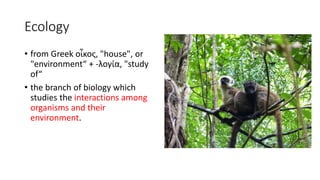
Ecology
• from Greek οἶκος, "house", or
"environment“ + -λογία, "study
of“
• the branch of biology which
studies the interactions among
organisms and their
environment.
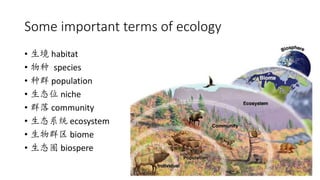
Some important terms of ecology
• 生境 habitat
• 物种 species
• 种群 population
• 生态位 niche
• 群落 community
• 生态系统 ecosystem
• 生物群区 biome
• 生态圈 biospere
Habitat
• The type of natural
environment in which a
particular species of organism
lives.
• A species' habitat is those
places where it can find food,
shelter, protection and mates
for reproduction.
• It is characterized by both
physical [abiotic] and biological
[biotic] features.
This coral reef in the Phoenix Islands Protected Area is a rich
habitat for sea life.
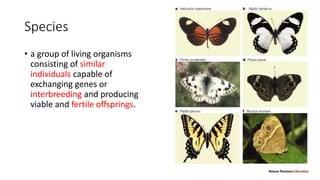
Species
• a group of living organisms
consisting of similar
individuals capable of
exchanging genes or
interbreeding and producing
viable and fertile offsprings.
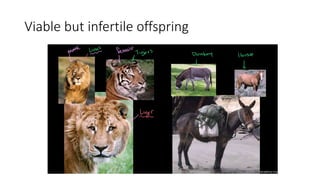
Viable but infertile offspring
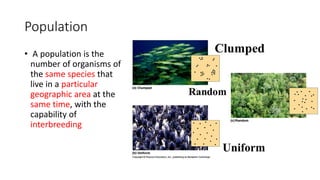
Population
• A population is the
number of organisms of
the same species that
live in a particular
geographic area at the
same time, with the
capability of
interbreeding
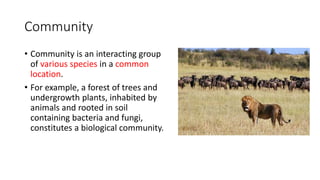
Community
• Community is an interacting group
of various species in a common
location.
• For example, a forest of trees and
undergrowth plants, inhabited by
animals and rooted in soil
containing bacteria and fungi,
constitutes a biological community.
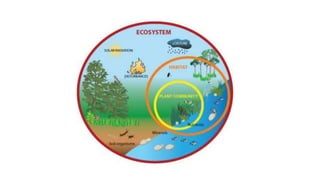
Ecosystem
• An ecosystem is a community of living
organisms [biotic] and their shared
physical environment [abiotic] to form
a stable and equilibrium system.
• Ecosystems can be small, such as the
tide pools found near the rocky shores
of many oceans, or very large, such as
the Amazon Rainforest in South
America.
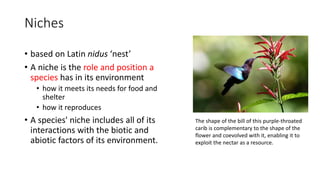
Niches
• based on Latin nidus ‘nest’
• A niche is the role and position a
species has in its environment
• how it meets its needs for food and
shelter
• how it reproduces
• A species' niche includes all of its
interactions with the biotic and
abiotic factors of its environment.
The shape of the bill of this purple-throated
carib is complementary to the shape of the
flower and coevolved with it, enabling it to
exploit the nectar as a resource.
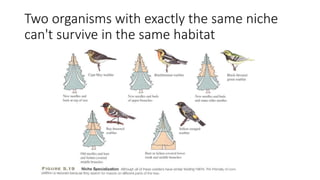
Two organisms with exactly the same niche
can't survive in the same habitat
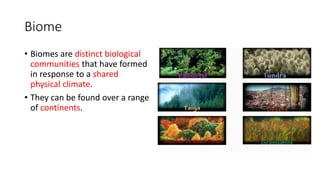
Biome
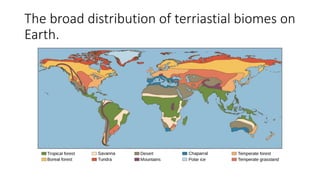
• Biomes are distinct biological
communities that have formed
in response to a shared
physical climate.
• They can be found over a range
of continents.
The broad distribution of terriastial biomes on
Earth.
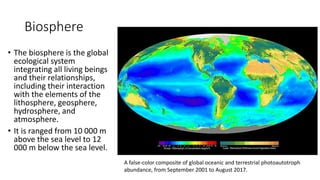
Biosphere
• The biosphere is the global
ecological system
integrating all living beings
and their relationships,
including their interaction
with the elements of the
lithosphere, geosphere,
hydrosphere, and
atmosphere.
• It is ranged from 10 000 m
above the sea level to 12
000 m below the sea level.
A false-color composite of global oceanic and terrestrial photoautotroph
abundance, from September 2001 to August 2017.
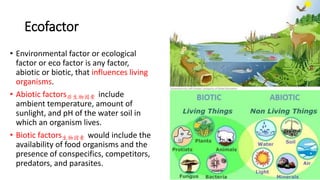
Ecofactor
• Environmental factor or ecological
factor or eco factor is any factor,
abiotic or biotic, that influences living
organisms.
• Abiotic factors非生物因素 include
ambient temperature, amount of
sunlight, and pH of the water soil in
which an organism lives.
• Biotic factors生物因素 would include the
availability of food organisms and the
presence of conspecifics, competitors,
predators, and parasites.
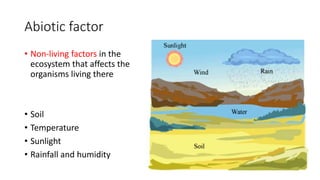
Abiotic factor
• Non-living factors in the
ecosystem that affects the
organisms living there
• Soil
• Temperature
• Sunlight
• Rainfall and humidity
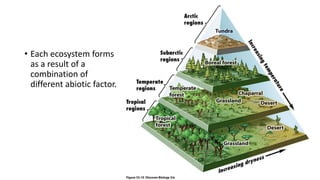
• Each ecosystem forms
as a result of a
combination of
different abiotic factor.
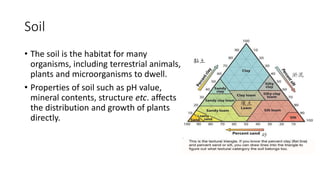
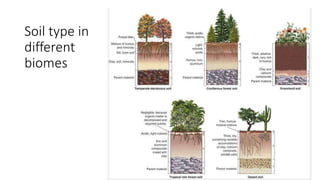
Soil
• The soil is the habitat for many
organisms, including terrestrial animals,
plants and microorganisms to dwell.
• Properties of soil such as pH value,
mineral contents, structure etc. affects
the distribution and growth of plants
directly.
黏土
淤泥
壤土
砂
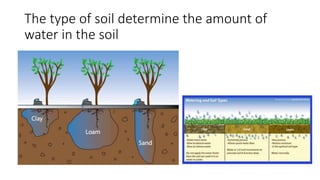
The type of soil determine the amount of
water in the soil
Soil type in
different
biomes
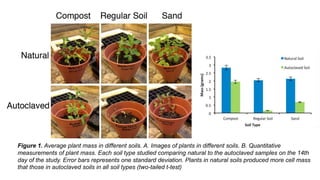
Figure 1. Average plant mass in different soils. A. Images of plants in different soils. B. Quantitative
measurements of plant mass. Each soil type studied comparing natural to the autoclaved samples on the 14th
day of the study. Error bars represents one standard deviation. Plants in natural soils produced more cell mass
that those in autoclaved soils in all soil types (two-tailed t-test)
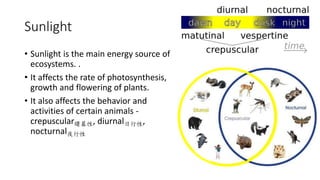
Sunlight
• Sunlight is the main energy source of
ecosystems. .
• It affects the rate of photosynthesis,
growth and flowering of plants.
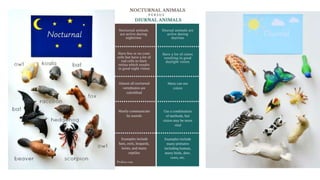
• It also affects the behavior and
activities of certain animals -
crepuscular曙暮性, diurnal日行性,
nocturnal夜行性
Sunlight of different
season
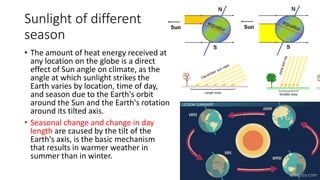
• The amount of heat energy received at
any location on the globe is a direct
effect of Sun angle on climate, as the
angle at which sunlight strikes the
Earth varies by location, time of day,
and season due to the Earth's orbit
around the Sun and the Earth's rotation
around its tilted axis.
• Seasonal change and change in day
length are caused by the tilt of the
Earth's axis, is the basic mechanism
that results in warmer weather in
summer than in winter.
Sunlight affects the reproduction of animals
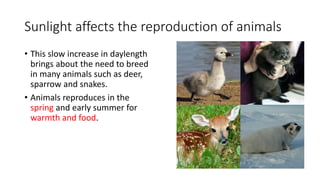
• This slow increase in daylength
brings about the need to breed
in many animals such as deer,
sparrow and snakes.
• Animals reproduces in the
spring and early summer for
warmth and food.
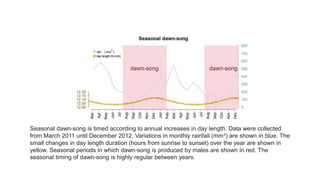
Seasonal dawn-song is timed according to annual increases in day length. Data were collected
from March 2011 until December 2012. Variations in monthly rainfall (mm3) are shown in blue. The
small changes in day length duration (hours from sunrise to sunset) over the year are shown in
yellow. Seasonal periods in which dawn-song is produced by males are shown in red. The
seasonal timing of dawn-song is highly regular between years.
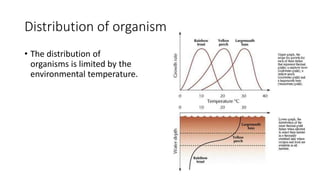
Temperature
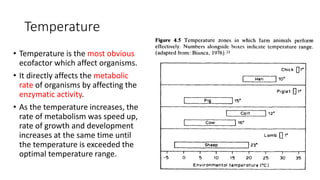
• Temperature is the most obvious
ecofactor which affect organisms.
• It directly affects the metabolic
rate of organisms by affecting the
enzymatic activity.
• As the temperature increases, the
rate of metabolism was speed up,
rate of growth and development
increases at the same time until
the temperature is exceeded the
optimal temperature range.
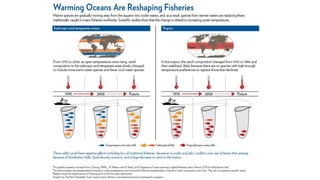
Distribution of organism
• The distribution of
organisms is limited by the
environmental temperature.
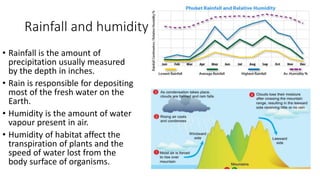
Rainfall and humidity
• Rainfall is the amount of
precipitation usually measured
by the depth in inches.
• Rain is responsible for depositing
most of the fresh water on the
Earth.
• Humidity is the amount of water
vapour present in air.
• Humidity of habitat affect the
transpiration of plants and the
speed of water lost from the
body surface of organisms.
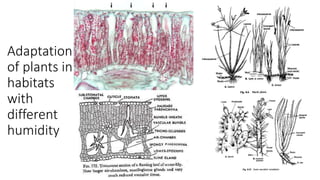
Adaptation
of plants in
habitats
with
different
humidity
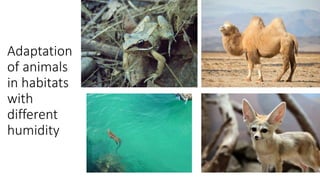
Adaptation
of animals
in habitats
with
different
humidity
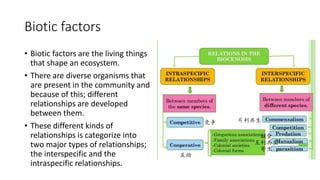
Biotic factors
• Biotic factors are the living things
that shape an ecosystem.
• There are diverse organisms that
are present in the community and
because of this; different
relationships are developed
between them.
• These different kinds of
relationships is categorize into
two major types of relationships;
the interspecific and the
intraspecific relationships.
竞争
互助
片利共生
互利共生
寄生
捕食
寄居动物
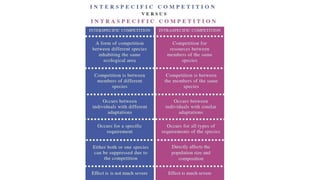
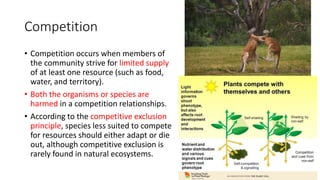
Competition
• Competition occurs when members of
the community strive for limited supply
of at least one resource (such as food,
water, and territory).
• Both the organisms or species are
harmed in a competition relationships.
• According to the competitive exclusion
principle, species less suited to compete
for resources should either adapt or die
out, although competitive exclusion is
rarely found in natural ecosystems.
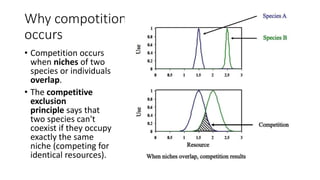
Why compotition
occurs
• Competition occurs
when niches of two
species or individuals
overlap.
• The competitive
exclusion
principle says that
two species can't
coexist if they occupy
exactly the same
niche (competing for
identical resources).
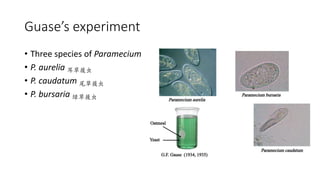
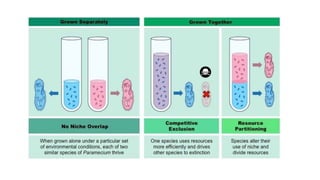
Guase’s experiment
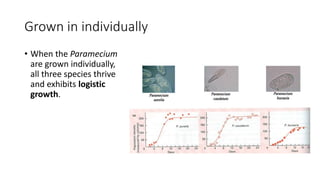
• Three species of Paramecium
• P. aurelia 耳草履虫
• P. caudatum 尾草履虫
• P. bursaria 绿草履虫
Grown in individually
• When the Paramecium
are grown individually,
all three species thrive
and exhibits logistic
growth.
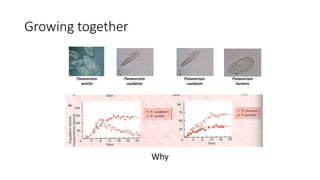
Growing together
Why
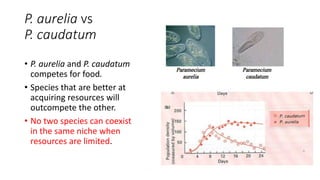
P. aurelia vs
P. caudatum
• P. aurelia and P. caudatum
competes for food.
• Species that are better at
acquiring resources will
outcompete the other.
• No two species can coexist
in the same niche when
resources are limited.
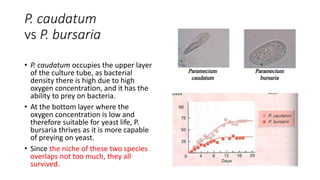
P. caudatum
vs P. bursaria
• P. caudatum occupies the upper layer
of the culture tube, as bacterial
density there is high due to high
oxygen concentration, and it has the
ability to prey on bacteria.
• At the bottom layer where the
oxygen concentration is low and
therefore suitable for yeast life, P.
bursaria thrives as it is more capable
of preying on yeast.
• Since the niche of these two species
overlaps not too much, they all
survived.
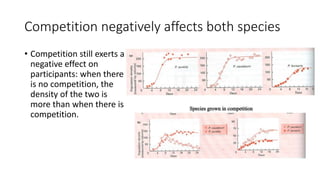
Competition negatively affects both species
• Competition still exerts a
negative effect on
participants: when there
is no competition, the
density of the two is
more than when there is
competition.
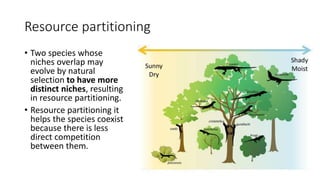
Resource partitioning
• Two species whose
niches overlap may
evolve by natural
selection to have more
distinct niches, resulting
in resource partitioning.
• Resource partitioning it
helps the species coexist
because there is less
direct competition
between them.
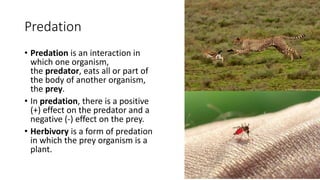
Predation
• Predation is an interaction in
which one organism,
the predator, eats all or part of
the body of another organism,
the prey.
• In predation, there is a positive
(+) effect on the predator and a
negative (-) effect on the prey.
• Herbivory is a form of predation
in which the prey organism is a
plant.
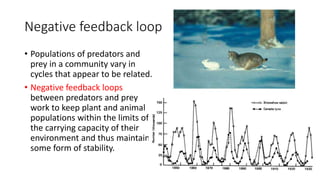
Negative feedback loop
• Populations of predators and
prey in a community vary in
cycles that appear to be related.
• Negative feedback loops
between predators and prey
work to keep plant and animal
populations within the limits of
the carrying capacity of their
environment and thus maintain
some form of stability.
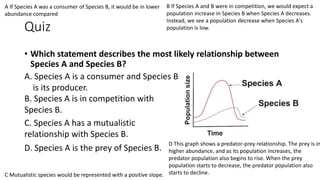
Quiz
• Which statement describes the most likely relationship between
Species A and Species B?
A If Species A was a consumer of Species B, it would be in lower
abundance compared
B If Species A and B were in competition, we would expect a
population increase in Species B when Species A decreases.
Instead, we see a population decrease when Species A's
population is low.
A. Species A is a consumer and Species B
is its producer.
B. Species A is in competition with
Species B.
C Mutualistic species would be represented with a positive slope.
C. Species A has a mutualistic
relationship with Species B.
D. Species A is the prey of Species B.
D This graph shows a predator-prey relationship. The prey is in
higher abundance, and as its population increases, the
predator population also begins to rise. When the prey
population starts to decrease, the predator population also
starts to decline.
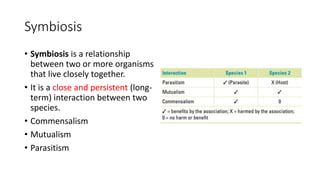
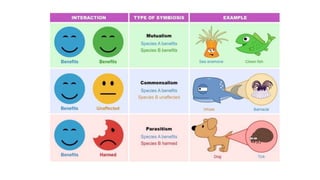
Symbiosis
• Symbiosis is a relationship
between two or more organisms
that live closely together.
• It is a close and persistent (long-
term) interaction between two
species.
• Commensalism
• Mutualism
• Parasitism
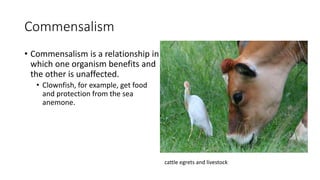
Commensalism
• Commensalism is a relationship in
which one organism benefits and
the other is unaffected.
• Clownfish, for example, get food
and protection from the sea
anemone.
cattle egrets and livestock
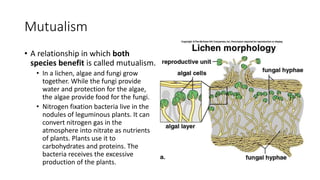
Mutualism
• A relationship in which both
species benefit is called mutualism.
• In a lichen, algae and fungi grow
together. While the fungi provide
water and protection for the algae,
the algae provide food for the fungi.
• Nitrogen fixation bacteria live in the
nodules of leguminous plants. It can
convert nitrogen gas in the
atmosphere into nitrate as nutrients
of plants. Plants use it to
carbohydrates and proteins. The
bacteria receives the excessive
production of the plants.
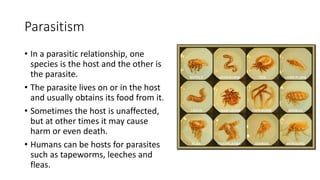
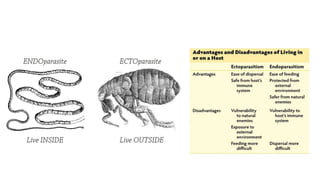
Parasitism
• In a parasitic relationship, one
species is the host and the other is
the parasite.
• The parasite lives on or in the host
and usually obtains its food from it.
• Sometimes the host is unaffected,
but at other times it may cause
harm or even death.
• Humans can be hosts for parasites
such as tapeworms, leeches and
fleas.
Quiz
• Which of the following best defines the ecological interaction
between the flowering plant and the bees?
A. Predation
B. Parasitism
C. Commensalism
D. Mutualism
Quiz
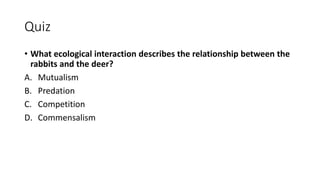
• What ecological interaction describes the relationship between the
rabbits and the deer?
A. Mutualism
B. Predation
C. Competition
D. Commensalism
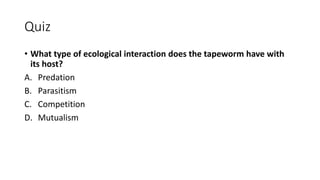
Quiz
• What type of ecological interaction does the tapeworm have with
its host?
A. Predation
B. Parasitism
C. Competition
D. Mutualism
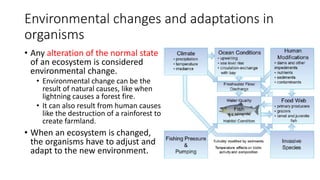
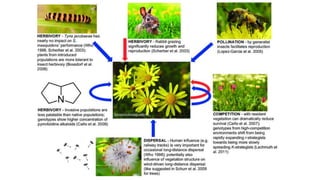
Environmental changes and adaptations in
organisms
• Any alteration of the normal state
of an ecosystem is considered
environmental change.
• Environmental change can be the
result of natural causes, like when
lightning causes a forest fire.
• It can also result from human causes
like the destruction of a rainforest to
create farmland.
• When an ecosystem is changed,
the organisms have to adjust and
adapt to the new environment.
Definition of adaptation
1. Adaptation is the evolutionary process whereby
an organism becomes better able to live in its
habitat or habitats.
2. Adaptedness is the state of being adapted: the
degree to which an organism is able to live and
reproduce in a given set of habitats.
3. An adaptive trait [physical features of an
organism] is an aspect of the developmental
pattern of the organism which enables or
enhances the probability of that organism
surviving and reproducing. Theodosius Dobzhansky
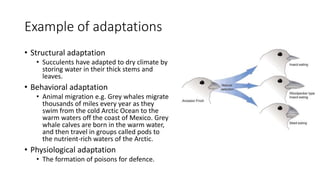
Example of adaptations
• Structural adaptation
• Succulents have adapted to dry climate by
storing water in their thick stems and
leaves.
• Behavioral adaptation
• Animal migration e.g. Grey whales migrate
thousands of miles every year as they
swim from the cold Arctic Ocean to the
warm waters off the coast of Mexico. Grey
whale calves are born in the warm water,
and then travel in groups called pods to
the nutrient-rich waters of the Arctic.
• Physiological adaptation
• The formation of poisons for defence.
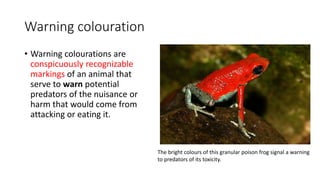
Warning colouration
• Warning colourations are
conspicuously recognizable
markings of an animal that
serve to warn potential
predators of the nuisance or
harm that would come from
attacking or eating it.
The bright colours of this granular poison frog signal a warning
to predators of its toxicity.
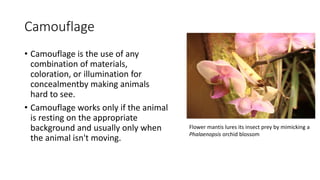
Camouflage
• Camouflage is the use of any
combination of materials,
coloration, or illumination for
concealmentby making animals
hard to see.
• Camouflage works only if the animal
is resting on the appropriate
background and usually only when
the animal isn't moving.
Flower mantis lures its insect prey by mimicking a
Phalaenopsis orchid blossom
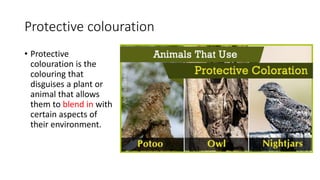
Protective colouration
• Protective
colouration is the
colouring that
disguises a plant or
animal that allows
them to blend in with
certain aspects of
their environment.
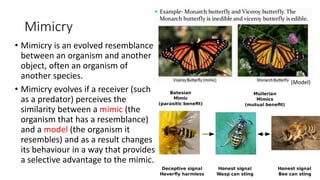
Mimicry
• Mimicry is an evolved resemblance
between an organism and another
object, often an organism of
another species.
• Mimicry evolves if a receiver (such
as a predator) perceives the
similarity between a mimic (the
organism that has a resemblance)
and a model (the organism it
resembles) and as a result changes
its behaviour in a way that provides
a selective advantage to the mimic.
(Model)
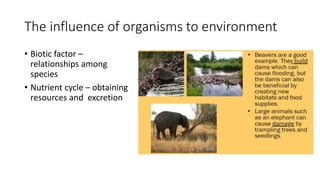
The influence of organisms to environment
• Biotic factor –
relationships among
species
• Nutrient cycle – obtaining
resources and excretion
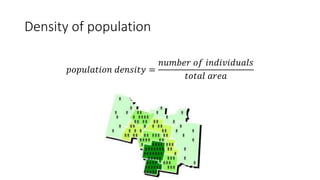
Density of population
𝑝𝑜𝑝𝑢𝑙𝑎𝑡𝑖𝑜𝑛 𝑑𝑒𝑛𝑠𝑖𝑡𝑦 =
𝑛𝑢𝑚𝑏𝑒𝑟 𝑜𝑓 𝑖𝑛𝑑𝑖𝑣𝑖𝑑𝑢𝑎𝑙𝑠
𝑡𝑜𝑡𝑎𝑙 𝑎𝑟𝑒𝑎
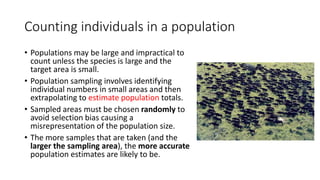
Counting individuals in a population
• Populations may be large and impractical to
count unless the species is large and the
target area is small.
• Population sampling involves identifying
individual numbers in small areas and then
extrapolating to estimate population totals.
• Sampled areas must be chosen randomly to
avoid selection bias causing a
misrepresentation of the population size.
• The more samples that are taken (and the
larger the sampling area), the more accurate
population estimates are likely to be.
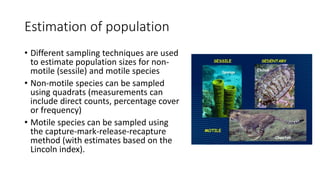
Estimation of population
• Different sampling techniques are used
to estimate population sizes for non-
motile (sessile) and motile species
• Non-motile species can be sampled
using quadrats (measurements can
include direct counts, percentage cover
or frequency)
• Motile species can be sampled using
the capture-mark-release-recapture
method (with estimates based on the
Lincoln index).
• http://www.classzone.com/books/hs/ca/sc/bio_07/virtual_labs/virtu
alLabs.html
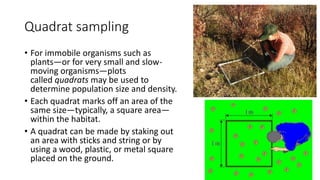
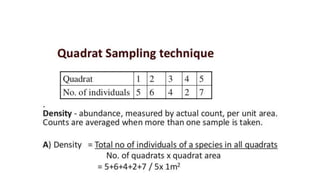
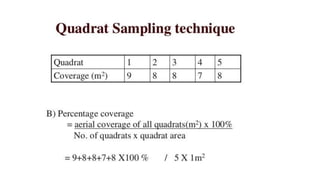
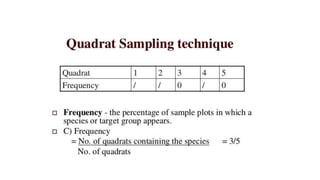
Quadrat sampling
• For immobile organisms such as
plants—or for very small and slow-
moving organisms—plots
called quadrats may be used to
determine population size and density.
• Each quadrat marks off an area of the
same size—typically, a square area—
within the habitat.
• A quadrat can be made by staking out
an area with sticks and string or by
using a wood, plastic, or metal square
placed on the ground.
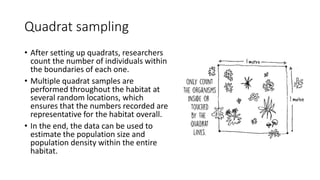
Quadrat sampling
• After setting up quadrats, researchers
count the number of individuals within
the boundaries of each one.
• Multiple quadrat samples are
performed throughout the habitat at
several random locations, which
ensures that the numbers recorded are
representative for the habitat overall.
• In the end, the data can be used to
estimate the population size and
population density within the entire
habitat.
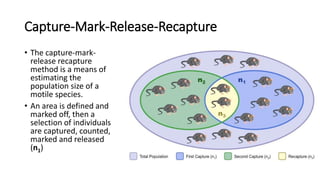
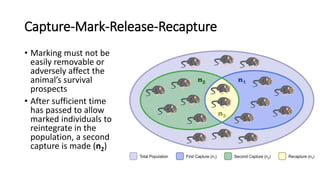
Capture-Mark-Release-Recapture
• The capture-mark-
release recapture
method is a means of
estimating the
population size of a
motile species.
• An area is defined and
marked off, then a
selection of individuals
are captured, counted,
marked and released
(n1)
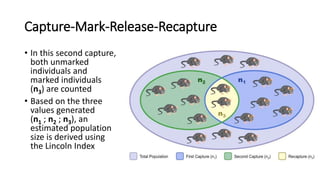
Capture-Mark-Release-Recapture
• Marking must not be
easily removable or
adversely affect the
animal’s survival
prospects
• After sufficient time
has passed to allow
marked individuals to
reintegrate in the
population, a second
capture is made (n2)
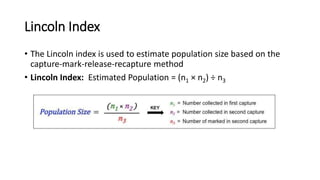
Capture-Mark-Release-Recapture
• In this second capture,
both unmarked
individuals and
marked individuals
(n3) are counted
• Based on the three
values generated
(n1 ; n2 ; n3), an
estimated population
size is derived using
the Lincoln Index
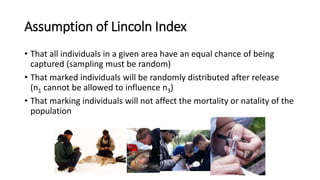
Lincoln Index
• The Lincoln index is used to estimate population size based on the
capture-mark-release-recapture method
• Lincoln Index: Estimated Population = (n1 × n2) ÷ n3
Assumption of Lincoln Index
• That all individuals in a given area have an equal chance of being
captured (sampling must be random)
• That marked individuals will be randomly distributed after release
(n1 cannot be allowed to influence n3)
• That marking individuals will not affect the mortality or natality of the
population
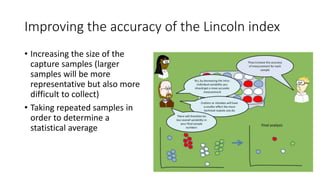
Improving the accuracy of the Lincoln index
• Increasing the size of the
capture samples (larger
samples will be more
representative but also more
difficult to collect)
• Taking repeated samples in
order to determine a
statistical average
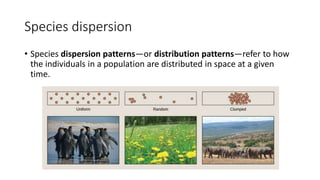
Species dispersion
• Species dispersion patterns—or distribution patterns—refer to how
the individuals in a population are distributed in space at a given
time.
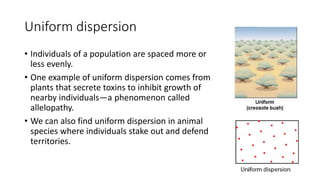
Uniform dispersion
• Individuals of a population are spaced more or
less evenly.
• One example of uniform dispersion comes from
plants that secrete toxins to inhibit growth of
nearby individuals—a phenomenon called
allelopathy.
• We can also find uniform dispersion in animal
species where individuals stake out and defend
territories.
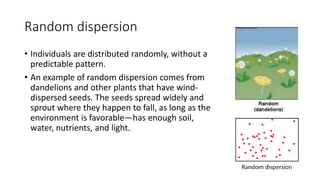
Random dispersion
• Individuals are distributed randomly, without a
predictable pattern.
• An example of random dispersion comes from
dandelions and other plants that have wind-
dispersed seeds. The seeds spread widely and
sprout where they happen to fall, as long as the
environment is favorable—has enough soil,
water, nutrients, and light.
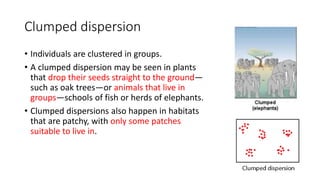
Clumped dispersion
• Individuals are clustered in groups.
• A clumped dispersion may be seen in plants
that drop their seeds straight to the ground—
such as oak trees—or animals that live in
groups—schools of fish or herds of elephants.
• Clumped dispersions also happen in habitats
that are patchy, with only some patches
suitable to live in.
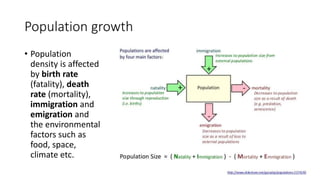
Population growth
• Population
density is affected
by birth rate
(fatality), death
rate (mortality),
immigration and
emigration and
the environmental
factors such as
food, space,
climate etc.
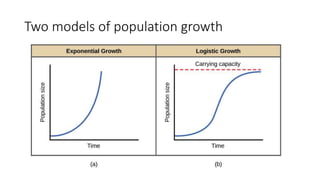
Two models of population growth
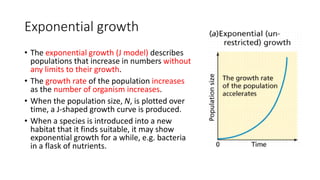
Exponential growth
• The exponential growth (J model) describes
populations that increase in numbers without
any limits to their growth.
• The growth rate of the population increases
as the number of organism increases.
• When the population size, N, is plotted over
time, a J-shaped growth curve is produced.
• When a species is introduced into a new
habitat that it finds suitable, it may show
exponential growth for a while, e.g. bacteria
in a flask of nutrients.
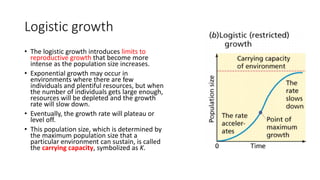
Logistic growth
• The logistic growth introduces limits to
reproductive growth that become more
intense as the population size increases.
• Exponential growth may occur in
environments where there are few
individuals and plentiful resources, but when
the number of individuals gets large enough,
resources will be depleted and the growth
rate will slow down.
• Eventually, the growth rate will plateau or
level off.
• This population size, which is determined by
the maximum population size that a
particular environment can sustain, is called
the carrying capacity, symbolized as K.
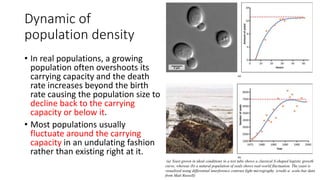
Dynamic of
population density
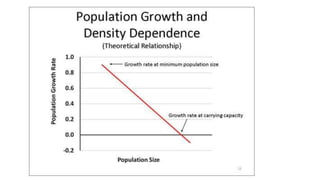
• In real populations, a growing
population often overshoots its
carrying capacity and the death
rate increases beyond the birth
rate causing the population size to
decline back to the carrying
capacity or below it.
• Most populations usually
fluctuate around the carrying
capacity in an undulating fashion
rather than existing right at it.
(a) Yeast grown in ideal conditions in a test tube shows a classical S-shaped logistic growth
curve, whereas (b) a natural population of seals shows real-world fluctuation. The yeast is
visualized using differential interference contrast light micrography. (credit a: scale-bar data
from Matt Russell)
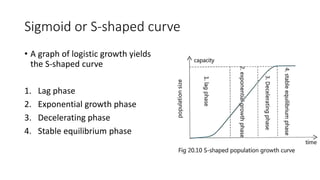
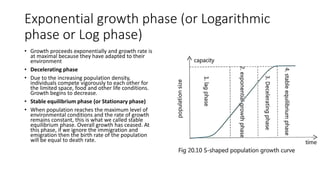
Sigmoid or S-shaped curve
• A graph of logistic growth yields
the S-shaped curve
1. Lag phase
2. Exponential growth phase
3. Decelerating phase
4. Stable equilibrium phase
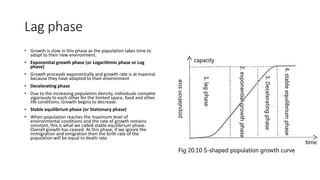
Lag phase
• Growth is slow in this phase as the population takes time to
adapt to their new environment.
• Exponential growth phase (or Logarithmic phase or Log
phase)
• Growth proceeds exponentially and growth rate is at maximal
because they have adapted to their environment
• Decelerating phase
• Due to the increasing population density, individuals compete
vigorously to each other for the limited space, food and other
life conditions. Growth begins to decrease.
• Stable equilibrium phase (or Stationary phase)
• When population reaches the maximum level of
environmental conditions and the rate of growth remains
constant, this is what we called stable equilibrium phase.
Overall growth has ceased. At this phase, if we ignore the
immigration and emigration then the birth rate of the
population will be equal to death rate.
Exponential growth phase (or Logarithmic
phase or Log phase)
• Growth proceeds exponentially and growth rate is
at maximal because they have adapted to their
environment
• Decelerating phase
• Due to the increasing population density,
individuals compete vigorously to each other for
the limited space, food and other life conditions.
Growth begins to decrease.
• Stable equilibrium phase (or Stationary phase)
• When population reaches the maximum level of
environmental conditions and the rate of growth
remains constant, this is what we called stable
equilibrium phase. Overall growth has ceased. At
this phase, if we ignore the immigration and
emigration then the birth rate of the population
will be equal to death rate.
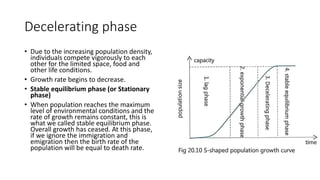
Decelerating phase
• Due to the increasing population density,
individuals compete vigorously to each
other for the limited space, food and
other life conditions.
• Growth rate begins to decrease.
• Stable equilibrium phase (or Stationary
phase)
• When population reaches the maximum
level of environmental conditions and the
rate of growth remains constant, this is
what we called stable equilibrium phase.
Overall growth has ceased. At this phase,
if we ignore the immigration and
emigration then the birth rate of the
population will be equal to death rate.
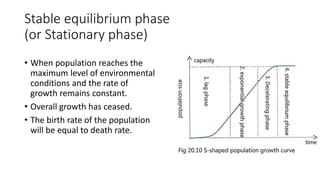
Stable equilibrium phase
(or Stationary phase)
• When population reaches the
maximum level of environmental
conditions and the rate of
growth remains constant.
• Overall growth has ceased.
• The birth rate of the population
will be equal to death rate.
Human population
• Development of
technology has
increases our
living standard,
increased
effective of using
resources and
advanced
technology in
medicine are
resulting in the
decreasing of
death rate.
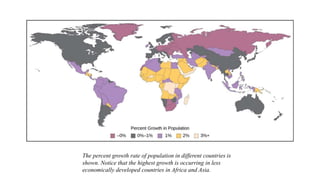
The percent growth rate of population in different countries is
shown. Notice that the highest growth is occurring in less
economically developed countries in Africa and Asia.
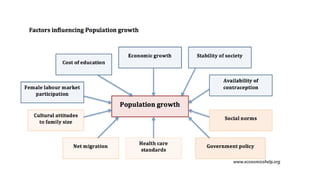
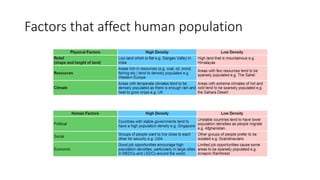
Factors that affect human population
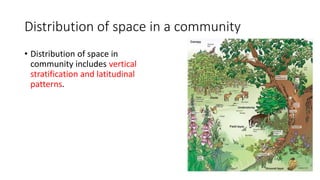
Distribution of space in a community
• Distribution of space in
community includes vertical
stratification and latitudinal
patterns.
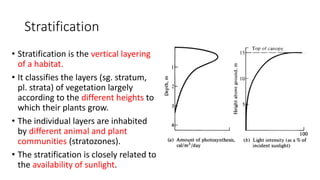
Stratification
• Stratification is the vertical layering
of a habitat.
• It classifies the layers (sg. stratum,
pl. strata) of vegetation largely
according to the different heights to
which their plants grow.
• The individual layers are inhabited
by different animal and plant
communities (stratozones).
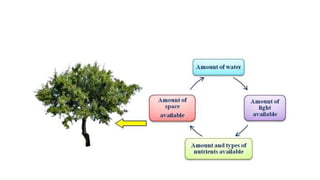
• The stratification is closely related to
the availability of sunlight.
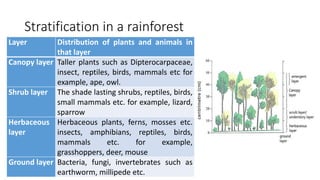
Stratification in a rainforest
Layer Distribution of plants and animals in
that layer
Canopy layer Taller plants such as Dipterocarpaceae,
insect, reptiles, birds, mammals etc for
example, ape, owl.
Shrub layer The shade lasting shrubs, reptiles, birds,
small mammals etc. for example, lizard,
sparrow
Herbaceous
layer
Herbaceous plants, ferns, mosses etc.
insects, amphibians, reptiles, birds,
mammals etc. for example,
grasshoppers, deer, mouse
Ground layer Bacteria, fungi, invertebrates such as
earthworm, millipede etc.
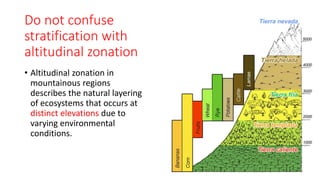
Do not confuse
stratification with
altitudinal zonation
• Altitudinal zonation in
mountainous regions
describes the natural layering
of ecosystems that occurs at
distinct elevations due to
varying environmental
conditions.
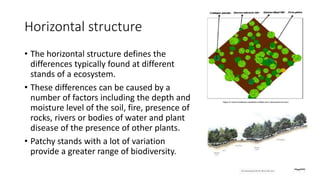
Horizontal structure
• The horizontal structure defines the
differences typically found at different
stands of a ecosystem.
• These differences can be caused by a
number of factors including the depth and
moisture level of the soil, fire, presence of
rocks, rivers or bodies of water and plant
disease of the presence of other plants.
• Patchy stands with a lot of variation
provide a greater range of biodiversity.
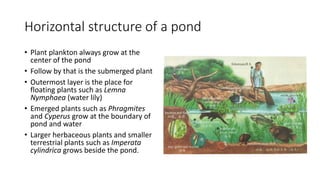
Horizontal structure of a pond
• Plant plankton always grow at the
center of the pond
• Follow by that is the submerged plant
• Outermost layer is the place for
floating plants such as Lemna
Nymphaea (water lily)
• Emerged plants such as Phragmites
and Cyperus grow at the boundary of
pond and water
• Larger herbaceous plants and smaller
terrestrial plants such as Imperata
cylindrica grows beside the pond.
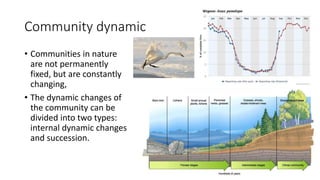
Community dynamic
• Communities in nature
are not permanently
fixed, but are constantly
changing,
• The dynamic changes of
the community can be
divided into two types:
internal dynamic changes
and succession.
Internal dynamics动态变化
• The internal dynamics of the
community (including dayly,
seasonal and interannual
changes)
• Limited to short-term reversible
changes within the community,
without the replacement of the
community.
• Fluctuations of the population
size due to environmental
conditions (wet years and dry
years, sudden catastrophes, and
annual cycle of the climate), and
the activity cycle of the organism
itself (outbreaks of pests and
diseases, migration, activity
patters).
Many small freshwater planktonic animals move vertically
during the daily cycle of illumination somewhat as shown here
(widths of bands represent the density of animals at a given
depth at a particular time). [After Cowles and Brambel 1936].
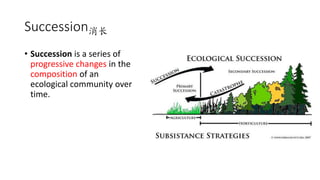
Succession消长
• Succession is a series of
progressive changes in the
composition of an
ecological community over
time.
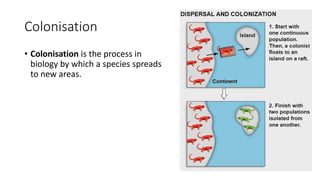
Colonisation
• Colonisation is the process in
biology by which a species spreads
to new areas.
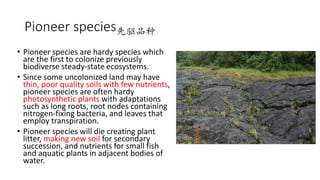
Pioneer species先驱品种
• Pioneer species are hardy species which
are the first to colonize previously
biodiverse steady-state ecosystems.
• Since some uncolonized land may have
thin, poor quality soils with few nutrients,
pioneer species are often hardy
photosynthetic plants with adaptations
such as long roots, root nodes containing
nitrogen-fixing bacteria, and leaves that
employ transpiration.
• Pioneer species will die creating plant
litter, making new soil for secondary
succession, and nutrients for small fish
and aquatic plants in adjacent bodies of
water.
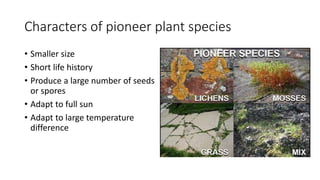
Characters of pioneer plant species
• Smaller size
• Short life history
• Produce a large number of seeds
or spores
• Adapt to full sun
• Adapt to large temperature
difference
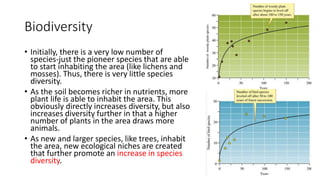
Biodiversity
• Initially, there is a very low number of
species-just the pioneer species that are able
to start inhabiting the area (like lichens and
mosses). Thus, there is very little species
diversity.
• As the soil becomes richer in nutrients, more
plant life is able to inhabit the area. This
obviously directly increases diversity, but also
increases diversity further in that a higher
number of plants in the area draws more
animals.
• As new and larger species, like trees, inhabit
the area, new ecological niches are created
that further promote an increase in species
diversity.
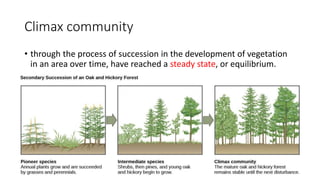
Climax community
• through the process of succession in the development of vegetation
in an area over time, have reached a steady state, or equilibrium.
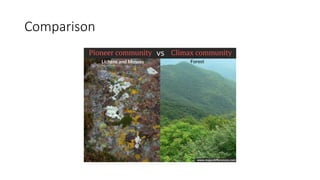
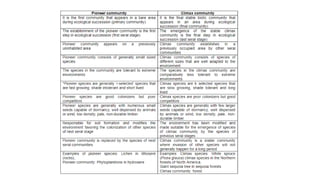
Comparison
Types of succession
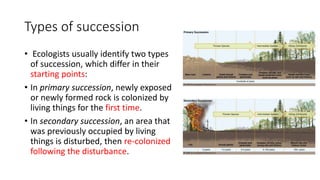
• Ecologists usually identify two types
of succession, which differ in their
starting points:
• In primary succession, newly exposed
or newly formed rock is colonized by
living things for the first time.
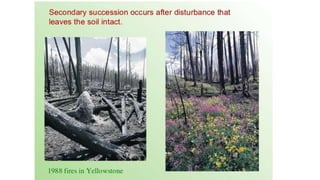
• In secondary succession, an area that
was previously occupied by living
things is disturbed, then re-colonized
following the disturbance.
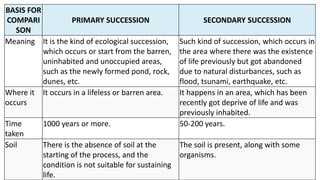
BASIS FOR
COMPARI
SON
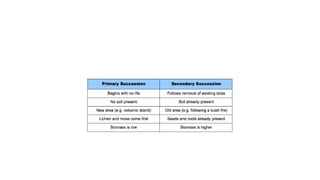
PRIMARY SUCCESSION SECONDARY SUCCESSION
Meaning It is the kind of ecological succession,
which occurs or start from the barren,
uninhabited and unoccupied areas,
such as the newly formed pond, rock,
dunes, etc.
Such kind of succession, which occurs in
the area where there was the existence
of life previously but got abandoned
due to natural disturbances, such as
flood, tsunami, earthquake, etc.
Where it
occurs
It occurs in a lifeless or barren area. It happens in an area, which has been
recently got deprive of life and was
previously inhabited.
Time
taken
1000 years or more. 50-200 years.
Soil There is the absence of soil at the
starting of the process, and the
condition is not suitable for sustaining
life.
The soil is present, along with some
organisms.
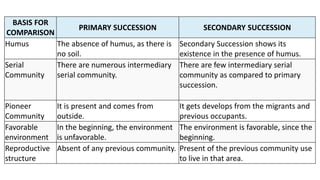
BASIS FOR
COMPARISON
PRIMARY SUCCESSION SECONDARY SUCCESSION
Humus The absence of humus, as there is
no soil.
Secondary Succession shows its
existence in the presence of humus.
Serial
Community
There are numerous intermediary
serial community.
There are few intermediary serial
community as compared to primary
succession.
Pioneer
Community
It is present and comes from
outside.
It gets develops from the migrants and
previous occupants.
Favorable
environment
In the beginning, the environment
is unfavorable.
The environment is favorable, since the
beginning.
Reproductive
structure
Absent of any previous community. Present of the previous community use
to live in that area.
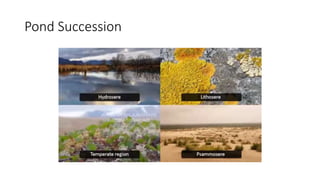
Pond Succession
15 minutes video
• https://www.youtube.com/watch?v=555EG8Vzs_I
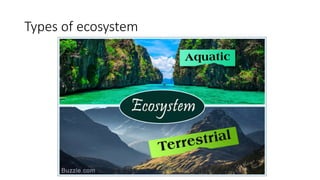
Types of ecosystem
Types of ecosystem
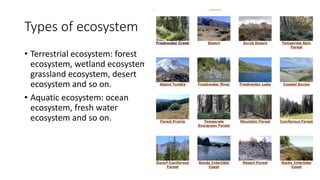
• Terrestrial ecosystem: forest
ecosystem, wetland ecosystem,
grassland ecosystem, desert
ecosystem and so on.
• Aquatic ecosystem: ocean
ecosystem, fresh water
ecosystem and so on.
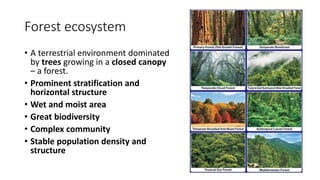
Forest ecosystem
• A terrestrial environment dominated
by trees growing in a closed canopy
– a forest.
• Prominent stratification and
horizontal structure
• Wet and moist area
• Great biodiversity
• Complex community
• Stable population density and
structure
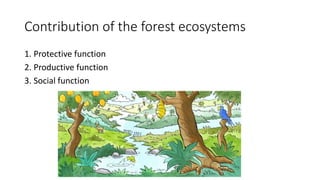
Contribution of the forest ecosystems
1. Protective function
2. Productive function
3. Social function
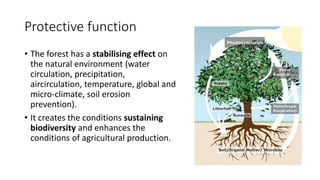
Protective function
• The forest has a stabilising effect on
the natural environment (water
circulation, precipitation,
aircirculation, temperature, global and
micro-climate, soil erosion
prevention).
• It creates the conditions sustaining
biodiversity and enhances the
conditions of agricultural production.
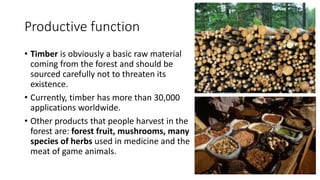
Productive function
• Timber is obviously a basic raw material
coming from the forest and should be
sourced carefully not to threaten its
existence.
• Currently, timber has more than 30,000
applications worldwide.
• Other products that people harvest in the
forest are: forest fruit, mushrooms, many
species of herbs used in medicine and the
meat of game animals.
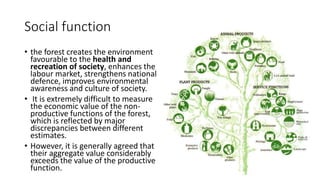
Social function
• the forest creates the environment
favourable to the health and
recreation of society, enhances the
labour market, strengthens national
defence, improves environmental
awareness and culture of society.
• It is extremely difficult to measure
the economic value of the non-
productive functions of the forest,
which is reflected by major
discrepancies between different
estimates.
• However, it is generally agreed that
their aggregate value considerably
exceeds the value of the productive
function.
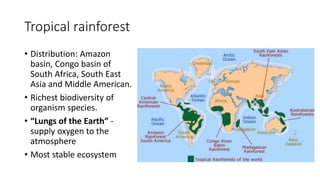
Tropical rainforest
• Distribution: Amazon
basin, Congo basin of
South Africa, South East
Asia and Middle American.
• Richest biodiversity of
organism species.
• “Lungs of the Earth” -
supply oxygen to the
atmosphere
• Most stable ecosystem
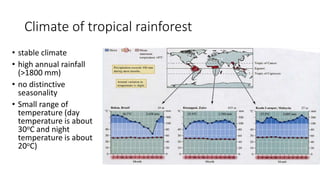
Climate of tropical rainforest
• stable climate
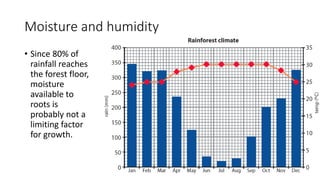
• high annual rainfall
(>1800 mm)
• no distinctive
seasonality
• Small range of
temperature (day
temperature is about
30oC and night
temperature is about
20oC)
Microclimate
• A microclimate is a local set of atmospheric conditions that differ
from those in the surrounding areas, often with a slight difference but
sometimes with a substantial one.
• Due to the cover of canopy, a typical microclimate is formed.
• Elements of microclimate:
• Light
• Moisture and vapour pressure
• temperature
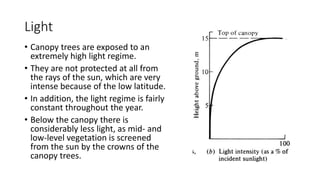
Light
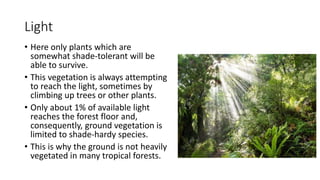
• Canopy trees are exposed to an
extremely high light regime.
• They are not protected at all from
the rays of the sun, which are very
intense because of the low latitude.
• In addition, the light regime is fairly
constant throughout the year.
• Below the canopy there is
considerably less light, as mid- and
low-level vegetation is screened
from the sun by the crowns of the
canopy trees.
Light
• Here only plants which are
somewhat shade-tolerant will be
able to survive.
• This vegetation is always attempting
to reach the light, sometimes by
climbing up trees or other plants.
• Only about 1% of available light
reaches the forest floor and,
consequently, ground vegetation is
limited to shade-hardy species.
• This is why the ground is not heavily
vegetated in many tropical forests.
Moisture and humidity
• Since 80% of
rainfall reaches
the forest floor,
moisture
available to
roots is
probably not a
limiting factor
for growth.
Humidity
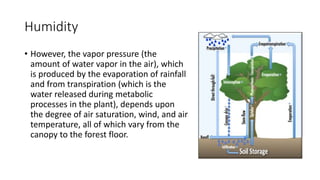
• However, the vapor pressure (the
amount of water vapor in the air), which
is produced by the evaporation of rainfall
and from transpiration (which is the
water released during metabolic
processes in the plant), depends upon
the degree of air saturation, wind, and air
temperature, all of which vary from the
canopy to the forest floor.
Humidity in the forest
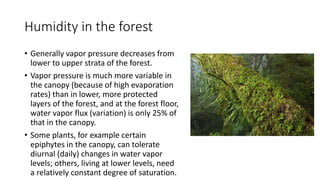
• Generally vapor pressure decreases from
lower to upper strata of the forest.
• Vapor pressure is much more variable in
the canopy (because of high evaporation
rates) than in lower, more protected
layers of the forest, and at the forest floor,
water vapor flux (variation) is only 25% of
that in the canopy.
• Some plants, for example certain
epiphytes in the canopy, can tolerate
diurnal (daily) changes in water vapor
levels; others, living at lower levels, need
a relatively constant degree of saturation.
Temperature
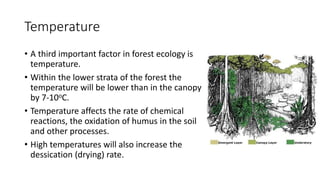
• A third important factor in forest ecology is
temperature.
• Within the lower strata of the forest the
temperature will be lower than in the canopy
by 7-10oC.
• Temperature affects the rate of chemical
reactions, the oxidation of humus in the soil
and other processes.
• High temperatures will also increase the
dessication (drying) rate.
Temperature
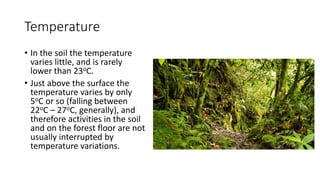
• In the soil the temperature
varies little, and is rarely
lower than 23oC.
• Just above the surface the
temperature varies by only
5oC or so (falling between
22oC – 27oC, generally), and
therefore activities in the soil
and on the forest floor are not
usually interrupted by
temperature variations.
Disturbance to forest ecosystem
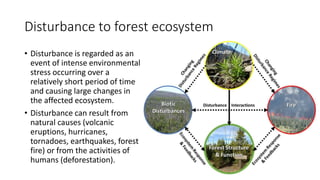
• Disturbance is regarded as an
event of intense environmental
stress occurring over a
relatively short period of time
and causing large changes in
the affected ecosystem.
• Disturbance can result from
natural causes (volcanic
eruptions, hurricanes,
tornadoes, earthquakes, forest
fire) or from the activities of
humans (deforestation).
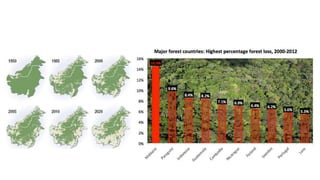
Deforestation
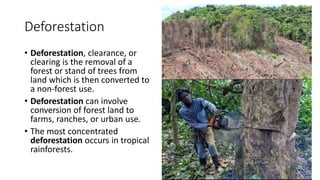
• Deforestation, clearance, or
clearing is the removal of a
forest or stand of trees from
land which is then converted to
a non-forest use.
• Deforestation can involve
conversion of forest land to
farms, ranches, or urban use.
• The most concentrated
deforestation occurs in tropical
rainforests.
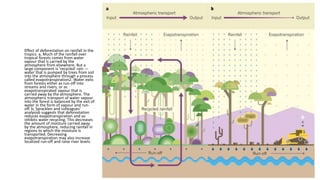
Effect of deforestation on rainfall in the
tropics. a, Much of the rainfall over
tropical forests comes from water
vapour that is carried by the
atmosphere from elsewhere. But a
large component is 'recycled' rain —
water that is pumped by trees from soil
into the atmosphere through a process
called evapotranspiration2. Water exits
from forests either as run-off into
streams and rivers, or as
evapotranspirated vapour that is
carried away by the atmosphere. The
atmospheric transport of water vapour
into the forest is balanced by the exit of
water in the form of vapour and run-
off. b, Spracklen and colleagues'
analysis6 suggests that deforestation
reduces evapotranspiration and so
inhibits water recycling. This decreases
the amount of moisture carried away
by the atmosphere, reducing rainfall in
regions to which the moisture is
transported. Decreasing
evapotranspiration may also increase
localized run-off and raise river levels.
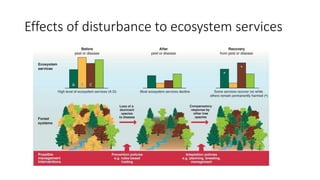
Effects of disturbance to ecosystem services
1. What are wetlands?
2. What are the services provided by the wetlands?
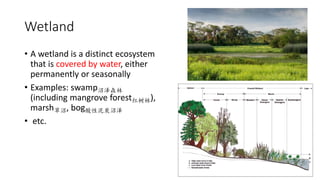
Wetland
• A wetland is a distinct ecosystem
that is covered by water, either
permanently or seasonally
• Examples: swamp沼泽森林
(including mangrove forest红树林),
marsh草沼, bog酸性泥炭沼泽
• etc.
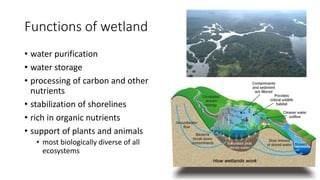
Functions of wetland
• water purification
• water storage
• processing of carbon and other
nutrients
• stabilization of shorelines
• rich in organic nutrients
• support of plants and animals
• most biologically diverse of all
ecosystems
Quiz
• What are the hydrologic functions of wetlands?
a. long term and short term water storage
b. energy dissipation
c. moderation of groundwater flow or discharge
d. all the above
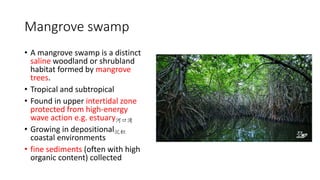
Mangrove swamp
• A mangrove swamp is a distinct
saline woodland or shrubland
habitat formed by mangrove
trees.
• Tropical and subtropical
• Found in upper intertidal zone
protected from high-energy
wave action e.g. estuary河口湾
• Growing in depositional沉积
coastal environments
• fine sediments (often with high
organic content) collected
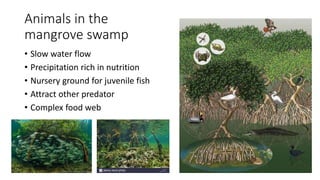
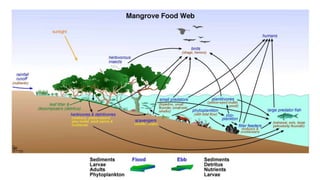
Animals in the
mangrove swamp
• Slow water flow
• Precipitation rich in nutrition
• Nursery ground for juvenile fish
• Attract other predator
• Complex food web
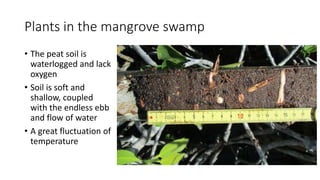
Plants in the mangrove swamp
• The peat soil is
waterlogged and lack
oxygen
• Soil is soft and
shallow, coupled
with the endless ebb
and flow of water
• A great fluctuation of
temperature
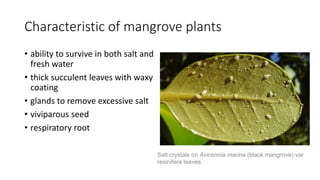
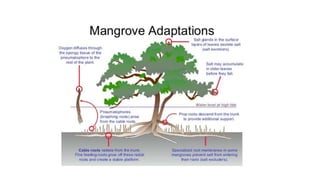
Characteristic of mangrove plants
• ability to survive in both salt and
fresh water
• thick succulent leaves with waxy
coating
• glands to remove excessive salt
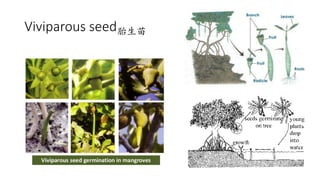
• viviparous seed
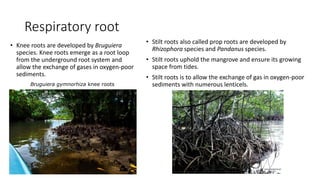
• respiratory root
Salt crystals on Avicennia marina (black mangrove) var
resinifera leaves.
Viviparous seed胎生苗
Respiratory root
• Stilt roots also called prop roots are developed by
Rhizophora species and Pandanus species.
• Stilt roots uphold the mangrove and ensure its growing
space from tides.
• Stilt roots is to allow the exchange of gas in oxygen-poor
sediments with numerous lenticels.Bruguiera gymnorhiza knee roots
• Knee roots are developed by Bruguiera
species. Knee roots emerge as a root loop
from the underground root system and
allow the exchange of gases in oxygen-poor
sediments.
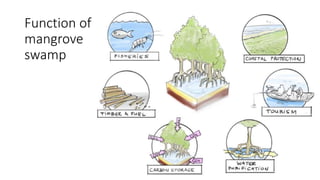
Function of
mangrove
swamp
Quiz
• Which of the following is NOT an example of the adaptive
characteristics of the mangrove plants inwhich enable them to survive
in the unfavourable environmental conditions in the mangrove
swamp.
A. viviparous seed
B. respiratory root
C. glands to remove excessive water
D. sunken stomata
Summary
• Mangrove forests are a type
of intertidal wetland
ecosystems.
• The mangroves have several
functions and adaptations to
a life in an intertidal
ecosystem.
• The mangrove forests
provide many ecosystem
services.

统考生物 Chapter 20 Ecosystem

  • 1.
    Chapter 20 Organisms andEnvironment Ong Yee Sing 2019
  • 2.
    Learning objectives: • Understandthe influence of abiotic factors to organism and interaction in between organisms. • Understand organisms to the adaptation of environment and influence. • Understand population density and population growth • Understand the structure and succession of community • Know the concept and types of ecosystem • Know the composition of ecosystem, food chain and food web • Comprehend energy flow of ecosystem • Comprehend recycle materials of ecosystem • Understand ecological balance • Comprehend human activities and environmental pollution • Manipulate the methods and importance of environmental protection.
  • 3.
    Ecology • from Greekοἶκος, "house", or "environment“ + -λογία, "study of“ • the branch of biology which studies the interactions among organisms and their environment.
  • 4.
    Some important termsof ecology • 生境 habitat • 物种 species • 种群 population • 生态位 niche • 群落 community • 生态系统 ecosystem • 生物群区 biome • 生态圈 biospere
  • 5.
    Habitat • The typeof natural environment in which a particular species of organism lives. • A species' habitat is those places where it can find food, shelter, protection and mates for reproduction. • It is characterized by both physical [abiotic] and biological [biotic] features. This coral reef in the Phoenix Islands Protected Area is a rich habitat for sea life.
  • 6.
    Species • a groupof living organisms consisting of similar individuals capable of exchanging genes or interbreeding and producing viable and fertile offsprings.
  • 7.
  • 8.
    Population • A populationis the number of organisms of the same species that live in a particular geographic area at the same time, with the capability of interbreeding
  • 9.
    Community • Community isan interacting group of various species in a common location. • For example, a forest of trees and undergrowth plants, inhabited by animals and rooted in soil containing bacteria and fungi, constitutes a biological community.
  • 10.
    Ecosystem • An ecosystemis a community of living organisms [biotic] and their shared physical environment [abiotic] to form a stable and equilibrium system. • Ecosystems can be small, such as the tide pools found near the rocky shores of many oceans, or very large, such as the Amazon Rainforest in South America.
  • 11.
    Niches • based onLatin nidus ‘nest’ • A niche is the role and position a species has in its environment • how it meets its needs for food and shelter • how it reproduces • A species' niche includes all of its interactions with the biotic and abiotic factors of its environment. The shape of the bill of this purple-throated carib is complementary to the shape of the flower and coevolved with it, enabling it to exploit the nectar as a resource.
  • 12.
    Two organisms withexactly the same niche can't survive in the same habitat
  • 13.
    Biome • Biomes aredistinct biological communities that have formed in response to a shared physical climate. • They can be found over a range of continents.
  • 14.
    The broad distributionof terriastial biomes on Earth.
  • 15.
    Biosphere • The biosphereis the global ecological system integrating all living beings and their relationships, including their interaction with the elements of the lithosphere, geosphere, hydrosphere, and atmosphere. • It is ranged from 10 000 m above the sea level to 12 000 m below the sea level. A false-color composite of global oceanic and terrestrial photoautotroph abundance, from September 2001 to August 2017.
  • 17.
    Ecofactor • Environmental factoror ecological factor or eco factor is any factor, abiotic or biotic, that influences living organisms. • Abiotic factors非生物因素 include ambient temperature, amount of sunlight, and pH of the water soil in which an organism lives. • Biotic factors生物因素 would include the availability of food organisms and the presence of conspecifics, competitors, predators, and parasites.
  • 18.
    Abiotic factor • Non-livingfactors in the ecosystem that affects the organisms living there • Soil • Temperature • Sunlight • Rainfall and humidity
  • 19.
    • Each ecosystemforms as a result of a combination of different abiotic factor.
  • 20.
    Soil • The soilis the habitat for many organisms, including terrestrial animals, plants and microorganisms to dwell. • Properties of soil such as pH value, mineral contents, structure etc. affects the distribution and growth of plants directly. 黏土 淤泥 壤土 砂
  • 21.
    The type ofsoil determine the amount of water in the soil
  • 22.
  • 23.
    Figure 1. Averageplant mass in different soils. A. Images of plants in different soils. B. Quantitative measurements of plant mass. Each soil type studied comparing natural to the autoclaved samples on the 14th day of the study. Error bars represents one standard deviation. Plants in natural soils produced more cell mass that those in autoclaved soils in all soil types (two-tailed t-test)
  • 24.
    Sunlight • Sunlight isthe main energy source of ecosystems. . • It affects the rate of photosynthesis, growth and flowering of plants. • It also affects the behavior and activities of certain animals - crepuscular曙暮性, diurnal日行性, nocturnal夜行性
  • 26.
    Sunlight of different season •The amount of heat energy received at any location on the globe is a direct effect of Sun angle on climate, as the angle at which sunlight strikes the Earth varies by location, time of day, and season due to the Earth's orbit around the Sun and the Earth's rotation around its tilted axis. • Seasonal change and change in day length are caused by the tilt of the Earth's axis, is the basic mechanism that results in warmer weather in summer than in winter.
  • 27.
    Sunlight affects thereproduction of animals • This slow increase in daylength brings about the need to breed in many animals such as deer, sparrow and snakes. • Animals reproduces in the spring and early summer for warmth and food.
  • 28.
    Seasonal dawn-song istimed according to annual increases in day length. Data were collected from March 2011 until December 2012. Variations in monthly rainfall (mm3) are shown in blue. The small changes in day length duration (hours from sunrise to sunset) over the year are shown in yellow. Seasonal periods in which dawn-song is produced by males are shown in red. The seasonal timing of dawn-song is highly regular between years.
  • 29.
    Temperature • Temperature isthe most obvious ecofactor which affect organisms. • It directly affects the metabolic rate of organisms by affecting the enzymatic activity. • As the temperature increases, the rate of metabolism was speed up, rate of growth and development increases at the same time until the temperature is exceeded the optimal temperature range.
  • 30.
    Distribution of organism •The distribution of organisms is limited by the environmental temperature.
  • 32.
    Rainfall and humidity •Rainfall is the amount of precipitation usually measured by the depth in inches. • Rain is responsible for depositing most of the fresh water on the Earth. • Humidity is the amount of water vapour present in air. • Humidity of habitat affect the transpiration of plants and the speed of water lost from the body surface of organisms.
  • 33.
  • 34.
  • 39.
    Biotic factors • Bioticfactors are the living things that shape an ecosystem. • There are diverse organisms that are present in the community and because of this; different relationships are developed between them. • These different kinds of relationships is categorize into two major types of relationships; the interspecific and the intraspecific relationships. 竞争 互助 片利共生 互利共生 寄生 捕食
  • 41.
  • 43.
    Competition • Competition occurswhen members of the community strive for limited supply of at least one resource (such as food, water, and territory). • Both the organisms or species are harmed in a competition relationships. • According to the competitive exclusion principle, species less suited to compete for resources should either adapt or die out, although competitive exclusion is rarely found in natural ecosystems.
  • 44.
    Why compotition occurs • Competitionoccurs when niches of two species or individuals overlap. • The competitive exclusion principle says that two species can't coexist if they occupy exactly the same niche (competing for identical resources).
  • 45.
    Guase’s experiment • Threespecies of Paramecium • P. aurelia 耳草履虫 • P. caudatum 尾草履虫 • P. bursaria 绿草履虫
  • 46.
    Grown in individually •When the Paramecium are grown individually, all three species thrive and exhibits logistic growth.
  • 47.
  • 48.
    P. aurelia vs P.caudatum • P. aurelia and P. caudatum competes for food. • Species that are better at acquiring resources will outcompete the other. • No two species can coexist in the same niche when resources are limited.
  • 49.
    P. caudatum vs P.bursaria • P. caudatum occupies the upper layer of the culture tube, as bacterial density there is high due to high oxygen concentration, and it has the ability to prey on bacteria. • At the bottom layer where the oxygen concentration is low and therefore suitable for yeast life, P. bursaria thrives as it is more capable of preying on yeast. • Since the niche of these two species overlaps not too much, they all survived.
  • 50.
    Competition negatively affectsboth species • Competition still exerts a negative effect on participants: when there is no competition, the density of the two is more than when there is competition.
  • 51.
    Resource partitioning • Twospecies whose niches overlap may evolve by natural selection to have more distinct niches, resulting in resource partitioning. • Resource partitioning it helps the species coexist because there is less direct competition between them.
  • 53.
    Predation • Predation isan interaction in which one organism, the predator, eats all or part of the body of another organism, the prey. • In predation, there is a positive (+) effect on the predator and a negative (-) effect on the prey. • Herbivory is a form of predation in which the prey organism is a plant.
  • 54.
    Negative feedback loop •Populations of predators and prey in a community vary in cycles that appear to be related. • Negative feedback loops between predators and prey work to keep plant and animal populations within the limits of the carrying capacity of their environment and thus maintain some form of stability.
  • 56.
    Quiz • Which statementdescribes the most likely relationship between Species A and Species B? A If Species A was a consumer of Species B, it would be in lower abundance compared B If Species A and B were in competition, we would expect a population increase in Species B when Species A decreases. Instead, we see a population decrease when Species A's population is low. A. Species A is a consumer and Species B is its producer. B. Species A is in competition with Species B. C Mutualistic species would be represented with a positive slope. C. Species A has a mutualistic relationship with Species B. D. Species A is the prey of Species B. D This graph shows a predator-prey relationship. The prey is in higher abundance, and as its population increases, the predator population also begins to rise. When the prey population starts to decrease, the predator population also starts to decline.
  • 58.
    Symbiosis • Symbiosis isa relationship between two or more organisms that live closely together. • It is a close and persistent (long- term) interaction between two species. • Commensalism • Mutualism • Parasitism
  • 59.
    Commensalism • Commensalism isa relationship in which one organism benefits and the other is unaffected. • Clownfish, for example, get food and protection from the sea anemone. cattle egrets and livestock
  • 60.
    Mutualism • A relationshipin which both species benefit is called mutualism. • In a lichen, algae and fungi grow together. While the fungi provide water and protection for the algae, the algae provide food for the fungi. • Nitrogen fixation bacteria live in the nodules of leguminous plants. It can convert nitrogen gas in the atmosphere into nitrate as nutrients of plants. Plants use it to carbohydrates and proteins. The bacteria receives the excessive production of the plants.
  • 61.
    Parasitism • In aparasitic relationship, one species is the host and the other is the parasite. • The parasite lives on or in the host and usually obtains its food from it. • Sometimes the host is unaffected, but at other times it may cause harm or even death. • Humans can be hosts for parasites such as tapeworms, leeches and fleas.
  • 64.
    Quiz • Which ofthe following best defines the ecological interaction between the flowering plant and the bees? A. Predation B. Parasitism C. Commensalism D. Mutualism
  • 65.
    Quiz • What ecologicalinteraction describes the relationship between the rabbits and the deer? A. Mutualism B. Predation C. Competition D. Commensalism
  • 66.
    Quiz • What typeof ecological interaction does the tapeworm have with its host? A. Predation B. Parasitism C. Competition D. Mutualism
  • 67.
    Environmental changes andadaptations in organisms • Any alteration of the normal state of an ecosystem is considered environmental change. • Environmental change can be the result of natural causes, like when lightning causes a forest fire. • It can also result from human causes like the destruction of a rainforest to create farmland. • When an ecosystem is changed, the organisms have to adjust and adapt to the new environment.
  • 69.
    Definition of adaptation 1.Adaptation is the evolutionary process whereby an organism becomes better able to live in its habitat or habitats. 2. Adaptedness is the state of being adapted: the degree to which an organism is able to live and reproduce in a given set of habitats. 3. An adaptive trait [physical features of an organism] is an aspect of the developmental pattern of the organism which enables or enhances the probability of that organism surviving and reproducing. Theodosius Dobzhansky
  • 70.
    Example of adaptations •Structural adaptation • Succulents have adapted to dry climate by storing water in their thick stems and leaves. • Behavioral adaptation • Animal migration e.g. Grey whales migrate thousands of miles every year as they swim from the cold Arctic Ocean to the warm waters off the coast of Mexico. Grey whale calves are born in the warm water, and then travel in groups called pods to the nutrient-rich waters of the Arctic. • Physiological adaptation • The formation of poisons for defence.
  • 71.
    Warning colouration • Warningcolourations are conspicuously recognizable markings of an animal that serve to warn potential predators of the nuisance or harm that would come from attacking or eating it. The bright colours of this granular poison frog signal a warning to predators of its toxicity.
  • 72.
    Camouflage • Camouflage isthe use of any combination of materials, coloration, or illumination for concealmentby making animals hard to see. • Camouflage works only if the animal is resting on the appropriate background and usually only when the animal isn't moving. Flower mantis lures its insect prey by mimicking a Phalaenopsis orchid blossom
  • 73.
    Protective colouration • Protective colourationis the colouring that disguises a plant or animal that allows them to blend in with certain aspects of their environment.
  • 74.
    Mimicry • Mimicry isan evolved resemblance between an organism and another object, often an organism of another species. • Mimicry evolves if a receiver (such as a predator) perceives the similarity between a mimic (the organism that has a resemblance) and a model (the organism it resembles) and as a result changes its behaviour in a way that provides a selective advantage to the mimic. (Model)
  • 75.
    The influence oforganisms to environment • Biotic factor – relationships among species • Nutrient cycle – obtaining resources and excretion
  • 76.
    Density of population 𝑝𝑜𝑝𝑢𝑙𝑎𝑡𝑖𝑜𝑛𝑑𝑒𝑛𝑠𝑖𝑡𝑦 = 𝑛𝑢𝑚𝑏𝑒𝑟 𝑜𝑓 𝑖𝑛𝑑𝑖𝑣𝑖𝑑𝑢𝑎𝑙𝑠 𝑡𝑜𝑡𝑎𝑙 𝑎𝑟𝑒𝑎
  • 77.
    Counting individuals ina population • Populations may be large and impractical to count unless the species is large and the target area is small. • Population sampling involves identifying individual numbers in small areas and then extrapolating to estimate population totals. • Sampled areas must be chosen randomly to avoid selection bias causing a misrepresentation of the population size. • The more samples that are taken (and the larger the sampling area), the more accurate population estimates are likely to be.
  • 78.
    Estimation of population •Different sampling techniques are used to estimate population sizes for non- motile (sessile) and motile species • Non-motile species can be sampled using quadrats (measurements can include direct counts, percentage cover or frequency) • Motile species can be sampled using the capture-mark-release-recapture method (with estimates based on the Lincoln index).
  • 80.
  • 81.
    Quadrat sampling • Forimmobile organisms such as plants—or for very small and slow- moving organisms—plots called quadrats may be used to determine population size and density. • Each quadrat marks off an area of the same size—typically, a square area— within the habitat. • A quadrat can be made by staking out an area with sticks and string or by using a wood, plastic, or metal square placed on the ground.
  • 82.
    Quadrat sampling • Aftersetting up quadrats, researchers count the number of individuals within the boundaries of each one. • Multiple quadrat samples are performed throughout the habitat at several random locations, which ensures that the numbers recorded are representative for the habitat overall. • In the end, the data can be used to estimate the population size and population density within the entire habitat.
  • 86.
    Capture-Mark-Release-Recapture • The capture-mark- releaserecapture method is a means of estimating the population size of a motile species. • An area is defined and marked off, then a selection of individuals are captured, counted, marked and released (n1)
  • 87.
    Capture-Mark-Release-Recapture • Marking mustnot be easily removable or adversely affect the animal’s survival prospects • After sufficient time has passed to allow marked individuals to reintegrate in the population, a second capture is made (n2)
  • 88.
    Capture-Mark-Release-Recapture • In thissecond capture, both unmarked individuals and marked individuals (n3) are counted • Based on the three values generated (n1 ; n2 ; n3), an estimated population size is derived using the Lincoln Index
  • 89.
    Lincoln Index • TheLincoln index is used to estimate population size based on the capture-mark-release-recapture method • Lincoln Index: Estimated Population = (n1 × n2) ÷ n3
  • 90.
    Assumption of LincolnIndex • That all individuals in a given area have an equal chance of being captured (sampling must be random) • That marked individuals will be randomly distributed after release (n1 cannot be allowed to influence n3) • That marking individuals will not affect the mortality or natality of the population
  • 91.
    Improving the accuracyof the Lincoln index • Increasing the size of the capture samples (larger samples will be more representative but also more difficult to collect) • Taking repeated samples in order to determine a statistical average
  • 92.
    Species dispersion • Speciesdispersion patterns—or distribution patterns—refer to how the individuals in a population are distributed in space at a given time.
  • 93.
    Uniform dispersion • Individualsof a population are spaced more or less evenly. • One example of uniform dispersion comes from plants that secrete toxins to inhibit growth of nearby individuals—a phenomenon called allelopathy. • We can also find uniform dispersion in animal species where individuals stake out and defend territories.
  • 94.
    Random dispersion • Individualsare distributed randomly, without a predictable pattern. • An example of random dispersion comes from dandelions and other plants that have wind- dispersed seeds. The seeds spread widely and sprout where they happen to fall, as long as the environment is favorable—has enough soil, water, nutrients, and light.
  • 95.
    Clumped dispersion • Individualsare clustered in groups. • A clumped dispersion may be seen in plants that drop their seeds straight to the ground— such as oak trees—or animals that live in groups—schools of fish or herds of elephants. • Clumped dispersions also happen in habitats that are patchy, with only some patches suitable to live in.
  • 96.
    Population growth • Population densityis affected by birth rate (fatality), death rate (mortality), immigration and emigration and the environmental factors such as food, space, climate etc.
  • 97.
    Two models ofpopulation growth
  • 98.
    Exponential growth • Theexponential growth (J model) describes populations that increase in numbers without any limits to their growth. • The growth rate of the population increases as the number of organism increases. • When the population size, N, is plotted over time, a J-shaped growth curve is produced. • When a species is introduced into a new habitat that it finds suitable, it may show exponential growth for a while, e.g. bacteria in a flask of nutrients.
  • 99.
    Logistic growth • Thelogistic growth introduces limits to reproductive growth that become more intense as the population size increases. • Exponential growth may occur in environments where there are few individuals and plentiful resources, but when the number of individuals gets large enough, resources will be depleted and the growth rate will slow down. • Eventually, the growth rate will plateau or level off. • This population size, which is determined by the maximum population size that a particular environment can sustain, is called the carrying capacity, symbolized as K.
  • 100.
    Dynamic of population density •In real populations, a growing population often overshoots its carrying capacity and the death rate increases beyond the birth rate causing the population size to decline back to the carrying capacity or below it. • Most populations usually fluctuate around the carrying capacity in an undulating fashion rather than existing right at it. (a) Yeast grown in ideal conditions in a test tube shows a classical S-shaped logistic growth curve, whereas (b) a natural population of seals shows real-world fluctuation. The yeast is visualized using differential interference contrast light micrography. (credit a: scale-bar data from Matt Russell)
  • 101.
    Sigmoid or S-shapedcurve • A graph of logistic growth yields the S-shaped curve 1. Lag phase 2. Exponential growth phase 3. Decelerating phase 4. Stable equilibrium phase
  • 102.
    Lag phase • Growthis slow in this phase as the population takes time to adapt to their new environment. • Exponential growth phase (or Logarithmic phase or Log phase) • Growth proceeds exponentially and growth rate is at maximal because they have adapted to their environment • Decelerating phase • Due to the increasing population density, individuals compete vigorously to each other for the limited space, food and other life conditions. Growth begins to decrease. • Stable equilibrium phase (or Stationary phase) • When population reaches the maximum level of environmental conditions and the rate of growth remains constant, this is what we called stable equilibrium phase. Overall growth has ceased. At this phase, if we ignore the immigration and emigration then the birth rate of the population will be equal to death rate.
  • 103.
    Exponential growth phase(or Logarithmic phase or Log phase) • Growth proceeds exponentially and growth rate is at maximal because they have adapted to their environment • Decelerating phase • Due to the increasing population density, individuals compete vigorously to each other for the limited space, food and other life conditions. Growth begins to decrease. • Stable equilibrium phase (or Stationary phase) • When population reaches the maximum level of environmental conditions and the rate of growth remains constant, this is what we called stable equilibrium phase. Overall growth has ceased. At this phase, if we ignore the immigration and emigration then the birth rate of the population will be equal to death rate.
  • 104.
    Decelerating phase • Dueto the increasing population density, individuals compete vigorously to each other for the limited space, food and other life conditions. • Growth rate begins to decrease. • Stable equilibrium phase (or Stationary phase) • When population reaches the maximum level of environmental conditions and the rate of growth remains constant, this is what we called stable equilibrium phase. Overall growth has ceased. At this phase, if we ignore the immigration and emigration then the birth rate of the population will be equal to death rate.
  • 105.
    Stable equilibrium phase (orStationary phase) • When population reaches the maximum level of environmental conditions and the rate of growth remains constant. • Overall growth has ceased. • The birth rate of the population will be equal to death rate.
  • 108.
    Human population • Developmentof technology has increases our living standard, increased effective of using resources and advanced technology in medicine are resulting in the decreasing of death rate.
  • 109.
    The percent growthrate of population in different countries is shown. Notice that the highest growth is occurring in less economically developed countries in Africa and Asia.
  • 111.
    Factors that affecthuman population
  • 112.
    Distribution of spacein a community • Distribution of space in community includes vertical stratification and latitudinal patterns.
  • 113.
    Stratification • Stratification isthe vertical layering of a habitat. • It classifies the layers (sg. stratum, pl. strata) of vegetation largely according to the different heights to which their plants grow. • The individual layers are inhabited by different animal and plant communities (stratozones). • The stratification is closely related to the availability of sunlight.
  • 115.
    Stratification in arainforest Layer Distribution of plants and animals in that layer Canopy layer Taller plants such as Dipterocarpaceae, insect, reptiles, birds, mammals etc for example, ape, owl. Shrub layer The shade lasting shrubs, reptiles, birds, small mammals etc. for example, lizard, sparrow Herbaceous layer Herbaceous plants, ferns, mosses etc. insects, amphibians, reptiles, birds, mammals etc. for example, grasshoppers, deer, mouse Ground layer Bacteria, fungi, invertebrates such as earthworm, millipede etc.
  • 116.
    Do not confuse stratificationwith altitudinal zonation • Altitudinal zonation in mountainous regions describes the natural layering of ecosystems that occurs at distinct elevations due to varying environmental conditions.
  • 117.
    Horizontal structure • Thehorizontal structure defines the differences typically found at different stands of a ecosystem. • These differences can be caused by a number of factors including the depth and moisture level of the soil, fire, presence of rocks, rivers or bodies of water and plant disease of the presence of other plants. • Patchy stands with a lot of variation provide a greater range of biodiversity.
  • 118.
    Horizontal structure ofa pond • Plant plankton always grow at the center of the pond • Follow by that is the submerged plant • Outermost layer is the place for floating plants such as Lemna Nymphaea (water lily) • Emerged plants such as Phragmites and Cyperus grow at the boundary of pond and water • Larger herbaceous plants and smaller terrestrial plants such as Imperata cylindrica grows beside the pond.
  • 119.
    Community dynamic • Communitiesin nature are not permanently fixed, but are constantly changing, • The dynamic changes of the community can be divided into two types: internal dynamic changes and succession.
  • 120.
    Internal dynamics动态变化 • Theinternal dynamics of the community (including dayly, seasonal and interannual changes) • Limited to short-term reversible changes within the community, without the replacement of the community. • Fluctuations of the population size due to environmental conditions (wet years and dry years, sudden catastrophes, and annual cycle of the climate), and the activity cycle of the organism itself (outbreaks of pests and diseases, migration, activity patters). Many small freshwater planktonic animals move vertically during the daily cycle of illumination somewhat as shown here (widths of bands represent the density of animals at a given depth at a particular time). [After Cowles and Brambel 1936].
  • 121.
    Succession消长 • Succession isa series of progressive changes in the composition of an ecological community over time.
  • 122.
    Colonisation • Colonisation isthe process in biology by which a species spreads to new areas.
  • 123.
    Pioneer species先驱品种 • Pioneerspecies are hardy species which are the first to colonize previously biodiverse steady-state ecosystems. • Since some uncolonized land may have thin, poor quality soils with few nutrients, pioneer species are often hardy photosynthetic plants with adaptations such as long roots, root nodes containing nitrogen-fixing bacteria, and leaves that employ transpiration. • Pioneer species will die creating plant litter, making new soil for secondary succession, and nutrients for small fish and aquatic plants in adjacent bodies of water.
  • 124.
    Characters of pioneerplant species • Smaller size • Short life history • Produce a large number of seeds or spores • Adapt to full sun • Adapt to large temperature difference
  • 125.
    Biodiversity • Initially, thereis a very low number of species-just the pioneer species that are able to start inhabiting the area (like lichens and mosses). Thus, there is very little species diversity. • As the soil becomes richer in nutrients, more plant life is able to inhabit the area. This obviously directly increases diversity, but also increases diversity further in that a higher number of plants in the area draws more animals. • As new and larger species, like trees, inhabit the area, new ecological niches are created that further promote an increase in species diversity.
  • 126.
    Climax community • throughthe process of succession in the development of vegetation in an area over time, have reached a steady state, or equilibrium.
  • 127.
  • 129.
    Types of succession •Ecologists usually identify two types of succession, which differ in their starting points: • In primary succession, newly exposed or newly formed rock is colonized by living things for the first time. • In secondary succession, an area that was previously occupied by living things is disturbed, then re-colonized following the disturbance.
  • 132.
    BASIS FOR COMPARI SON PRIMARY SUCCESSIONSECONDARY SUCCESSION Meaning It is the kind of ecological succession, which occurs or start from the barren, uninhabited and unoccupied areas, such as the newly formed pond, rock, dunes, etc. Such kind of succession, which occurs in the area where there was the existence of life previously but got abandoned due to natural disturbances, such as flood, tsunami, earthquake, etc. Where it occurs It occurs in a lifeless or barren area. It happens in an area, which has been recently got deprive of life and was previously inhabited. Time taken 1000 years or more. 50-200 years. Soil There is the absence of soil at the starting of the process, and the condition is not suitable for sustaining life. The soil is present, along with some organisms.
  • 133.
    BASIS FOR COMPARISON PRIMARY SUCCESSIONSECONDARY SUCCESSION Humus The absence of humus, as there is no soil. Secondary Succession shows its existence in the presence of humus. Serial Community There are numerous intermediary serial community. There are few intermediary serial community as compared to primary succession. Pioneer Community It is present and comes from outside. It gets develops from the migrants and previous occupants. Favorable environment In the beginning, the environment is unfavorable. The environment is favorable, since the beginning. Reproductive structure Absent of any previous community. Present of the previous community use to live in that area.
  • 134.
  • 135.
    15 minutes video •https://www.youtube.com/watch?v=555EG8Vzs_I
  • 136.
  • 137.
    Types of ecosystem •Terrestrial ecosystem: forest ecosystem, wetland ecosystem, grassland ecosystem, desert ecosystem and so on. • Aquatic ecosystem: ocean ecosystem, fresh water ecosystem and so on.
  • 138.
    Forest ecosystem • Aterrestrial environment dominated by trees growing in a closed canopy – a forest. • Prominent stratification and horizontal structure • Wet and moist area • Great biodiversity • Complex community • Stable population density and structure
  • 139.
    Contribution of theforest ecosystems 1. Protective function 2. Productive function 3. Social function
  • 140.
    Protective function • Theforest has a stabilising effect on the natural environment (water circulation, precipitation, aircirculation, temperature, global and micro-climate, soil erosion prevention). • It creates the conditions sustaining biodiversity and enhances the conditions of agricultural production.
  • 141.
    Productive function • Timberis obviously a basic raw material coming from the forest and should be sourced carefully not to threaten its existence. • Currently, timber has more than 30,000 applications worldwide. • Other products that people harvest in the forest are: forest fruit, mushrooms, many species of herbs used in medicine and the meat of game animals.
  • 142.
    Social function • theforest creates the environment favourable to the health and recreation of society, enhances the labour market, strengthens national defence, improves environmental awareness and culture of society. • It is extremely difficult to measure the economic value of the non- productive functions of the forest, which is reflected by major discrepancies between different estimates. • However, it is generally agreed that their aggregate value considerably exceeds the value of the productive function.
  • 144.
    Tropical rainforest • Distribution:Amazon basin, Congo basin of South Africa, South East Asia and Middle American. • Richest biodiversity of organism species. • “Lungs of the Earth” - supply oxygen to the atmosphere • Most stable ecosystem
  • 145.
    Climate of tropicalrainforest • stable climate • high annual rainfall (>1800 mm) • no distinctive seasonality • Small range of temperature (day temperature is about 30oC and night temperature is about 20oC)
  • 146.
    Microclimate • A microclimateis a local set of atmospheric conditions that differ from those in the surrounding areas, often with a slight difference but sometimes with a substantial one. • Due to the cover of canopy, a typical microclimate is formed. • Elements of microclimate: • Light • Moisture and vapour pressure • temperature
  • 147.
    Light • Canopy treesare exposed to an extremely high light regime. • They are not protected at all from the rays of the sun, which are very intense because of the low latitude. • In addition, the light regime is fairly constant throughout the year. • Below the canopy there is considerably less light, as mid- and low-level vegetation is screened from the sun by the crowns of the canopy trees.
  • 148.
    Light • Here onlyplants which are somewhat shade-tolerant will be able to survive. • This vegetation is always attempting to reach the light, sometimes by climbing up trees or other plants. • Only about 1% of available light reaches the forest floor and, consequently, ground vegetation is limited to shade-hardy species. • This is why the ground is not heavily vegetated in many tropical forests.
  • 149.
    Moisture and humidity •Since 80% of rainfall reaches the forest floor, moisture available to roots is probably not a limiting factor for growth.
  • 150.
    Humidity • However, thevapor pressure (the amount of water vapor in the air), which is produced by the evaporation of rainfall and from transpiration (which is the water released during metabolic processes in the plant), depends upon the degree of air saturation, wind, and air temperature, all of which vary from the canopy to the forest floor.
  • 151.
    Humidity in theforest • Generally vapor pressure decreases from lower to upper strata of the forest. • Vapor pressure is much more variable in the canopy (because of high evaporation rates) than in lower, more protected layers of the forest, and at the forest floor, water vapor flux (variation) is only 25% of that in the canopy. • Some plants, for example certain epiphytes in the canopy, can tolerate diurnal (daily) changes in water vapor levels; others, living at lower levels, need a relatively constant degree of saturation.
  • 152.
    Temperature • A thirdimportant factor in forest ecology is temperature. • Within the lower strata of the forest the temperature will be lower than in the canopy by 7-10oC. • Temperature affects the rate of chemical reactions, the oxidation of humus in the soil and other processes. • High temperatures will also increase the dessication (drying) rate.
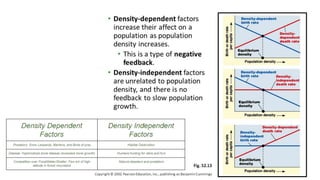
  • 153.
    Temperature • In thesoil the temperature varies little, and is rarely lower than 23oC. • Just above the surface the temperature varies by only 5oC or so (falling between 22oC – 27oC, generally), and therefore activities in the soil and on the forest floor are not usually interrupted by temperature variations.
  • 154.
    Disturbance to forestecosystem • Disturbance is regarded as an event of intense environmental stress occurring over a relatively short period of time and causing large changes in the affected ecosystem. • Disturbance can result from natural causes (volcanic eruptions, hurricanes, tornadoes, earthquakes, forest fire) or from the activities of humans (deforestation).
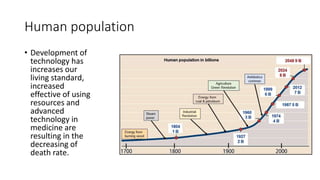
  • 155.
    Deforestation • Deforestation, clearance,or clearing is the removal of a forest or stand of trees from land which is then converted to a non-forest use. • Deforestation can involve conversion of forest land to farms, ranches, or urban use. • The most concentrated deforestation occurs in tropical rainforests.
  • 156.
    Effect of deforestationon rainfall in the tropics. a, Much of the rainfall over tropical forests comes from water vapour that is carried by the atmosphere from elsewhere. But a large component is 'recycled' rain — water that is pumped by trees from soil into the atmosphere through a process called evapotranspiration2. Water exits from forests either as run-off into streams and rivers, or as evapotranspirated vapour that is carried away by the atmosphere. The atmospheric transport of water vapour into the forest is balanced by the exit of water in the form of vapour and run- off. b, Spracklen and colleagues' analysis6 suggests that deforestation reduces evapotranspiration and so inhibits water recycling. This decreases the amount of moisture carried away by the atmosphere, reducing rainfall in regions to which the moisture is transported. Decreasing evapotranspiration may also increase localized run-off and raise river levels.
  • 158.
    Effects of disturbanceto ecosystem services
  • 160.
    1. What arewetlands? 2. What are the services provided by the wetlands?
  • 161.
    Wetland • A wetlandis a distinct ecosystem that is covered by water, either permanently or seasonally • Examples: swamp沼泽森林 (including mangrove forest红树林), marsh草沼, bog酸性泥炭沼泽 • etc.
  • 162.
    Functions of wetland •water purification • water storage • processing of carbon and other nutrients • stabilization of shorelines • rich in organic nutrients • support of plants and animals • most biologically diverse of all ecosystems
  • 163.
    Quiz • What arethe hydrologic functions of wetlands? a. long term and short term water storage b. energy dissipation c. moderation of groundwater flow or discharge d. all the above
  • 164.
    Mangrove swamp • Amangrove swamp is a distinct saline woodland or shrubland habitat formed by mangrove trees. • Tropical and subtropical • Found in upper intertidal zone protected from high-energy wave action e.g. estuary河口湾 • Growing in depositional沉积 coastal environments • fine sediments (often with high organic content) collected
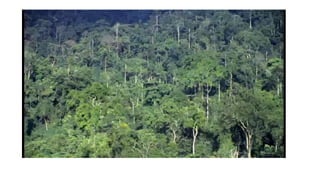
  • 165.
    Animals in the mangroveswamp • Slow water flow • Precipitation rich in nutrition • Nursery ground for juvenile fish • Attract other predator • Complex food web
  • 167.
    Plants in themangrove swamp • The peat soil is waterlogged and lack oxygen • Soil is soft and shallow, coupled with the endless ebb and flow of water • A great fluctuation of temperature
  • 168.
    Characteristic of mangroveplants • ability to survive in both salt and fresh water • thick succulent leaves with waxy coating • glands to remove excessive salt • viviparous seed • respiratory root Salt crystals on Avicennia marina (black mangrove) var resinifera leaves.
  • 169.
  • 170.
    Respiratory root • Stiltroots also called prop roots are developed by Rhizophora species and Pandanus species. • Stilt roots uphold the mangrove and ensure its growing space from tides. • Stilt roots is to allow the exchange of gas in oxygen-poor sediments with numerous lenticels.Bruguiera gymnorhiza knee roots • Knee roots are developed by Bruguiera species. Knee roots emerge as a root loop from the underground root system and allow the exchange of gases in oxygen-poor sediments.
  • 172.
  • 173.
    Quiz • Which ofthe following is NOT an example of the adaptive characteristics of the mangrove plants inwhich enable them to survive in the unfavourable environmental conditions in the mangrove swamp. A. viviparous seed B. respiratory root C. glands to remove excessive water D. sunken stomata
  • 175.
    Summary • Mangrove forestsare a type of intertidal wetland ecosystems. • The mangroves have several functions and adaptations to a life in an intertidal ecosystem. • The mangrove forests provide many ecosystem services.

Editor's Notes

  • #4 https://www.bournemouth.ac.uk/sites/default/files/styles/lightbox/public/assets/images/Ecology%201png.png?itok=318rasuj
  • #5 http://www.goldiesroom.org/Multimedia/Bio_Images/22%20Ecology/02%20Ecological%20Organization.jpg
  • #6 https://en.wikipedia.org/wiki/File:Rotjan_-_Enderbury_Day_1_-_2nd_half_(62).JPG
  • #7 https://media.nature.com/m685/nature-assets/nrg/journal/v3/n6/images/nrg818-f1.jpg
  • #8 https://cdn.kastatic.org/KA-youtube-converted/Tmt4zrDK3dA.mp4/Tmt4zrDK3dA.png
  • #9 http://images.slideplayer.com/23/6861599/slides/slide_3.jpg
  • #10 http://www.biologyreference.com/photos/community-3928.jpg
  • #11 http://www.scienceclarified.com/images/uesc_04_img0211.jpg
  • #12 https://en.wikipedia.org/wiki/File:Purple-throated_carib_hummingbird_feeding.jpg
  • #13 http://faculty.ycp.edu/~kkleiner/envbio/envimages/L11Popgrowth/Warbler_Niches.jpg
  • #14 https://vnaya.com/wp-content/uploads/2017/04/biomes-1.jpg
  • #15 https://www.khanacademy.org/science/biology/ecology/intro-to-ecosystems/a/what-is-an-ecosystem
  • #16 https://en.wikipedia.org/wiki/Biosphere
  • #18 http://cradlemountainpark.weebly.com/uploads/2/8/3/4/28348995/599111594.jpg?417 https://d2jmvrsizmvf4x.cloudfront.net/CcxgSYzTFGHWYUJ1VWCg_abiotic.jpg
  • #19 https://slideplayer.com/slide/10774270/38/images/3/Abiotic%3A+non-living+factors+in+an+ecosystem+that+affect+the+organisms+that+live+there.jpg
  • #20 https://d2jmvrsizmvf4x.cloudfront.net/vV5lmWGrRdKm9EE7LpqT_biome%2520determine.jpg
  • #21 https://www.soils4teachers.org/files/images/s4t/soil-2-8-texture-triangle.jpg
  • #22 https://www.dripworks.com/wordpress/wp-content/uploads/2016/06/soil-types.jpg http://www.sprinklertalk.com/Sprinkler_School/images/adjusting_water_to_match_your_soil.jpg
  • #23 https://i.pinimg.com/originals/e5/db/be/e5dbbe2d2ed3ad0895fcf6e33cbad61c.jpg
  • #24 https://jbs.camden.rutgers.edu/sites/jbs/files/Stang%20and%20Tkachuk-figure-1a.png https://jbs.camden.rutgers.edu/stang_oksana_microbial_communities
  • #25 https://i.stack.imgur.com/O0CEC.png https://cdn.shopify.com/s/files/1/0910/9258/products/SC-063-DiurnalNocturnalCrepuscuclar_1024x1024.jpg?v=1445213336
  • #26 http://pediaa.com/wp-content/uploads/2016/07/Difference-Between-Nocturnal-and-Diurnal-Animals-infographic-1.jpg https://www.howwemontessori.com/how-we-montessori/2015/07/montessori-nocturnal-diurnal-activity.html https://www.howwemontessori.com/how-we-montessori/2015/07/montessori-nocturnal-diurnal-activity.html
  • #27 https://physics.weber.edu/schroeder/ua/SunRayAngles.png http://astronomy.swin.edu.au/cms/cpg15x/albums/userpics/seasons.2.jpg https://study.com/cimages/videopreview/videopreview-full/gnfv4p0i29.jpg
  • #28 http://www.blossominggifts.com/blog/2016/04/08/animals-born-in-spring/
  • #29 https://www.nature.com/articles/s41598-017-08800-6
  • #30 https://www.google.com/search?ei=AW01XNy-GILVvgTv_YGABA&q=%E6%9C%80%E9%80%82%E6%B8%A9%E5%BA%A6+english&oq=%E6%9C%80%E9%80%82%E6%B8%A9%E5%BA%A6+english&gs_l=psy-ab.3..0i30.2619.3847..4254...0.0..0.77.516.8......0....1..gws-wiz.......0i71j0i5i30j0i4i30j0i5i4i30.pXSVAPuVAe4
  • #31 http://leml.asu.edu/jingle/Web_Pages/BIO320_Website/Lectures/2-Physiol_Ecology/Figures_Dodson/5_6lr.jpg
  • #32 http://news.ubc.ca/wp-content/uploads/2013/05/CheungGraphic_web1.jpg
  • #33 https://en.wikipedia.org/wiki/Humidity
  • #34 http://www.biologydiscussion.com/plants/plant-adaptations-introduction-and-ecological-classification-of-plants/6902 http://www.sbs.utexas.edu/mauseth/weblab/webchap10epi/web10.3-14.jpg http://www.biologydiscussion.com/plants/hydrophytes/hydrophyte-plants-and-their-classification-botany/18191
  • #35 https://s3-us-west-1.amazonaws.com/contentlab.studiod/getty/48d0efaa5e964efdb58135daa7ffd1de https://s3-us-west-1.amazonaws.com/contentlab.studiod/getty/ca4e65ca16f1462cb10005d7f9c3e2aa
  • #36 https://www.slideshare.net/mrimbiology/adaptations-in-different-biomes-notes
  • #37 https://www.slideshare.net/mrimbiology/adaptations-in-different-biomes-notes
  • #38 https://www.slideshare.net/mrimbiology/adaptations-in-different-biomes-notes
  • #39 https://image.slidesharecdn.com/adaptationsindifferentbiomesnotes-130310165904-phpapp02/95/adaptations-in-different-biomes-notes-7-638.jpg?cb=1362935023
  • #40 https://image.slidesharecdn.com/unit5-ecosystems-160331225012/95/unit-5-ecosystems-11-638.jpg?cb=1459464630
  • #41 https://www.slideshare.net/irenebyg/biotic-relations
  • #42 https://www.slideshare.net/irenebyg/biotic-relations
  • #43 http://pediaa.com/wp-content/uploads/2018/09/Difference-Between-Interspecific-and-Intraspecific-Competition-Comparison-Summary.jpg
  • #44 https://dr282zn36sxxg.cloudfront.net/datastreams/f-d%3A8190129dd67acad18dbf4e38abd56cd1f3fe3d299608b03d62ef4971%2BIMAGE_TINY%2BIMAGE_TINY.1 https://slideplayer.com/slide/9218922/27/images/16/Plants+compete+with+themselves+and+others.jpg
  • #45 https://slideplayer.com/slide/4405511/
  • #46 https://slideplayer.com/slide/4405511/
  • #47 https://slideplayer.com/slide/4405511/
  • #48 https://slideplayer.com/slide/4405511/
  • #49 https://slideplayer.com/slide/4405511/http://blog.sina.com.cn/s/blog_87b716070100yn8n.html
  • #50 https://slideplayer.com/slide/4405511/ http://blog.sina.com.cn/s/blog_87b716070100yn8n.html
  • #51 https://slideplayer.com/slide/4405511/ http://blog.sina.com.cn/s/blog_87b716070100yn8n.html
  • #52 https://www.khanacademy.org/science/biology/ecology/community-ecosystem-ecology/a/niches-competition
  • #53 http://ib.bioninja.com.au/standard-level/topic-4-ecology/41-species-communities-and/species-interactions.html
  • #54 https://biologydictionary.net/wp-content/uploads/2016/10/Cheetah-Hunting.jpg https://media.mnn.com/assets/images/2016/05/Mosquito-Filled-With-Human-Blood-Arm.jpg.653x0_q80_crop-smart.jpg
  • #55 https://globalchange.umich.edu/globalchange1/current/lectures/predation/tmp26.gif http://www2.nau.edu/~gaud/bio301/images/snwlynx.jpg
  • #56 https://www.youtube.com/watch?v=esObgcaAHT8
  • #57 https://www.khanacademy.org/science/biology/ecology/community-ecosystem-ecology/a/niches-competition
  • #58 https://www.youtube.com/watch?v=zSmL2F1t81Q
  • #59 http://adasciss.weebly.com/uploads/7/0/5/7/7057322/6749809_orig.png https://www.wiley.com/legacy/Australia/PageProofs/SQ7_VIC_AC_c04_web.pdf
  • #61 https://i.pinimg.com/originals/d8/bb/15/d8bb15a9e461e19ddeec04227afb7acb.jpg
  • #62 http://saipancakes.com/2013/05/human-parasites.html
  • #63 https://i.pinimg.com/originals/ca/e5/93/cae593593a0ef35264f1c6f409251395.jpg https://swh-826d.kxcdn.com/wp-content/uploads/2011/12/ectoparasitism-endoparasitism.jpg
  • #64 http://ib.bioninja.com.au/_Media/symbiosis_med.jpeg
  • #65 https://www.khanacademy.org/science/biology/ecology/community-ecosystem-ecology/a/niches-competition
  • #66 https://www.khanacademy.org/science/biology/ecology/community-ecosystem-ecology/a/niches-competition
  • #67 https://www.khanacademy.org/science/biology/ecology/community-ecosystem-ecology/a/niches-competition
  • #68 https://www.nap.edu/openbook/13394/xhtml/images/69.jpg
  • #69 https://www.researchgate.net/profile/Tamara_Muenkemueller/publication/264703124/figure/fig1/AS:614019354349569@1523405030073/Overview-of-studied-interspecific-effects-on-the-range-expansion-rate-in-the-invasive.png
  • #70 https://en.wikipedia.org/wiki/Theodosius_Dobzhansky#/media/File:Theodosius_Dobzhansky.jpg
  • #71 https://upload.wikimedia.org/wikipedia/commons/f/f7/Evolution_sm.png
  • #72 https://upload.wikimedia.org/wikipedia/commons/5/52/Geopelia_striata_-_Laem_Pak_Bia.jpg
  • #73 https://en.wikipedia.org/wiki/File:Insect_camouflage_PP08338.png
  • #74 https://pixfeeds.com/images/40/598340/1280-598340-91039872-468783450-841705072.png
  • #75 https://image.slidesharecdn.com/mimicry-170225183522/95/mimicry-evolutionary-biology-8-638.jpg?cb=1488048278 https://upload.wikimedia.org/wikipedia/commons/thumb/9/93/Batesian_vs_M%C3%BCllerian_Mimicry.svg/2000px-Batesian_vs_M%C3%BCllerian_Mimicry.svg.png
  • #76 https://slideplayer.com/slide/9856597/
  • #77 https://www150.statcan.gc.ca/n1/pub/92-195-x/2011001/other-autre/pop/image/pop.jpg
  • #78 https://slideplayer.com/slide/5211259/16/images/5/Measuring+density+of+populations+is+a+difficult+task..jpg http://ib.bioninja.com.au/options/option-c-ecology-and-conser/c5-population-ecology/population-sampling.html
  • #79 https://slideplayer.com/slide/6231797/20/images/17/SESSILE+SEDENTARY+Chiton+Sponge+MOTILE+Cheetah+copyright+cmassengale.jpg http://ib.bioninja.com.au/options/option-c-ecology-and-conser/c5-population-ecology/population-sampling.html
  • #80 https://www.youtubnow.com/watch/?v=7nr9rQpm2A4
  • #82 https://www.khanacademy.org/science/high-school-biology/hs-ecology/hs-population-ecology/a/population-size-density-and-dispersal
  • #83 https://prod-media.coolaustralia.org/wp-content/uploads/2016/04/06192825/Sampling-Instructions.pdf https://www.khanacademy.org/science/high-school-biology/hs-ecology/hs-population-ecology/a/population-size-density-and-dispersal
  • #84 https://www.slideshare.net/nirmalajosephine1/biology-form-4-chapter-8-dynamic-ecosystem-part-3-42839437
  • #85 https://www.slideshare.net/nirmalajosephine1/biology-form-4-chapter-8-dynamic-ecosystem-part-3-42839437
  • #86 https://www.slideshare.net/nirmalajosephine1/biology-form-4-chapter-8-dynamic-ecosystem-part-3-42839437
  • #87 http://ib.bioninja.com.au/options/option-c-ecology-and-conser/c5-population-ecology/population-sampling.html
  • #88 http://ib.bioninja.com.au/options/option-c-ecology-and-conser/c5-population-ecology/population-sampling.html
  • #89 http://ib.bioninja.com.au/options/option-c-ecology-and-conser/c5-population-ecology/population-sampling.html
  • #90 http://ib.bioninja.com.au/options/option-c-ecology-and-conser/c5-population-ecology/population-sampling.html
  • #91 http://ib.bioninja.com.au/options/option-c-ecology-and-conser/c5-population-ecology/population-sampling.html https://slideplayer.com/slide/6262022/21/images/4/To+use+the+Lincoln+Index%2C+scientists+capture+a+sample+of+the+population+they+want+to+measure..jpg
  • #92 http://ib.bioninja.com.au/options/option-c-ecology-and-conser/c5-population-ecology/population-sampling.html https://image.slidesharecdn.com/experimentaldesigncartoonpart5samplesize-180821152126/95/experimental-design-cartoon-part-5-sample-size-51-638.jpg?cb=1534864952
  • #93 https://textimgs.s3.amazonaws.com/boundless-biology/figure-45-01-04.jpe
  • #94 https://image.slidesharecdn.com/populationecology-140310064710-phpapp01/95/population-ecology-15-638.jpg?cb=1394434087 https://www.khanacademy.org/science/high-school-biology/hs-ecology/hs-population-ecology/a/population-size-density-and-dispersal
  • #95 https://image.slidesharecdn.com/populationecology-140310064710-phpapp01/95/population-ecology-15-638.jpg?cb=1394434087 https://www.khanacademy.org/science/high-school-biology/hs-ecology/hs-population-ecology/a/population-size-density-and-dispersal
  • #96 https://image.slidesharecdn.com/populationecology-140310064710-phpapp01/95/population-ecology-15-638.jpg?cb=1394434087 https://www.khanacademy.org/science/high-school-biology/hs-ecology/hs-population-ecology/a/population-size-density-and-dispersal
  • #97 https://image.slidesharecdn.com/biokc-150127072141-conversion-gate01/95/bioknowledgy-c5-population-ecology-ahl-10-638.jpg?cb=1424236315
  • #98 https://openoregon.pressbooks.pub/envirobiology/chapter/4-2-population-growth-and-regulation/
  • #99 https://www2.estrellamountain.edu/faculty/farabee/biobk/expgrowth.gif
  • #100 https://www2.estrellamountain.edu/faculty/farabee/biobk/expgrowth.gif
  • #101 https://openoregon.pressbooks.pub/envirobiology/chapter/4-2-population-growth-and-regulation/
  • #107 http://www.msudeerlab.com/img/dynamics/dynamics9.jpg
  • #108 https://slideplayer.com/slide/4259445/14/images/38/This+is+a+type+of+negative+feedback..jpg https://superchubbystubbyfluffycuddlyfuzzywuzzyredpanpansblog.files.wordpress.com/2016/10/kkkkkkk.png?w=676
  • #109 http://suindependent.com/wp-content/uploads/2018/03/IndependentArticle-Population1.jpg
  • #110 https://openoregon.pressbooks.pub/envirobiology/chapter/4-3-the-human-population/
  • #111 https://www.economicshelp.org/blog/469/development/factors-effect-population-size-and-growth/
  • #112 http://www.thegeographeronline.net/uploads/2/6/6/2/26629356/7646197_orig.png
  • #113 https://i0.wp.com/forestschoolportfolio.com/wp-content/uploads/2015/08/woodland-vertical-structure-1.jpg
  • #114 http://www.zo.utexas.edu/courses/bio373/chapters/Chapter4/fig4-10.jpg
  • #115 https://isebindia.com/icpep-5/souvenir/plants-healthy-growth-environment.jpg
  • #117 https://4.bp.blogspot.com/--W_0n5pj7IQ/WDpGyFjtT6I/AAAAAAAAAF8/g2dpdQ-YzVcvJCutXdxbEuXcMWbMTi85gCLcB/s1600/vertical%2Bmountain%2Bstratification.PNG https://en.wikipedia.org/wiki/Altitudinal_zonation
  • #118 http://www.imedpub.com/articles/study-of-vertical-and-horizontal-forest-structure-in-northern-zagros-forest-case-study-west-of-iran-oak-forest.php?aid=11590 https://www.forestschoolportfolio.com/unit-1-forest-school-programmes-and-the-woodland-environment/1-1-explain-the-vertical-and-horizontal-ecological-structures-of-british-woodland/
  • #120 http://visityellowstonenationalparkyall.weebly.com/uploads/1/9/1/2/19128651/4659793_orig.jpg https://ousewasheslps.files.wordpress.com/2014/09/bird-track-reporting-rate-graph-showing-the-increase-in-wigeon.jpg https://www.purelypoultry.com/images/whooper-swan_04.jpg
  • #121 http://www.zo.utexas.edu/courses/bio373/chapters/Chapter4/Chapter4.html
  • #122 http://ecology-project.weebly.com/uploads/4/9/5/9/49594703/5862597_orig.jpg
  • #123 https://images.slideplayer.com/16/5111352/slides/slide_2.jpg
  • #124 https://en.wikipedia.org/wiki/Pioneer_species#/media/File:Plants_Colonizing_a_Lava_Flow_on_Hawaii.jpg
  • #125 http://c0380802.cdn2.cloudfiles.rackspacecloud.com/15147.jpg
  • #126 https://slideplayer.com/slide/4060377/ https://socratic.org/questions/how-does-species-diversity-change-as-succession-occurs
  • #127 https://d1k5w7mbrh6vq5.cloudfront.net/images/cache/c1/d8/e5/c1d8e5f67d9293cf76efc33cf3f8cb0c.jpg
  • #128 https://www.majordifferences.com/2018/08/10-differences-between-pioneer-community-and-climax-community.html#.XEimeVVKgdU
  • #129 https://www.majordifferences.com/2018/08/10-differences-between-pioneer-community-and-climax-community.html#.XEimeVVKgdU
  • #130 https://cdn.britannica.com/s:500x350/98/95198-004-2619E3FA.jpg https://cdn.britannica.com/97/95197-004-7F9B8F09.jpg
  • #131 http://image.slidesharecdn.com/succession-110605083057-phpapp02/95/succession-4-728.jpg%3Fcb%3D1307263812
  • #132 http://www.old-ib.bioninja.com.au/_Media/screen-shot-2013-02-14-at_med-3.png
  • #133 https://biodifferences.com/difference-between-primary-succession-and-secondary-succession.html
  • #134 https://biodifferences.com/difference-between-primary-succession-and-secondary-succession.html
  • #135 https://www.youtube.com/watch?v=UsiEcapJ3KU
  • #137 https://media.buzzle.com/media/images-en/photos/earth-science/1200-604469-types-of-ecosystems.jpg
  • #138 http://grade2abis.weebly.com/uploads/7/6/0/7/7607093/8092472_orig.png
  • #139 https://images-na.ssl-images-amazon.com/images/I/81qd6y-OOgL._SY450_.jpg
  • #140 http://www.aboutvalues.net/assets/es_slides_1.jpg
  • #141 https://www.ue.katowice.pl/en/units/unieko/functions-of-the-forest.html http://www.nature.com/scitable/content/ne0000/ne0000/ne0000/ne0000/13311390/beman_figure2_ksm.jpg
  • #142 https://www.ue.katowice.pl/en/units/unieko/functions-of-the-forest.html https://umaine.edu/pdc/wp-content/uploads/sites/398/2016/01/woodpile-3-1229344-1280x960.jpg http://forestproduct.com.vn/wp-content/uploads/2015/04/r%E1%BB%ABng-1.jpg
  • #143 https://www.ue.katowice.pl/en/units/unieko/functions-of-the-forest.html http://www.fao.org/docrep/v2535e/v2535e04.jpg
  • #144 https://www.youtube.com/watch?v=RpvHzjgENoc
  • #145 http://savetropicalrainforests.weebly.com/uploads/2/9/6/7/29676117/152254793.jpg
  • #146 https://txt15.book118.com/2016/1201/book65602/65601823.jpg
  • #148 http://www.zo.utexas.edu/courses/bio373/chapters/Chapter4/fig4-10.jpg
  • #149 https://previews.123rf.com/images/pilens/pilens1206/pilens120600186/14087119-sun-beams-of-light-penetrating-dense-lush-green-canopy-of-tropical-rainforest-jungle-wilderness.jpg
  • #150 http://geotallis.weebly.com/uploads/1/7/7/2/17728259/5534949_orig.png
  • #151 https://i.pinimg.com/originals/d2/49/2f/d2492f7948ea079520a1386d02d57c7c.jpg
  • #152 https://glassgardens.co.za/wp-content/uploads/2017/02/Glass-Gardens-Epiphytes-1.jpg
  • #153 http://www.mbgnet.net/sets/rforest/explore/jnglclr.jpg
  • #154 https://kids.nationalgeographic.com/content/dam/kids/photos/articles/Nature/H-P/Habitats/Rain-Forest/rain-forest-ecuador.ngsversion.1501248815064.jpg
  • #155 https://depts.washington.edu/bjhlab/wordpress/wp-content/uploads/2014/01/HarveyLab-1-1024x793.jpg
  • #156 https://www.environment.co.za/wp-content/uploads/2014/12/Congo_12_11_09_McConnell_deforestation10_edit.jpg
  • #157 https://www.researchgate.net/profile/Luiz_Aragao/publication/230804530/figure/fig1/AS:289275712163867@1445980112493/Effect-of-deforestation-on-rainfall-in-the-tropics-a-Much-of-the-rainfall-over-tropical.png
  • #158 http://2.bp.blogspot.com/-mUX0zrUgvBw/UwVAr-kx4xI/AAAAAAAAAL4/eYI0BHycu0c/s1600/deforestation_borneo.jpg https://mongabay-images.s3.amazonaws.com/13/1116-malaysia.gif
  • #159 http://science.sciencemag.org/content/sci/342/6160/1235773/F1.large.jpg
  • #160 https://www.youtube.com/watch?time_continue=221&v=lv3W_YlDnOs
  • #161 https://www.youtube.com/watch?v=xoID0Ztlt_Y
  • #162 http://footage.framepool.com/shotimg/803902561-%E6%B2%99%E5%B7%B4-%E6%B2%B3%E5%BA%8A-%E9%A9%AC%E6%9D%A5%E8%A5%BF%E4%BA%9A-%E4%B8%89%E8%A7%92%E6%B4%B2.jpg https://en.wikipedia.org/wiki/Swamp#/media/File:USGS_image_cropped.jpg https://ccm.ddcdn.com/discovery/production/1519980526_open-uri20180302-1-rsxh3j
  • #163 http://footage.framepool.com/shotimg/803902561-%E6%B2%99%E5%B7%B4-%E6%B2%B3%E5%BA%8A-%E9%A9%AC%E6%9D%A5%E8%A5%BF%E4%BA%9A-%E4%B8%89%E8%A7%92%E6%B4%B2.jpg http://ash-west-wetlands.weebly.com/uploads/2/3/9/3/23939738/7181681.jpg?597 https://ccm.ddcdn.com/discovery/production/1519980526_open-uri20180302-1-rsxh3j
  • #165 http://5b0988e595225.cdn.sohucs.com/images/20180107/a01645d7aacc43e4ac7758a95dd89c77.jpeg
  • #166 https://c8.alamy.com/comp/EBB1E9/mangrove-ecosystem-underwater-with-coral-and-juvenile-fish-in-the-EBB1E9.jpg https://www.exploringnature.org/graphics/biomes/mangrove_header.jpg https://blog.nationalgeographic.org/wp-content/uploads/2015/09/NN05-Web-FSA-02.jpg
  • #167 https://239f21.medialib.edu.glogster.com/VcqUjctsxgnwE2CtOwng/media/97/9791b53edae0c636fb9b347c73b76b041592a289/4-mangrovefoodwebop.jpg
  • #168 https://phys.org/news/2018-07-mangroves-planet-cool.html
  • #169 https://1d59b73swr1f1swu2v451xcx-wpengine.netdna-ssl.com/wp-content/uploads/strategy/0ef4cce98e84127a384ff963259e4724/372pxsaltcrystals_on_avicennia_marina_var_resinifera_leaves.jpg
  • #170 http://mangrovecosystems.weebly.com/adaptations.html http://www.jochemnet.de/fiu/Mangrove.gif http://images.tutorvista.com/content/plant-growth-movements/viviparous-reproduction.jpeg
  • #171 http://www.mangrove.at/mangrove_roots.html
  • #172 http://mangrovecosystems.weebly.com/adaptations.html http://images.tutorvista.com/content/plant-growth-movements/viviparous-reproduction.jpeg
  • #173 https://www.weadapt.org/sites/weadapt.org/files/2017/mangrove_benefits.png
  • #175 https://www.youtube.com/watch?v=cwTZhyA57mA
  • #176 https://wrm.org.uy/wp-content/uploads/2014/07/for-the-mangrove-ecosystem-and-oceans-1.jpg