 Transaminase or an aminotransferase is
an enzyme that catalyzes a type of reaction
between an amino acid and an α-keto acid.
They are important in the synthesis of amino
acids, which form proteins.
 An amino acid contains an amine (NH2)
group. A keto acid contains a keto (=O)
group. In transamination, the NH2 group on
one molecule is exchanged with the =O
group on the other molecule. The amino acid
becomes a keto acid, and the keto acid
becomes an amino acid
 The transaminase enzymes are important in
the production of various amino acids, and
measuring the concentrations of various
transaminases in the blood is important in
the diagnosing and tracking many diseases.
 Aspartate aminotransferase (EC 2.6.1.1; l-
aspartate:2-oxoglutarate aminotransferase;
AST) and alanine aminotransferase (EC
2.6.1.2; l-alanine:2- oxoglutarate
aminotransferase; ALT) are examples of
aminotransferases that are of clinical interest.
Transaminases require the coenzyme pyridoxal-
phosphate, which is converted into pyridoxamine in
the first phase of the reaction, when an amino acid is
converted into a keto acid. Enzyme-
bound pyridoxamine in turn reacts
with pyruvate, oxaloacetate, or alpha-ketoglutarate,
giving alanine, aspartic acid, or glutamic acid,
respectively. Many transamination reactions occur in
tissues, catalysed by transaminases specific for a
particular amino/keto acid pair. The reactions are
readily reversible, the direction being determined by
which of the reactants are in excess
 Transaminases are widely distributed throughout
the body. AST is found primarily in the heart,
liver, skeletal muscle, and kidney, whereas ALT is
found primarily in the liver and kidney, with
lesser amounts in heart and skeletal muscle. ALT
is exclusively cytoplasmic; both mitochondrial
and cytoplasmic forms of AST are found in cells.
These are genetically distinct isoenzymes with a
dimeric structure composed of two identical
polypeptide subunits of about 400 amino acid
residues.
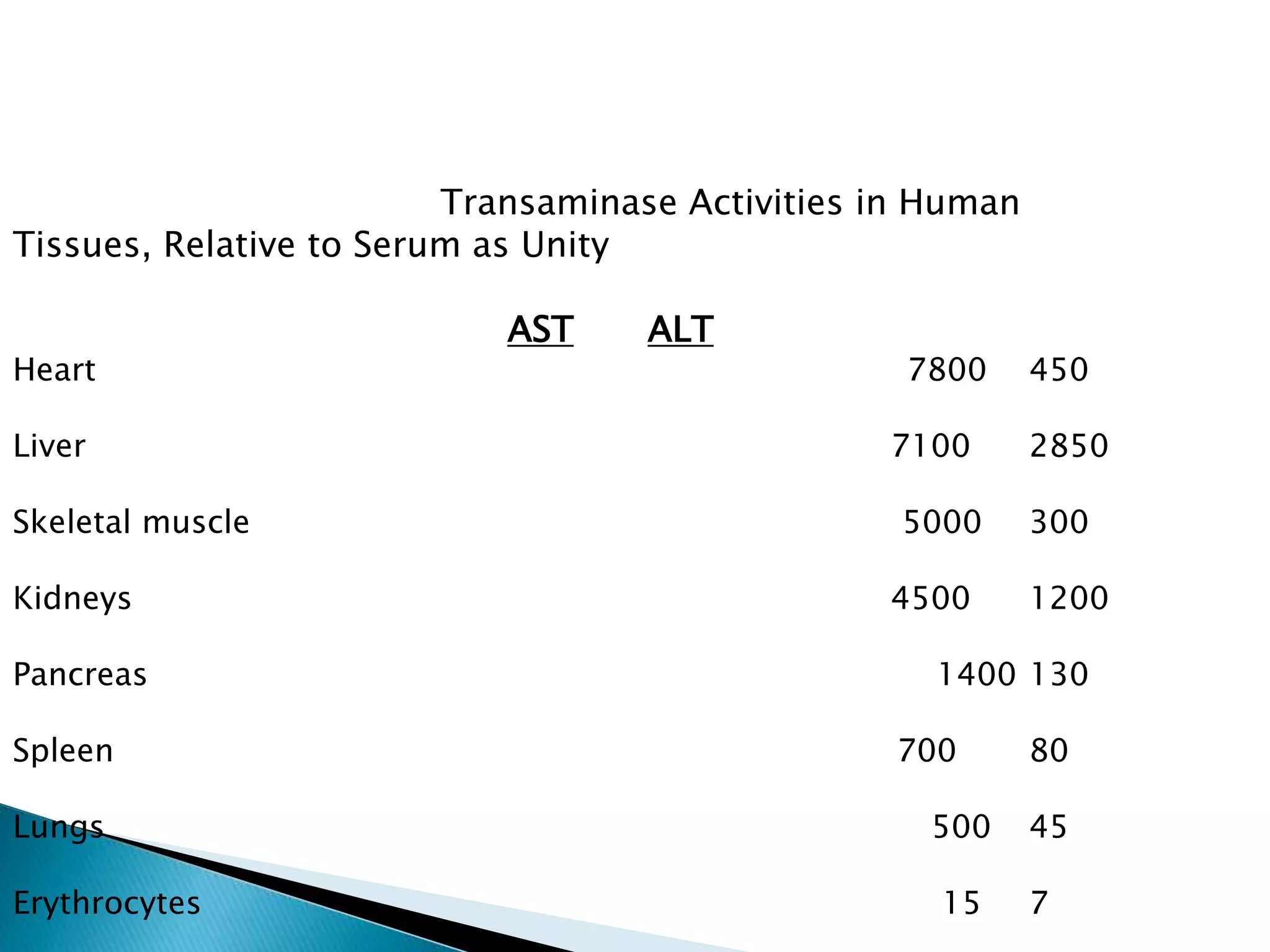
Transaminase Activities in Human
Tissues, Relative to Serum as Unity
AST ALT
Heart 7800 450
Liver 7100 2850
Skeletal muscle 5000 300
Kidneys 4500 1200
Pancreas 1400 130
Spleen 700 80
Lungs 500 45
Erythrocytes 15 7
 PURPOSE OF EXAMINATION
 Alanine amino transferase(glutamate pyruvate
transaminase) belongs to the group of
transaminase , which catalyses the conversion
of amino acids to the corresponding alpha
keto acids via the transfer of amino groups,
they also catalyse the reverse process.
 Estimation of alanine aminotransferase
helps in the diagnosis of MI, hepatopathies,
muscular dystrophy, and damage to the
internal organs.
 METHODS BASED ON IFCC RECOMMENDATION
 ALT transfers the amino group from alanine to
2-oxoglutarate to form pyruvate and
glutamate. The addition of pyridoxal phisphate
to the reaction mixture ensures maximum
catalytic activity of ALT.
 The pyruvate enters a lactate dehydrogenase
(LDH) catalysed reaction with NADH to produce
lactate and NAD+ . The decreased in
absorbance due to consumption of NADH is
measured at 340 nm and is proportional to the
ALT activity in the sample. Endogenous
pyruvate is removed during incubation period.
 2- OXOGLUTARATE + L-ALANINE L-GLUTAMATE +
PYRUVATE
 PYRUVATE + NADH + H+ L- LACTATE +
NAD+
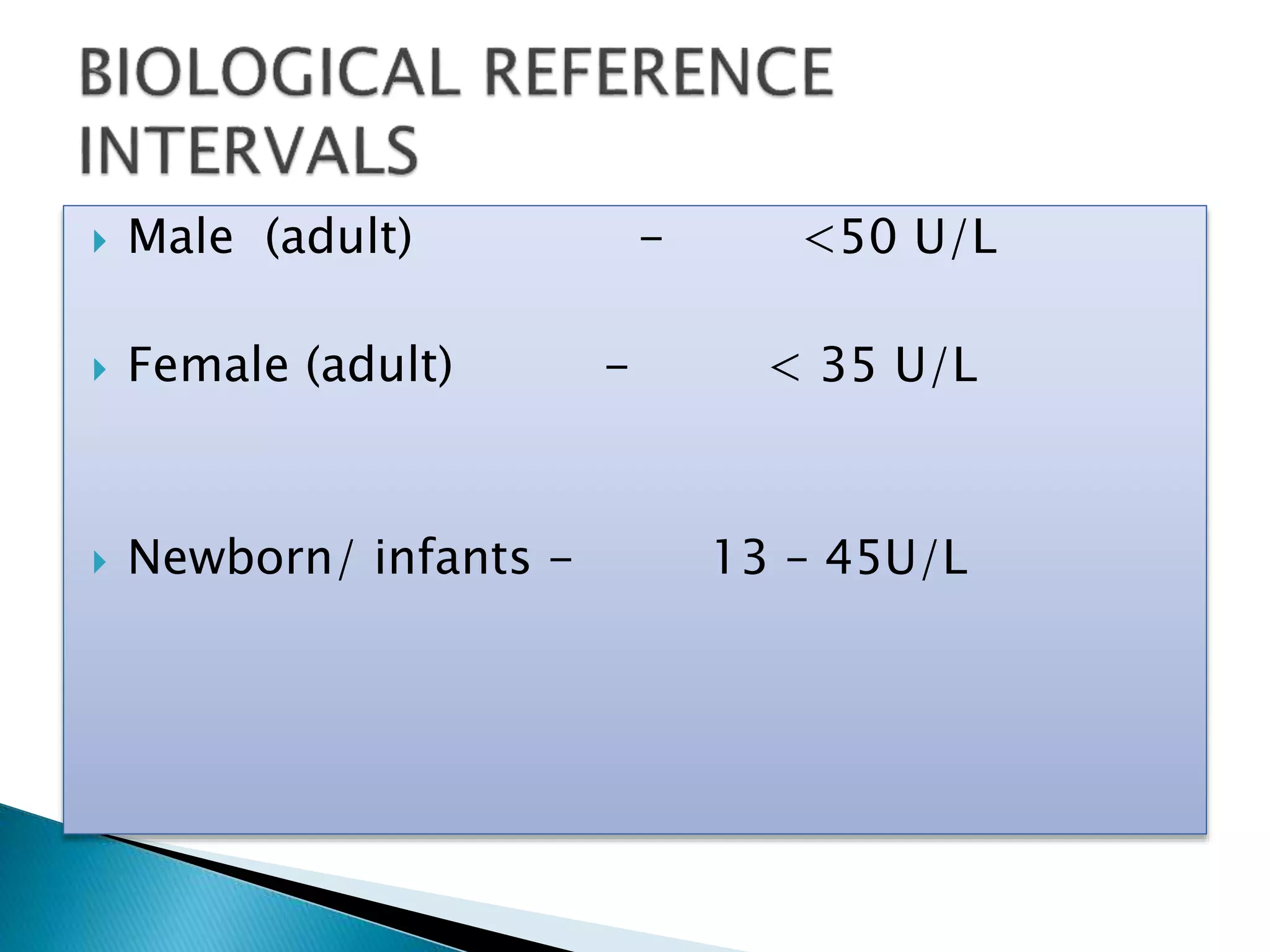
 Male (adult) - <50 U/L
 Female (adult) - < 35 U/L
 Newborn/ infants - 13 – 45U/L
 PURPOSE OF EXAMINATION
 Ast occurs in a wide variety of tissues
including liver, cardiac muscle, skeletal
muscle, brain, kidneys, lungs pancreas,
erythrocytes and leucocytes with highest
activities found in liver and skeletal muscle.
Measurment of AST is indicated in the
diagnosis , differentiation and monitoring of
hepatobilliary disease, myocardial infarction
and skeletal muscle.
 TEST PRINCIPLE
 Method based on the recommendation of the
“international federation for clinical
chemistry”(IFCC)
 In this method, Asparate
aminotransferase(AST) catalyses the
transamination of aspartate and 2-
oxoglutarate, forming l-glutamate and
oxalacetate. The addition of pyridoxal
phosphate to the reaction mixture ensures
maximum catalytic activity of AST.
 The oxaloacetate is reduced to L- malate by
malate dehydrogenase(MDH), while NADH is
simultaneously converted to NAD+ . The
decrease in absorbance due to the
consumption of NADH is measured at 340nm
and is proportional to the AST activity in the
sample. Endogenous pyruvate is removed by
the LDH-reaction during the incubation
period.
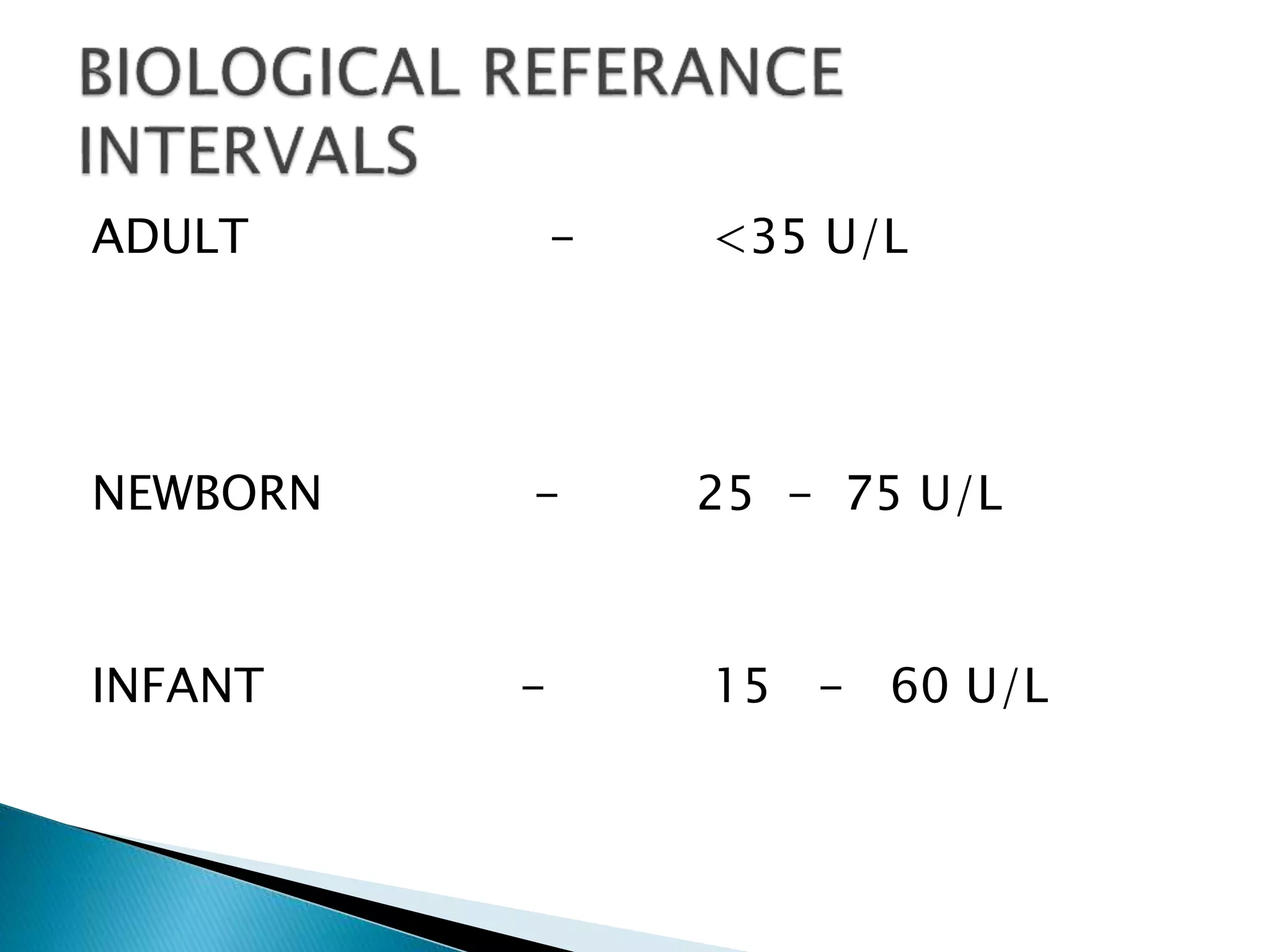
ADULT - <35 U/L
NEWBORN - 25 - 75 U/L
INFANT - 15 - 60 U/L
THANK
YOUUUUUU

Transaminase

  • 2.
     Transaminase oran aminotransferase is an enzyme that catalyzes a type of reaction between an amino acid and an α-keto acid. They are important in the synthesis of amino acids, which form proteins.
  • 3.
     An aminoacid contains an amine (NH2) group. A keto acid contains a keto (=O) group. In transamination, the NH2 group on one molecule is exchanged with the =O group on the other molecule. The amino acid becomes a keto acid, and the keto acid becomes an amino acid
  • 4.
     The transaminaseenzymes are important in the production of various amino acids, and measuring the concentrations of various transaminases in the blood is important in the diagnosing and tracking many diseases.
  • 5.
     Aspartate aminotransferase(EC 2.6.1.1; l- aspartate:2-oxoglutarate aminotransferase; AST) and alanine aminotransferase (EC 2.6.1.2; l-alanine:2- oxoglutarate aminotransferase; ALT) are examples of aminotransferases that are of clinical interest.
  • 6.
    Transaminases require thecoenzyme pyridoxal- phosphate, which is converted into pyridoxamine in the first phase of the reaction, when an amino acid is converted into a keto acid. Enzyme- bound pyridoxamine in turn reacts with pyruvate, oxaloacetate, or alpha-ketoglutarate, giving alanine, aspartic acid, or glutamic acid, respectively. Many transamination reactions occur in tissues, catalysed by transaminases specific for a particular amino/keto acid pair. The reactions are readily reversible, the direction being determined by which of the reactants are in excess
  • 7.
     Transaminases arewidely distributed throughout the body. AST is found primarily in the heart, liver, skeletal muscle, and kidney, whereas ALT is found primarily in the liver and kidney, with lesser amounts in heart and skeletal muscle. ALT is exclusively cytoplasmic; both mitochondrial and cytoplasmic forms of AST are found in cells. These are genetically distinct isoenzymes with a dimeric structure composed of two identical polypeptide subunits of about 400 amino acid residues.
  • 8.
    Transaminase Activities inHuman Tissues, Relative to Serum as Unity AST ALT Heart 7800 450 Liver 7100 2850 Skeletal muscle 5000 300 Kidneys 4500 1200 Pancreas 1400 130 Spleen 700 80 Lungs 500 45 Erythrocytes 15 7
  • 9.
     PURPOSE OFEXAMINATION  Alanine amino transferase(glutamate pyruvate transaminase) belongs to the group of transaminase , which catalyses the conversion of amino acids to the corresponding alpha keto acids via the transfer of amino groups, they also catalyse the reverse process.  Estimation of alanine aminotransferase helps in the diagnosis of MI, hepatopathies, muscular dystrophy, and damage to the internal organs.
  • 10.
     METHODS BASEDON IFCC RECOMMENDATION  ALT transfers the amino group from alanine to 2-oxoglutarate to form pyruvate and glutamate. The addition of pyridoxal phisphate to the reaction mixture ensures maximum catalytic activity of ALT.  The pyruvate enters a lactate dehydrogenase (LDH) catalysed reaction with NADH to produce lactate and NAD+ . The decreased in absorbance due to consumption of NADH is measured at 340 nm and is proportional to the ALT activity in the sample. Endogenous pyruvate is removed during incubation period.
  • 11.
     2- OXOGLUTARATE+ L-ALANINE L-GLUTAMATE + PYRUVATE  PYRUVATE + NADH + H+ L- LACTATE + NAD+
  • 12.
     Male (adult)- <50 U/L  Female (adult) - < 35 U/L  Newborn/ infants - 13 – 45U/L
  • 13.
     PURPOSE OFEXAMINATION  Ast occurs in a wide variety of tissues including liver, cardiac muscle, skeletal muscle, brain, kidneys, lungs pancreas, erythrocytes and leucocytes with highest activities found in liver and skeletal muscle. Measurment of AST is indicated in the diagnosis , differentiation and monitoring of hepatobilliary disease, myocardial infarction and skeletal muscle.
  • 14.
     TEST PRINCIPLE Method based on the recommendation of the “international federation for clinical chemistry”(IFCC)  In this method, Asparate aminotransferase(AST) catalyses the transamination of aspartate and 2- oxoglutarate, forming l-glutamate and oxalacetate. The addition of pyridoxal phosphate to the reaction mixture ensures maximum catalytic activity of AST.
  • 15.
     The oxaloacetateis reduced to L- malate by malate dehydrogenase(MDH), while NADH is simultaneously converted to NAD+ . The decrease in absorbance due to the consumption of NADH is measured at 340nm and is proportional to the AST activity in the sample. Endogenous pyruvate is removed by the LDH-reaction during the incubation period.
  • 16.
    ADULT - <35U/L NEWBORN - 25 - 75 U/L INFANT - 15 - 60 U/L
  • 17.