12.5 Other sensations
12.5.1 Smell
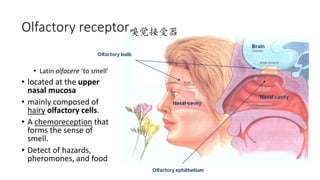
Olfactory receptor嗅觉接受器
• Latin olfacere ‘to smell’
• located at the upper
nasal mucosa
• mainly composed of
hairy olfactory cells.
• A chemoreception that
forms the sense of
smell.
• Detect of hazards,
pheromones, and food
Quiz
• What is the purpose of the Olfactory System?
A. Recognise the things we eat
B. Sense of smell perceived by the brain
C. Recognise the things we see
D. Work out what we are hearing
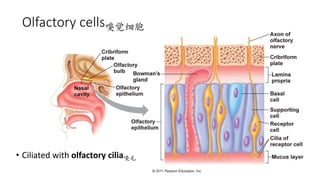
Olfactory cells嗅觉细胞
• Ciliated with olfactory cilia嗅毛
Quiz
• The sense of smell is dependent on ______ cells.
A. optic
B. auditory
C. olfactory
D. proprioceptor
E. odiferous
There are many different types of olfactory cells
and the smell we perceive depends upon the
combination of olfactory cells that are stimulated.
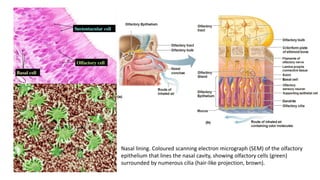
Nasal lining. Coloured scanning electron micrograph (SEM) of the olfactory
epithelium that lines the nasal cavity, showing olfactory cells (green)
surrounded by numerous cilia (hair-like projection, brown).
Formation of smell
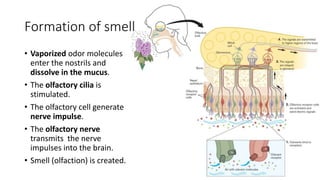
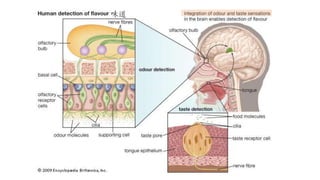
• Vaporized odor molecules
enter the nostrils and
dissolve in the mucus.
• The olfactory cilia is
stimulated.
• The olfactory cell generate
nerve impulse.
• The olfactory nerve
transmits the nerve
impulses into the brain.
• Smell (olfaction) is created.
12.5.2 Taste
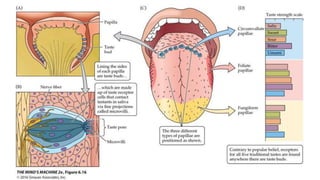
Taste receptor
• Tongue is the taste organ.
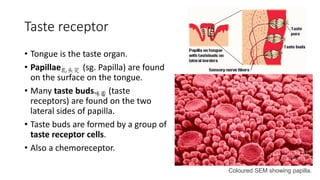
• Papillae乳头突 (sg. Papilla) are found
on the surface on the tongue.
• Many taste buds味蕾 (taste
receptors) are found on the two
lateral sides of papilla.
• Taste buds are formed by a group of
taste receptor cells.
• Also a chemoreceptor.
Coloured SEM showing papilla.
Taste buds
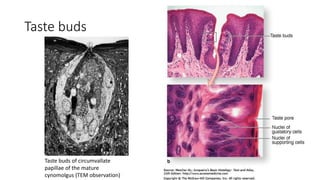
Taste buds of circumvallate
papillae of the mature
cynomolgus (TEM observation)
Quiz
• Taste buds are located primarily on the ______.
A. upper palate
B. tongue
C. gums
D. turbinates of the nose
E. uvula
Quiz
• Taste buds are pockets of cells that ____________.
A. lie flat on the surface of the tongue epithelium
B. extend through tongue epithelium and open at a taste pore
C. lie along the walls of papillae
D. lack microvilli
E. all of the above
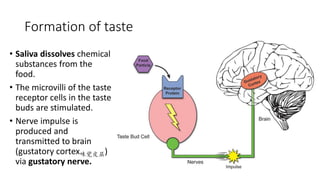
Formation of taste
• Saliva dissolves chemical
substances from the
food.
• The microvilli of the taste
receptor cells in the taste
buds are stimulated.
• Nerve impulse is
produced and
transmitted to brain
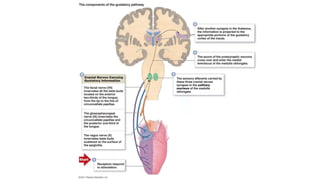
(gustatory cortex味觉皮层)
via gustatory nerve.
Quiz
• The _________ bear receptor proteins for certain molecules; when
molecules bind to these receptor proteins, nerve impulses are
generated in associated sensory nerve fibers that are interpreted in
the brain as tastes.
A. taste buds
B. thermoreceptors
C. taste pores
D. papillae
E. taste receptor cells
味道
12.5.3 Sensation of
skin
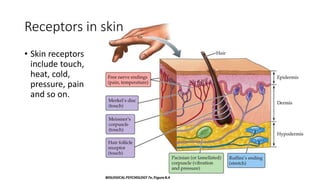
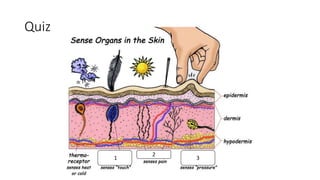
Receptors in skin
• Skin receptors
include touch,
heat, cold,
pressure, pain
and so on.
Quiz
• Skin contains receptors for ____________.
A. touch
B. pressure
C. pain
D. temperature
E. all of the above
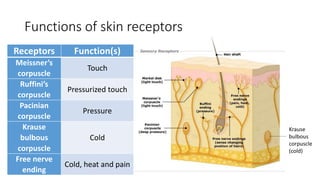
Functions of skin receptors
Receptors Function(s)
Meissner’s
corpuscle
Touch
Ruffini’s
corpuscle
Pressurized touch
Pacinian
corpuscle
Pressure
Krause
bulbous
corpuscle
Cold
Free nerve
ending
Cold, heat and pain
Krause
bulbous
corpuscle
(cold)
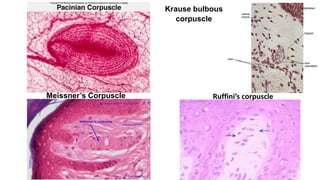
Meissner’s Corpuscle
Krause bulbous
corpuscle
Ruffini’s corpuscle
Quiz
• The sense of fine touch is due to ___________.
A. Pacinian corpuscles
B. Meissner corpuscles
C. end-bulbs of Krause
D. Ruffini end organs
E. all of the above
The sense of fine touch is due to Meissner
corpuscles and Merkel disks. Pacinian corpuscles,
end-bulbs of Krause, and Ruffini end organs are
general pressure receptors.
Quiz
• Pain receptors ______________.
A. are highly specialized nerve endings
B. are free nerve endings
C. have unique neurotransmitters and neuron paths
D. are perceived independently from the brain
E. all of the above are true
Quiz
11
2
3
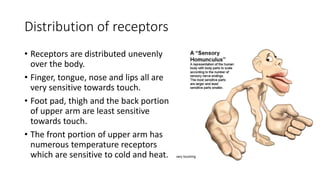
Distribution of receptors
• Receptors are distributed unevenly
over the body.
• Finger, tongue, nose and lips all are
very sensitive towards touch.
• Foot pad, thigh and the back portion
of upper arm are least sensitive
towards touch.
• The front portion of upper arm has
numerous temperature receptors
which are sensitive to cold and heat.
Quiz
• Receptors for a particular sensation, such as touch, are spread evenly
throughout the skin surface.
A. True
B. False
Summary
• Smell is detected by the olfactory receptors in the nasal cavity.
• Taste is detected by the taste receptor cells of the taste buds on the
papillae of the tongue.
• Skin receptors detects touch, pressure, and temperature.
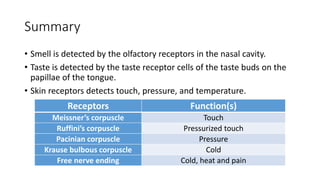
Receptors Function(s)
Meissner’s corpuscle Touch
Ruffini’s corpuscle Pressurized touch
Pacinian corpuscle Pressure
Krause bulbous corpuscle Cold
Free nerve ending Cold, heat and pain

独中高中生物 Chapter 12 Part 3

  • 1.
  • 2.
  • 3.
    Olfactory receptor嗅觉接受器 • Latinolfacere ‘to smell’ • located at the upper nasal mucosa • mainly composed of hairy olfactory cells. • A chemoreception that forms the sense of smell. • Detect of hazards, pheromones, and food
  • 4.
    Quiz • What isthe purpose of the Olfactory System? A. Recognise the things we eat B. Sense of smell perceived by the brain C. Recognise the things we see D. Work out what we are hearing
  • 5.
    Olfactory cells嗅觉细胞 • Ciliatedwith olfactory cilia嗅毛
  • 6.
    Quiz • The senseof smell is dependent on ______ cells. A. optic B. auditory C. olfactory D. proprioceptor E. odiferous There are many different types of olfactory cells and the smell we perceive depends upon the combination of olfactory cells that are stimulated.
  • 7.
    Nasal lining. Colouredscanning electron micrograph (SEM) of the olfactory epithelium that lines the nasal cavity, showing olfactory cells (green) surrounded by numerous cilia (hair-like projection, brown).
  • 8.
    Formation of smell •Vaporized odor molecules enter the nostrils and dissolve in the mucus. • The olfactory cilia is stimulated. • The olfactory cell generate nerve impulse. • The olfactory nerve transmits the nerve impulses into the brain. • Smell (olfaction) is created.
  • 9.
  • 10.
    Taste receptor • Tongueis the taste organ. • Papillae乳头突 (sg. Papilla) are found on the surface on the tongue. • Many taste buds味蕾 (taste receptors) are found on the two lateral sides of papilla. • Taste buds are formed by a group of taste receptor cells. • Also a chemoreceptor. Coloured SEM showing papilla.
  • 11.
    Taste buds Taste budsof circumvallate papillae of the mature cynomolgus (TEM observation)
  • 13.
    Quiz • Taste budsare located primarily on the ______. A. upper palate B. tongue C. gums D. turbinates of the nose E. uvula
  • 14.
    Quiz • Taste budsare pockets of cells that ____________. A. lie flat on the surface of the tongue epithelium B. extend through tongue epithelium and open at a taste pore C. lie along the walls of papillae D. lack microvilli E. all of the above
  • 15.
    Formation of taste •Saliva dissolves chemical substances from the food. • The microvilli of the taste receptor cells in the taste buds are stimulated. • Nerve impulse is produced and transmitted to brain (gustatory cortex味觉皮层) via gustatory nerve.
  • 17.
    Quiz • The _________bear receptor proteins for certain molecules; when molecules bind to these receptor proteins, nerve impulses are generated in associated sensory nerve fibers that are interpreted in the brain as tastes. A. taste buds B. thermoreceptors C. taste pores D. papillae E. taste receptor cells
  • 18.
  • 19.
  • 20.
    Receptors in skin •Skin receptors include touch, heat, cold, pressure, pain and so on.
  • 21.
    Quiz • Skin containsreceptors for ____________. A. touch B. pressure C. pain D. temperature E. all of the above
  • 22.
    Functions of skinreceptors Receptors Function(s) Meissner’s corpuscle Touch Ruffini’s corpuscle Pressurized touch Pacinian corpuscle Pressure Krause bulbous corpuscle Cold Free nerve ending Cold, heat and pain Krause bulbous corpuscle (cold)
  • 23.
  • 24.
    Quiz • The senseof fine touch is due to ___________. A. Pacinian corpuscles B. Meissner corpuscles C. end-bulbs of Krause D. Ruffini end organs E. all of the above The sense of fine touch is due to Meissner corpuscles and Merkel disks. Pacinian corpuscles, end-bulbs of Krause, and Ruffini end organs are general pressure receptors.
  • 25.
    Quiz • Pain receptors______________. A. are highly specialized nerve endings B. are free nerve endings C. have unique neurotransmitters and neuron paths D. are perceived independently from the brain E. all of the above are true
  • 26.
  • 27.
    Distribution of receptors •Receptors are distributed unevenly over the body. • Finger, tongue, nose and lips all are very sensitive towards touch. • Foot pad, thigh and the back portion of upper arm are least sensitive towards touch. • The front portion of upper arm has numerous temperature receptors which are sensitive to cold and heat.
  • 28.
    Quiz • Receptors fora particular sensation, such as touch, are spread evenly throughout the skin surface. A. True B. False
  • 29.
    Summary • Smell isdetected by the olfactory receptors in the nasal cavity. • Taste is detected by the taste receptor cells of the taste buds on the papillae of the tongue. • Skin receptors detects touch, pressure, and temperature. Receptors Function(s) Meissner’s corpuscle Touch Ruffini’s corpuscle Pressurized touch Pacinian corpuscle Pressure Krause bulbous corpuscle Cold Free nerve ending Cold, heat and pain

Editor's Notes

  • #3 http://s2.quickmeme.com/img/46/467ed0104ebb00f65436fc80ddff2c5dd1b3c79c765ae83f3614ce58bf360012.jpg
  • #4 http://odotech.com/wp-content/uploads/2014/11/Odor-perception2.png
  • #6 http://antranik.org/wp-content/uploads/2011/11/smell-olfaction-epithelium-cilia-olfactory-sensory-neurons-and-basal-cells.jpg
  • #8 http://antranik.org/wp-content/uploads/2011/11/smell-olfaction-epithelium-cilia-olfactory-sensory-neurons-and-basal-cells.jpg https://image.slidesharecdn.com/respiration-140721102032-phpapp02/95/respiration-8-638.jpg?cb=1405965890 http://www.sciencephoto.com/media/461344/view
  • #9 The olfactory bulbs has sensory receptors that are actually part of the brain which send messages directly to:The most primitive brain centers where they influence emotions and memories (limbic system structures), and “Higher” centers where they modify conscious thought (neo-cortex). http://www.tsbvi.edu/seehear/summer05/smell.htm https://www.nobelprize.org/nobel_prizes/medicine/laureates/2004/press.html https://www.researchgate.net/profile/Martha_Shenton/publication/46179763/figure/fig2/AS:276972178558976@1443046721057/Projections-of-the-primary-olfactory-cortex-used-with-permission-from-the-Human-Brain.png
  • #10 https://wholefoodlife.files.wordpress.com/2011/05/taste-buds.jpg
  • #11 http://www.vivo.colostate.edu/hbooks/pathphys/digestion/pregastric/tastebuds.gif https://www.the-scientist.com/Sept2016/SensorsTaste2B_640px.jpg
  • #12 http://histonano.com/books/Junqueira's%20Basic%20Histology%20PDF%20WHOLE%20BOOK/New%20folder%2015/loadBinary_013.gif https://image.jimcdn.com/app/cms/image/transf/none/path/sfd4cd9812896ce5d/image/iccb8c1afbd6224e9/version/1487224741/image.jpg
  • #13 https://2e.mindsmachine.com/figures/06/lowres/MM2e-Fig-06-16-0.jpg
  • #16 https://www.frontiersin.org/files/Articles/259865/frym-05-00033-HTML/image_m/figure-2.jpg
  • #17 http://www2.highlands.edu/academics/divisions/scipe/biology/faculty/harnden/2121/images/gustatory.jpg
  • #19 https://media1.britannica.com/eb-media/79/126079-004-DC09312C.gif
  • #20 https://i.imgflip.com/11kg8k.jpg
  • #21 http://slideplayer.com/slide/8377658/26/images/1/Receptors+in+Skin+Skin+has+three+separate+layers:.jpg
  • #23 https://online.science.psu.edu/sites/default/files/bisc004/content/sensory_receptors.jpg
  • #24 http://images.slideplayer.com/28/9369776/slides/slide_8.jpg http://images.slideplayer.com/28/9369776/slides/slide_6.jpg
  • #27 https://incubatorium.files.wordpress.com/2016/05/sensory_organs_in_skin.jpg?w=720
  • #28 https://www.coolgalapagos.com/slider_pictures/Biology/touch.jpg