The Structures of the Solar
System
Chapter 11.1
p 374-380
What is the solar system?
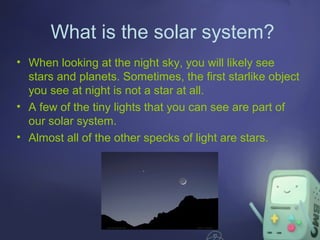
• When looking at the night sky, you will likely see
stars and planets. Sometimes, the first starlike object
you see at night is not a star at all.
• A few of the tiny lights that you can see are part of
our solar system.
• Almost all of the other specks of light are stars.
Objects in the Solar System
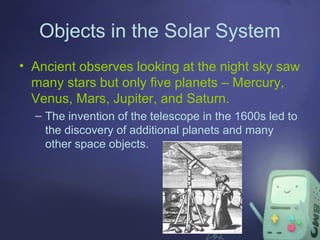
• Ancient observes looking at the night sky saw
many stars but only five planets – Mercury,
Venus, Mars, Jupiter, and Saturn.
– The invention of the telescope in the 1600s led to
the discovery of additional planets and many
other space objects.
The Sun
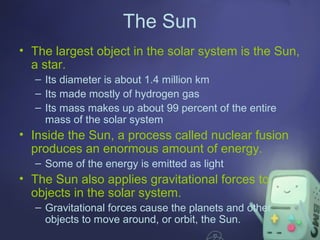
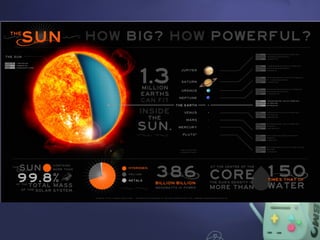
• The largest object in the solar system is the Sun,
a star.
– Its diameter is about 1.4 million km
– Its made mostly of hydrogen gas
– Its mass makes up about 99 percent of the entire
mass of the solar system

• Inside the Sun, a process called nuclear fusion
produces an enormous amount of energy.
– Some of the energy is emitted as light

• The Sun also applies gravitational forces to
objects in the solar system.
– Gravitational forces cause the planets and other
objects to move around, or orbit, the Sun.
Objects That Orbit the Sun
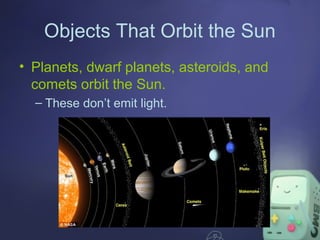
• Planets, dwarf planets, asteroids, and
comets orbit the Sun.
– These don’t emit light.
Planets
• An object is a planet only if it orbits the Sun and
has a nearly spherical shape.
• The mass of a planet must be much larger than
the total mass of all other objects whose orbits
are close by.
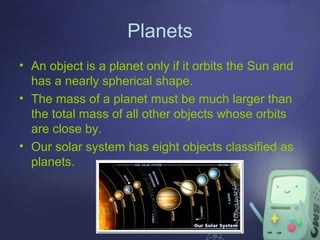
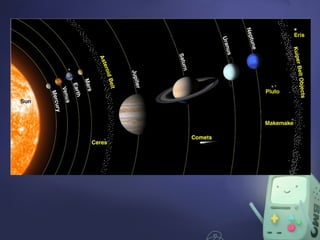
• Our solar system has eight objects classified as
planets.
Inner Planets and Outer Planets
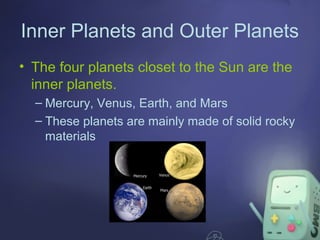
• The four planets closet to the Sun are the
inner planets.
– Mercury, Venus, Earth, and Mars
– These planets are mainly made of solid rocky
materials
Inner Planets and Outer Planets
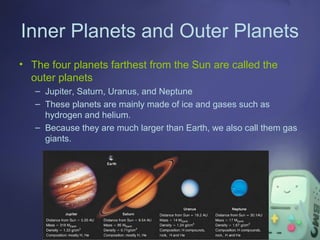
• The four planets farthest from the Sun are called the
outer planets
– Jupiter, Saturn, Uranus, and Neptune
– These planets are mainly made of ice and gases such as
hydrogen and helium.
– Because they are much larger than Earth, we also call them gas
giants.
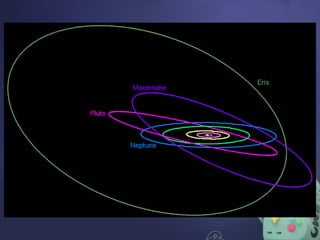
Dwarf Planets
• A dwarf planet is a spherical object that orbits
the Sun.
– It is not a moon of another planet and is in a region of
the solar system where there are many objects
orbiting near it.
– Unlike a planet, a dwarf planet does not have more
mass than objects in nearby orbits
– They are made of rock and ice and are much smaller
than Earth.
– They include Ceres, Eris, Pluto, and MakeMake.
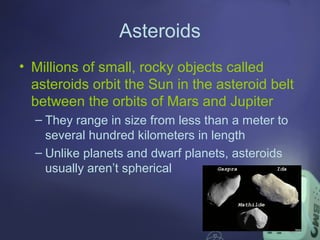
Asteroids
• Millions of small, rocky objects called
asteroids orbit the Sun in the asteroid belt
between the orbits of Mars and Jupiter
– They range in size from less than a meter to
several hundred kilometers in length
– Unlike planets and dwarf planets, asteroids
usually aren’t spherical
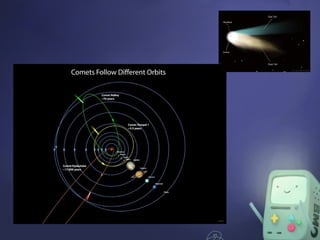
Comets
• A comet is made of gas, dust, and ice and
moves around the Sun in an oval-shaped
orbit.
– Comets come from the outer parts of the solar
system.
– There might be 1 trillion comets orbiting the
Sun.
The Astronomical Unit
• On Earth we use meters or kilometer.
• Objects in the solar system, are so far
apart that astronomers use a larger
distance unit.
• An astronomical unit (AU) is the average
distance from Earth to the Sun – about
150 million km.
The Motion of the Planets
• Revolution and Rotation
– The time it takes an object to travel once
around the Sun is its period of revolution
• Earth’s period of revolution is one year.

– The time it takes an object to complete one
rotation is its period of rotation
• Earth’s period of rotation is one day
The Motion of the Planets
• Planetary Orbits and Speeds
– Unlike a ball swinging on the end of a string, planets do not
move in circles
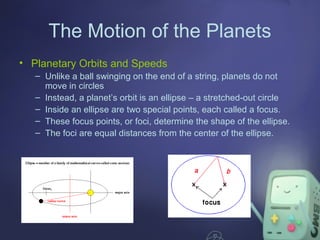
– Instead, a planet’s orbit is an ellipse – a stretched-out circle
– Inside an ellipse are two special points, each called a focus.
– These focus points, or foci, determine the shape of the ellipse.
– The foci are equal distances from the center of the ellipse.
The Motion of the Planets
• Planetary Orbits and Speeds
– A planet’s speed also changes as it orbits the
Sun. The closer the planet is to the Sun, the
faster it moves.
– This also means that planets farther from the
Sun have longer periods of revolution.
– For example, Jupiter is more than 5 times
farther from the Sun than Earth.
• It takes Jupiter 12 times longer than Earth to
revolve around the Sun.

Chapter 11.1: The Structure of the Solar System

  • 1.
    The Structures ofthe Solar System Chapter 11.1 p 374-380
  • 2.
    What is thesolar system? • When looking at the night sky, you will likely see stars and planets. Sometimes, the first starlike object you see at night is not a star at all. • A few of the tiny lights that you can see are part of our solar system. • Almost all of the other specks of light are stars.
  • 3.
    Objects in theSolar System • Ancient observes looking at the night sky saw many stars but only five planets – Mercury, Venus, Mars, Jupiter, and Saturn. – The invention of the telescope in the 1600s led to the discovery of additional planets and many other space objects.
  • 4.
    The Sun • Thelargest object in the solar system is the Sun, a star. – Its diameter is about 1.4 million km – Its made mostly of hydrogen gas – Its mass makes up about 99 percent of the entire mass of the solar system • Inside the Sun, a process called nuclear fusion produces an enormous amount of energy. – Some of the energy is emitted as light • The Sun also applies gravitational forces to objects in the solar system. – Gravitational forces cause the planets and other objects to move around, or orbit, the Sun.
  • 6.
    Objects That Orbitthe Sun • Planets, dwarf planets, asteroids, and comets orbit the Sun. – These don’t emit light.
  • 7.
    Planets • An objectis a planet only if it orbits the Sun and has a nearly spherical shape. • The mass of a planet must be much larger than the total mass of all other objects whose orbits are close by. • Our solar system has eight objects classified as planets.
  • 8.
    Inner Planets andOuter Planets • The four planets closet to the Sun are the inner planets. – Mercury, Venus, Earth, and Mars – These planets are mainly made of solid rocky materials
  • 9.
    Inner Planets andOuter Planets • The four planets farthest from the Sun are called the outer planets – Jupiter, Saturn, Uranus, and Neptune – These planets are mainly made of ice and gases such as hydrogen and helium. – Because they are much larger than Earth, we also call them gas giants.
  • 10.
    Dwarf Planets • Adwarf planet is a spherical object that orbits the Sun. – It is not a moon of another planet and is in a region of the solar system where there are many objects orbiting near it. – Unlike a planet, a dwarf planet does not have more mass than objects in nearby orbits – They are made of rock and ice and are much smaller than Earth. – They include Ceres, Eris, Pluto, and MakeMake.
  • 13.
    Asteroids • Millions ofsmall, rocky objects called asteroids orbit the Sun in the asteroid belt between the orbits of Mars and Jupiter – They range in size from less than a meter to several hundred kilometers in length – Unlike planets and dwarf planets, asteroids usually aren’t spherical
  • 14.
    Comets • A cometis made of gas, dust, and ice and moves around the Sun in an oval-shaped orbit. – Comets come from the outer parts of the solar system. – There might be 1 trillion comets orbiting the Sun.
  • 16.
    The Astronomical Unit •On Earth we use meters or kilometer. • Objects in the solar system, are so far apart that astronomers use a larger distance unit. • An astronomical unit (AU) is the average distance from Earth to the Sun – about 150 million km.
  • 17.
    The Motion ofthe Planets • Revolution and Rotation – The time it takes an object to travel once around the Sun is its period of revolution • Earth’s period of revolution is one year. – The time it takes an object to complete one rotation is its period of rotation • Earth’s period of rotation is one day
  • 18.
    The Motion ofthe Planets • Planetary Orbits and Speeds – Unlike a ball swinging on the end of a string, planets do not move in circles – Instead, a planet’s orbit is an ellipse – a stretched-out circle – Inside an ellipse are two special points, each called a focus. – These focus points, or foci, determine the shape of the ellipse. – The foci are equal distances from the center of the ellipse.
  • 19.
    The Motion ofthe Planets • Planetary Orbits and Speeds – A planet’s speed also changes as it orbits the Sun. The closer the planet is to the Sun, the faster it moves. – This also means that planets farther from the Sun have longer periods of revolution. – For example, Jupiter is more than 5 times farther from the Sun than Earth. • It takes Jupiter 12 times longer than Earth to revolve around the Sun.