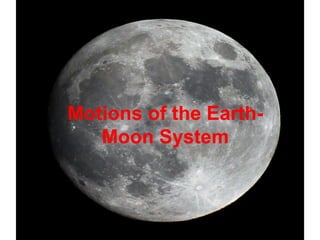
Motions of the Earth- Moon System
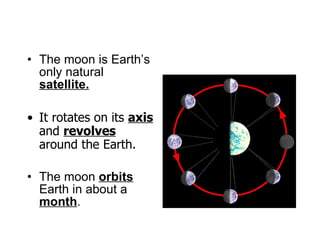
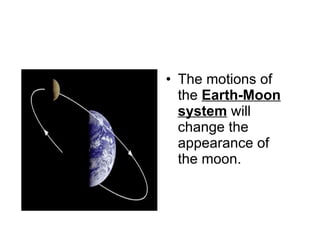
The moon is Earth’s only natural  satellite. It rotates on its  axis  and  revolves  around the Earth. The moon  orbits  Earth in about a  month .
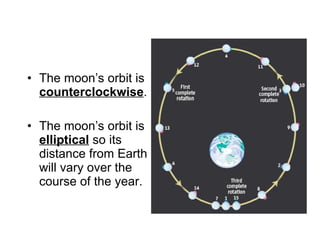
The moon’s orbit is  counterclockwise . The moon’s orbit is  elliptical  so its distance from Earth will vary over the course of the year.
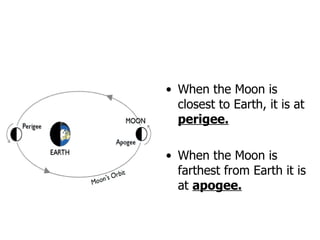
When the Moon is closest to Earth, it is at  perigee.   When the Moon is farthest from Earth it is at  apogee.
The motions of the  Earth-Moon system  will change the appearance of the moon.
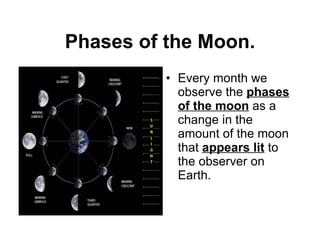
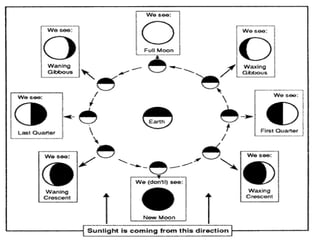
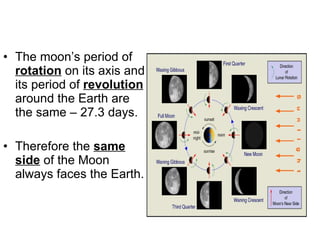
Phases of the Moon. Every month we observe the  phases of the moon  as a change in the amount of the moon that  appears lit  to the observer on Earth.
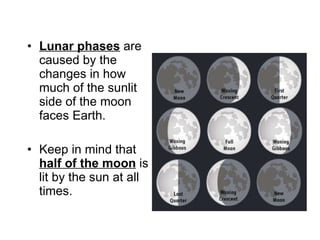
Lunar phases  are caused by the changes in how much of the sunlit side of the moon faces Earth. Keep in mind that  half of the moon  is lit by the sun at all times.
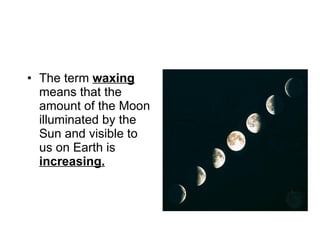
The term  waxing  means that the amount of the Moon illuminated by the Sun and visible to us on Earth is  increasing.
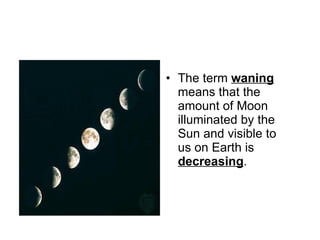
The term  waning  means that the amount of Moon illuminated by the Sun and visible to us on Earth is  decreasing .
To an observer on Earth, the amount of the moon visible depends on  where the moon is in its orbit of the Earth.
 
For example, when the moon lies  between  the sun and Earth, none of its bright side faces the Earth.
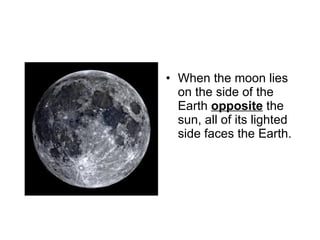
When the moon lies on the side of the Earth  opposite  the sun, all of its lighted side faces the Earth.
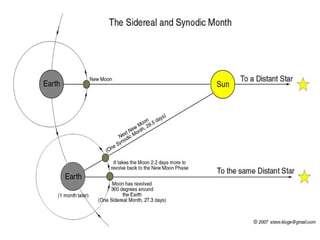
Lunar Motions Synodic Month  –  apparent   period of time it takes the moon to revolve around the Earth and cycle through its phases; about 29.5 days. Basis for the Roman calendar. The moon is back to the same starting position (New Moon) relative to the  Earth and the Sun.
Sidereal Month  – the 27.3 days it  really  takes the moon to revolve around the Earth relative to a distant star. Moon is back at its starting point relative to the Earth and a  distant star .   It will  not be  in the New Moon phase.
 
The moon’s period of  rotation  on its axis and its period of  revolution  around the Earth are the same – 27.3 days. Therefore the  same side  of the Moon always faces the Earth.
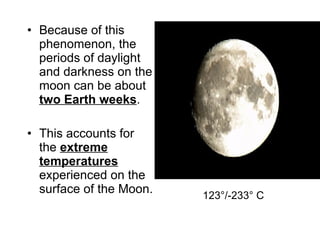
Because of this phenomenon, the periods of daylight and darkness on the moon can be about  two Earth weeks . This accounts for the  extreme temperatures  experienced on the surface of the Moon. 123°/-233° C
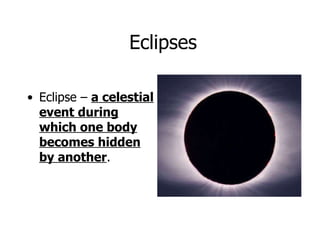
Eclipses Eclipse –  a celestial event during which one body becomes hidden by another .
The early  Greeks  were the first observers we know of to determine that eclipses are  shadow effects  of the moon or the earth.
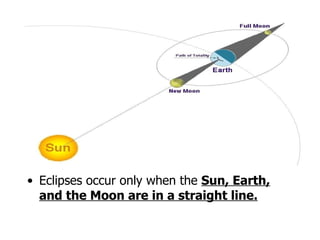
Eclipses occur only when the  Sun, Earth, and the Moon are in a straight line.
An eclipse of the sun or moon would occur during every  new moon or full moon phase  if the orbit of the Earth and the moon were on the  same plane  and caused both  celestial objects  to line up.
 
Since the moon’s plane of orbit is slightly inclined relative to earth’s plan of orbit, the  shadow of the moon  usually misses earth.
 
During a new moon or full moon phase, the moon’s orbit must  cross the plane of Earth’s orbit  for an eclipse to occur. Since these conditions only occur  twice a year , the usual number of eclipses is  four . The eclipses usually occur as a set of  one solar and one lunar  eclipse followed by another set six months later.
Solar Eclipse
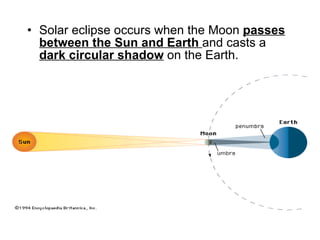
Solar eclipse occurs when the Moon  passes between the Sun and Earth  and casts a  dark circular shadow  on the Earth.
This can only occur during  new moon  phases.
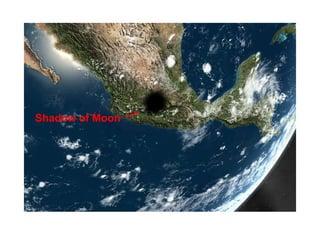
Solar eclipses can be  total or partial , depending on where you are on Earth’s surface. The part of Earth within that shadow experiences  a solar eclipse.
Shadow of Moon
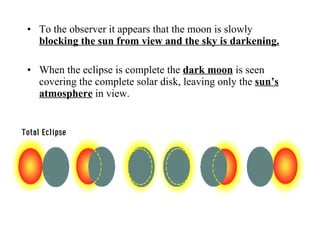
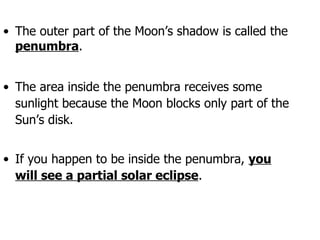
To the observer it appears that the moon is slowly  blocking the sun from view and the sky is darkening. When the eclipse is complete the  dark moon  is seen covering the complete solar disk, leaving only the  sun’s atmosphere  in view.
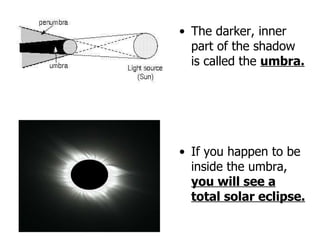
The darker, inner part of the shadow is called the  umbra. If you happen to be inside the umbra,  you will see a total solar eclipse.
 
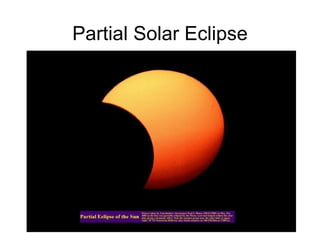
The outer part of the Moon’s shadow is called the  penumbra . The area inside the penumbra receives some sunlight because the Moon blocks only part of the Sun’s disk. If you happen to be inside the penumbra,  you will see a partial solar eclipse .
Partial Solar Eclipse
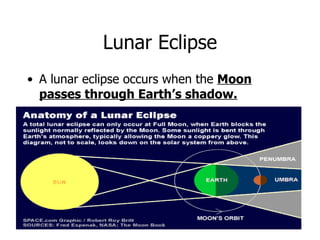
Lunar Eclipse A lunar eclipse occurs when the  Moon passes through Earth’s shadow.
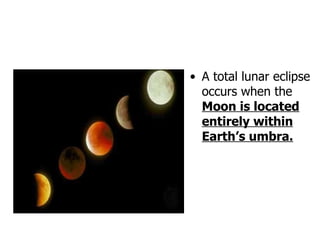
A total lunar eclipse occurs when the  Moon is located entirely within Earth’s umbra.
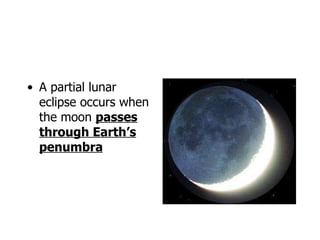
A partial lunar eclipse occurs when the moon  passes through Earth’s penumbra
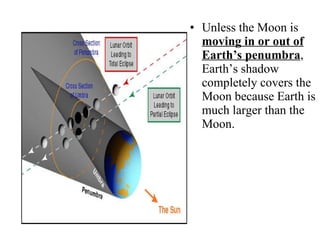
Unless the Moon is  moving in or out of Earth’s penumbra , Earth’s shadow completely covers the Moon because Earth is much larger than the Moon.
Lunar eclipses occur only  during a full moon , when the Sun, Moon, and Earth are  lined up . Everyone on the  night side of earth  would be able to see a total lunar eclipse.

 
During a lunar eclipse  Earth’s circular shadow  can be seen moving slowly across the disk of the full moon.
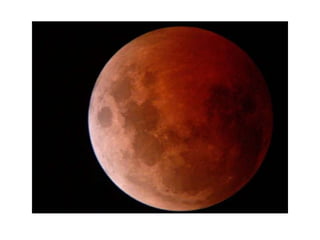
When totally eclipsed the moon is  in shadow  and appears to be a coppery color. Usually lasts for four hours and is visible to anyone on the side of earth  facing the moon at that time.
 

Moon Motions and Eclipses

  • 1.
    Motions of theEarth- Moon System
  • 2.
    The moon isEarth’s only natural satellite. It rotates on its axis and revolves around the Earth. The moon orbits Earth in about a month .
  • 3.
    The moon’s orbitis counterclockwise . The moon’s orbit is elliptical so its distance from Earth will vary over the course of the year.
  • 4.
    When the Moonis closest to Earth, it is at perigee. When the Moon is farthest from Earth it is at apogee.
  • 5.
    The motions ofthe Earth-Moon system will change the appearance of the moon.
  • 6.
    Phases of theMoon. Every month we observe the phases of the moon as a change in the amount of the moon that appears lit to the observer on Earth.
  • 7.
    Lunar phases are caused by the changes in how much of the sunlit side of the moon faces Earth. Keep in mind that half of the moon is lit by the sun at all times.
  • 8.
    The term waxing means that the amount of the Moon illuminated by the Sun and visible to us on Earth is increasing.
  • 9.
    The term waning means that the amount of Moon illuminated by the Sun and visible to us on Earth is decreasing .
  • 10.
    To an observeron Earth, the amount of the moon visible depends on where the moon is in its orbit of the Earth.
  • 11.
  • 12.
    For example, whenthe moon lies between the sun and Earth, none of its bright side faces the Earth.
  • 13.
    When the moonlies on the side of the Earth opposite the sun, all of its lighted side faces the Earth.
  • 14.
    Lunar Motions SynodicMonth – apparent period of time it takes the moon to revolve around the Earth and cycle through its phases; about 29.5 days. Basis for the Roman calendar. The moon is back to the same starting position (New Moon) relative to the Earth and the Sun.
  • 15.
    Sidereal Month – the 27.3 days it really takes the moon to revolve around the Earth relative to a distant star. Moon is back at its starting point relative to the Earth and a distant star .   It will not be in the New Moon phase.
  • 16.
  • 17.
    The moon’s periodof rotation on its axis and its period of revolution around the Earth are the same – 27.3 days. Therefore the same side of the Moon always faces the Earth.
  • 18.
    Because of thisphenomenon, the periods of daylight and darkness on the moon can be about two Earth weeks . This accounts for the extreme temperatures experienced on the surface of the Moon. 123°/-233° C
  • 19.
    Eclipses Eclipse – a celestial event during which one body becomes hidden by another .
  • 20.
    The early Greeks were the first observers we know of to determine that eclipses are shadow effects of the moon or the earth.
  • 21.
    Eclipses occur onlywhen the Sun, Earth, and the Moon are in a straight line.
  • 22.
    An eclipse ofthe sun or moon would occur during every new moon or full moon phase if the orbit of the Earth and the moon were on the same plane and caused both celestial objects to line up.
  • 23.
  • 24.
    Since the moon’splane of orbit is slightly inclined relative to earth’s plan of orbit, the shadow of the moon usually misses earth.
  • 25.
  • 26.
    During a newmoon or full moon phase, the moon’s orbit must cross the plane of Earth’s orbit for an eclipse to occur. Since these conditions only occur twice a year , the usual number of eclipses is four . The eclipses usually occur as a set of one solar and one lunar eclipse followed by another set six months later.
  • 27.
  • 28.
    Solar eclipse occurswhen the Moon passes between the Sun and Earth and casts a dark circular shadow on the Earth.
  • 29.
    This can onlyoccur during new moon phases.
  • 30.
    Solar eclipses canbe total or partial , depending on where you are on Earth’s surface. The part of Earth within that shadow experiences a solar eclipse.
  • 31.
  • 32.
    To the observerit appears that the moon is slowly blocking the sun from view and the sky is darkening. When the eclipse is complete the dark moon is seen covering the complete solar disk, leaving only the sun’s atmosphere in view.
  • 33.
    The darker, innerpart of the shadow is called the umbra. If you happen to be inside the umbra, you will see a total solar eclipse.
  • 34.
  • 35.
    The outer partof the Moon’s shadow is called the penumbra . The area inside the penumbra receives some sunlight because the Moon blocks only part of the Sun’s disk. If you happen to be inside the penumbra, you will see a partial solar eclipse .
  • 36.
  • 37.
    Lunar Eclipse Alunar eclipse occurs when the Moon passes through Earth’s shadow.
  • 38.
    A total lunareclipse occurs when the Moon is located entirely within Earth’s umbra.
  • 39.
    A partial lunareclipse occurs when the moon passes through Earth’s penumbra
  • 40.
    Unless the Moonis moving in or out of Earth’s penumbra , Earth’s shadow completely covers the Moon because Earth is much larger than the Moon.
  • 41.
    Lunar eclipses occuronly during a full moon , when the Sun, Moon, and Earth are lined up . Everyone on the night side of earth would be able to see a total lunar eclipse.
  • 42.
  • 43.
    During a lunareclipse Earth’s circular shadow can be seen moving slowly across the disk of the full moon.
  • 44.
    When totally eclipsedthe moon is in shadow and appears to be a coppery color. Usually lasts for four hours and is visible to anyone on the side of earth facing the moon at that time.
  • 45.