Max Bureck, 08. June 2016
XTEND – API AND DSL DESIGN PATTERNS
2
XTEND – API AND DSL DESIGN PATTERNS
Intro – Xtend
 Xtend is a general purpose programming language transpiling to Java source
 Its syntax is flexible allowing definition of internal DSLs and interesting APIs
 This presentation will show some ways how the syntax can be utilized
 No detailed explanation of Xtend‘s features though
© Fraunhofer FOKUS
©MatthiasHeyde/FraunhoferFOKUS©MatthiasHeyde/FraunhoferFOKUS
3
XTEND – API AND DSL DESIGN PATTERNS
Intro – Patterns
 Based on some observations from designing Xtend APIs
 Some ideas inspired by other languages (e.g. Scala, F#)
 Some patterns may or should be implemented via active annotations in future
© Fraunhofer FOKUS
©MatthiasHeyde/FraunhoferFOKUS©MatthiasHeyde/FraunhoferFOKUS
4
XTEND – API AND DSL DESIGN PATTERNS
Intro – The Tools Provided By Xtend
 Lambdas
 Call with lambda as last parameter: place after brackets; omit empty brackets
strProv.apply([String s | println(s)]) ⇨ strProv.apply [println(it)]
 Setter call can be written as assignment
button.setText("Press Me") ⇨ button.text = "Press Me"
 Extension methods
emphasize("boo") ⇨ "boo".emphasize
 Operator overloading
operator_plus(1e15bd, 1e-4bd) ⇨ 1e15bd + 1e-4bd
 Active annotations
© Fraunhofer FOKUS
©MatthiasHeyde/FraunhoferFOKUS©MatthiasHeyde/FraunhoferFOKUS
5
XTEND – API AND DSL DESIGN PATTERNS
Pattern Overview
 Nested Block Syntax
 Fluent Case Distinction
 Immutable Data Structure Patterns
 Implicit Parameter Values
 Type Providers
 API Xtendification
© Fraunhofer FOKUS
6
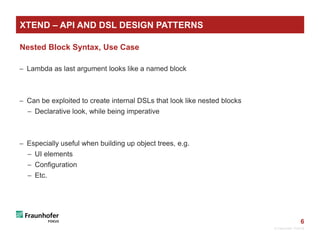
Nested Block Syntax, Use Case
 Lambda as last argument looks like a named block
 Can be exploited to create internal DSLs that look like nested blocks
 Declarative look, while being imperative
 Especially useful when building up object trees, e.g.
 UI elements
 Configuration
 Etc.
© Fraunhofer FOKUS
XTEND – API AND DSL DESIGN PATTERNS
7
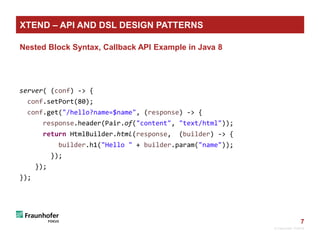
Nested Block Syntax, Callback API Example in Java 8
server( (conf) -> {
conf.setPort(80);
conf.get("/hello?name=$name", (response) -> {
response.header(Pair.of("content", "text/html"));
return HtmlBuilder.html(response, (builder) -> {
builder.h1("Hello " + builder.param("name"));
});
});
});
© Fraunhofer FOKUS
XTEND – API AND DSL DESIGN PATTERNS
8
Nested Block Syntax, Callback API Example
server [
port = 80
get("/hello?name=$name") [
header("Content-Type" -> "text/html")
html [
h1("Hello " + param('name'))
]
]
]
© Fraunhofer FOKUS
XTEND – API AND DSL DESIGN PATTERNS
Assignment to setter on default argument
default argument it
Implicit return of last expression result
Extension method
Method with lambda argument
Mapping operator
9
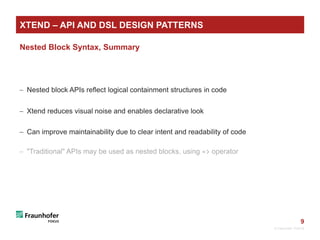
Nested Block Syntax, Summary
 Nested block APIs reflect logical containment structures in code
 Xtend reduces visual noise and enables declarative look
 Can improve maintainability due to clear intent and readability of code
 "Traditional" APIs may be used as nested blocks, using => operator
© Fraunhofer FOKUS
XTEND – API AND DSL DESIGN PATTERNS
10
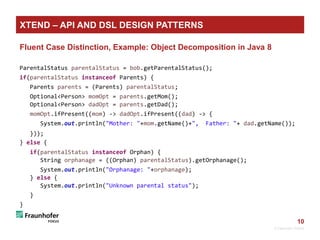
Fluent Case Distinction, Example: Object Decomposition in Java 8
ParentalStatus parentalStatus = bob.getParentalStatus();
if(parentalStatus instanceof Parents) {
Parents parents = (Parents) parentalStatus;
Optional<Person> momOpt = parents.getMom();
Optional<Person> dadOpt = parents.getDad();
momOpt.ifPresent((mom) -> dadOpt.ifPresent((dad) -> {
System.out.println("Mother: "+mom.getName()+", Father: "+ dad.getName());
}));
} else {
if(parentalStatus instanceof Orphan) {
String orphanage = ((Orphan) parentalStatus).getOrphanage();
System.out.println("Orphanage: "+orphanage);
} else {
System.out.println("Unknown parental status");
}
}
© Fraunhofer FOKUS
XTEND – API AND DSL DESIGN PATTERNS
11
Signal /
© Fraunhofer FOKUS
XTEND – API AND DSL DESIGN PATTERNS
12
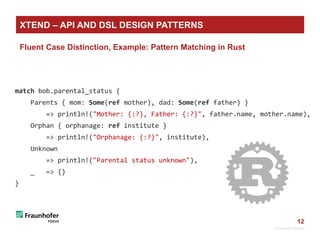
Fluent Case Distinction, Example: Pattern Matching in Rust
match bob.parental_status {
Parents { mom: Some(ref mother), dad: Some(ref father) }
=> println!("Mother: {:?}, Father: {:?}", father.name, mother.name),
Orphan { orphanage: ref institute }
=> println!("Orphanage: {:?}", institute),
Unknown
=> println!("Parental status unknown"),
_ => {}
}
© Fraunhofer FOKUS
XTEND – API AND DSL DESIGN PATTERNS
15
Fluent Case Distinction, Example
val daredevil = Person::orphan("Matt Murdock", "St Agnes Orphanage")
daredevil.parentalStatus
.caseParents [ mom, dad |
println('''Mother: «mom.name», Father: «dad.name»''')
].caseOrphan [ orphanage |
println("Orphanage: " + orphanage)
].caseUnknown [
println("Unknown parental status")
]
© Fraunhofer FOKUS
XTEND – API AND DSL DESIGN PATTERNS
👿
16
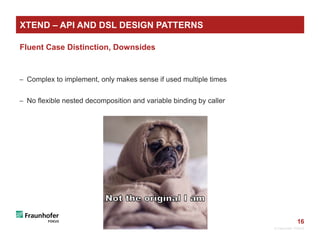
Fluent Case Distinction, Downsides
 Complex to implement, only makes sense if used multiple times
 No flexible nested decomposition and variable binding by caller
© Fraunhofer FOKUS
XTEND – API AND DSL DESIGN PATTERNS
17
Fluent Case Distinction, Summary / Use Cases
 Most times the powerful switch statement or multiple dispatch is good enough
 Still, this pattern can be useful for several use cases:
 Short notation for reoccurring, non trivial object decomposition
 Null-safe data access
 Can enforce exhaustive case handling or at least default case
 Alternative to inheritance hierarchies: No looking for all possible subclasses
© Fraunhofer FOKUS
XTEND – API AND DSL DESIGN PATTERNS
19
Immutable Data Structure Patterns – Intro
 Immutable objects are easier to reason about
 No unexpected changes when passed to methods
 Can safely be shared between threads
 Interestingly better for Java GC (according to Brian Goetz)
© Fraunhofer FOKUS
XTEND – API AND DSL DESIGN PATTERNS
20
Immutable Data Structure Patterns
 Immutable objects are tricky in some cases
 Especially demanding are:
 Object manipulation and
 Circular references
© Fraunhofer FOKUS
XTEND – API AND DSL DESIGN PATTERNS
What??? You said immutable!
Bear with me, explanation in
3 slides
21
Immutable Data Structure Patterns: Object Instantiation
 Initialization using mutable builder objects
 Especially nice: Lambda builder pattern
 Example:
val p = ImmutablePerson.create [
firstName = "Mack"
lastName = "The Knife"
]
© Fraunhofer FOKUS
XTEND – API AND DSL DESIGN PATTERNS
🔨
23
Immutable Data Structure Patterns: Object Manipulation
 So called “persistent data structures“
 For simple structures: Fields may have ”update” method
 Takes lambda parameter mapping old field value to new value
 Returns new immutable updated object
© Fraunhofer FOKUS
XTEND – API AND DSL DESIGN PATTERNS
24
Immutable Object Patterns: Object Manipulation Example
class ImmutablePerson {
// ...
def ImmutablePerson firstName((String)=>String mapper) {
val newFirstName = mapper.apply(firstName)
new ImmutablePerson(newFirstName, lastName)
}
}
var p = ImmutablePerson.create […]
p = p.firstName["max"]
p = p.firstName[toFirstUpper]
© Fraunhofer FOKUS
XTEND – API AND DSL DESIGN PATTERNS
25
Immutable Data Structure Patterns: Object Manipulation - Problem
 Cyclic references will come back to bite you on manipulation!
 Especially when automatically generating manipulators
© Fraunhofer FOKUS
XTEND – API AND DSL DESIGN PATTERNS
26
Immutable Data Structure Patterns: Object Manipulation - Alternative
Manipulation by builder
 Create pre-filled builder from existing object
 Add some sugar for ease of use, similar to lambda builder
© Fraunhofer FOKUS
XTEND – API AND DSL DESIGN PATTERNS
27
Immutable Data Structure Patterns: Manipulation By Builder Example
var homer = ImmutablePerson.create [
firstName = "Homer"
lastName = "Simpson"
town = "Springfield"
]
homer = homer.with [
firstName = "Max"
lastName = "Power"
]
© Fraunhofer FOKUS
XTEND – API AND DSL DESIGN PATTERNS
29
API Xtendification – Intro
 Java APIs are not written with Xtend in mind
 Some language features of Xtend only shine when API is shaped in a certain way
 Extension methods to the rescue!
© Fraunhofer FOKUS
XTEND – API AND DSL DESIGN PATTERNS
30
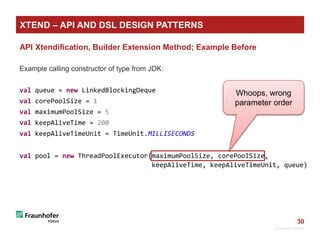
API Xtendification, Builder Extension Method; Example Before
Example calling constructor of type from JDK:
val queue = new LinkedBlockingDeque
val corePoolSize = 1
val maximumPoolSize = 5
val keepAliveTime = 200
val keepAliveTimeUnit = TimeUnit.MILLISECONDS
val pool = new ThreadPoolExecutor(maximumPoolSize, corePoolSize,
keepAliveTime, keepAliveTimeUnit, queue)
© Fraunhofer FOKUS
XTEND – API AND DSL DESIGN PATTERNS
Whoops, wrong
parameter order
32
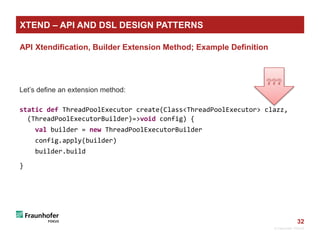
API Xtendification, Builder Extension Method; Example Definition
Let’s define an extension method:
static def ThreadPoolExecutor create(Class<ThreadPoolExecutor> clazz,
(ThreadPoolExecutorBuilder)=>void config) {
val builder = new ThreadPoolExecutorBuilder
config.apply(builder)
builder.build
}
© Fraunhofer FOKUS
XTEND – API AND DSL DESIGN PATTERNS
33
API Xtendification, Builder Extension Method; Example Usage
Example using extension method
val pool = ThreadPoolExecutor.create [
corePoolSize = 1
maximumPoolSize = 5
keepAliveTime = 200
keepAliveTimeUnit = TimeUnit.MILLISECONDS
workQueue = new LinkedBlockingDeque
]
© Fraunhofer FOKUS
XTEND – API AND DSL DESIGN PATTERNS
🔨
35
Further Xtend Patterns
10 Java Idioms Stomped with Xtend
https://www.youtube.com/watch?v=n7LUgXX_3cE
© Fraunhofer FOKUS
XTEND – API AND DSL DESIGN PATTERNS
36
Summary
 Xtend language is pretty flexible, due to its syntax features
 Declarative looking internal DSLs are possible
 Enables new types of API patterns
 Patterns can be used to make Java APIs friendlier to use in Xtend
 Some patterns can be automated with Active Annotations
© Fraunhofer FOKUS
XTEND – API AND DSL DESIGN PATTERNS
37
© Fraunhofer FOKUS
38
Feedback and Opinions?
 Examples repository:
https://github.com/Boereck/eclipsecon_france_2016-xtend_patterns
 Useful?
 Interesting?
 Impractical?
 Too obvious?
 What are your favorite patterns?
© Fraunhofer FOKUS
XTEND – API AND DSL DESIGN PATTERNS
39
Image Sources
 Max Power:
http://25.media.tumblr.com/tumblr_lxxowbwXTs1qhkm9yo1_400.gif
 Joda Pug:
https://unsplash.com/photos/2Ts5HnA67k8
© Fraunhofer FOKUS
XTEND – API AND DSL DESIGN PATTERNS
41
© Fraunhofer FOKUS
Fraunhofer FOKUS
Kaiserin-Augusta-Allee 31
10589 Berlin, Germany
www.fokus.fraunhofer.de
Max Bureck
Senior Researcher
max.bureck@fokus.fraunhofer.de
Phone +49 (0)30 3463-7321
CONTACT

Xtend api and_dsl_design_patterns_eclipse_confrance2016

  • 1.
    Max Bureck, 08.June 2016 XTEND – API AND DSL DESIGN PATTERNS
  • 2.
    2 XTEND – APIAND DSL DESIGN PATTERNS Intro – Xtend  Xtend is a general purpose programming language transpiling to Java source  Its syntax is flexible allowing definition of internal DSLs and interesting APIs  This presentation will show some ways how the syntax can be utilized  No detailed explanation of Xtend‘s features though © Fraunhofer FOKUS ©MatthiasHeyde/FraunhoferFOKUS©MatthiasHeyde/FraunhoferFOKUS
  • 3.
    3 XTEND – APIAND DSL DESIGN PATTERNS Intro – Patterns  Based on some observations from designing Xtend APIs  Some ideas inspired by other languages (e.g. Scala, F#)  Some patterns may or should be implemented via active annotations in future © Fraunhofer FOKUS ©MatthiasHeyde/FraunhoferFOKUS©MatthiasHeyde/FraunhoferFOKUS
  • 4.
    4 XTEND – APIAND DSL DESIGN PATTERNS Intro – The Tools Provided By Xtend  Lambdas  Call with lambda as last parameter: place after brackets; omit empty brackets strProv.apply([String s | println(s)]) ⇨ strProv.apply [println(it)]  Setter call can be written as assignment button.setText("Press Me") ⇨ button.text = "Press Me"  Extension methods emphasize("boo") ⇨ "boo".emphasize  Operator overloading operator_plus(1e15bd, 1e-4bd) ⇨ 1e15bd + 1e-4bd  Active annotations © Fraunhofer FOKUS ©MatthiasHeyde/FraunhoferFOKUS©MatthiasHeyde/FraunhoferFOKUS
  • 5.
    5 XTEND – APIAND DSL DESIGN PATTERNS Pattern Overview  Nested Block Syntax  Fluent Case Distinction  Immutable Data Structure Patterns  Implicit Parameter Values  Type Providers  API Xtendification © Fraunhofer FOKUS
  • 6.
    6 Nested Block Syntax,Use Case  Lambda as last argument looks like a named block  Can be exploited to create internal DSLs that look like nested blocks  Declarative look, while being imperative  Especially useful when building up object trees, e.g.  UI elements  Configuration  Etc. © Fraunhofer FOKUS XTEND – API AND DSL DESIGN PATTERNS
  • 7.
    7 Nested Block Syntax,Callback API Example in Java 8 server( (conf) -> { conf.setPort(80); conf.get("/hello?name=$name", (response) -> { response.header(Pair.of("content", "text/html")); return HtmlBuilder.html(response, (builder) -> { builder.h1("Hello " + builder.param("name")); }); }); }); © Fraunhofer FOKUS XTEND – API AND DSL DESIGN PATTERNS
  • 8.
    8 Nested Block Syntax,Callback API Example server [ port = 80 get("/hello?name=$name") [ header("Content-Type" -> "text/html") html [ h1("Hello " + param('name')) ] ] ] © Fraunhofer FOKUS XTEND – API AND DSL DESIGN PATTERNS Assignment to setter on default argument default argument it Implicit return of last expression result Extension method Method with lambda argument Mapping operator
  • 9.
    9 Nested Block Syntax,Summary  Nested block APIs reflect logical containment structures in code  Xtend reduces visual noise and enables declarative look  Can improve maintainability due to clear intent and readability of code  "Traditional" APIs may be used as nested blocks, using => operator © Fraunhofer FOKUS XTEND – API AND DSL DESIGN PATTERNS
  • 10.
    10 Fluent Case Distinction,Example: Object Decomposition in Java 8 ParentalStatus parentalStatus = bob.getParentalStatus(); if(parentalStatus instanceof Parents) { Parents parents = (Parents) parentalStatus; Optional<Person> momOpt = parents.getMom(); Optional<Person> dadOpt = parents.getDad(); momOpt.ifPresent((mom) -> dadOpt.ifPresent((dad) -> { System.out.println("Mother: "+mom.getName()+", Father: "+ dad.getName()); })); } else { if(parentalStatus instanceof Orphan) { String orphanage = ((Orphan) parentalStatus).getOrphanage(); System.out.println("Orphanage: "+orphanage); } else { System.out.println("Unknown parental status"); } } © Fraunhofer FOKUS XTEND – API AND DSL DESIGN PATTERNS
  • 11.
    11 Signal / © FraunhoferFOKUS XTEND – API AND DSL DESIGN PATTERNS
  • 12.
    12 Fluent Case Distinction,Example: Pattern Matching in Rust match bob.parental_status { Parents { mom: Some(ref mother), dad: Some(ref father) } => println!("Mother: {:?}, Father: {:?}", father.name, mother.name), Orphan { orphanage: ref institute } => println!("Orphanage: {:?}", institute), Unknown => println!("Parental status unknown"), _ => {} } © Fraunhofer FOKUS XTEND – API AND DSL DESIGN PATTERNS
  • 13.
    15 Fluent Case Distinction,Example val daredevil = Person::orphan("Matt Murdock", "St Agnes Orphanage") daredevil.parentalStatus .caseParents [ mom, dad | println('''Mother: «mom.name», Father: «dad.name»''') ].caseOrphan [ orphanage | println("Orphanage: " + orphanage) ].caseUnknown [ println("Unknown parental status") ] © Fraunhofer FOKUS XTEND – API AND DSL DESIGN PATTERNS 👿
  • 14.
    16 Fluent Case Distinction,Downsides  Complex to implement, only makes sense if used multiple times  No flexible nested decomposition and variable binding by caller © Fraunhofer FOKUS XTEND – API AND DSL DESIGN PATTERNS
  • 15.
    17 Fluent Case Distinction,Summary / Use Cases  Most times the powerful switch statement or multiple dispatch is good enough  Still, this pattern can be useful for several use cases:  Short notation for reoccurring, non trivial object decomposition  Null-safe data access  Can enforce exhaustive case handling or at least default case  Alternative to inheritance hierarchies: No looking for all possible subclasses © Fraunhofer FOKUS XTEND – API AND DSL DESIGN PATTERNS
  • 16.
    19 Immutable Data StructurePatterns – Intro  Immutable objects are easier to reason about  No unexpected changes when passed to methods  Can safely be shared between threads  Interestingly better for Java GC (according to Brian Goetz) © Fraunhofer FOKUS XTEND – API AND DSL DESIGN PATTERNS
  • 17.
    20 Immutable Data StructurePatterns  Immutable objects are tricky in some cases  Especially demanding are:  Object manipulation and  Circular references © Fraunhofer FOKUS XTEND – API AND DSL DESIGN PATTERNS What??? You said immutable! Bear with me, explanation in 3 slides
  • 18.
    21 Immutable Data StructurePatterns: Object Instantiation  Initialization using mutable builder objects  Especially nice: Lambda builder pattern  Example: val p = ImmutablePerson.create [ firstName = "Mack" lastName = "The Knife" ] © Fraunhofer FOKUS XTEND – API AND DSL DESIGN PATTERNS 🔨
  • 19.
    23 Immutable Data StructurePatterns: Object Manipulation  So called “persistent data structures“  For simple structures: Fields may have ”update” method  Takes lambda parameter mapping old field value to new value  Returns new immutable updated object © Fraunhofer FOKUS XTEND – API AND DSL DESIGN PATTERNS
  • 20.
    24 Immutable Object Patterns:Object Manipulation Example class ImmutablePerson { // ... def ImmutablePerson firstName((String)=>String mapper) { val newFirstName = mapper.apply(firstName) new ImmutablePerson(newFirstName, lastName) } } var p = ImmutablePerson.create […] p = p.firstName["max"] p = p.firstName[toFirstUpper] © Fraunhofer FOKUS XTEND – API AND DSL DESIGN PATTERNS
  • 21.
    25 Immutable Data StructurePatterns: Object Manipulation - Problem  Cyclic references will come back to bite you on manipulation!  Especially when automatically generating manipulators © Fraunhofer FOKUS XTEND – API AND DSL DESIGN PATTERNS
  • 22.
    26 Immutable Data StructurePatterns: Object Manipulation - Alternative Manipulation by builder  Create pre-filled builder from existing object  Add some sugar for ease of use, similar to lambda builder © Fraunhofer FOKUS XTEND – API AND DSL DESIGN PATTERNS
  • 23.
    27 Immutable Data StructurePatterns: Manipulation By Builder Example var homer = ImmutablePerson.create [ firstName = "Homer" lastName = "Simpson" town = "Springfield" ] homer = homer.with [ firstName = "Max" lastName = "Power" ] © Fraunhofer FOKUS XTEND – API AND DSL DESIGN PATTERNS
  • 24.
    29 API Xtendification –Intro  Java APIs are not written with Xtend in mind  Some language features of Xtend only shine when API is shaped in a certain way  Extension methods to the rescue! © Fraunhofer FOKUS XTEND – API AND DSL DESIGN PATTERNS
  • 25.
    30 API Xtendification, BuilderExtension Method; Example Before Example calling constructor of type from JDK: val queue = new LinkedBlockingDeque val corePoolSize = 1 val maximumPoolSize = 5 val keepAliveTime = 200 val keepAliveTimeUnit = TimeUnit.MILLISECONDS val pool = new ThreadPoolExecutor(maximumPoolSize, corePoolSize, keepAliveTime, keepAliveTimeUnit, queue) © Fraunhofer FOKUS XTEND – API AND DSL DESIGN PATTERNS Whoops, wrong parameter order
  • 26.
    32 API Xtendification, BuilderExtension Method; Example Definition Let’s define an extension method: static def ThreadPoolExecutor create(Class<ThreadPoolExecutor> clazz, (ThreadPoolExecutorBuilder)=>void config) { val builder = new ThreadPoolExecutorBuilder config.apply(builder) builder.build } © Fraunhofer FOKUS XTEND – API AND DSL DESIGN PATTERNS
  • 27.
    33 API Xtendification, BuilderExtension Method; Example Usage Example using extension method val pool = ThreadPoolExecutor.create [ corePoolSize = 1 maximumPoolSize = 5 keepAliveTime = 200 keepAliveTimeUnit = TimeUnit.MILLISECONDS workQueue = new LinkedBlockingDeque ] © Fraunhofer FOKUS XTEND – API AND DSL DESIGN PATTERNS 🔨
  • 28.
    35 Further Xtend Patterns 10Java Idioms Stomped with Xtend https://www.youtube.com/watch?v=n7LUgXX_3cE © Fraunhofer FOKUS XTEND – API AND DSL DESIGN PATTERNS
  • 29.
    36 Summary  Xtend languageis pretty flexible, due to its syntax features  Declarative looking internal DSLs are possible  Enables new types of API patterns  Patterns can be used to make Java APIs friendlier to use in Xtend  Some patterns can be automated with Active Annotations © Fraunhofer FOKUS XTEND – API AND DSL DESIGN PATTERNS
  • 30.
  • 31.
    38 Feedback and Opinions? Examples repository: https://github.com/Boereck/eclipsecon_france_2016-xtend_patterns  Useful?  Interesting?  Impractical?  Too obvious?  What are your favorite patterns? © Fraunhofer FOKUS XTEND – API AND DSL DESIGN PATTERNS
  • 32.
    39 Image Sources  MaxPower: http://25.media.tumblr.com/tumblr_lxxowbwXTs1qhkm9yo1_400.gif  Joda Pug: https://unsplash.com/photos/2Ts5HnA67k8 © Fraunhofer FOKUS XTEND – API AND DSL DESIGN PATTERNS
  • 33.
    41 © Fraunhofer FOKUS FraunhoferFOKUS Kaiserin-Augusta-Allee 31 10589 Berlin, Germany www.fokus.fraunhofer.de Max Bureck Senior Researcher max.bureck@fokus.fraunhofer.de Phone +49 (0)30 3463-7321 CONTACT

Editor's Notes

  • #3 If not xperienced: hopefully learn on the go Example ideas inspired by pop culture
  • #4 Library to xtend some Java 8 types
  • #5 Lambda: if only one argument: implicit argument it
  • #7 Leaving out how imparative APIs can be used in block style
  • #8 Silly example (stringly typed) designed to show off Xtend features See active annotation version talk referenced later
  • #9 „It“ can be used same as „this“ (as in leaving out) Exact same API !!
  • #13 Xtend: Switch only on types; Generic library solution not possible Datatype specific APIs
  • #16 Checks which fields are null Just hiding boilerplate Direct apporoach can be optimized to never allocate: Initially returning immutable object for state „not found“ Always returning same obj when match not found yet Returning a simple NoOp singleton after match found
  • #17 IMG src: https://unsplash.com/photos/2Ts5HnA67k8 http://creativecommons.org/publicdomain/zero/1.0/
  • #18 Exhaustiveness could also be checked at runtime, if no default case enforced Short notation could even be implemented via extension methods Direct version: exhaustion works best when cases return value
  • #20 Working with them can come with memory and/or runtime overhead Use where appropriate
  • #22 Not a person who won‘t stop talking Looks like constuctor call with named params Syntactic sugar for builder use Drawbacks: Assignment only if setter does not returns void. Incompatible with fluent builder pattern. Compiler cannot ensure all mandatory fields are set What is the problem with cyclic references?
  • #24 Alternative „with“ method, simply pass in value: Have a look at Java 8 DateTime classes. Why lambda? Next slide! Property access is variation of “over” combinator of “lense” pattern in Haskell.
  • #25 See creating new ImmutablePerson, how cyclic reference? We need info how to update field holding cyclic ref Apart from cycles: shallow copies can be used if all objects are immutable.
  • #28 Only flat copy, if only immutable types (again: cyclic references are a problem) Imparative code style possible in block IMG src: http://25.media.tumblr.com/tumblr_lxxowbwXTs1qhkm9yo1_400.gif
  • #29 Think about a containment hierarchy Root object: appearently Domain Driven Design practice Nesting alternative: monatic data types
  • #30 Context first, lambda last
  • #31 Builder is the answer
  • #34 Basically named parameters Looks like static method call: Lambda builder pattern Can have default values for each param