WELCOME
The sun and the celestial bodies which revolve 
around it form the solar system. It consist of 
large number of bodies such as planets, comets, 
asteroids and meteors. The gravitational 
attraction between the sun and these objects 
keeps them revolving around it.
The Sun 
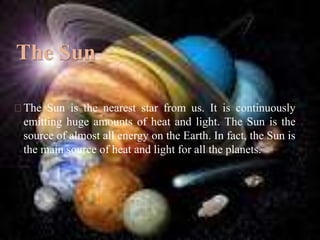
The Sun is the nearest star from us. It is continuously 
emitting huge amounts of heat and light. The Sun is the 
source of almost all energy on the Earth. In fact, the Sun is 
the main source of heat and light for all the planets.
The Planets 
The Planets look like stars, but they do not have light of their 
own. They merely reflect the sunlight that falls on them. 
The simplest method of identifying planets from stars is that 
stars twinkle, whereas planets do not. Also the planets keep 
changing their positions with respect to the stars. 
A planet has a definite path in which it revolves around the 
Sun. This path is called an orbit. The time taken by a planet to 
complete one revolution is called its period of revolution. This 
period of revolution increases as the distance of the planet 
increases from the sun.
Planets 
Mercury 
Venus 
Earth 
Mars 
Jupiter 
Saturn 
Uranus 
Neptune
Mercury, Venus, Earth and Mars are mainly composed 
of solid substances like rocks, iron and nickel. They are 
called terrestrial planets. 
Jupiter, Saturn, Uranus and Neptune are mainly 
composed of condensed gases such as hydrogen and 
methane. They are called Jovian planets.
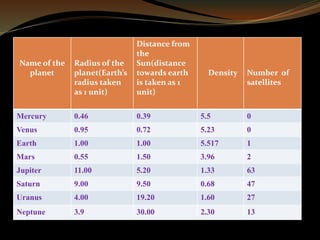
Name of the 
planet 
Radius of the 
planet(Earth’s 
radius taken 
as 1 unit) 
Distance from 
the 
Sun(distance 
towards earth 
is taken as 1 
unit) 
Density Number of 
satellites 
Mercury 0.46 0.39 5.5 0 
Venus 0.95 0.72 5.23 0 
Earth 1.00 1.00 5.517 1 
Mars 0.55 1.50 3.96 2 
Jupiter 11.00 5.20 1.33 63 
Saturn 9.00 9.50 0.68 47 
Uranus 4.00 19.20 1.60 27 
Neptune 3.9 30.00 2.30 13
THANK YOU

Solar system

  • 1.
  • 2.
    The sun andthe celestial bodies which revolve around it form the solar system. It consist of large number of bodies such as planets, comets, asteroids and meteors. The gravitational attraction between the sun and these objects keeps them revolving around it.
  • 3.
    The Sun TheSun is the nearest star from us. It is continuously emitting huge amounts of heat and light. The Sun is the source of almost all energy on the Earth. In fact, the Sun is the main source of heat and light for all the planets.
  • 4.
    The Planets ThePlanets look like stars, but they do not have light of their own. They merely reflect the sunlight that falls on them. The simplest method of identifying planets from stars is that stars twinkle, whereas planets do not. Also the planets keep changing their positions with respect to the stars. A planet has a definite path in which it revolves around the Sun. This path is called an orbit. The time taken by a planet to complete one revolution is called its period of revolution. This period of revolution increases as the distance of the planet increases from the sun.
  • 5.
    Planets Mercury Venus Earth Mars Jupiter Saturn Uranus Neptune
  • 6.
    Mercury, Venus, Earthand Mars are mainly composed of solid substances like rocks, iron and nickel. They are called terrestrial planets. Jupiter, Saturn, Uranus and Neptune are mainly composed of condensed gases such as hydrogen and methane. They are called Jovian planets.
  • 7.
    Name of the planet Radius of the planet(Earth’s radius taken as 1 unit) Distance from the Sun(distance towards earth is taken as 1 unit) Density Number of satellites Mercury 0.46 0.39 5.5 0 Venus 0.95 0.72 5.23 0 Earth 1.00 1.00 5.517 1 Mars 0.55 1.50 3.96 2 Jupiter 11.00 5.20 1.33 63 Saturn 9.00 9.50 0.68 47 Uranus 4.00 19.20 1.60 27 Neptune 3.9 30.00 2.30 13
  • 8.