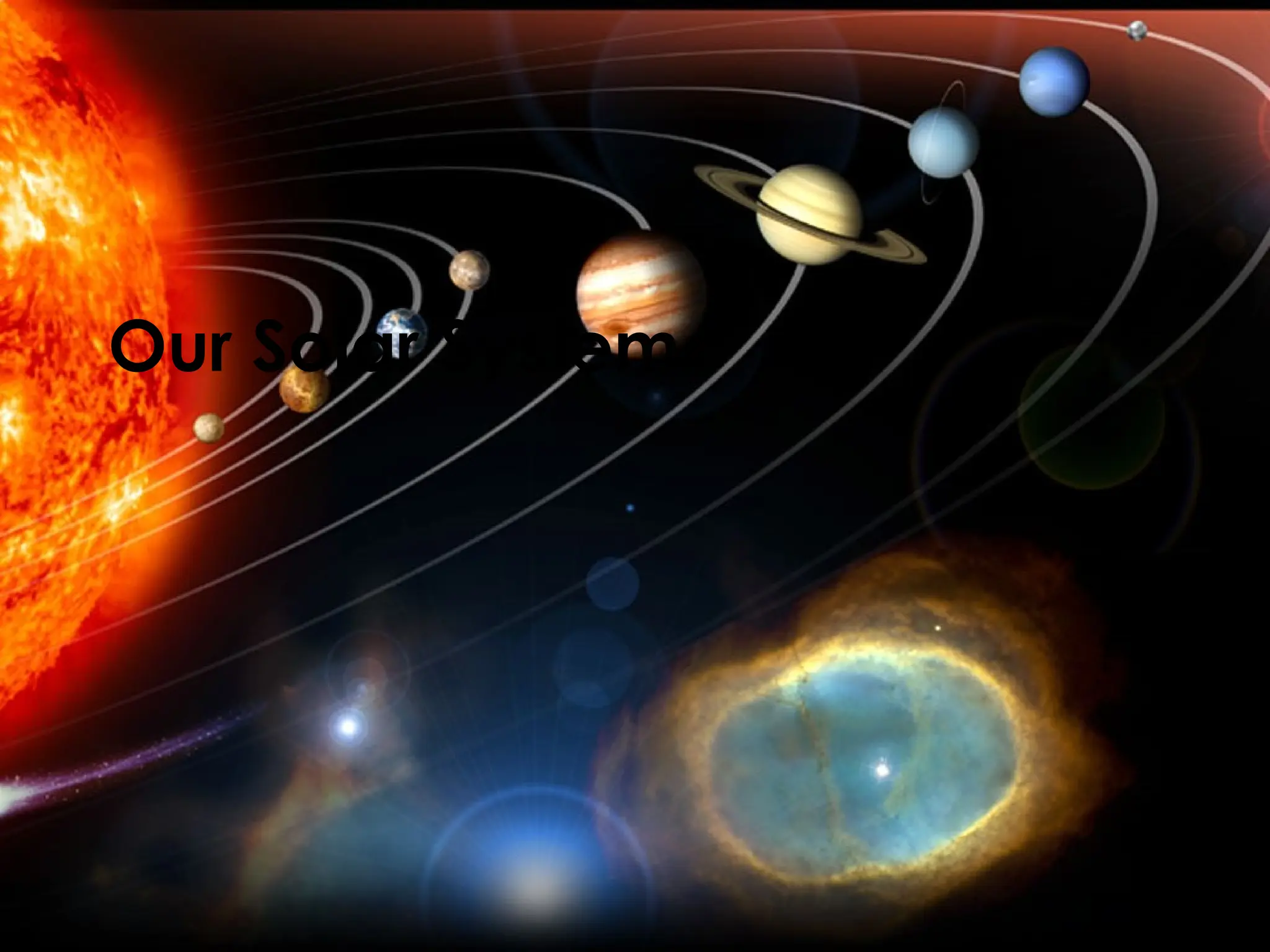
Our Solar System
Journal
 Can you name the 8 planets in our Solar System? This
includes Earth…
Mercury, Venus, Earth, Mars, Jupiter, Saturn,
Uranus, Neptune
Do you know any ways to
remember all 8?
My Very Excellent Mother
Just Sold Us Nuggets!
Galaxies
 Our sun is 1 of trillions of stars in the universe. Stars
are found in groups held together by gravity.
 A huge group of stars is called a galaxy.
 Our entire universe is made up of thousands of
galaxies.
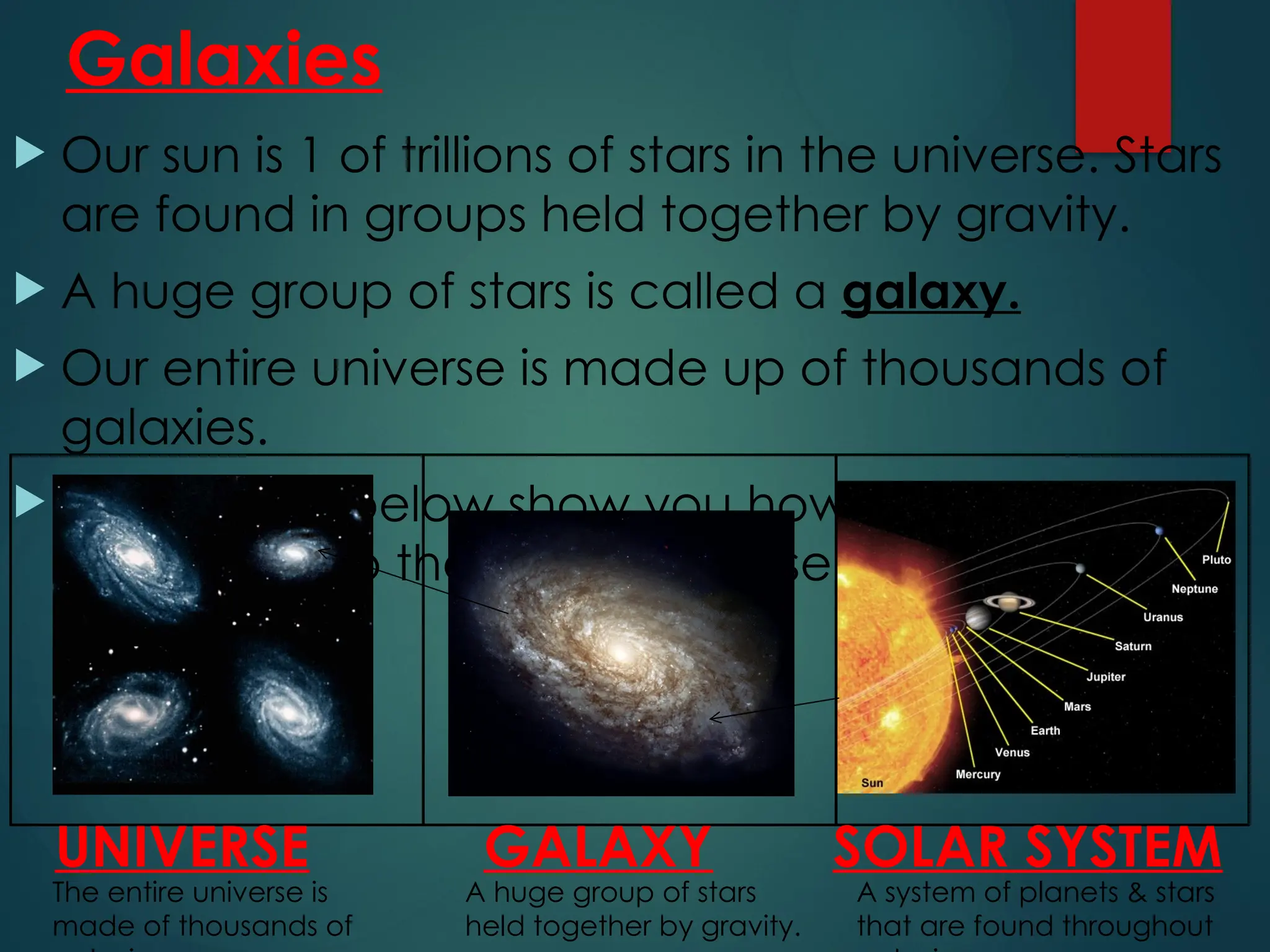
 The images below show you how small we are
compared to the entire universe.
UNIVERSE GALAXY SOLAR SYSTEM
The entire universe is
made of thousands of
A huge group of stars
held together by gravity.
A system of planets & stars
that are found throughout
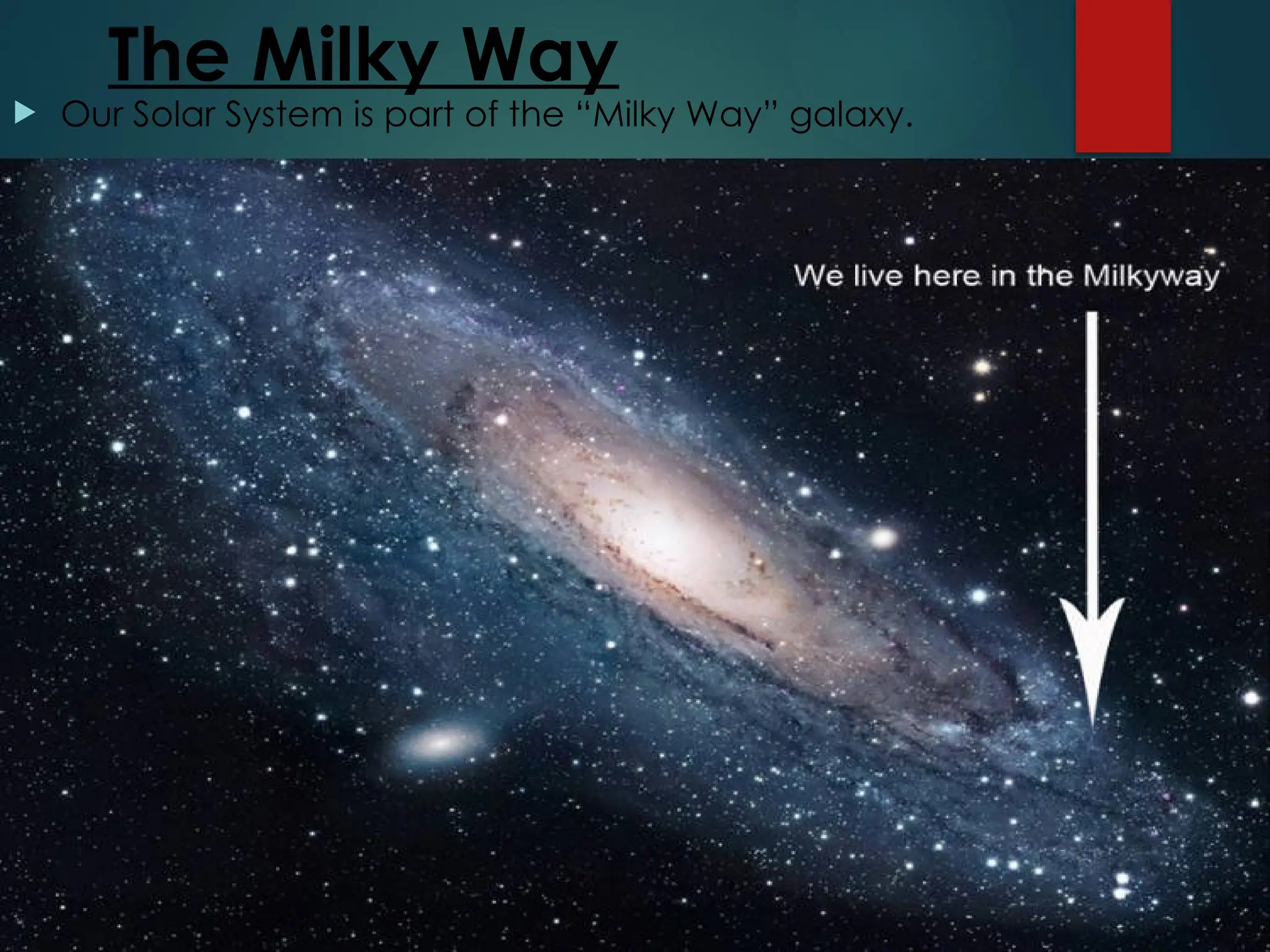
The Milky Way
 Our Solar System is part of the “Milky Way” galaxy.
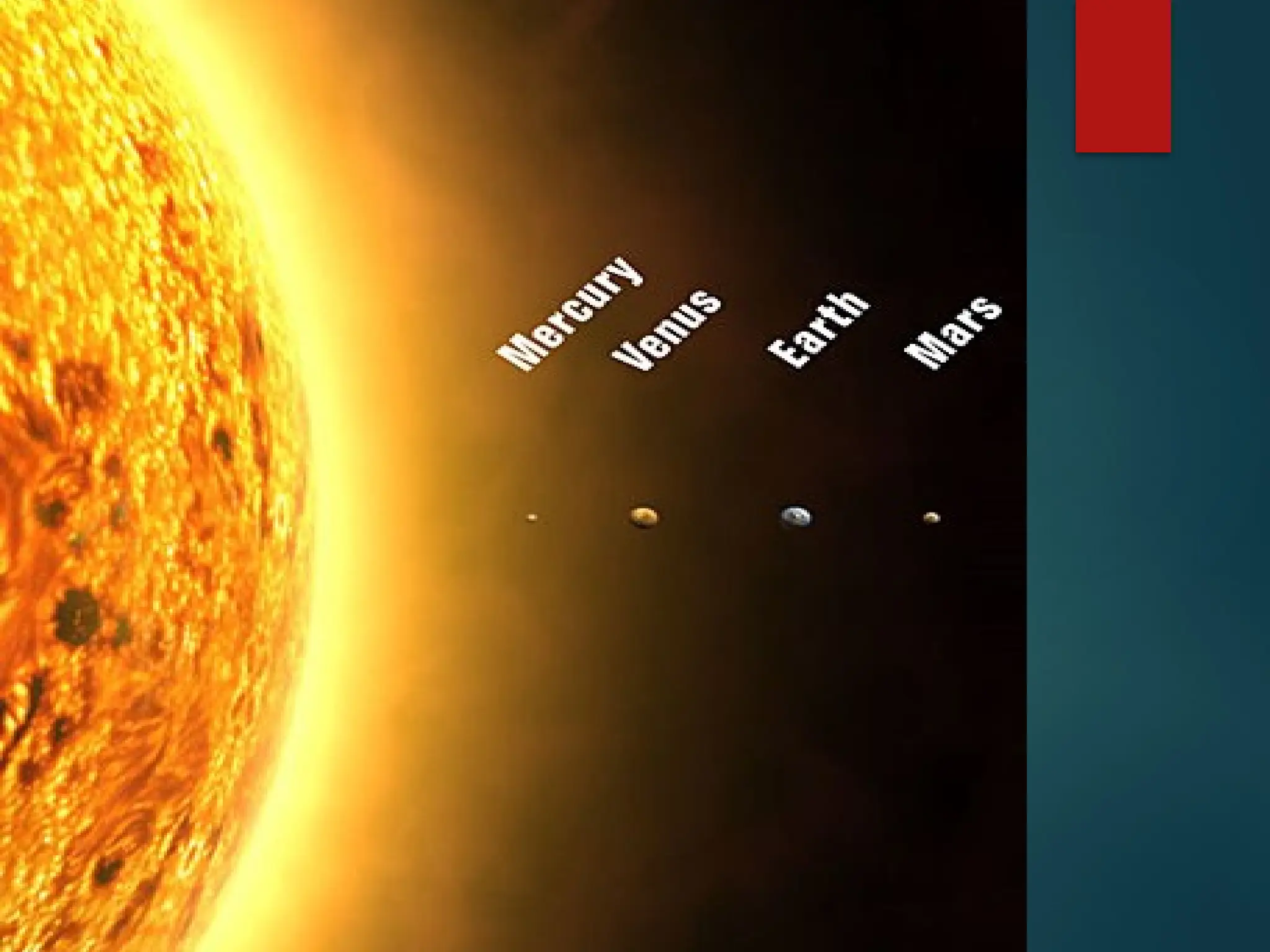
The Inner Planets
(Terrestrial Planets)
Spinning Planets
 Period of Rotation: amount of time that an object
takes to rotate once. (1 Day)
 Period of Revolution: time it takes an object to
revolve around the sun once. (1 year)
http://www.youtube.com/watch?v=97Ob0xR0Ut8&fe
ature=related
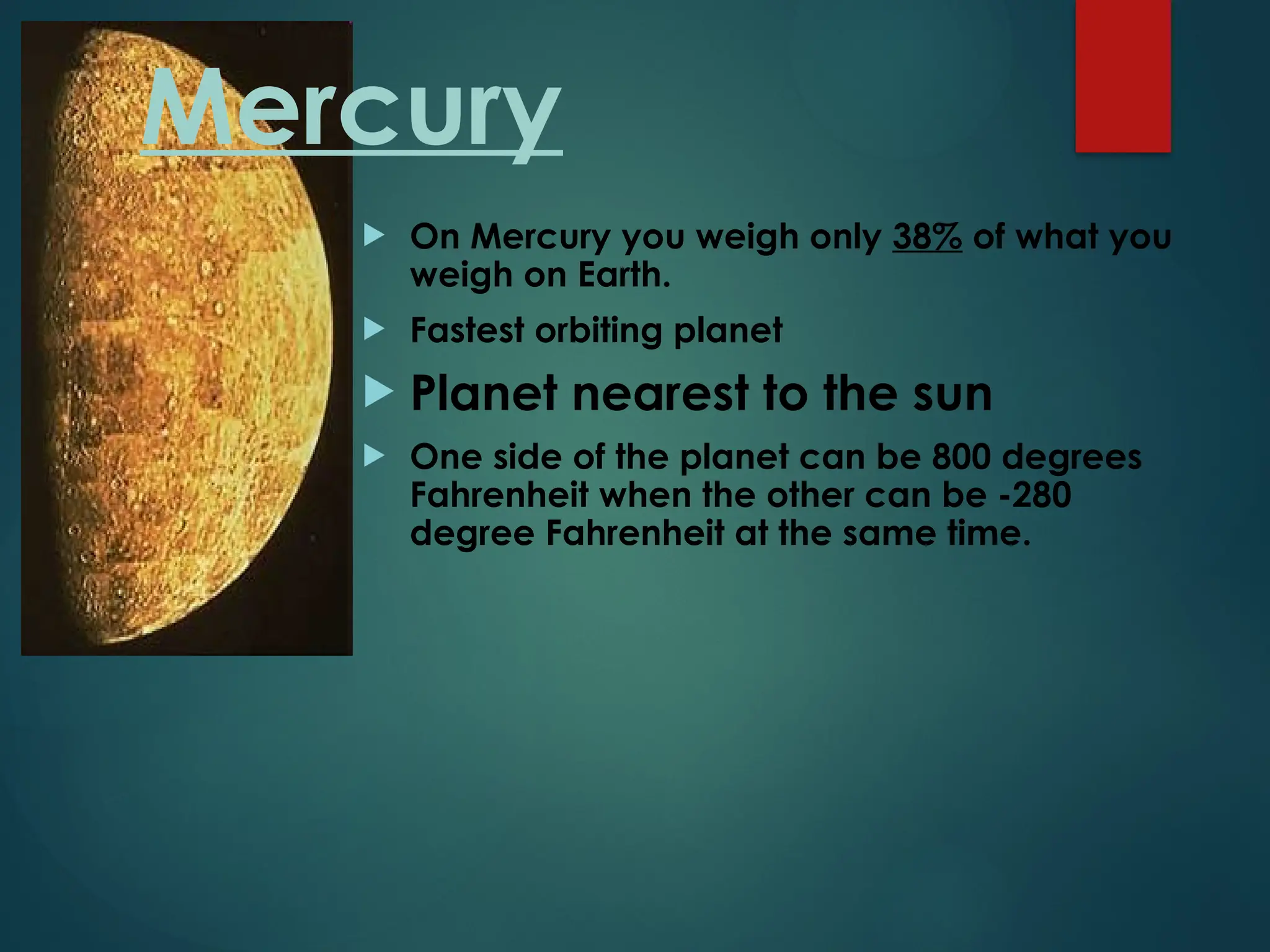
Mercury
 On Mercury you weigh only 38% of what you
weigh on Earth.
 Fastest orbiting planet
 Planet nearest to the sun
 One side of the planet can be 800 degrees
Fahrenheit when the other can be -280
degree Fahrenheit at the same time.
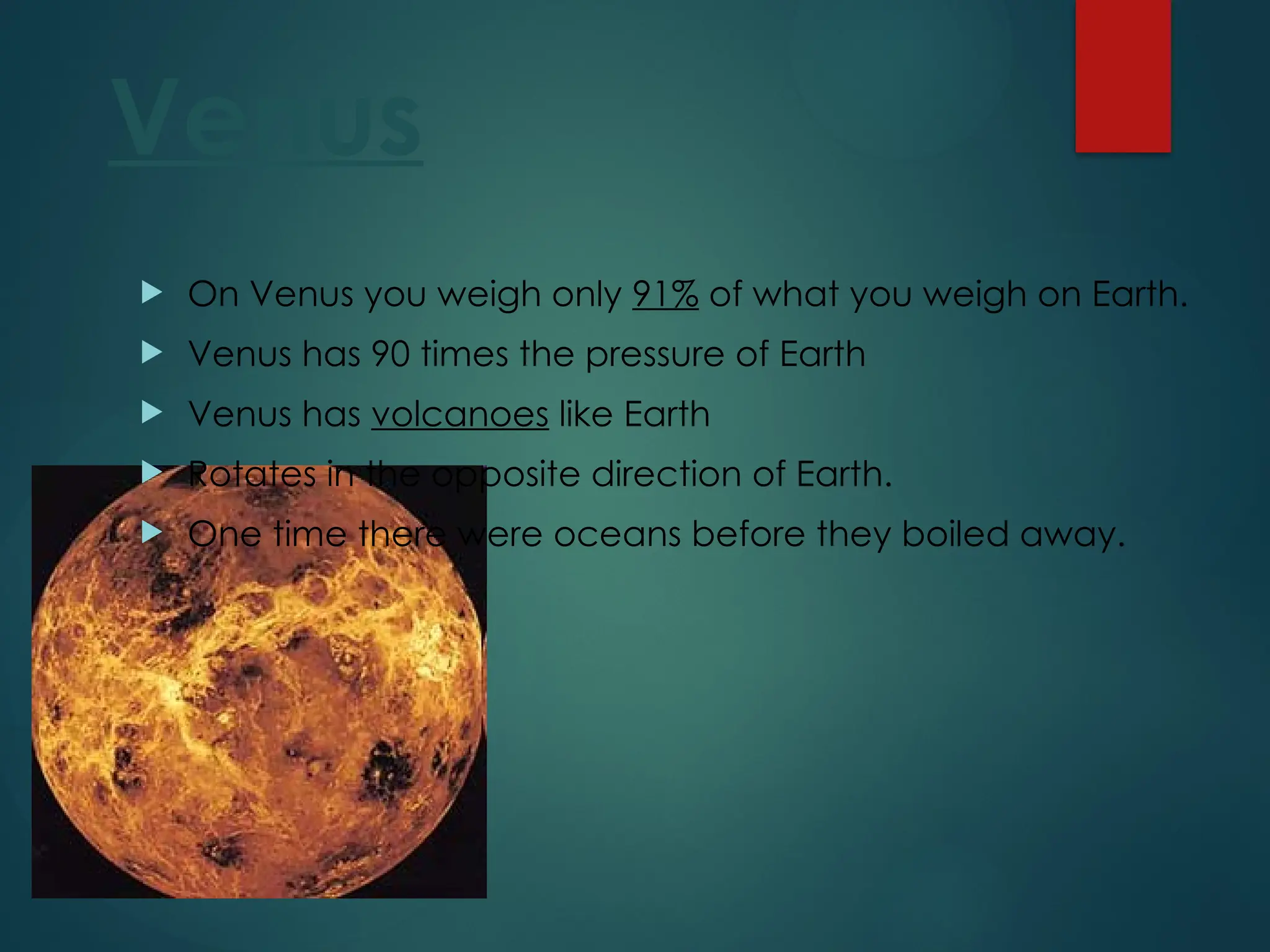
Venus
 On Venus you weigh only 91% of what you weigh on Earth.
 Venus has 90 times the pressure of Earth
 Venus has volcanoes like Earth
 Rotates in the opposite direction of Earth.
 One time there were oceans before they boiled away.
Earth
 23 hours and 56 min=1 Earth day (rotation)
 365 days =1 Earth year (revolution)
 Earth is warm enough to keep most of its water from
freezing and cold enough to keep it’s water from boiling
 Temperature is between –13 degrees Celsius and 37
degrees Celsius
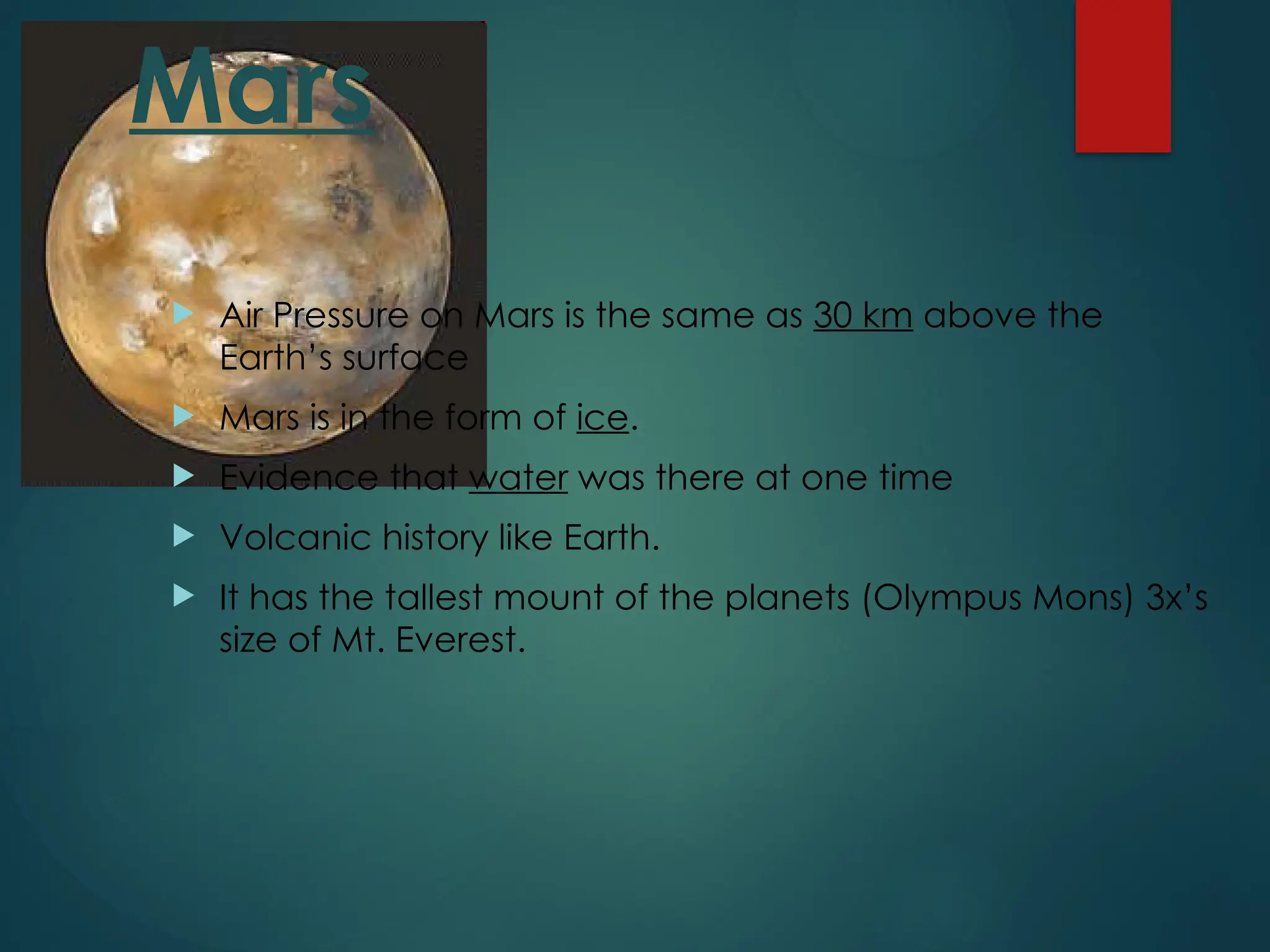
Mars
 Air Pressure on Mars is the same as 30 km above the
Earth’s surface
 Mars is in the form of ice.
 Evidence that water was there at one time
 Volcanic history like Earth.
 It has the tallest mount of the planets (Olympus Mons) 3x’s
size of Mt. Everest.
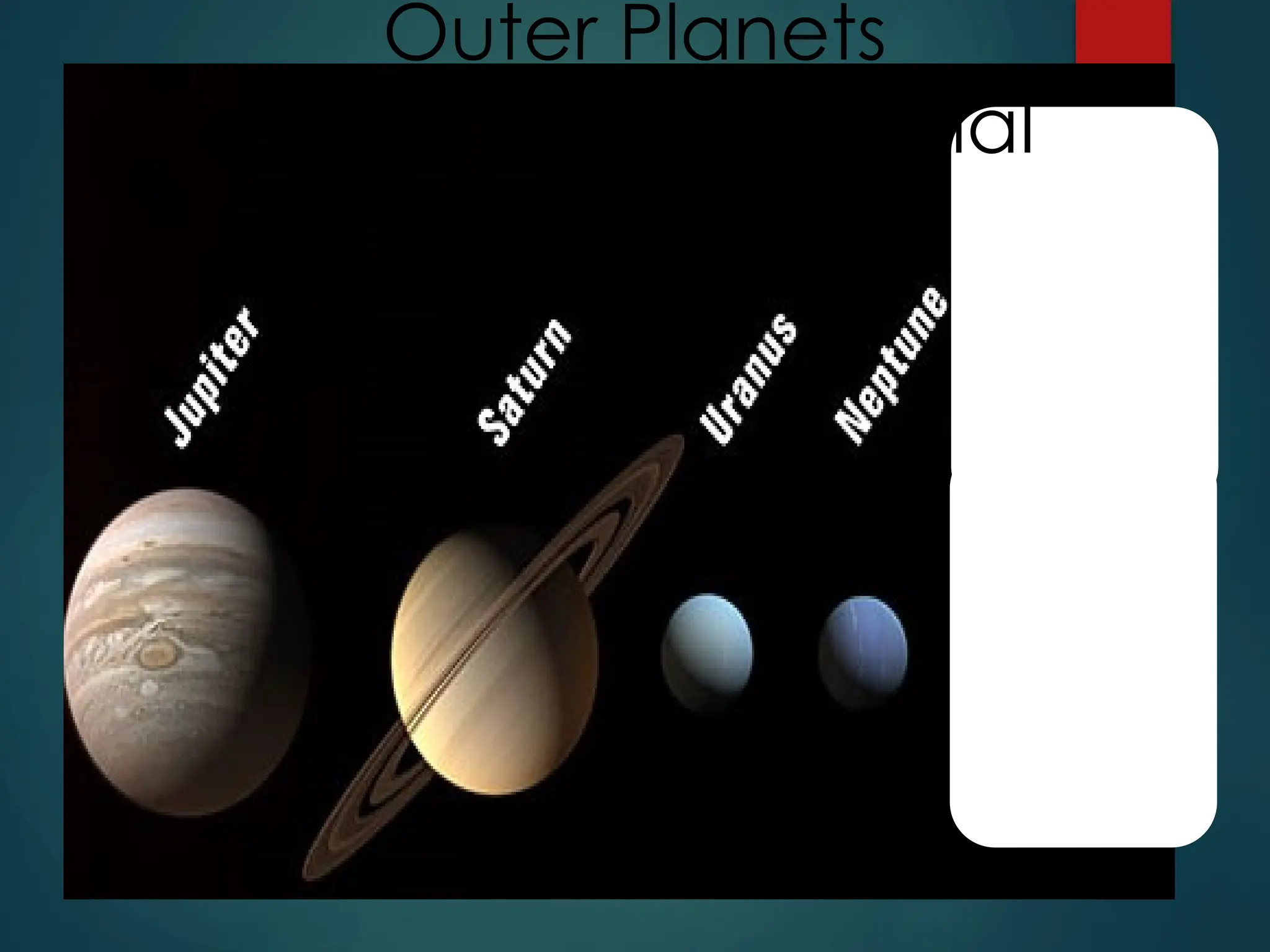
Outer Planets
(Gas Planets or Jovial
Planets)
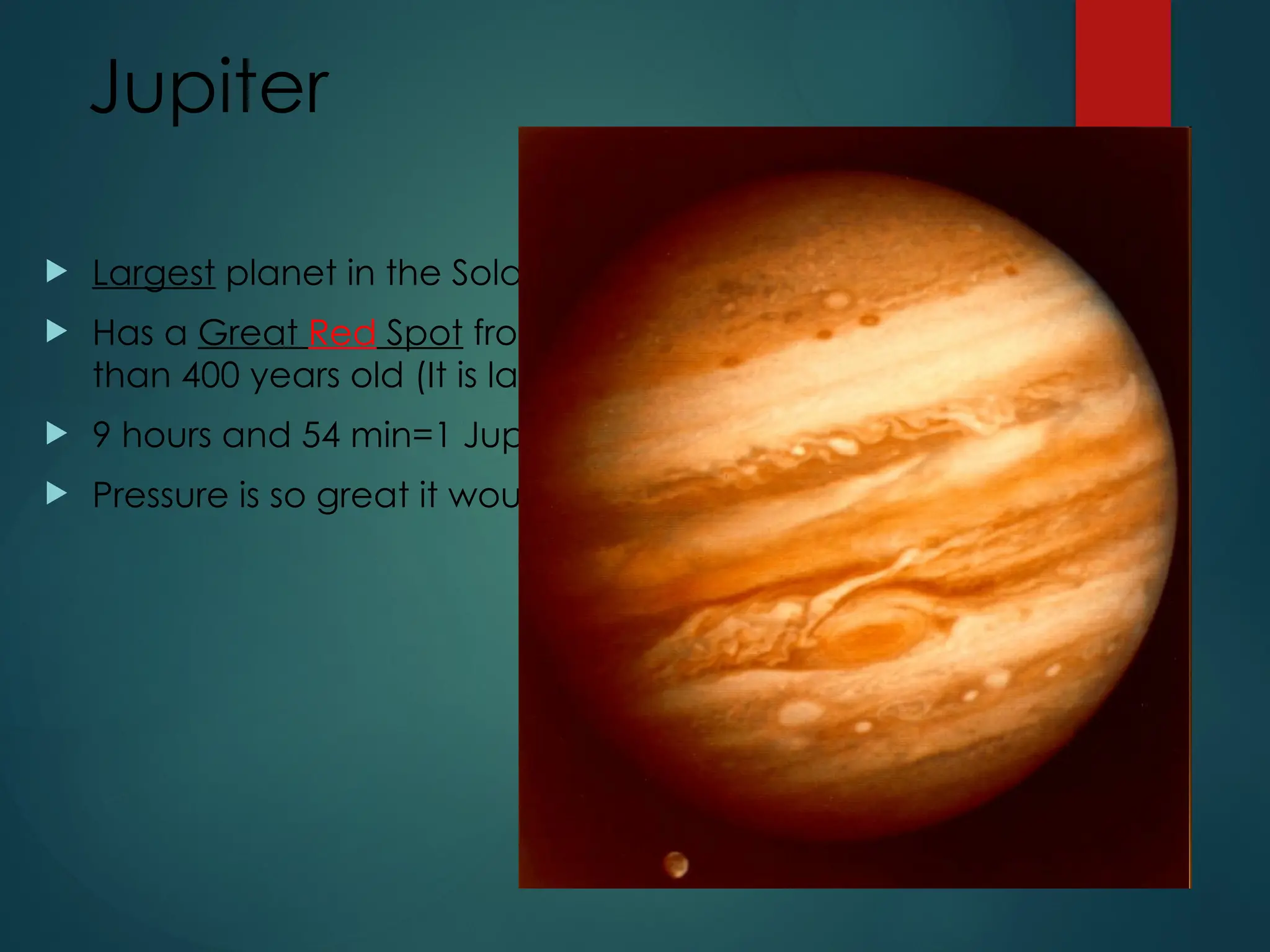
Jupiter
 Largest planet in the Solar System
 Has a Great Red Spot from a storm system that is more
than 400 years old (It is larger than Earth!)
 9 hours and 54 min=1 Jupiter day (shortest day)
 Pressure is so great it would crush a spaceship.
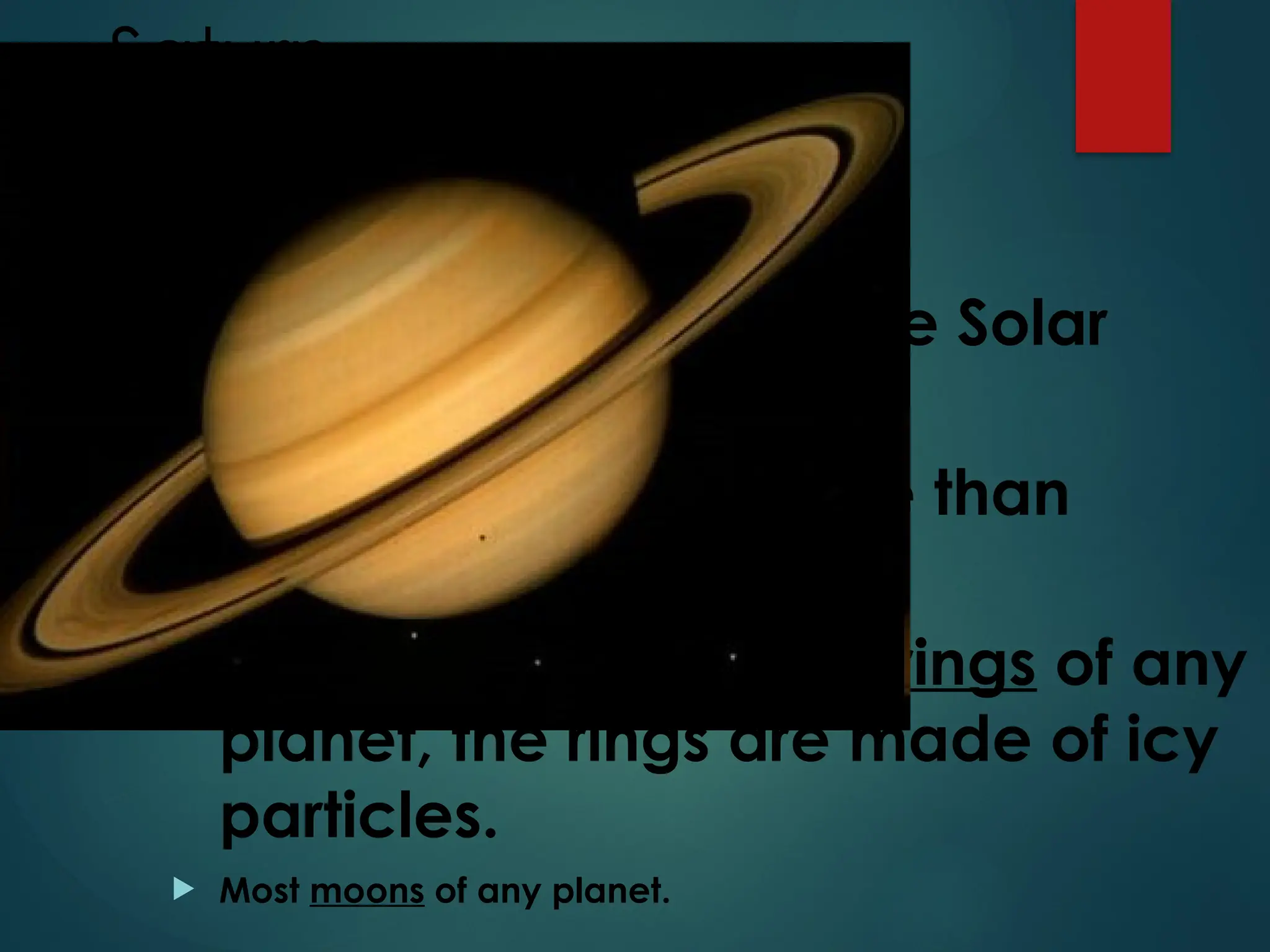
Saturn
2nd
Largest planet in the Solar
System
95 times more massive than
earth.
Saturn has the largest rings of any
planet, the rings are made of icy
particles.
 Most moons of any planet.
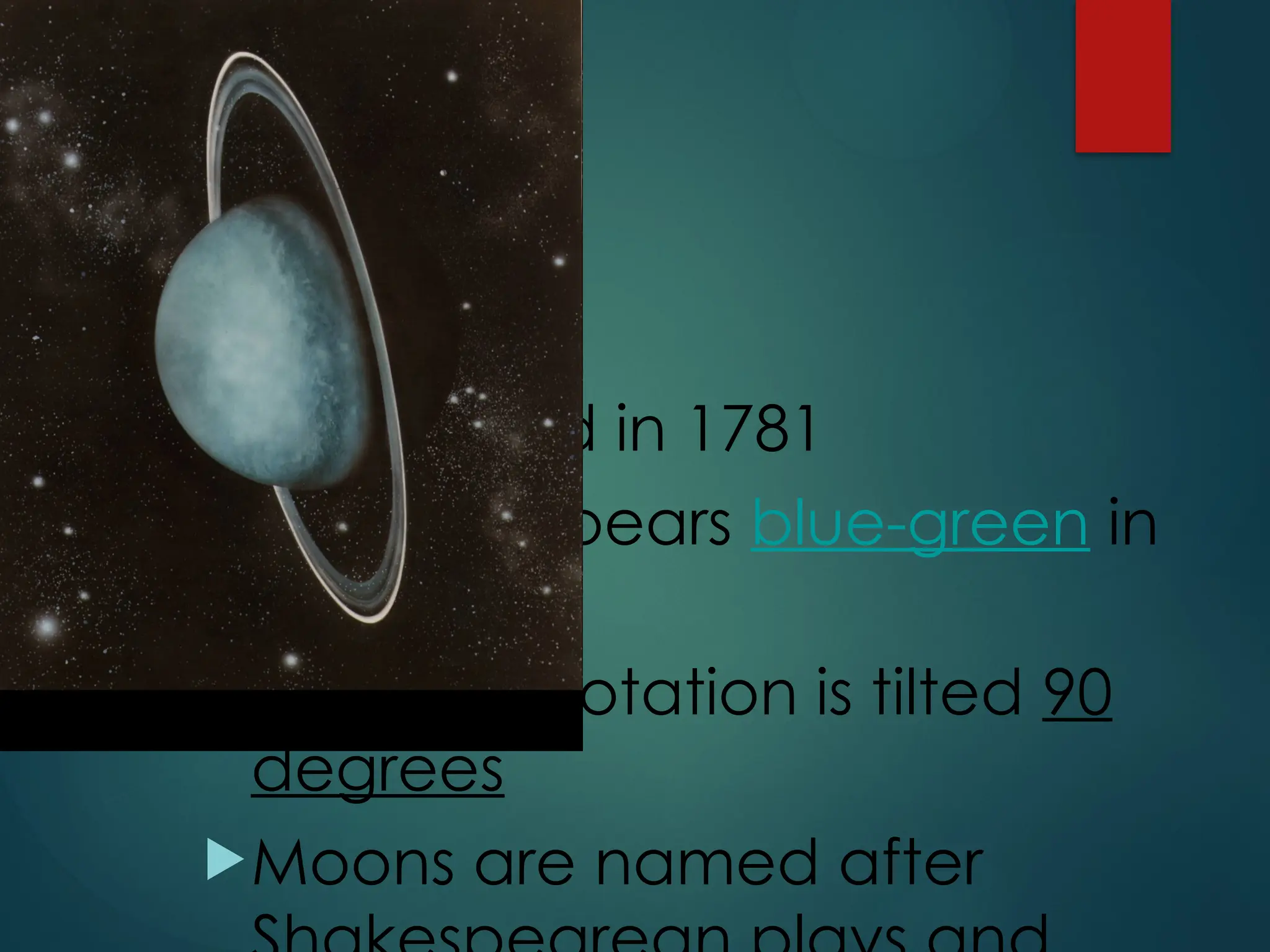
Uranus
Discovered in 1781
Uranus appears blue-green in
color
It’s axis of rotation is tilted 90
degrees
Moons are named after
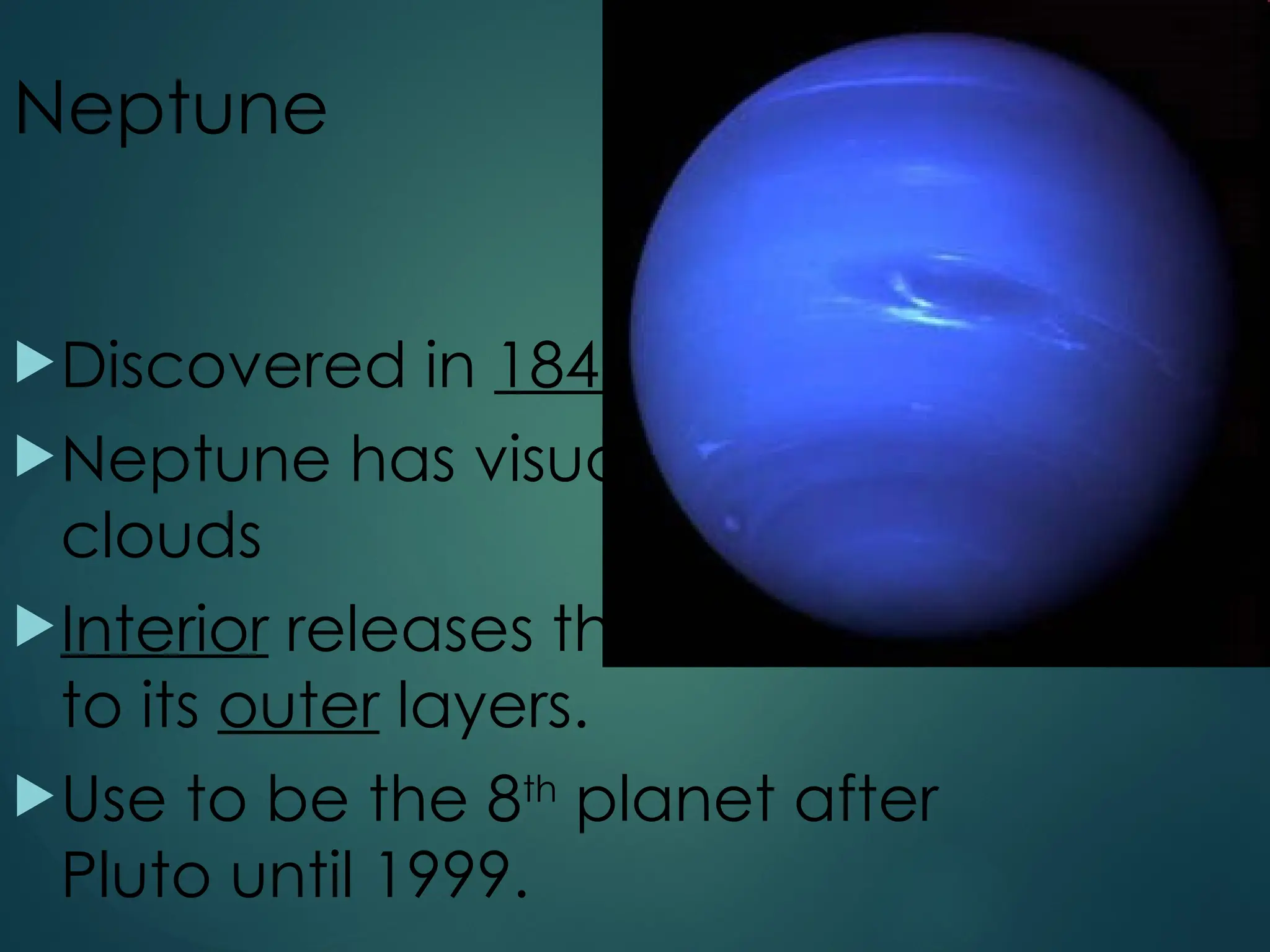
Neptune
Discovered in 1846
Neptune has visual belts of
clouds
Interior releases thermal energy
to its outer layers.
Use to be the 8th
planet after
Pluto until 1999.
What Keeps Our Planets &
Other Objects In Space In
Orbit??
GRAVITY & INERTIA
GRAVITY & INERTIA
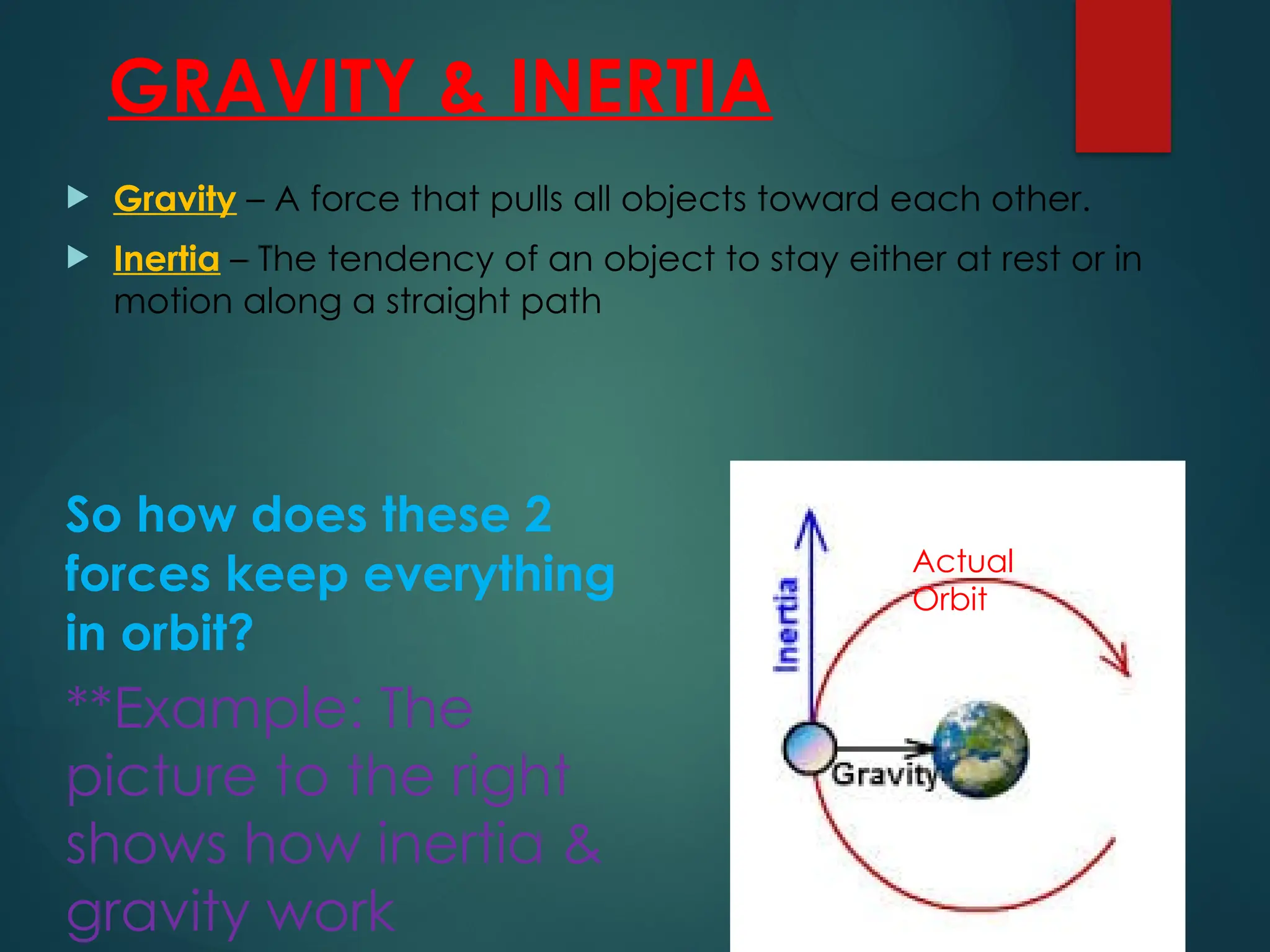
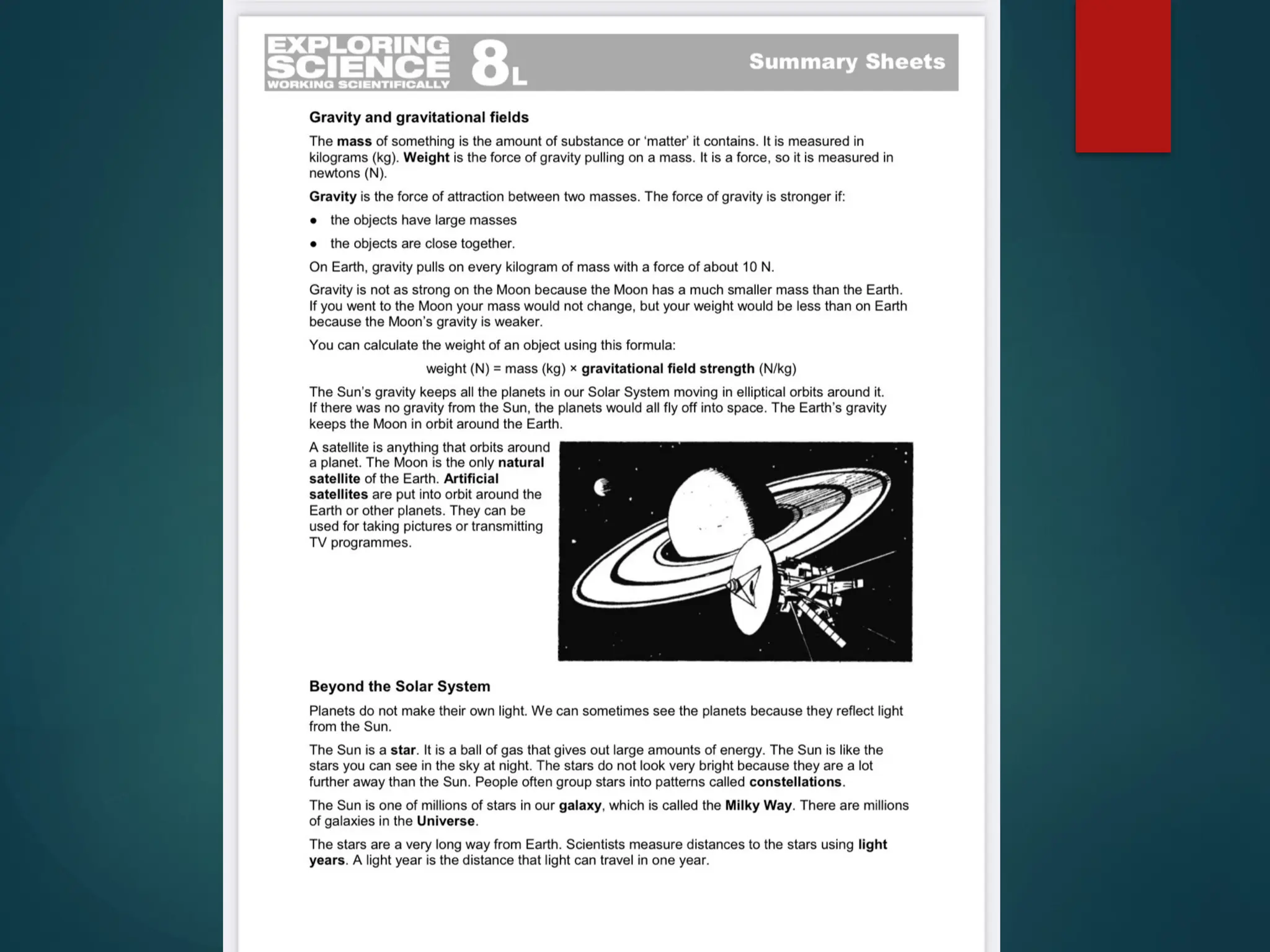
 Gravity – A force that pulls all objects toward each other.
 Inertia – The tendency of an object to stay either at rest or in
motion along a straight path
So how does these 2
forces keep everything
in orbit?
**Example: The
picture to the right
shows how inertia &
gravity work
Actual
Orbit
GRAVITY & INERTIA
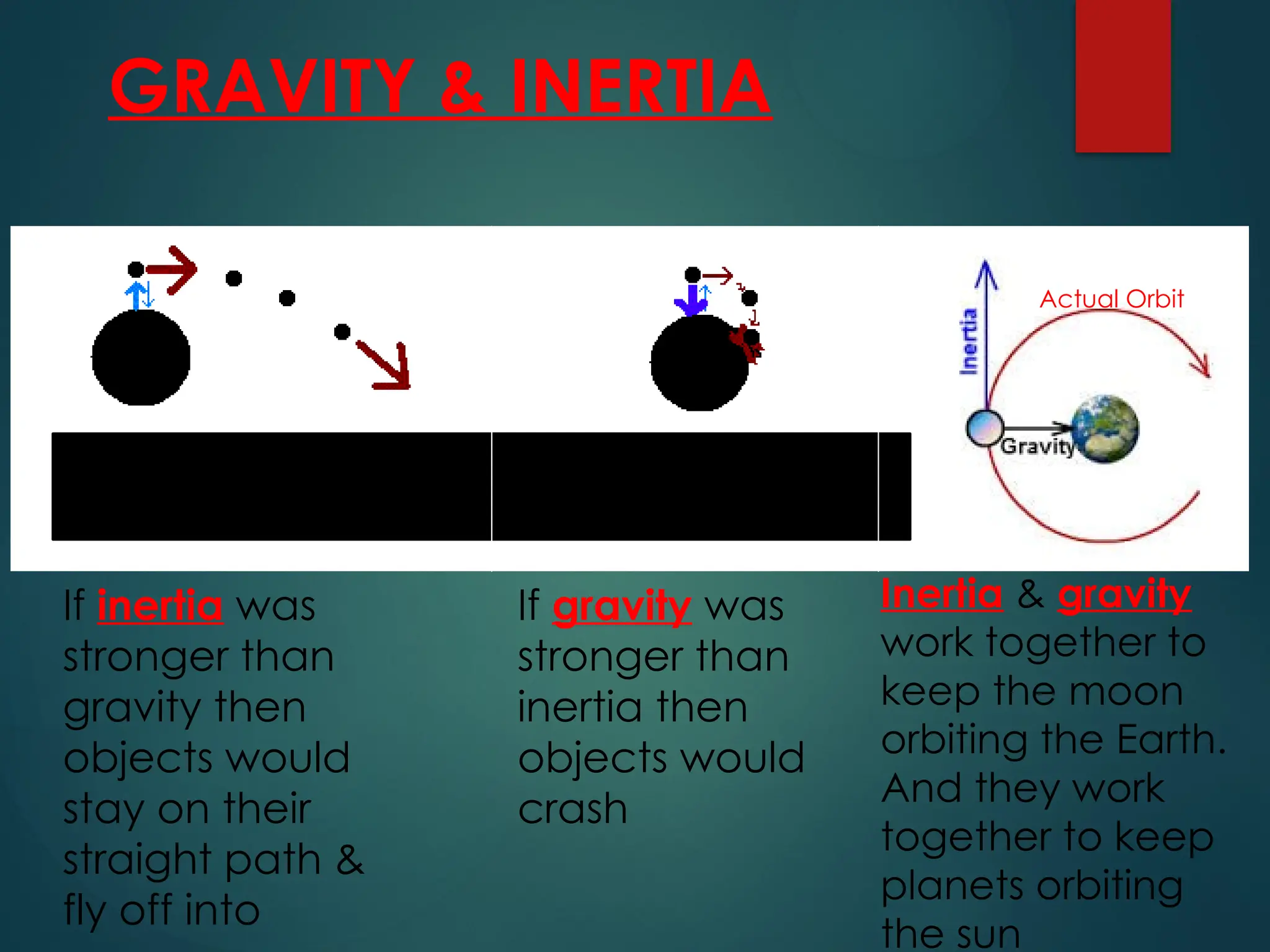
If inertia was
stronger than
gravity then
objects would
stay on their
straight path &
fly off into
Actual Orbit
If gravity was
stronger than
inertia then
objects would
crash
Inertia & gravity
work together to
keep the moon
orbiting the Earth.
And they work
together to keep
planets orbiting
the sun
COMETS
ASTEROIDS METEOROIDS
Other Space Objects
What is a comet?
• A comet is a small
body made out of
dust, rock, gas & ice.
• They are kind of like
a dirty snowball
• Comets come from
faraway regions of
our solar system
beyond the planets
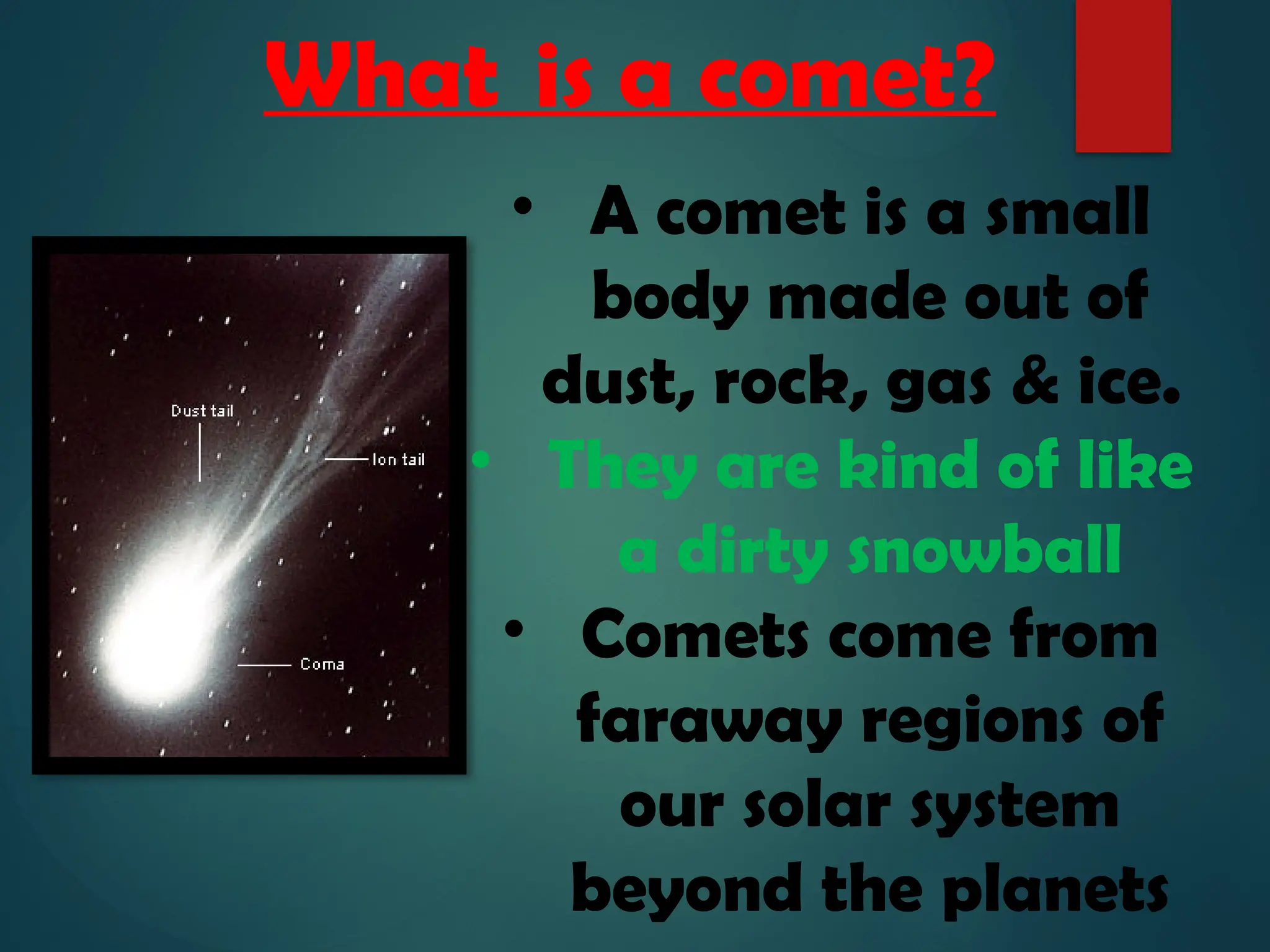
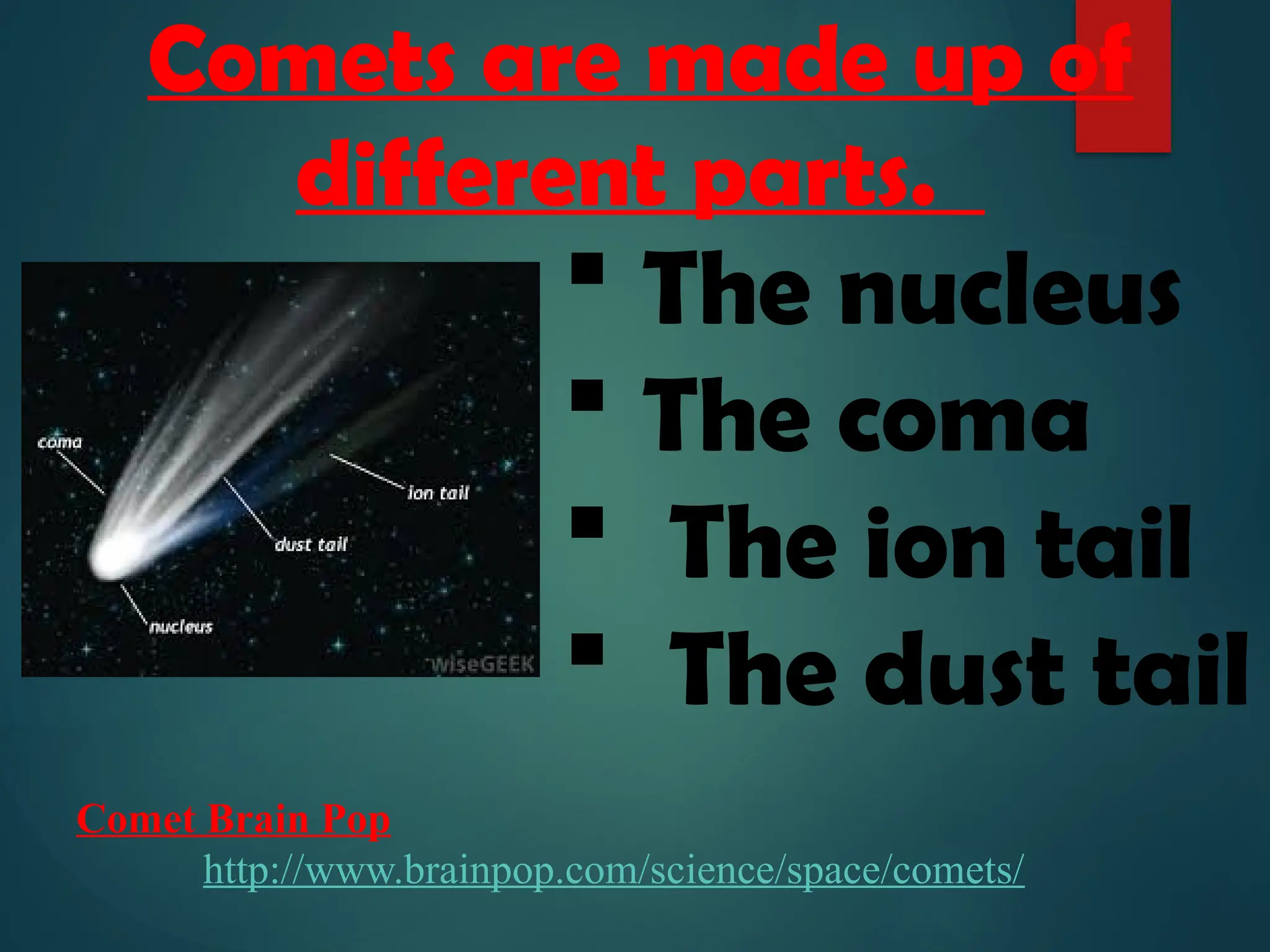
Comets are made up of
different parts.
Comet Brain Pop
http://www.brainpop.com/science/space/comets/
 The nucleus
 The coma
 The ion tail
 The dust tail
What is an asteroid?
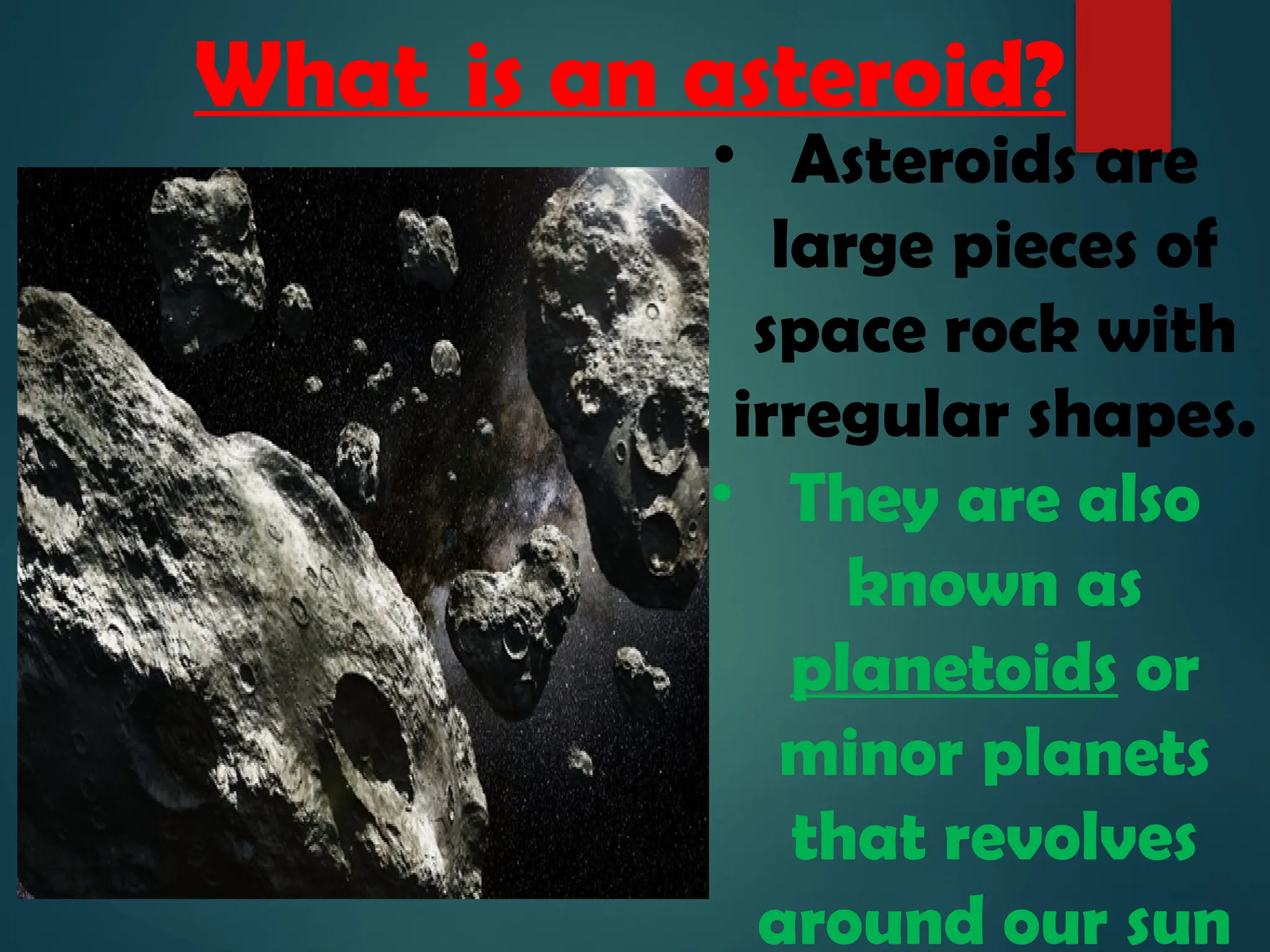
• Asteroids are
large pieces of
space rock with
irregular shapes.
• They are also
known as
planetoids or
minor planets
that revolves
around our sun
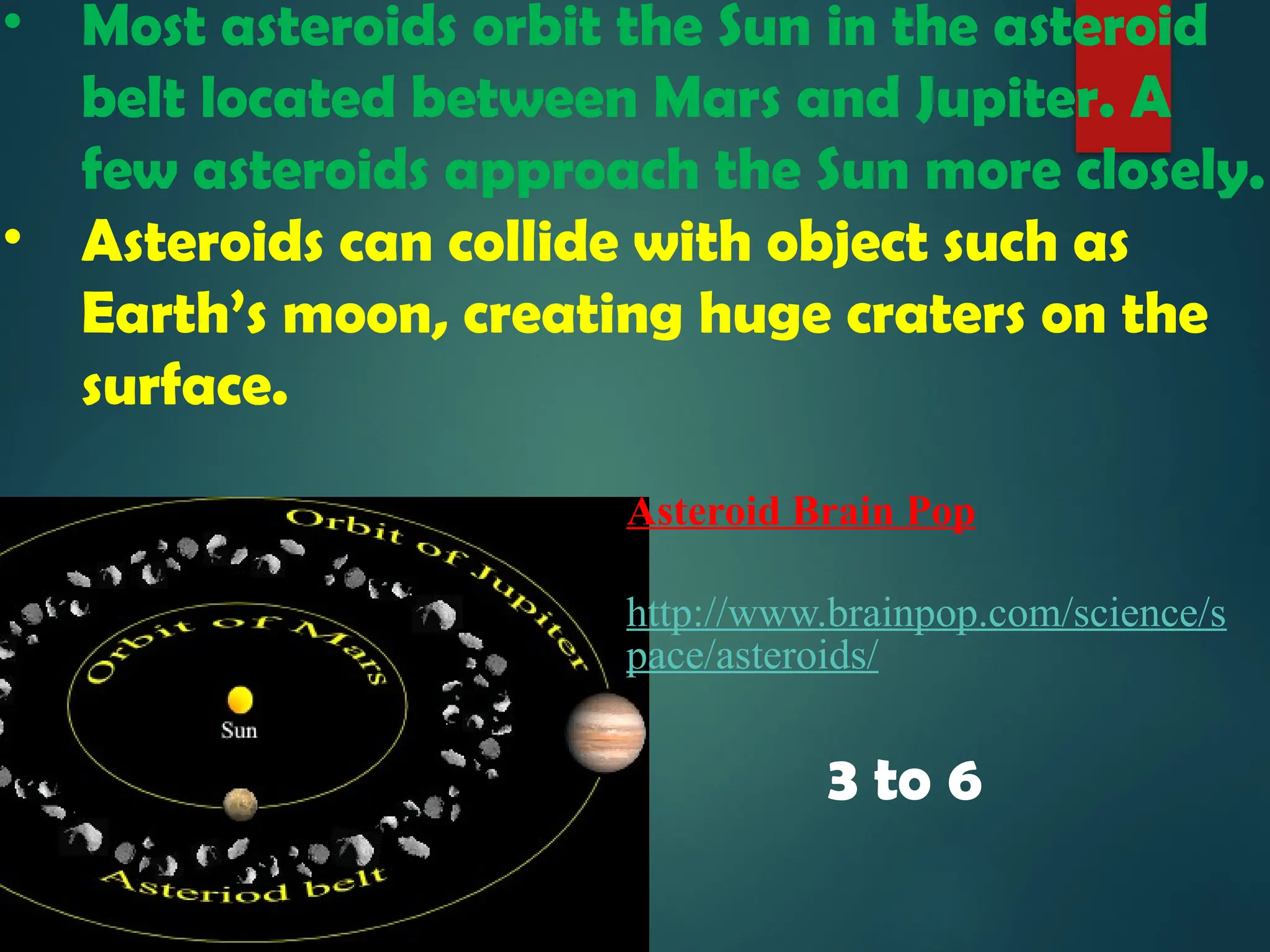
• Most asteroids orbit the Sun in the asteroid
belt located between Mars and Jupiter. A
few asteroids approach the Sun more closely.
• Asteroids can collide with object such as
Earth’s moon, creating huge craters on the
surface.
3 to 6
Asteroid Brain Pop
http://www.brainpop.com/science/s
pace/asteroids/
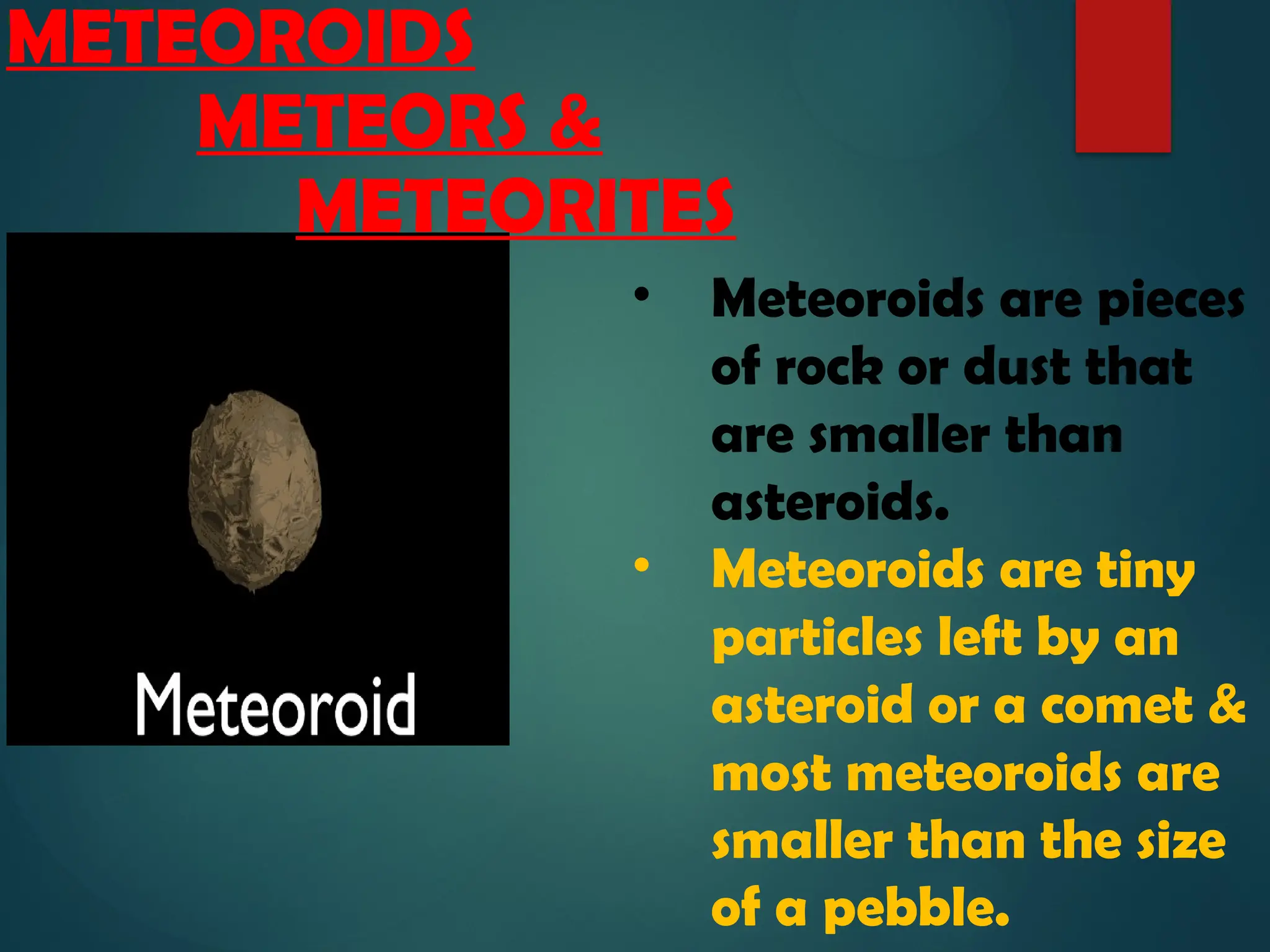
• Meteoroids are pieces
of rock or dust that
are smaller than
asteroids.
• Meteoroids are tiny
particles left by an
asteroid or a comet &
most meteoroids are
smaller than the size
of a pebble.
METEOROIDS
METEORS &
METEORITES
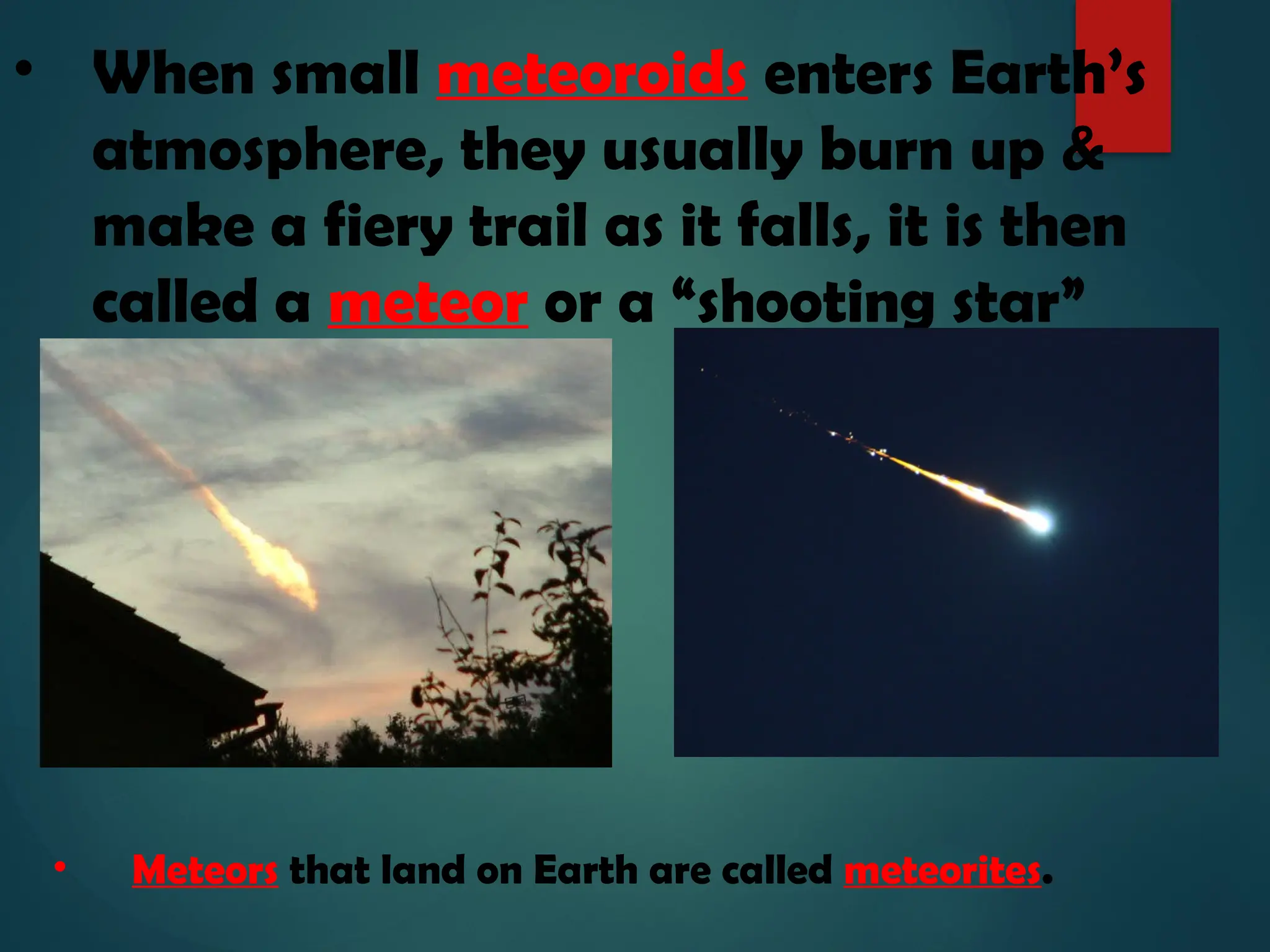
• When small meteoroids enters Earth’s
atmosphere, they usually burn up &
make a fiery trail as it falls, it is then
called a meteor or a “shooting star”
• Meteors that land on Earth are called meteorites.
Explanation
Our solar system
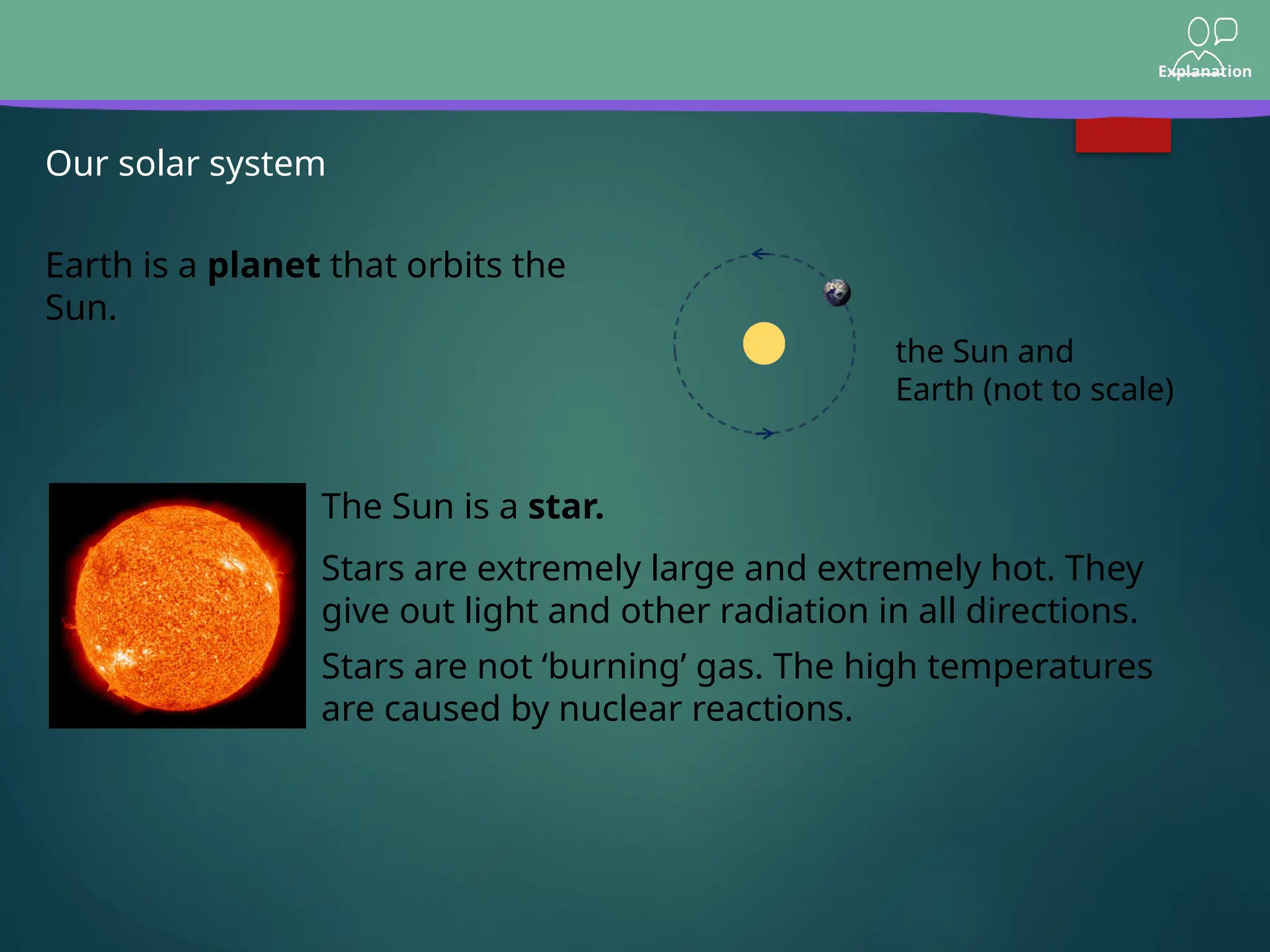
Earth is a planet that orbits the
Sun.
The Sun is a star.
Stars are not ‘burning’ gas. The high temperatures
are caused by nuclear reactions.
Stars are extremely large and extremely hot. They
give out light and other radiation in all directions.
the Sun and
Earth (not to scale)
Explanation
Our solar system
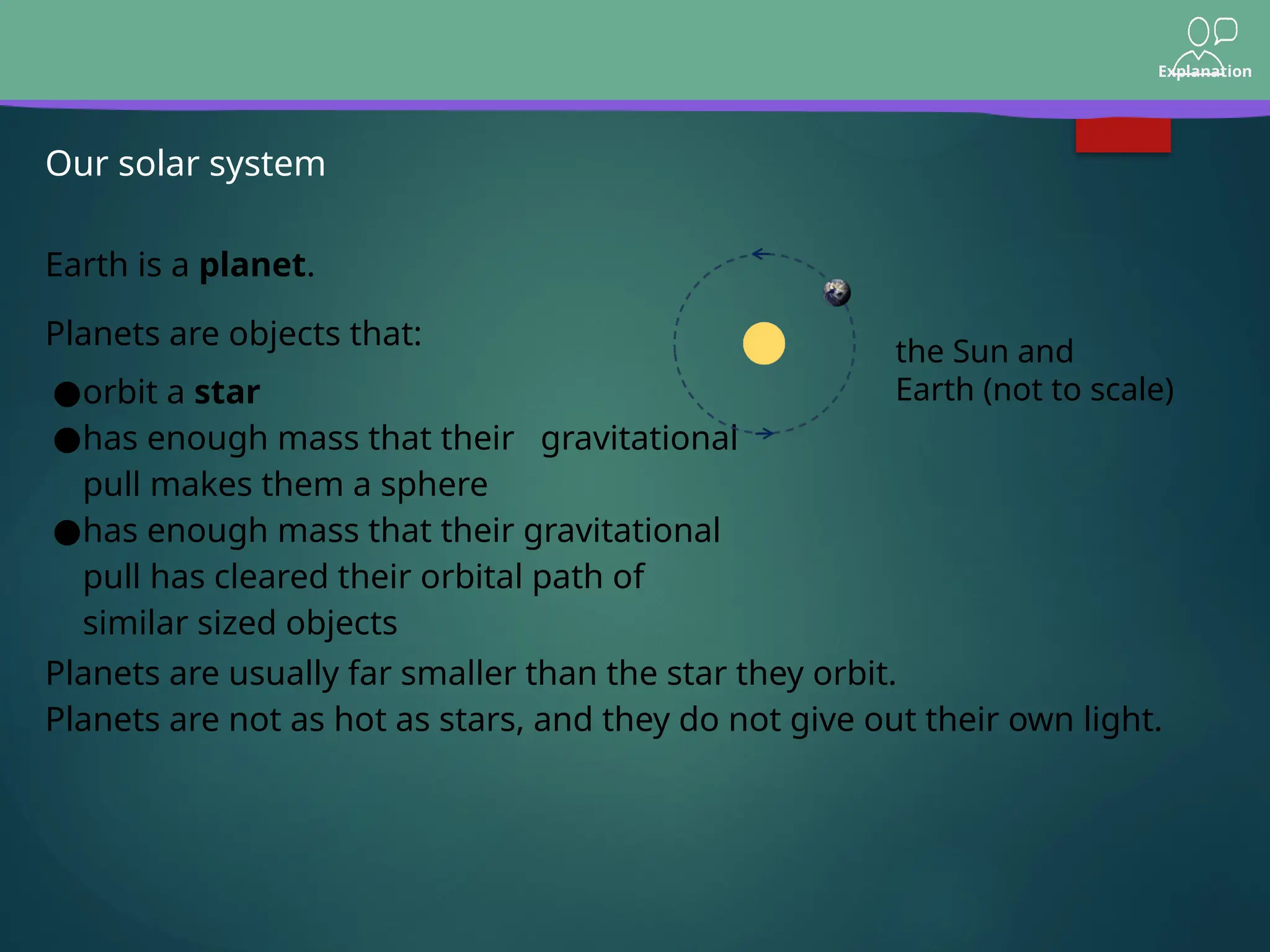
Earth is a planet.
Planets are objects that:
●orbit a star
●has enough mass that their gravitational
pull makes them a sphere
●has enough mass that their gravitational
pull has cleared their orbital path of
similar sized objects
Planets are usually far smaller than the star they orbit.
Planets are not as hot as stars, and they do not give out their own light.
the Sun and
Earth (not to scale)
Check
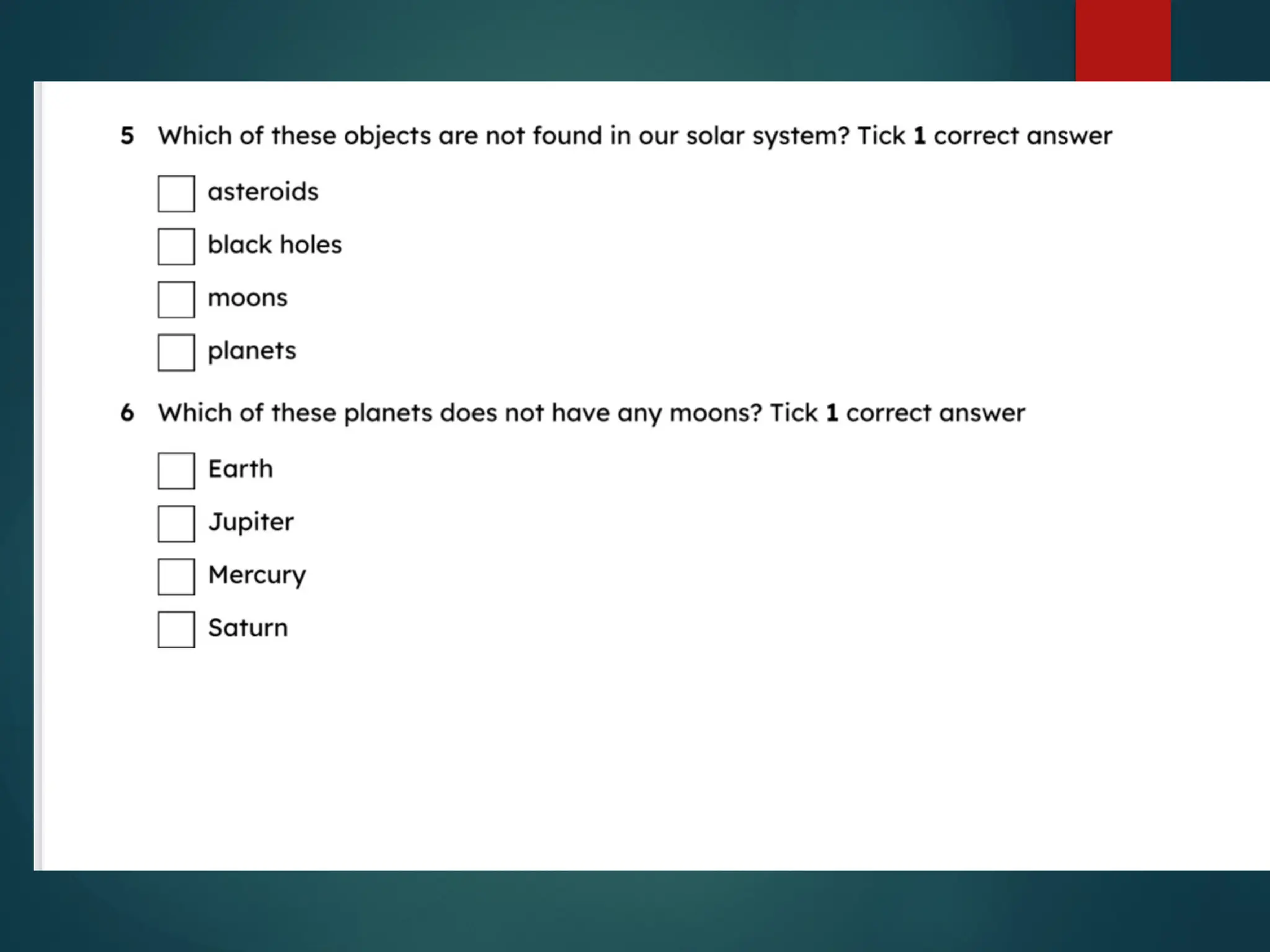
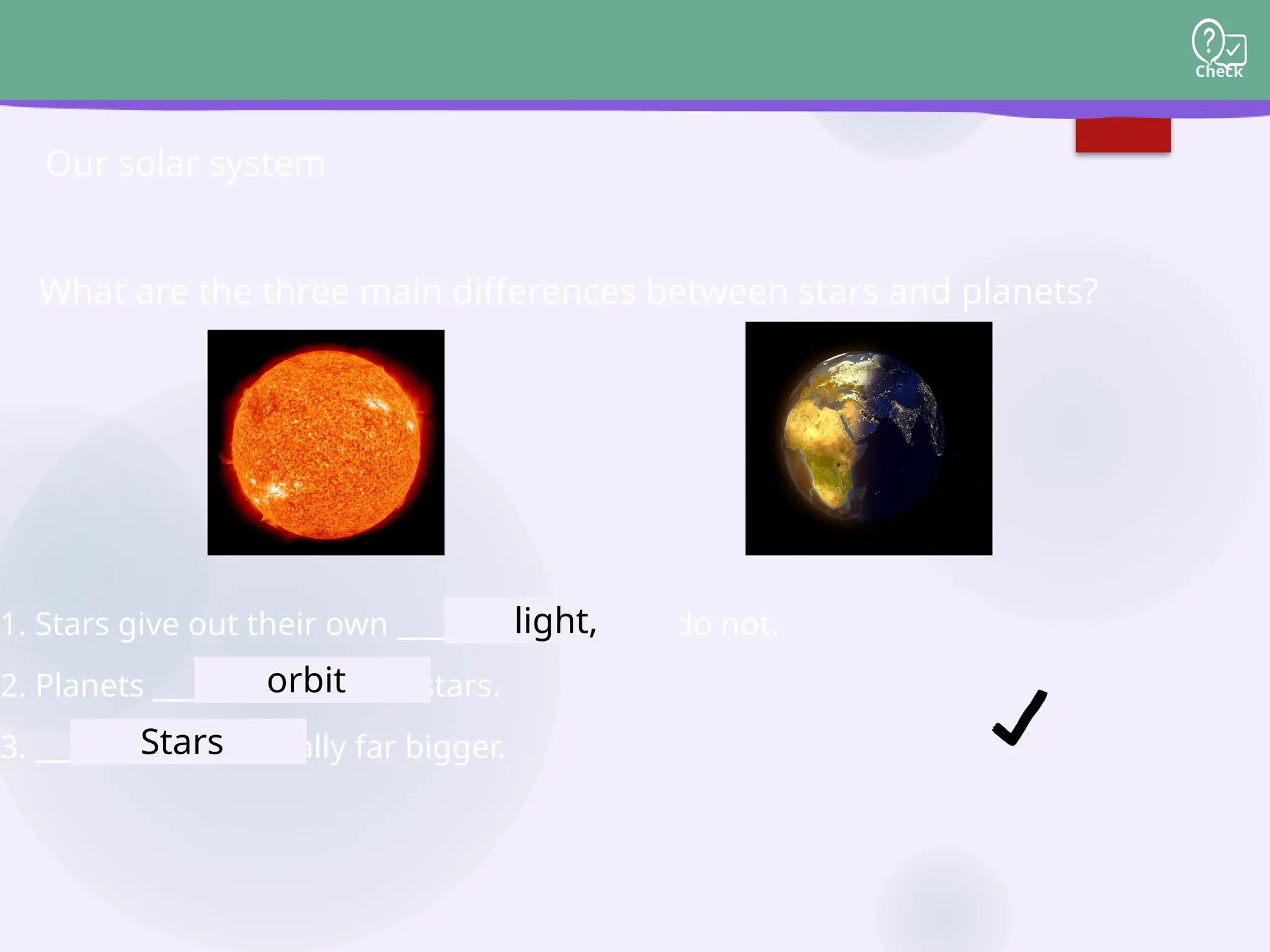
What are the three main differences between stars and planets?
Our solar system
1. Stars give out their own __________, planets do not.
2. Planets __________ around stars.
3. __________ are usually far bigger.
light,
orbit
Stars
Explanation
Our solar system
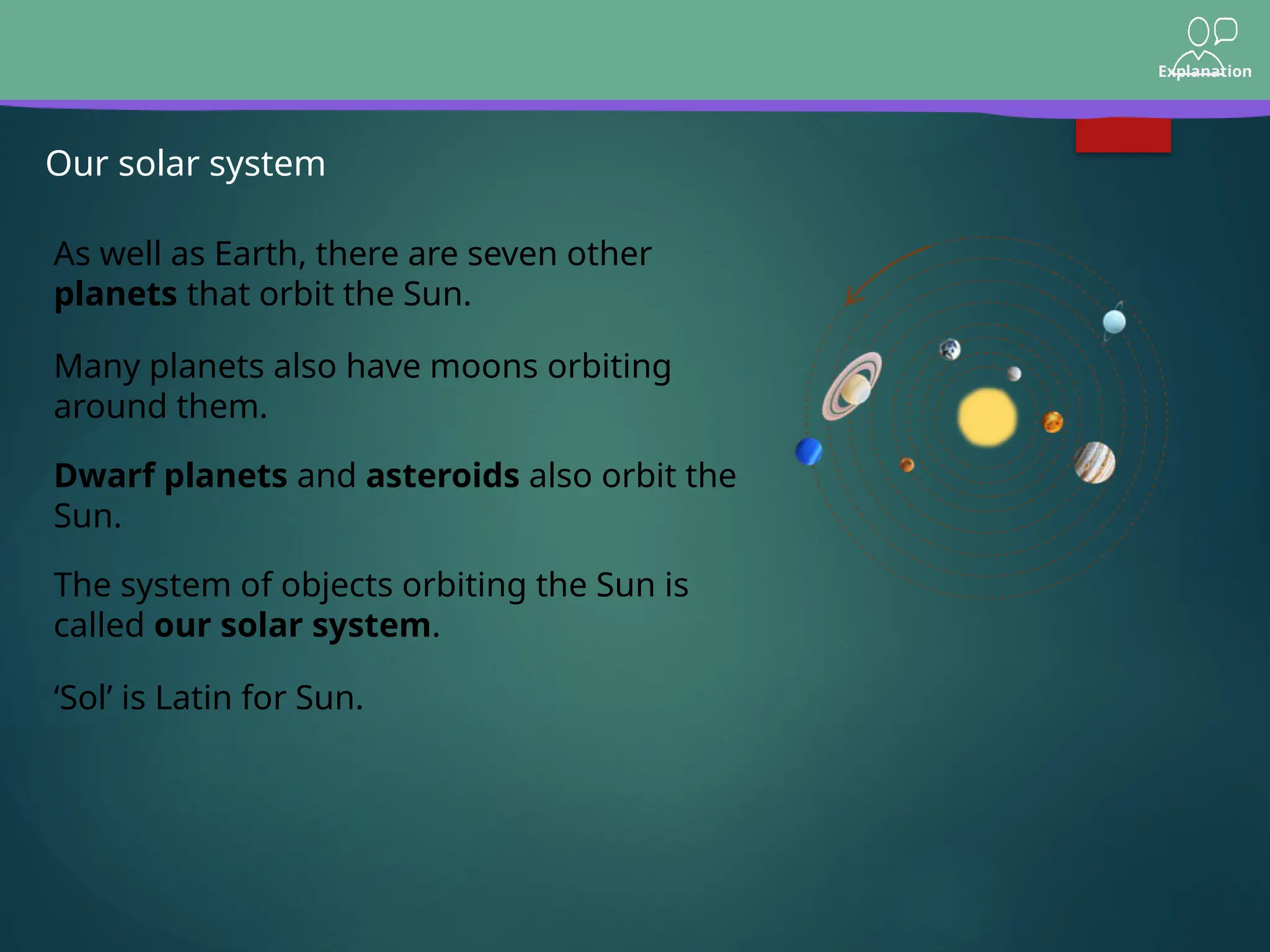
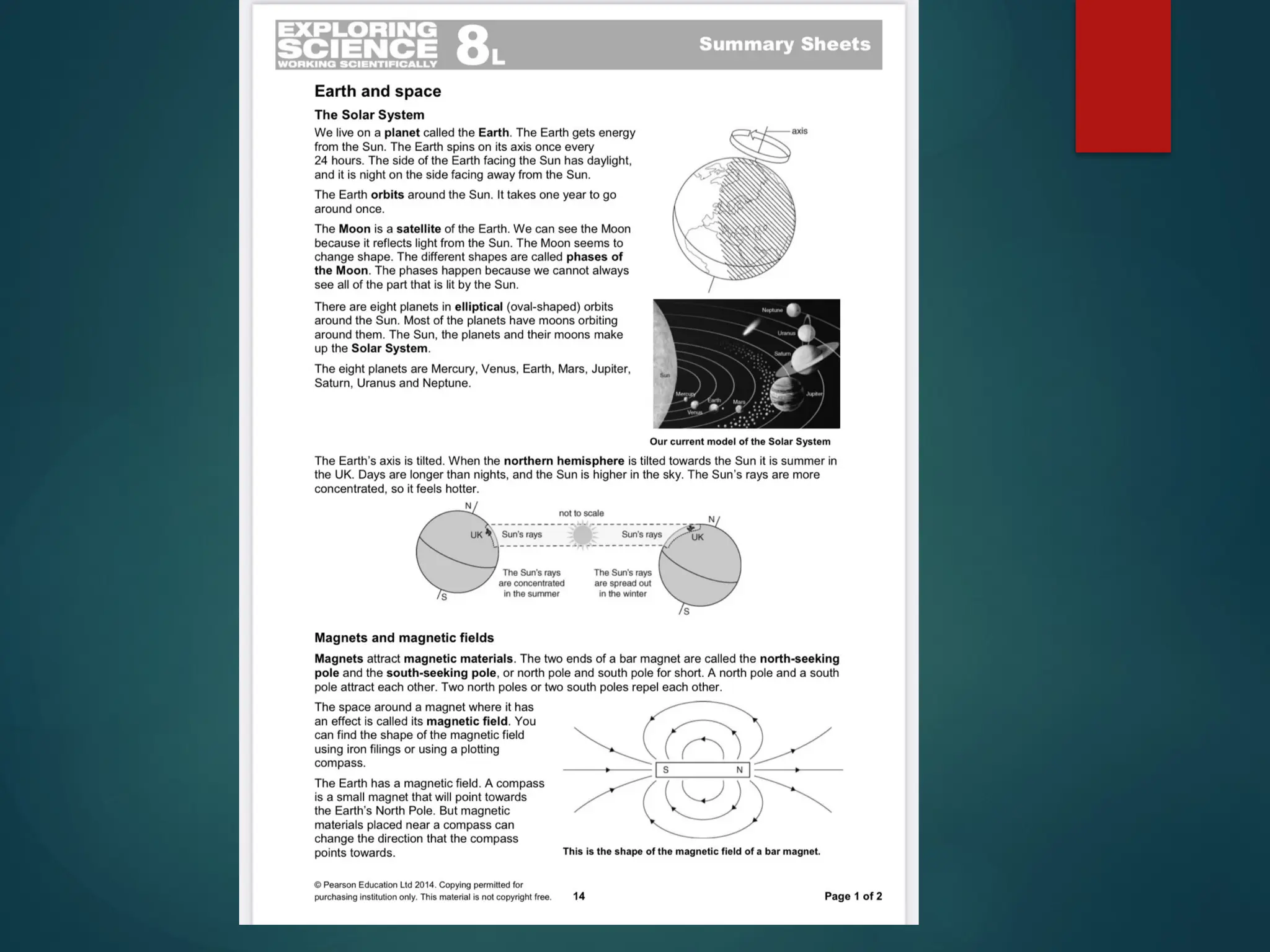
As well as Earth, there are seven other
planets that orbit the Sun.
Dwarf planets and asteroids also orbit the
Sun.
Many planets also have moons orbiting
around them.
The system of objects orbiting the Sun is
called our solar system.
‘Sol’ is Latin for Sun.
Explanation
Our solar system
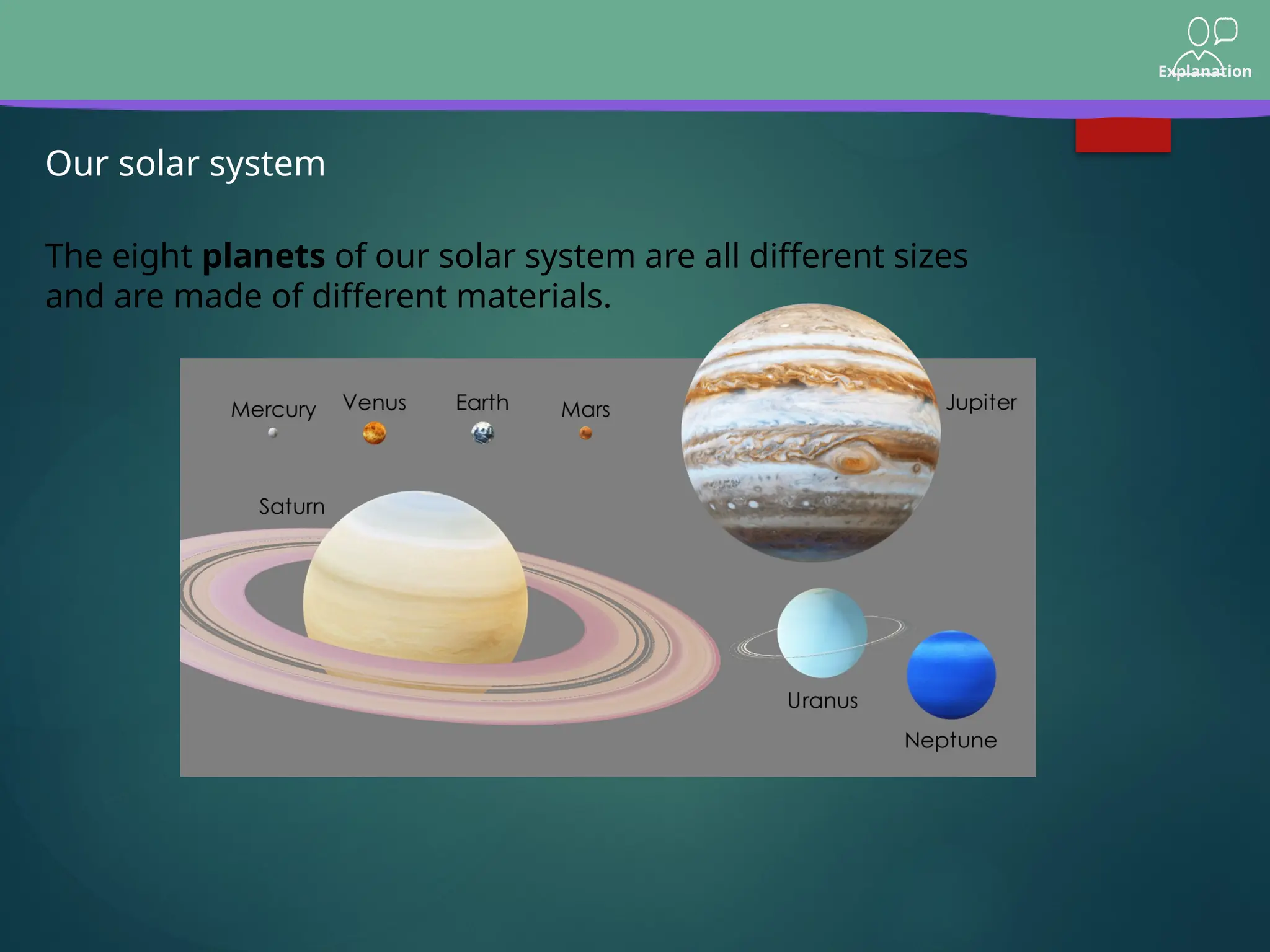
The eight planets of our solar system are all different sizes
and are made of different materials.
Explanation
Our solar system
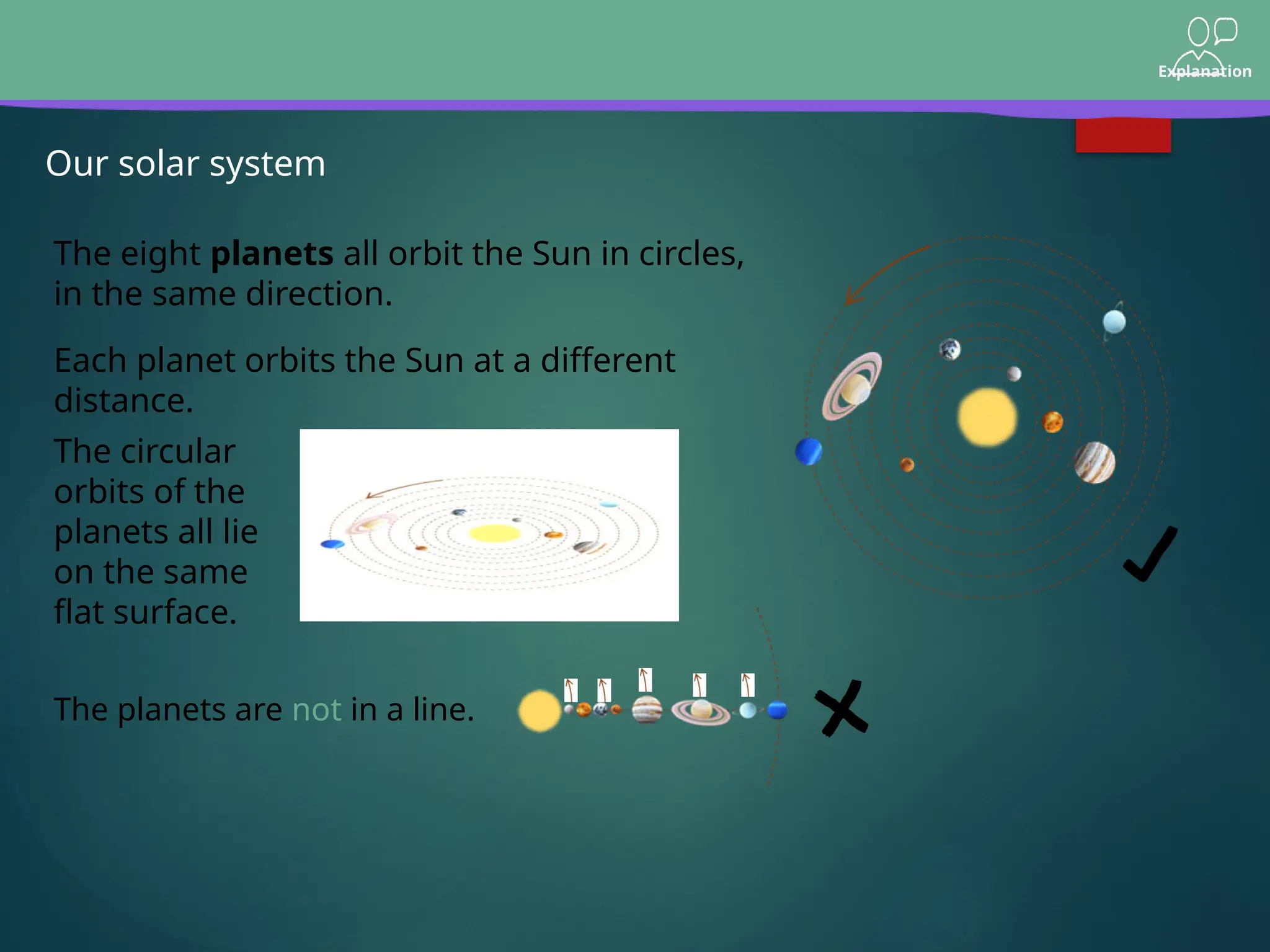
The eight planets all orbit the Sun in circles,
in the same direction.
Each planet orbits the Sun at a different
distance.
The planets are not in a line.
The circular
orbits of the
planets all lie
on the same
flat surface.
Explanation
Our solar system
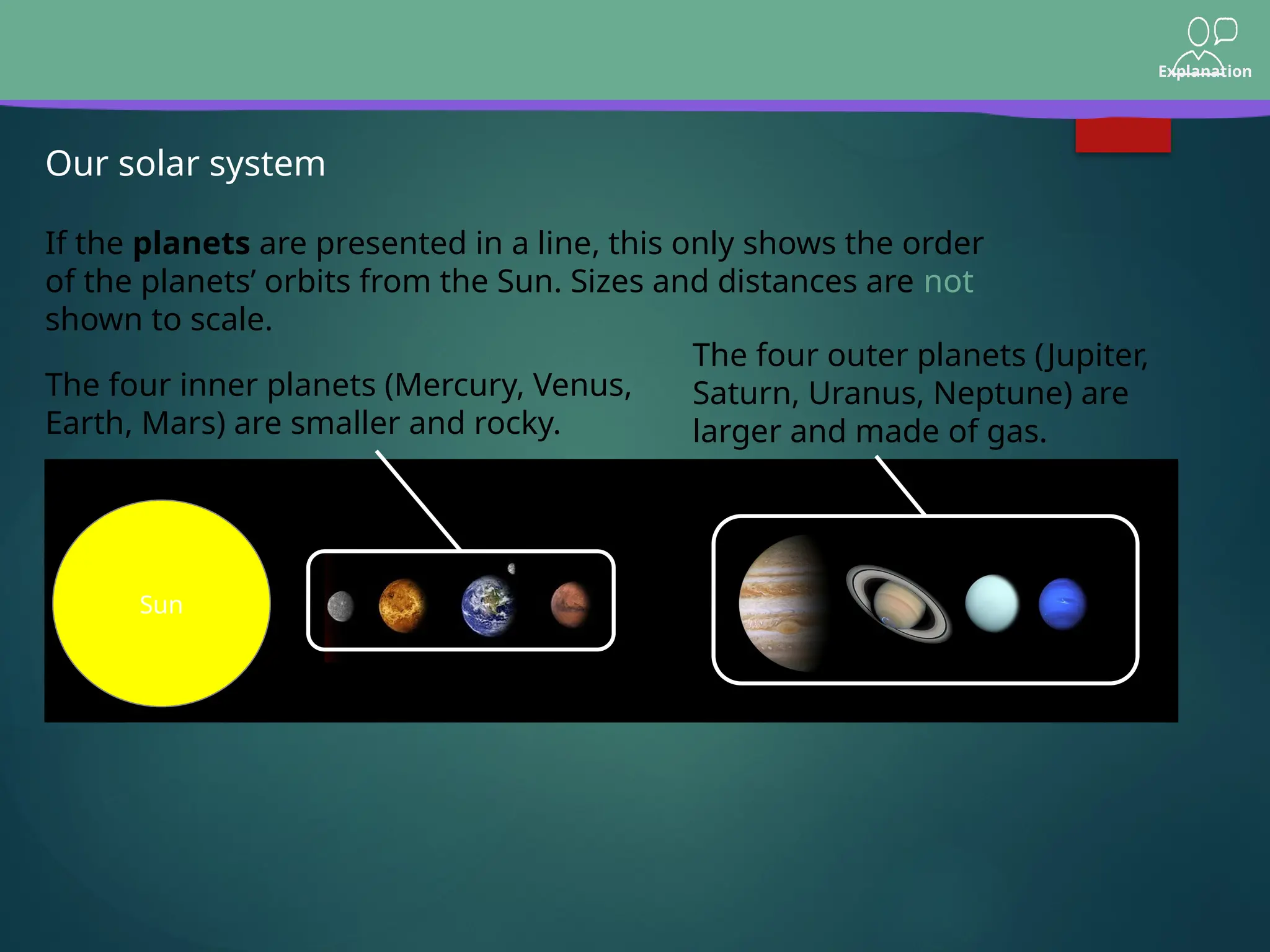
Sun
The four outer planets (Jupiter,
Saturn, Uranus, Neptune) are
larger and made of gas.
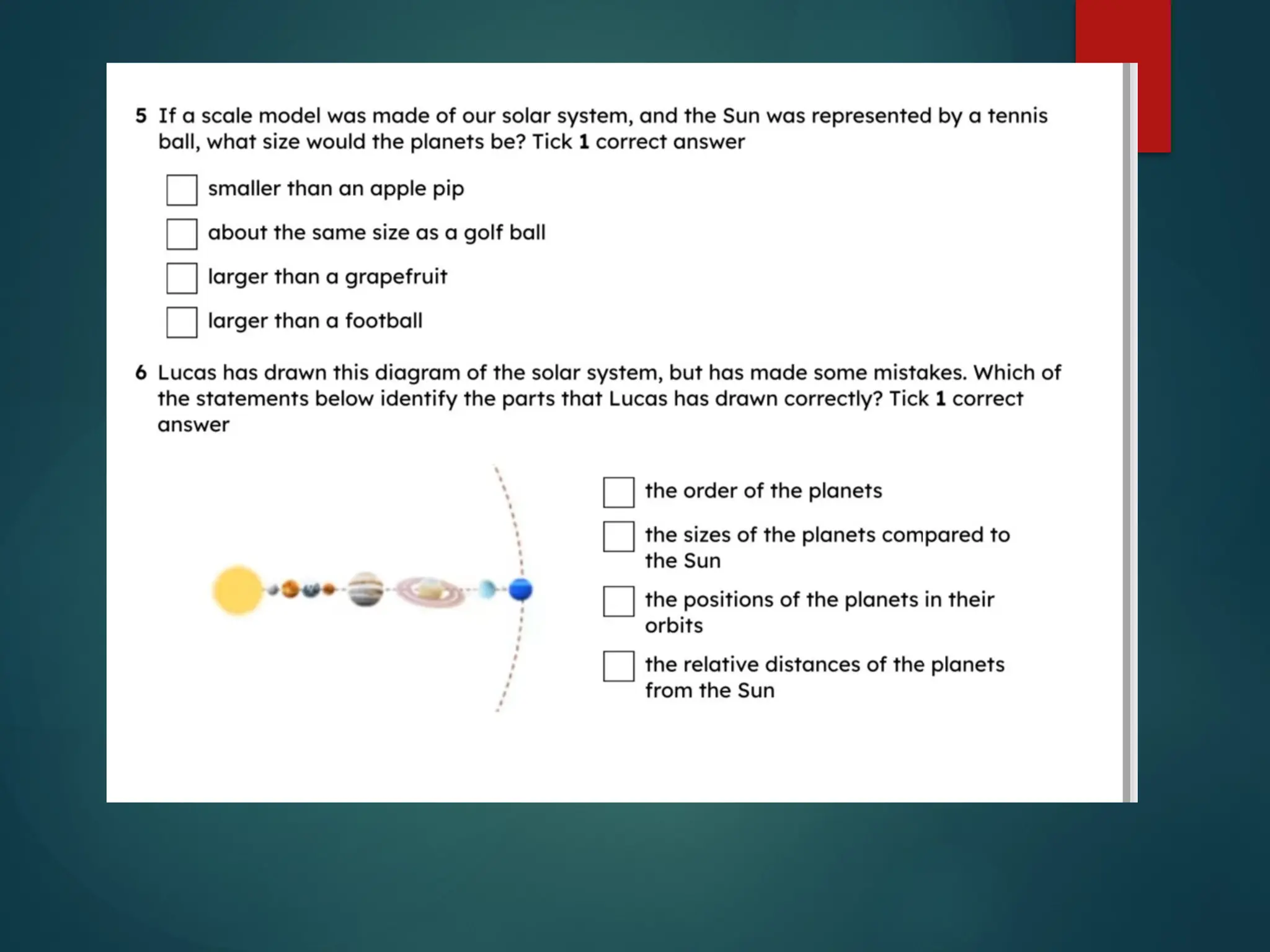
If the planets are presented in a line, this only shows the order
of the planets’ orbits from the Sun. Sizes and distances are not
shown to scale.
The four inner planets (Mercury, Venus,
Earth, Mars) are smaller and rocky.
Check
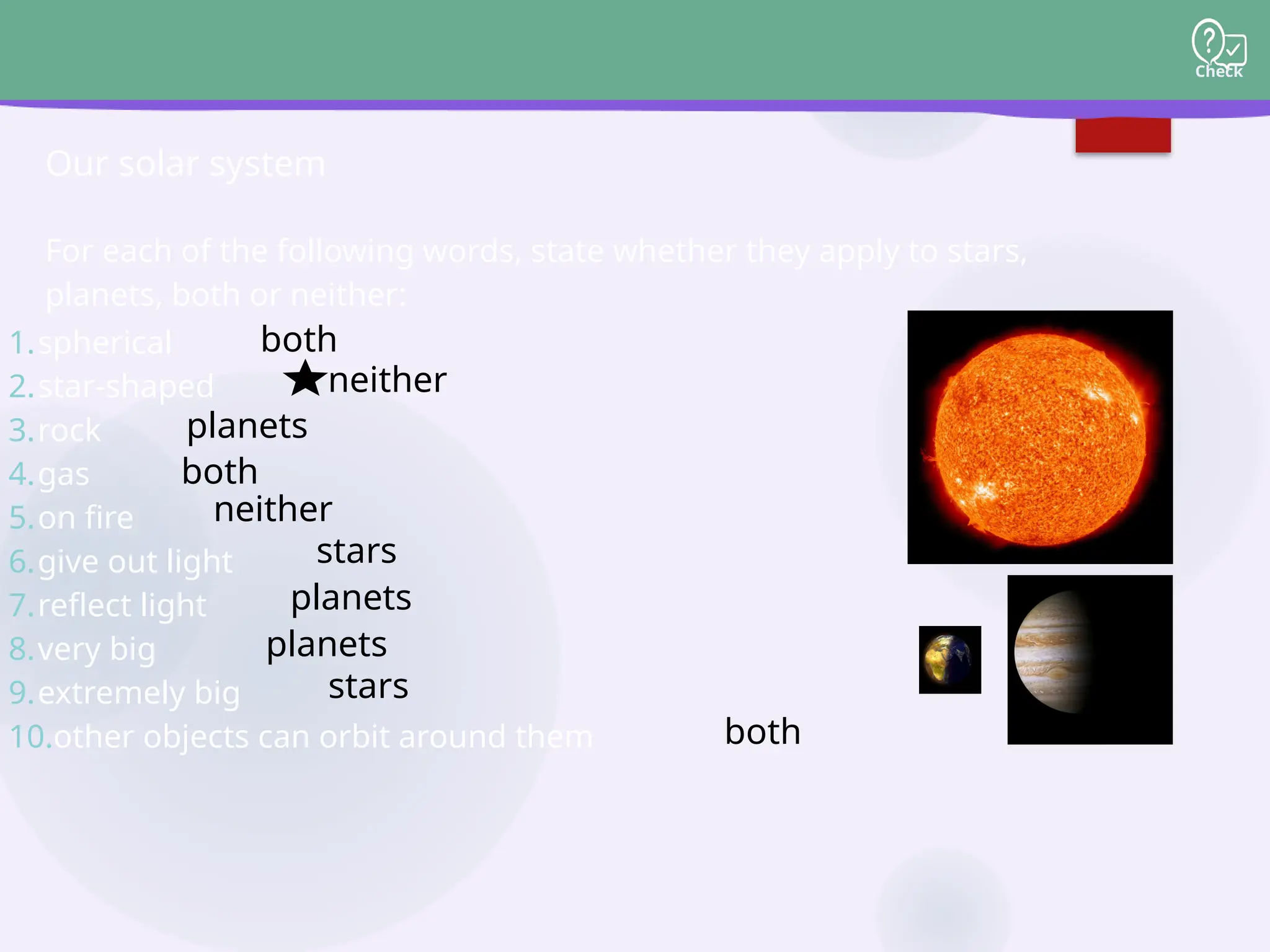
For each of the following words, state whether they apply to stars,
planets, both or neither:
Our solar system
1.spherical
2.star-shaped
3.rock
4.gas
5.on fire
6.give out light
7.reflect light
8.very big
9.extremely big
10.other objects can orbit around them
both
neither
planets
both
neither
stars
planets
planets
stars
both
Explanation
Our solar system
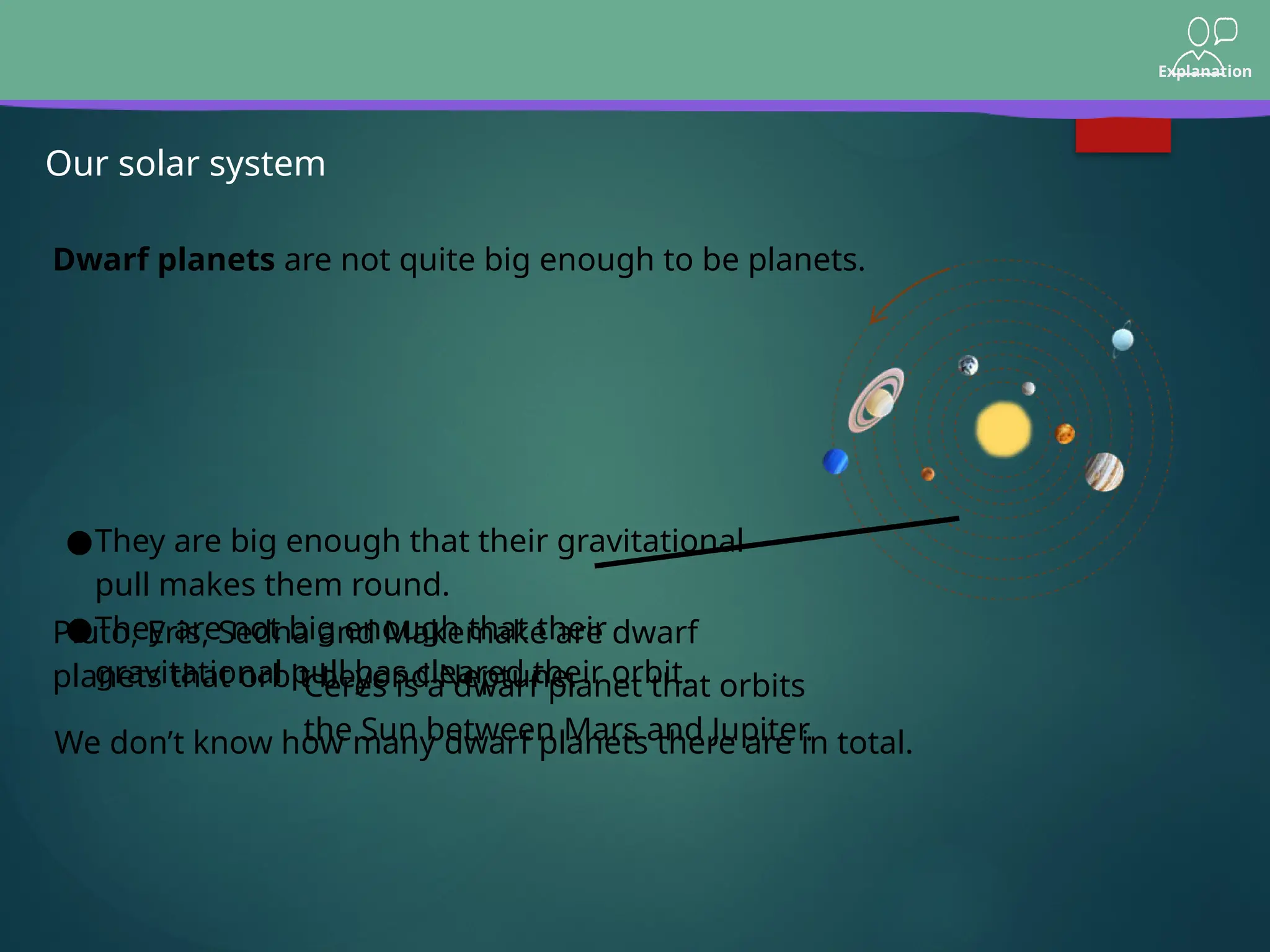
●They are big enough that their gravitational
pull makes them round.
●They are not big enough that their
gravitational pull has cleared their orbit.
Ceres is a dwarf planet that orbits
the Sun between Mars and Jupiter.
Pluto, Eris, Sedna and Makemake are dwarf
planets that orbit beyond Neptune.
Dwarf planets are not quite big enough to be planets.
We don’t know how many dwarf planets there are in total.
Explanation
Our solar system
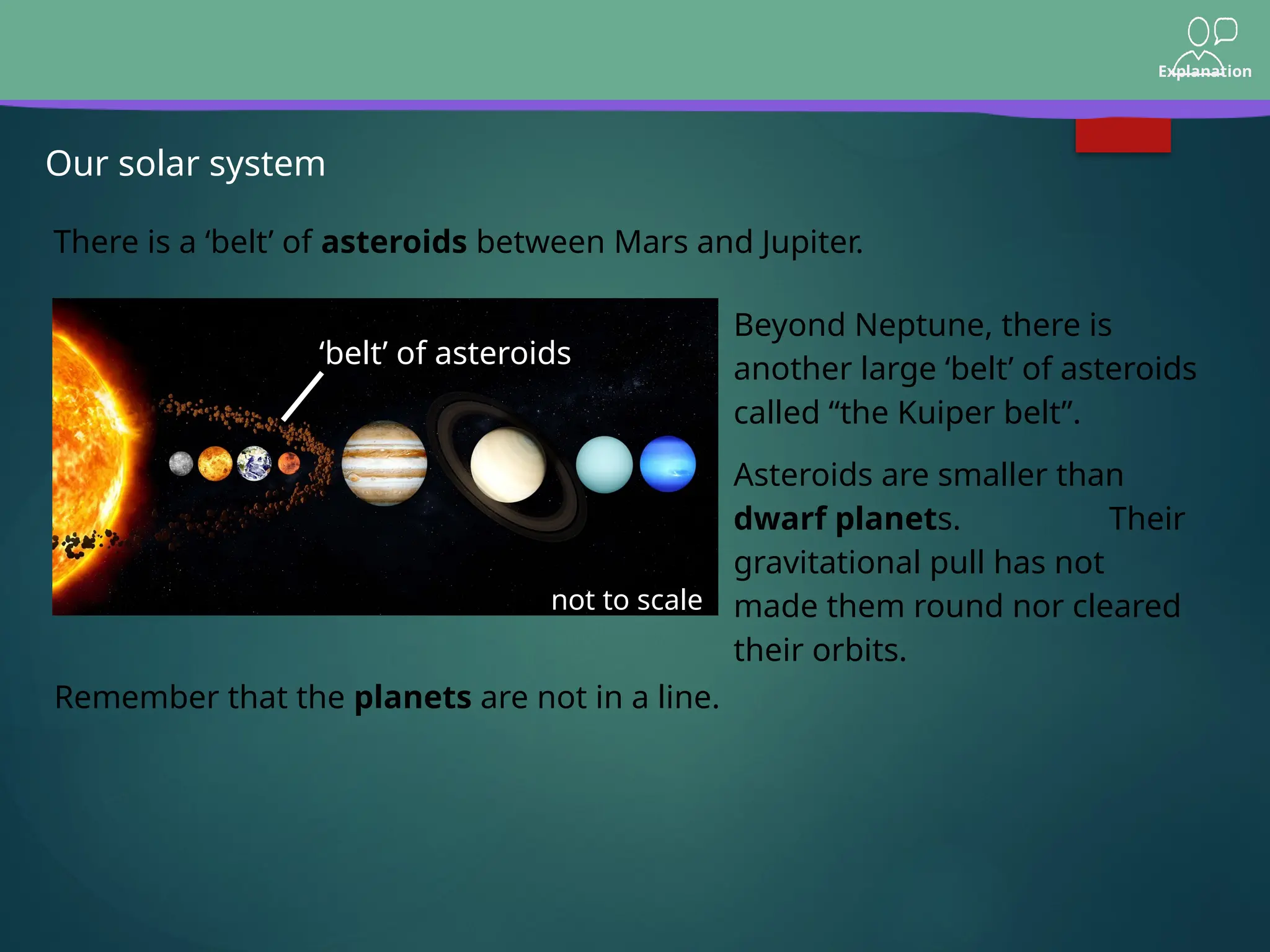
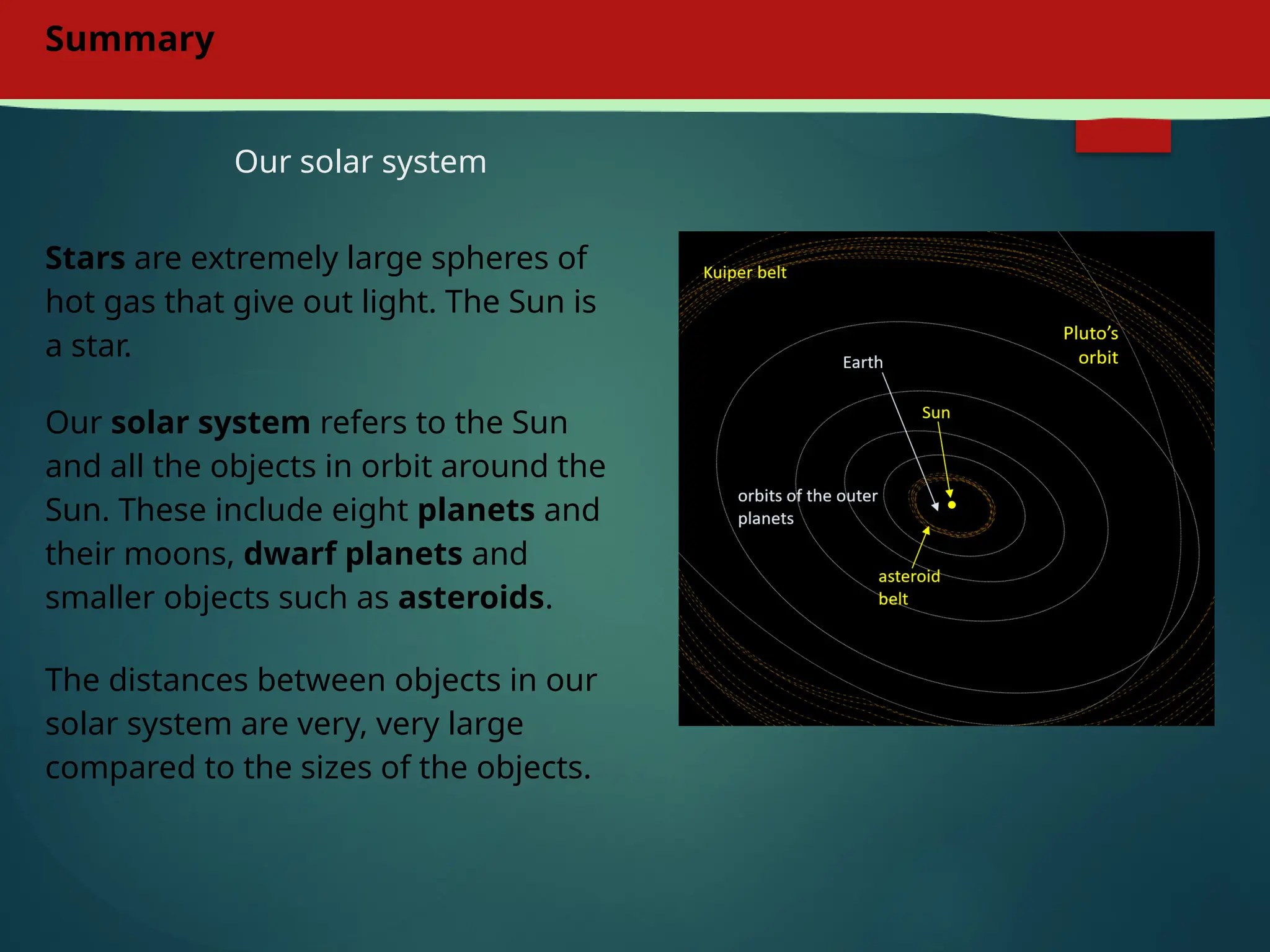
There is a ‘belt’ of asteroids between Mars and Jupiter.
Beyond Neptune, there is
another large ‘belt’ of asteroids
called “the Kuiper belt”.
Remember that the planets are not in a line.
Asteroids are smaller than
dwarf planets. Their
gravitational pull has not
made them round nor cleared
their orbits.
‘belt’ of asteroids
not to scale
Check
Our solar system
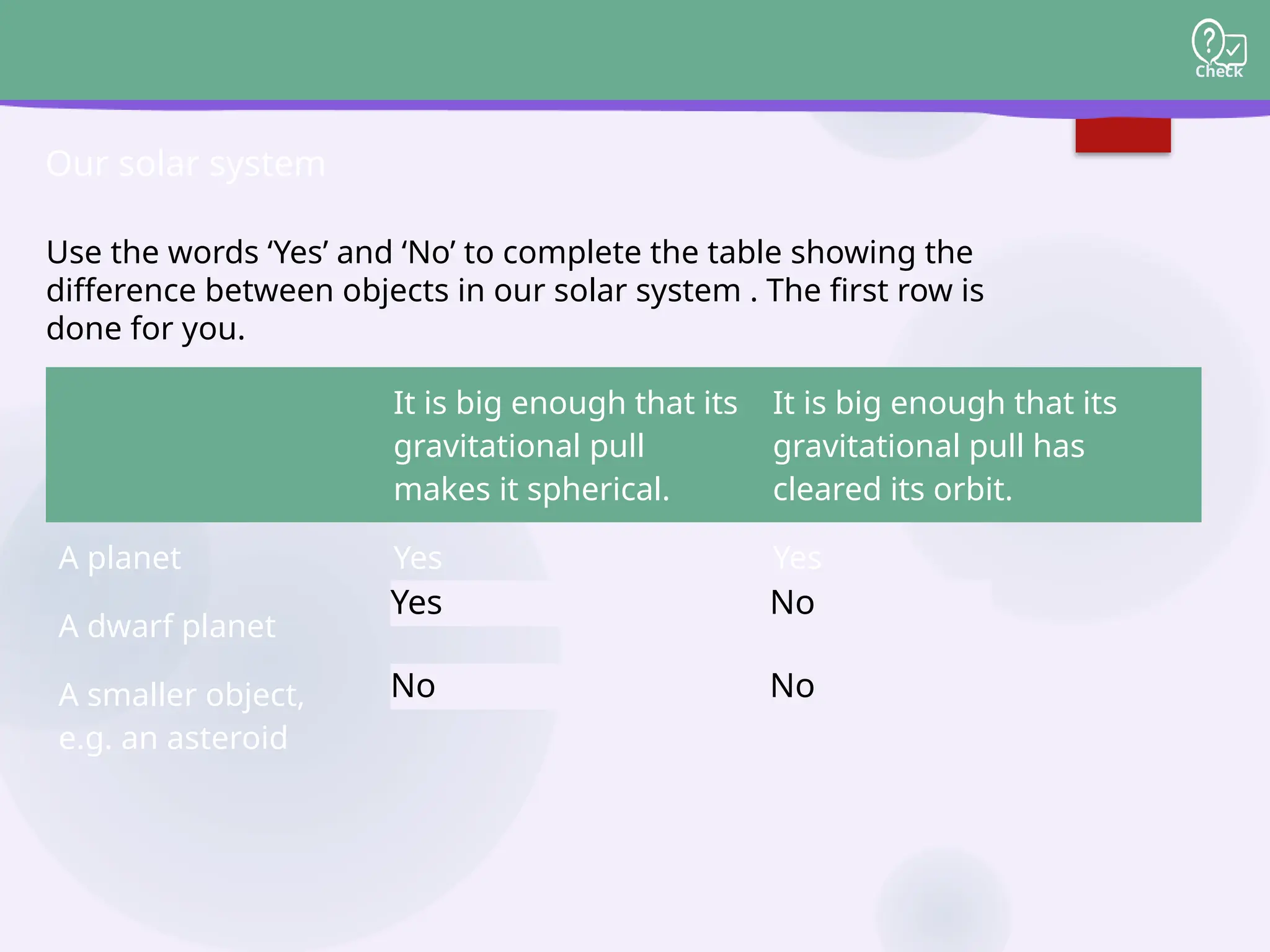
Use the words ‘Yes’ and ‘No’ to complete the table showing the
difference between objects in our solar system . The first row is
done for you.
Yes No
No No
It is big enough that its
gravitational pull
makes it spherical.
It is big enough that its
gravitational pull has
cleared its orbit.
A planet Yes Yes
A dwarf planet
A smaller object,
e.g. an asteroid
Explanation
Our solar system
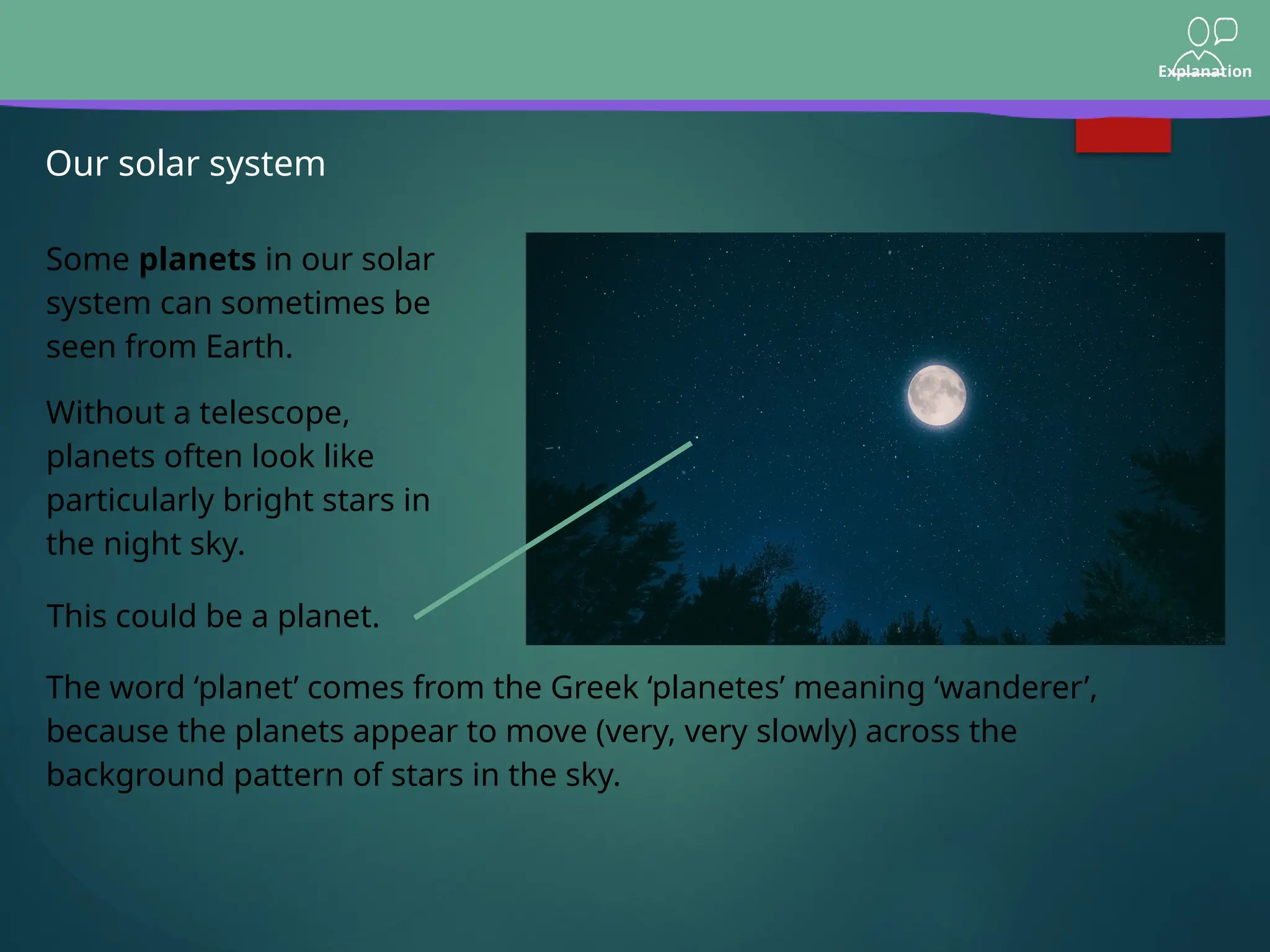
Some planets in our solar
system can sometimes be
seen from Earth.
Without a telescope,
planets often look like
particularly bright stars in
the night sky.
The word ‘planet’ comes from the Greek ‘planetes’ meaning ‘wanderer’,
because the planets appear to move (very, very slowly) across the
background pattern of stars in the sky.
This could be a planet.
Explanation
Our solar system
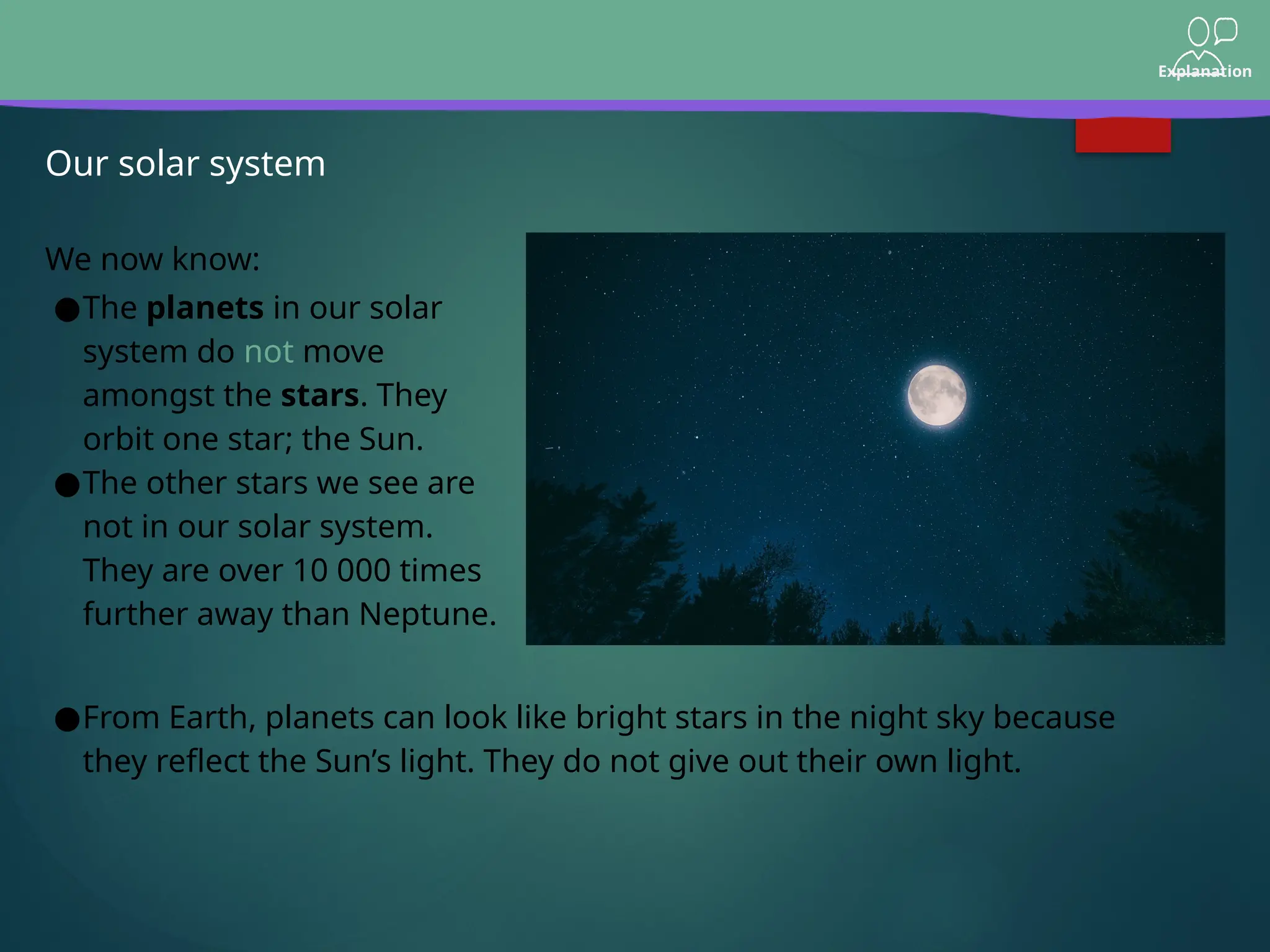
We now know:
●From Earth, planets can look like bright stars in the night sky because
they reflect the Sun’s light. They do not give out their own light.
●The planets in our solar
system do not move
amongst the stars. They
orbit one star; the Sun.
●The other stars we see are
not in our solar system.
They are over 10 000 times
further away than Neptune.
Check
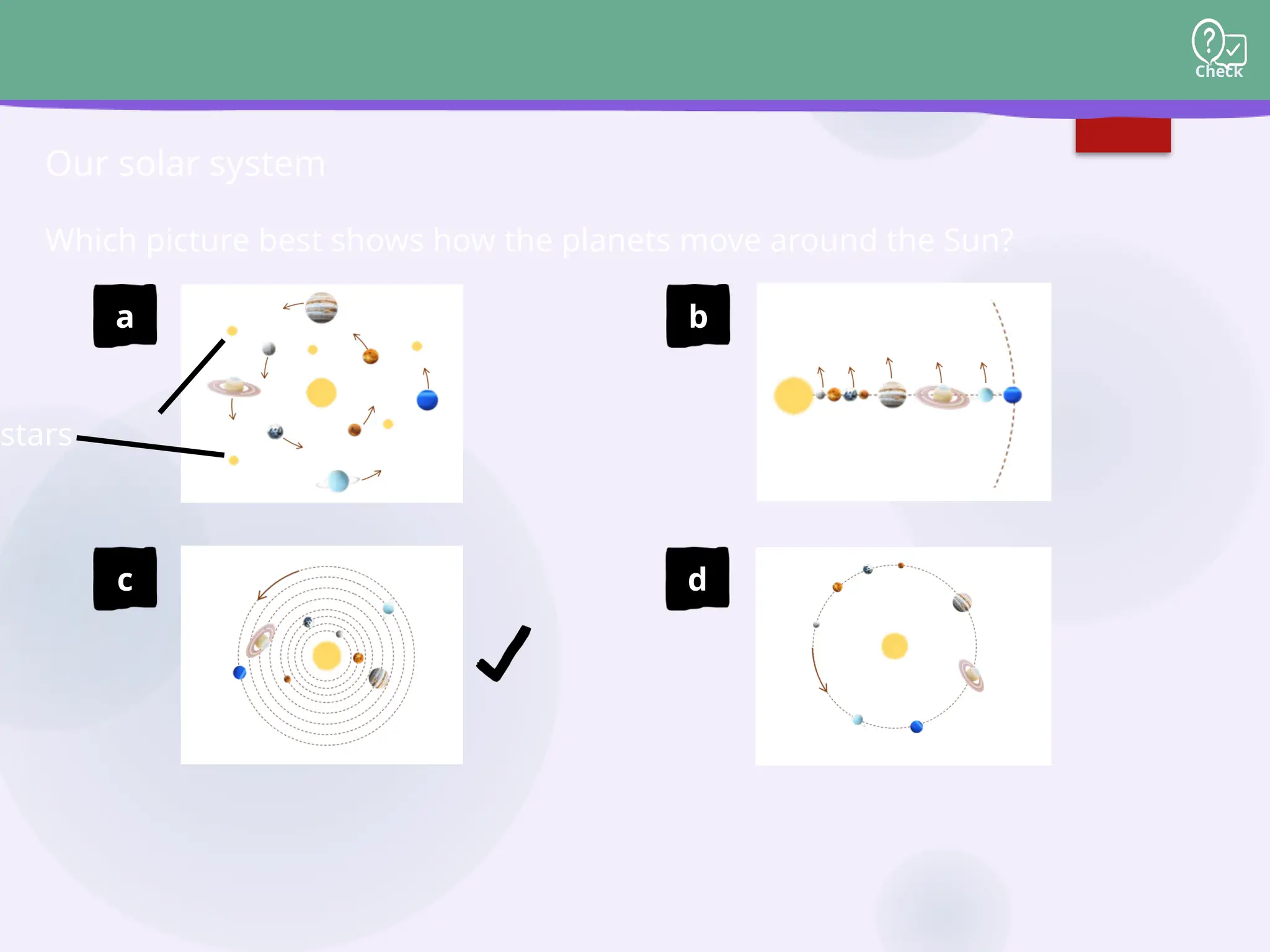
Which picture best shows how the planets move around the Sun?
Our solar system
stars
a b
c d
Task A
Practice
Our solar system
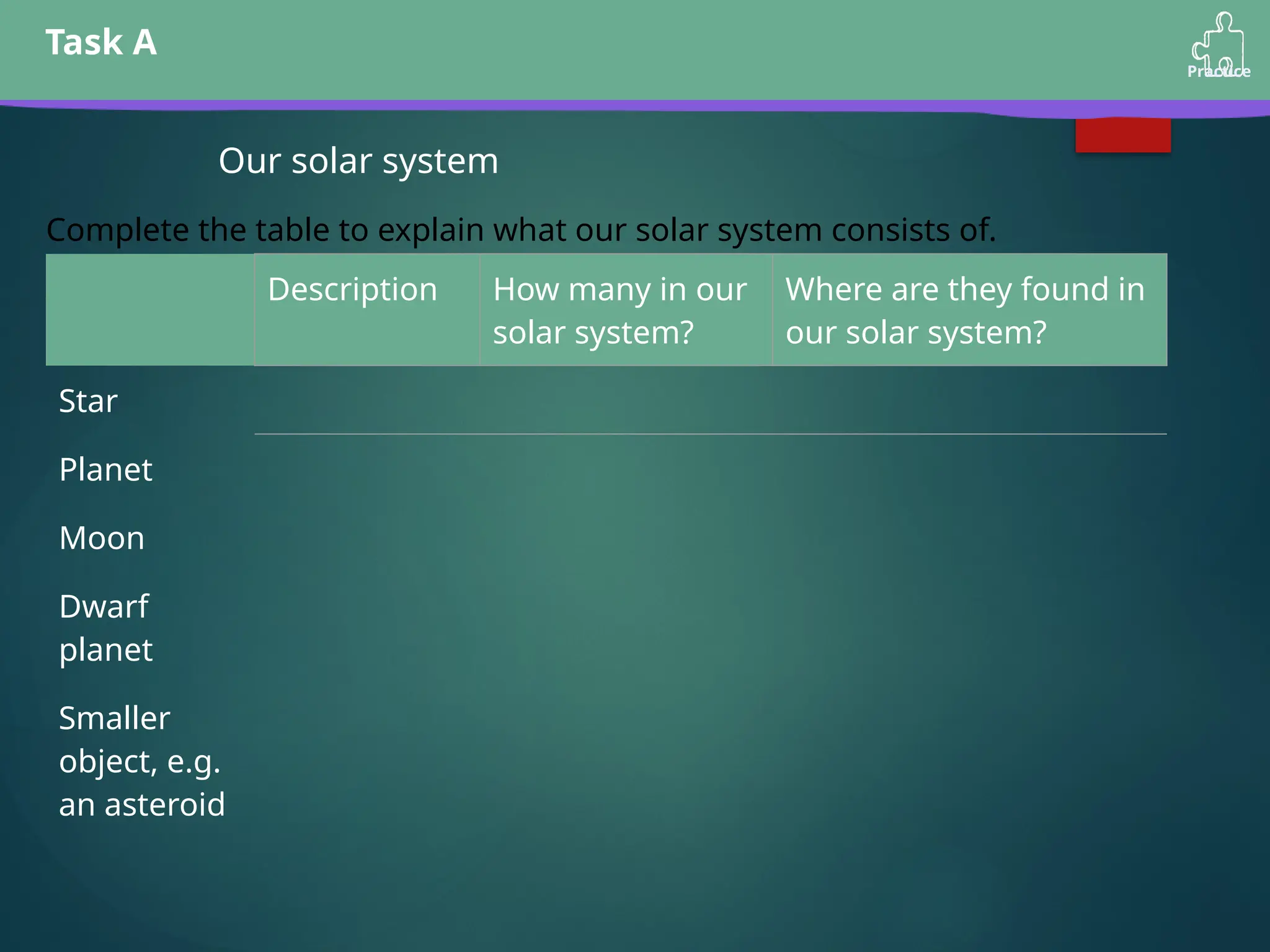
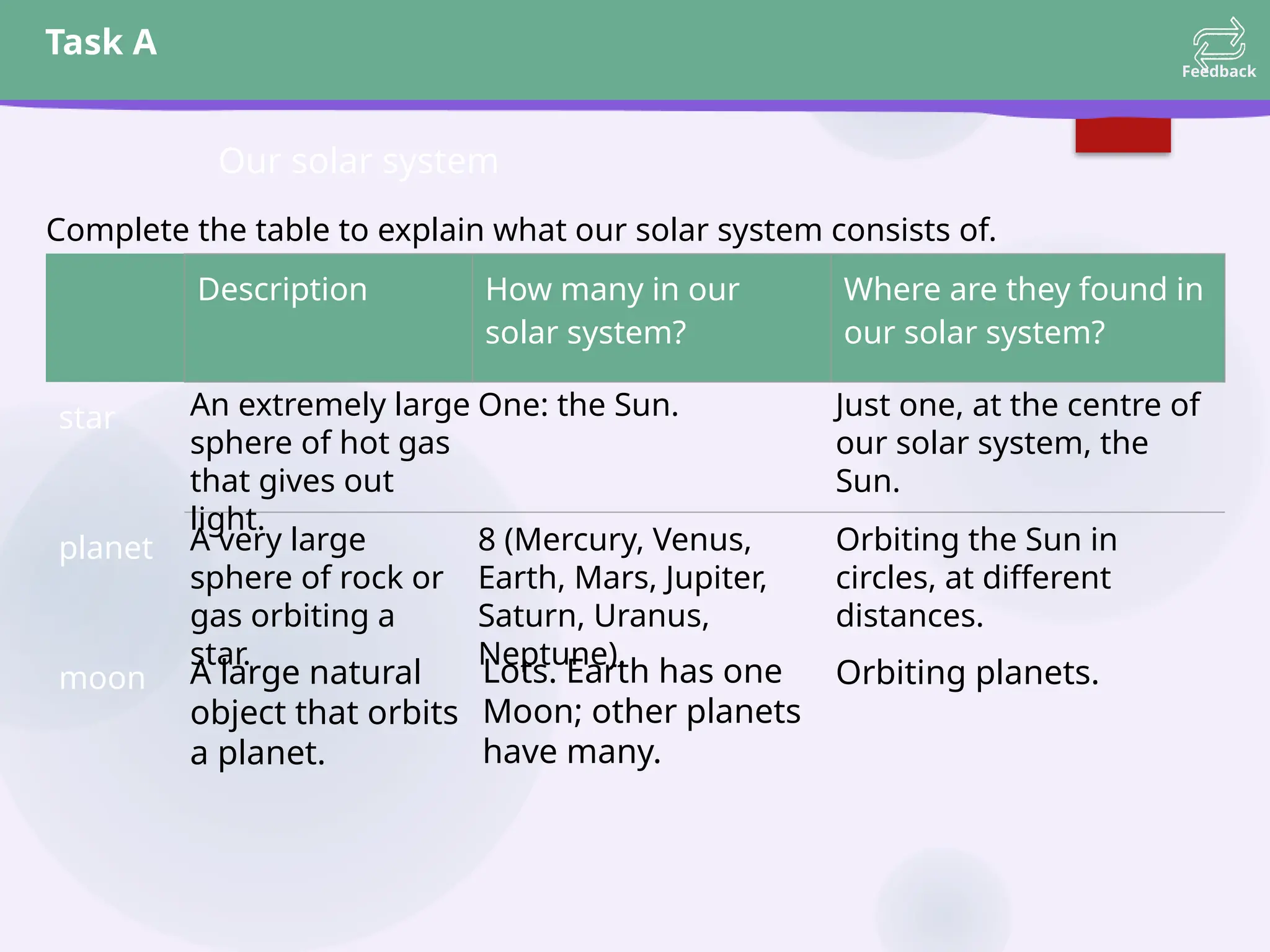
Complete the table to explain what our solar system consists of.
Description How many in our
solar system?
Where are they found in
our solar system?
Star
Planet
Moon
Dwarf
planet
Smaller
object, e.g.
an asteroid
Task A
Feedback
Description How many in our
solar system?
Where are they found in
our solar system?
star
planet
moon
Our solar system
A very large
sphere of rock or
gas orbiting a
star.
8 (Mercury, Venus,
Earth, Mars, Jupiter,
Saturn, Uranus,
Neptune).
Orbiting the Sun in
circles, at different
distances.
Complete the table to explain what our solar system consists of.
An extremely large
sphere of hot gas
that gives out
light.
One: the Sun. Just one, at the centre of
our solar system, the
Sun.
A large natural
object that orbits
a planet.
Lots. Earth has one
Moon; other planets
have many.
Orbiting planets.
Task A
Feedback
Our solar system
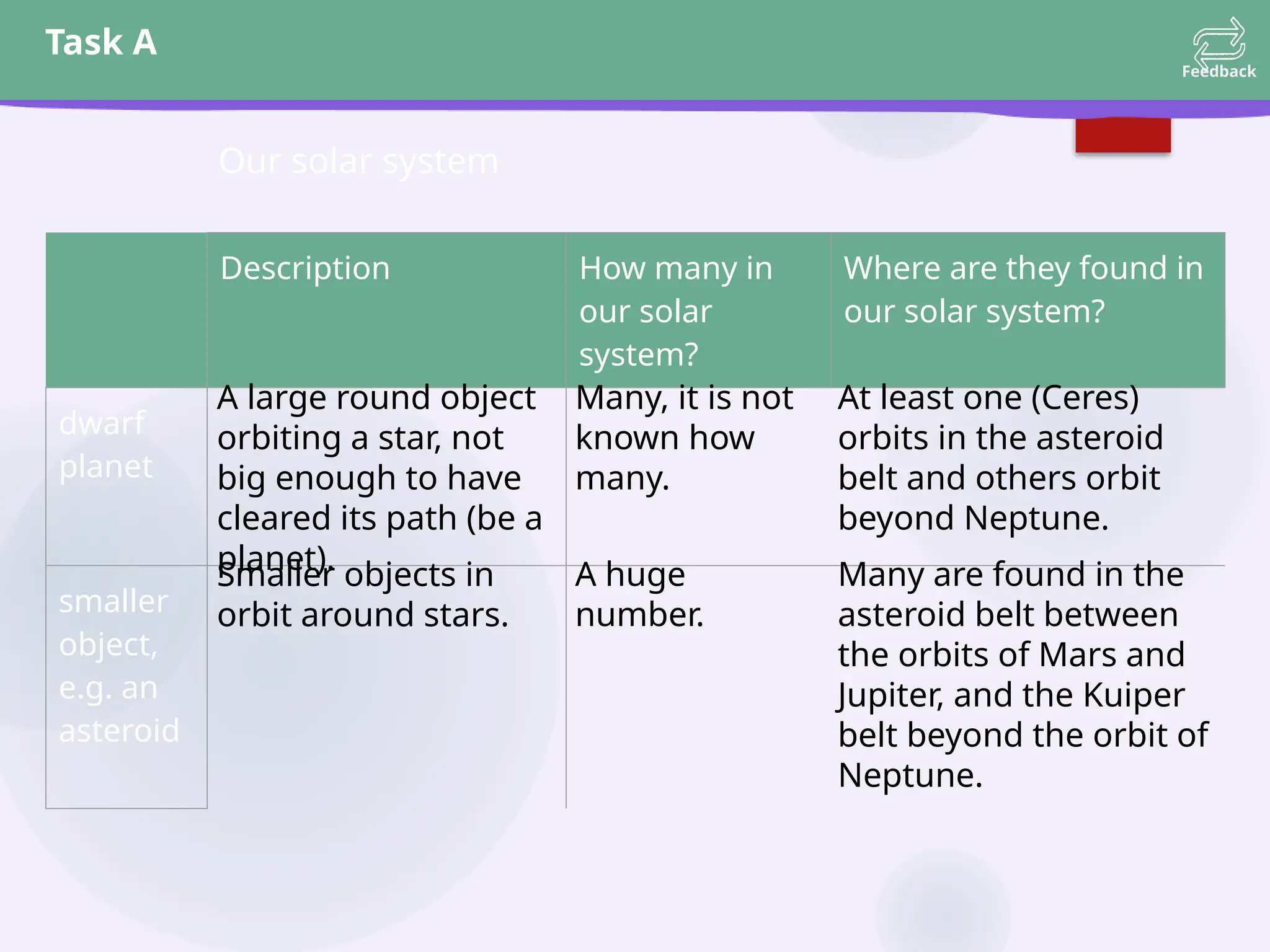
Description How many in
our solar
system?
Where are they found in
our solar system?
dwarf
planet
smaller
object,
e.g. an
asteroid
A large round object
orbiting a star, not
big enough to have
cleared its path (be a
planet).
Many, it is not
known how
many.
At least one (Ceres)
orbits in the asteroid
belt and others orbit
beyond Neptune.
Smaller objects in
orbit around stars.
A huge
number.
Many are found in the
asteroid belt between
the orbits of Mars and
Jupiter, and the Kuiper
belt beyond the orbit of
Neptune.
Explanation
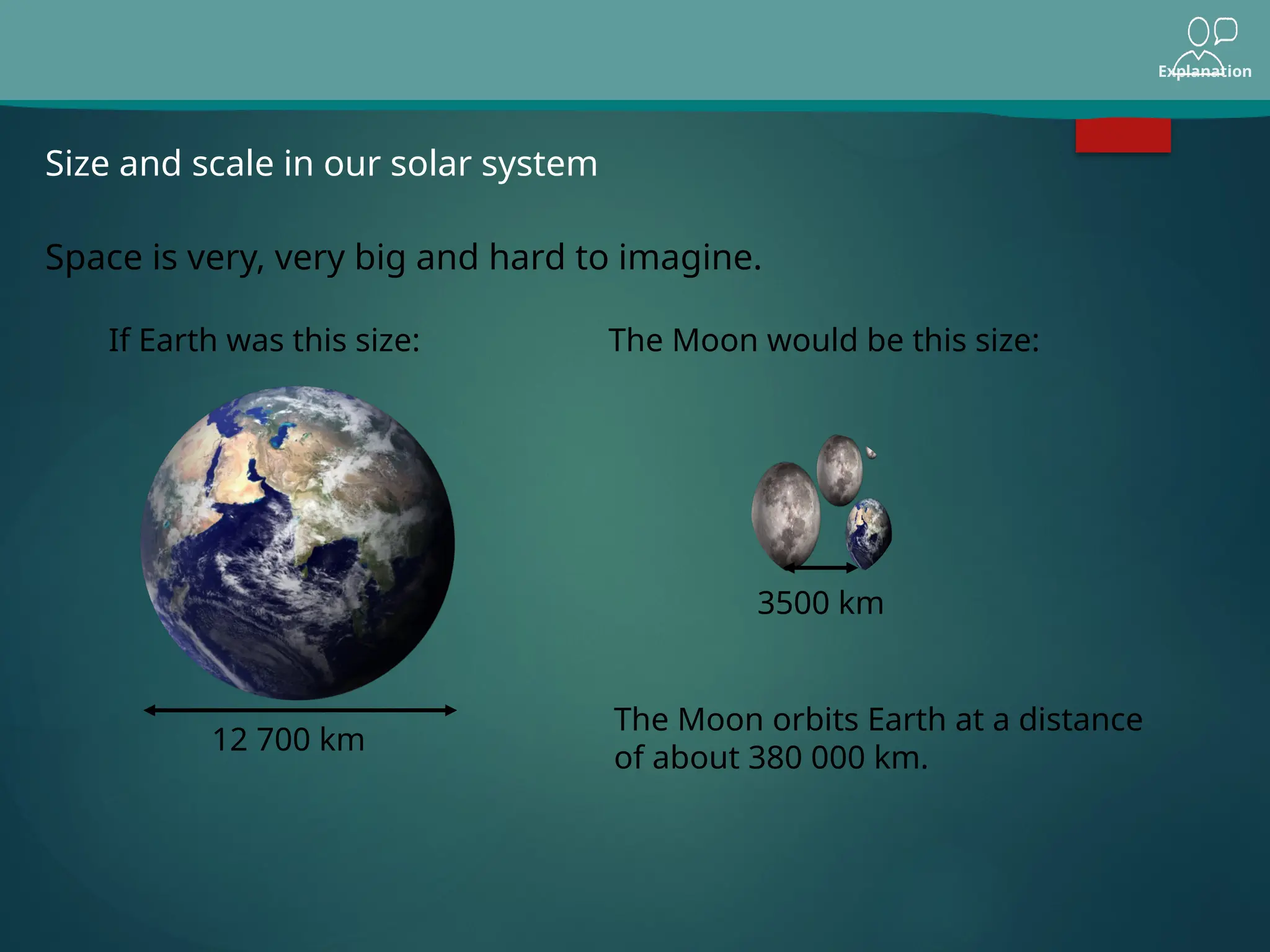
Size and scale in our solar system
Space is very, very big and hard to imagine.
If Earth was this size: The Moon would be this size:
12 700 km
3500 km
The Moon orbits Earth at a distance
of about 380 000 km.
Explanation
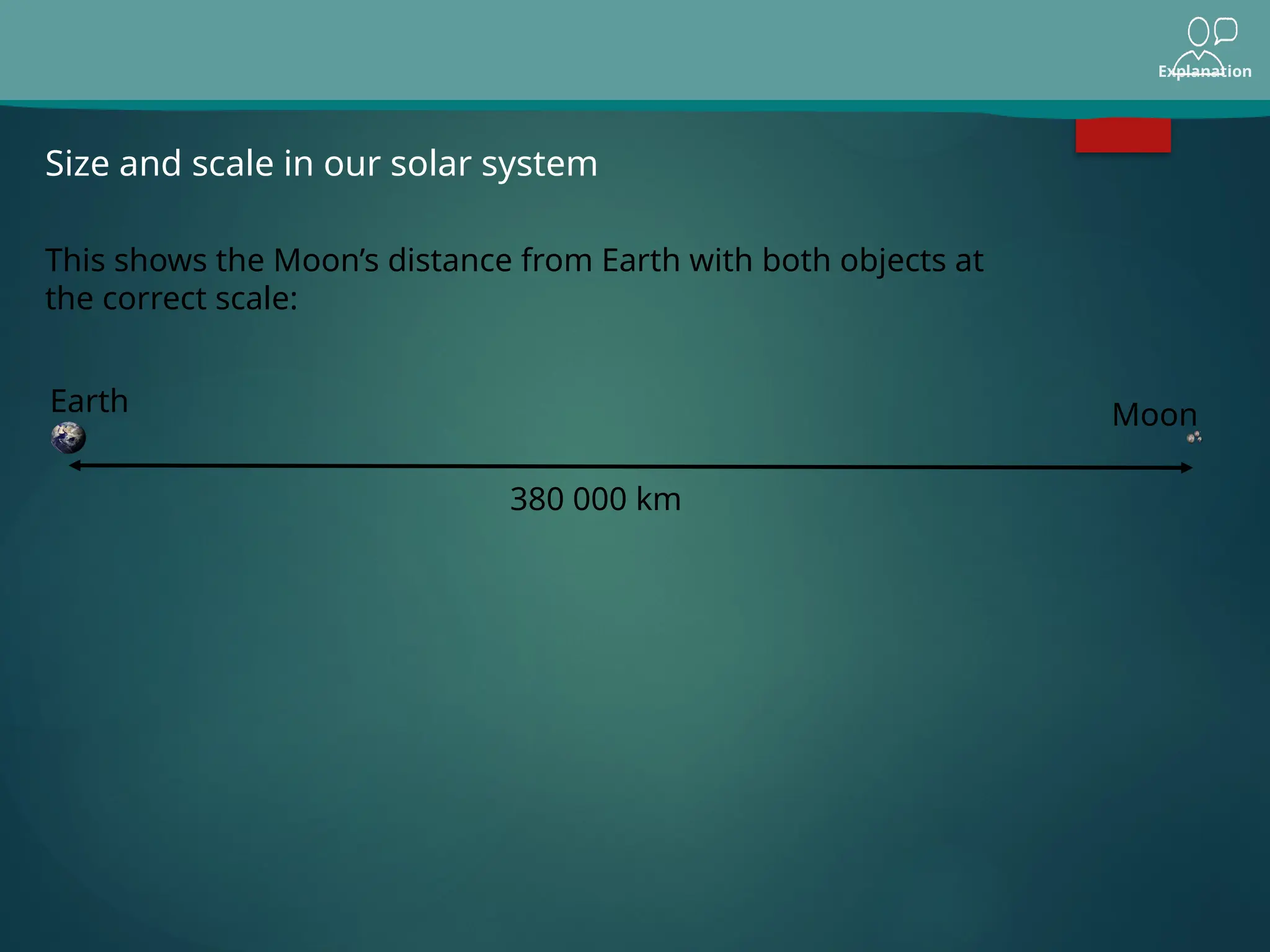
Moon
Size and scale in our solar system
This shows the Moon’s distance from Earth with both objects at
the correct scale:
380 000 km
Earth
Explanation
Size and scale in our solar system
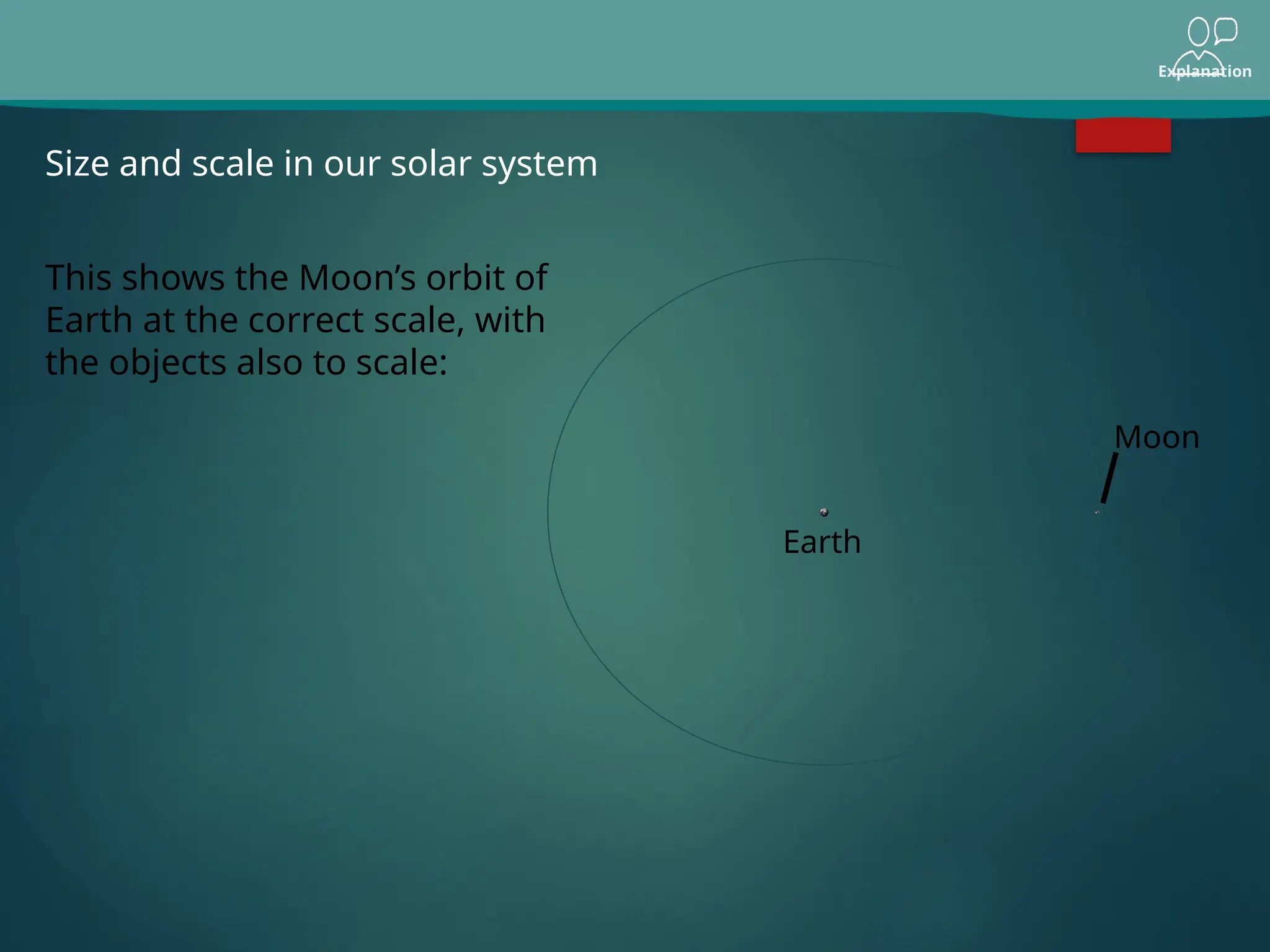
This shows the Moon’s orbit of
Earth at the correct scale, with
the objects also to scale:
Earth
Moon
Explanation
Size and scale in our solar system
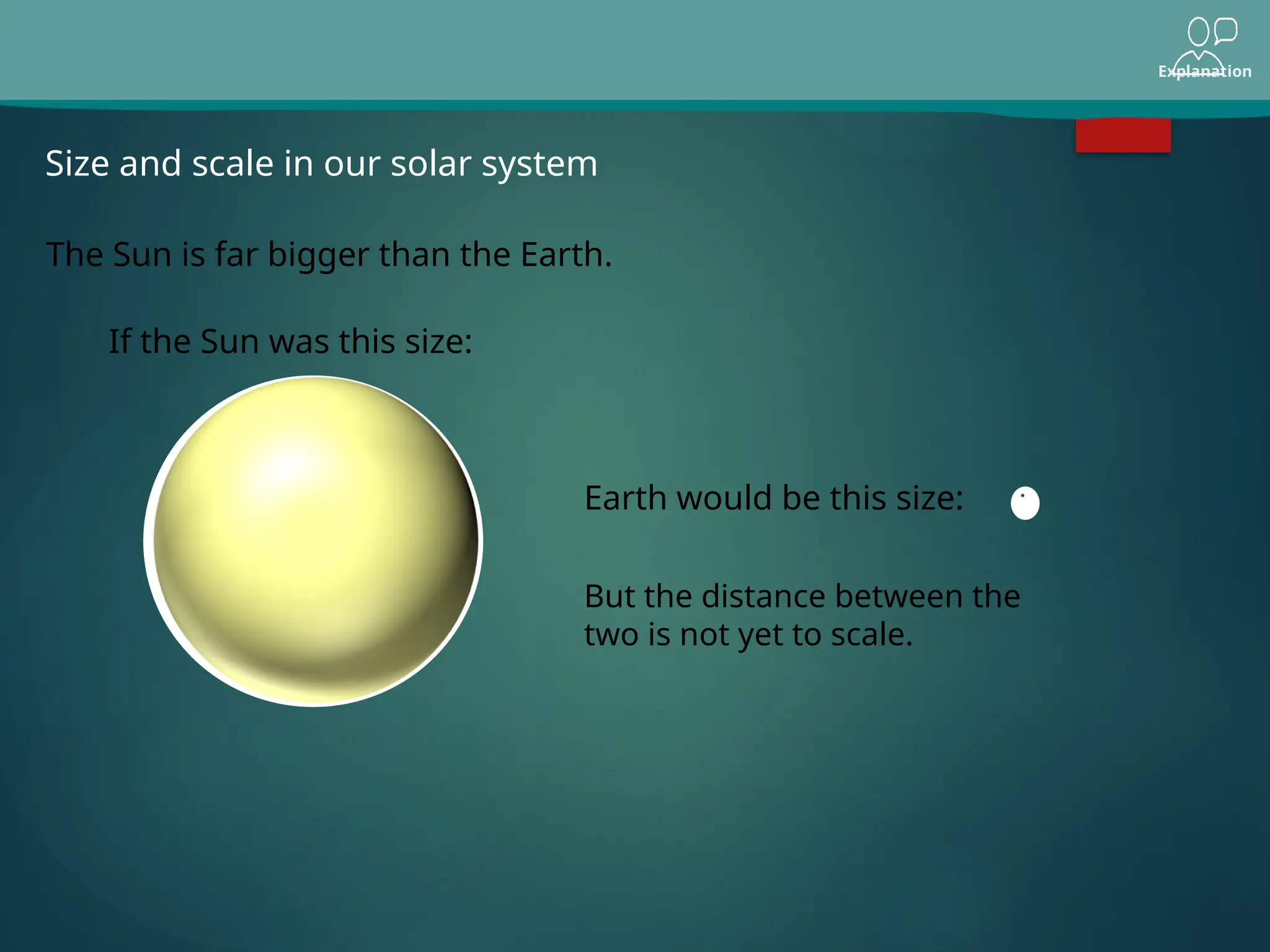
The Sun is far bigger than the Earth.
If the Sun was this size:
Earth would be this size:
But the distance between the
two is not yet to scale.
Explanation Check
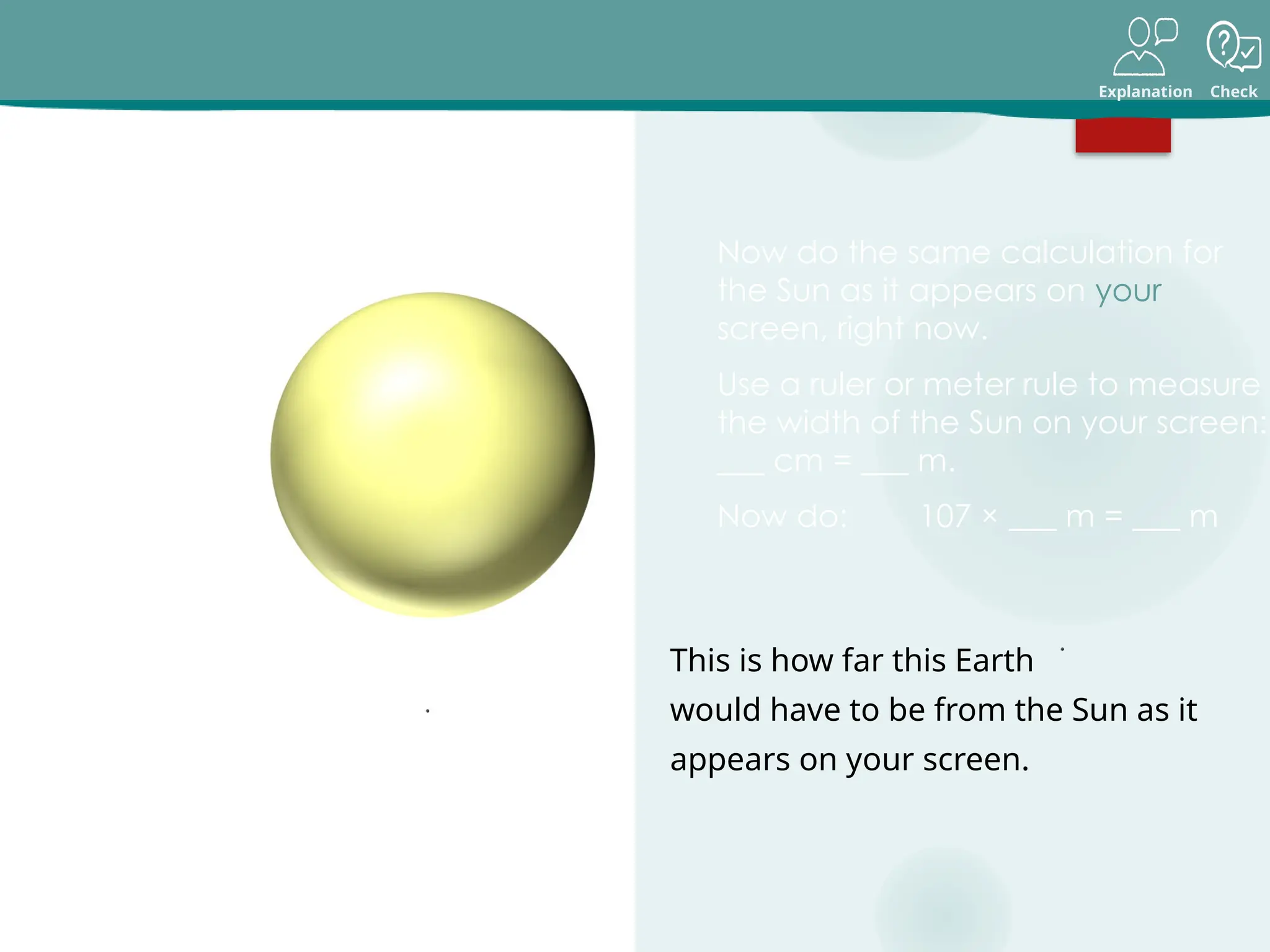
Earth is about 107 sun-widths away
from the Sun.
On one screen,
this Sun is
about 15 cm
across.
Size and scale in our solar system
Now do the same calculation for
the Sun as it appears on your
screen, right now.
Use a ruler or meter rule to measure
the width of the Sun on your screen:
___ cm = ___ m.
Now do: 107 × ___ m = ___ m
15 cm = 0.15 m
107 × 0.15 m = 16.05 m
On that scale, this Earth
would have to be 16 m
away.
This is how far this Earth
would have to be from the Sun as it
appears on your screen.
Explanation
Size and scale in our solar system
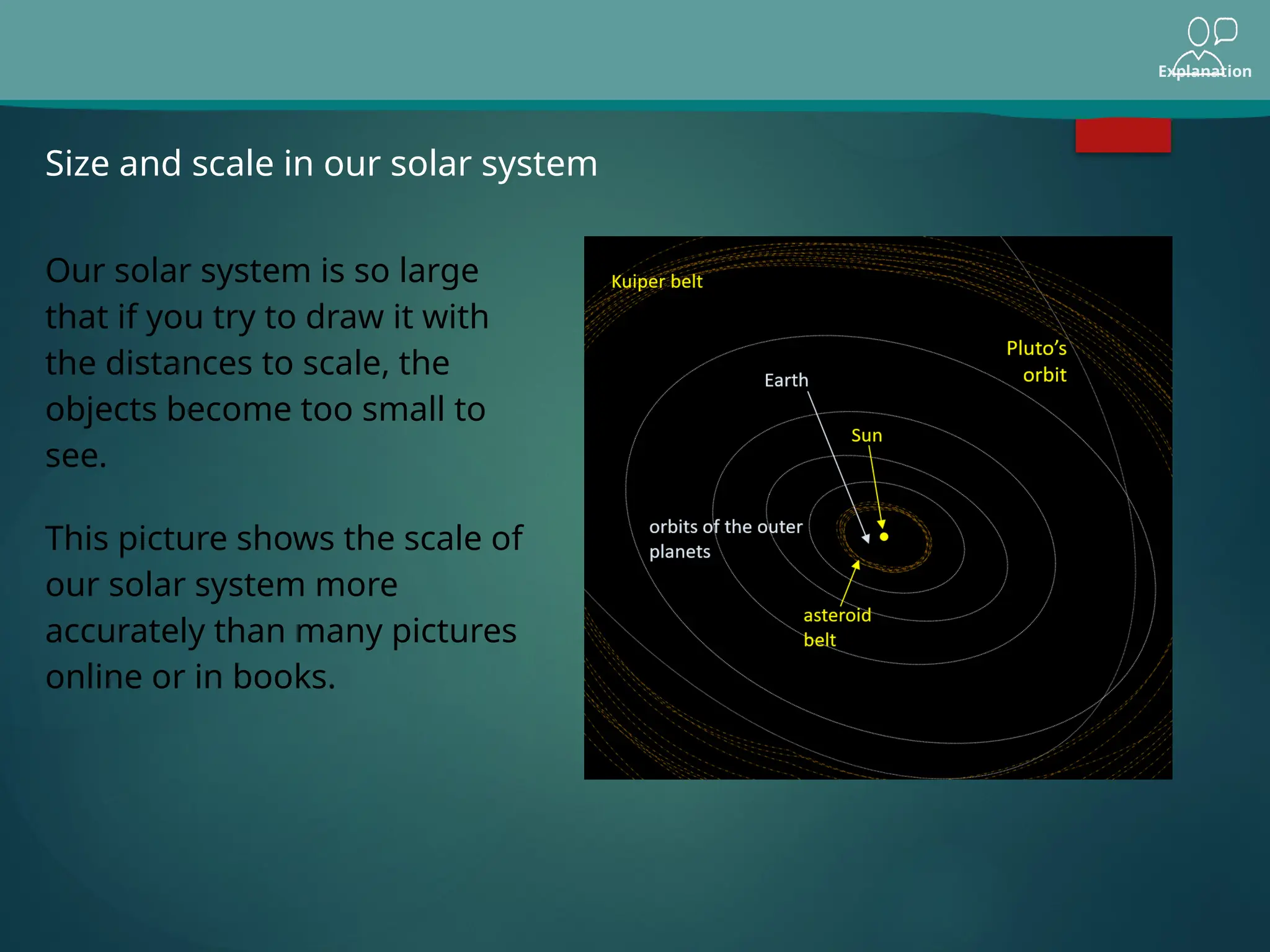
Our solar system is so large
that if you try to draw it with
the distances to scale, the
objects become too small to
see.
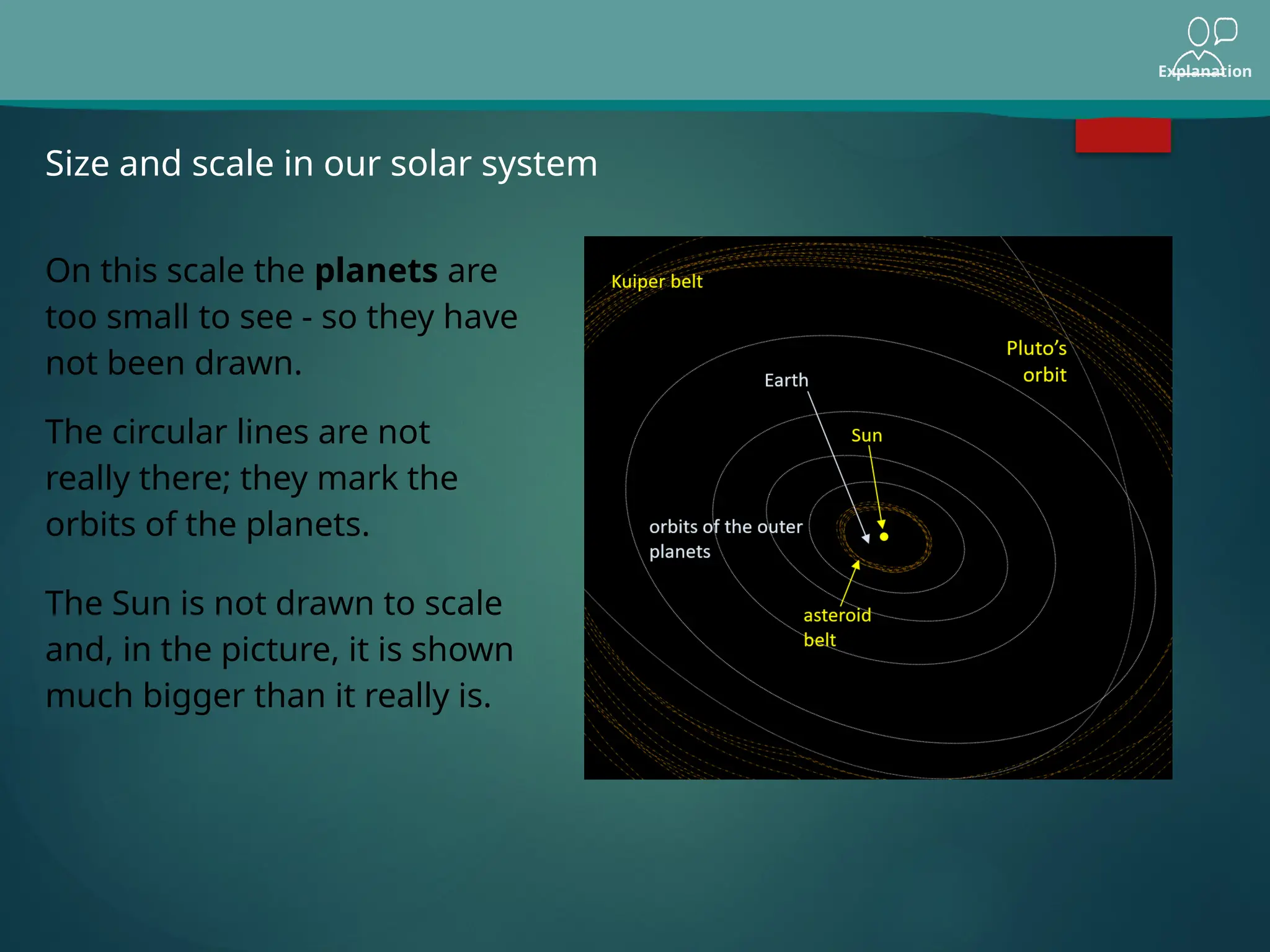
This picture shows the scale of
our solar system more
accurately than many pictures
online or in books.
Explanation
Size and scale in our solar system
On this scale the planets are
too small to see - so they have
not been drawn.
The circular lines are not
really there; they mark the
orbits of the planets.
The Sun is not drawn to scale
and, in the picture, it is shown
much bigger than it really is.
Explanation
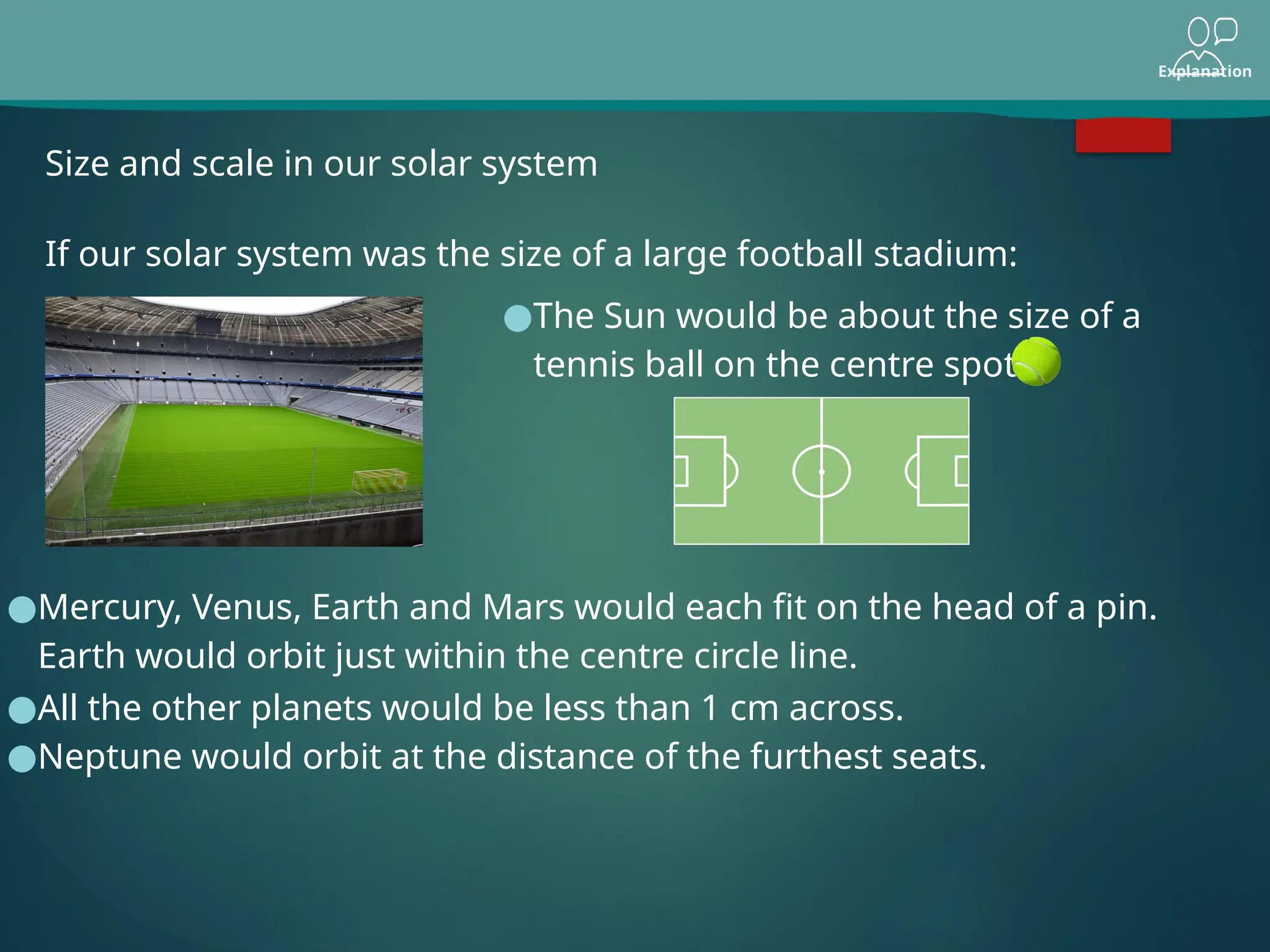
If our solar system was the size of a large football stadium:
Size and scale in our solar system
●The Sun would be about the size of a
tennis ball on the centre spot.
●Mercury, Venus, Earth and Mars would each fit on the head of a pin.
Earth would orbit just within the centre circle line.
●All the other planets would be less than 1 cm across.
●Neptune would orbit at the distance of the furthest seats.
Check
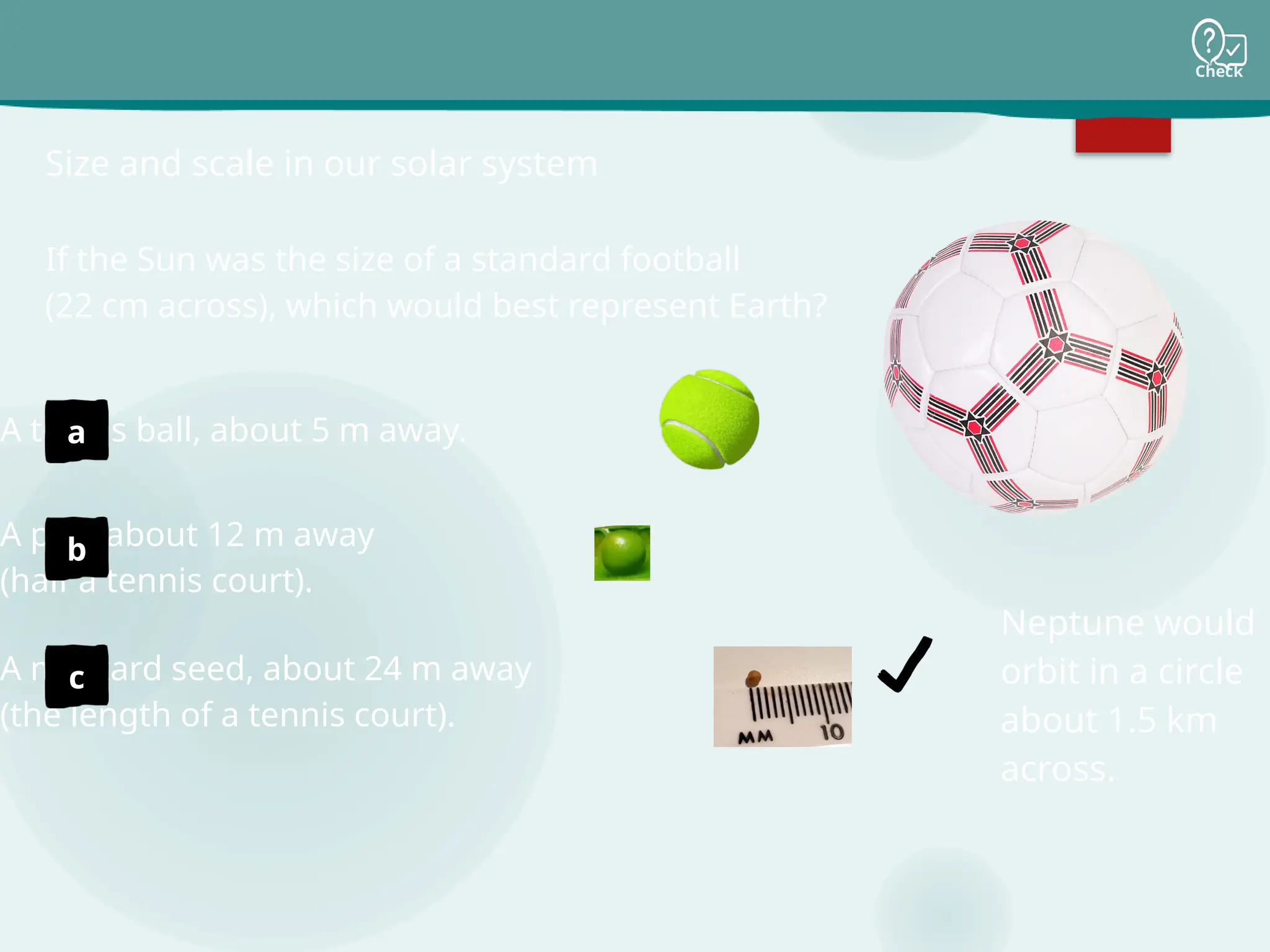
If the Sun was the size of a standard football
(22 cm across), which would best represent Earth?
Size and scale in our solar system
A tennis ball, about 5 m away.
A pea, about 12 m away
(half a tennis court).
A mustard seed, about 24 m away
(the length of a tennis court).
Neptune would
orbit in a circle
about 1.5 km
across.
a
b
c
Practice
Task B
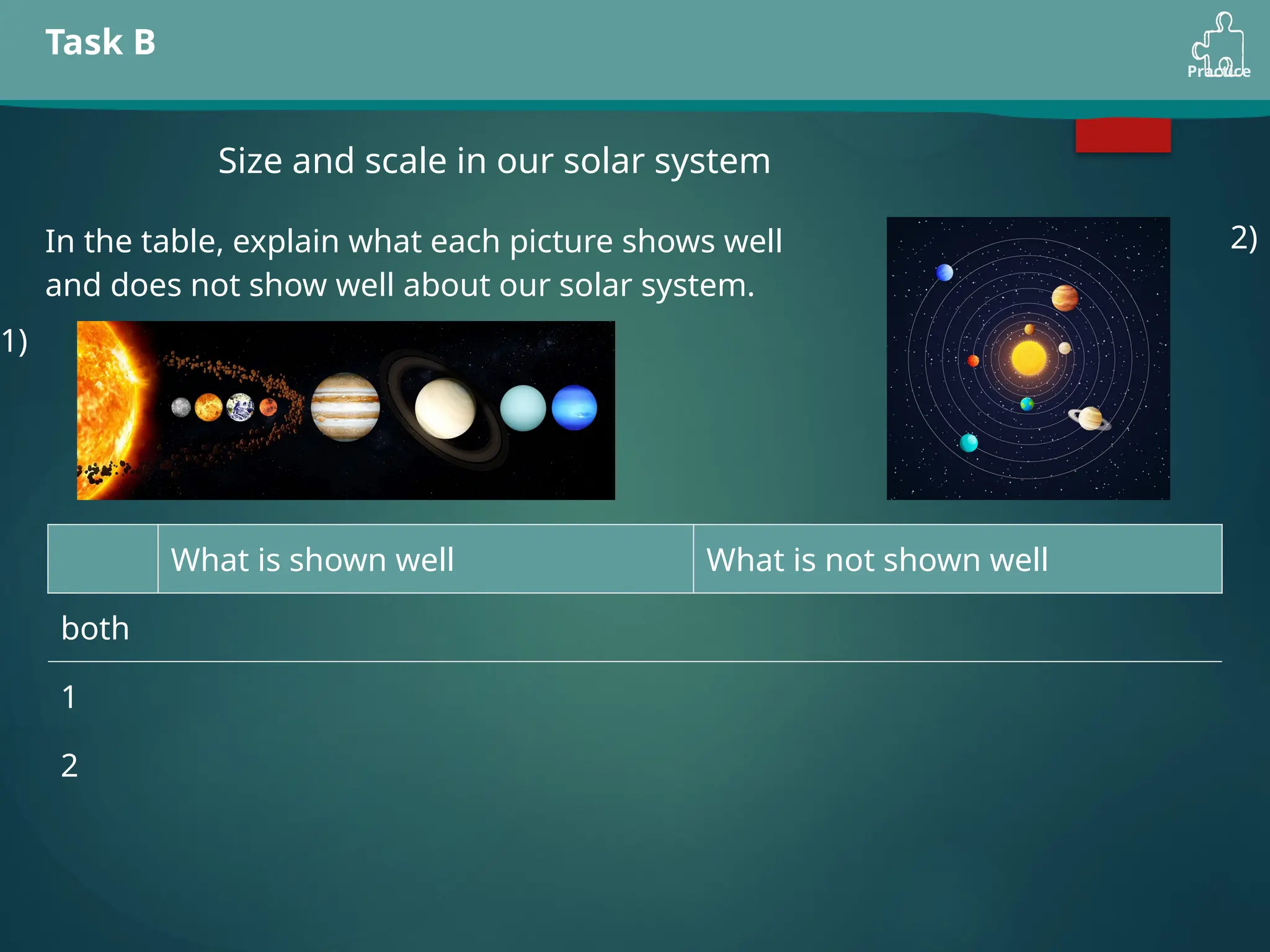
In the table, explain what each picture shows well
and does not show well about our solar system.
Size and scale in our solar system
1)
2)
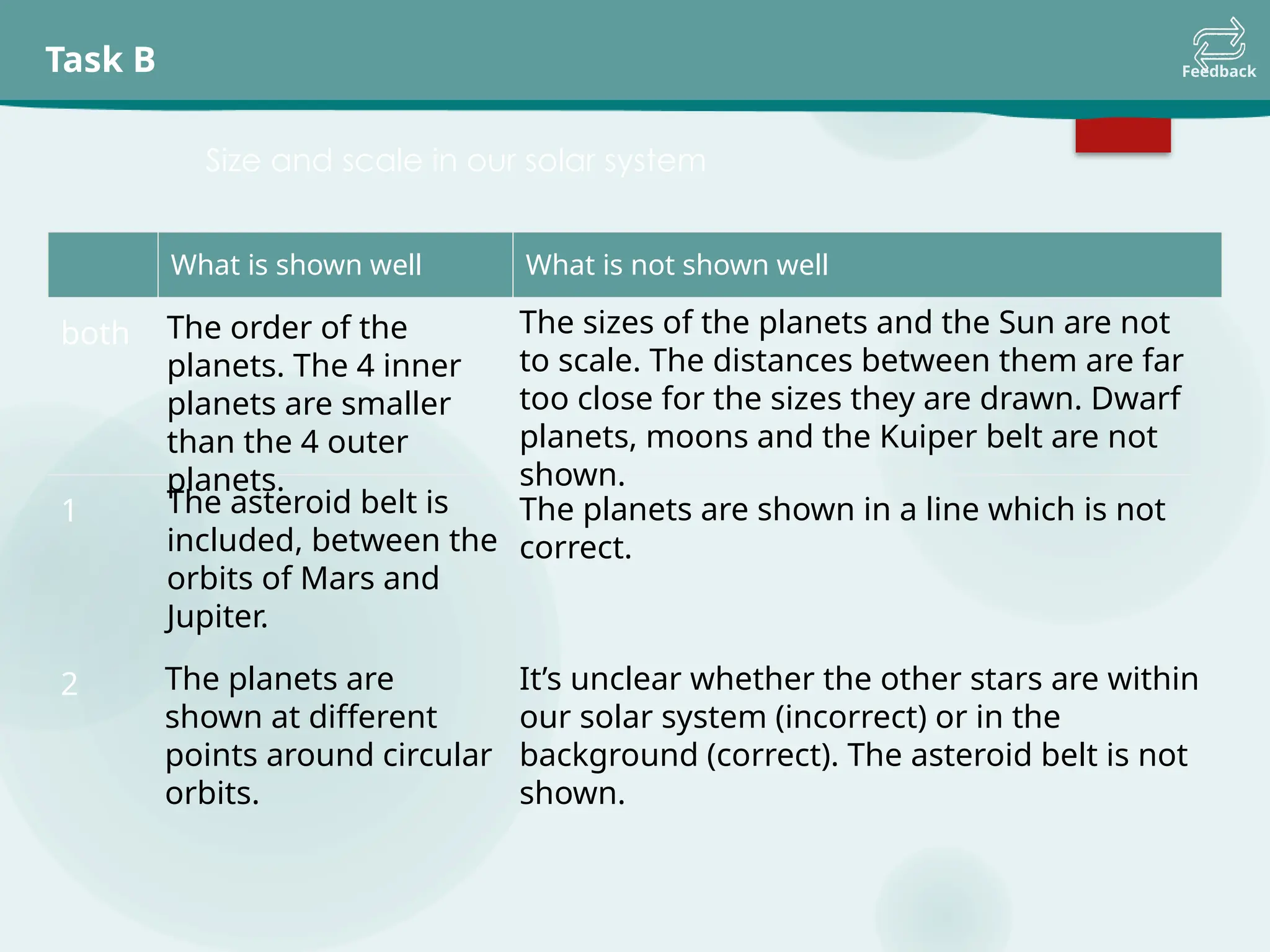
What is shown well What is not shown well
both
1
2
Feedback
Task B
Size and scale in our solar system
What is shown well What is not shown well
both
1
2
The order of the
planets. The 4 inner
planets are smaller
than the 4 outer
planets.
The asteroid belt is
included, between the
orbits of Mars and
Jupiter.
The planets are
shown at different
points around circular
orbits.
It’s unclear whether the other stars are within
our solar system (incorrect) or in the
background (correct). The asteroid belt is not
shown.
The sizes of the planets and the Sun are not
to scale. The distances between them are far
too close for the sizes they are drawn. Dwarf
planets, moons and the Kuiper belt are not
shown.
The planets are shown in a line which is not
correct.
Summary
Our solar system
Our solar system refers to the Sun
and all the objects in orbit around the
Sun. These include eight planets and
their moons, dwarf planets and
smaller objects such as asteroids.
Stars are extremely large spheres of
hot gas that give out light. The Sun is
a star.
The distances between objects in our
solar system are very, very large
compared to the sizes of the objects.
Explanation
The Sun and other stars
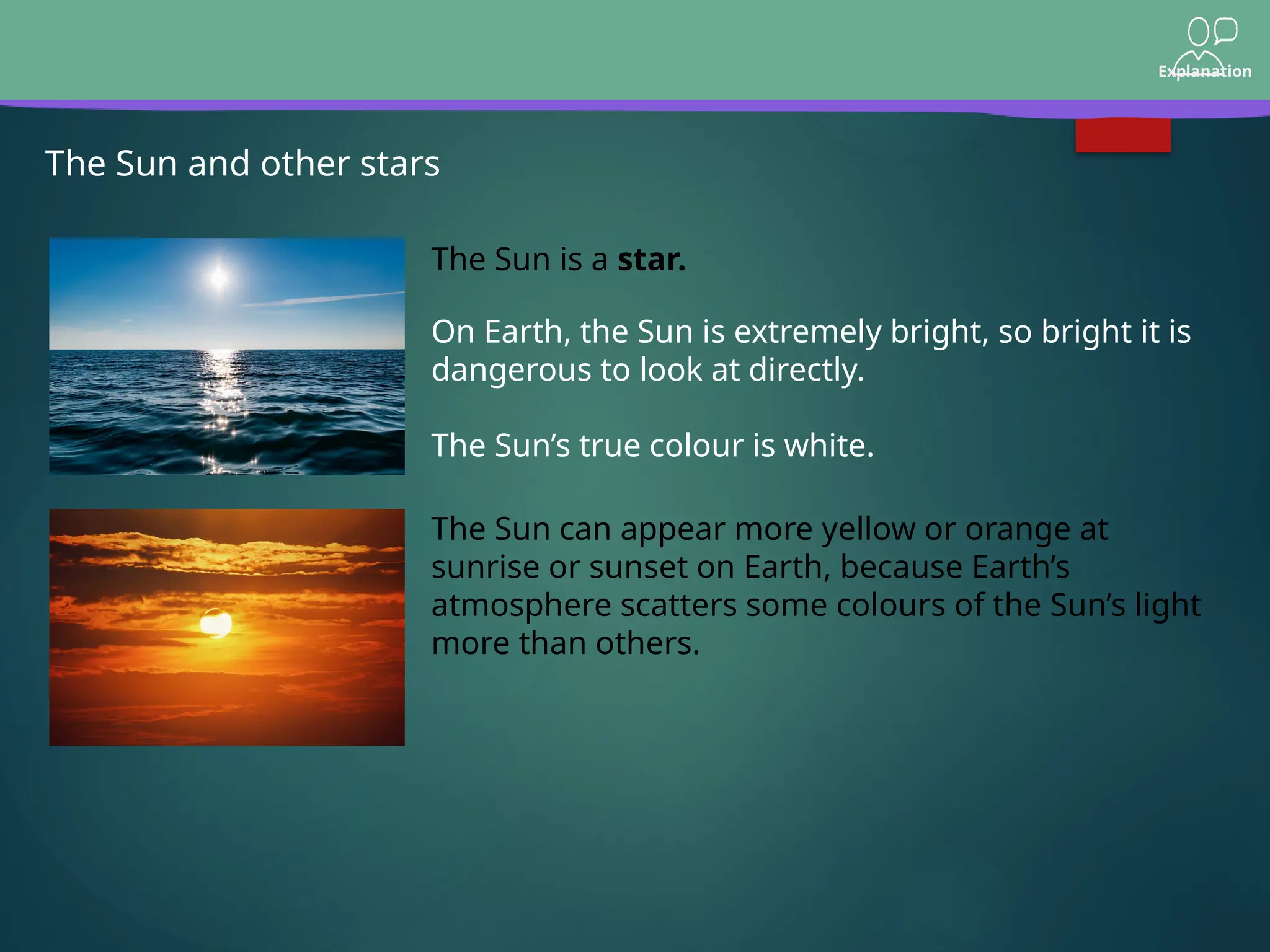
The Sun is a star.
On Earth, the Sun is extremely bright, so bright it is
dangerous to look at directly.
The Sun’s true colour is white.
The Sun can appear more yellow or orange at
sunrise or sunset on Earth, because Earth’s
atmosphere scatters some colours of the Sun’s light
more than others.
Explanation
The Sun and other stars
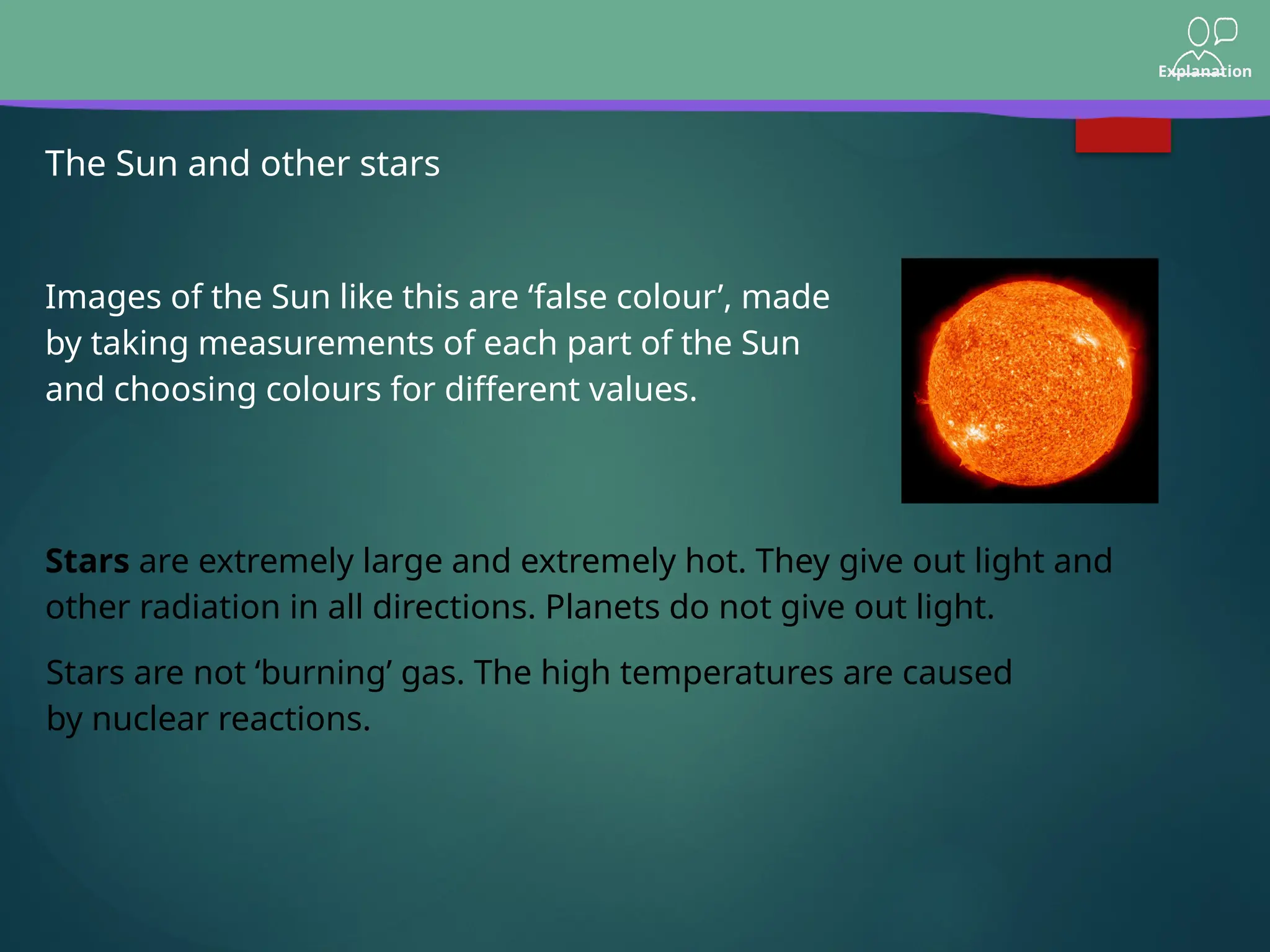
Images of the Sun like this are ‘false colour’, made
by taking measurements of each part of the Sun
and choosing colours for different values.
Stars are not ‘burning’ gas. The high temperatures are caused
by nuclear reactions.
Stars are extremely large and extremely hot. They give out light and
other radiation in all directions. Planets do not give out light.
Check
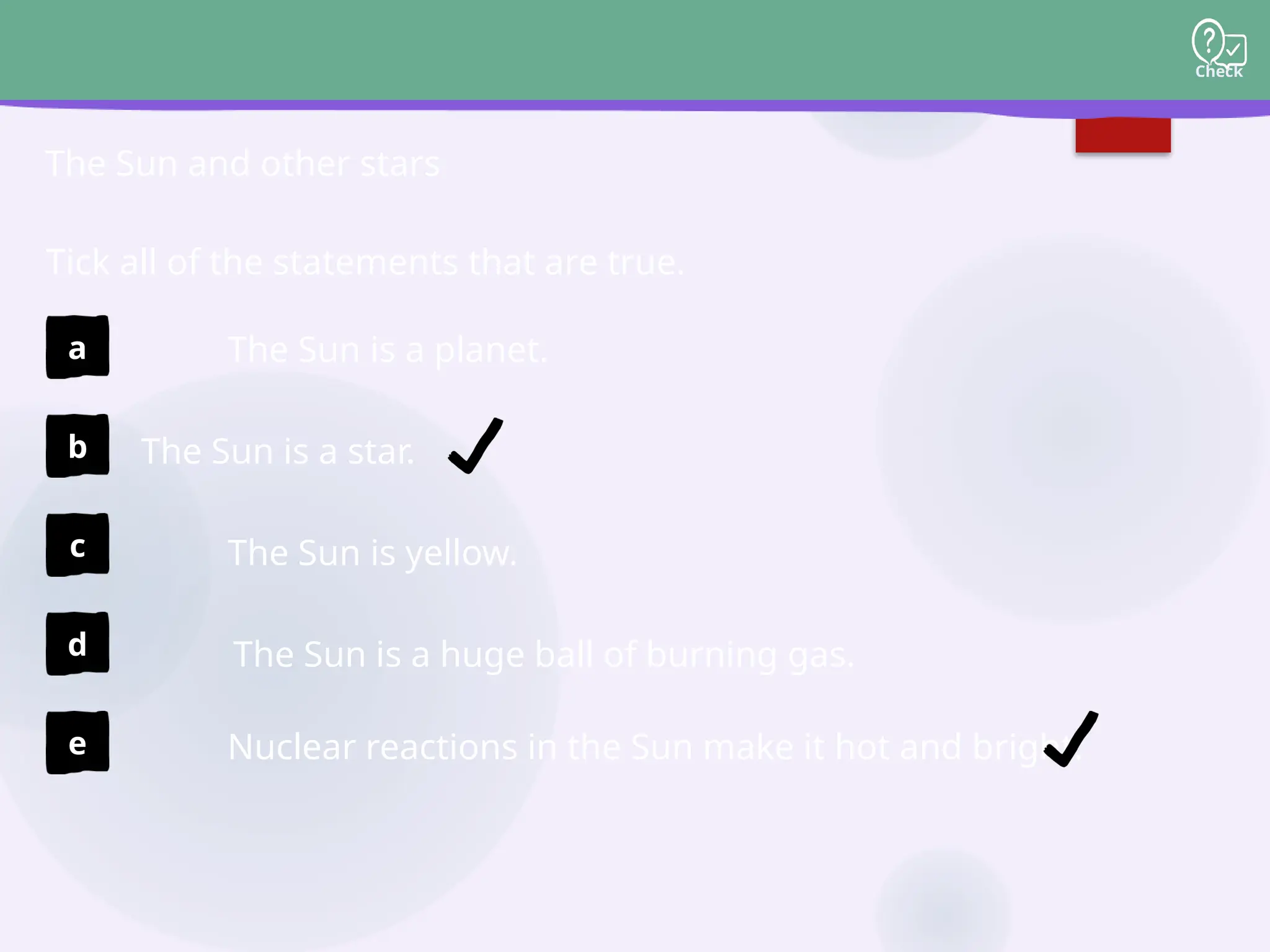
The Sun is a star.
The Sun and other stars
The Sun is a huge ball of burning gas.
Nuclear reactions in the Sun make it hot and bright.
The Sun is a planet.
The Sun is yellow.
Tick all of the statements that are true.
a
b
c
d
e
Explanation
The Sun and other stars
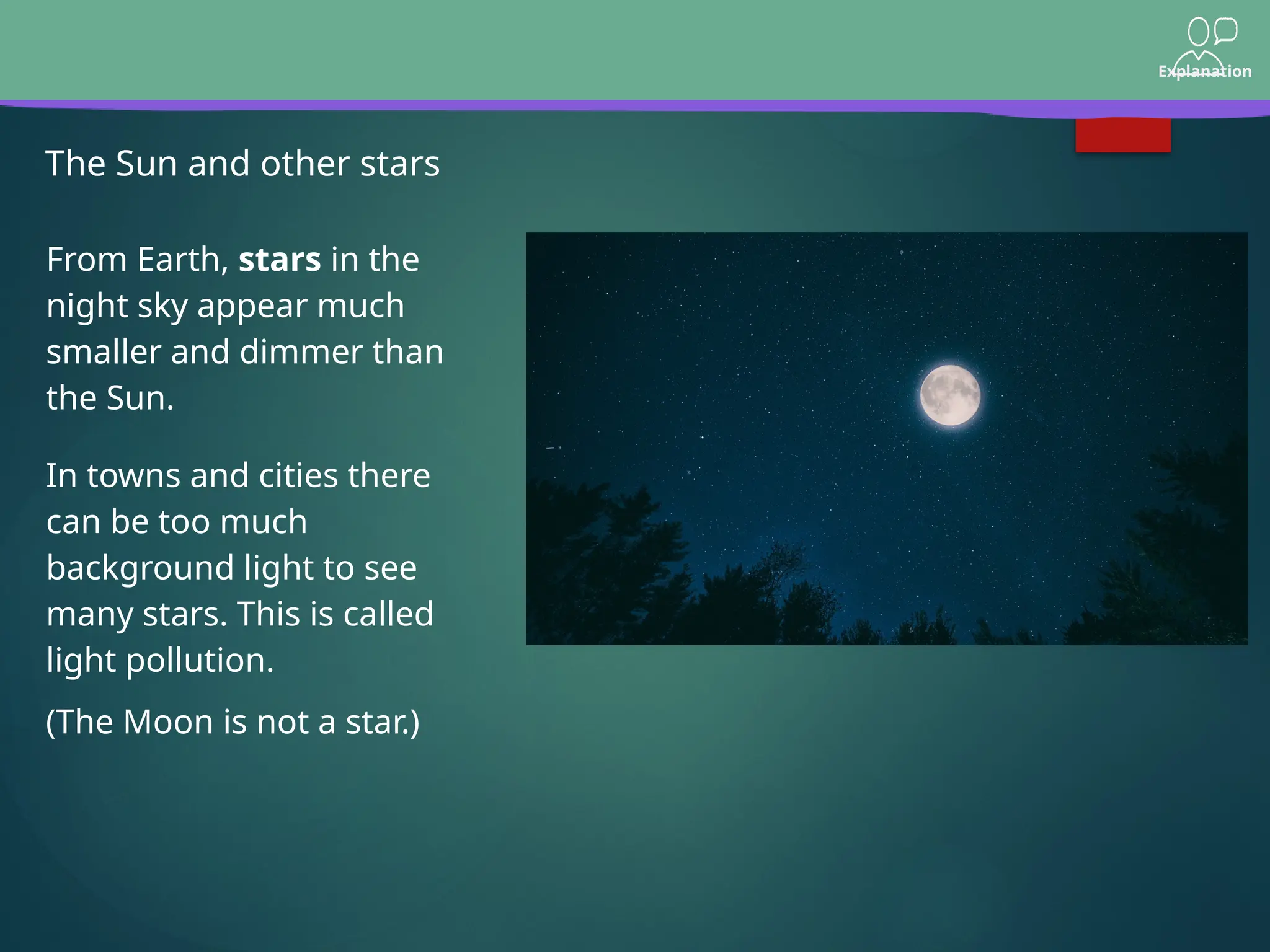
From Earth, stars in the
night sky appear much
smaller and dimmer than
the Sun.
(The Moon is not a star.)
In towns and cities there
can be too much
background light to see
many stars. This is called
light pollution.
Explanation
The Sun and other stars
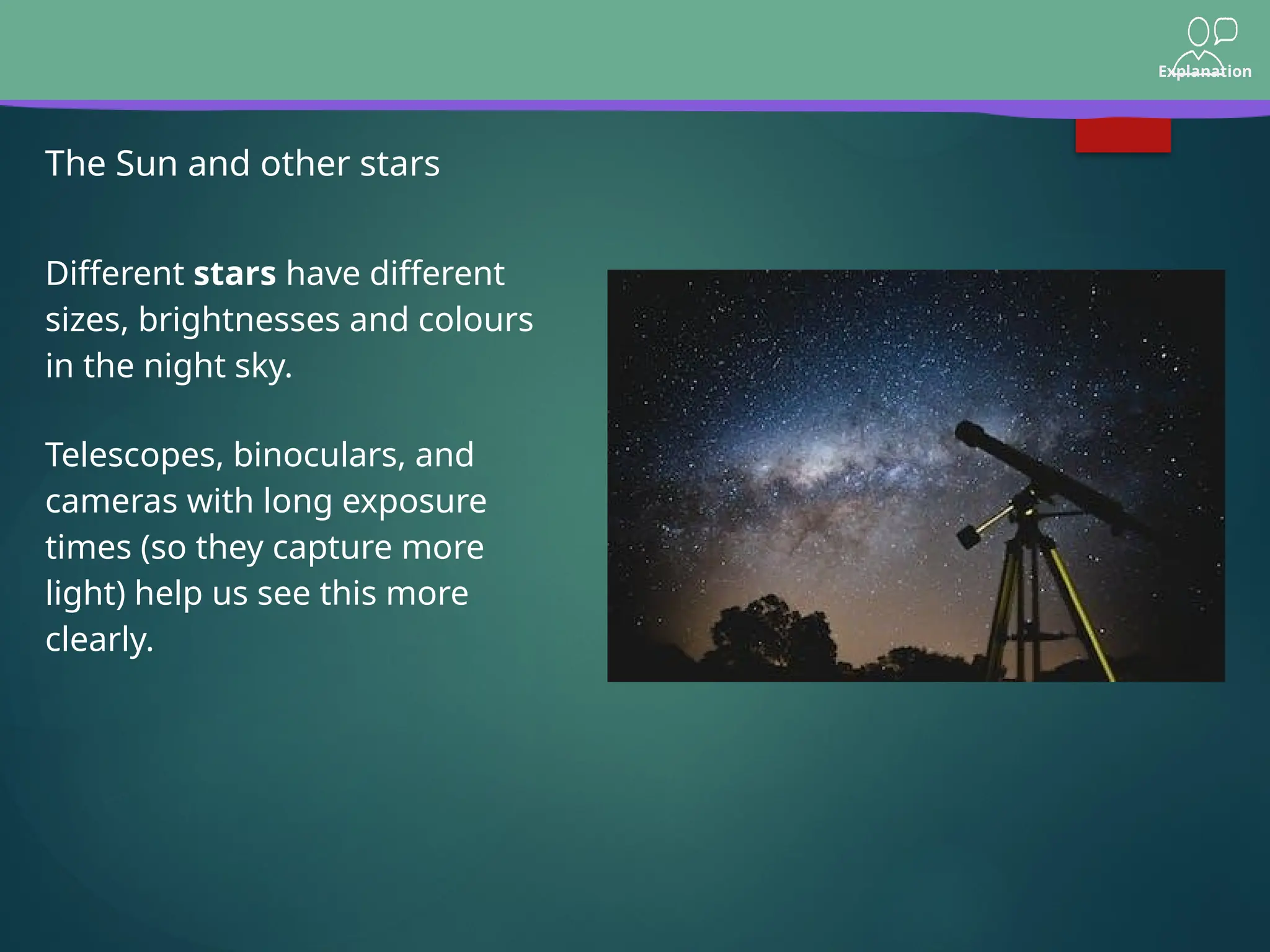
Telescopes, binoculars, and
cameras with long exposure
times (so they capture more
light) help us see this more
clearly.
Different stars have different
sizes, brightnesses and colours
in the night sky.
Explanation
The Sun and other stars
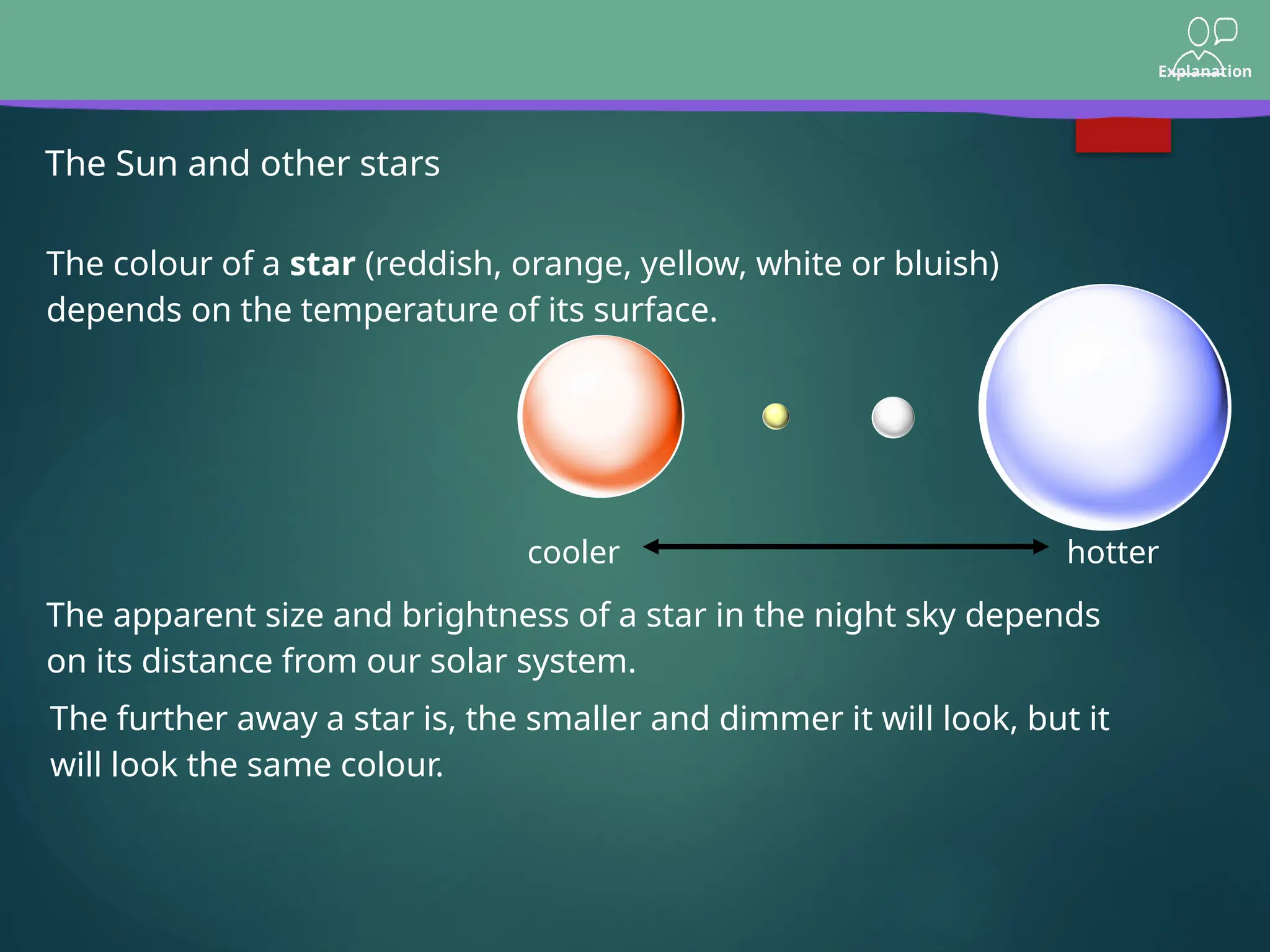
The colour of a star (reddish, orange, yellow, white or bluish)
depends on the temperature of its surface.
The apparent size and brightness of a star in the night sky depends
on its distance from our solar system.
The further away a star is, the smaller and dimmer it will look, but it
will look the same colour.
cooler hotter
Check
The Sun and other stars
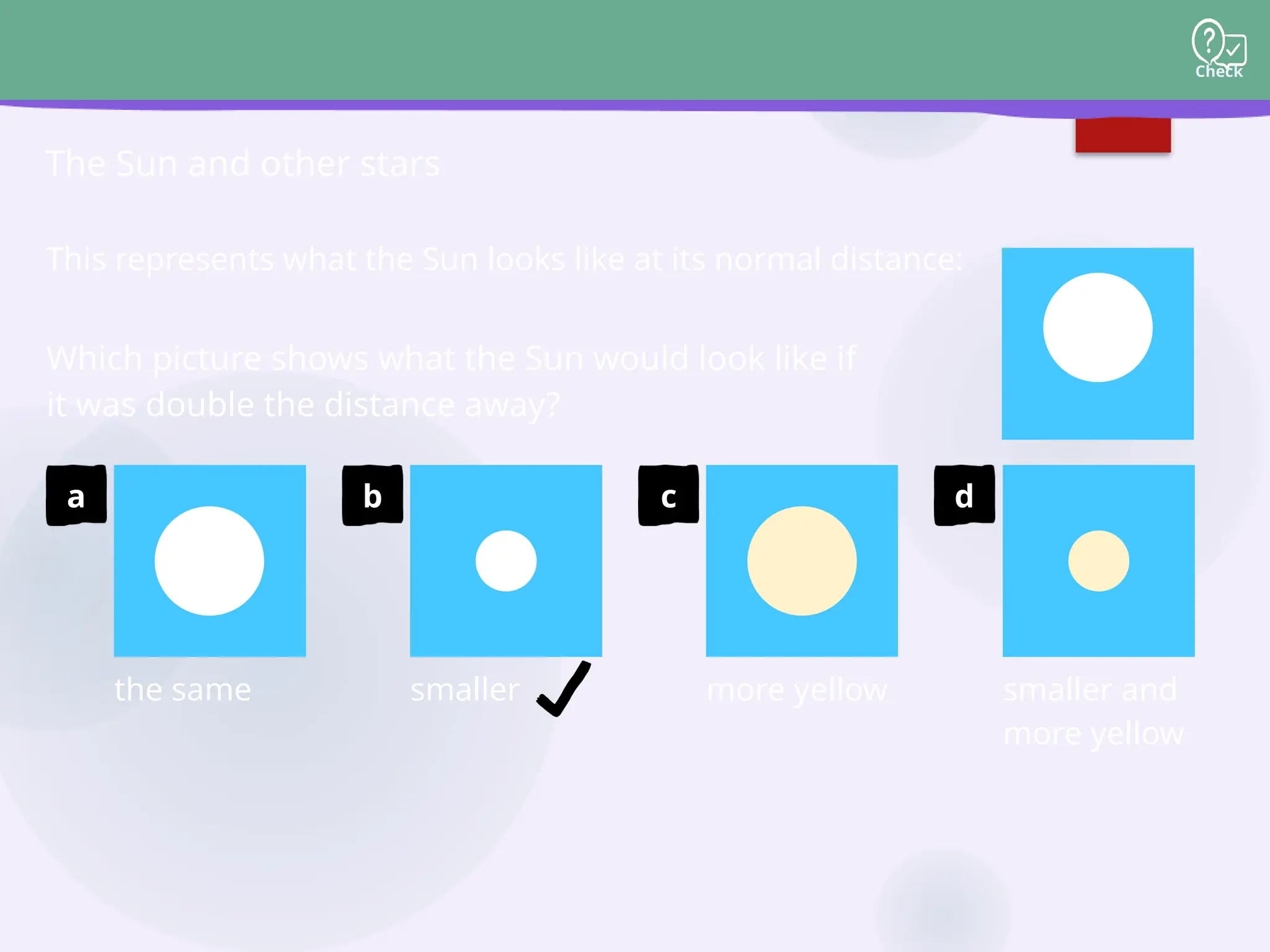
This represents what the Sun looks like at its normal distance:
Which picture shows what the Sun would look like if
it was double the distance away?
d
smaller and
more yellow
c
more yellow
b
smaller
a
the same
Task A
Practice
The Sun and other stars
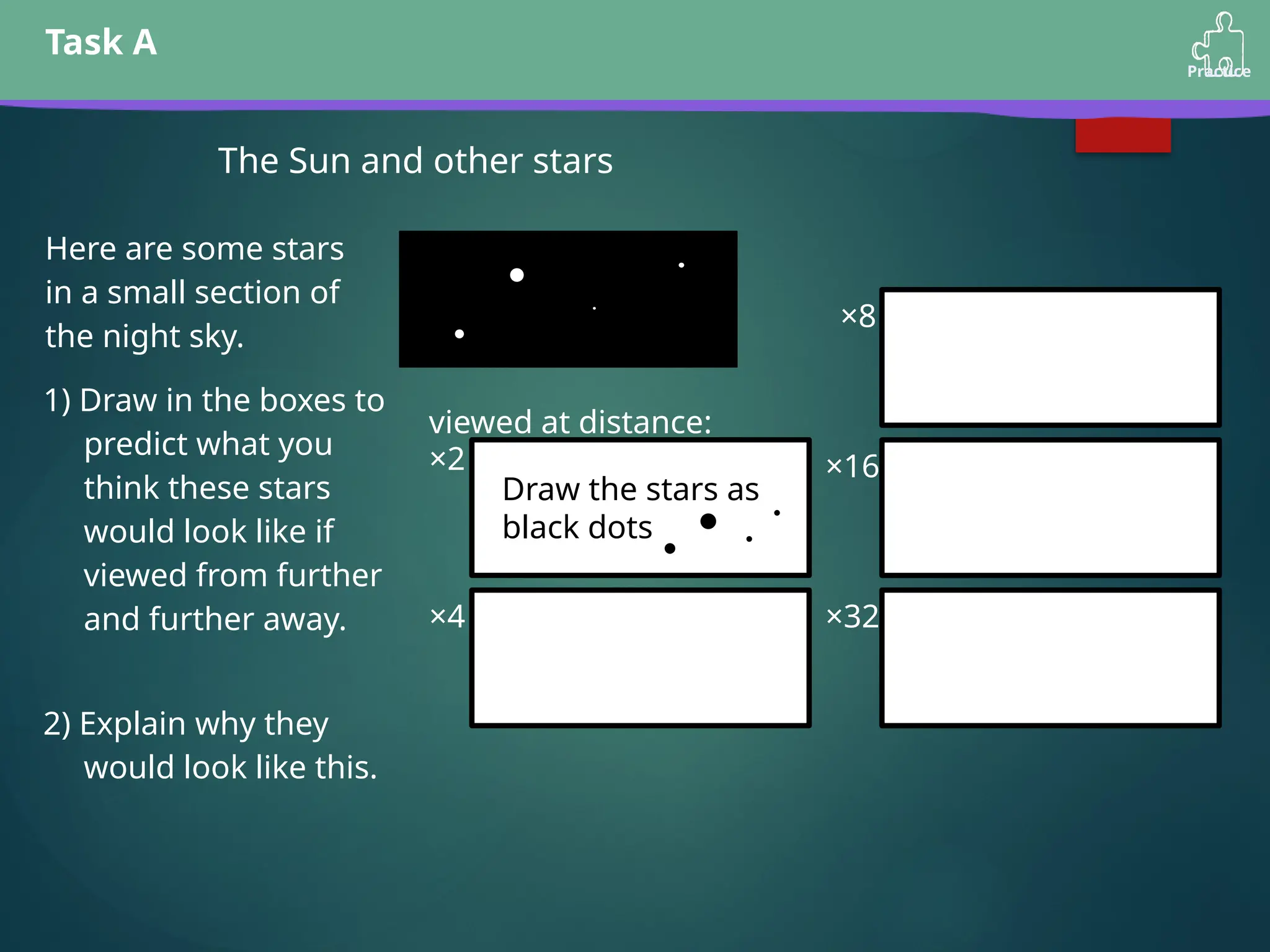
Here are some stars
in a small section of
the night sky.
1) Draw in the boxes to
predict what you
think these stars
would look like if
viewed from further
and further away.
×2
×4
viewed at distance:
×8
×16
×32
2) Explain why they
would look like this.
Draw the stars as
black dots
Task A
Practice
The Sun and other stars
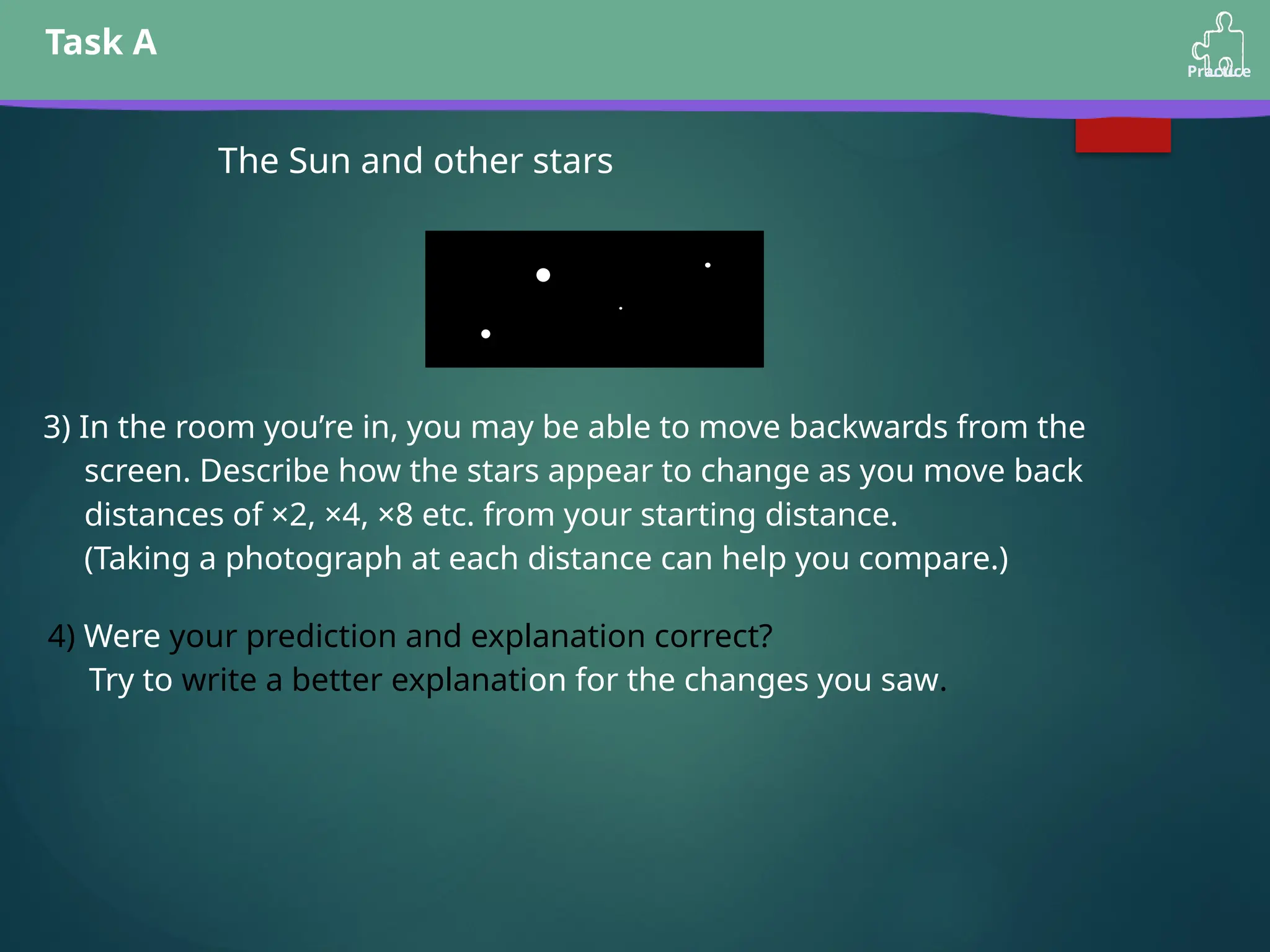
3) In the room you’re in, you may be able to move backwards from the
screen. Describe how the stars appear to change as you move back
distances of ×2, ×4, ×8 etc. from your starting distance.
(Taking a photograph at each distance can help you compare.)
4) Were your prediction and explanation correct?
Try to write a better explanation for the changes you saw.
Task A
Feedback
The Sun and other stars
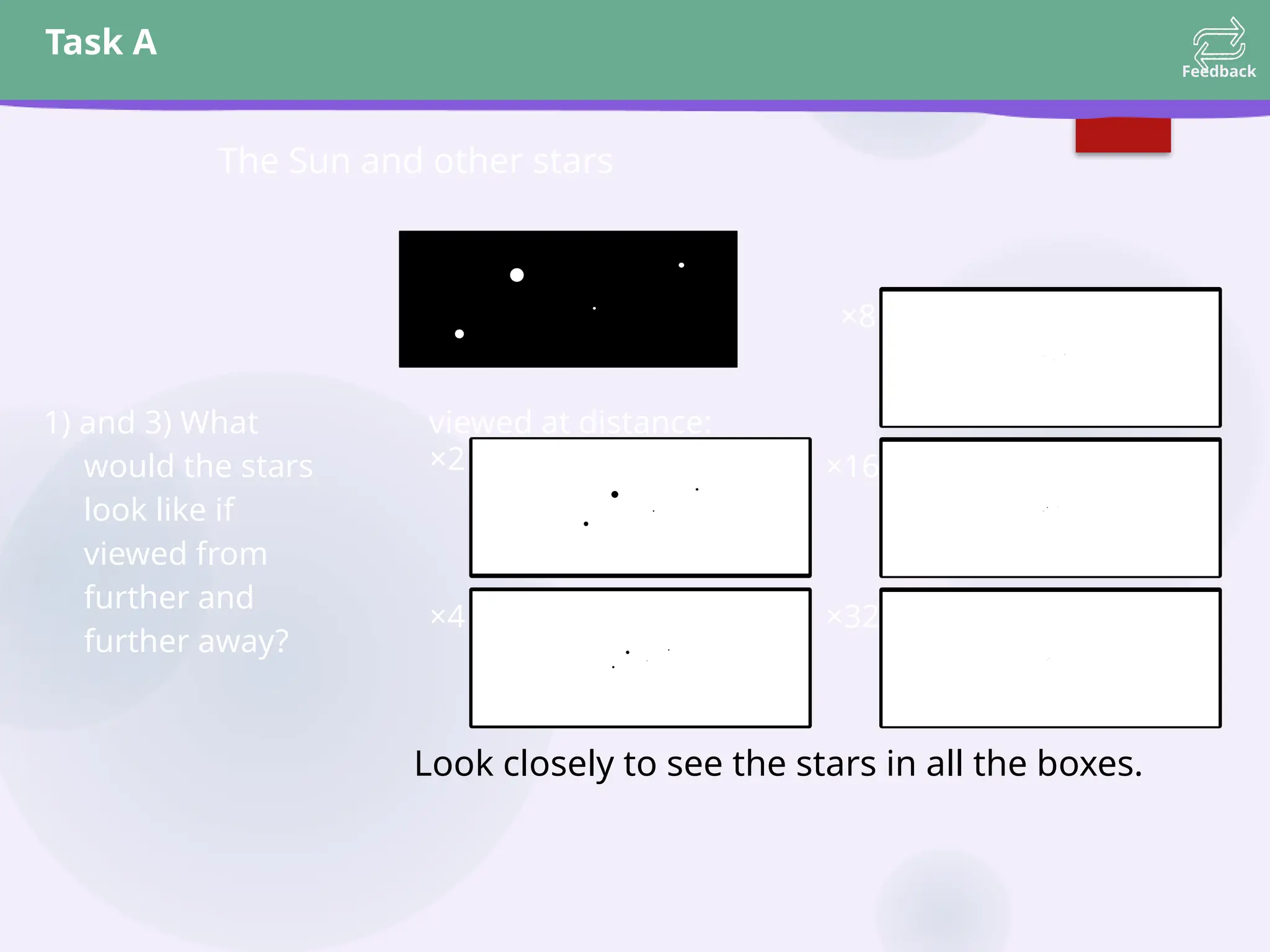
×2
×4
viewed at distance:
×8
×16
×32
1) and 3) What
would the stars
look like if
viewed from
further and
further away?
Look closely to see the stars in all the boxes.
Task A
Feedback
The Sun and other stars
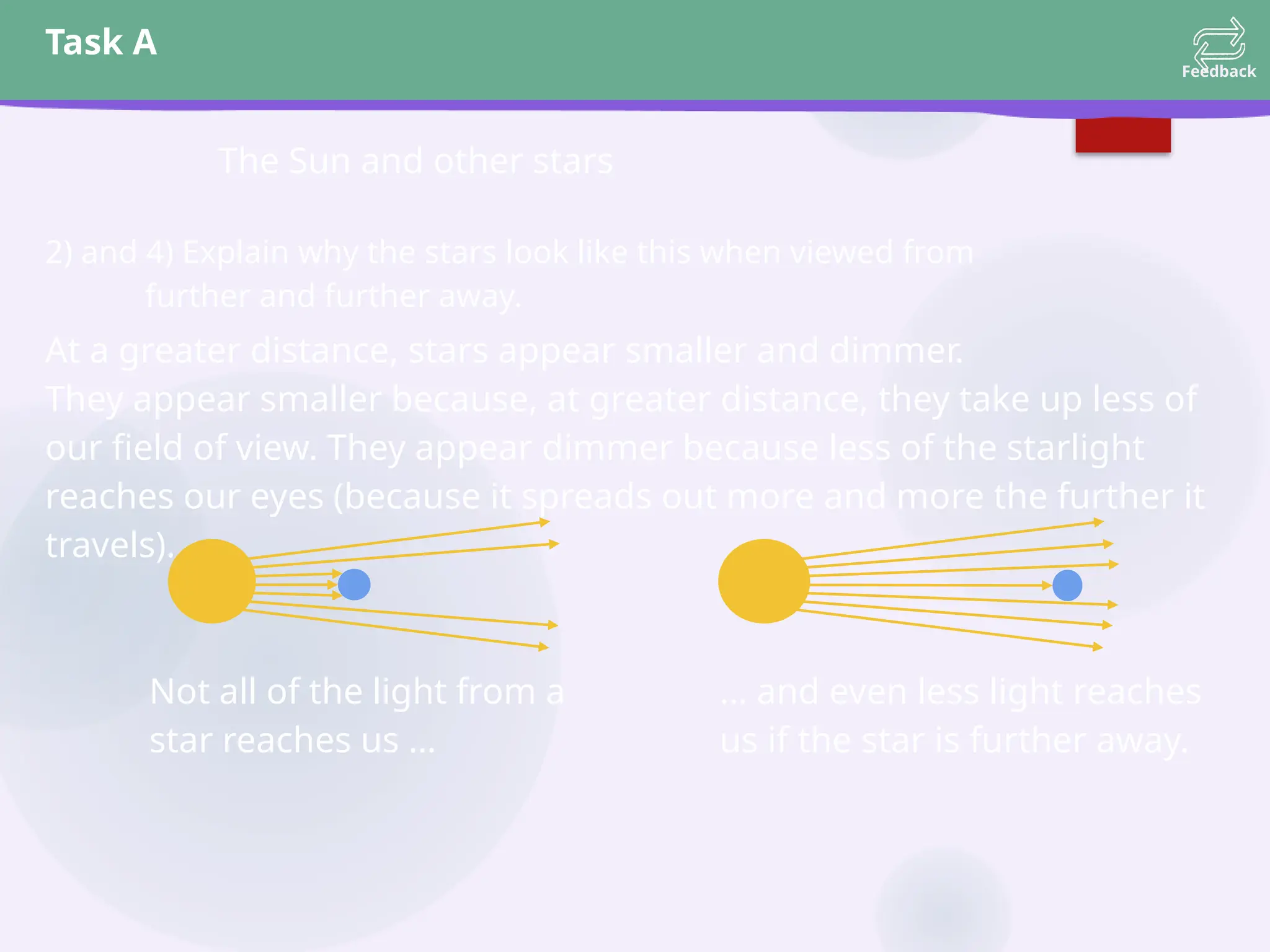
2) and 4) Explain why the stars look like this when viewed from
further and further away.
At a greater distance, stars appear smaller and dimmer.
They appear smaller because, at greater distance, they take up less of
our field of view. They appear dimmer because less of the starlight
reaches our eyes (because it spreads out more and more the further it
travels).
Not all of the light from a
star reaches us …
… and even less light reaches
us if the star is further away.
Explanation
The distance of stars explains their appearance
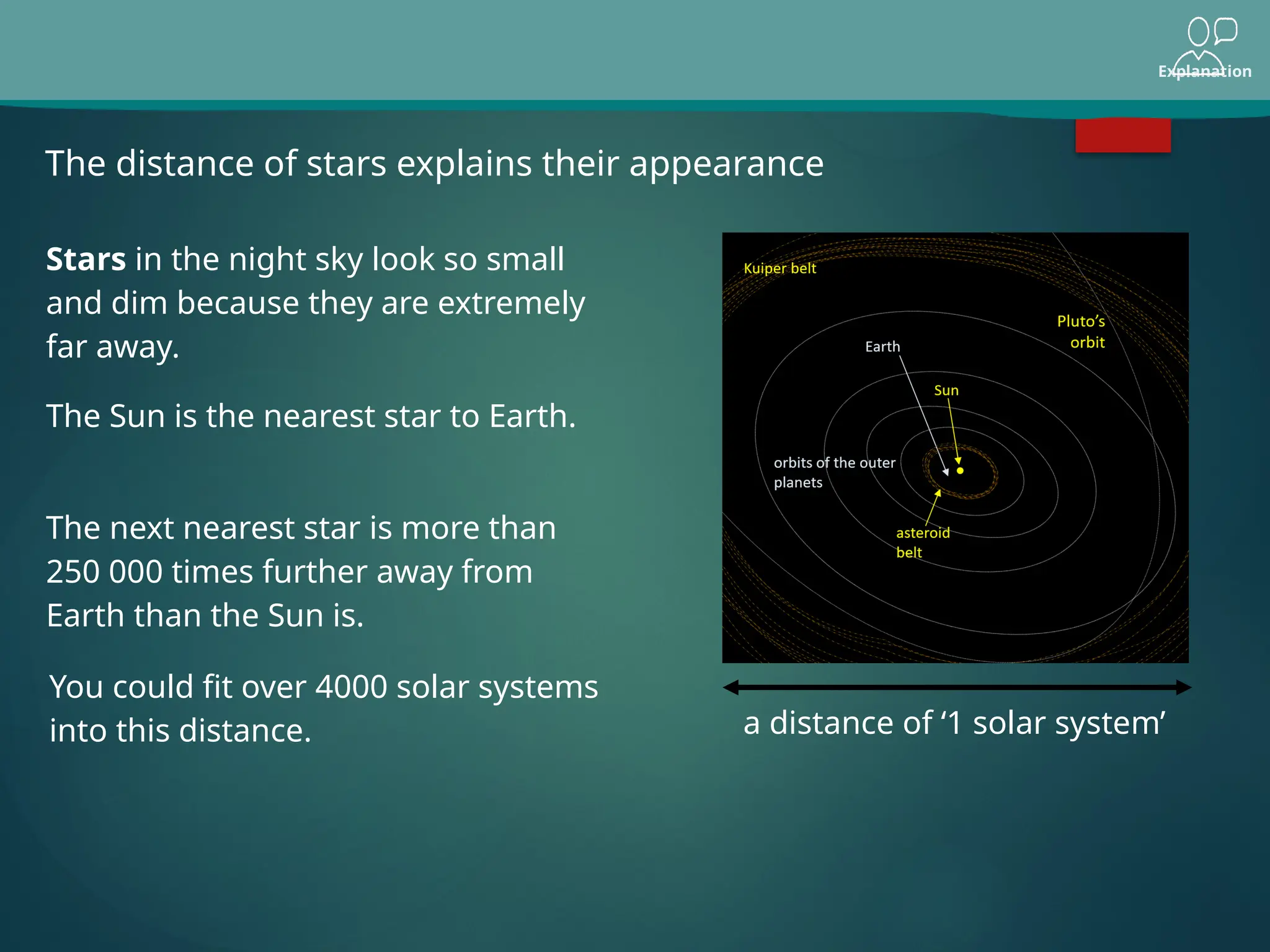
Stars in the night sky look so small
and dim because they are extremely
far away.
The Sun is the nearest star to Earth.
The next nearest star is more than
250 000 times further away from
Earth than the Sun is.
You could fit over 4000 solar systems
into this distance. a distance of ‘1 solar system’
Explanation
The distance of stars explains their appearance
Usually, distances are measured in metres or centimetres.
However, the distances to other stars are so large that a larger unit would be
more convenient.
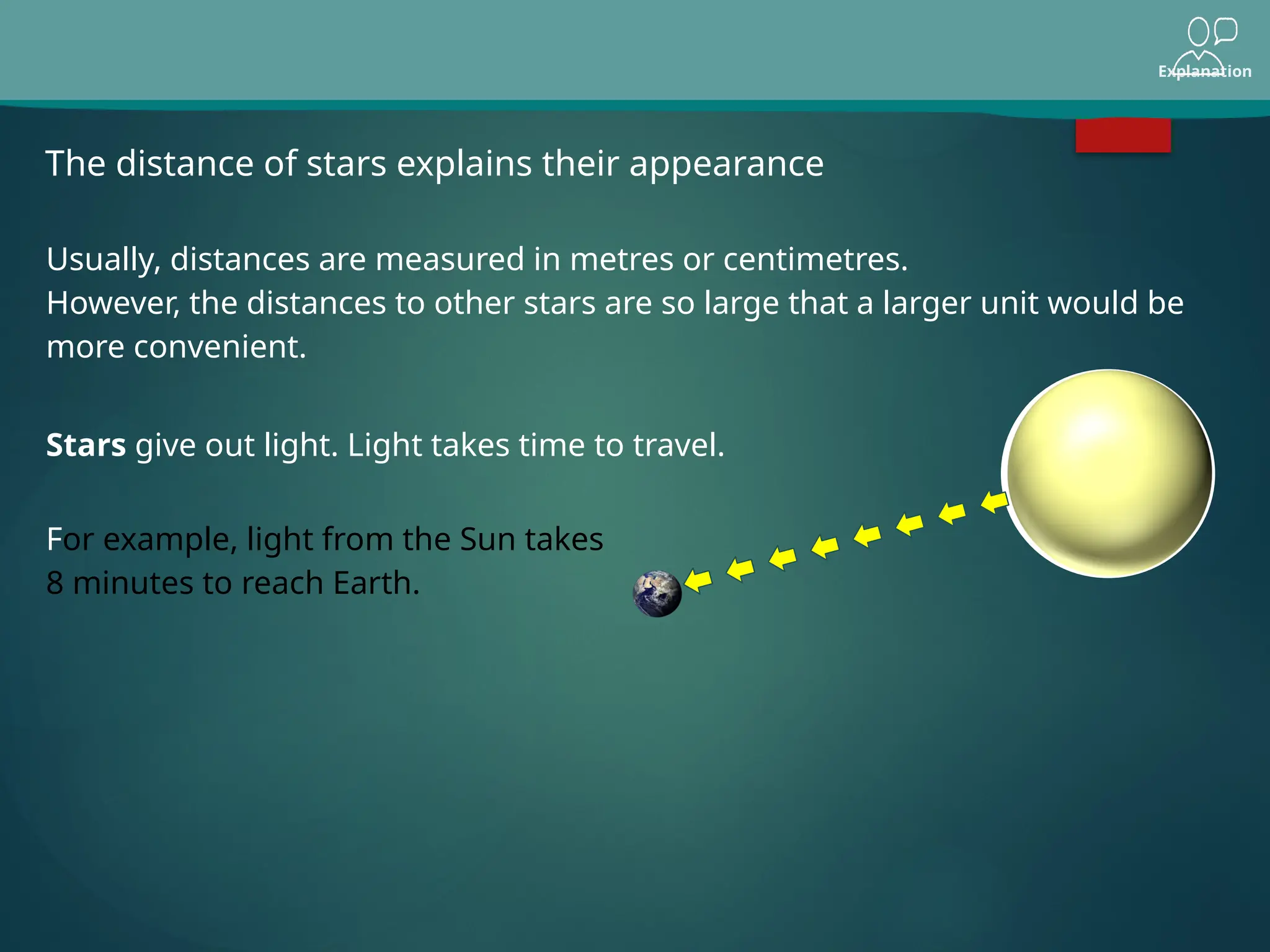
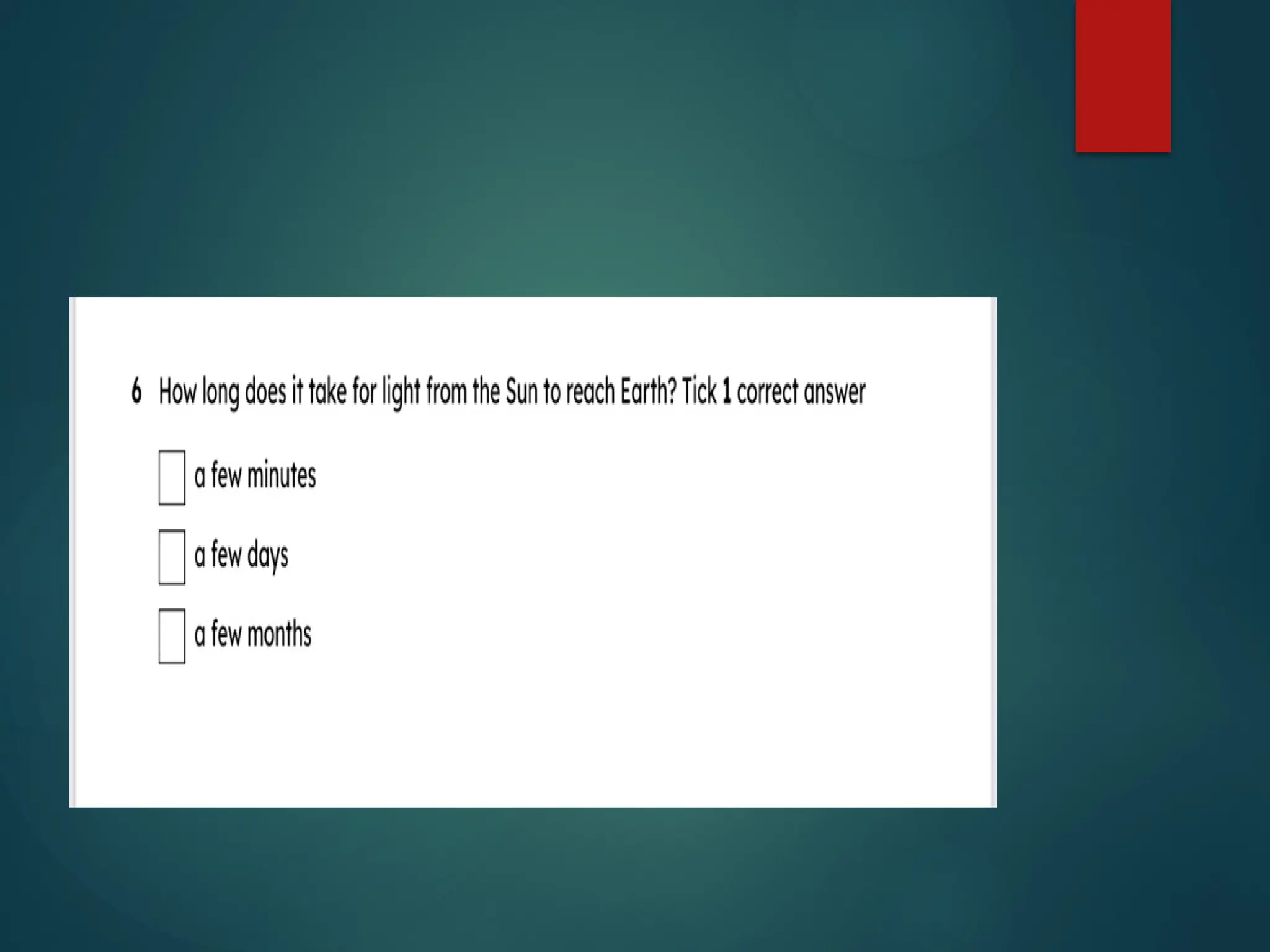
Stars give out light. Light takes time to travel.
For example, light from the Sun takes
8 minutes to reach Earth.
Explanation
The distance of stars explains their appearance
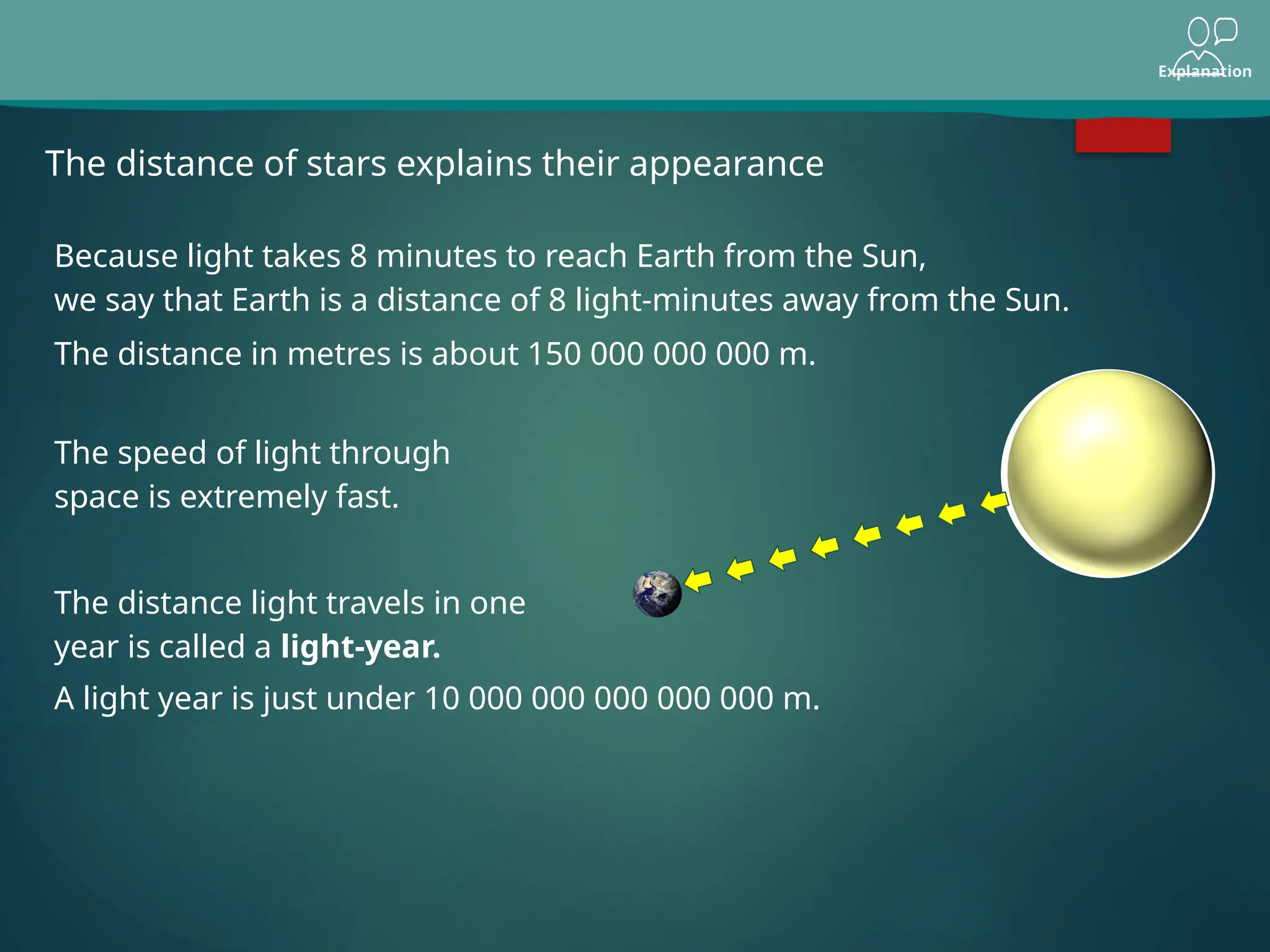
Because light takes 8 minutes to reach Earth from the Sun,
we say that Earth is a distance of 8 light-minutes away from the Sun.
The distance in metres is about 150 000 000 000 m.
The speed of light through
space is extremely fast.
The distance light travels in one
year is called a light-year.
A light year is just under 10 000 000 000 000 000 m.
Check
a
b
c
d
The distance of stars explains their appearance
A light-second (the distance light travels in 1 s)
A light-minute (the distance light travels in 1 min)
A light-day (the distance light travels in 1 day)
A light-year (the distance light travels in 1 year)
Which of these would be the longest distance?
Explanation
The distance of stars explains their appearance
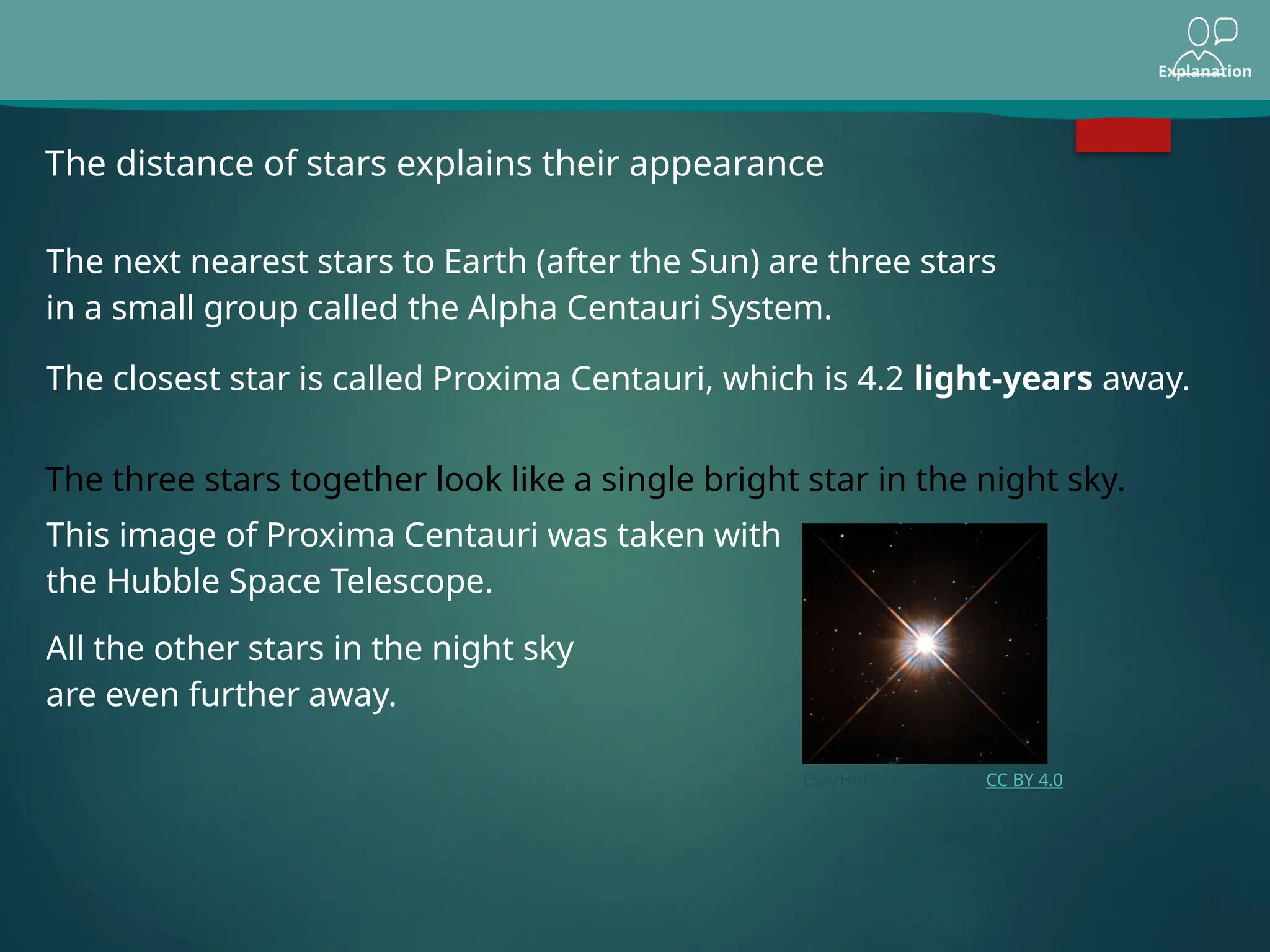
The next nearest stars to Earth (after the Sun) are three stars
in a small group called the Alpha Centauri System.
The closest star is called Proxima Centauri, which is 4.2 light-years away.
All the other stars in the night sky
are even further away.
The three stars together look like a single bright star in the night sky.
This image of Proxima Centauri was taken with
the Hubble Space Telescope.
ESA/Hubble & NASA | CC BY 4.0
Check
a
b
c
d
The distance of stars explains their appearance
It is 4.2 million miles away.
It would take 4.2 years to get there from Earth.
It takes light from Proxima Centauri 4.2 years to travel the
distance to Earth.
The distance between Earth and Proxima Centauri is 4.2
years.
Proxima Centauri is 4.2 light-years away from Earth.
What does this mean?
Check
a
b
c
d
The distance of stars explains their appearance
It is a different kind of star to the stars in the night sky.
It is a different colour to all the stars in the night sky.
It is brighter because it gives out more light than any of
the stars in the night sky.
It is much closer than any star in the night sky.
Why does the Sun look very different to all other stars
(which are seen from Earth in the night sky)?
Practice
Task B
The distance of stars explains their appearance
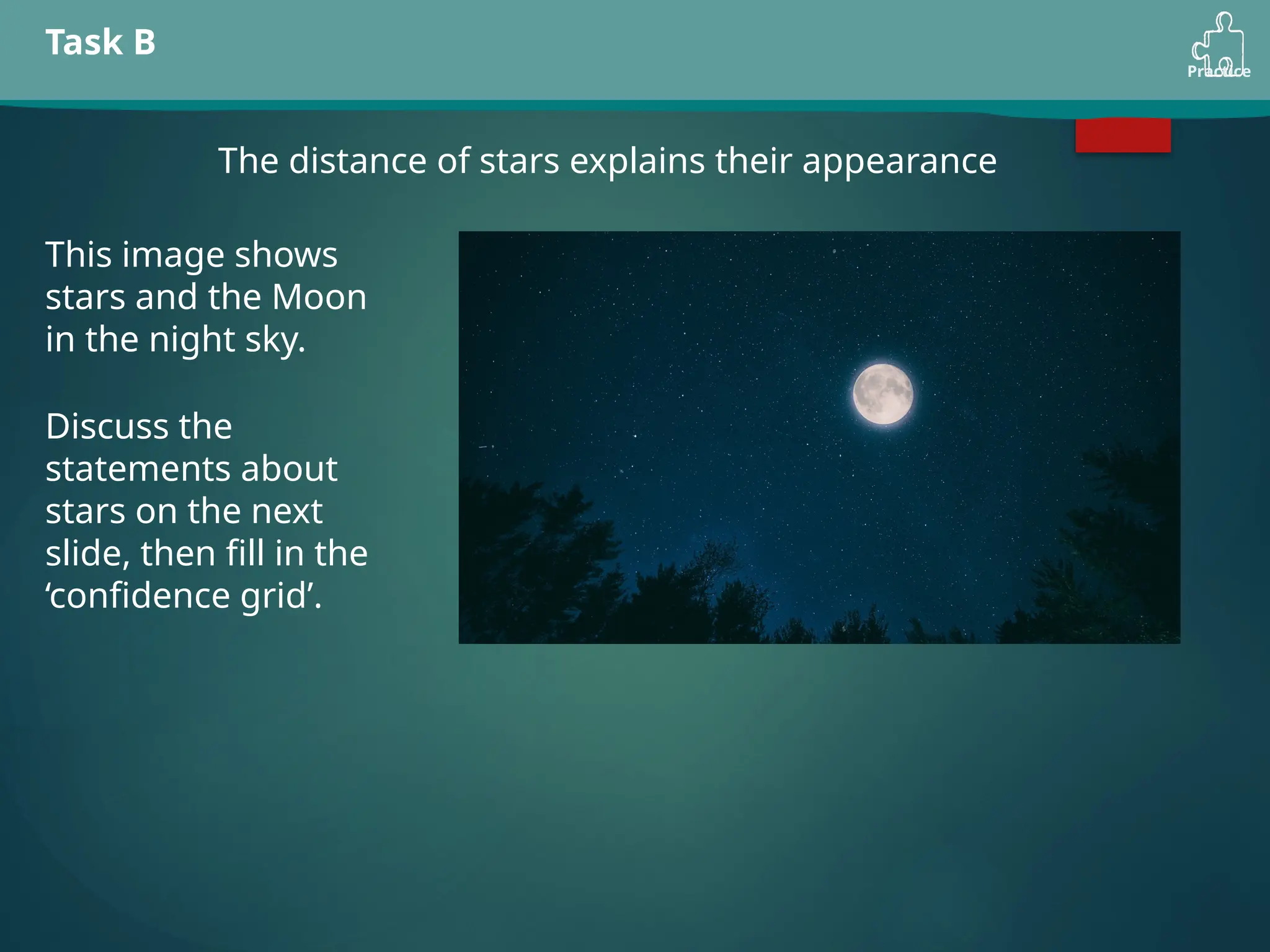
This image shows
stars and the Moon
in the night sky.
Discuss the
statements about
stars on the next
slide, then fill in the
‘confidence grid’.
Practice
Task B
The distance of stars explains their appearance
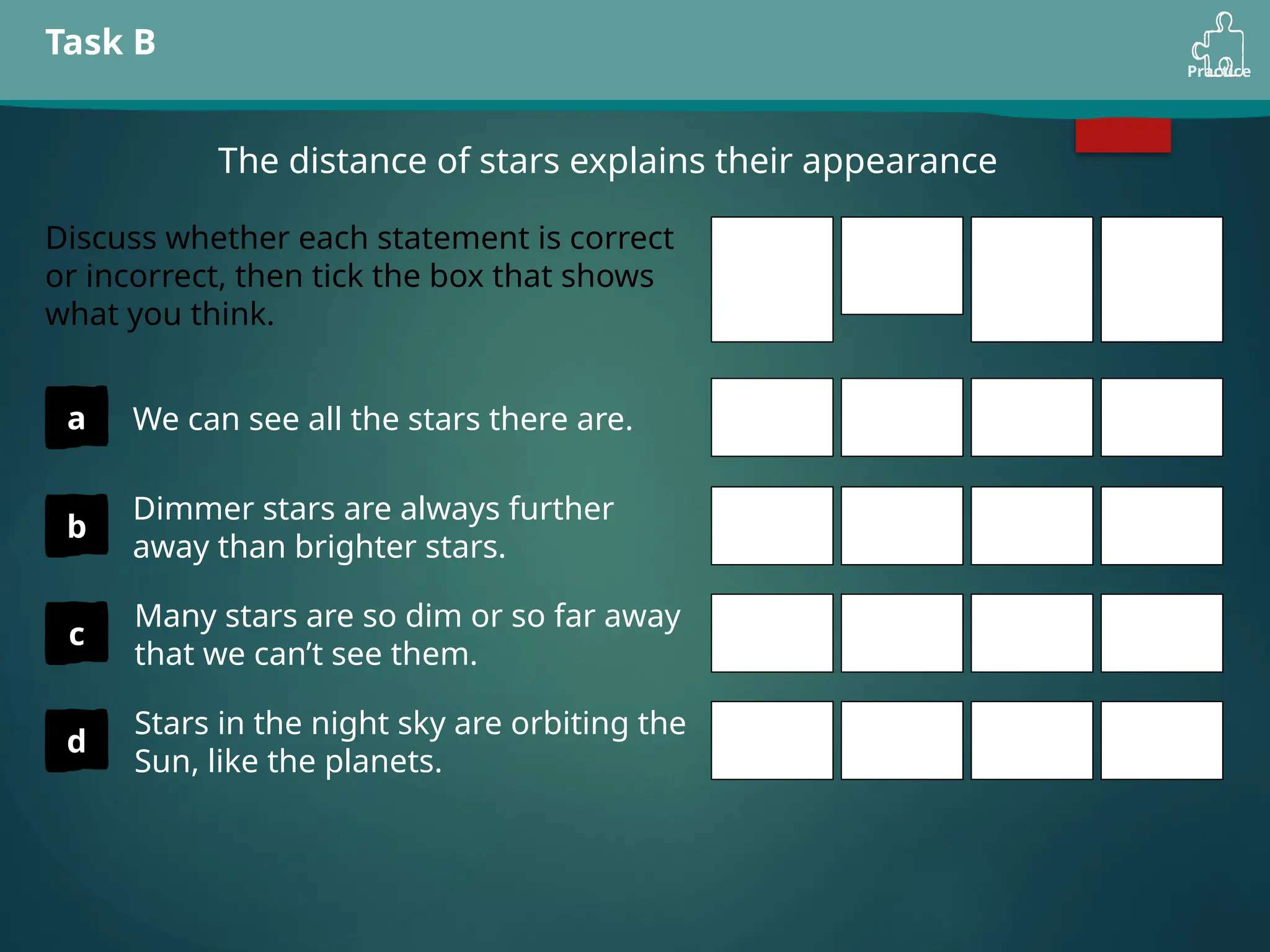
Discuss whether each statement is correct
or incorrect, then tick the box that shows
what you think.
We can see all the stars there are.
Dimmer stars are always further
away than brighter stars.
Many stars are so dim or so far away
that we can’t see them.
Stars in the night sky are orbiting the
Sun, like the planets.
a
b
c
d
I
am sure
this is
correct
I
think this
is correct
I
think this
is
incorrect
I
am sure
this is
incorrect
Task B
Feedback
The distance of stars explains their appearance
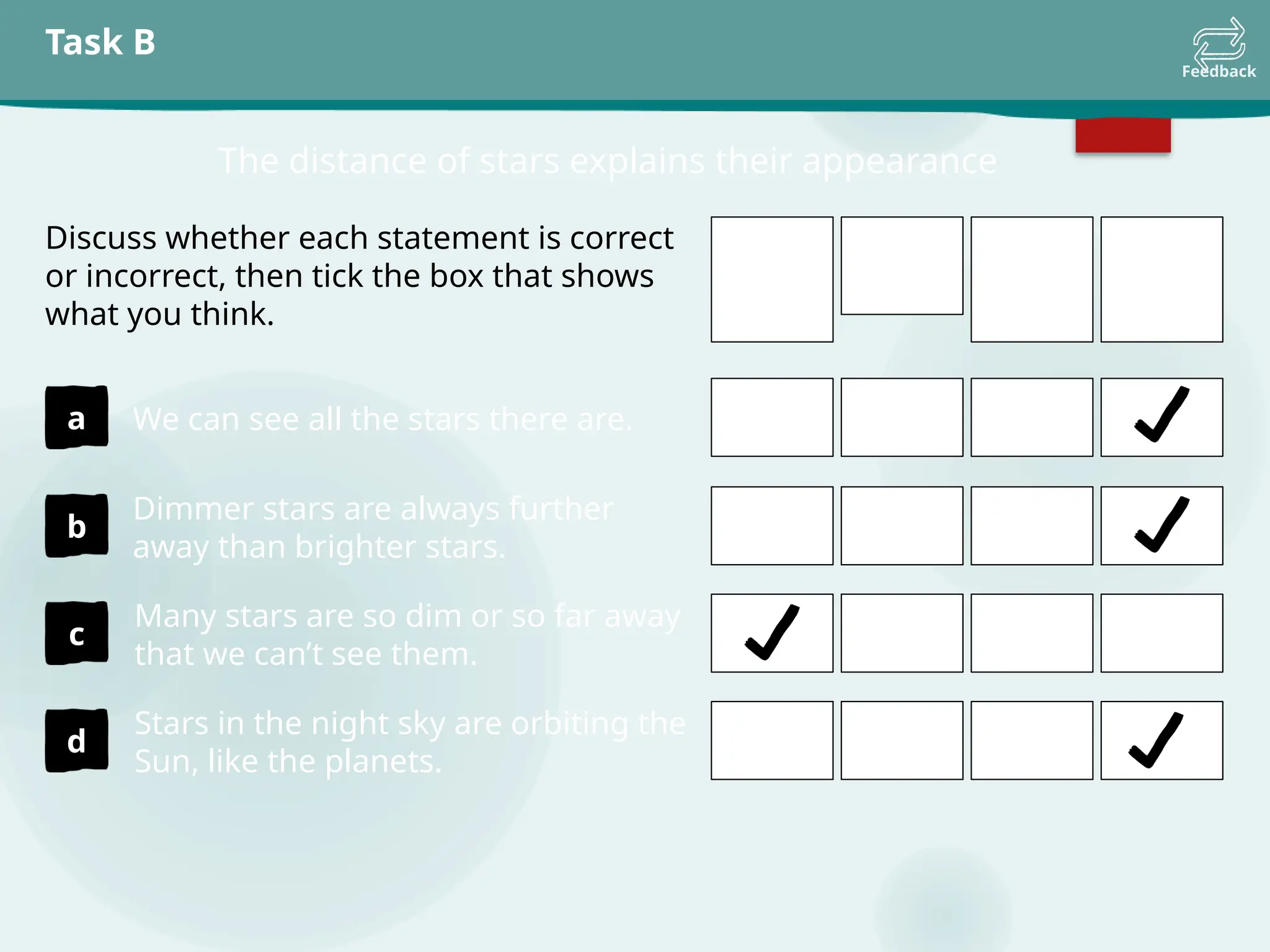
Discuss whether each statement is correct
or incorrect, then tick the box that shows
what you think.
We can see all the stars there are.
Dimmer stars are always further
away than brighter stars.
Many stars are so dim or so far away
that we can’t see them.
Stars in the night sky are orbiting the
Sun, like the planets.
a
b
c
d
I
am sure
this is
correct
I
think this
is correct
I
think this
is
incorrect
I
am sure
this is
incorrect
Explanation
From even further:
From further away:
Galaxies and the universe
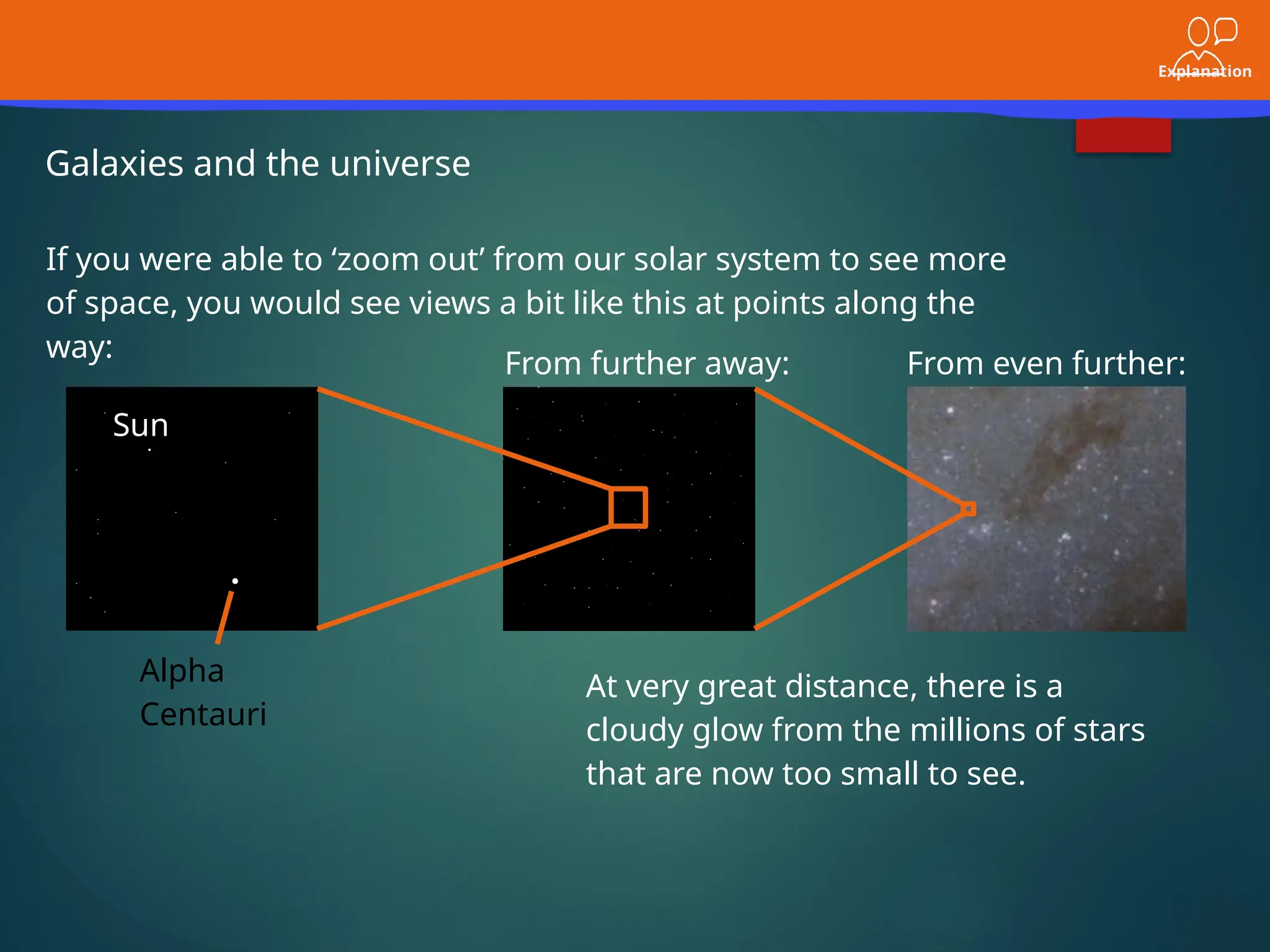
If you were able to ‘zoom out’ from our solar system to see more
of space, you would see views a bit like this at points along the
way:
Sun
Alpha
Centauri
At very great distance, there is a
cloudy glow from the millions of stars
that are now too small to see.
Explanation
Galaxies and the universe
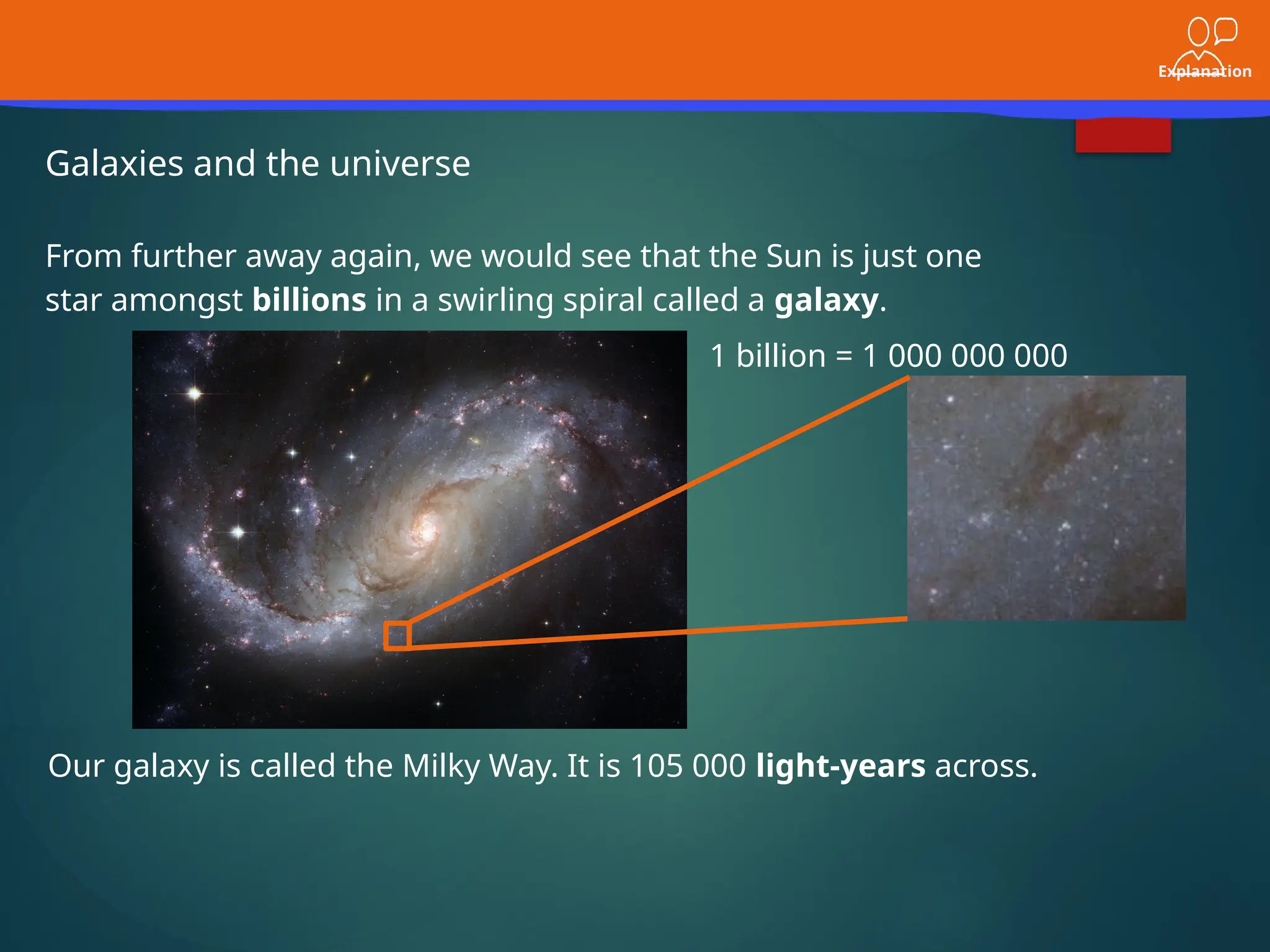
From further away again, we would see that the Sun is just one
star amongst billions in a swirling spiral called a galaxy.
Our galaxy is called the Milky Way. It is 105 000 light-years across.
1 billion = 1 000 000 000
Explanation
Galaxies and the universe
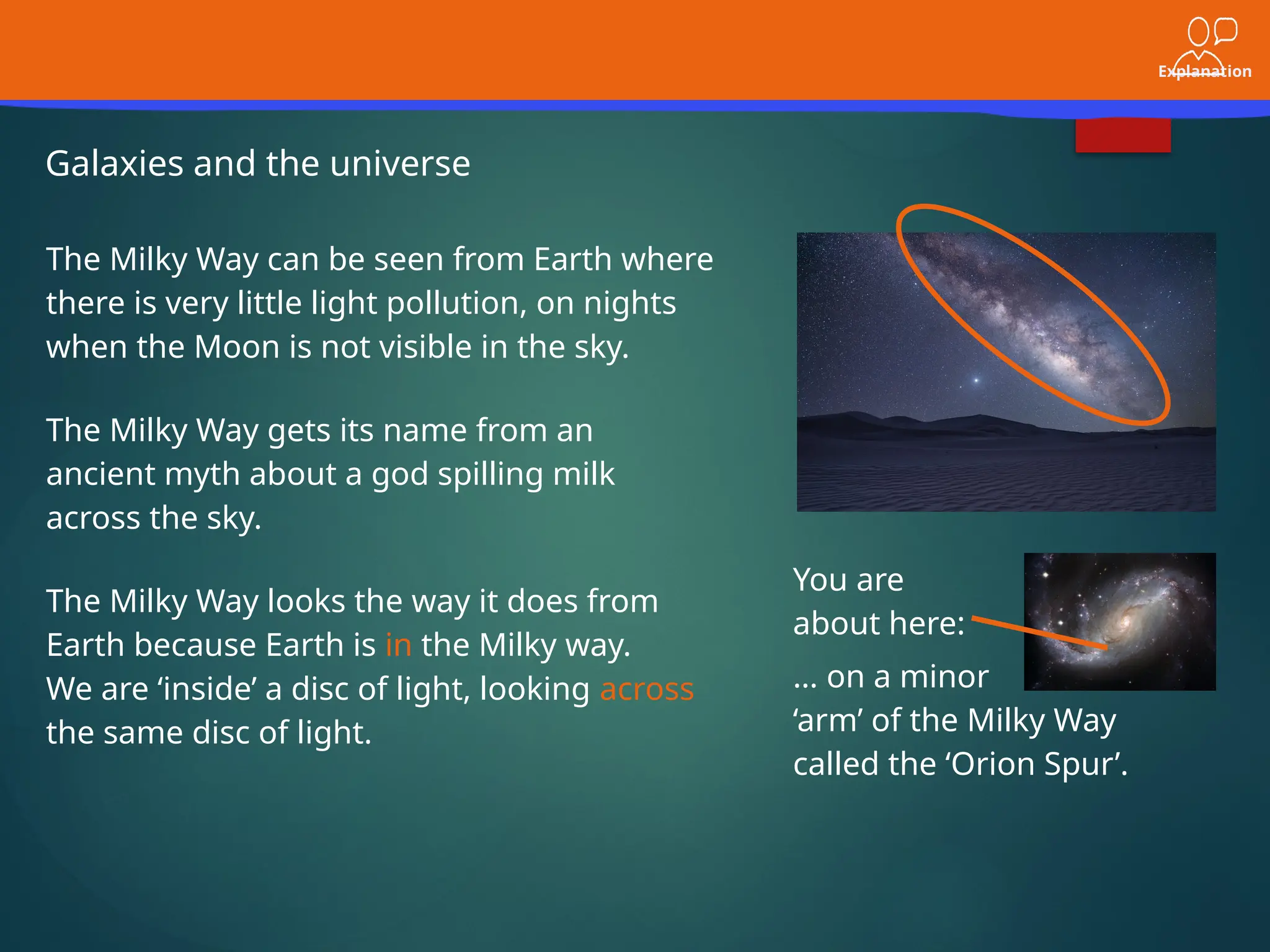
The Milky Way can be seen from Earth where
there is very little light pollution, on nights
when the Moon is not visible in the sky.
You are
about here:
The Milky Way gets its name from an
ancient myth about a god spilling milk
across the sky.
The Milky Way looks the way it does from
Earth because Earth is in the Milky way.
We are ‘inside’ a disc of light, looking across
the same disc of light.
… on a minor
‘arm’ of the Milky Way
called the ‘Orion Spur’.
Explanation
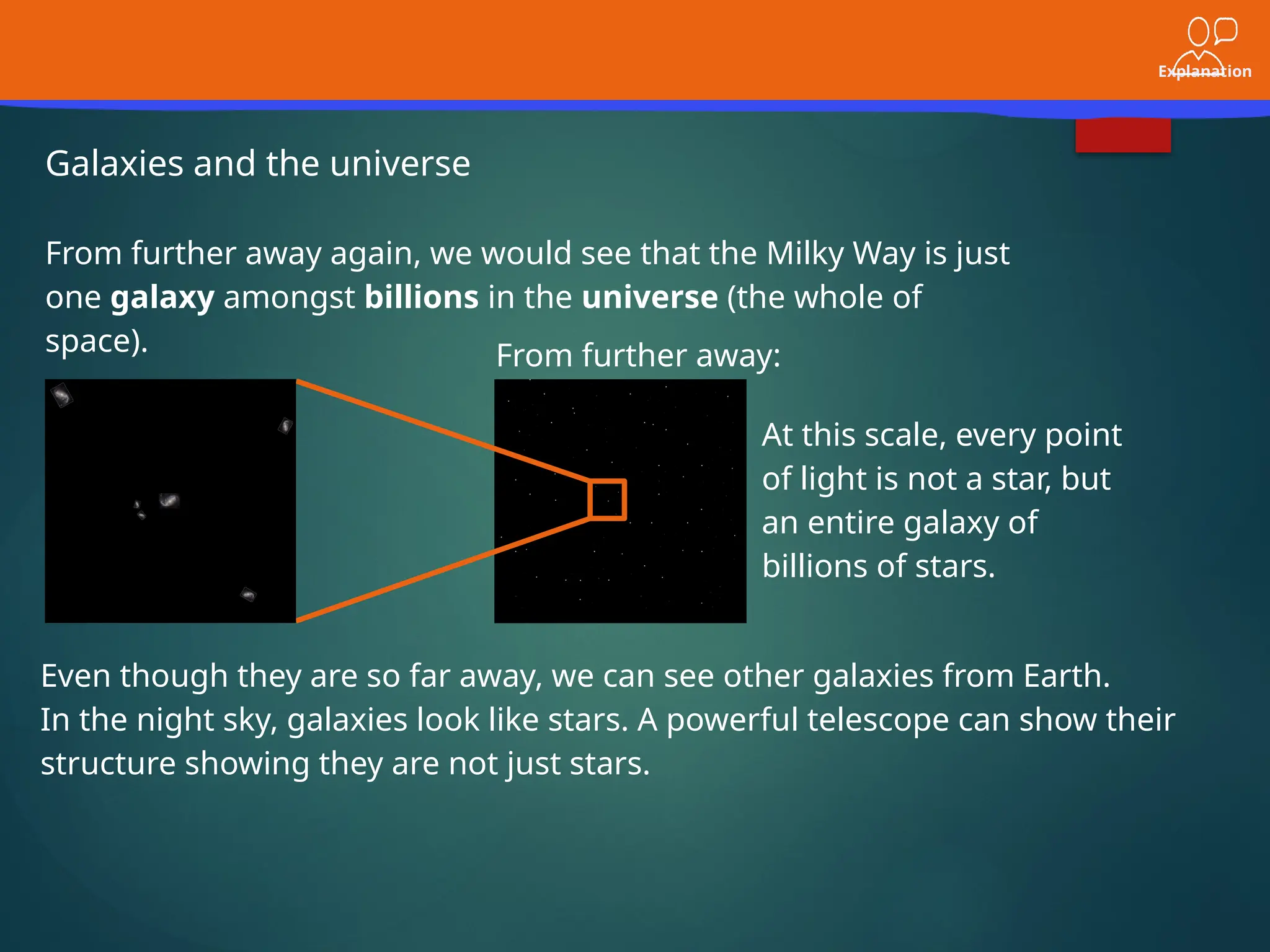
From further away:
Galaxies and the universe
At this scale, every point
of light is not a star, but
an entire galaxy of
billions of stars.
From further away again, we would see that the Milky Way is just
one galaxy amongst billions in the universe (the whole of
space).
Even though they are so far away, we can see other galaxies from Earth.
In the night sky, galaxies look like stars. A powerful telescope can show their
structure showing they are not just stars.
Check
Galaxies and the universe
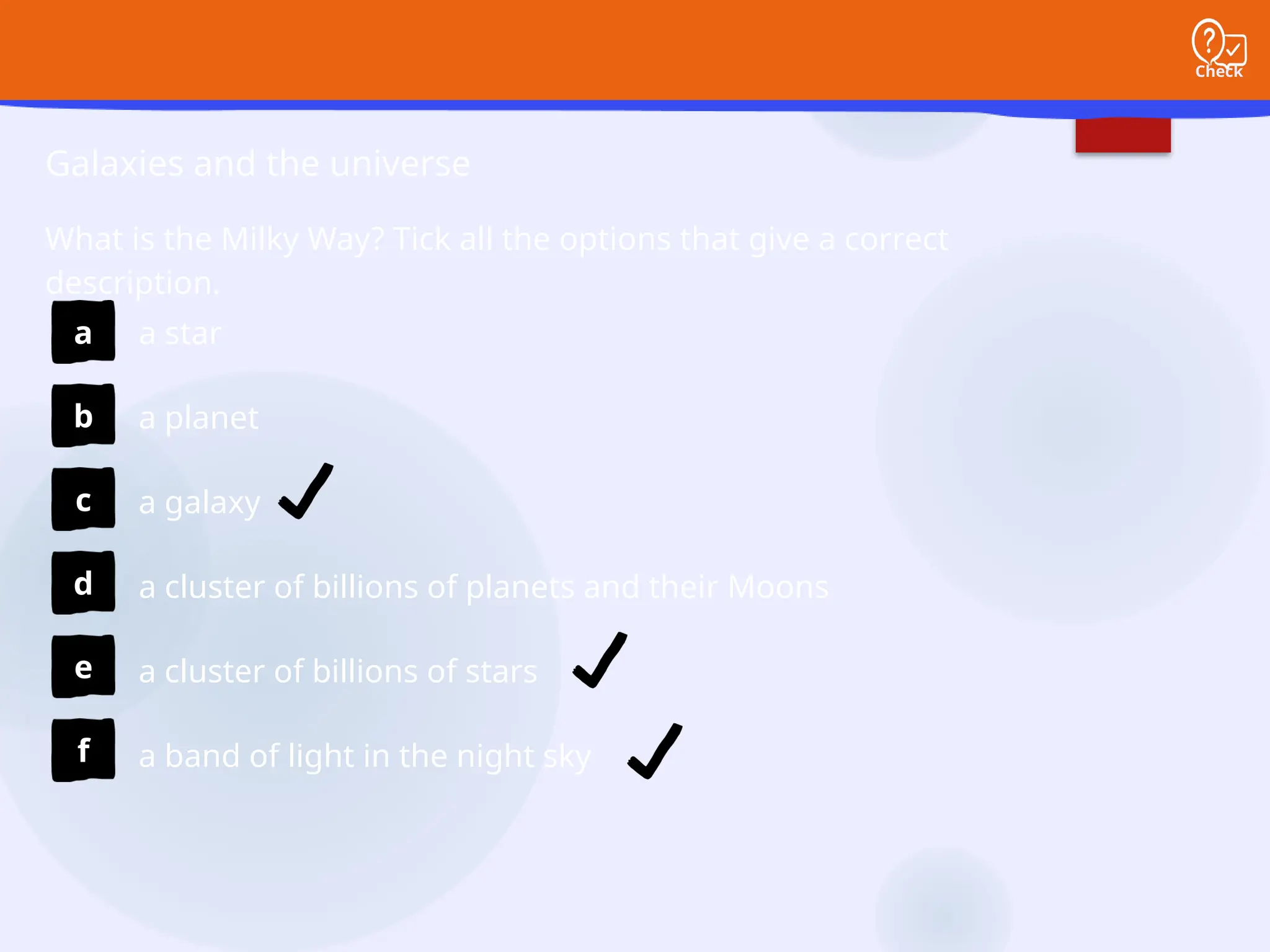
What is the Milky Way? Tick all the options that give a correct
description.
a
b
c
d
e
f
a star
a planet
a galaxy
a cluster of billions of planets and their Moons
a cluster of billions of stars
a band of light in the night sky
Practice
Task C
Galaxies and the universe
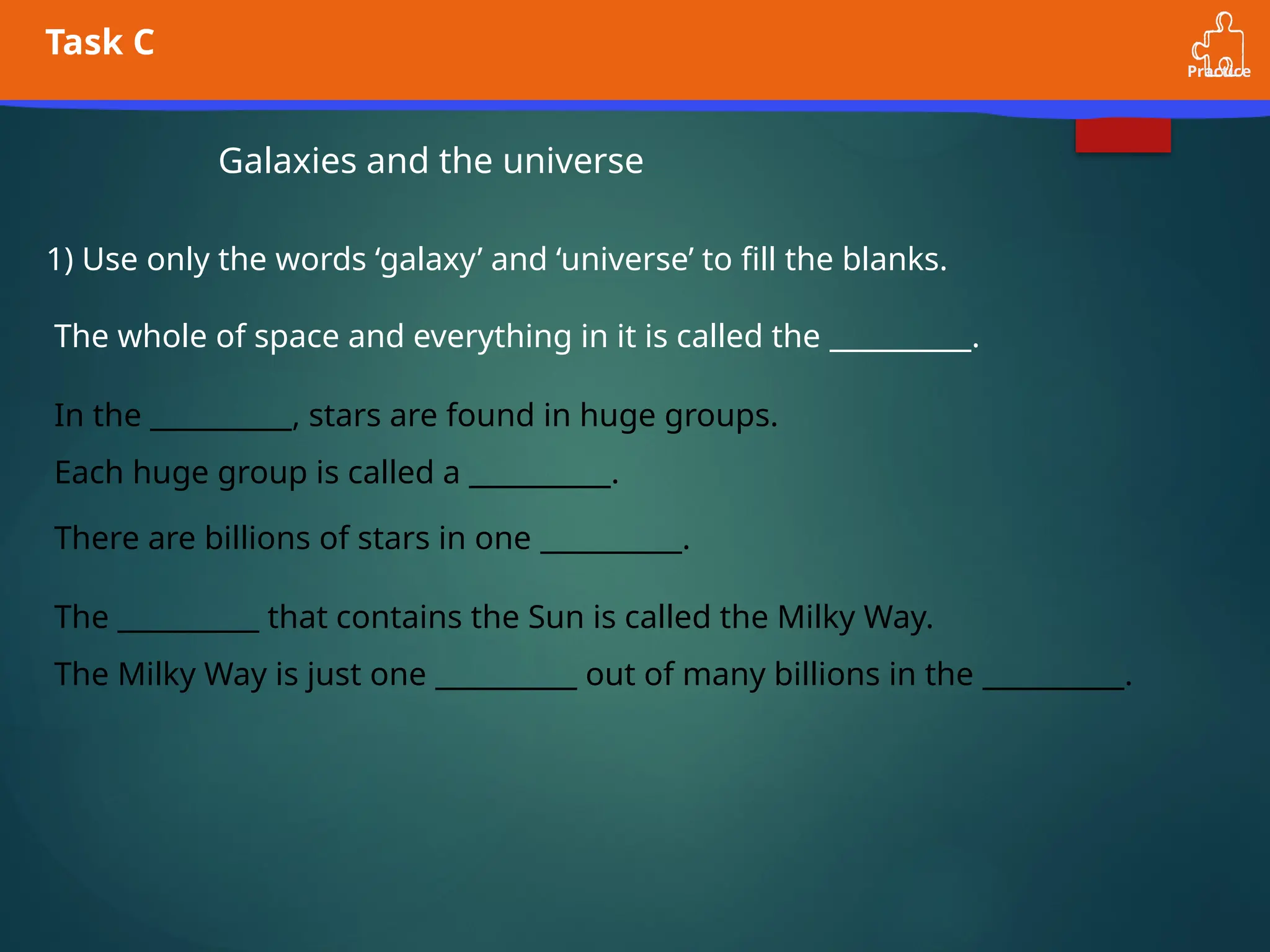
1) Use only the words ‘galaxy’ and ‘universe’ to fill the blanks.
The whole of space and everything in it is called the __________.
In the __________, stars are found in huge groups.
Each huge group is called a __________.
There are billions of stars in one __________.
The __________ that contains the Sun is called the Milky Way.
The Milky Way is just one __________ out of many billions in the __________.
Task C
Feedback
Galaxies and the universe
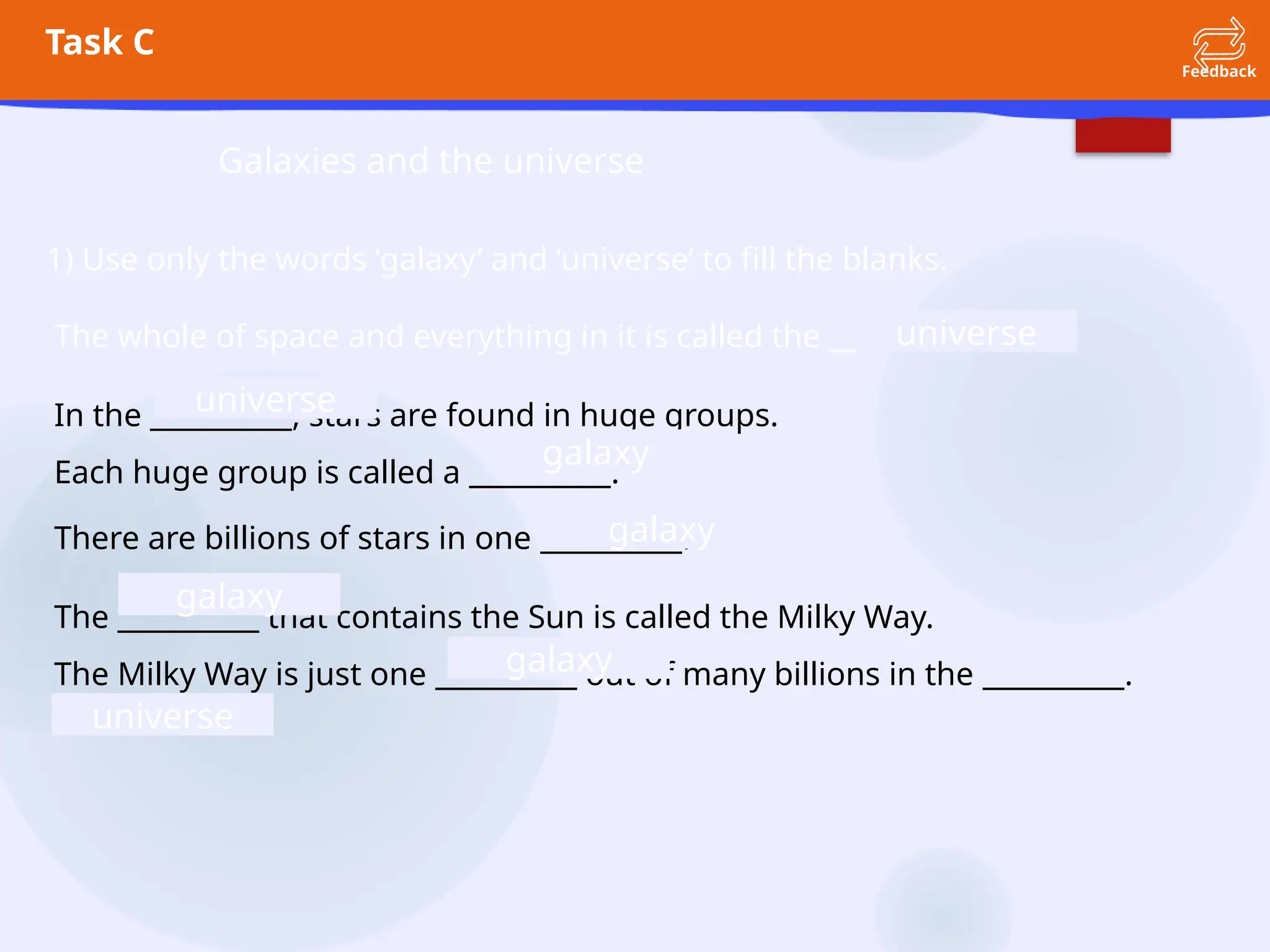
1) Use only the words ‘galaxy’ and ‘universe’ to fill the blanks.
The whole of space and everything in it is called the __________.
In the __________, stars are found in huge groups.
Each huge group is called a __________.
There are billions of stars in one __________.
The __________ that contains the Sun is called the Milky Way.
The Milky Way is just one __________ out of many billions in the __________.
universe
universe
universe
galaxy
galaxy
galaxy
galaxy
Practice
Task C
Galaxies and the universe
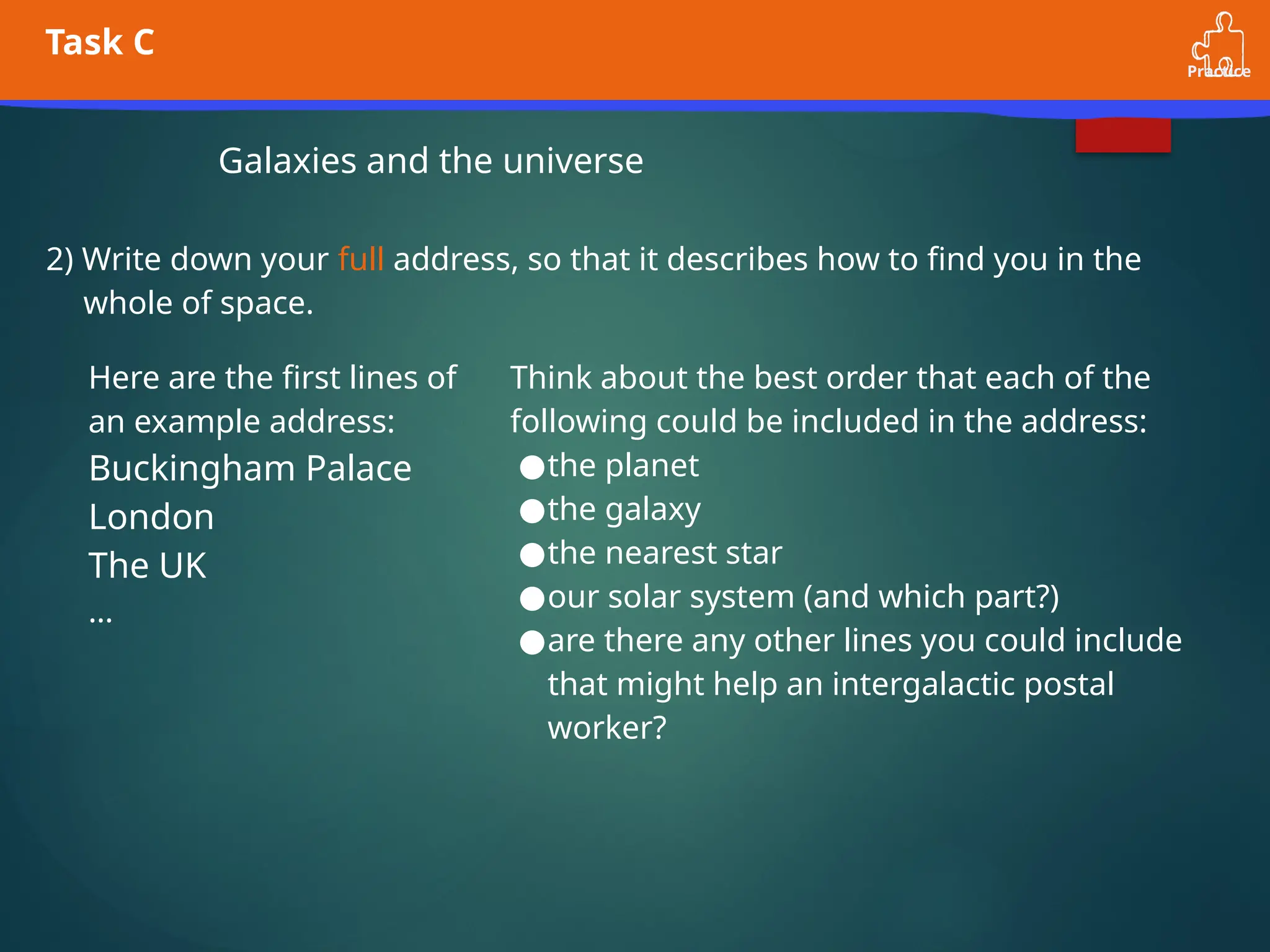
2) Write down your full address, so that it describes how to find you in the
whole of space.
Here are the first lines of
an example address:
Buckingham Palace
London
The UK
…
Think about the best order that each of the
following could be included in the address:
●the planet
●the galaxy
●the nearest star
●our solar system (and which part?)
●are there any other lines you could include
that might help an intergalactic postal
worker?
Task C
Feedback
Galaxies and the universe
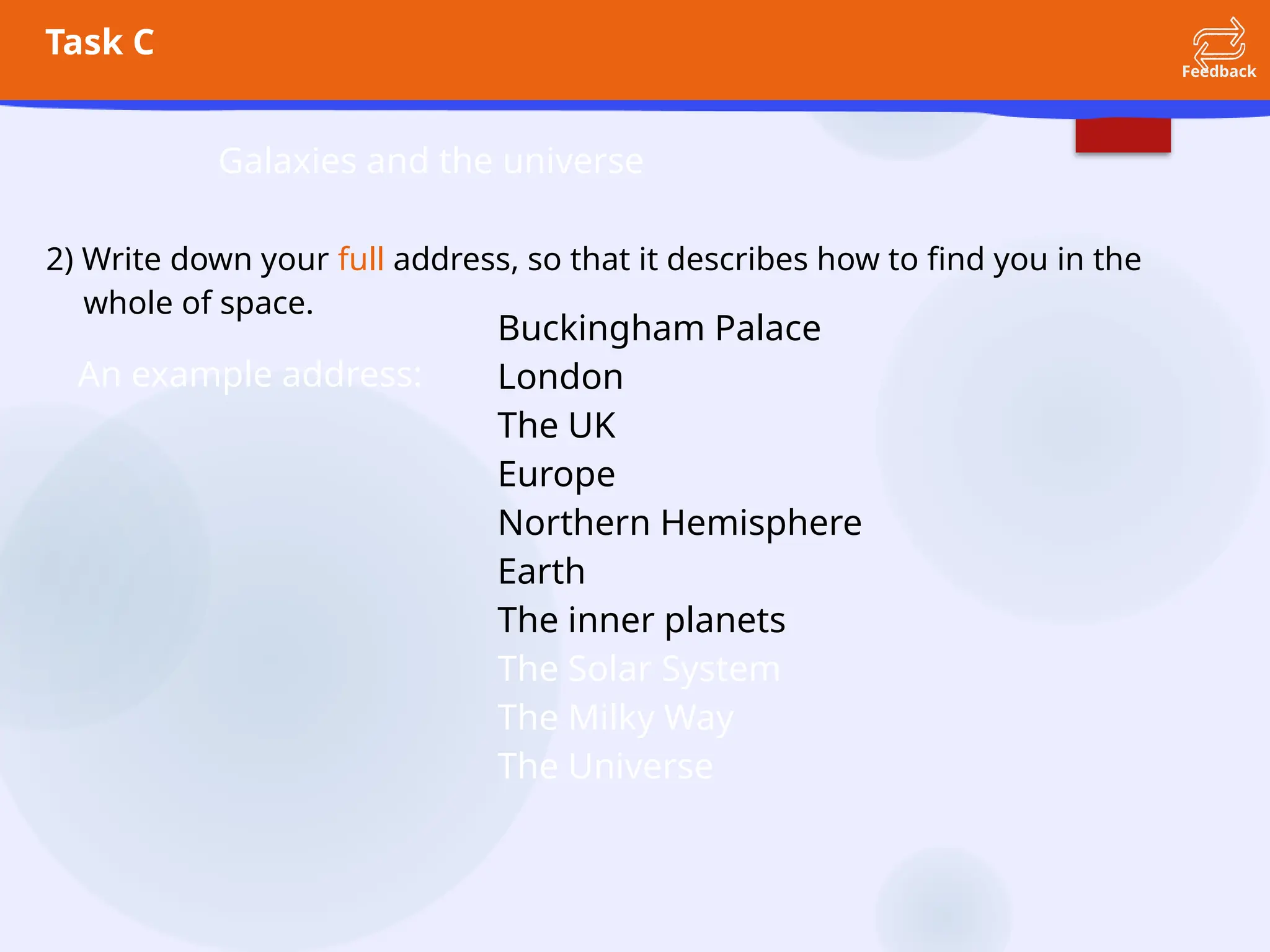
2) Write down your full address, so that it describes how to find you in the
whole of space.
An example address:
Buckingham Palace
London
The UK
Europe
Northern Hemisphere
Earth
The inner planets
The Solar System
The Milky Way
The Universe
Task B
Feedback
Stars, galaxies and
the universe
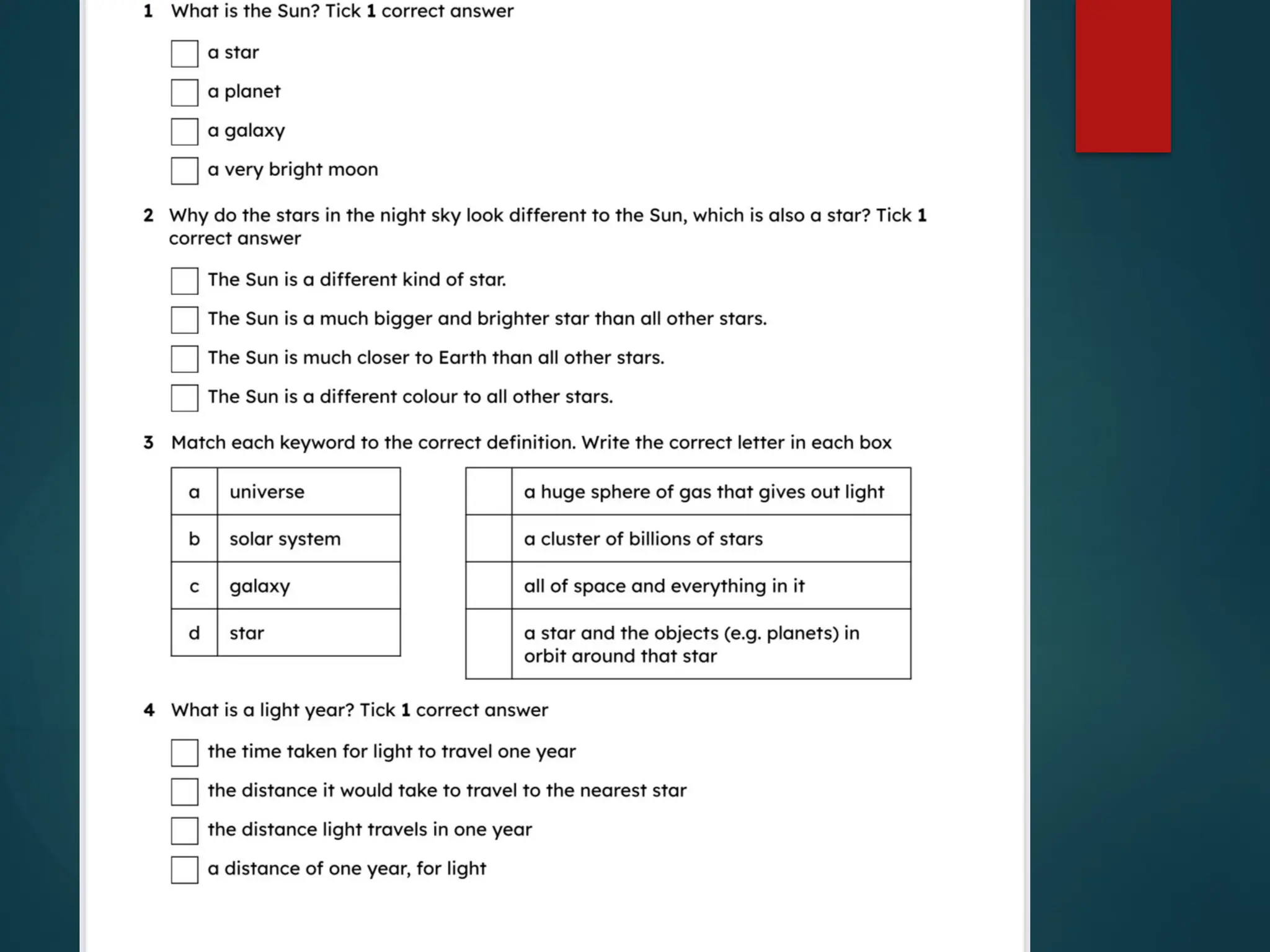
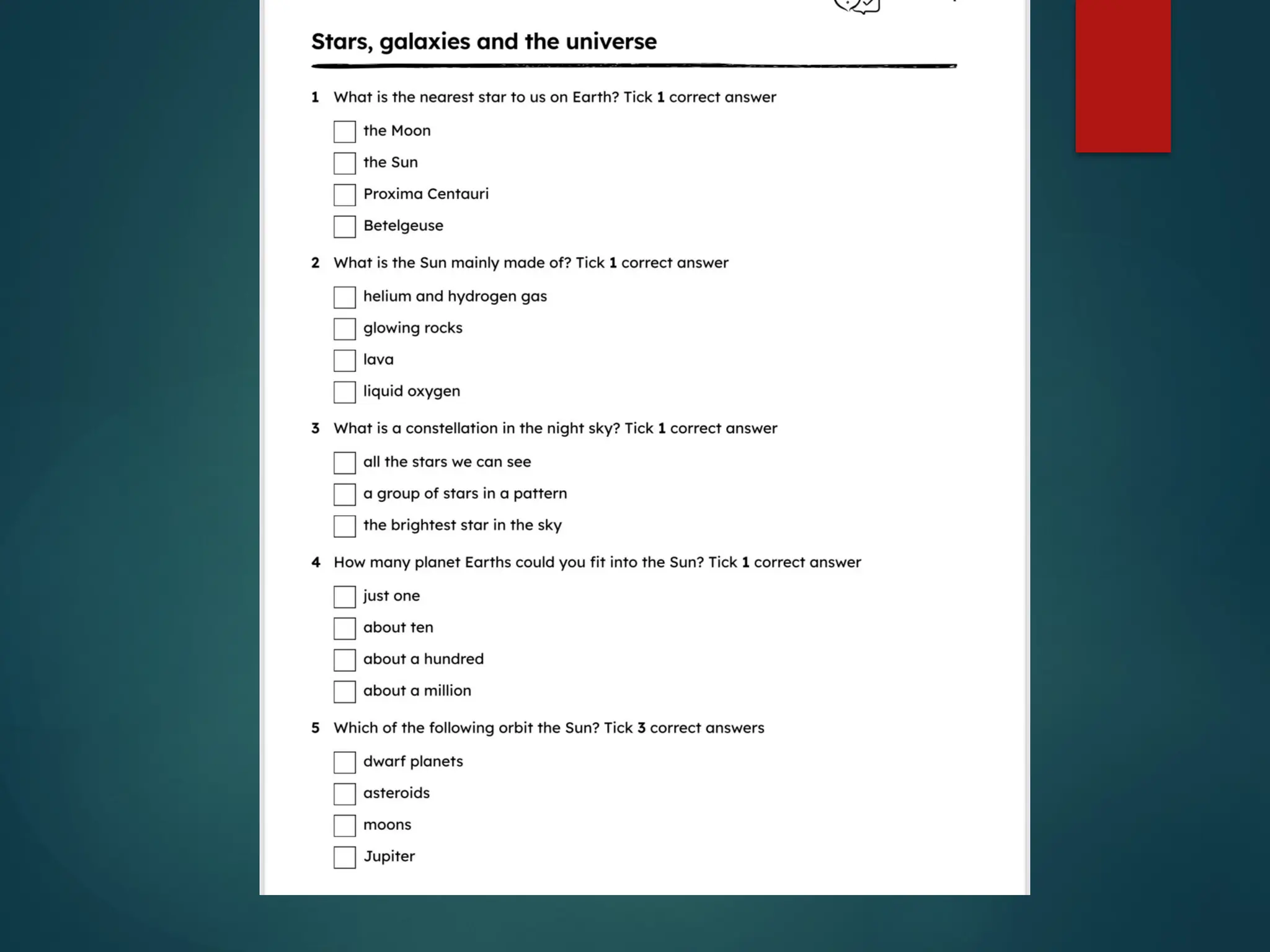
The Sun is a star, an extremely hot sphere of gas that emits light.
Stars in the night sky are much smaller and dimmer than the Sun because
they are much further away.
A light-year is the distance light travels in one year. It is a huge distance and
is used to measure distances in space.
Beyond the Sun, the next nearest star
to Earth is about 4 light-years away.
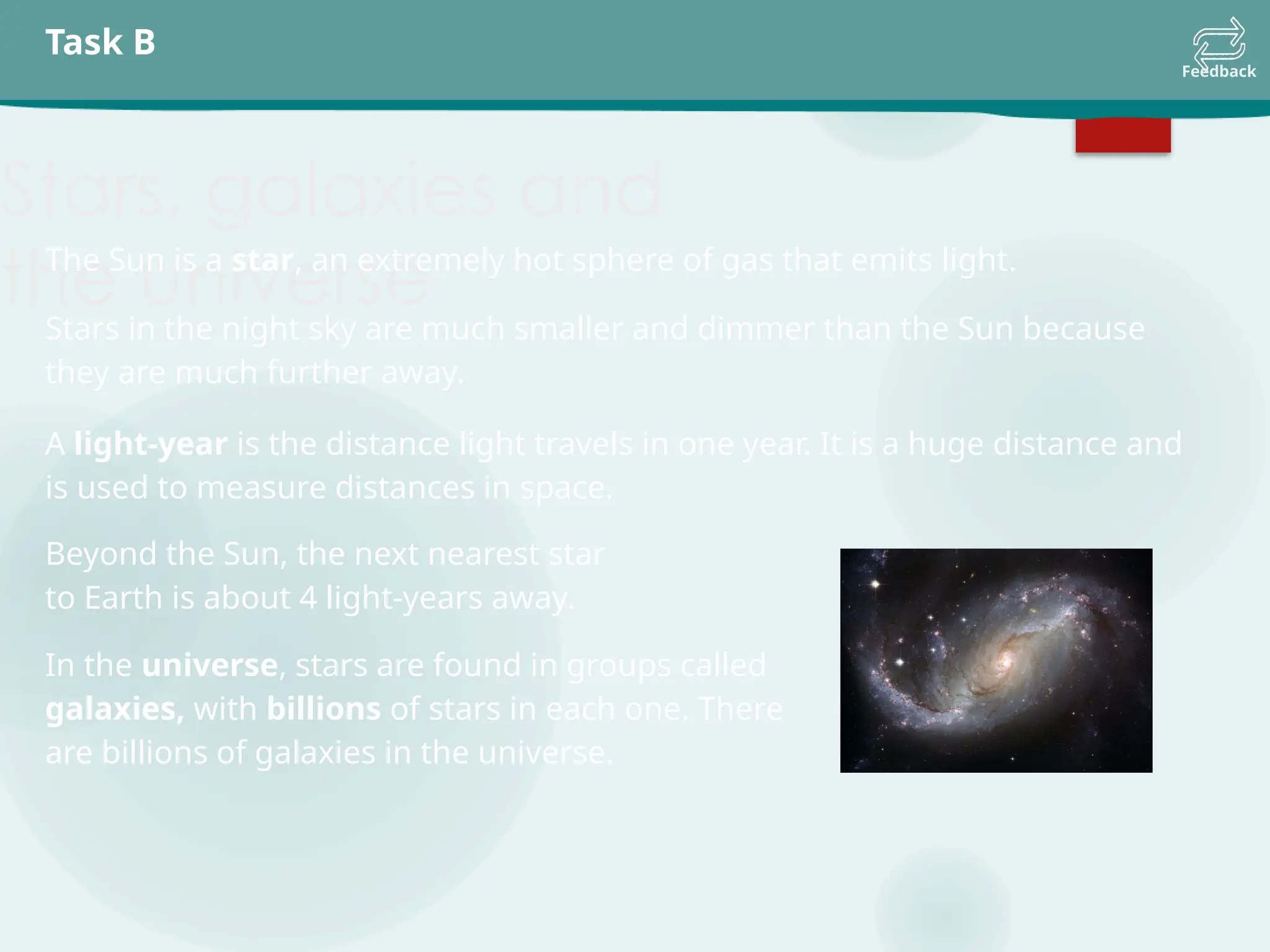
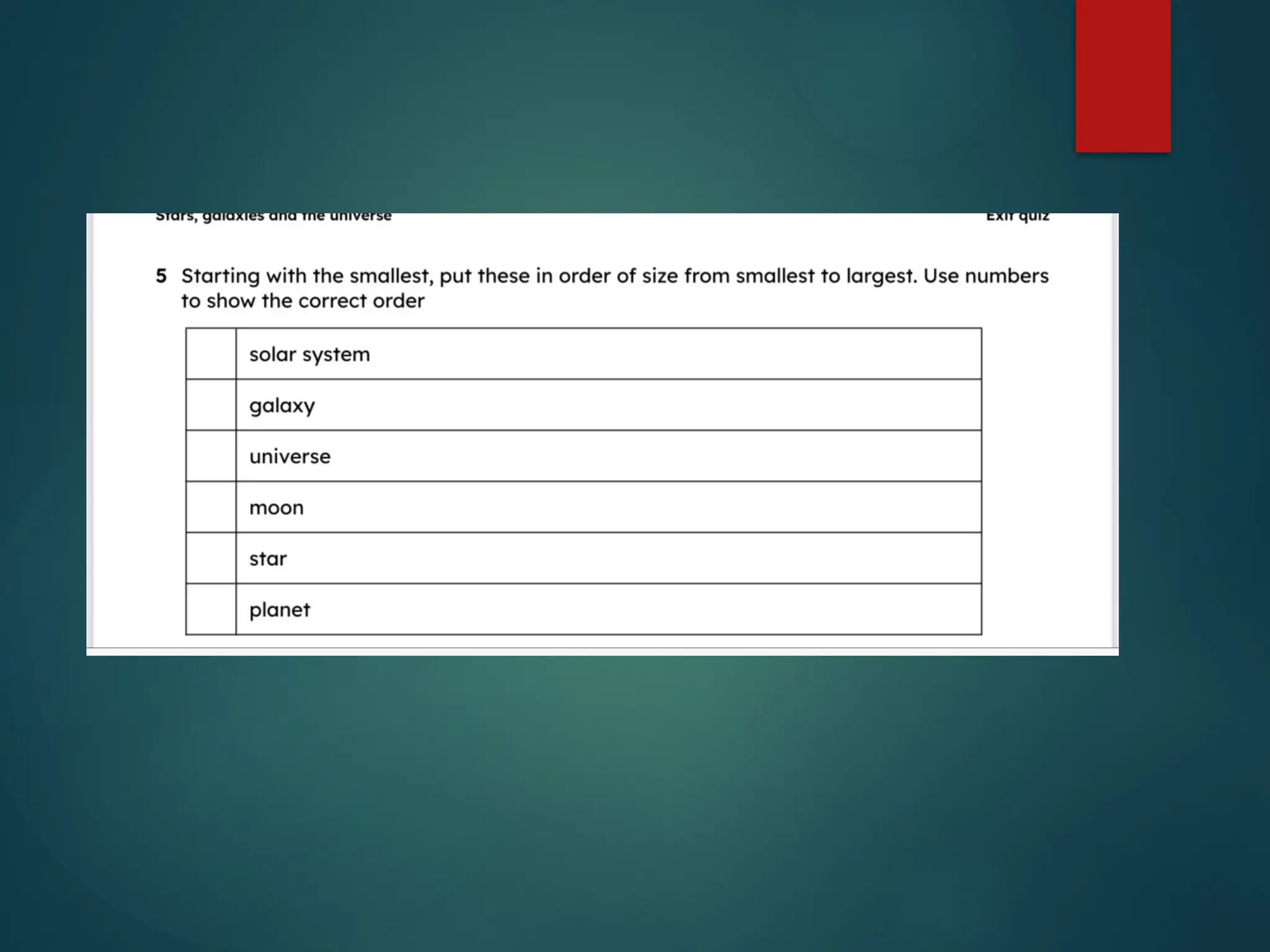
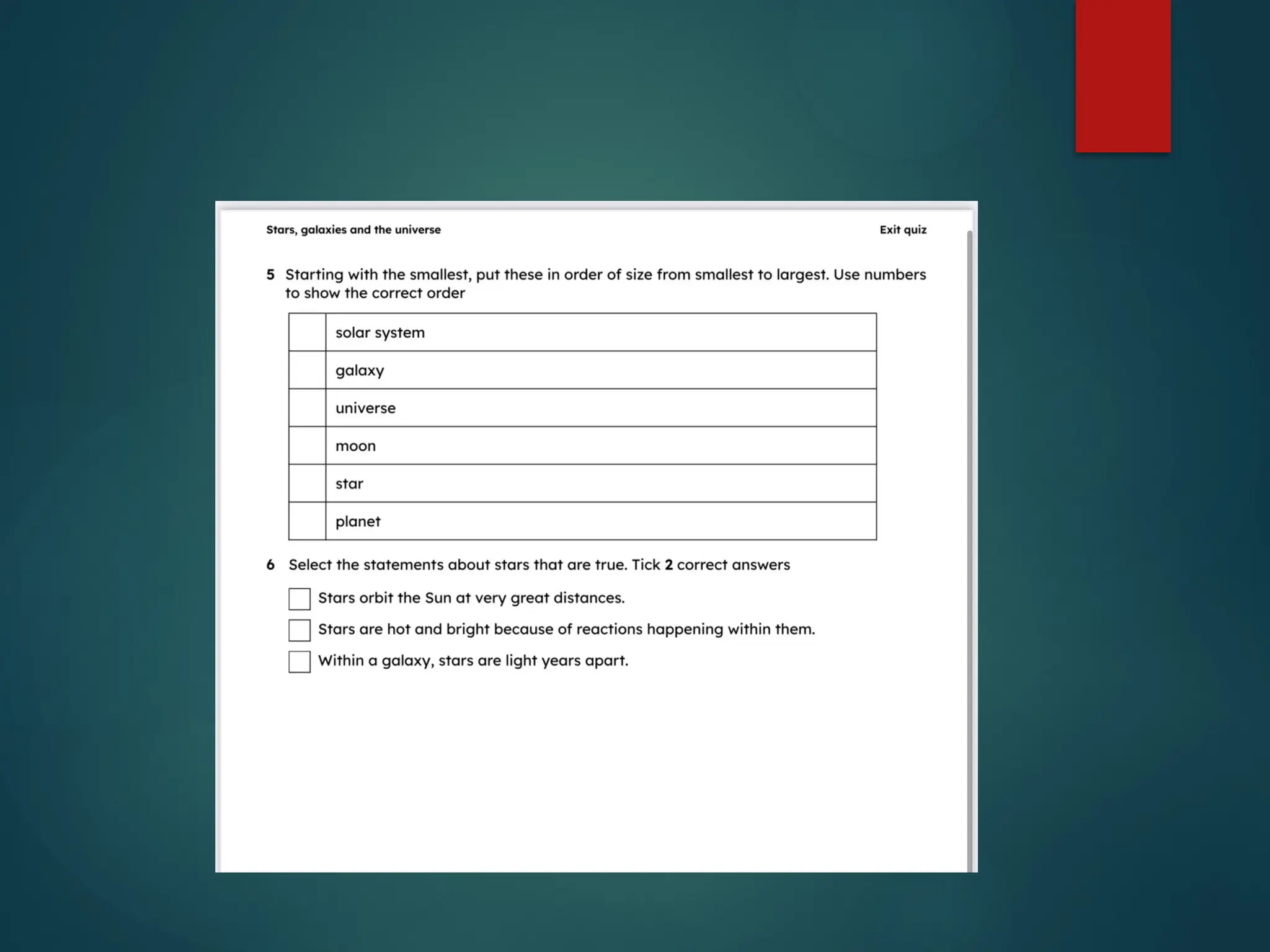
In the universe, stars are found in groups called
galaxies, with billions of stars in each one. There
are billions of galaxies in the universe.
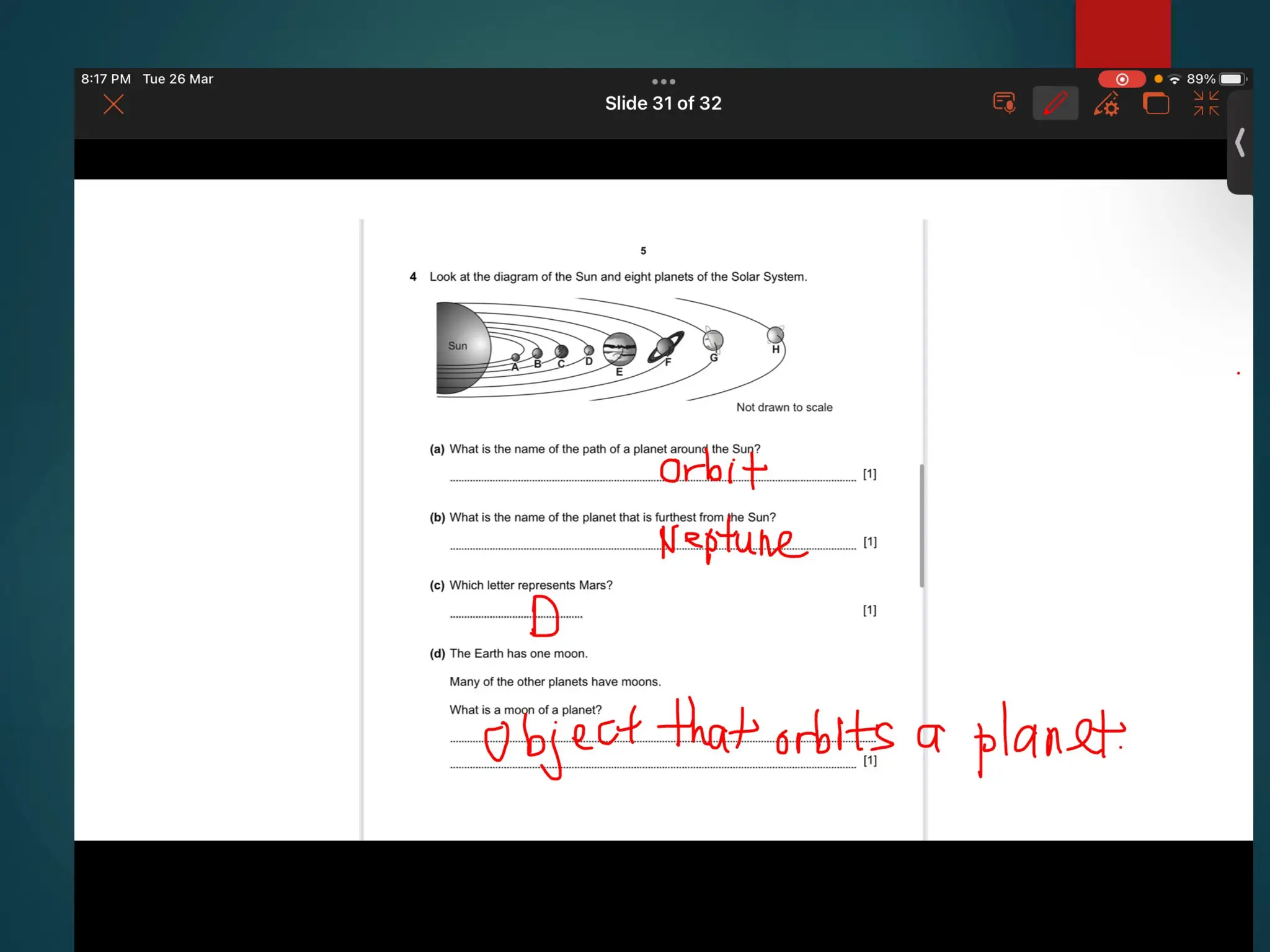
Solar System.pptx Solar System.pptxpptpp

Solar System.pptx Solar System.pptxpptpp

  • 1.
  • 2.
    Journal  Can youname the 8 planets in our Solar System? This includes Earth… Mercury, Venus, Earth, Mars, Jupiter, Saturn, Uranus, Neptune
  • 3.
    Do you knowany ways to remember all 8? My Very Excellent Mother Just Sold Us Nuggets!
  • 4.
    Galaxies  Our sunis 1 of trillions of stars in the universe. Stars are found in groups held together by gravity.  A huge group of stars is called a galaxy.  Our entire universe is made up of thousands of galaxies.  The images below show you how small we are compared to the entire universe. UNIVERSE GALAXY SOLAR SYSTEM The entire universe is made of thousands of A huge group of stars held together by gravity. A system of planets & stars that are found throughout
  • 5.
    The Milky Way Our Solar System is part of the “Milky Way” galaxy.
  • 6.
  • 7.
    Spinning Planets  Periodof Rotation: amount of time that an object takes to rotate once. (1 Day)  Period of Revolution: time it takes an object to revolve around the sun once. (1 year) http://www.youtube.com/watch?v=97Ob0xR0Ut8&fe ature=related
  • 8.
    Mercury  On Mercuryyou weigh only 38% of what you weigh on Earth.  Fastest orbiting planet  Planet nearest to the sun  One side of the planet can be 800 degrees Fahrenheit when the other can be -280 degree Fahrenheit at the same time.
  • 9.
    Venus  On Venusyou weigh only 91% of what you weigh on Earth.  Venus has 90 times the pressure of Earth  Venus has volcanoes like Earth  Rotates in the opposite direction of Earth.  One time there were oceans before they boiled away.
  • 10.
    Earth  23 hoursand 56 min=1 Earth day (rotation)  365 days =1 Earth year (revolution)  Earth is warm enough to keep most of its water from freezing and cold enough to keep it’s water from boiling  Temperature is between –13 degrees Celsius and 37 degrees Celsius
  • 11.
    Mars  Air Pressureon Mars is the same as 30 km above the Earth’s surface  Mars is in the form of ice.  Evidence that water was there at one time  Volcanic history like Earth.  It has the tallest mount of the planets (Olympus Mons) 3x’s size of Mt. Everest.
  • 12.
    Outer Planets (Gas Planetsor Jovial Planets)
  • 13.
    Jupiter  Largest planetin the Solar System  Has a Great Red Spot from a storm system that is more than 400 years old (It is larger than Earth!)  9 hours and 54 min=1 Jupiter day (shortest day)  Pressure is so great it would crush a spaceship.
  • 14.
    Saturn 2nd Largest planet inthe Solar System 95 times more massive than earth. Saturn has the largest rings of any planet, the rings are made of icy particles.  Most moons of any planet.
  • 15.
    Uranus Discovered in 1781 Uranusappears blue-green in color It’s axis of rotation is tilted 90 degrees Moons are named after
  • 16.
    Neptune Discovered in 1846 Neptunehas visual belts of clouds Interior releases thermal energy to its outer layers. Use to be the 8th planet after Pluto until 1999.
  • 17.
    What Keeps OurPlanets & Other Objects In Space In Orbit?? GRAVITY & INERTIA
  • 18.
    GRAVITY & INERTIA Gravity – A force that pulls all objects toward each other.  Inertia – The tendency of an object to stay either at rest or in motion along a straight path So how does these 2 forces keep everything in orbit? **Example: The picture to the right shows how inertia & gravity work Actual Orbit
  • 19.
    GRAVITY & INERTIA Ifinertia was stronger than gravity then objects would stay on their straight path & fly off into Actual Orbit If gravity was stronger than inertia then objects would crash Inertia & gravity work together to keep the moon orbiting the Earth. And they work together to keep planets orbiting the sun
  • 20.
  • 21.
    What is acomet? • A comet is a small body made out of dust, rock, gas & ice. • They are kind of like a dirty snowball • Comets come from faraway regions of our solar system beyond the planets
  • 22.
    Comets are madeup of different parts. Comet Brain Pop http://www.brainpop.com/science/space/comets/  The nucleus  The coma  The ion tail  The dust tail
  • 23.
    What is anasteroid? • Asteroids are large pieces of space rock with irregular shapes. • They are also known as planetoids or minor planets that revolves around our sun
  • 24.
    • Most asteroidsorbit the Sun in the asteroid belt located between Mars and Jupiter. A few asteroids approach the Sun more closely. • Asteroids can collide with object such as Earth’s moon, creating huge craters on the surface. 3 to 6 Asteroid Brain Pop http://www.brainpop.com/science/s pace/asteroids/
  • 25.
    • Meteoroids arepieces of rock or dust that are smaller than asteroids. • Meteoroids are tiny particles left by an asteroid or a comet & most meteoroids are smaller than the size of a pebble. METEOROIDS METEORS & METEORITES
  • 26.
    • When smallmeteoroids enters Earth’s atmosphere, they usually burn up & make a fiery trail as it falls, it is then called a meteor or a “shooting star” • Meteors that land on Earth are called meteorites.
  • 27.
    Explanation Our solar system Earthis a planet that orbits the Sun. The Sun is a star. Stars are not ‘burning’ gas. The high temperatures are caused by nuclear reactions. Stars are extremely large and extremely hot. They give out light and other radiation in all directions. the Sun and Earth (not to scale)
  • 28.
    Explanation Our solar system Earthis a planet. Planets are objects that: ●orbit a star ●has enough mass that their gravitational pull makes them a sphere ●has enough mass that their gravitational pull has cleared their orbital path of similar sized objects Planets are usually far smaller than the star they orbit. Planets are not as hot as stars, and they do not give out their own light. the Sun and Earth (not to scale)
  • 29.
    Check What are thethree main differences between stars and planets? Our solar system 1. Stars give out their own __________, planets do not. 2. Planets __________ around stars. 3. __________ are usually far bigger. light, orbit Stars
  • 30.
    Explanation Our solar system Aswell as Earth, there are seven other planets that orbit the Sun. Dwarf planets and asteroids also orbit the Sun. Many planets also have moons orbiting around them. The system of objects orbiting the Sun is called our solar system. ‘Sol’ is Latin for Sun.
  • 31.
    Explanation Our solar system Theeight planets of our solar system are all different sizes and are made of different materials.
  • 32.
    Explanation Our solar system Theeight planets all orbit the Sun in circles, in the same direction. Each planet orbits the Sun at a different distance. The planets are not in a line. The circular orbits of the planets all lie on the same flat surface.
  • 33.
    Explanation Our solar system Sun Thefour outer planets (Jupiter, Saturn, Uranus, Neptune) are larger and made of gas. If the planets are presented in a line, this only shows the order of the planets’ orbits from the Sun. Sizes and distances are not shown to scale. The four inner planets (Mercury, Venus, Earth, Mars) are smaller and rocky.
  • 34.
    Check For each ofthe following words, state whether they apply to stars, planets, both or neither: Our solar system 1.spherical 2.star-shaped 3.rock 4.gas 5.on fire 6.give out light 7.reflect light 8.very big 9.extremely big 10.other objects can orbit around them both neither planets both neither stars planets planets stars both
  • 35.
    Explanation Our solar system ●Theyare big enough that their gravitational pull makes them round. ●They are not big enough that their gravitational pull has cleared their orbit. Ceres is a dwarf planet that orbits the Sun between Mars and Jupiter. Pluto, Eris, Sedna and Makemake are dwarf planets that orbit beyond Neptune. Dwarf planets are not quite big enough to be planets. We don’t know how many dwarf planets there are in total.
  • 36.
    Explanation Our solar system Thereis a ‘belt’ of asteroids between Mars and Jupiter. Beyond Neptune, there is another large ‘belt’ of asteroids called “the Kuiper belt”. Remember that the planets are not in a line. Asteroids are smaller than dwarf planets. Their gravitational pull has not made them round nor cleared their orbits. ‘belt’ of asteroids not to scale
  • 37.
    Check Our solar system Usethe words ‘Yes’ and ‘No’ to complete the table showing the difference between objects in our solar system . The first row is done for you. Yes No No No It is big enough that its gravitational pull makes it spherical. It is big enough that its gravitational pull has cleared its orbit. A planet Yes Yes A dwarf planet A smaller object, e.g. an asteroid
  • 38.
    Explanation Our solar system Someplanets in our solar system can sometimes be seen from Earth. Without a telescope, planets often look like particularly bright stars in the night sky. The word ‘planet’ comes from the Greek ‘planetes’ meaning ‘wanderer’, because the planets appear to move (very, very slowly) across the background pattern of stars in the sky. This could be a planet.
  • 39.
    Explanation Our solar system Wenow know: ●From Earth, planets can look like bright stars in the night sky because they reflect the Sun’s light. They do not give out their own light. ●The planets in our solar system do not move amongst the stars. They orbit one star; the Sun. ●The other stars we see are not in our solar system. They are over 10 000 times further away than Neptune.
  • 40.
    Check Which picture bestshows how the planets move around the Sun? Our solar system stars a b c d
  • 41.
    Task A Practice Our solarsystem Complete the table to explain what our solar system consists of. Description How many in our solar system? Where are they found in our solar system? Star Planet Moon Dwarf planet Smaller object, e.g. an asteroid
  • 42.
    Task A Feedback Description Howmany in our solar system? Where are they found in our solar system? star planet moon Our solar system A very large sphere of rock or gas orbiting a star. 8 (Mercury, Venus, Earth, Mars, Jupiter, Saturn, Uranus, Neptune). Orbiting the Sun in circles, at different distances. Complete the table to explain what our solar system consists of. An extremely large sphere of hot gas that gives out light. One: the Sun. Just one, at the centre of our solar system, the Sun. A large natural object that orbits a planet. Lots. Earth has one Moon; other planets have many. Orbiting planets.
  • 43.
    Task A Feedback Our solarsystem Description How many in our solar system? Where are they found in our solar system? dwarf planet smaller object, e.g. an asteroid A large round object orbiting a star, not big enough to have cleared its path (be a planet). Many, it is not known how many. At least one (Ceres) orbits in the asteroid belt and others orbit beyond Neptune. Smaller objects in orbit around stars. A huge number. Many are found in the asteroid belt between the orbits of Mars and Jupiter, and the Kuiper belt beyond the orbit of Neptune.
  • 44.
    Explanation Size and scalein our solar system Space is very, very big and hard to imagine. If Earth was this size: The Moon would be this size: 12 700 km 3500 km The Moon orbits Earth at a distance of about 380 000 km.
  • 45.
    Explanation Moon Size and scalein our solar system This shows the Moon’s distance from Earth with both objects at the correct scale: 380 000 km Earth
  • 46.
    Explanation Size and scalein our solar system This shows the Moon’s orbit of Earth at the correct scale, with the objects also to scale: Earth Moon
  • 47.
    Explanation Size and scalein our solar system The Sun is far bigger than the Earth. If the Sun was this size: Earth would be this size: But the distance between the two is not yet to scale.
  • 48.
    Explanation Check Earth isabout 107 sun-widths away from the Sun. On one screen, this Sun is about 15 cm across. Size and scale in our solar system Now do the same calculation for the Sun as it appears on your screen, right now. Use a ruler or meter rule to measure the width of the Sun on your screen: ___ cm = ___ m. Now do: 107 × ___ m = ___ m 15 cm = 0.15 m 107 × 0.15 m = 16.05 m On that scale, this Earth would have to be 16 m away. This is how far this Earth would have to be from the Sun as it appears on your screen.
  • 49.
    Explanation Size and scalein our solar system Our solar system is so large that if you try to draw it with the distances to scale, the objects become too small to see. This picture shows the scale of our solar system more accurately than many pictures online or in books.
  • 50.
    Explanation Size and scalein our solar system On this scale the planets are too small to see - so they have not been drawn. The circular lines are not really there; they mark the orbits of the planets. The Sun is not drawn to scale and, in the picture, it is shown much bigger than it really is.
  • 51.
    Explanation If our solarsystem was the size of a large football stadium: Size and scale in our solar system ●The Sun would be about the size of a tennis ball on the centre spot. ●Mercury, Venus, Earth and Mars would each fit on the head of a pin. Earth would orbit just within the centre circle line. ●All the other planets would be less than 1 cm across. ●Neptune would orbit at the distance of the furthest seats.
  • 52.
    Check If the Sunwas the size of a standard football (22 cm across), which would best represent Earth? Size and scale in our solar system A tennis ball, about 5 m away. A pea, about 12 m away (half a tennis court). A mustard seed, about 24 m away (the length of a tennis court). Neptune would orbit in a circle about 1.5 km across. a b c
  • 53.
    Practice Task B In thetable, explain what each picture shows well and does not show well about our solar system. Size and scale in our solar system 1) 2) What is shown well What is not shown well both 1 2
  • 54.
    Feedback Task B Size andscale in our solar system What is shown well What is not shown well both 1 2 The order of the planets. The 4 inner planets are smaller than the 4 outer planets. The asteroid belt is included, between the orbits of Mars and Jupiter. The planets are shown at different points around circular orbits. It’s unclear whether the other stars are within our solar system (incorrect) or in the background (correct). The asteroid belt is not shown. The sizes of the planets and the Sun are not to scale. The distances between them are far too close for the sizes they are drawn. Dwarf planets, moons and the Kuiper belt are not shown. The planets are shown in a line which is not correct.
  • 55.
    Summary Our solar system Oursolar system refers to the Sun and all the objects in orbit around the Sun. These include eight planets and their moons, dwarf planets and smaller objects such as asteroids. Stars are extremely large spheres of hot gas that give out light. The Sun is a star. The distances between objects in our solar system are very, very large compared to the sizes of the objects.
  • 56.
    Explanation The Sun andother stars The Sun is a star. On Earth, the Sun is extremely bright, so bright it is dangerous to look at directly. The Sun’s true colour is white. The Sun can appear more yellow or orange at sunrise or sunset on Earth, because Earth’s atmosphere scatters some colours of the Sun’s light more than others.
  • 57.
    Explanation The Sun andother stars Images of the Sun like this are ‘false colour’, made by taking measurements of each part of the Sun and choosing colours for different values. Stars are not ‘burning’ gas. The high temperatures are caused by nuclear reactions. Stars are extremely large and extremely hot. They give out light and other radiation in all directions. Planets do not give out light.
  • 58.
    Check The Sun isa star. The Sun and other stars The Sun is a huge ball of burning gas. Nuclear reactions in the Sun make it hot and bright. The Sun is a planet. The Sun is yellow. Tick all of the statements that are true. a b c d e
  • 59.
    Explanation The Sun andother stars From Earth, stars in the night sky appear much smaller and dimmer than the Sun. (The Moon is not a star.) In towns and cities there can be too much background light to see many stars. This is called light pollution.
  • 60.
    Explanation The Sun andother stars Telescopes, binoculars, and cameras with long exposure times (so they capture more light) help us see this more clearly. Different stars have different sizes, brightnesses and colours in the night sky.
  • 61.
    Explanation The Sun andother stars The colour of a star (reddish, orange, yellow, white or bluish) depends on the temperature of its surface. The apparent size and brightness of a star in the night sky depends on its distance from our solar system. The further away a star is, the smaller and dimmer it will look, but it will look the same colour. cooler hotter
  • 62.
    Check The Sun andother stars This represents what the Sun looks like at its normal distance: Which picture shows what the Sun would look like if it was double the distance away? d smaller and more yellow c more yellow b smaller a the same
  • 63.
    Task A Practice The Sunand other stars Here are some stars in a small section of the night sky. 1) Draw in the boxes to predict what you think these stars would look like if viewed from further and further away. ×2 ×4 viewed at distance: ×8 ×16 ×32 2) Explain why they would look like this. Draw the stars as black dots
  • 64.
    Task A Practice The Sunand other stars 3) In the room you’re in, you may be able to move backwards from the screen. Describe how the stars appear to change as you move back distances of ×2, ×4, ×8 etc. from your starting distance. (Taking a photograph at each distance can help you compare.) 4) Were your prediction and explanation correct? Try to write a better explanation for the changes you saw.
  • 65.
    Task A Feedback The Sunand other stars ×2 ×4 viewed at distance: ×8 ×16 ×32 1) and 3) What would the stars look like if viewed from further and further away? Look closely to see the stars in all the boxes.
  • 66.
    Task A Feedback The Sunand other stars 2) and 4) Explain why the stars look like this when viewed from further and further away. At a greater distance, stars appear smaller and dimmer. They appear smaller because, at greater distance, they take up less of our field of view. They appear dimmer because less of the starlight reaches our eyes (because it spreads out more and more the further it travels). Not all of the light from a star reaches us … … and even less light reaches us if the star is further away.
  • 67.
    Explanation The distance ofstars explains their appearance Stars in the night sky look so small and dim because they are extremely far away. The Sun is the nearest star to Earth. The next nearest star is more than 250 000 times further away from Earth than the Sun is. You could fit over 4000 solar systems into this distance. a distance of ‘1 solar system’
  • 68.
    Explanation The distance ofstars explains their appearance Usually, distances are measured in metres or centimetres. However, the distances to other stars are so large that a larger unit would be more convenient. Stars give out light. Light takes time to travel. For example, light from the Sun takes 8 minutes to reach Earth.
  • 69.
    Explanation The distance ofstars explains their appearance Because light takes 8 minutes to reach Earth from the Sun, we say that Earth is a distance of 8 light-minutes away from the Sun. The distance in metres is about 150 000 000 000 m. The speed of light through space is extremely fast. The distance light travels in one year is called a light-year. A light year is just under 10 000 000 000 000 000 m.
  • 70.
    Check a b c d The distance ofstars explains their appearance A light-second (the distance light travels in 1 s) A light-minute (the distance light travels in 1 min) A light-day (the distance light travels in 1 day) A light-year (the distance light travels in 1 year) Which of these would be the longest distance?
  • 71.
    Explanation The distance ofstars explains their appearance The next nearest stars to Earth (after the Sun) are three stars in a small group called the Alpha Centauri System. The closest star is called Proxima Centauri, which is 4.2 light-years away. All the other stars in the night sky are even further away. The three stars together look like a single bright star in the night sky. This image of Proxima Centauri was taken with the Hubble Space Telescope. ESA/Hubble & NASA | CC BY 4.0
  • 72.
    Check a b c d The distance ofstars explains their appearance It is 4.2 million miles away. It would take 4.2 years to get there from Earth. It takes light from Proxima Centauri 4.2 years to travel the distance to Earth. The distance between Earth and Proxima Centauri is 4.2 years. Proxima Centauri is 4.2 light-years away from Earth. What does this mean?
  • 73.
    Check a b c d The distance ofstars explains their appearance It is a different kind of star to the stars in the night sky. It is a different colour to all the stars in the night sky. It is brighter because it gives out more light than any of the stars in the night sky. It is much closer than any star in the night sky. Why does the Sun look very different to all other stars (which are seen from Earth in the night sky)?
  • 74.
    Practice Task B The distanceof stars explains their appearance This image shows stars and the Moon in the night sky. Discuss the statements about stars on the next slide, then fill in the ‘confidence grid’.
  • 75.
    Practice Task B The distanceof stars explains their appearance Discuss whether each statement is correct or incorrect, then tick the box that shows what you think. We can see all the stars there are. Dimmer stars are always further away than brighter stars. Many stars are so dim or so far away that we can’t see them. Stars in the night sky are orbiting the Sun, like the planets. a b c d I am sure this is correct I think this is correct I think this is incorrect I am sure this is incorrect
  • 76.
    Task B Feedback The distanceof stars explains their appearance Discuss whether each statement is correct or incorrect, then tick the box that shows what you think. We can see all the stars there are. Dimmer stars are always further away than brighter stars. Many stars are so dim or so far away that we can’t see them. Stars in the night sky are orbiting the Sun, like the planets. a b c d I am sure this is correct I think this is correct I think this is incorrect I am sure this is incorrect
  • 77.
    Explanation From even further: Fromfurther away: Galaxies and the universe If you were able to ‘zoom out’ from our solar system to see more of space, you would see views a bit like this at points along the way: Sun Alpha Centauri At very great distance, there is a cloudy glow from the millions of stars that are now too small to see.
  • 78.
    Explanation Galaxies and theuniverse From further away again, we would see that the Sun is just one star amongst billions in a swirling spiral called a galaxy. Our galaxy is called the Milky Way. It is 105 000 light-years across. 1 billion = 1 000 000 000
  • 79.
    Explanation Galaxies and theuniverse The Milky Way can be seen from Earth where there is very little light pollution, on nights when the Moon is not visible in the sky. You are about here: The Milky Way gets its name from an ancient myth about a god spilling milk across the sky. The Milky Way looks the way it does from Earth because Earth is in the Milky way. We are ‘inside’ a disc of light, looking across the same disc of light. … on a minor ‘arm’ of the Milky Way called the ‘Orion Spur’.
  • 80.
    Explanation From further away: Galaxiesand the universe At this scale, every point of light is not a star, but an entire galaxy of billions of stars. From further away again, we would see that the Milky Way is just one galaxy amongst billions in the universe (the whole of space). Even though they are so far away, we can see other galaxies from Earth. In the night sky, galaxies look like stars. A powerful telescope can show their structure showing they are not just stars.
  • 81.
    Check Galaxies and theuniverse What is the Milky Way? Tick all the options that give a correct description. a b c d e f a star a planet a galaxy a cluster of billions of planets and their Moons a cluster of billions of stars a band of light in the night sky
  • 82.
    Practice Task C Galaxies andthe universe 1) Use only the words ‘galaxy’ and ‘universe’ to fill the blanks. The whole of space and everything in it is called the __________. In the __________, stars are found in huge groups. Each huge group is called a __________. There are billions of stars in one __________. The __________ that contains the Sun is called the Milky Way. The Milky Way is just one __________ out of many billions in the __________.
  • 83.
    Task C Feedback Galaxies andthe universe 1) Use only the words ‘galaxy’ and ‘universe’ to fill the blanks. The whole of space and everything in it is called the __________. In the __________, stars are found in huge groups. Each huge group is called a __________. There are billions of stars in one __________. The __________ that contains the Sun is called the Milky Way. The Milky Way is just one __________ out of many billions in the __________. universe universe universe galaxy galaxy galaxy galaxy
  • 84.
    Practice Task C Galaxies andthe universe 2) Write down your full address, so that it describes how to find you in the whole of space. Here are the first lines of an example address: Buckingham Palace London The UK … Think about the best order that each of the following could be included in the address: ●the planet ●the galaxy ●the nearest star ●our solar system (and which part?) ●are there any other lines you could include that might help an intergalactic postal worker?
  • 85.
    Task C Feedback Galaxies andthe universe 2) Write down your full address, so that it describes how to find you in the whole of space. An example address: Buckingham Palace London The UK Europe Northern Hemisphere Earth The inner planets The Solar System The Milky Way The Universe
  • 86.
    Task B Feedback Stars, galaxiesand the universe The Sun is a star, an extremely hot sphere of gas that emits light. Stars in the night sky are much smaller and dimmer than the Sun because they are much further away. A light-year is the distance light travels in one year. It is a huge distance and is used to measure distances in space. Beyond the Sun, the next nearest star to Earth is about 4 light-years away. In the universe, stars are found in groups called galaxies, with billions of stars in each one. There are billions of galaxies in the universe.