1. The document discusses different units used to measure astronomical distances, including the astronomical unit (AU), light year, and parsec.
2. It explains how parallax can be used to measure distances to stars by observing the apparent shift in position of a star relative to background objects as the Earth orbits the Sun.
3. Spectroscopic parallax and studying Cepheid variable stars can also be used to determine distances. Analyzing a star's spectrum provides information to estimate its luminosity and place it on the Hertzsprung-Russell diagram to find distance.
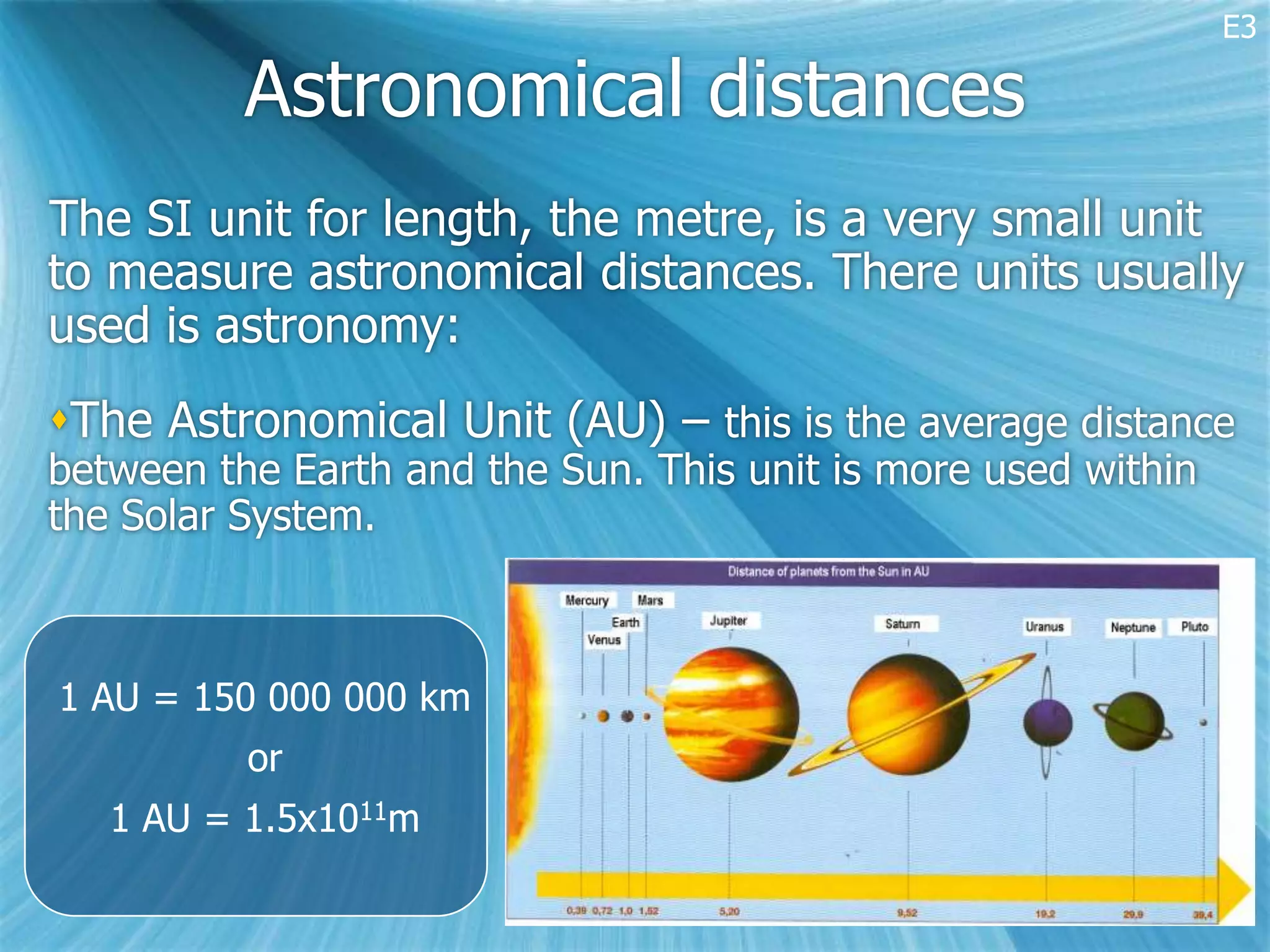
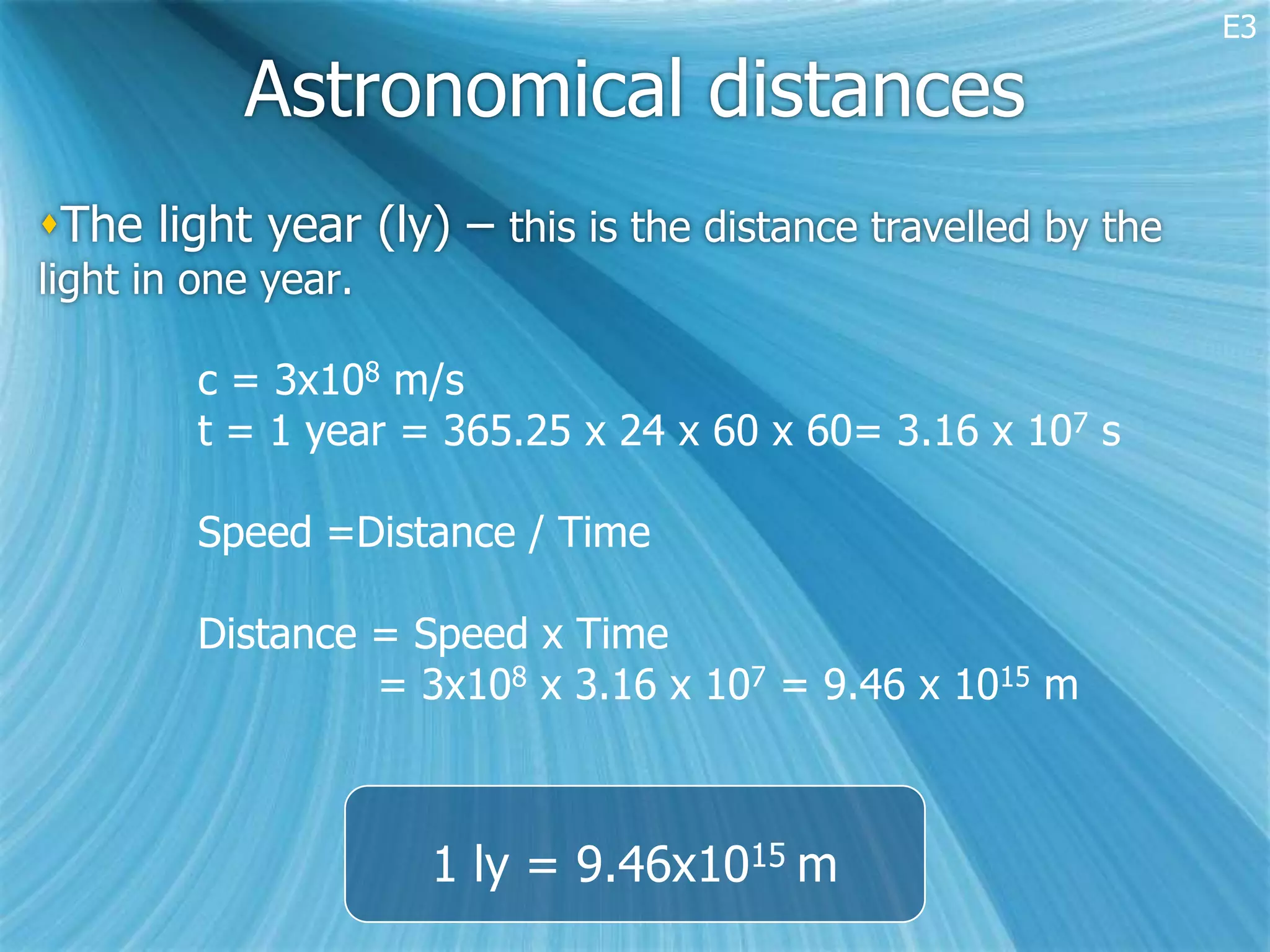
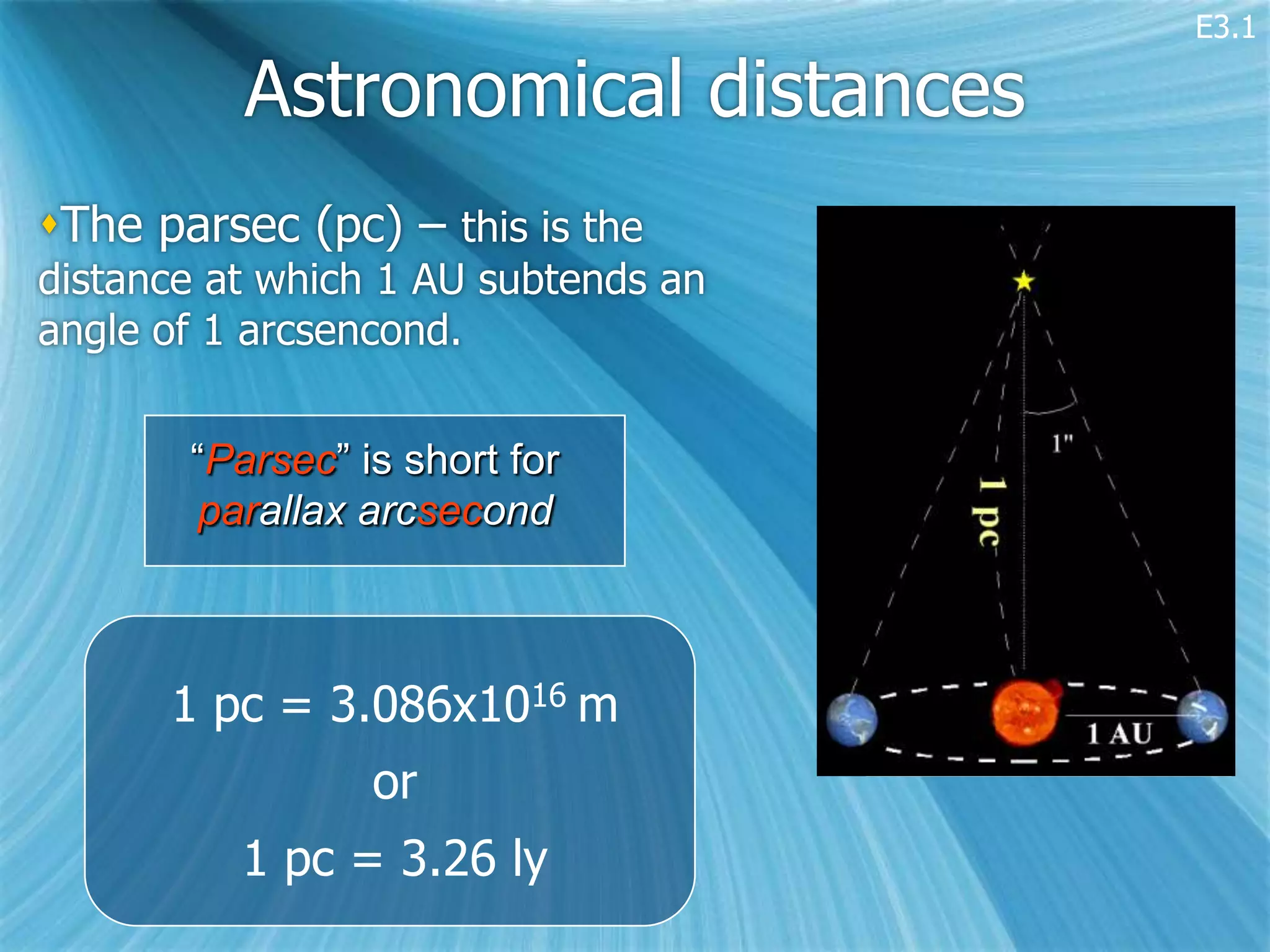
Discusses the measurement of astronomical distances using units such as Astronomical Unit (1 AU = 150 million km), Light Year (1 ly = 9.46 x 10^15 m), and Parsec (1 pc = 3.086 x 10^16 m, equivalent to 3.26 ly).
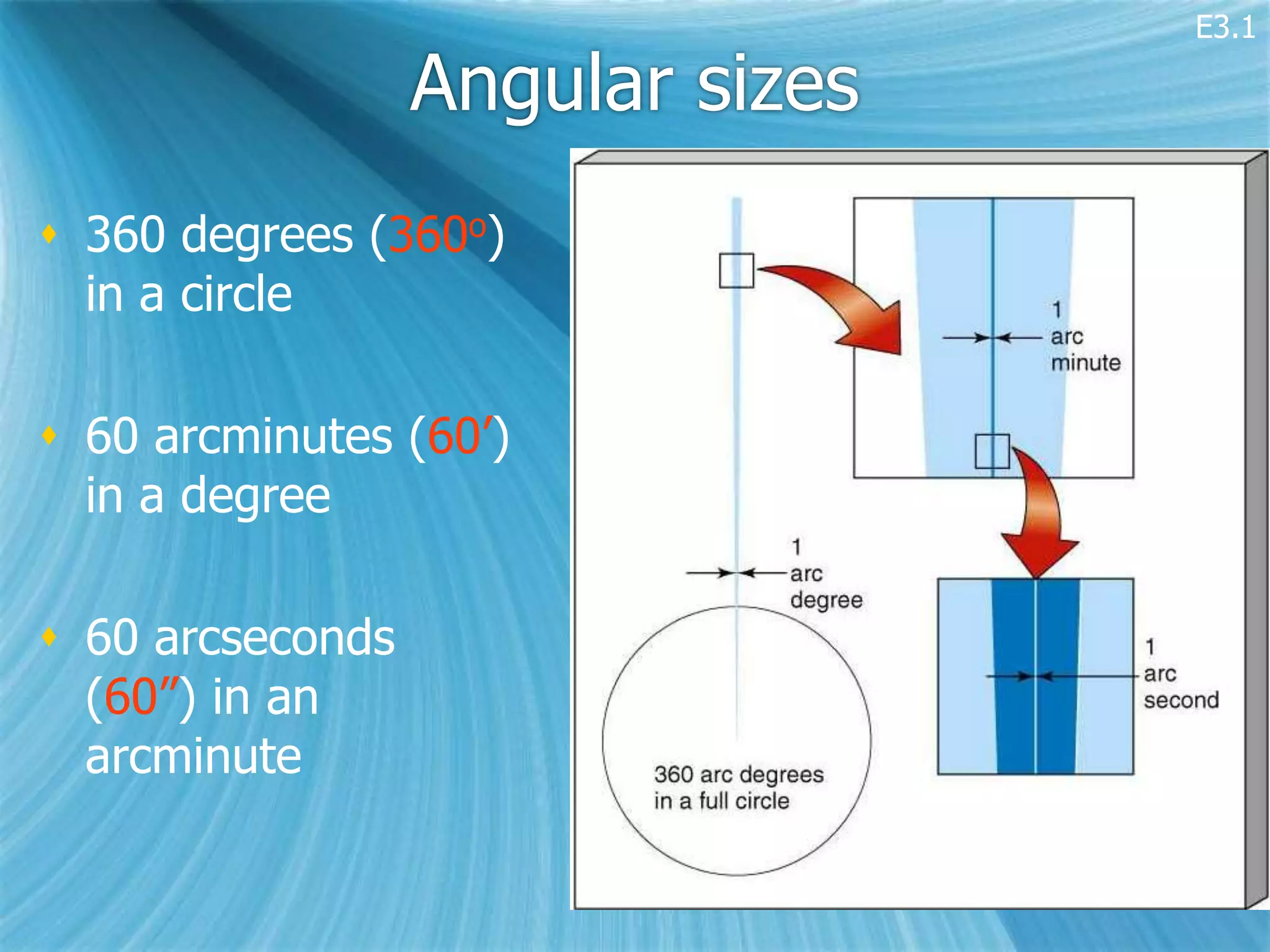
Introduces angular sizes including degrees, arcminutes, arcseconds, and the concept of parsecs, highlighting that 1 parsec (pc) corresponds to 3.086 x 10^16 m.
Explains the parallax effect, how it leads to distance measurements, concepts of baseline and angle shifts, and mathematical relationships for determining distance using parallax.
Discusses the limitation of parallax measurements as the distance of objects increases, making shifts increasingly difficult to observe.
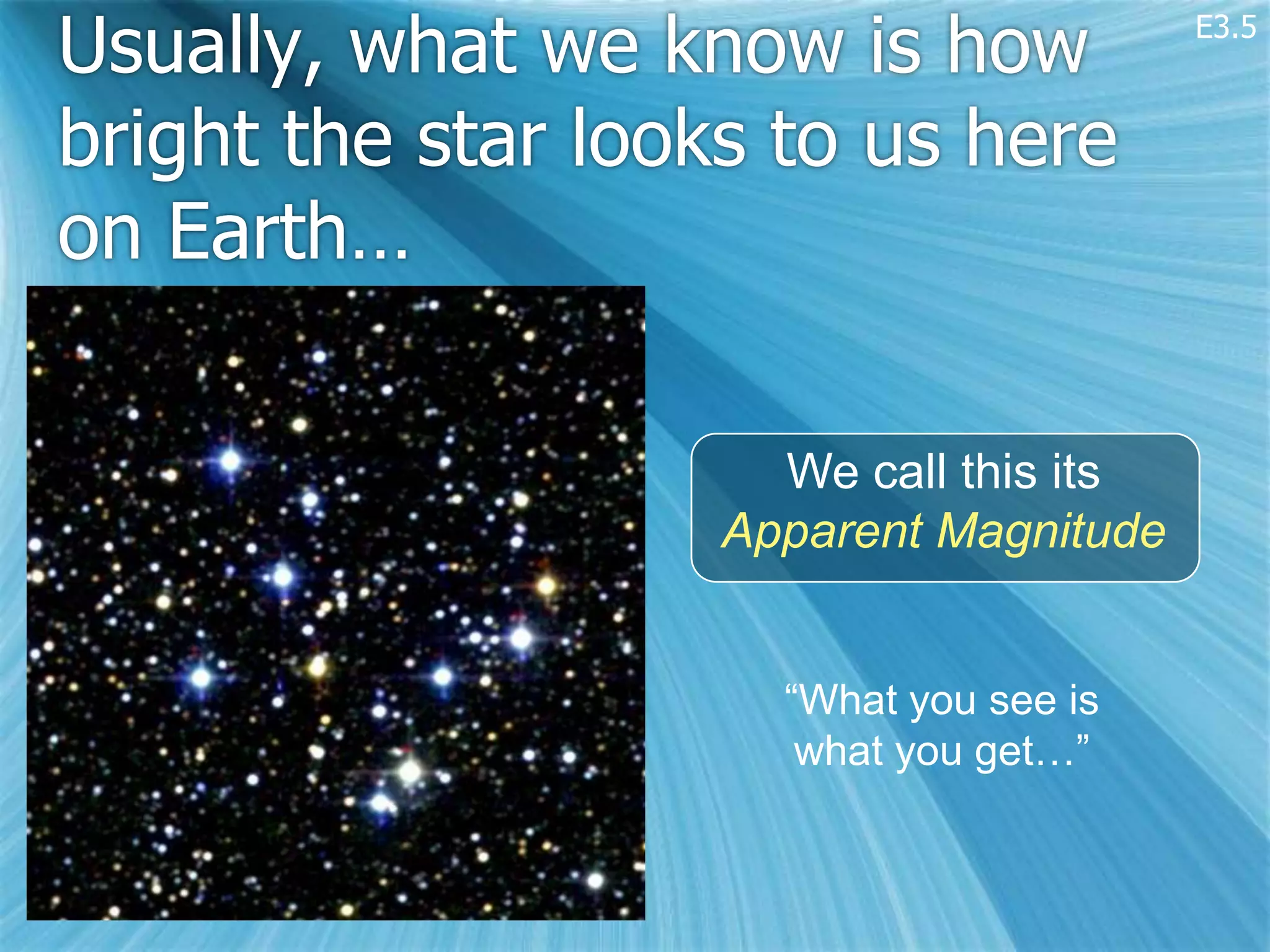
Introduces the concept of Apparent Magnitude, defining how bright a star appears from Earth.
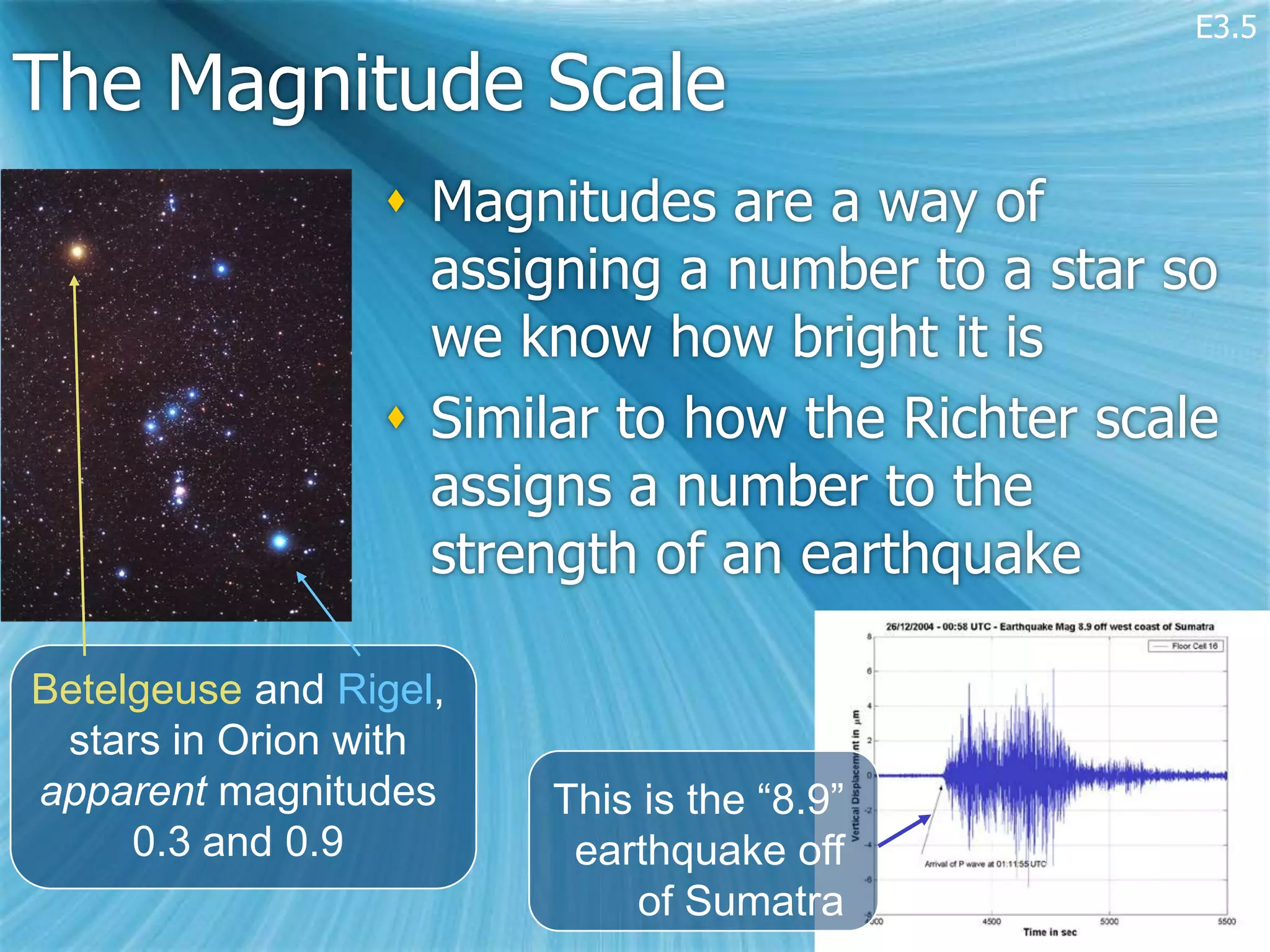
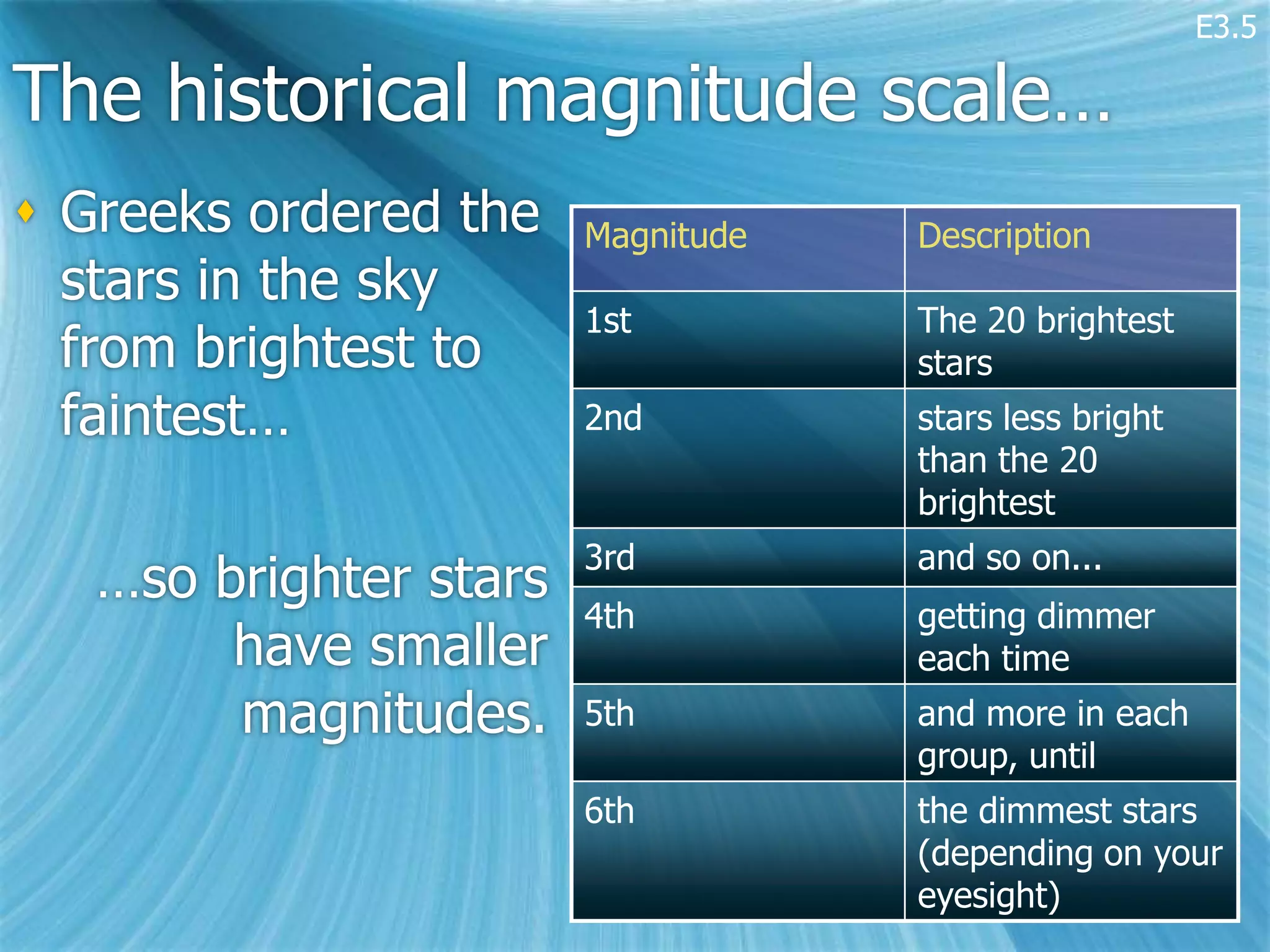
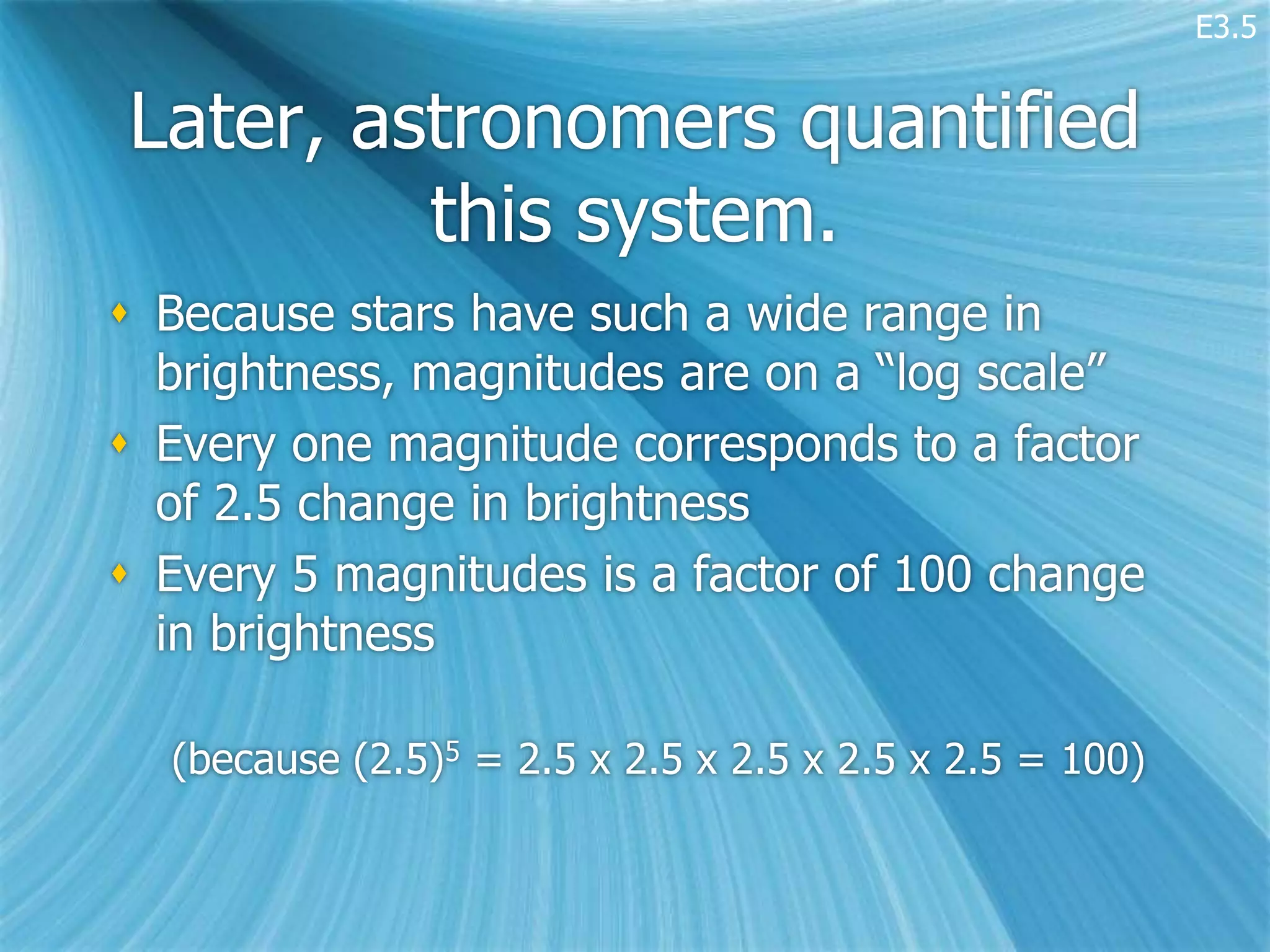
Describes the magnitude scale for star brightness, explaining how it was developed and the logarithmic nature of the scale relating brightness.
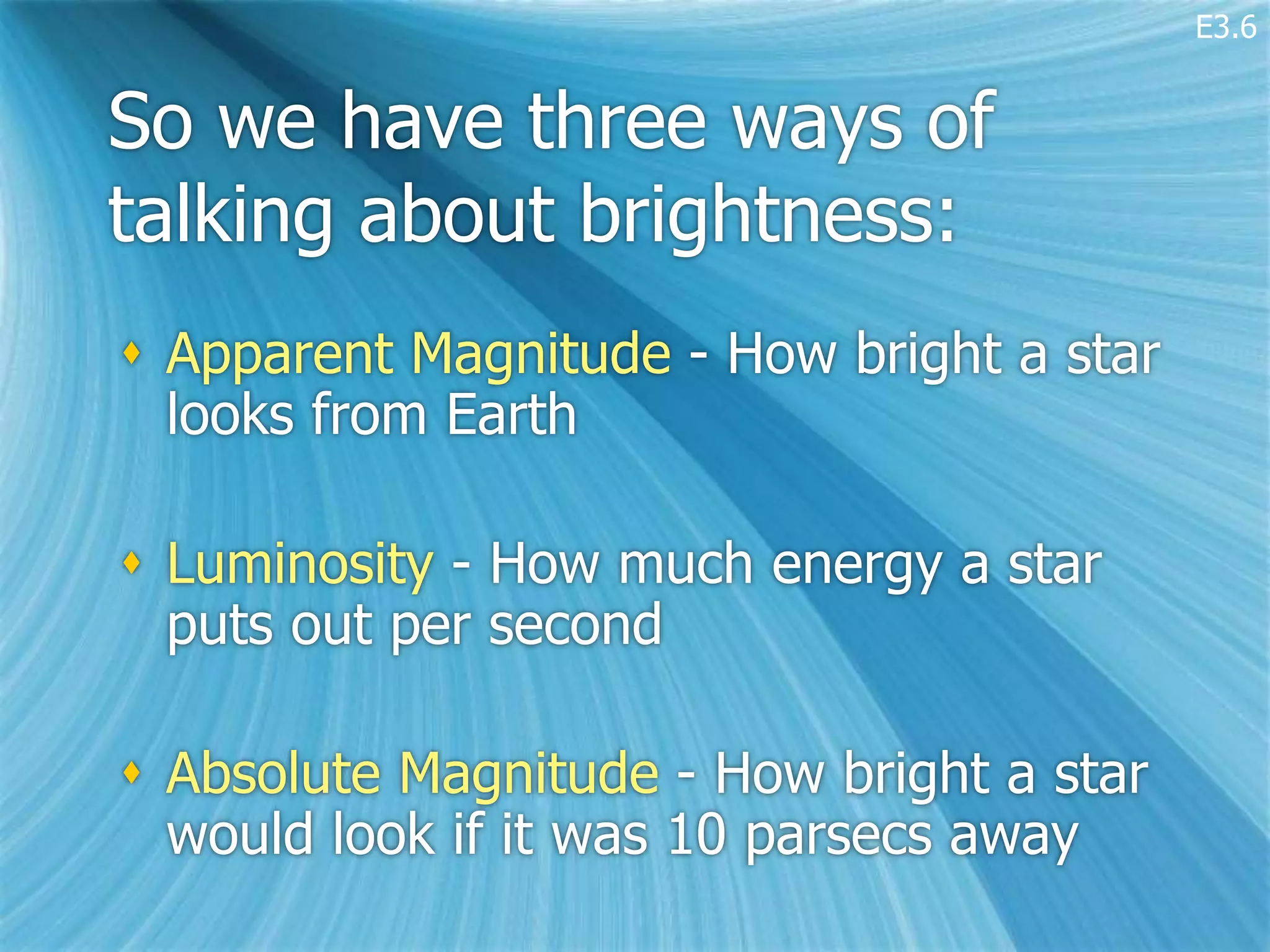
Details about the relationship between Apparent Magnitude, Luminosity, and Absolute Magnitude and how distance impacts perceived brightness.
Introduces the spectroscopic parallax method for measuring star distances based on their spectral characteristics and luminosity.
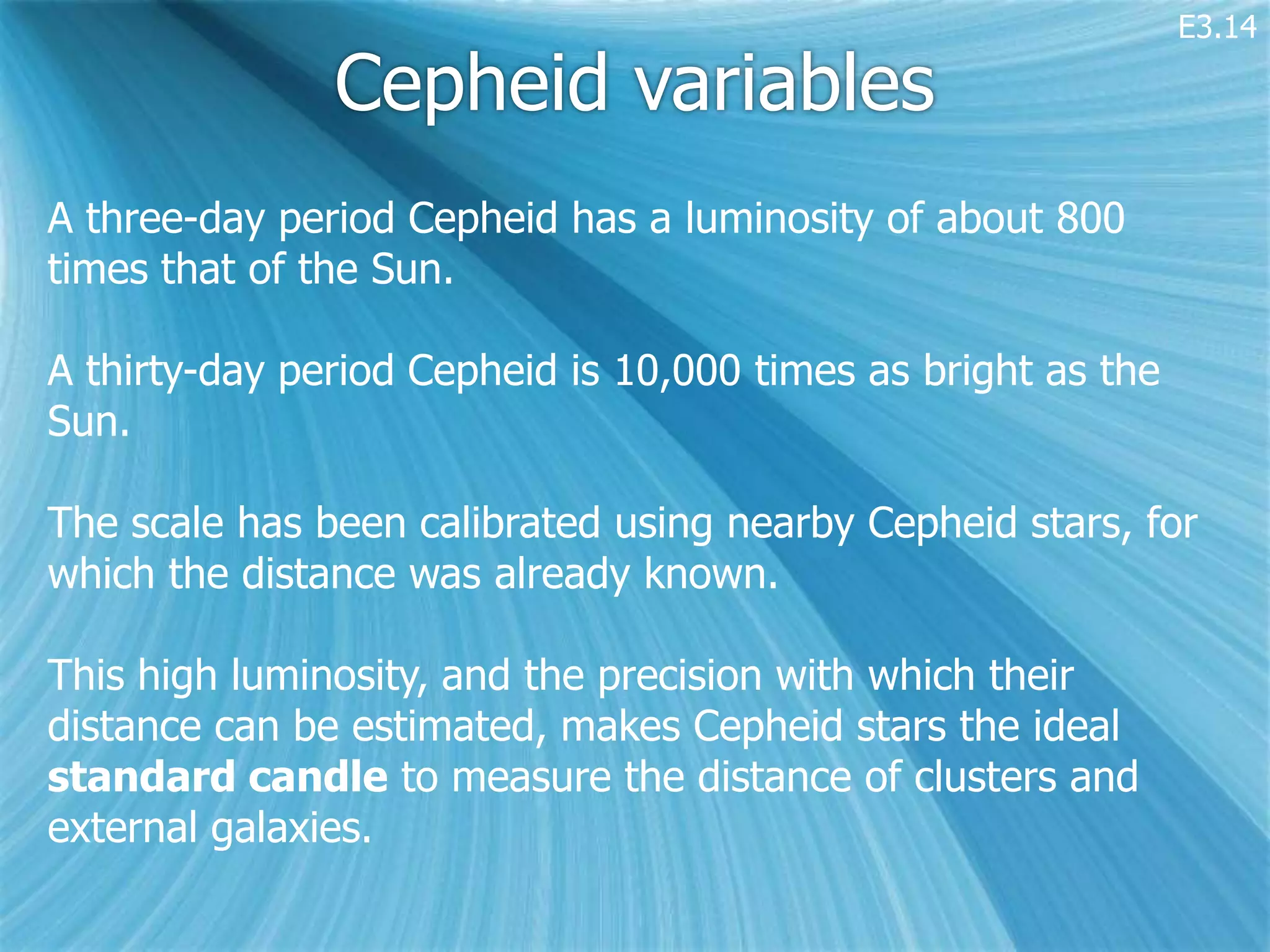
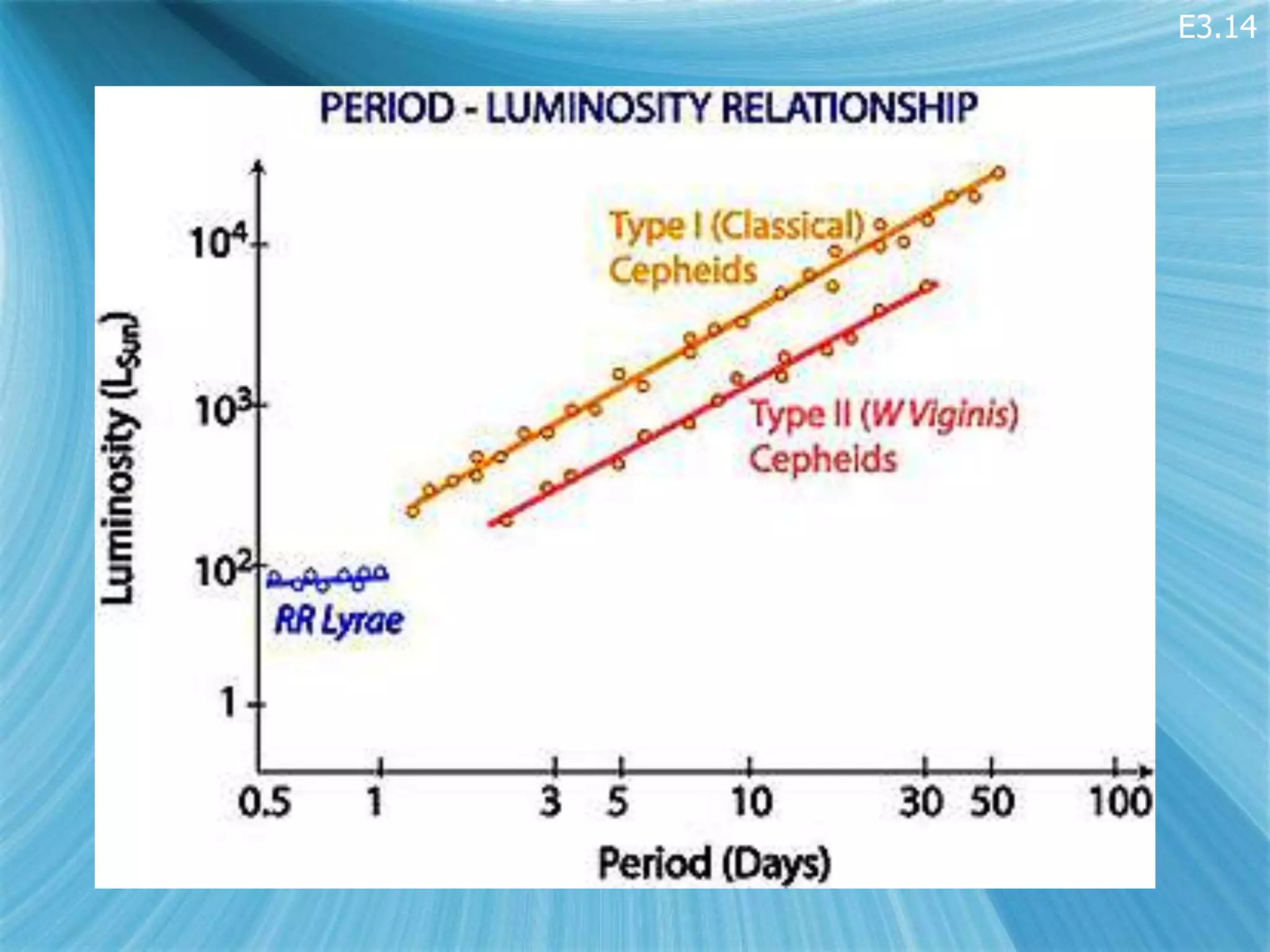
Describes Cepheid variables as standard candles in astronomy, emphasizing their variable luminosity and the period-luminosity relationship.
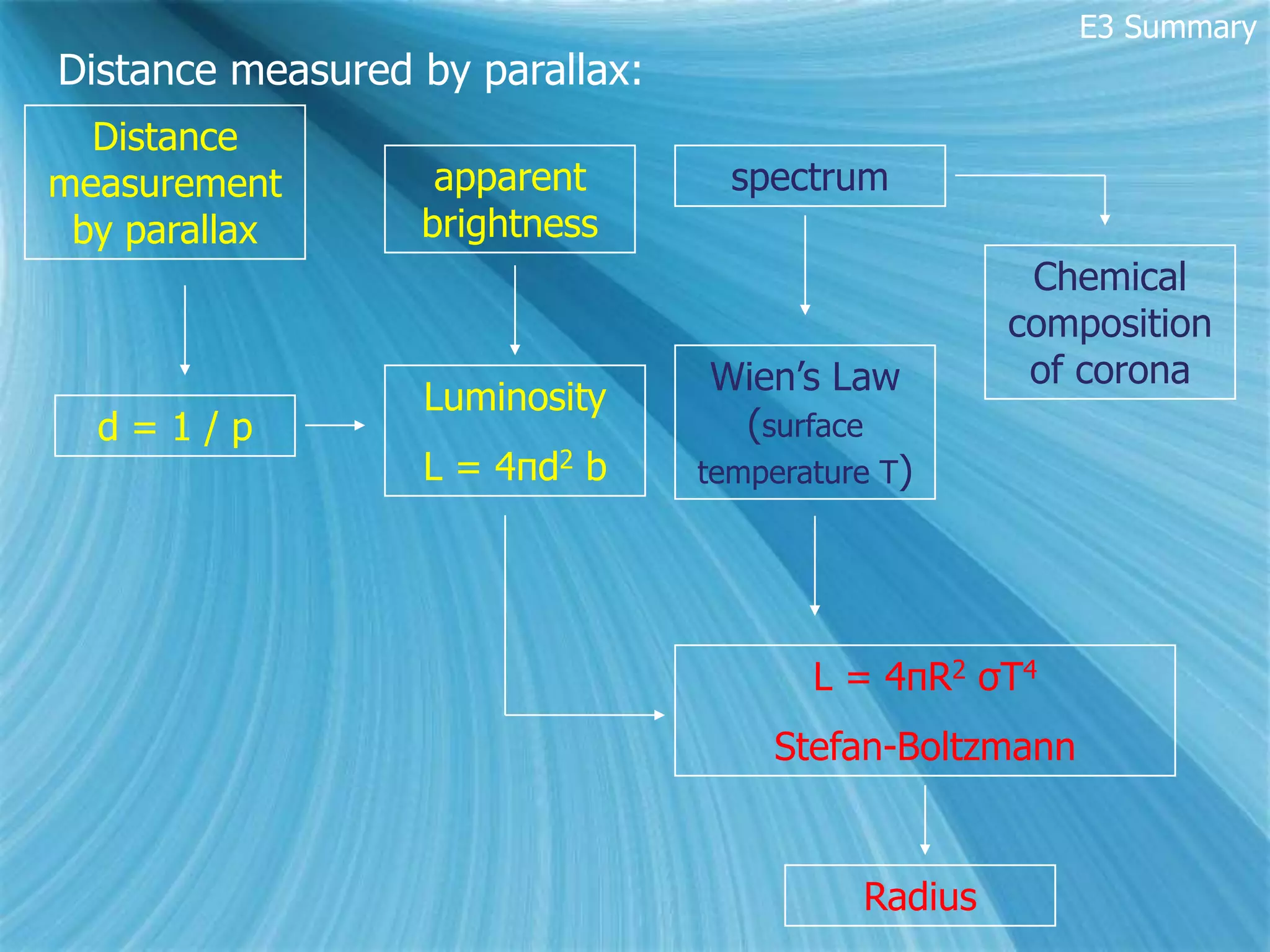
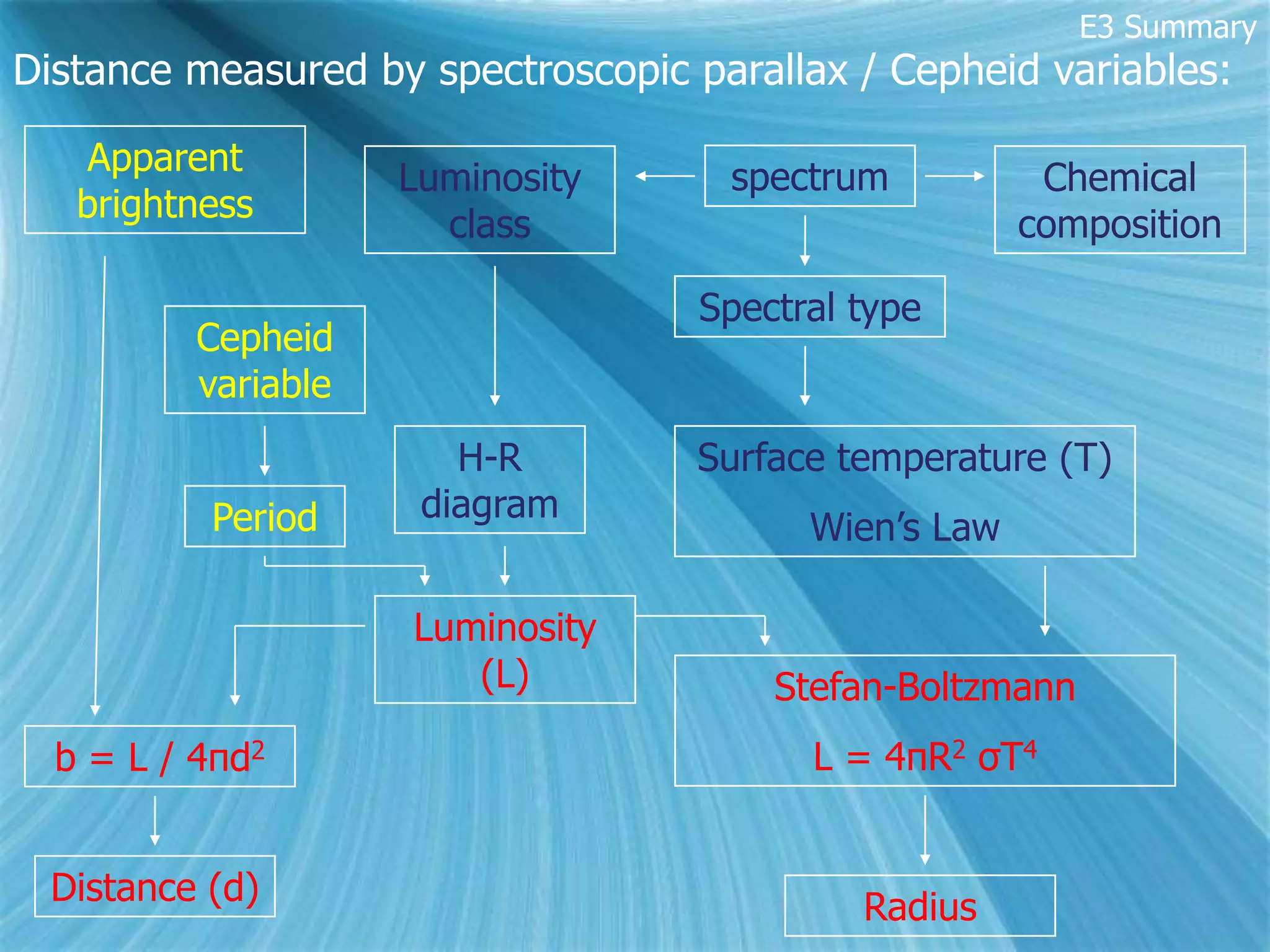
Summarizes distance measurement methods using parallax and spectroscopic parallax, integrating concepts of apparent brightness, chemical composition, temperature, and luminosity.
E3
Astronomical distances
The SI unit for length, the metre, is a very small unit
to measure astronomical distances. There units usually
used is astronomy:
The Astronomical Unit (AU) – this is the average distance
between the Earth and the Sun. This unit is more used within
the Solar System.
1 AU = 150 000 000 km
or
1 AU = 1.5x10¹¹m
2.
E3
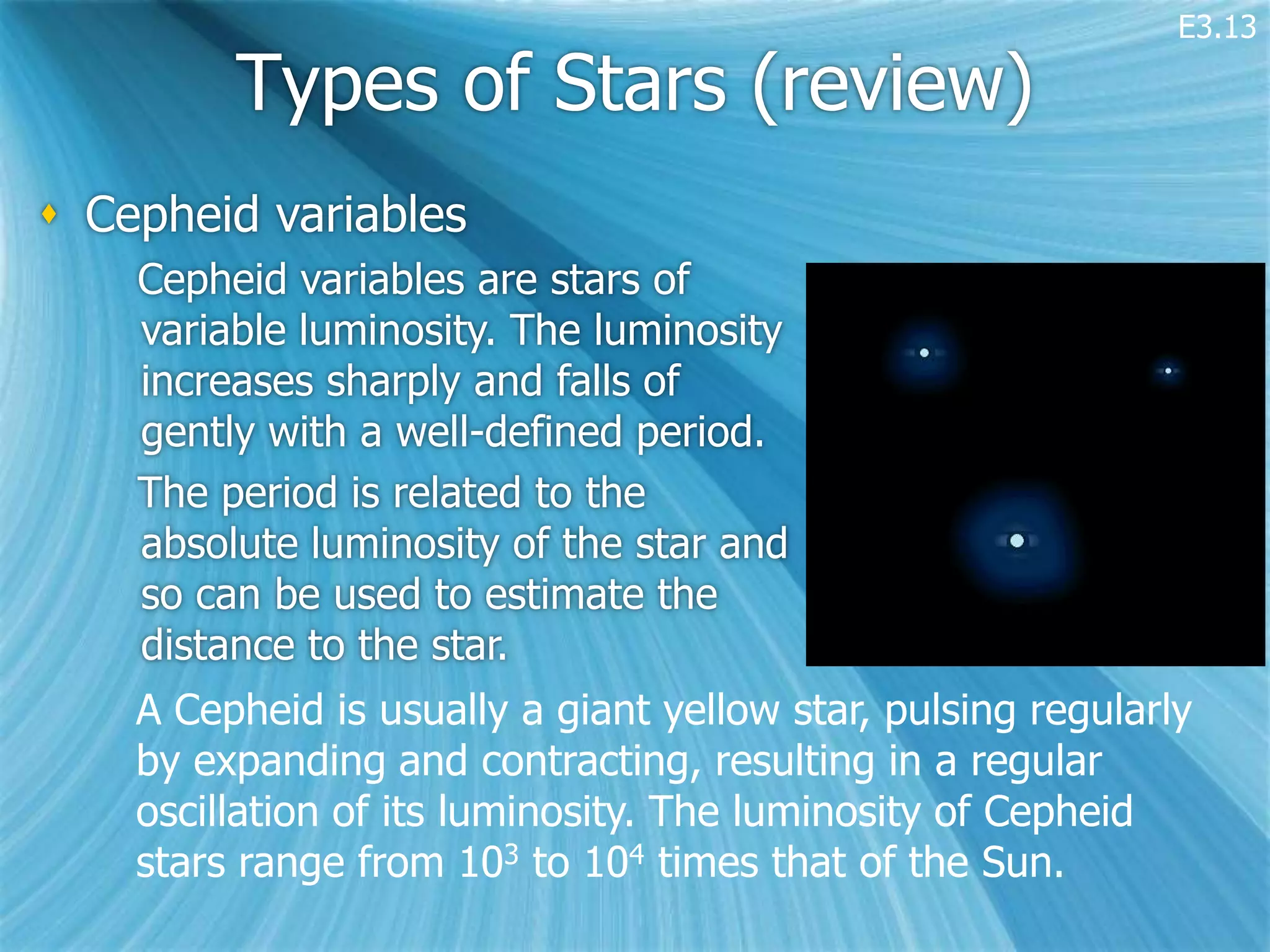
Astronomical distances
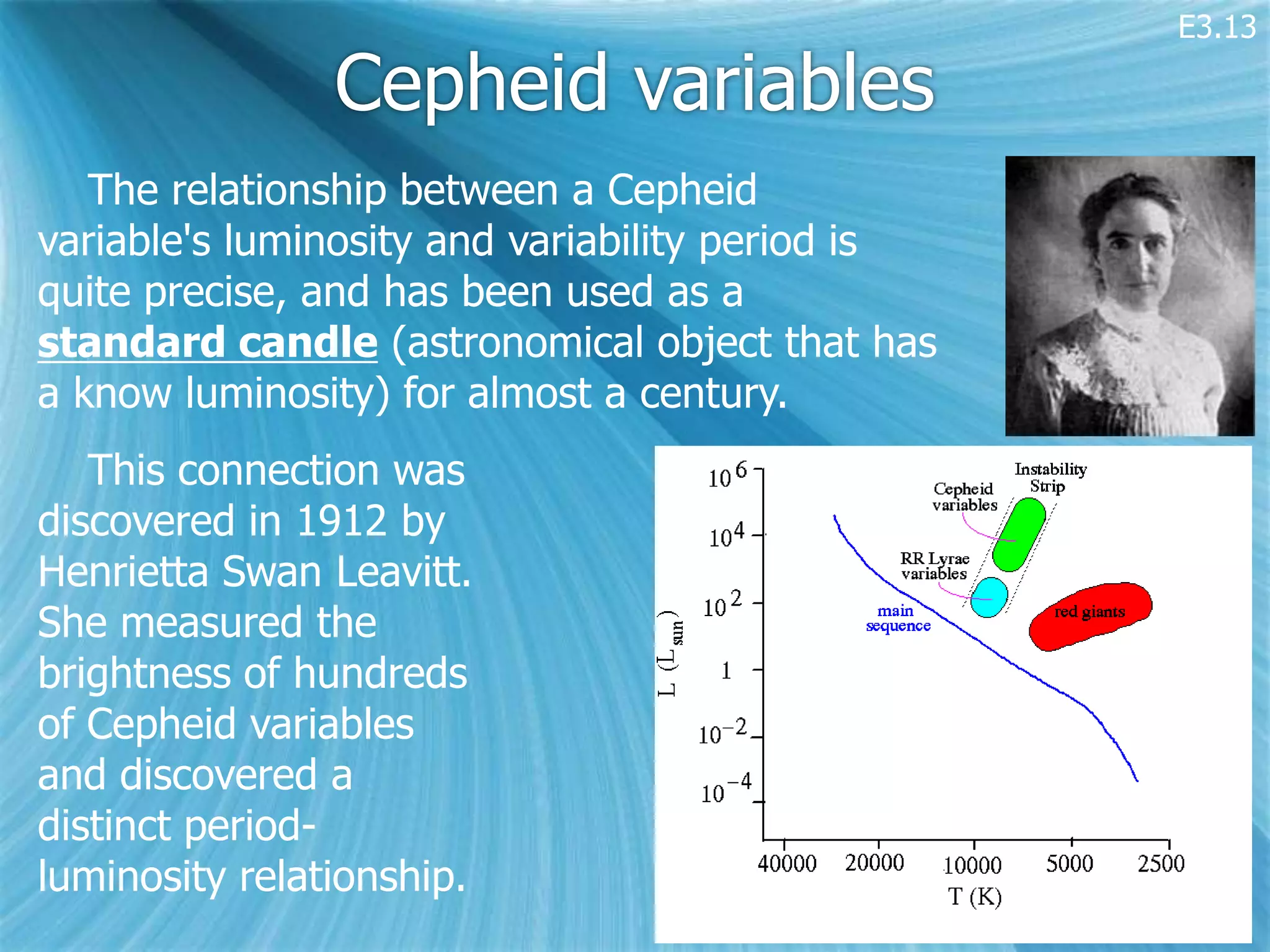
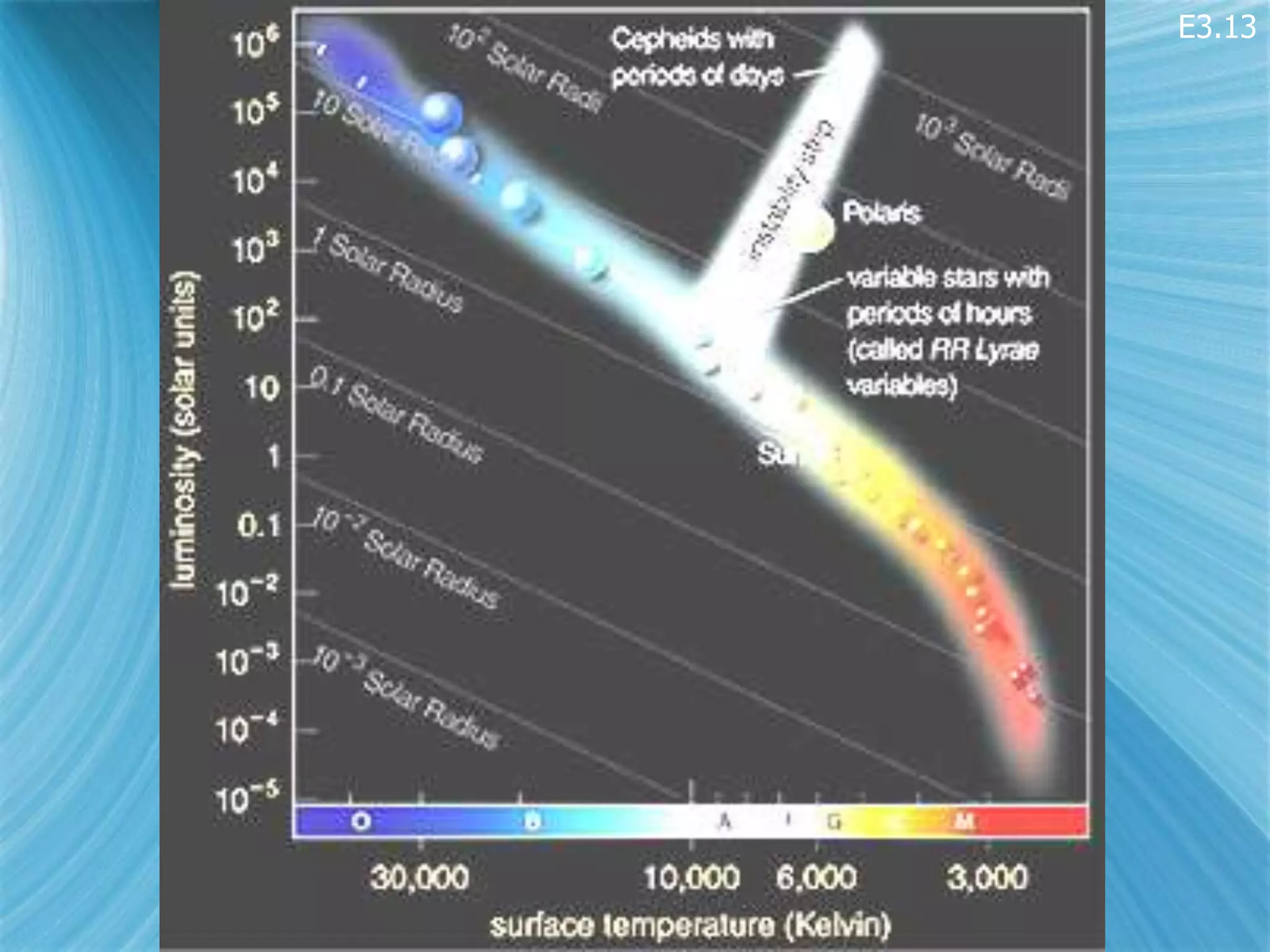
The light year (ly) – this is the distance travelled by the
light in one year.
c = 3x10⁸ m/s
t = 1 year = 365.25 x 24 x 60 x 60= 3.16 x 10⁷ s
Speed =Distance / Time
Distance = Speed x Time
= 3x108 x 3.16 x 107 = 9.46 x 10¹⁵ m
1 ly = 9.46x10¹⁵ m
3.
E3.1
Astronomical distances
The parsec (pc) – this is the
distance at which 1 AU subtends an
angle of 1 arcsencond.
“Parsec” is short for
parallax arcsecond
1 pc = 3.086x10¹⁶ m
or
1 pc = 3.26 ly
4.
E3.1
Angular sizes
360 degrees (360o)
in a circle
60 arcminutes (60’)
in a degree
60 arcseconds
(60”) in an
arcminute
5.
E3.1
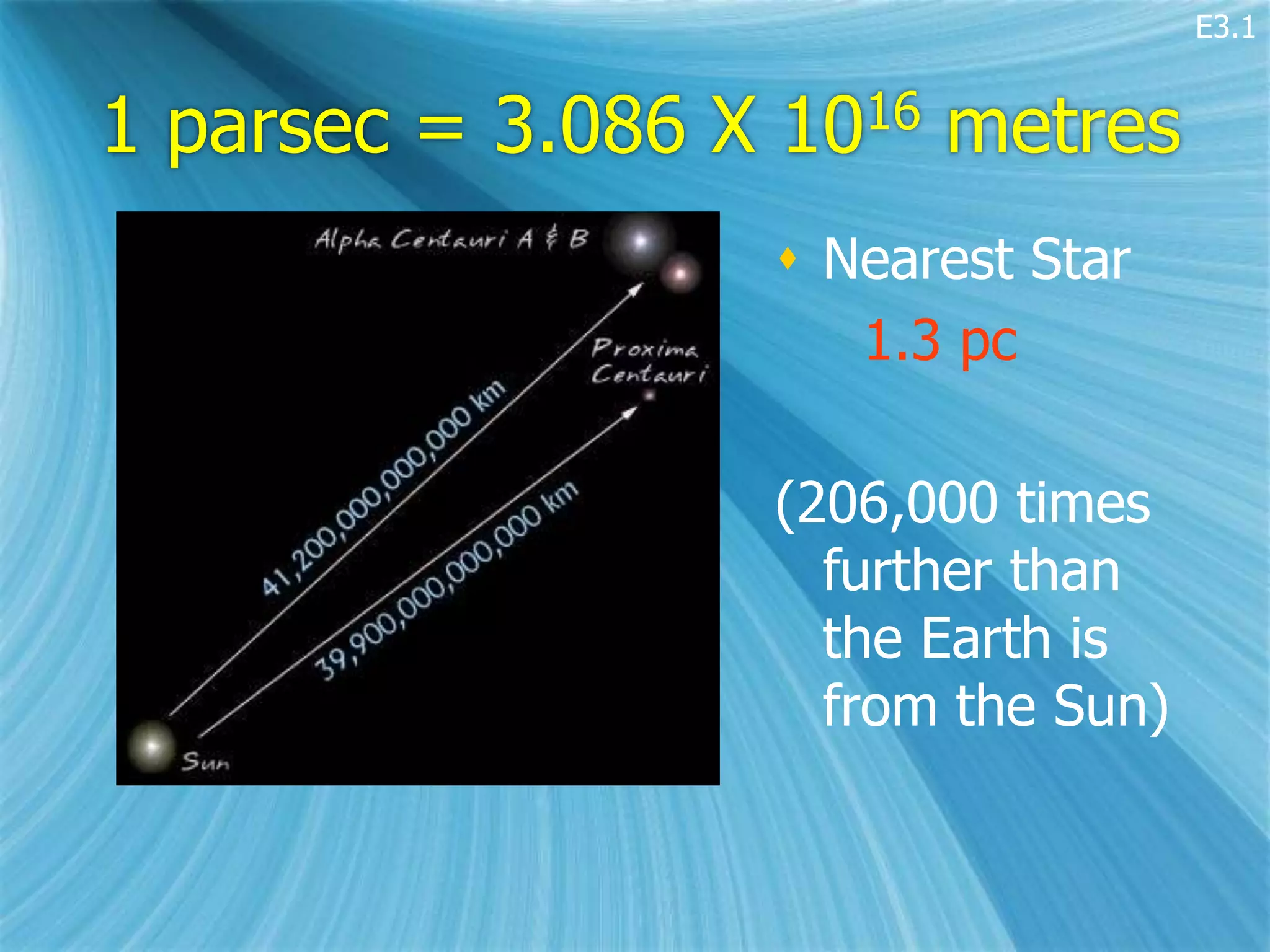
1 parsec =3.086 X 10¹⁶ metres
Nearest Star
1.3 pc
(206,000 times
further than
the Earth is
from the Sun)
6.
E3.2
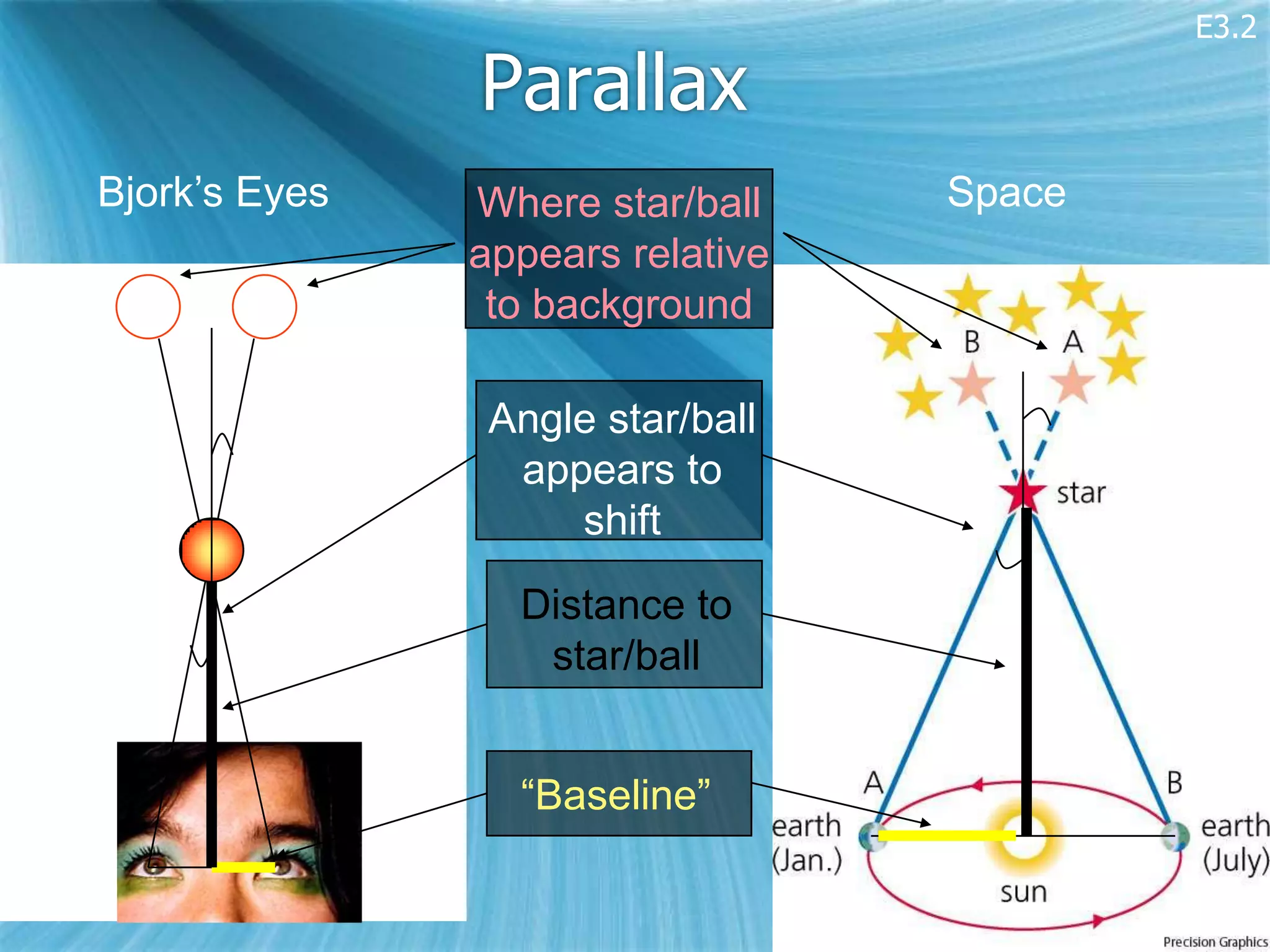
Parallax
Bjork’s Eyes Where star/ball Space
appears relative
to background
Angle star/ball
appears to
shift
Distance to
star/ball
“Baseline”
7.
E3.2
Parallax
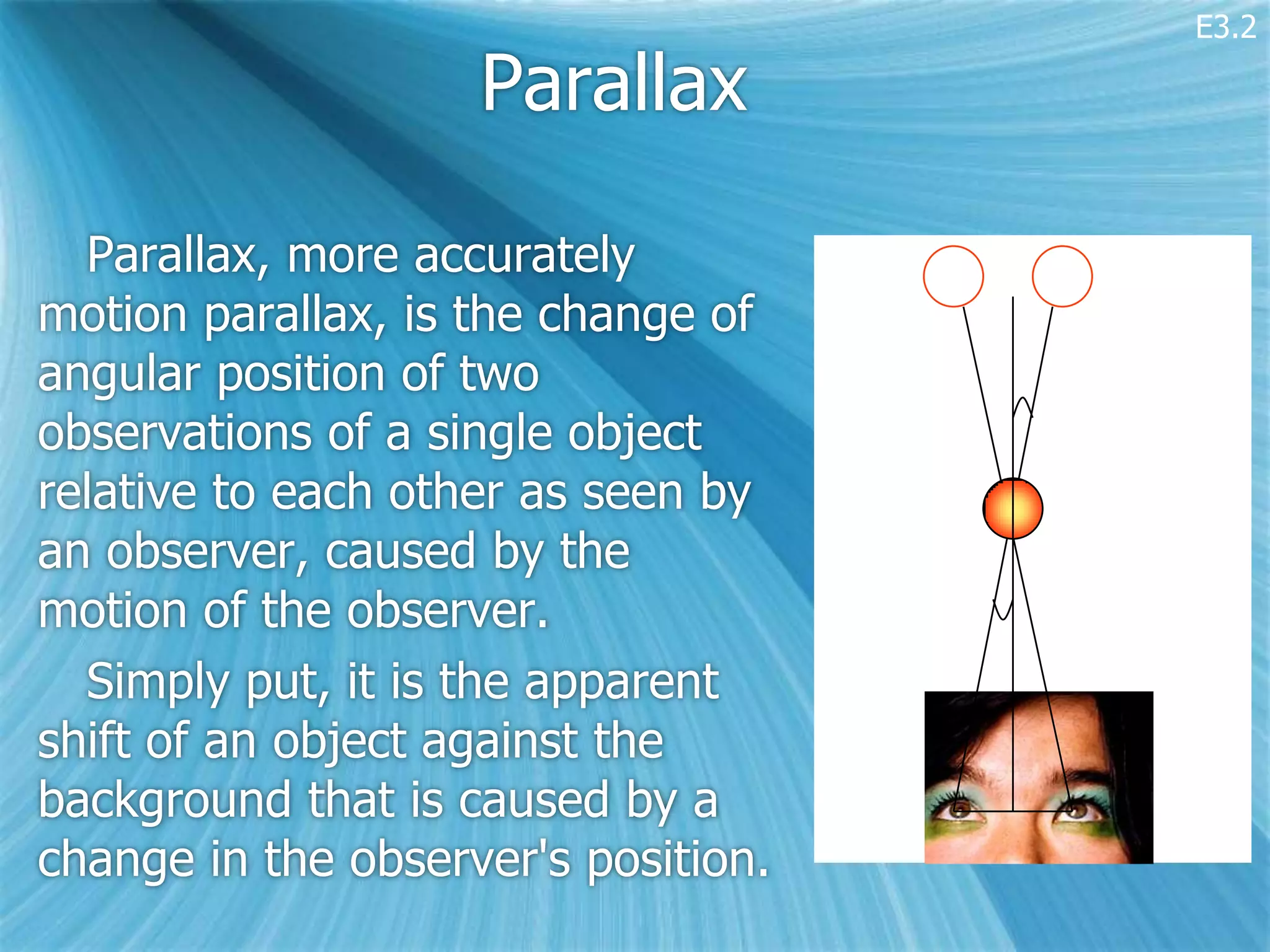
Parallax, more accurately
motion parallax, is the change of
angular position of two
observations of a single object
relative to each other as seen by
an observer, caused by the
motion of the observer.
Simply put, it is the apparent
shift of an object against the
background that is caused by a
change in the observer's position.
8.
E3.2
Parallax
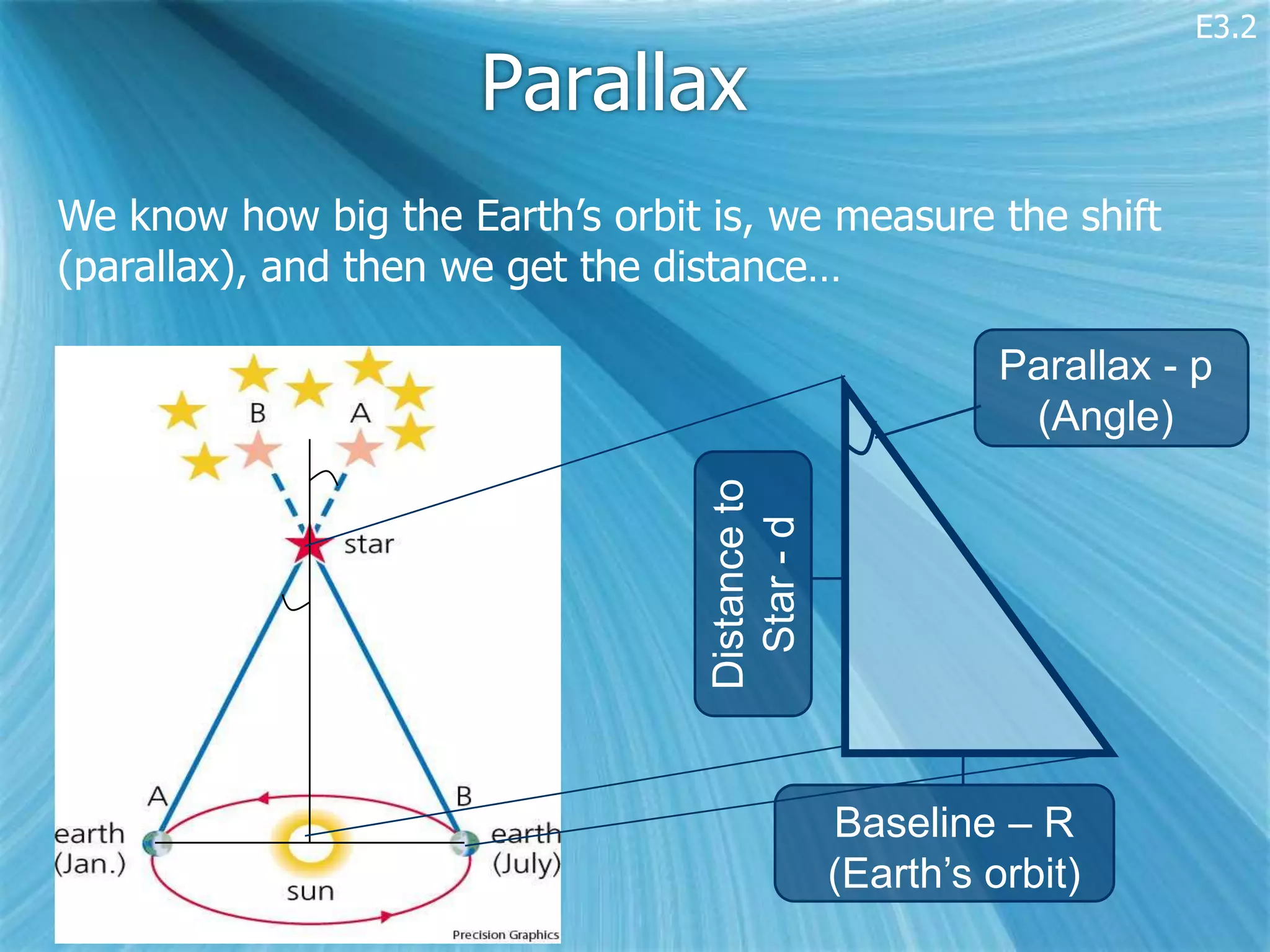
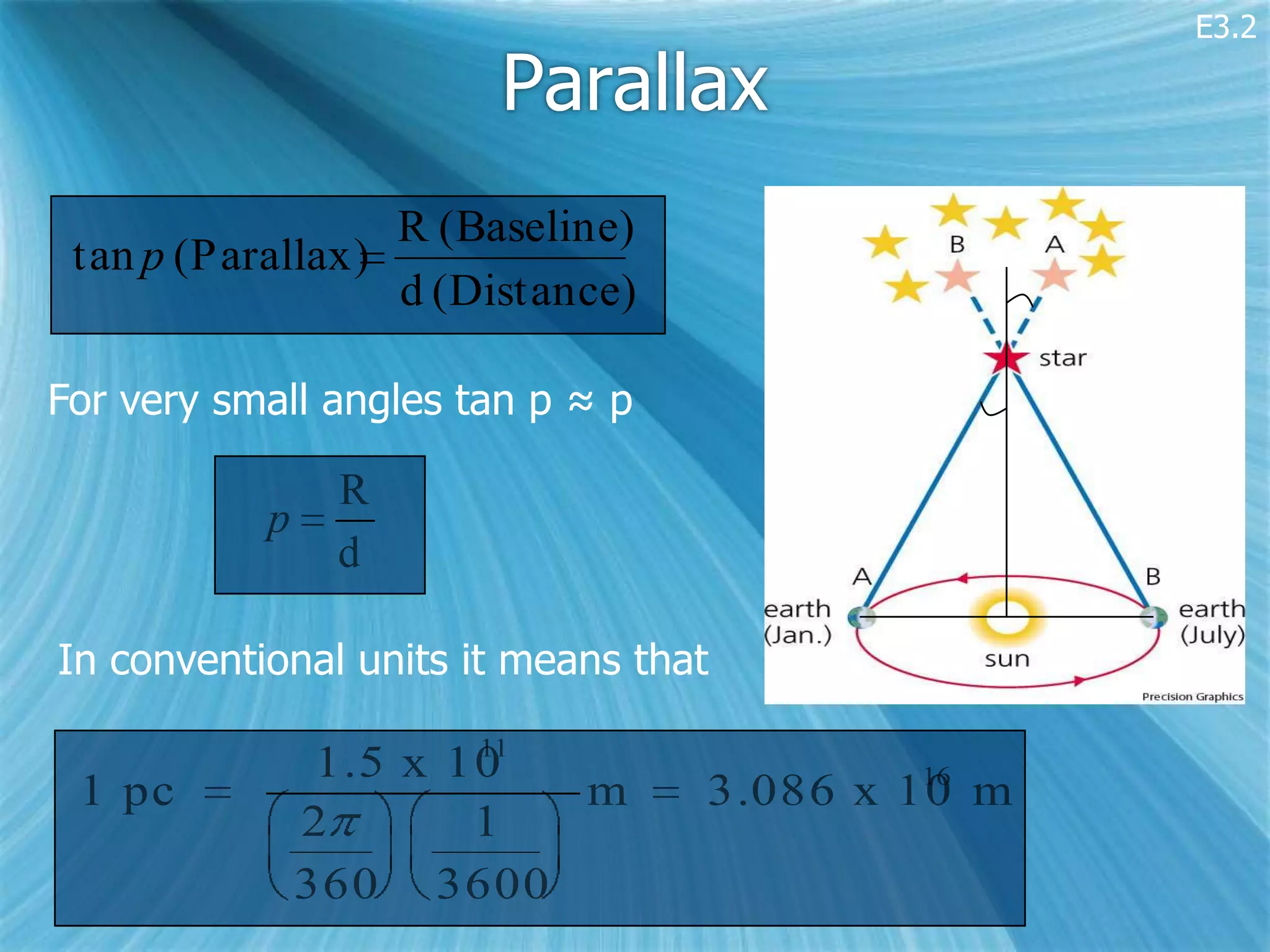
We know how big the Earth’s orbit is, we measure the shift
(parallax), and then we get the distance…
Parallax - p
(Angle)
Distance to
Star - d
Baseline – R
(Earth’s orbit)
9.
E3.2
Parallax
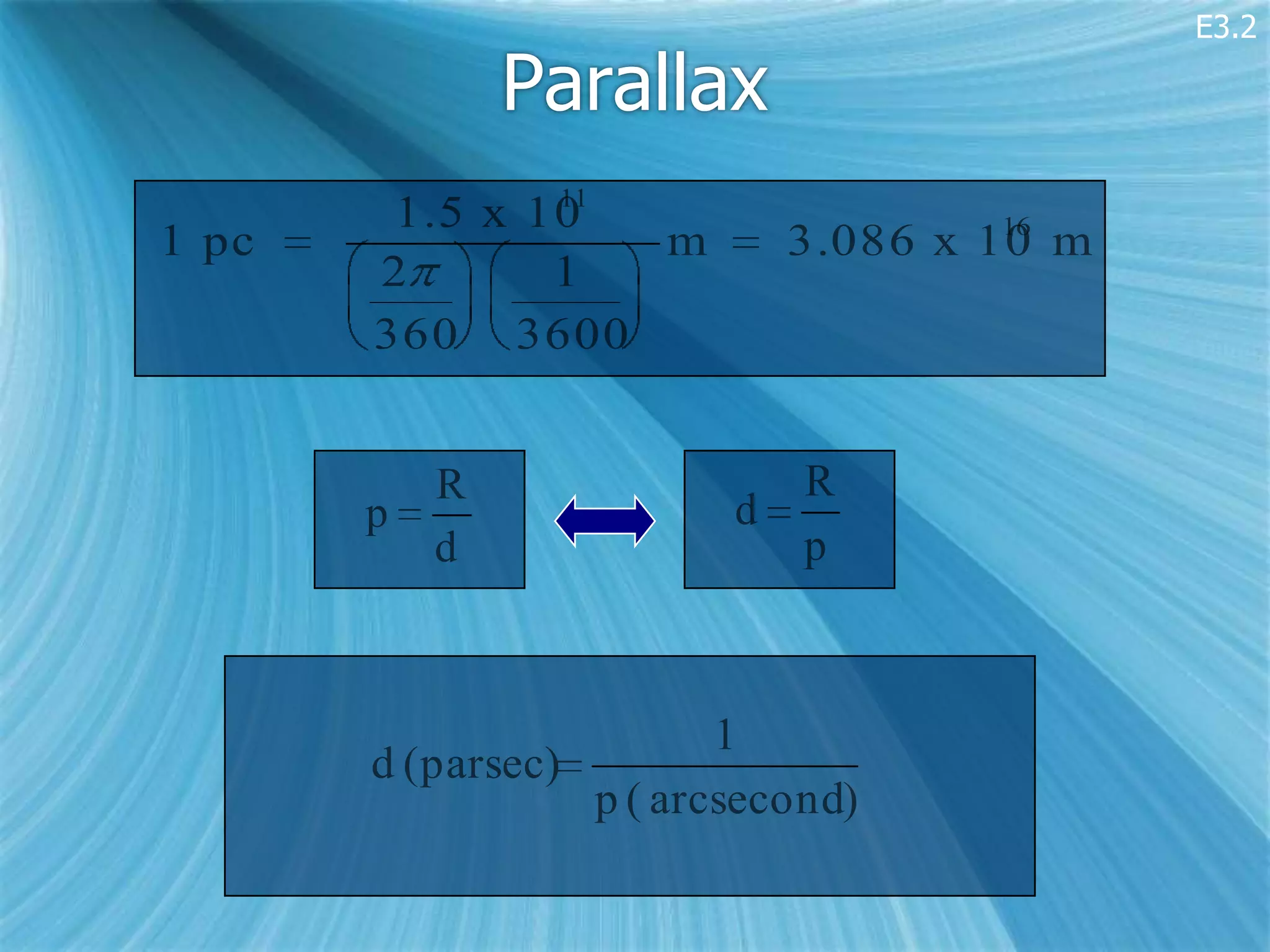
R (Baseline)
tan p (Parallax)
d (Distance)
For very small angles tan p ≈ p
R
p
d
In conventional units it means that
11
1.5 x 10 16
1 pc m 3.086 x 10 m
2 1
360 3600
10.
E3.2
Parallax
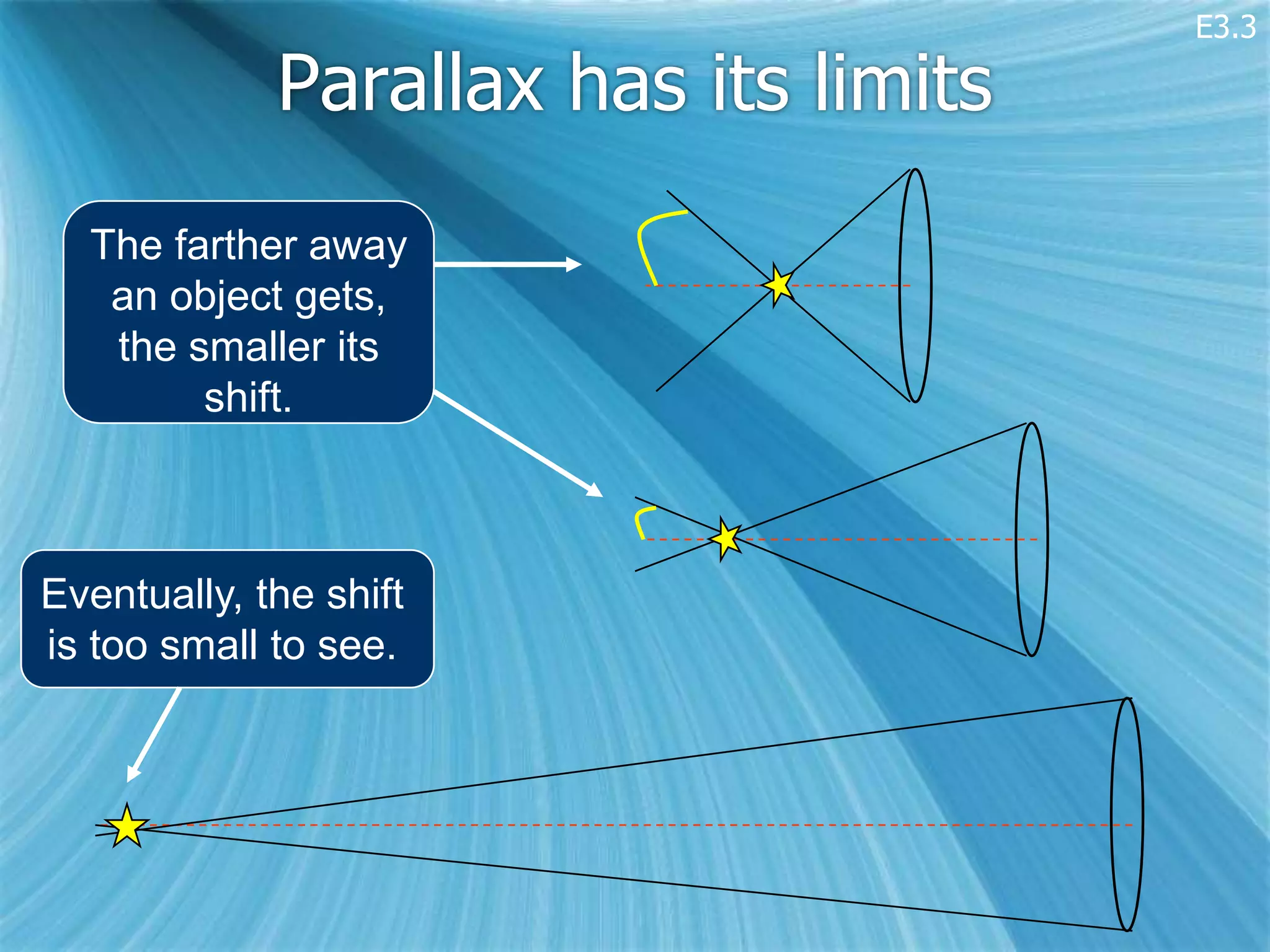
11
1.5 x 10 16
1 pc m 3.086 x 10 m
2 1
360 3600
R R
p d
d p
1
d (parsec)
p ( arcsecond)
11.
E3.3
Parallax has its limits
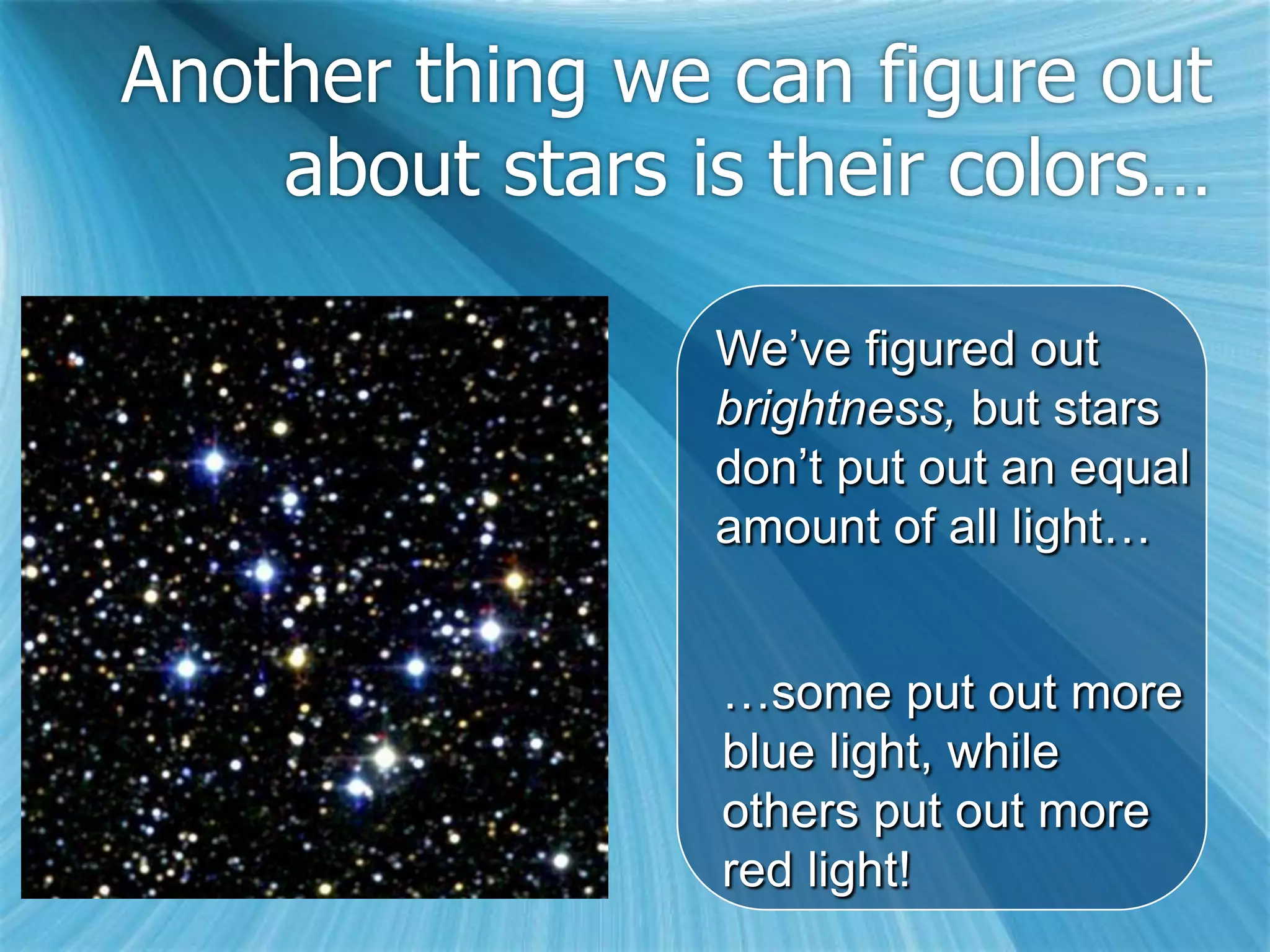
The farther away
an object gets,
the smaller its
shift.
Eventually, the shift
is too small to see.
12.
Another thing wecan figure out
about stars is their colors…
We’ve figured out
brightness, but stars
don’t put out an equal
amount of all light…
…some put out more
blue light, while
others put out more
red light!
13.
Usually, what weknow is how E3.5
bright the star looks to us here
on Earth…
We call this its
Apparent Magnitude
“What you see is
what you get…”
14.
E3.5
The Magnitude Scale
Magnitudes are a way of
assigning a number to a star so
we know how bright it is
Similar to how the Richter scale
assigns a number to the
strength of an earthquake
Betelgeuse and Rigel,
stars in Orion with
apparent magnitudes This is the “8.9”
0.3 and 0.9 earthquake off
of Sumatra
15.
E3.5
The historical magnitudescale…
Greeks ordered the Magnitude Description
stars in the sky
1st The 20 brightest
from brightest to stars
faintest… 2nd stars less bright
than the 20
brightest
3rd and so on...
…so brighter stars
4th getting dimmer
have smaller each time
magnitudes. 5th and more in each
group, until
6th the dimmest stars
(depending on your
eyesight)
16.
E3.5
Later, astronomers quantified
this system.
Because stars have such a wide range in
brightness, magnitudes are on a “log scale”
Every one magnitude corresponds to a factor
of 2.5 change in brightness
Every 5 magnitudes is a factor of 100 change
in brightness
(because (2.5)5 = 2.5 x 2.5 x 2.5 x 2.5 x 2.5 = 100)
17.
E3.5
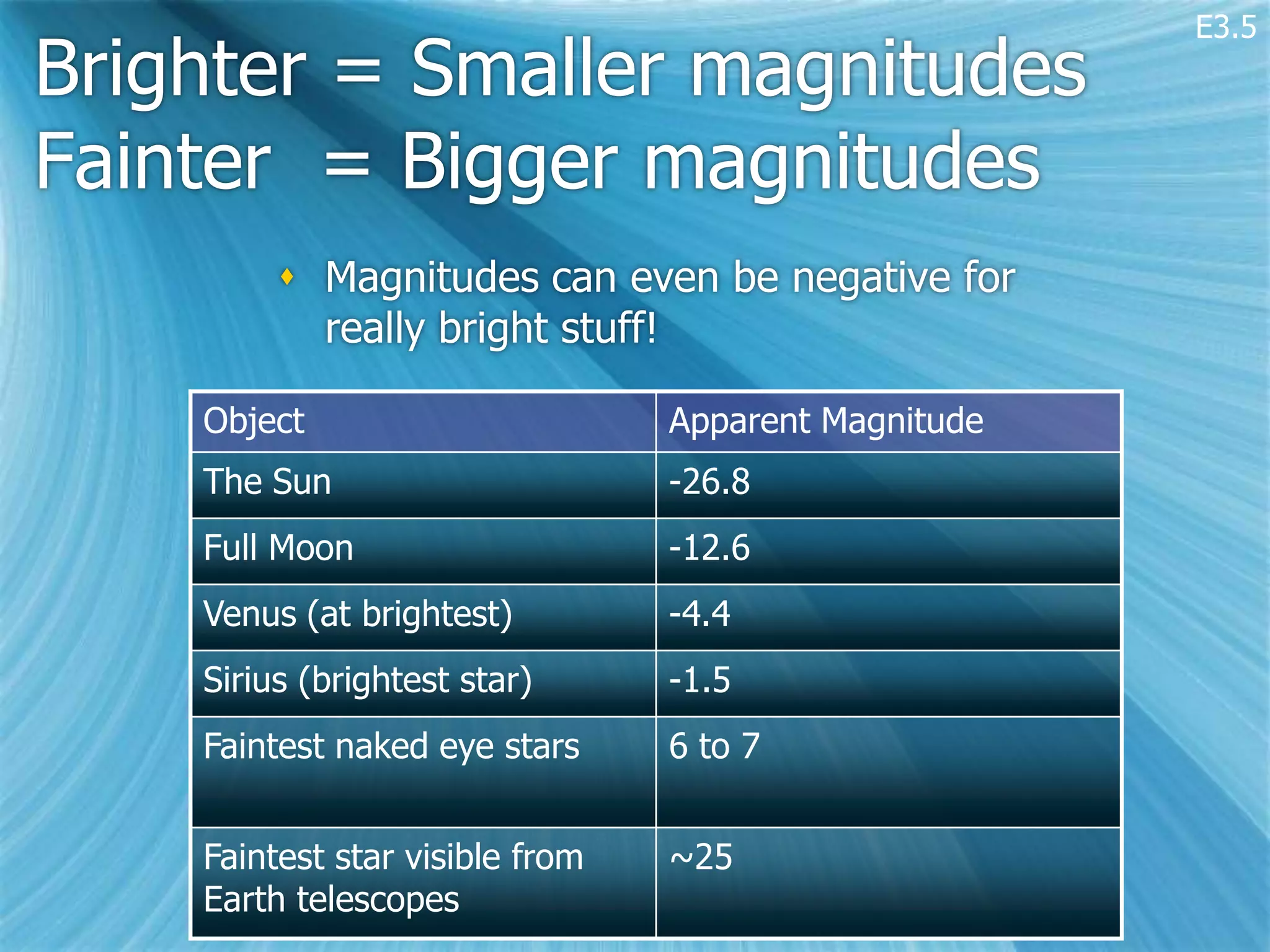
Brighter = Smallermagnitudes
Fainter = Bigger magnitudes
Magnitudes can even be negative for
really bright stuff!
Object Apparent Magnitude
The Sun -26.8
Full Moon -12.6
Venus (at brightest) -4.4
Sirius (brightest star) -1.5
Faintest naked eye stars 6 to 7
Faintest star visible from ~25
Earth telescopes
18.
E3.5
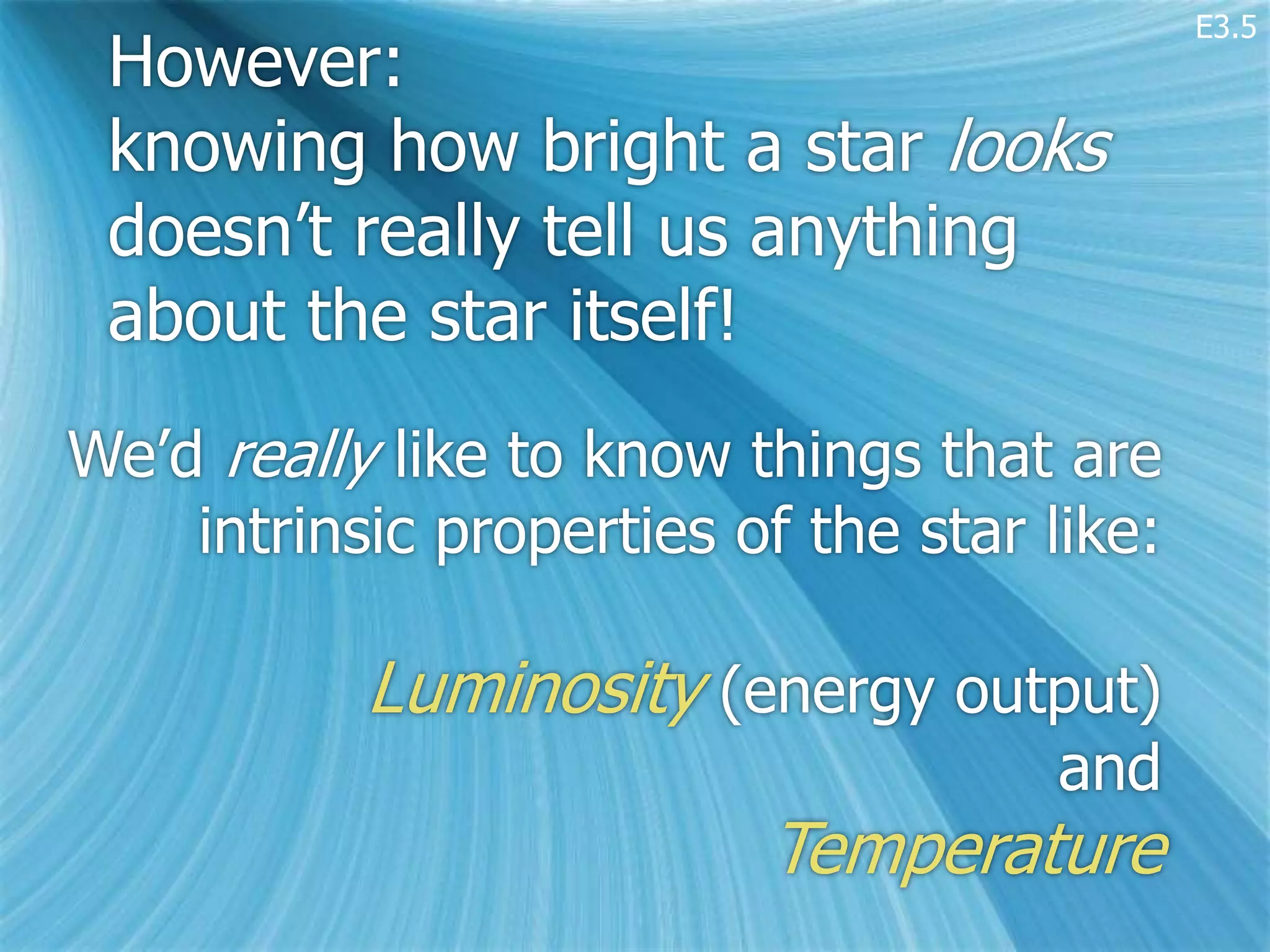
However:
knowinghow bright a star looks
doesn’t really tell us anything
about the star itself!
We’d really like to know things that are
intrinsic properties of the star like:
Luminosity (energy output)
and
Temperature
19.
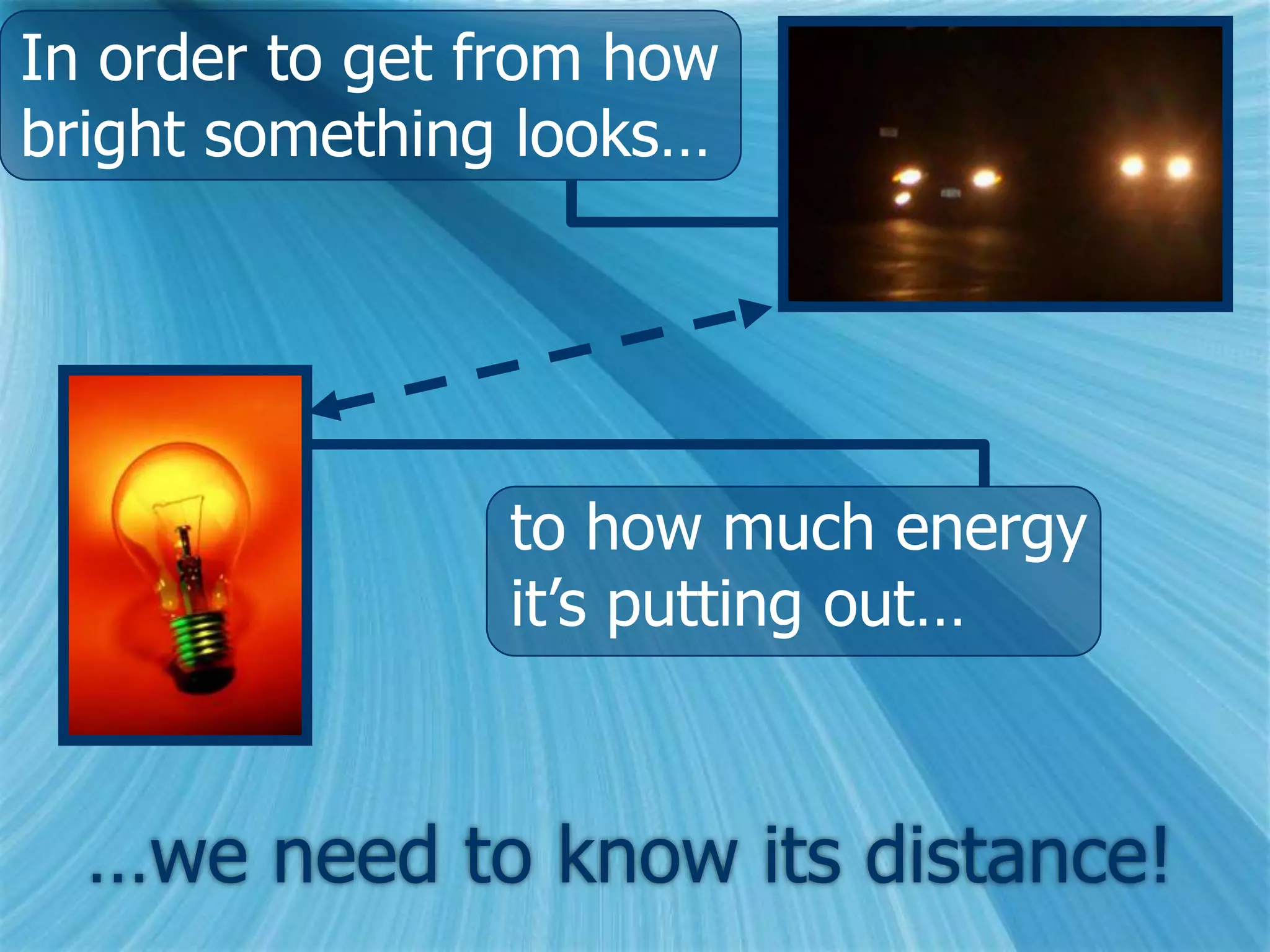
In order toget from how
bright something looks…
to how much energy
it’s putting out…
…we need to know its distance!
20.
E3.6
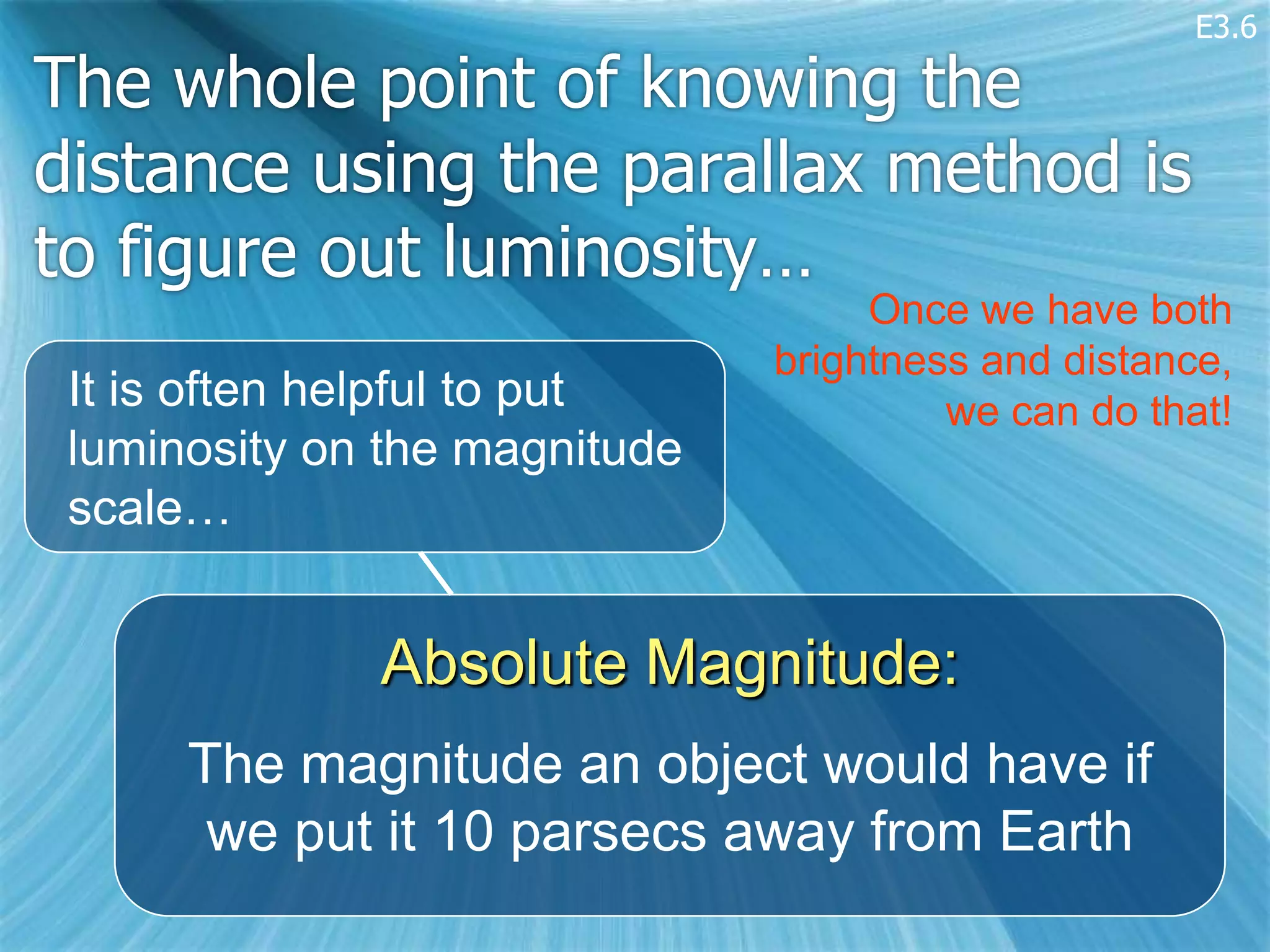
The whole pointof knowing the
distance using the parallax method is
to figure out luminosity…
Once we have both
brightness and distance,
It is often helpful to put we can do that!
luminosity on the magnitude
scale…
Absolute Magnitude:
The magnitude an object would have if
we put it 10 parsecs away from Earth
21.
E3.6
Absolute Magnitude (M)
removes the effect of distance
and
puts stars on a common scale
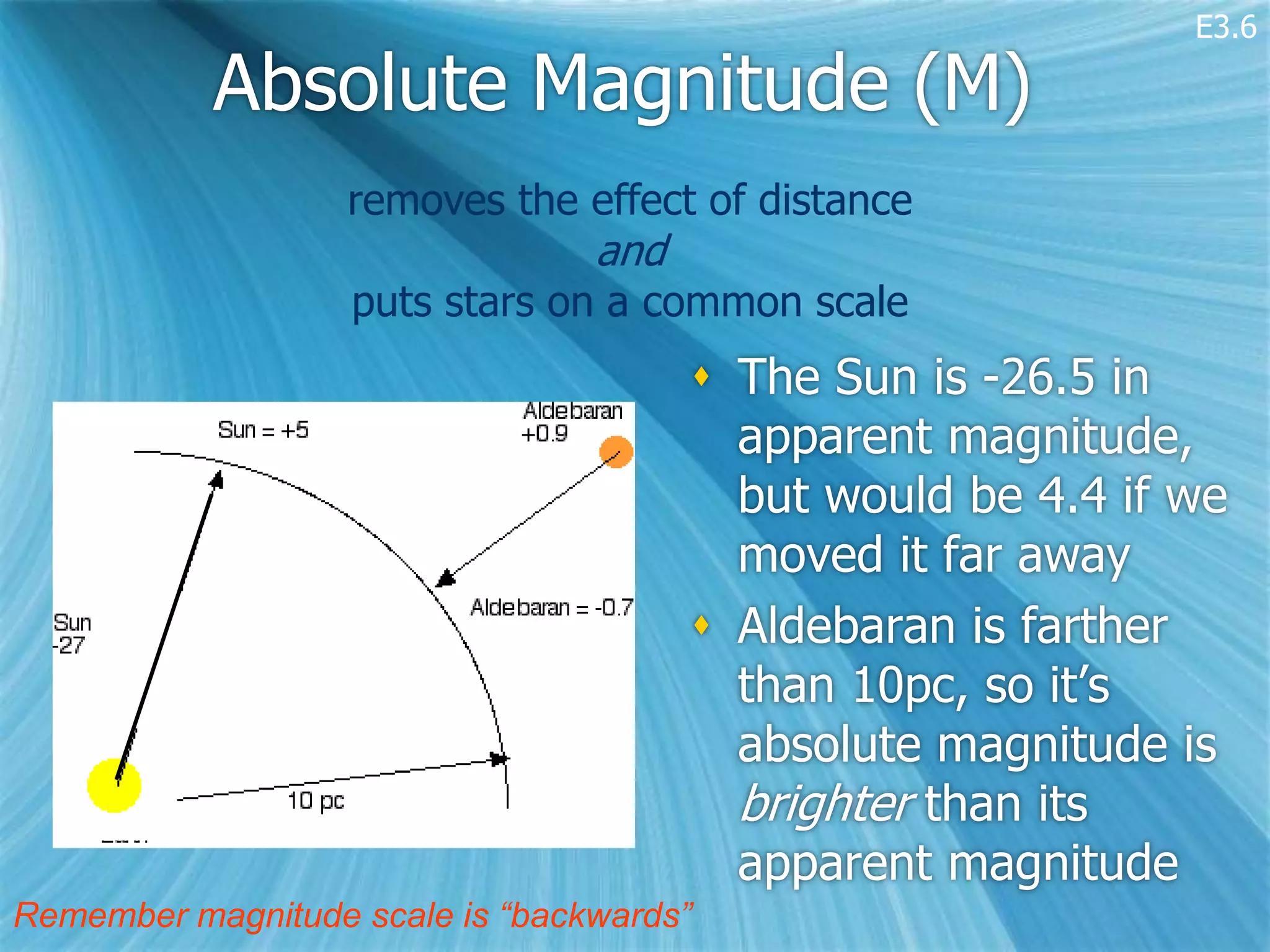
The Sun is -26.5 in
apparent magnitude,
but would be 4.4 if we
moved it far away
Aldebaran is farther
than 10pc, so it’s
absolute magnitude is
brighter than its
apparent magnitude
Remember magnitude scale is “backwards”
22.
E3.6
Absolute Magnitude (M)
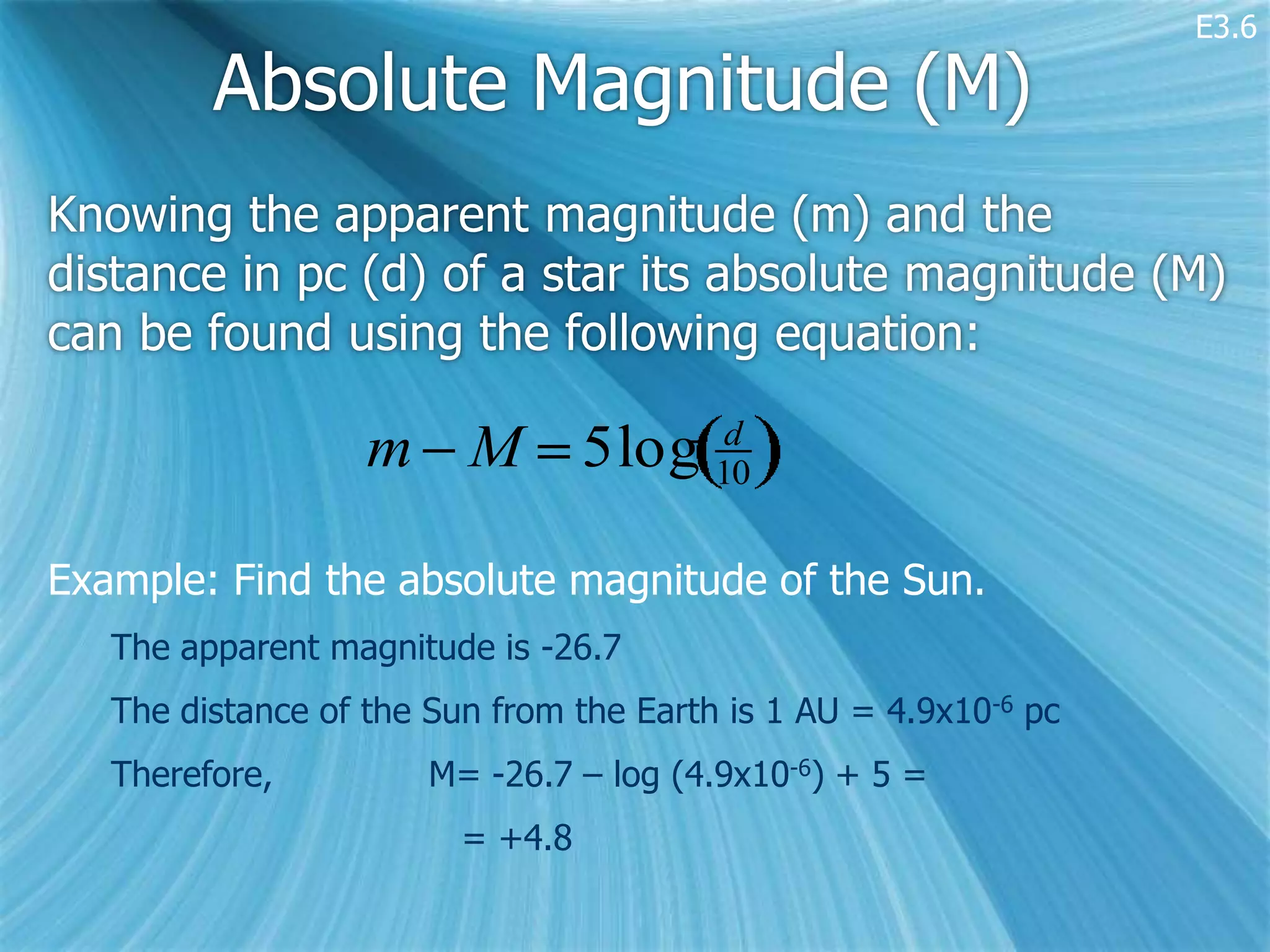
Knowing the apparent magnitude (m) and the
distance in pc (d) of a star its absolute magnitude (M)
can be found using the following equation:
m M 5log 10
d
Example: Find the absolute magnitude of the Sun.
The apparent magnitude is -26.7
The distance of the Sun from the Earth is 1 AU = 4.9x10⁻⁶ pc
Therefore, M= -26.7 – log (4.9x10⁻⁶) + 5 =
= +4.8
23.
E3.6
So we havethree ways of
talking about brightness:
Apparent Magnitude - How bright a star
looks from Earth
Luminosity - How much energy a star
puts out per second
Absolute Magnitude - How bright a star
would look if it was 10 parsecs away
24.
E3.9
Spectroscopic parallax
Spectroscopic parallax is an astronomical
method for measuring the distances to stars.
Despite its name, it does not rely on the
apparent change in the position of the star.
This technique can be applied to any main
sequence star for which a spectrum can be
recorded.
25.
E3.9
Spectroscopic parallax
The Luminosity of a star can be found using an
absorption spectrum.
Using its spectrum a star can be placed in a spectral
class.
Also the star’s surface temperature can determined
from its spectrum (Wien’s law)
Using the H-R diagram and knowing both
temperature and spectral class of the star, its
luminosity can be found.
26.
E3.13
Types of Stars (review)
Cepheid variables
Cepheid variables are stars of
variable luminosity. The luminosity
increases sharply and falls of
gently with a well-defined period.
The period is related to the
absolute luminosity of the star and
so can be used to estimate the
distance to the star.
A Cepheid is usually a giant yellow star, pulsing regularly
by expanding and contracting, resulting in a regular
oscillation of its luminosity. The luminosity of Cepheid
stars range from 103 to 104 times that of the Sun.
27.
E3.13
Cepheid variables
The relationship between a Cepheid
variable's luminosity and variability period is
quite precise, and has been used as a
standard candle (astronomical object that has
a know luminosity) for almost a century.
This connection was
discovered in 1912 by
Henrietta Swan Leavitt.
She measured the
brightness of hundreds
of Cepheid variables
and discovered a
distinct period-
luminosity relationship.
E3.14
Cepheid variables
A three-day period Cepheid has a luminosity of about 800
times that of the Sun.
A thirty-day period Cepheid is 10,000 times as bright as the
Sun.
The scale has been calibrated using nearby Cepheid stars, for
which the distance was already known.
This high luminosity, and the precision with which their
distance can be estimated, makes Cepheid stars the ideal
standard candle to measure the distance of clusters and
external galaxies.
E3 Summary
Distance measuredby parallax:
Distance
measurement apparent spectrum
by parallax brightness
Chemical
composition
Wien’s Law of corona
Luminosity
d=1/p (surface
L = 4πd2 b temperature T)
L = 4πR2 σT4
Stefan-Boltzmann
Radius
33.
E3 Summary
Distance measuredby spectroscopic parallax / Cepheid variables:
Apparent
Luminosity spectrum Chemical
brightness
class composition
Spectral type
Cepheid
variable
H-R Surface temperature (T)
Period diagram
Wien’s Law
Luminosity
(L) Stefan-Boltzmann
b = L / 4πd2 L = 4πR2 σT4
Distance (d)
Radius