Basic Business Statistics, 11e © 2009 Prentice-Hall, Inc. Chap 14-1
Chapter 14
Introduction to Multiple Regression
Basic Business Statistics
11th Edition
Basic Business Statistics, 11e © 2009 Prentice-Hall, Inc.. Chap 14-2
Learning Objectives
In this chapter, you learn:
 How to develop a multiple regression model
 How to interpret the regression coefficients
 How to determine which independent variables to
include in the regression model
 How to determine which independent variables are more
important in predicting a dependent variable
 How to use categorical variables in a regression model
 How to predict a categorical dependent variable using
logistic regression
Basic Business Statistics, 11e © 2009 Prentice-Hall, Inc.. Chap 14-3
The Multiple Regression
Model
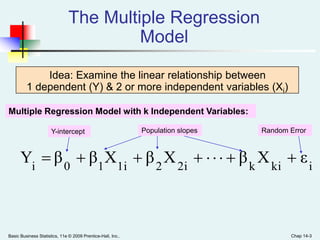
Idea: Examine the linear relationship between
1 dependent (Y) & 2 or more independent variables (Xi)
ikik2i21i10i
εXβXβXββY 
Multiple Regression Model with k Independent Variables:
Y-intercept Population slopes Random Error
Basic Business Statistics, 11e © 2009 Prentice-Hall, Inc.. Chap 14-4
Multiple Regression Equation
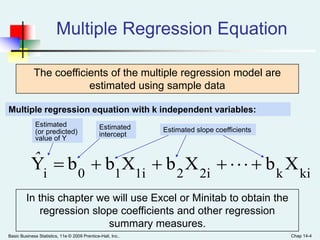
The coefficients of the multiple regression model are
estimated using sample data
kik2i21i10i
XbXbXbbY ˆ
Estimated
(or predicted)
value of Y
Estimated slope coefficients
Multiple regression equation with k independent variables:
Estimated
intercept
In this chapter we will use Excel or Minitab to obtain the
regression slope coefficients and other regression
summary measures.
Basic Business Statistics, 11e © 2009 Prentice-Hall, Inc.. Chap 14-5
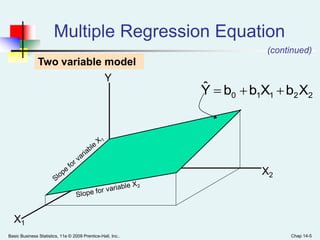
Two variable model
Y
X1
X2
22110 XbXbbYˆ 
Multiple Regression Equation
(continued)
Basic Business Statistics, 11e © 2009 Prentice-Hall, Inc.. Chap 14-6
Example:
2 Independent Variables
 A distributor of frozen dessert pies wants to
evaluate factors thought to influence demand
 Dependent variable: Pie sales (units per week)
 Independent variables: Price (in $)
Advertising ($100’s)
 Data are collected for 15 weeks
Basic Business Statistics, 11e © 2009 Prentice-Hall, Inc.. Chap 14-7
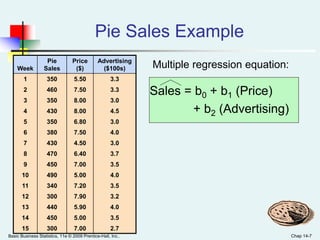
Pie Sales Example
Sales = b0 + b1 (Price)
+ b2 (Advertising)
Week
Pie
Sales
Price
($)
Advertising
($100s)
1 350 5.50 3.3
2 460 7.50 3.3
3 350 8.00 3.0
4 430 8.00 4.5
5 350 6.80 3.0
6 380 7.50 4.0
7 430 4.50 3.0
8 470 6.40 3.7
9 450 7.00 3.5
10 490 5.00 4.0
11 340 7.20 3.5
12 300 7.90 3.2
13 440 5.90 4.0
14 450 5.00 3.5
15 300 7.00 2.7
Multiple regression equation:
Basic Business Statistics, 11e © 2009 Prentice-Hall, Inc.. Chap 14-8
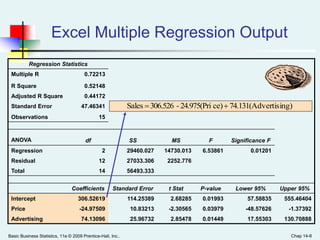
Excel Multiple Regression Output
Regression Statistics
Multiple R 0.72213
R Square 0.52148
Adjusted R Square 0.44172
Standard Error 47.46341
Observations 15
ANOVA df SS MS F Significance F
Regression 2 29460.027 14730.013 6.53861 0.01201
Residual 12 27033.306 2252.776
Total 14 56493.333
Coefficients Standard Error t Stat P-value Lower 95% Upper 95%
Intercept 306.52619 114.25389 2.68285 0.01993 57.58835 555.46404
Price -24.97509 10.83213 -2.30565 0.03979 -48.57626 -1.37392
Advertising 74.13096 25.96732 2.85478 0.01449 17.55303 130.70888
ertising)74.131(Advce)24.975(Pri-306.526Sales 
Basic Business Statistics, 11e © 2009 Prentice-Hall, Inc.. Chap 14-9
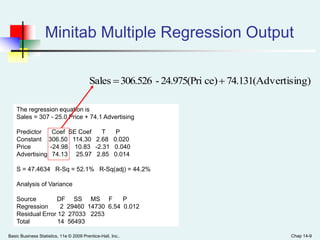
Minitab Multiple Regression Output
The regression equation is
Sales = 307 - 25.0 Price + 74.1 Advertising
Predictor Coef SE Coef T P
Constant 306.50 114.30 2.68 0.020
Price -24.98 10.83 -2.31 0.040
Advertising 74.13 25.97 2.85 0.014
S = 47.4634 R-Sq = 52.1% R-Sq(adj) = 44.2%
Analysis of Variance
Source DF SS MS F P
Regression 2 29460 14730 6.54 0.012
Residual Error 12 27033 2253
Total 14 56493
ertising)74.131(Advce)24.975(Pri-306.526Sales 
Basic Business Statistics, 11e © 2009 Prentice-Hall, Inc.. Chap 14-10
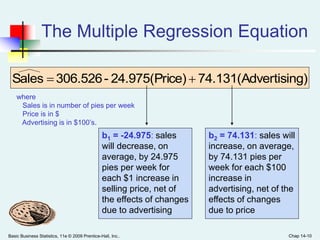
The Multiple Regression Equation
ertising)74.131(Advce)24.975(Pri-306.526Sales 
b1 = -24.975: sales
will decrease, on
average, by 24.975
pies per week for
each $1 increase in
selling price, net of
the effects of changes
due to advertising
b2 = 74.131: sales will
increase, on average,
by 74.131 pies per
week for each $100
increase in
advertising, net of the
effects of changes
due to price
where
Sales is in number of pies per week
Price is in $
Advertising is in $100’s.
Basic Business Statistics, 11e © 2009 Prentice-Hall, Inc.. Chap 14-11
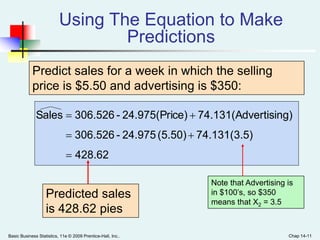
Using The Equation to Make
Predictions
Predict sales for a week in which the selling
price is $5.50 and advertising is $350:
Predicted sales
is 428.62 pies
428.62
(3.5)74.131(5.50)24.975-306.526
ertising)74.131(Advce)24.975(Pri-306.526Sales



Note that Advertising is
in $100’s, so $350
means that X2 = 3.5
Basic Business Statistics, 11e © 2009 Prentice-Hall, Inc.. Chap 14-12
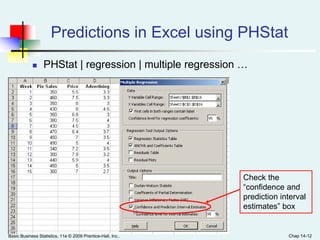
Predictions in Excel using PHStat
 PHStat | regression | multiple regression …
Check the
“confidence and
prediction interval
estimates” box
Basic Business Statistics, 11e © 2009 Prentice-Hall, Inc.. Chap 14-13
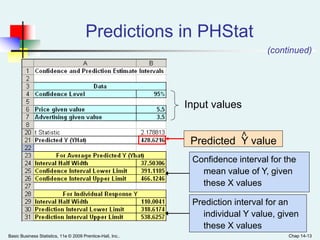
Input values
Predictions in PHStat
(continued)
Predicted Y value
<
Confidence interval for the
mean value of Y, given
these X values
Prediction interval for an
individual Y value, given
these X values
Basic Business Statistics, 11e © 2009 Prentice-Hall, Inc.. Chap 14-14
Predictions in Minitab
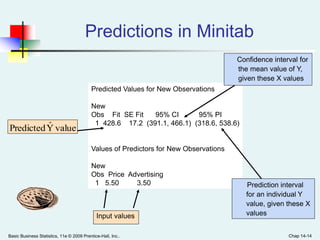
Input values
Predicted Values for New Observations
New
Obs Fit SE Fit 95% CI 95% PI
1 428.6 17.2 (391.1, 466.1) (318.6, 538.6)
Values of Predictors for New Observations
New
Obs Price Advertising
1 5.50 3.50
valueYPredicted ˆ
Confidence interval for
the mean value of Y,
given these X values
Prediction interval
for an individual Y
value, given these X
values
Basic Business Statistics, 11e © 2009 Prentice-Hall, Inc.. Chap 14-15
Coefficient of
Multiple Determination
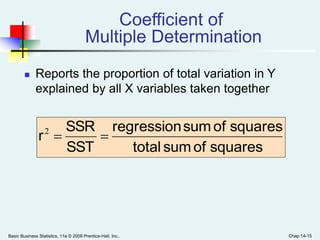
 Reports the proportion of total variation in Y
explained by all X variables taken together
squaresofsumtotal
squaresofsumregression
SST
SSR
r 2
Basic Business Statistics, 11e © 2009 Prentice-Hall, Inc.. Chap 14-16
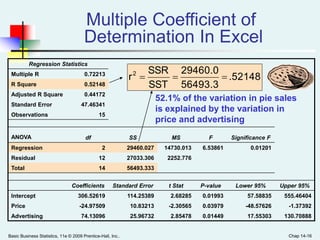
Regression Statistics
Multiple R 0.72213
R Square 0.52148
Adjusted R Square 0.44172
Standard Error 47.46341
Observations 15
ANOVA df SS MS F Significance F
Regression 2 29460.027 14730.013 6.53861 0.01201
Residual 12 27033.306 2252.776
Total 14 56493.333
Coefficients Standard Error t Stat P-value Lower 95% Upper 95%
Intercept 306.52619 114.25389 2.68285 0.01993 57.58835 555.46404
Price -24.97509 10.83213 -2.30565 0.03979 -48.57626 -1.37392
Advertising 74.13096 25.96732 2.85478 0.01449 17.55303 130.70888
.52148
56493.3
29460.0
SST
SSR
r2

52.1% of the variation in pie sales
is explained by the variation in
price and advertising
Multiple Coefficient of
Determination In Excel
Basic Business Statistics, 11e © 2009 Prentice-Hall, Inc.. Chap 14-17
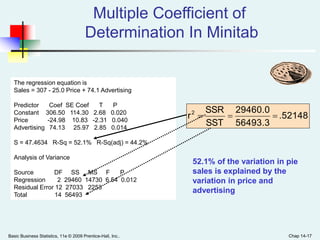
Multiple Coefficient of
Determination In Minitab
The regression equation is
Sales = 307 - 25.0 Price + 74.1 Advertising
Predictor Coef SE Coef T P
Constant 306.50 114.30 2.68 0.020
Price -24.98 10.83 -2.31 0.040
Advertising 74.13 25.97 2.85 0.014
S = 47.4634 R-Sq = 52.1% R-Sq(adj) = 44.2%
Analysis of Variance
Source DF SS MS F P
Regression 2 29460 14730 6.54 0.012
Residual Error 12 27033 2253
Total 14 56493
.52148
56493.3
29460.0
SST
SSR
r2

52.1% of the variation in pie
sales is explained by the
variation in price and
advertising
Basic Business Statistics, 11e © 2009 Prentice-Hall, Inc.. Chap 14-18
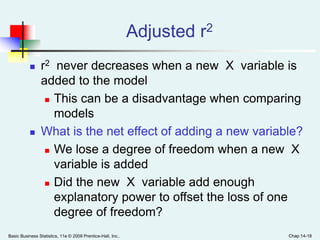
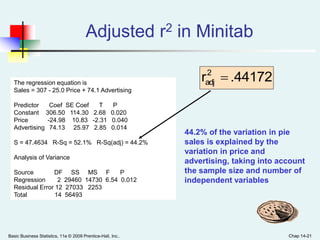
Adjusted r2
 r2 never decreases when a new X variable is
added to the model
 This can be a disadvantage when comparing
models
 What is the net effect of adding a new variable?
 We lose a degree of freedom when a new X
variable is added
 Did the new X variable add enough
explanatory power to offset the loss of one
degree of freedom?
Basic Business Statistics, 11e © 2009 Prentice-Hall, Inc.. Chap 14-19
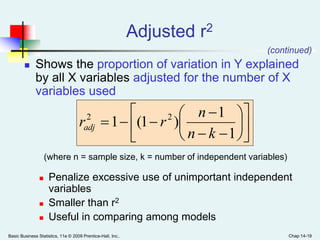
 Shows the proportion of variation in Y explained
by all X variables adjusted for the number of X
variables used
(where n = sample size, k = number of independent variables)
 Penalize excessive use of unimportant independent
variables
 Smaller than r2
 Useful in comparing among models
Adjusted r2
(continued)















1
1
)1(1 22
kn
n
rradj
Basic Business Statistics, 11e © 2009 Prentice-Hall, Inc.. Chap 14-20
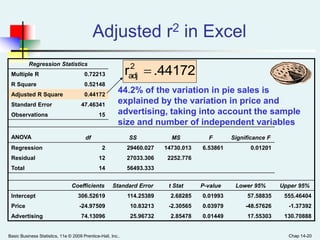
Regression Statistics
Multiple R 0.72213
R Square 0.52148
Adjusted R Square 0.44172
Standard Error 47.46341
Observations 15
ANOVA df SS MS F Significance F
Regression 2 29460.027 14730.013 6.53861 0.01201
Residual 12 27033.306 2252.776
Total 14 56493.333
Coefficients Standard Error t Stat P-value Lower 95% Upper 95%
Intercept 306.52619 114.25389 2.68285 0.01993 57.58835 555.46404
Price -24.97509 10.83213 -2.30565 0.03979 -48.57626 -1.37392
Advertising 74.13096 25.96732 2.85478 0.01449 17.55303 130.70888
.44172r2
adj 
44.2% of the variation in pie sales is
explained by the variation in price and
advertising, taking into account the sample
size and number of independent variables
Adjusted r2 in Excel
Basic Business Statistics, 11e © 2009 Prentice-Hall, Inc.. Chap 14-21
Adjusted r2 in Minitab
The regression equation is
Sales = 307 - 25.0 Price + 74.1 Advertising
Predictor Coef SE Coef T P
Constant 306.50 114.30 2.68 0.020
Price -24.98 10.83 -2.31 0.040
Advertising 74.13 25.97 2.85 0.014
S = 47.4634 R-Sq = 52.1% R-Sq(adj) = 44.2%
Analysis of Variance
Source DF SS MS F P
Regression 2 29460 14730 6.54 0.012
Residual Error 12 27033 2253
Total 14 56493
.44172r2
adj 
44.2% of the variation in pie
sales is explained by the
variation in price and
advertising, taking into account
the sample size and number of
independent variables
Basic Business Statistics, 11e © 2009 Prentice-Hall, Inc.. Chap 14-22
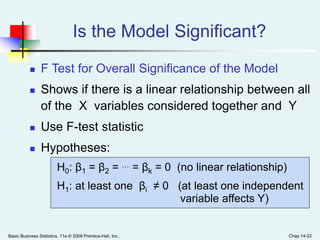
Is the Model Significant?
 F Test for Overall Significance of the Model
 Shows if there is a linear relationship between all
of the X variables considered together and Y
 Use F-test statistic
 Hypotheses:
H0: β1 = β2 = … = βk = 0 (no linear relationship)
H1: at least one βi ≠ 0 (at least one independent
variable affects Y)
Basic Business Statistics, 11e © 2009 Prentice-Hall, Inc.. Chap 14-23
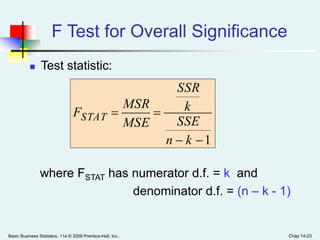
F Test for Overall Significance
 Test statistic:
where FSTAT has numerator d.f. = k and
denominator d.f. = (n – k - 1)
1

kn
SSE
k
SSR
MSE
MSR
FSTAT
Basic Business Statistics, 11e © 2009 Prentice-Hall, Inc.. Chap 14-24
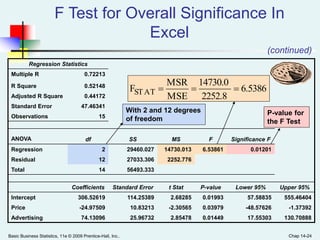
Regression Statistics
Multiple R 0.72213
R Square 0.52148
Adjusted R Square 0.44172
Standard Error 47.46341
Observations 15
ANOVA df SS MS F Significance F
Regression 2 29460.027 14730.013 6.53861 0.01201
Residual 12 27033.306 2252.776
Total 14 56493.333
Coefficients Standard Error t Stat P-value Lower 95% Upper 95%
Intercept 306.52619 114.25389 2.68285 0.01993 57.58835 555.46404
Price -24.97509 10.83213 -2.30565 0.03979 -48.57626 -1.37392
Advertising 74.13096 25.96732 2.85478 0.01449 17.55303 130.70888
(continued)
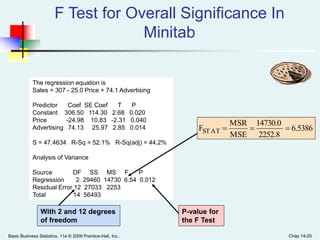
F Test for Overall Significance In
Excel
With 2 and 12 degrees
of freedom
P-value for
the F Test
6.5386
2252.8
14730.0
MSE
MSR
FSTAT 
Basic Business Statistics, 11e © 2009 Prentice-Hall, Inc.. Chap 14-25
F Test for Overall Significance In
Minitab
The regression equation is
Sales = 307 - 25.0 Price + 74.1 Advertising
Predictor Coef SE Coef T P
Constant 306.50 114.30 2.68 0.020
Price -24.98 10.83 -2.31 0.040
Advertising 74.13 25.97 2.85 0.014
S = 47.4634 R-Sq = 52.1% R-Sq(adj) = 44.2%
Analysis of Variance
Source DF SS MS F P
Regression 2 29460 14730 6.54 0.012
Residual Error 12 27033 2253
Total 14 56493
6.5386
2252.8
14730.0
MSE
MSR
FSTAT 
With 2 and 12 degrees
of freedom
P-value for
the F Test
Basic Business Statistics, 11e © 2009 Prentice-Hall, Inc.. Chap 14-26
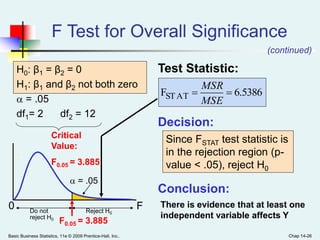
H0: β1 = β2 = 0
H1: β1 and β2 not both zero
 = .05
df1= 2 df2 = 12
Test Statistic:
Decision:
Conclusion:
Since FSTAT test statistic is
in the rejection region (p-
value < .05), reject H0
There is evidence that at least one
independent variable affects Y
0
 = .05
F0.05 = 3.885
Reject H0Do not
reject H0
6.5386FSTAT 
MSE
MSR
Critical
Value:
F0.05 = 3.885
F Test for Overall Significance
(continued)
F
Basic Business Statistics, 11e © 2009 Prentice-Hall, Inc.. Chap 14-27
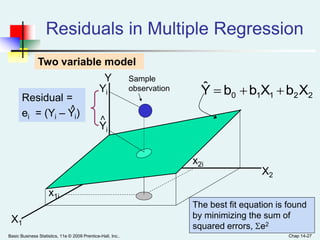
Two variable model
Y
X1
X2
22110 XbXbbYˆ Yi
Yi
<
x2i
x1i
The best fit equation is found
by minimizing the sum of
squared errors, e2
Sample
observation
Residuals in Multiple Regression
Residual =
ei = (Yi – Yi)
<
Basic Business Statistics, 11e © 2009 Prentice-Hall, Inc.. Chap 14-28
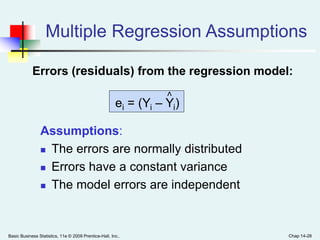
Multiple Regression Assumptions
Assumptions:
 The errors are normally distributed
 Errors have a constant variance
 The model errors are independent
ei = (Yi – Yi)
<
Errors (residuals) from the regression model:
Basic Business Statistics, 11e © 2009 Prentice-Hall, Inc.. Chap 14-29
Residual Plots Used
in Multiple Regression
 These residual plots are used in multiple
regression:
 Residuals vs. Yi
 Residuals vs. X1i
 Residuals vs. X2i
 Residuals vs. time (if time series data)
<
Use the residual plots to check for
violations of regression assumptions
Basic Business Statistics, 11e © 2009 Prentice-Hall, Inc.. Chap 14-30
Are Individual Variables
Significant?
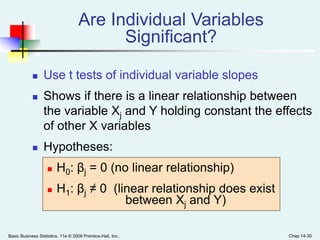
 Use t tests of individual variable slopes
 Shows if there is a linear relationship between
the variable Xj and Y holding constant the effects
of other X variables
 Hypotheses:
 H0: βj = 0 (no linear relationship)
 H1: βj ≠ 0 (linear relationship does exist
between Xj and Y)
Basic Business Statistics, 11e © 2009 Prentice-Hall, Inc.. Chap 14-31
Are Individual Variables
Significant?
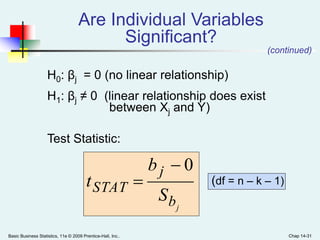
H0: βj = 0 (no linear relationship)
H1: βj ≠ 0 (linear relationship does exist
between Xj and Y)
Test Statistic:
(df = n – k – 1)
j
b
j
STAT
S
b
t
0

(continued)
Basic Business Statistics, 11e © 2009 Prentice-Hall, Inc.. Chap 14-32
Regression Statistics
Multiple R 0.72213
R Square 0.52148
Adjusted R Square 0.44172
Standard Error 47.46341
Observations 15
ANOVA df SS MS F Significance F
Regression 2 29460.027 14730.013 6.53861 0.01201
Residual 12 27033.306 2252.776
Total 14 56493.333
Coefficients Standard Error t Stat P-value Lower 95% Upper 95%
Intercept 306.52619 114.25389 2.68285 0.01993 57.58835 555.46404
Price -24.97509 10.83213 -2.30565 0.03979 -48.57626 -1.37392
Advertising 74.13096 25.96732 2.85478 0.01449 17.55303 130.70888
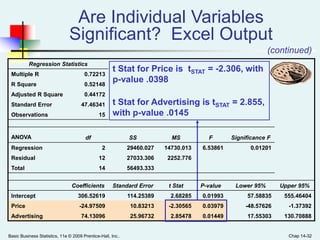
t Stat for Price is tSTAT = -2.306, with
p-value .0398
t Stat for Advertising is tSTAT = 2.855,
with p-value .0145
(continued)
Are Individual Variables
Significant? Excel Output
Basic Business Statistics, 11e © 2009 Prentice-Hall, Inc.. Chap 14-33
Are Individual Variables
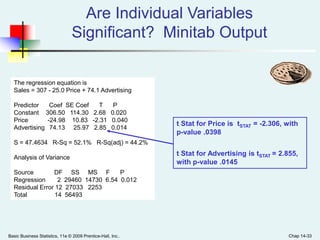
Significant? Minitab Output
The regression equation is
Sales = 307 - 25.0 Price + 74.1 Advertising
Predictor Coef SE Coef T P
Constant 306.50 114.30 2.68 0.020
Price -24.98 10.83 -2.31 0.040
Advertising 74.13 25.97 2.85 0.014
S = 47.4634 R-Sq = 52.1% R-Sq(adj) = 44.2%
Analysis of Variance
Source DF SS MS F P
Regression 2 29460 14730 6.54 0.012
Residual Error 12 27033 2253
Total 14 56493
t Stat for Price is tSTAT = -2.306, with
p-value .0398
t Stat for Advertising is tSTAT = 2.855,
with p-value .0145
Basic Business Statistics, 11e © 2009 Prentice-Hall, Inc.. Chap 14-34
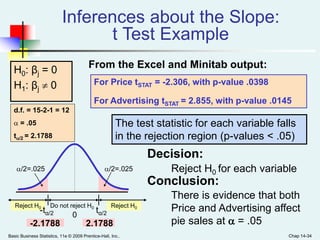
d.f. = 15-2-1 = 12
 = .05
t/2 = 2.1788
Inferences about the Slope:
t Test Example
H0: βj = 0
H1: βj  0
The test statistic for each variable falls
in the rejection region (p-values < .05)
There is evidence that both
Price and Advertising affect
pie sales at  = .05
From the Excel and Minitab output:
Reject H0 for each variable
Decision:
Conclusion:
Reject H0Reject H0
/2=.025
-tα/2
Do not reject H0
0
tα/2
/2=.025
-2.1788 2.1788
For Price tSTAT = -2.306, with p-value .0398
For Advertising tSTAT = 2.855, with p-value .0145
Basic Business Statistics, 11e © 2009 Prentice-Hall, Inc.. Chap 14-35
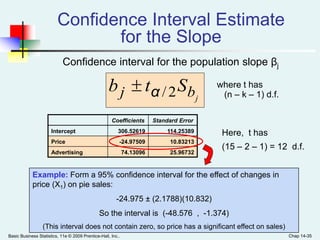
Confidence Interval Estimate
for the Slope
Confidence interval for the population slope βj
Example: Form a 95% confidence interval for the effect of changes in
price (X1) on pie sales:
-24.975 ± (2.1788)(10.832)
So the interval is (-48.576 , -1.374)
(This interval does not contain zero, so price has a significant effect on sales)
j
bj Stb 2/α
Coefficients Standard Error
Intercept 306.52619 114.25389
Price -24.97509 10.83213
Advertising 74.13096 25.96732
where t has
(n – k – 1) d.f.
Here, t has
(15 – 2 – 1) = 12 d.f.
Basic Business Statistics, 11e © 2009 Prentice-Hall, Inc.. Chap 14-36
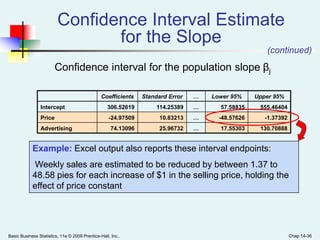
Confidence Interval Estimate
for the Slope
Confidence interval for the population slope βj
Example: Excel output also reports these interval endpoints:
Weekly sales are estimated to be reduced by between 1.37 to
48.58 pies for each increase of $1 in the selling price, holding the
effect of price constant
Coefficients Standard Error … Lower 95% Upper 95%
Intercept 306.52619 114.25389 … 57.58835 555.46404
Price -24.97509 10.83213 … -48.57626 -1.37392
Advertising 74.13096 25.96732 … 17.55303 130.70888
(continued)
Basic Business Statistics, 11e © 2009 Prentice-Hall, Inc.. Chap 14-37
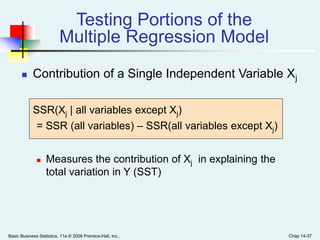
 Contribution of a Single Independent Variable Xj
SSR(Xj | all variables except Xj)
= SSR (all variables) – SSR(all variables except Xj)
 Measures the contribution of Xj in explaining the
total variation in Y (SST)
Testing Portions of the
Multiple Regression Model
Basic Business Statistics, 11e © 2009 Prentice-Hall, Inc.. Chap 14-38
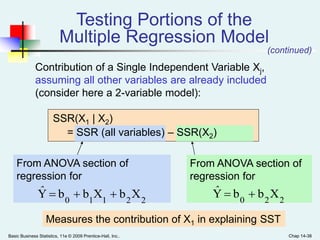
Measures the contribution of X1 in explaining SST
From ANOVA section of
regression for
From ANOVA section of
regression for
Testing Portions of the
Multiple Regression Model
Contribution of a Single Independent Variable Xj,
assuming all other variables are already included
(consider here a 2-variable model):
SSR(X1 | X2)
= SSR (all variables) – SSR(X2)
(continued)
22110
XbXbbY ˆ
220
XbbY ˆ
Basic Business Statistics, 11e © 2009 Prentice-Hall, Inc.. Chap 14-39
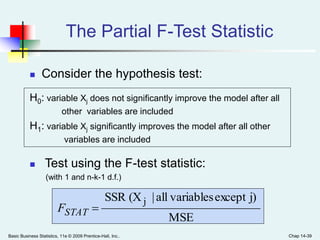
The Partial F-Test Statistic
 Consider the hypothesis test:
H0: variable Xj does not significantly improve the model after all
other variables are included
H1: variable Xj significantly improves the model after all other
variables are included
 Test using the F-test statistic:
(with 1 and n-k-1 d.f.)
MSE
j)exceptvariablesall|(XSSR j
STATF
Basic Business Statistics, 11e © 2009 Prentice-Hall, Inc.. Chap 14-40
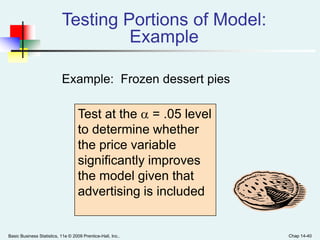
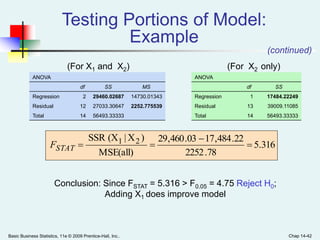
Testing Portions of Model:
Example
Test at the  = .05 level
to determine whether
the price variable
significantly improves
the model given that
advertising is included
Example: Frozen dessert pies
Basic Business Statistics, 11e © 2009 Prentice-Hall, Inc.. Chap 14-41
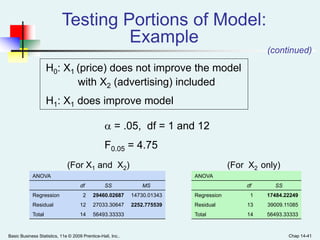
Testing Portions of Model:
Example
H0: X1 (price) does not improve the model
with X2 (advertising) included
H1: X1 does improve model
 = .05, df = 1 and 12
F0.05 = 4.75
(For X1 and X2) (For X2 only)
ANOVA
df SS MS
Regression 2 29460.02687 14730.01343
Residual 12 27033.30647 2252.775539
Total 14 56493.33333
ANOVA
df SS
Regression 1 17484.22249
Residual 13 39009.11085
Total 14 56493.33333
(continued)
Basic Business Statistics, 11e © 2009 Prentice-Hall, Inc.. Chap 14-42
Testing Portions of Model:
Example
Conclusion: Since FSTAT = 5.316 > F0.05 = 4.75 Reject H0;
Adding X1 does improve model
316.5
78.2252
22.484,1703.460,29
MSE(all)
)X|(XSSR 21


STATF
(continued)
(For X1 and X2) (For X2 only)
ANOVA
df SS MS
Regression 2 29460.02687 14730.01343
Residual 12 27033.30647 2252.775539
Total 14 56493.33333
ANOVA
df SS
Regression 1 17484.22249
Residual 13 39009.11085
Total 14 56493.33333
Basic Business Statistics, 11e © 2009 Prentice-Hall, Inc.. Chap 14-43
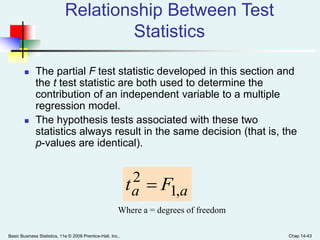
Relationship Between Test
Statistics
 The partial F test statistic developed in this section and
the t test statistic are both used to determine the
contribution of an independent variable to a multiple
regression model.
 The hypothesis tests associated with these two
statistics always result in the same decision (that is, the
p-values are identical).
aa Ft ,1
2

Where a = degrees of freedom
Basic Business Statistics, 11e © 2009 Prentice-Hall, Inc.. Chap 14-44
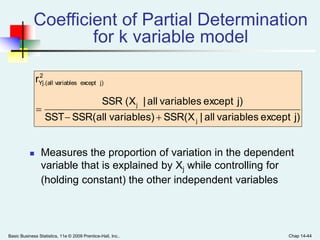
Coefficient of Partial Determination
for k variable model
 Measures the proportion of variation in the dependent
variable that is explained by Xj while controlling for
(holding constant) the other independent variables
j)exceptvariablesall|SSR(Xvariables)SSR(allSST
j)exceptvariablesall|(XSSR
r
j
j
2
j)exceptvariablesYj.(all


Basic Business Statistics, 11e © 2009 Prentice-Hall, Inc.. Chap 14-45
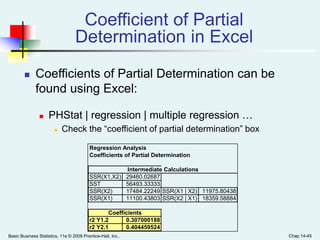
Coefficient of Partial
Determination in Excel
 Coefficients of Partial Determination can be
found using Excel:
 PHStat | regression | multiple regression …
 Check the “coefficient of partial determination” box
Regression Analysis
Coefficients of Partial Determination
SSR(X1,X2) 29460.02687
SST 56493.33333
SSR(X2) 17484.22249 SSR(X1 | X2) 11975.80438
SSR(X1) 11100.43803 SSR(X2 | X1) 18359.58884
r2 Y1.2 0.307000188
r2 Y2.1 0.404459524
Intermediate Calculations
Coefficients
Basic Business Statistics, 11e © 2009 Prentice-Hall, Inc.. Chap 14-46
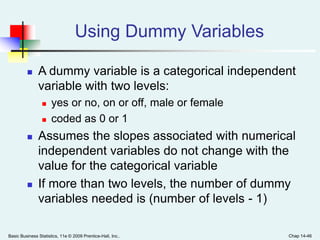
Using Dummy Variables
 A dummy variable is a categorical independent
variable with two levels:
 yes or no, on or off, male or female
 coded as 0 or 1
 Assumes the slopes associated with numerical
independent variables do not change with the
value for the categorical variable
 If more than two levels, the number of dummy
variables needed is (number of levels - 1)
Basic Business Statistics, 11e © 2009 Prentice-Hall, Inc.. Chap 14-47
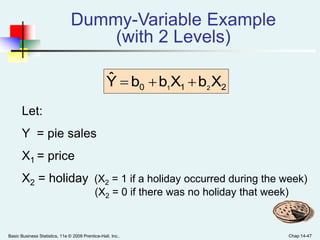
Dummy-Variable Example
(with 2 Levels)
Let:
Y = pie sales
X1 = price
X2 = holiday (X2 = 1 if a holiday occurred during the week)
(X2 = 0 if there was no holiday that week)
210 XbXbbYˆ
21

Basic Business Statistics, 11e © 2009 Prentice-Hall, Inc.. Chap 14-48
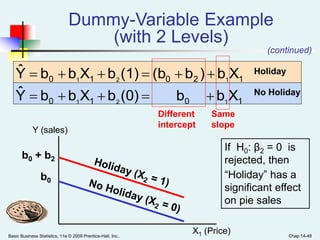
Same
slope
Dummy-Variable Example
(with 2 Levels)
(continued)
X1 (Price)
Y (sales)
b0 + b2
b0
1010
12010
Xbb(0)bXbbYˆ
Xb)b(b(1)bXbbYˆ
121
121

 Holiday
No Holiday
Different
intercept
If H0: β2 = 0 is
rejected, then
“Holiday” has a
significant effect
on pie sales
Basic Business Statistics, 11e © 2009 Prentice-Hall, Inc.. Chap 14-49
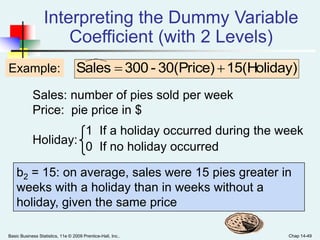
Sales: number of pies sold per week
Price: pie price in $
Holiday:
Interpreting the Dummy Variable
Coefficient (with 2 Levels)
Example:
1 If a holiday occurred during the week
0 If no holiday occurred
b2 = 15: on average, sales were 15 pies greater in
weeks with a holiday than in weeks without a
holiday, given the same price
)15(Holiday30(Price)-300Sales 
Basic Business Statistics, 11e © 2009 Prentice-Hall, Inc.. Chap 14-50
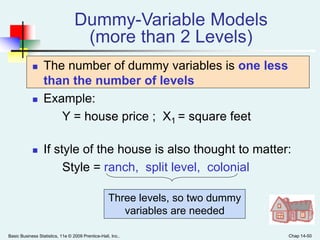
Dummy-Variable Models
(more than 2 Levels)
 The number of dummy variables is one less
than the number of levels
 Example:
Y = house price ; X1 = square feet
 If style of the house is also thought to matter:
Style = ranch, split level, colonial
Three levels, so two dummy
variables are needed
Basic Business Statistics, 11e © 2009 Prentice-Hall, Inc.. Chap 14-51
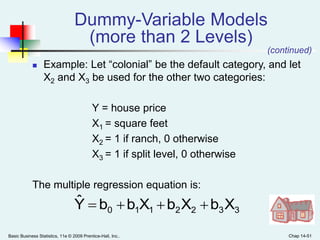
Dummy-Variable Models
(more than 2 Levels)
 Example: Let “colonial” be the default category, and let
X2 and X3 be used for the other two categories:
Y = house price
X1 = square feet
X2 = 1 if ranch, 0 otherwise
X3 = 1 if split level, 0 otherwise
The multiple regression equation is:
3322110 XbXbXbbYˆ 
(continued)
Basic Business Statistics, 11e © 2009 Prentice-Hall, Inc.. Chap 14-52
18.840.045X20.43Yˆ
1 
23.530.045X20.43Yˆ
1 
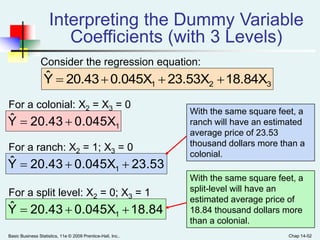
Interpreting the Dummy Variable
Coefficients (with 3 Levels)
With the same square feet, a
ranch will have an estimated
average price of 23.53
thousand dollars more than a
colonial.
With the same square feet, a
split-level will have an
estimated average price of
18.84 thousand dollars more
than a colonial.
Consider the regression equation:
321 18.84X23.53X0.045X20.43Yˆ 
10.045X20.43Yˆ 
For a colonial: X2 = X3 = 0
For a ranch: X2 = 1; X3 = 0
For a split level: X2 = 0; X3 = 1
Basic Business Statistics, 11e © 2009 Prentice-Hall, Inc.. Chap 14-53
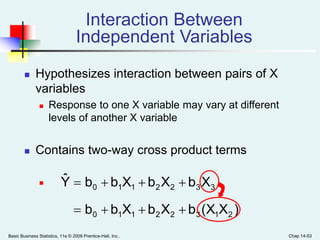
Interaction Between
Independent Variables
 Hypothesizes interaction between pairs of X
variables
 Response to one X variable may vary at different
levels of another X variable
 Contains two-way cross product terms

)X(XbXbXbb
XbXbXbbYˆ
21322110
3322110


Basic Business Statistics, 11e © 2009 Prentice-Hall, Inc.. Chap 14-54
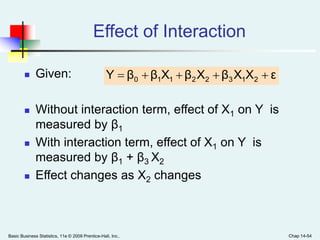
Effect of Interaction
 Given:
 Without interaction term, effect of X1 on Y is
measured by β1
 With interaction term, effect of X1 on Y is
measured by β1 + β3 X2
 Effect changes as X2 changes
εXXβXβXββY 21322110 
Basic Business Statistics, 11e © 2009 Prentice-Hall, Inc.. Chap 14-55
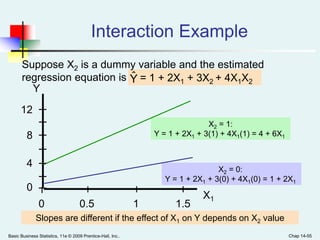
X2 = 1:
Y = 1 + 2X1 + 3(1) + 4X1(1) = 4 + 6X1
X2 = 0:
Y = 1 + 2X1 + 3(0) + 4X1(0) = 1 + 2X1
Interaction Example
Slopes are different if the effect of X1 on Y depends on X2 value
X1
4
8
12
0
0 10.5 1.5
Y
= 1 + 2X1 + 3X2 + 4X1X2
Suppose X2 is a dummy variable and the estimated
regression equation is Yˆ
Basic Business Statistics, 11e © 2009 Prentice-Hall, Inc.. Chap 14-56
Significance of Interaction Term
 Can perform a partial F test for the contribution
of a variable to see if the addition of an
interaction term improves the model
 Multiple interaction terms can be included
 Use a partial F test for the simultaneous contribution
of multiple variables to the model
Basic Business Statistics, 11e © 2009 Prentice-Hall, Inc.. Chap 14-57
Simultaneous Contribution of
Independent Variables
 Use partial F test for the simultaneous
contribution of multiple variables to the model
 Let m variables be an additional set of variables
added simultaneously
 To test the hypothesis that the set of m variables
improves the model:
MSE(all)
m/)]variablesmofsetnewexcept(allSSR[SSR(all) 
STATF
(where FSTAT has m and n-k-1 d.f.)
Basic Business Statistics, 11e © 2009 Prentice-Hall, Inc.. Chap 14-58
Logistic Regression
 Used when the dependent variable Y is binary
(i.e., Y takes on only two values)
 Examples
 Customer prefers Brand A or Brand B
 Employee chooses to work full-time or part-time
 Loan is delinquent or is not delinquent
 Person voted in last election or did not
 Logistic regression allows you to predict the
probability of a particular categorical response
Basic Business Statistics, 11e © 2009 Prentice-Hall, Inc.. Chap 14-59
Logistic Regression
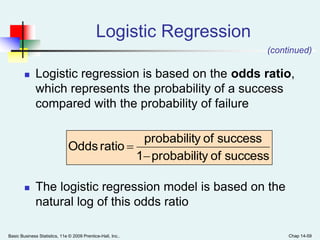
 Logistic regression is based on the odds ratio,
which represents the probability of a success
compared with the probability of failure
 The logistic regression model is based on the
natural log of this odds ratio
(continued)
successofyprobabilit1
successofyprobabilit
ratioOdds


Basic Business Statistics, 11e © 2009 Prentice-Hall, Inc.. Chap 14-60
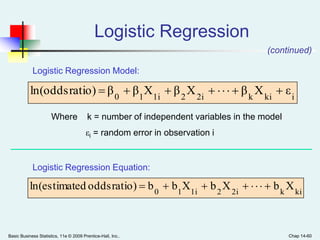
Logistic Regression
ikik2i21i10
εXβXβXββratio)ln(odds 
Where k = number of independent variables in the model
εi = random error in observation i
kik2i21i10
XbXbXbbratio)oddsedln(estimat 
Logistic Regression Model:
Logistic Regression Equation:
(continued)
Basic Business Statistics, 11e © 2009 Prentice-Hall, Inc.. Chap 14-61
Estimated Odds Ratio and
Probability of Success
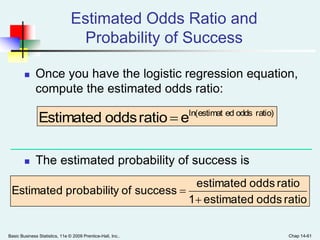
 Once you have the logistic regression equation,
compute the estimated odds ratio:
 The estimated probability of success is
ratio)oddsedln(estimat
eratiooddsEstimated 
ratiooddsestimated1
ratiooddsestimated
successofyprobabilitEstimated


Basic Business Statistics, 11e © 2009 Prentice-Hall, Inc.. Chap 14-62
Chapter Summary
 Developed the multiple regression model
 Tested the significance of the multiple regression model
 Discussed adjusted r2
 Discussed using residual plots to check model
assumptions
 Tested individual regression coefficients
 Tested portions of the regression model
 Used dummy variables
 Evaluated interaction effects
 Discussed logistic regression

Bbs11 ppt ch14

  • 1.
    Basic Business Statistics,11e © 2009 Prentice-Hall, Inc. Chap 14-1 Chapter 14 Introduction to Multiple Regression Basic Business Statistics 11th Edition
  • 2.
    Basic Business Statistics,11e © 2009 Prentice-Hall, Inc.. Chap 14-2 Learning Objectives In this chapter, you learn:  How to develop a multiple regression model  How to interpret the regression coefficients  How to determine which independent variables to include in the regression model  How to determine which independent variables are more important in predicting a dependent variable  How to use categorical variables in a regression model  How to predict a categorical dependent variable using logistic regression
  • 3.
    Basic Business Statistics,11e © 2009 Prentice-Hall, Inc.. Chap 14-3 The Multiple Regression Model Idea: Examine the linear relationship between 1 dependent (Y) & 2 or more independent variables (Xi) ikik2i21i10i εXβXβXββY  Multiple Regression Model with k Independent Variables: Y-intercept Population slopes Random Error
  • 4.
    Basic Business Statistics,11e © 2009 Prentice-Hall, Inc.. Chap 14-4 Multiple Regression Equation The coefficients of the multiple regression model are estimated using sample data kik2i21i10i XbXbXbbY ˆ Estimated (or predicted) value of Y Estimated slope coefficients Multiple regression equation with k independent variables: Estimated intercept In this chapter we will use Excel or Minitab to obtain the regression slope coefficients and other regression summary measures.
  • 5.
    Basic Business Statistics,11e © 2009 Prentice-Hall, Inc.. Chap 14-5 Two variable model Y X1 X2 22110 XbXbbYˆ  Multiple Regression Equation (continued)
  • 6.
    Basic Business Statistics,11e © 2009 Prentice-Hall, Inc.. Chap 14-6 Example: 2 Independent Variables  A distributor of frozen dessert pies wants to evaluate factors thought to influence demand  Dependent variable: Pie sales (units per week)  Independent variables: Price (in $) Advertising ($100’s)  Data are collected for 15 weeks
  • 7.
    Basic Business Statistics,11e © 2009 Prentice-Hall, Inc.. Chap 14-7 Pie Sales Example Sales = b0 + b1 (Price) + b2 (Advertising) Week Pie Sales Price ($) Advertising ($100s) 1 350 5.50 3.3 2 460 7.50 3.3 3 350 8.00 3.0 4 430 8.00 4.5 5 350 6.80 3.0 6 380 7.50 4.0 7 430 4.50 3.0 8 470 6.40 3.7 9 450 7.00 3.5 10 490 5.00 4.0 11 340 7.20 3.5 12 300 7.90 3.2 13 440 5.90 4.0 14 450 5.00 3.5 15 300 7.00 2.7 Multiple regression equation:
  • 8.
    Basic Business Statistics,11e © 2009 Prentice-Hall, Inc.. Chap 14-8 Excel Multiple Regression Output Regression Statistics Multiple R 0.72213 R Square 0.52148 Adjusted R Square 0.44172 Standard Error 47.46341 Observations 15 ANOVA df SS MS F Significance F Regression 2 29460.027 14730.013 6.53861 0.01201 Residual 12 27033.306 2252.776 Total 14 56493.333 Coefficients Standard Error t Stat P-value Lower 95% Upper 95% Intercept 306.52619 114.25389 2.68285 0.01993 57.58835 555.46404 Price -24.97509 10.83213 -2.30565 0.03979 -48.57626 -1.37392 Advertising 74.13096 25.96732 2.85478 0.01449 17.55303 130.70888 ertising)74.131(Advce)24.975(Pri-306.526Sales 
  • 9.
    Basic Business Statistics,11e © 2009 Prentice-Hall, Inc.. Chap 14-9 Minitab Multiple Regression Output The regression equation is Sales = 307 - 25.0 Price + 74.1 Advertising Predictor Coef SE Coef T P Constant 306.50 114.30 2.68 0.020 Price -24.98 10.83 -2.31 0.040 Advertising 74.13 25.97 2.85 0.014 S = 47.4634 R-Sq = 52.1% R-Sq(adj) = 44.2% Analysis of Variance Source DF SS MS F P Regression 2 29460 14730 6.54 0.012 Residual Error 12 27033 2253 Total 14 56493 ertising)74.131(Advce)24.975(Pri-306.526Sales 
  • 10.
    Basic Business Statistics,11e © 2009 Prentice-Hall, Inc.. Chap 14-10 The Multiple Regression Equation ertising)74.131(Advce)24.975(Pri-306.526Sales  b1 = -24.975: sales will decrease, on average, by 24.975 pies per week for each $1 increase in selling price, net of the effects of changes due to advertising b2 = 74.131: sales will increase, on average, by 74.131 pies per week for each $100 increase in advertising, net of the effects of changes due to price where Sales is in number of pies per week Price is in $ Advertising is in $100’s.
  • 11.
    Basic Business Statistics,11e © 2009 Prentice-Hall, Inc.. Chap 14-11 Using The Equation to Make Predictions Predict sales for a week in which the selling price is $5.50 and advertising is $350: Predicted sales is 428.62 pies 428.62 (3.5)74.131(5.50)24.975-306.526 ertising)74.131(Advce)24.975(Pri-306.526Sales    Note that Advertising is in $100’s, so $350 means that X2 = 3.5
  • 12.
    Basic Business Statistics,11e © 2009 Prentice-Hall, Inc.. Chap 14-12 Predictions in Excel using PHStat  PHStat | regression | multiple regression … Check the “confidence and prediction interval estimates” box
  • 13.
    Basic Business Statistics,11e © 2009 Prentice-Hall, Inc.. Chap 14-13 Input values Predictions in PHStat (continued) Predicted Y value < Confidence interval for the mean value of Y, given these X values Prediction interval for an individual Y value, given these X values
  • 14.
    Basic Business Statistics,11e © 2009 Prentice-Hall, Inc.. Chap 14-14 Predictions in Minitab Input values Predicted Values for New Observations New Obs Fit SE Fit 95% CI 95% PI 1 428.6 17.2 (391.1, 466.1) (318.6, 538.6) Values of Predictors for New Observations New Obs Price Advertising 1 5.50 3.50 valueYPredicted ˆ Confidence interval for the mean value of Y, given these X values Prediction interval for an individual Y value, given these X values
  • 15.
    Basic Business Statistics,11e © 2009 Prentice-Hall, Inc.. Chap 14-15 Coefficient of Multiple Determination  Reports the proportion of total variation in Y explained by all X variables taken together squaresofsumtotal squaresofsumregression SST SSR r 2
  • 16.
    Basic Business Statistics,11e © 2009 Prentice-Hall, Inc.. Chap 14-16 Regression Statistics Multiple R 0.72213 R Square 0.52148 Adjusted R Square 0.44172 Standard Error 47.46341 Observations 15 ANOVA df SS MS F Significance F Regression 2 29460.027 14730.013 6.53861 0.01201 Residual 12 27033.306 2252.776 Total 14 56493.333 Coefficients Standard Error t Stat P-value Lower 95% Upper 95% Intercept 306.52619 114.25389 2.68285 0.01993 57.58835 555.46404 Price -24.97509 10.83213 -2.30565 0.03979 -48.57626 -1.37392 Advertising 74.13096 25.96732 2.85478 0.01449 17.55303 130.70888 .52148 56493.3 29460.0 SST SSR r2  52.1% of the variation in pie sales is explained by the variation in price and advertising Multiple Coefficient of Determination In Excel
  • 17.
    Basic Business Statistics,11e © 2009 Prentice-Hall, Inc.. Chap 14-17 Multiple Coefficient of Determination In Minitab The regression equation is Sales = 307 - 25.0 Price + 74.1 Advertising Predictor Coef SE Coef T P Constant 306.50 114.30 2.68 0.020 Price -24.98 10.83 -2.31 0.040 Advertising 74.13 25.97 2.85 0.014 S = 47.4634 R-Sq = 52.1% R-Sq(adj) = 44.2% Analysis of Variance Source DF SS MS F P Regression 2 29460 14730 6.54 0.012 Residual Error 12 27033 2253 Total 14 56493 .52148 56493.3 29460.0 SST SSR r2  52.1% of the variation in pie sales is explained by the variation in price and advertising
  • 18.
    Basic Business Statistics,11e © 2009 Prentice-Hall, Inc.. Chap 14-18 Adjusted r2  r2 never decreases when a new X variable is added to the model  This can be a disadvantage when comparing models  What is the net effect of adding a new variable?  We lose a degree of freedom when a new X variable is added  Did the new X variable add enough explanatory power to offset the loss of one degree of freedom?
  • 19.
    Basic Business Statistics,11e © 2009 Prentice-Hall, Inc.. Chap 14-19  Shows the proportion of variation in Y explained by all X variables adjusted for the number of X variables used (where n = sample size, k = number of independent variables)  Penalize excessive use of unimportant independent variables  Smaller than r2  Useful in comparing among models Adjusted r2 (continued)                1 1 )1(1 22 kn n rradj
  • 20.
    Basic Business Statistics,11e © 2009 Prentice-Hall, Inc.. Chap 14-20 Regression Statistics Multiple R 0.72213 R Square 0.52148 Adjusted R Square 0.44172 Standard Error 47.46341 Observations 15 ANOVA df SS MS F Significance F Regression 2 29460.027 14730.013 6.53861 0.01201 Residual 12 27033.306 2252.776 Total 14 56493.333 Coefficients Standard Error t Stat P-value Lower 95% Upper 95% Intercept 306.52619 114.25389 2.68285 0.01993 57.58835 555.46404 Price -24.97509 10.83213 -2.30565 0.03979 -48.57626 -1.37392 Advertising 74.13096 25.96732 2.85478 0.01449 17.55303 130.70888 .44172r2 adj  44.2% of the variation in pie sales is explained by the variation in price and advertising, taking into account the sample size and number of independent variables Adjusted r2 in Excel
  • 21.
    Basic Business Statistics,11e © 2009 Prentice-Hall, Inc.. Chap 14-21 Adjusted r2 in Minitab The regression equation is Sales = 307 - 25.0 Price + 74.1 Advertising Predictor Coef SE Coef T P Constant 306.50 114.30 2.68 0.020 Price -24.98 10.83 -2.31 0.040 Advertising 74.13 25.97 2.85 0.014 S = 47.4634 R-Sq = 52.1% R-Sq(adj) = 44.2% Analysis of Variance Source DF SS MS F P Regression 2 29460 14730 6.54 0.012 Residual Error 12 27033 2253 Total 14 56493 .44172r2 adj  44.2% of the variation in pie sales is explained by the variation in price and advertising, taking into account the sample size and number of independent variables
  • 22.
    Basic Business Statistics,11e © 2009 Prentice-Hall, Inc.. Chap 14-22 Is the Model Significant?  F Test for Overall Significance of the Model  Shows if there is a linear relationship between all of the X variables considered together and Y  Use F-test statistic  Hypotheses: H0: β1 = β2 = … = βk = 0 (no linear relationship) H1: at least one βi ≠ 0 (at least one independent variable affects Y)
  • 23.
    Basic Business Statistics,11e © 2009 Prentice-Hall, Inc.. Chap 14-23 F Test for Overall Significance  Test statistic: where FSTAT has numerator d.f. = k and denominator d.f. = (n – k - 1) 1  kn SSE k SSR MSE MSR FSTAT
  • 24.
    Basic Business Statistics,11e © 2009 Prentice-Hall, Inc.. Chap 14-24 Regression Statistics Multiple R 0.72213 R Square 0.52148 Adjusted R Square 0.44172 Standard Error 47.46341 Observations 15 ANOVA df SS MS F Significance F Regression 2 29460.027 14730.013 6.53861 0.01201 Residual 12 27033.306 2252.776 Total 14 56493.333 Coefficients Standard Error t Stat P-value Lower 95% Upper 95% Intercept 306.52619 114.25389 2.68285 0.01993 57.58835 555.46404 Price -24.97509 10.83213 -2.30565 0.03979 -48.57626 -1.37392 Advertising 74.13096 25.96732 2.85478 0.01449 17.55303 130.70888 (continued) F Test for Overall Significance In Excel With 2 and 12 degrees of freedom P-value for the F Test 6.5386 2252.8 14730.0 MSE MSR FSTAT 
  • 25.
    Basic Business Statistics,11e © 2009 Prentice-Hall, Inc.. Chap 14-25 F Test for Overall Significance In Minitab The regression equation is Sales = 307 - 25.0 Price + 74.1 Advertising Predictor Coef SE Coef T P Constant 306.50 114.30 2.68 0.020 Price -24.98 10.83 -2.31 0.040 Advertising 74.13 25.97 2.85 0.014 S = 47.4634 R-Sq = 52.1% R-Sq(adj) = 44.2% Analysis of Variance Source DF SS MS F P Regression 2 29460 14730 6.54 0.012 Residual Error 12 27033 2253 Total 14 56493 6.5386 2252.8 14730.0 MSE MSR FSTAT  With 2 and 12 degrees of freedom P-value for the F Test
  • 26.
    Basic Business Statistics,11e © 2009 Prentice-Hall, Inc.. Chap 14-26 H0: β1 = β2 = 0 H1: β1 and β2 not both zero  = .05 df1= 2 df2 = 12 Test Statistic: Decision: Conclusion: Since FSTAT test statistic is in the rejection region (p- value < .05), reject H0 There is evidence that at least one independent variable affects Y 0  = .05 F0.05 = 3.885 Reject H0Do not reject H0 6.5386FSTAT  MSE MSR Critical Value: F0.05 = 3.885 F Test for Overall Significance (continued) F
  • 27.
    Basic Business Statistics,11e © 2009 Prentice-Hall, Inc.. Chap 14-27 Two variable model Y X1 X2 22110 XbXbbYˆ Yi Yi < x2i x1i The best fit equation is found by minimizing the sum of squared errors, e2 Sample observation Residuals in Multiple Regression Residual = ei = (Yi – Yi) <
  • 28.
    Basic Business Statistics,11e © 2009 Prentice-Hall, Inc.. Chap 14-28 Multiple Regression Assumptions Assumptions:  The errors are normally distributed  Errors have a constant variance  The model errors are independent ei = (Yi – Yi) < Errors (residuals) from the regression model:
  • 29.
    Basic Business Statistics,11e © 2009 Prentice-Hall, Inc.. Chap 14-29 Residual Plots Used in Multiple Regression  These residual plots are used in multiple regression:  Residuals vs. Yi  Residuals vs. X1i  Residuals vs. X2i  Residuals vs. time (if time series data) < Use the residual plots to check for violations of regression assumptions
  • 30.
    Basic Business Statistics,11e © 2009 Prentice-Hall, Inc.. Chap 14-30 Are Individual Variables Significant?  Use t tests of individual variable slopes  Shows if there is a linear relationship between the variable Xj and Y holding constant the effects of other X variables  Hypotheses:  H0: βj = 0 (no linear relationship)  H1: βj ≠ 0 (linear relationship does exist between Xj and Y)
  • 31.
    Basic Business Statistics,11e © 2009 Prentice-Hall, Inc.. Chap 14-31 Are Individual Variables Significant? H0: βj = 0 (no linear relationship) H1: βj ≠ 0 (linear relationship does exist between Xj and Y) Test Statistic: (df = n – k – 1) j b j STAT S b t 0  (continued)
  • 32.
    Basic Business Statistics,11e © 2009 Prentice-Hall, Inc.. Chap 14-32 Regression Statistics Multiple R 0.72213 R Square 0.52148 Adjusted R Square 0.44172 Standard Error 47.46341 Observations 15 ANOVA df SS MS F Significance F Regression 2 29460.027 14730.013 6.53861 0.01201 Residual 12 27033.306 2252.776 Total 14 56493.333 Coefficients Standard Error t Stat P-value Lower 95% Upper 95% Intercept 306.52619 114.25389 2.68285 0.01993 57.58835 555.46404 Price -24.97509 10.83213 -2.30565 0.03979 -48.57626 -1.37392 Advertising 74.13096 25.96732 2.85478 0.01449 17.55303 130.70888 t Stat for Price is tSTAT = -2.306, with p-value .0398 t Stat for Advertising is tSTAT = 2.855, with p-value .0145 (continued) Are Individual Variables Significant? Excel Output
  • 33.
    Basic Business Statistics,11e © 2009 Prentice-Hall, Inc.. Chap 14-33 Are Individual Variables Significant? Minitab Output The regression equation is Sales = 307 - 25.0 Price + 74.1 Advertising Predictor Coef SE Coef T P Constant 306.50 114.30 2.68 0.020 Price -24.98 10.83 -2.31 0.040 Advertising 74.13 25.97 2.85 0.014 S = 47.4634 R-Sq = 52.1% R-Sq(adj) = 44.2% Analysis of Variance Source DF SS MS F P Regression 2 29460 14730 6.54 0.012 Residual Error 12 27033 2253 Total 14 56493 t Stat for Price is tSTAT = -2.306, with p-value .0398 t Stat for Advertising is tSTAT = 2.855, with p-value .0145
  • 34.
    Basic Business Statistics,11e © 2009 Prentice-Hall, Inc.. Chap 14-34 d.f. = 15-2-1 = 12  = .05 t/2 = 2.1788 Inferences about the Slope: t Test Example H0: βj = 0 H1: βj  0 The test statistic for each variable falls in the rejection region (p-values < .05) There is evidence that both Price and Advertising affect pie sales at  = .05 From the Excel and Minitab output: Reject H0 for each variable Decision: Conclusion: Reject H0Reject H0 /2=.025 -tα/2 Do not reject H0 0 tα/2 /2=.025 -2.1788 2.1788 For Price tSTAT = -2.306, with p-value .0398 For Advertising tSTAT = 2.855, with p-value .0145
  • 35.
    Basic Business Statistics,11e © 2009 Prentice-Hall, Inc.. Chap 14-35 Confidence Interval Estimate for the Slope Confidence interval for the population slope βj Example: Form a 95% confidence interval for the effect of changes in price (X1) on pie sales: -24.975 ± (2.1788)(10.832) So the interval is (-48.576 , -1.374) (This interval does not contain zero, so price has a significant effect on sales) j bj Stb 2/α Coefficients Standard Error Intercept 306.52619 114.25389 Price -24.97509 10.83213 Advertising 74.13096 25.96732 where t has (n – k – 1) d.f. Here, t has (15 – 2 – 1) = 12 d.f.
  • 36.
    Basic Business Statistics,11e © 2009 Prentice-Hall, Inc.. Chap 14-36 Confidence Interval Estimate for the Slope Confidence interval for the population slope βj Example: Excel output also reports these interval endpoints: Weekly sales are estimated to be reduced by between 1.37 to 48.58 pies for each increase of $1 in the selling price, holding the effect of price constant Coefficients Standard Error … Lower 95% Upper 95% Intercept 306.52619 114.25389 … 57.58835 555.46404 Price -24.97509 10.83213 … -48.57626 -1.37392 Advertising 74.13096 25.96732 … 17.55303 130.70888 (continued)
  • 37.
    Basic Business Statistics,11e © 2009 Prentice-Hall, Inc.. Chap 14-37  Contribution of a Single Independent Variable Xj SSR(Xj | all variables except Xj) = SSR (all variables) – SSR(all variables except Xj)  Measures the contribution of Xj in explaining the total variation in Y (SST) Testing Portions of the Multiple Regression Model
  • 38.
    Basic Business Statistics,11e © 2009 Prentice-Hall, Inc.. Chap 14-38 Measures the contribution of X1 in explaining SST From ANOVA section of regression for From ANOVA section of regression for Testing Portions of the Multiple Regression Model Contribution of a Single Independent Variable Xj, assuming all other variables are already included (consider here a 2-variable model): SSR(X1 | X2) = SSR (all variables) – SSR(X2) (continued) 22110 XbXbbY ˆ 220 XbbY ˆ
  • 39.
    Basic Business Statistics,11e © 2009 Prentice-Hall, Inc.. Chap 14-39 The Partial F-Test Statistic  Consider the hypothesis test: H0: variable Xj does not significantly improve the model after all other variables are included H1: variable Xj significantly improves the model after all other variables are included  Test using the F-test statistic: (with 1 and n-k-1 d.f.) MSE j)exceptvariablesall|(XSSR j STATF
  • 40.
    Basic Business Statistics,11e © 2009 Prentice-Hall, Inc.. Chap 14-40 Testing Portions of Model: Example Test at the  = .05 level to determine whether the price variable significantly improves the model given that advertising is included Example: Frozen dessert pies
  • 41.
    Basic Business Statistics,11e © 2009 Prentice-Hall, Inc.. Chap 14-41 Testing Portions of Model: Example H0: X1 (price) does not improve the model with X2 (advertising) included H1: X1 does improve model  = .05, df = 1 and 12 F0.05 = 4.75 (For X1 and X2) (For X2 only) ANOVA df SS MS Regression 2 29460.02687 14730.01343 Residual 12 27033.30647 2252.775539 Total 14 56493.33333 ANOVA df SS Regression 1 17484.22249 Residual 13 39009.11085 Total 14 56493.33333 (continued)
  • 42.
    Basic Business Statistics,11e © 2009 Prentice-Hall, Inc.. Chap 14-42 Testing Portions of Model: Example Conclusion: Since FSTAT = 5.316 > F0.05 = 4.75 Reject H0; Adding X1 does improve model 316.5 78.2252 22.484,1703.460,29 MSE(all) )X|(XSSR 21   STATF (continued) (For X1 and X2) (For X2 only) ANOVA df SS MS Regression 2 29460.02687 14730.01343 Residual 12 27033.30647 2252.775539 Total 14 56493.33333 ANOVA df SS Regression 1 17484.22249 Residual 13 39009.11085 Total 14 56493.33333
  • 43.
    Basic Business Statistics,11e © 2009 Prentice-Hall, Inc.. Chap 14-43 Relationship Between Test Statistics  The partial F test statistic developed in this section and the t test statistic are both used to determine the contribution of an independent variable to a multiple regression model.  The hypothesis tests associated with these two statistics always result in the same decision (that is, the p-values are identical). aa Ft ,1 2  Where a = degrees of freedom
  • 44.
    Basic Business Statistics,11e © 2009 Prentice-Hall, Inc.. Chap 14-44 Coefficient of Partial Determination for k variable model  Measures the proportion of variation in the dependent variable that is explained by Xj while controlling for (holding constant) the other independent variables j)exceptvariablesall|SSR(Xvariables)SSR(allSST j)exceptvariablesall|(XSSR r j j 2 j)exceptvariablesYj.(all  
  • 45.
    Basic Business Statistics,11e © 2009 Prentice-Hall, Inc.. Chap 14-45 Coefficient of Partial Determination in Excel  Coefficients of Partial Determination can be found using Excel:  PHStat | regression | multiple regression …  Check the “coefficient of partial determination” box Regression Analysis Coefficients of Partial Determination SSR(X1,X2) 29460.02687 SST 56493.33333 SSR(X2) 17484.22249 SSR(X1 | X2) 11975.80438 SSR(X1) 11100.43803 SSR(X2 | X1) 18359.58884 r2 Y1.2 0.307000188 r2 Y2.1 0.404459524 Intermediate Calculations Coefficients
  • 46.
    Basic Business Statistics,11e © 2009 Prentice-Hall, Inc.. Chap 14-46 Using Dummy Variables  A dummy variable is a categorical independent variable with two levels:  yes or no, on or off, male or female  coded as 0 or 1  Assumes the slopes associated with numerical independent variables do not change with the value for the categorical variable  If more than two levels, the number of dummy variables needed is (number of levels - 1)
  • 47.
    Basic Business Statistics,11e © 2009 Prentice-Hall, Inc.. Chap 14-47 Dummy-Variable Example (with 2 Levels) Let: Y = pie sales X1 = price X2 = holiday (X2 = 1 if a holiday occurred during the week) (X2 = 0 if there was no holiday that week) 210 XbXbbYˆ 21 
  • 48.
    Basic Business Statistics,11e © 2009 Prentice-Hall, Inc.. Chap 14-48 Same slope Dummy-Variable Example (with 2 Levels) (continued) X1 (Price) Y (sales) b0 + b2 b0 1010 12010 Xbb(0)bXbbYˆ Xb)b(b(1)bXbbYˆ 121 121   Holiday No Holiday Different intercept If H0: β2 = 0 is rejected, then “Holiday” has a significant effect on pie sales
  • 49.
    Basic Business Statistics,11e © 2009 Prentice-Hall, Inc.. Chap 14-49 Sales: number of pies sold per week Price: pie price in $ Holiday: Interpreting the Dummy Variable Coefficient (with 2 Levels) Example: 1 If a holiday occurred during the week 0 If no holiday occurred b2 = 15: on average, sales were 15 pies greater in weeks with a holiday than in weeks without a holiday, given the same price )15(Holiday30(Price)-300Sales 
  • 50.
    Basic Business Statistics,11e © 2009 Prentice-Hall, Inc.. Chap 14-50 Dummy-Variable Models (more than 2 Levels)  The number of dummy variables is one less than the number of levels  Example: Y = house price ; X1 = square feet  If style of the house is also thought to matter: Style = ranch, split level, colonial Three levels, so two dummy variables are needed
  • 51.
    Basic Business Statistics,11e © 2009 Prentice-Hall, Inc.. Chap 14-51 Dummy-Variable Models (more than 2 Levels)  Example: Let “colonial” be the default category, and let X2 and X3 be used for the other two categories: Y = house price X1 = square feet X2 = 1 if ranch, 0 otherwise X3 = 1 if split level, 0 otherwise The multiple regression equation is: 3322110 XbXbXbbYˆ  (continued)
  • 52.
    Basic Business Statistics,11e © 2009 Prentice-Hall, Inc.. Chap 14-52 18.840.045X20.43Yˆ 1  23.530.045X20.43Yˆ 1  Interpreting the Dummy Variable Coefficients (with 3 Levels) With the same square feet, a ranch will have an estimated average price of 23.53 thousand dollars more than a colonial. With the same square feet, a split-level will have an estimated average price of 18.84 thousand dollars more than a colonial. Consider the regression equation: 321 18.84X23.53X0.045X20.43Yˆ  10.045X20.43Yˆ  For a colonial: X2 = X3 = 0 For a ranch: X2 = 1; X3 = 0 For a split level: X2 = 0; X3 = 1
  • 53.
    Basic Business Statistics,11e © 2009 Prentice-Hall, Inc.. Chap 14-53 Interaction Between Independent Variables  Hypothesizes interaction between pairs of X variables  Response to one X variable may vary at different levels of another X variable  Contains two-way cross product terms  )X(XbXbXbb XbXbXbbYˆ 21322110 3322110  
  • 54.
    Basic Business Statistics,11e © 2009 Prentice-Hall, Inc.. Chap 14-54 Effect of Interaction  Given:  Without interaction term, effect of X1 on Y is measured by β1  With interaction term, effect of X1 on Y is measured by β1 + β3 X2  Effect changes as X2 changes εXXβXβXββY 21322110 
  • 55.
    Basic Business Statistics,11e © 2009 Prentice-Hall, Inc.. Chap 14-55 X2 = 1: Y = 1 + 2X1 + 3(1) + 4X1(1) = 4 + 6X1 X2 = 0: Y = 1 + 2X1 + 3(0) + 4X1(0) = 1 + 2X1 Interaction Example Slopes are different if the effect of X1 on Y depends on X2 value X1 4 8 12 0 0 10.5 1.5 Y = 1 + 2X1 + 3X2 + 4X1X2 Suppose X2 is a dummy variable and the estimated regression equation is Yˆ
  • 56.
    Basic Business Statistics,11e © 2009 Prentice-Hall, Inc.. Chap 14-56 Significance of Interaction Term  Can perform a partial F test for the contribution of a variable to see if the addition of an interaction term improves the model  Multiple interaction terms can be included  Use a partial F test for the simultaneous contribution of multiple variables to the model
  • 57.
    Basic Business Statistics,11e © 2009 Prentice-Hall, Inc.. Chap 14-57 Simultaneous Contribution of Independent Variables  Use partial F test for the simultaneous contribution of multiple variables to the model  Let m variables be an additional set of variables added simultaneously  To test the hypothesis that the set of m variables improves the model: MSE(all) m/)]variablesmofsetnewexcept(allSSR[SSR(all)  STATF (where FSTAT has m and n-k-1 d.f.)
  • 58.
    Basic Business Statistics,11e © 2009 Prentice-Hall, Inc.. Chap 14-58 Logistic Regression  Used when the dependent variable Y is binary (i.e., Y takes on only two values)  Examples  Customer prefers Brand A or Brand B  Employee chooses to work full-time or part-time  Loan is delinquent or is not delinquent  Person voted in last election or did not  Logistic regression allows you to predict the probability of a particular categorical response
  • 59.
    Basic Business Statistics,11e © 2009 Prentice-Hall, Inc.. Chap 14-59 Logistic Regression  Logistic regression is based on the odds ratio, which represents the probability of a success compared with the probability of failure  The logistic regression model is based on the natural log of this odds ratio (continued) successofyprobabilit1 successofyprobabilit ratioOdds  
  • 60.
    Basic Business Statistics,11e © 2009 Prentice-Hall, Inc.. Chap 14-60 Logistic Regression ikik2i21i10 εXβXβXββratio)ln(odds  Where k = number of independent variables in the model εi = random error in observation i kik2i21i10 XbXbXbbratio)oddsedln(estimat  Logistic Regression Model: Logistic Regression Equation: (continued)
  • 61.
    Basic Business Statistics,11e © 2009 Prentice-Hall, Inc.. Chap 14-61 Estimated Odds Ratio and Probability of Success  Once you have the logistic regression equation, compute the estimated odds ratio:  The estimated probability of success is ratio)oddsedln(estimat eratiooddsEstimated  ratiooddsestimated1 ratiooddsestimated successofyprobabilitEstimated  
  • 62.
    Basic Business Statistics,11e © 2009 Prentice-Hall, Inc.. Chap 14-62 Chapter Summary  Developed the multiple regression model  Tested the significance of the multiple regression model  Discussed adjusted r2  Discussed using residual plots to check model assumptions  Tested individual regression coefficients  Tested portions of the regression model  Used dummy variables  Evaluated interaction effects  Discussed logistic regression