



S.S.A.S.I.T, SURAT GTU
INTRODUCTION
• Building construction is an ancient human activity. It
began with the purely functional need for a controlled
environment to moderate the effects of climate.
Constructed shelters were one means by which human
beings were able to adapt themselves to a wide variety of
climates and become a global species.
2
The history of civil construction was began from the period of
Primitive human.
From the protection against cold, rain,
heat, etc they made “cave” as their
shelter.
But that was not enough, cave didn’t
remained safe for long, so huts from the
straws and leaves…..evolution goes
on…!
But for better comfort, civil
construction got evolved and still
evolving…
Today, we have every comfort and facility, but we have to face the future
upcoming challenges as the shortage of land, etc
3
TYPES OF BUILDINGS
4
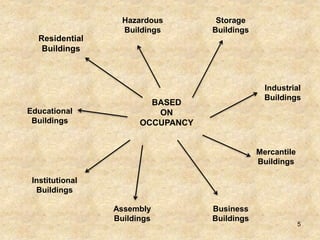
BASED
ON
OCCUPANCY
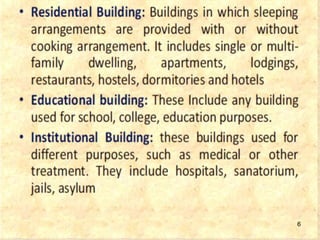
Residential
Buildings
Educational
Buildings
Institutional
Buildings
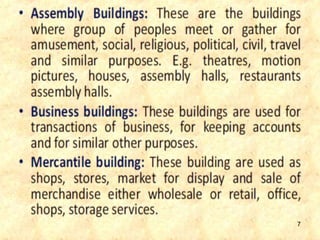
Assembly
Buildings
Business
Buildings
Mercantile
Buildings
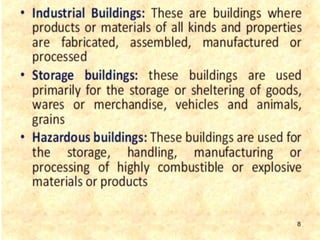
Industrial
Buildings
Storage
Buildings
Hazardous
Buildings
5
6
7
8
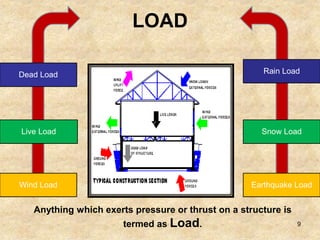
LOAD
Dead Load
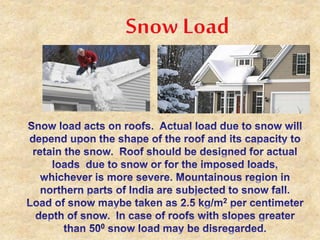
Live Load Snow Load
Rain Load
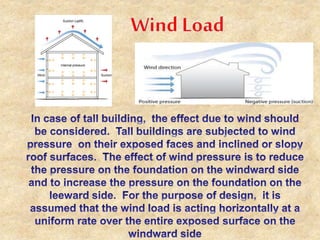
Wind Load Earthquake Load
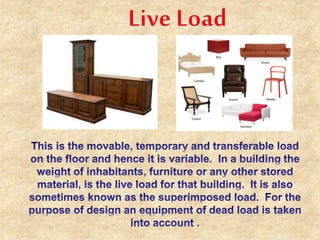
Anything which exerts pressure or thrust on a structure is
termed as Load. 9
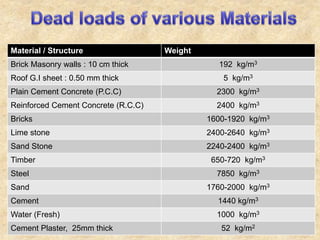
Material / Structure Weight
Brick Masonry walls : 10 cm thick 192 kg/m3
Roof G.I sheet : 0.50 mm thick 5 kg/m3
Plain Cement Concrete (P.C.C) 2300 kg/m3
Reinforced Cement Concrete (R.C.C) 2400 kg/m3
Bricks 1600-1920 kg/m3
Lime stone 2400-2640 kg/m3
Sand Stone 2240-2400 kg/m3
Timber 650-720 kg/m3
Steel 7850 kg/m3
Sand 1760-2000 kg/m3
Cement 1440 kg/m3
Water (Fresh) 1000 kg/m3
Cement Plaster, 25mm thick 52 kg/m2
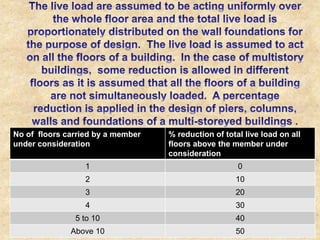
No of floors carried by a member
under consideration
% reduction of total live load on all
floors above the member under
consideration
1 0
2 10
3 20
4 30
5 to 10 40
Above 10 50
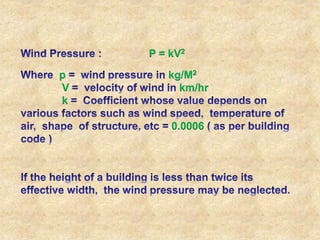
P = kV2
p kg/M2
V km/hr
k
0.0006
Building Construction
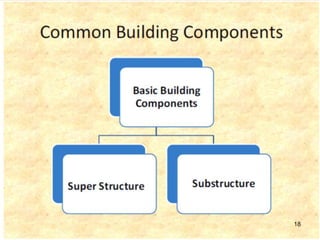
18
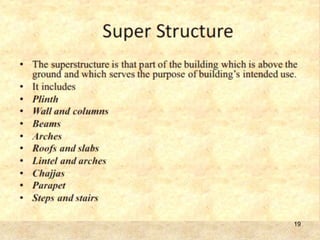
19
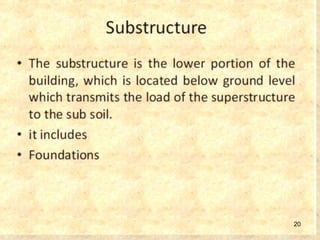
20
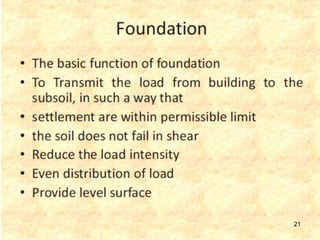
21
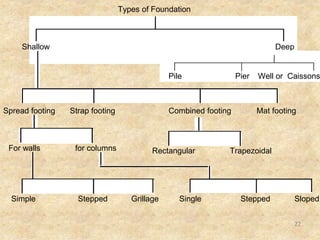
Types of Foundation
Shallow Deep
Pile Pier Well or Caissons
Spread footing Strap footing Combined footing Mat footing
For walls for columns Rectangular Trapezoidal
Simple Stepped Grillage Single Stepped Sloped
22
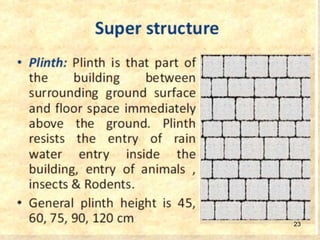
23
24
25
Doors and windows
• A door provides a connecting link between
rooms, allowing easy free movement in the
building. Window are opening provided in
walls. Doors and windows provide lighting and
ventilation. The provide resistance to weather,
sound
privacy
and heat. They provide security and
27
28
29
30
31
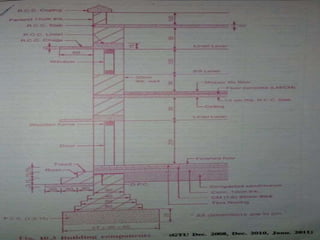
Building Components and their
Functions
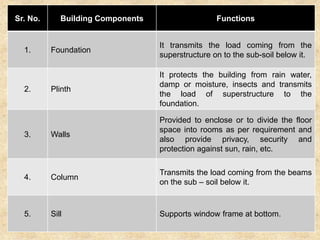
Sr. No. Building Components Functions
1. Foundation
It transmits the load coming from the
superstructure on to the sub-soil below it.
2. Plinth
It protects the building from rain water,
damp or moisture, insects and transmits
the load of superstructure to the
foundation.
3. Walls
Provided to enclose or to divide the floor
space into rooms as per requirement and
also provide privacy, security and
protection against sun, rain, etc.
4. Column
Transmits the load coming from the beams
on the sub – soil below it.
5. Sill Supports window frame at bottom.
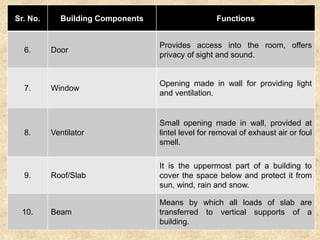
Sr. No. Building Components Functions
6. Door
Provides access into the room, offers
privacy of sight and sound.
7. Window
Opening made in wall for providing light
and ventilation.
8. Ventilator
Small opening made in wall, provided at
lintel level for removal of exhaust air or foul
smell.
9. Roof/Slab
It is the uppermost part of a building to
cover the space below and protect it from
sun, wind, rain and snow.
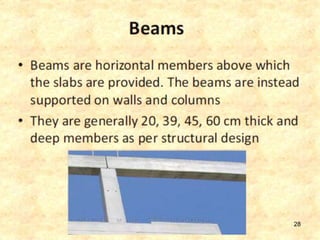
10. Beam
Means by which all loads of slab are
transferred to vertical supports of a
building.
Sr. No. Building Components Functions
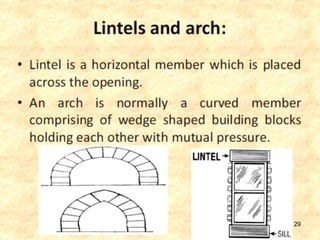
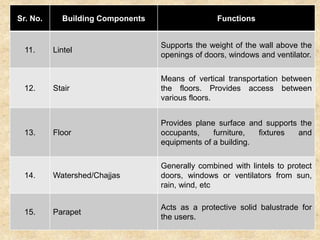
11. Lintel
Supports the weight of the wall above the
openings of doors, windows and ventilator.
12. Stair
Means of vertical transportation between
the floors. Provides access between
various floors.
13. Floor
Provides plane surface and supports the
occupants, furniture, fixtures and
equipments of a building.
14. Watershed/Chajjas
Generally combined with lintels to protect
doors, windows or ventilators from sun,
rain, wind, etc
15. Parapet
Acts as a protective solid balustrade for
the users.
Building Components and their
Nominal Dimensions
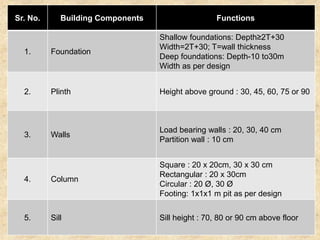
Sr. No. Building Components Functions
1. Foundation
Shallow foundations: Depth≥2T+30
Width=2T+30; T=wall thickness
Deep foundations: Depth-10 to30m
Width as per design
2. Plinth Height above ground : 30, 45, 60, 75 or 90
3. Walls
Load bearing walls : 20, 30, 40 cm
Partition wall : 10 cm
4. Column
Square : 20 x 20cm, 30 x 30 cm
Rectangular : 20 x 30cm
Circular : 20 Ø, 30 Ø
Footing: 1x1x1 m pit as per design
5. Sill Sill height : 70, 80 or 90 cm above floor
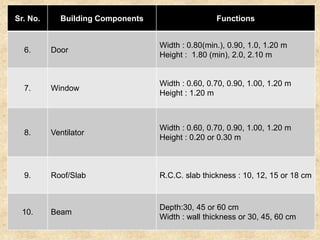
Sr. No. Building Components Functions
6. Door
Width : 0.80(min.), 0.90, 1.0, 1.20 m
Height : 1.80 (min), 2.0, 2.10 m
7. Window
Width : 0.60, 0.70, 0.90, 1.00, 1.20 m
Height : 1.20 m
8. Ventilator
Width : 0.60, 0.70, 0.90, 1.00, 1.20 m
Height : 0.20 or 0.30 m
9. Roof/Slab R.C.C. slab thickness : 10, 12, 15 or 18 cm
10. Beam
Depth:30, 45 or 60 cm
Width : wall thickness or 30, 45, 60 cm
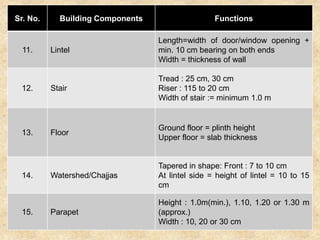
Sr. No. Building Components Functions
11. Lintel
Length=width of door/window opening +
min. 10 cm bearing on both ends
Width = thickness of wall
12. Stair
Tread : 25 cm, 30 cm
Riser : 115 to 20 cm
Width of stair := minimum 1.0 m
13. Floor
Ground floor = plinth height
Upper floor = slab thickness
14. Watershed/Chajjas
Tapered in shape: Front : 7 to 10 cm
At lintel side = height of lintel = 10 to 15
cm
15. Parapet
Height : 1.0m(min.), 1.10, 1.20 or 1.30 m
(approx.)
Width : 10, 20 or 30 cm
40

Chapter 1 introduction of building construction

  • 1.
  • 2.
    INTRODUCTION • Building constructionis an ancient human activity. It began with the purely functional need for a controlled environment to moderate the effects of climate. Constructed shelters were one means by which human beings were able to adapt themselves to a wide variety of climates and become a global species. 2
  • 3.
    The history ofcivil construction was began from the period of Primitive human. From the protection against cold, rain, heat, etc they made “cave” as their shelter. But that was not enough, cave didn’t remained safe for long, so huts from the straws and leaves…..evolution goes on…! But for better comfort, civil construction got evolved and still evolving… Today, we have every comfort and facility, but we have to face the future upcoming challenges as the shortage of land, etc 3
  • 4.
  • 5.
  • 6.
  • 7.
  • 8.
  • 9.
    LOAD Dead Load Live LoadSnow Load Rain Load Wind Load Earthquake Load Anything which exerts pressure or thrust on a structure is termed as Load. 9
  • 11.
    Material / StructureWeight Brick Masonry walls : 10 cm thick 192 kg/m3 Roof G.I sheet : 0.50 mm thick 5 kg/m3 Plain Cement Concrete (P.C.C) 2300 kg/m3 Reinforced Cement Concrete (R.C.C) 2400 kg/m3 Bricks 1600-1920 kg/m3 Lime stone 2400-2640 kg/m3 Sand Stone 2240-2400 kg/m3 Timber 650-720 kg/m3 Steel 7850 kg/m3 Sand 1760-2000 kg/m3 Cement 1440 kg/m3 Water (Fresh) 1000 kg/m3 Cement Plaster, 25mm thick 52 kg/m2
  • 13.
    No of floorscarried by a member under consideration % reduction of total live load on all floors above the member under consideration 1 0 2 10 3 20 4 30 5 to 10 40 Above 10 50
  • 15.
    P = kV2 pkg/M2 V km/hr k 0.0006
  • 18.
  • 19.
  • 20.
  • 21.
  • 22.
    Types of Foundation ShallowDeep Pile Pier Well or Caissons Spread footing Strap footing Combined footing Mat footing For walls for columns Rectangular Trapezoidal Simple Stepped Grillage Single Stepped Sloped 22
  • 23.
  • 24.
  • 25.
  • 26.
    Doors and windows •A door provides a connecting link between rooms, allowing easy free movement in the building. Window are opening provided in walls. Doors and windows provide lighting and ventilation. The provide resistance to weather, sound privacy and heat. They provide security and
  • 27.
  • 28.
  • 29.
  • 30.
  • 31.
  • 32.
    Building Components andtheir Functions
  • 33.
    Sr. No. BuildingComponents Functions 1. Foundation It transmits the load coming from the superstructure on to the sub-soil below it. 2. Plinth It protects the building from rain water, damp or moisture, insects and transmits the load of superstructure to the foundation. 3. Walls Provided to enclose or to divide the floor space into rooms as per requirement and also provide privacy, security and protection against sun, rain, etc. 4. Column Transmits the load coming from the beams on the sub – soil below it. 5. Sill Supports window frame at bottom.
  • 34.
    Sr. No. BuildingComponents Functions 6. Door Provides access into the room, offers privacy of sight and sound. 7. Window Opening made in wall for providing light and ventilation. 8. Ventilator Small opening made in wall, provided at lintel level for removal of exhaust air or foul smell. 9. Roof/Slab It is the uppermost part of a building to cover the space below and protect it from sun, wind, rain and snow. 10. Beam Means by which all loads of slab are transferred to vertical supports of a building.
  • 35.
    Sr. No. BuildingComponents Functions 11. Lintel Supports the weight of the wall above the openings of doors, windows and ventilator. 12. Stair Means of vertical transportation between the floors. Provides access between various floors. 13. Floor Provides plane surface and supports the occupants, furniture, fixtures and equipments of a building. 14. Watershed/Chajjas Generally combined with lintels to protect doors, windows or ventilators from sun, rain, wind, etc 15. Parapet Acts as a protective solid balustrade for the users.
  • 36.
    Building Components andtheir Nominal Dimensions
  • 37.
    Sr. No. BuildingComponents Functions 1. Foundation Shallow foundations: Depth≥2T+30 Width=2T+30; T=wall thickness Deep foundations: Depth-10 to30m Width as per design 2. Plinth Height above ground : 30, 45, 60, 75 or 90 3. Walls Load bearing walls : 20, 30, 40 cm Partition wall : 10 cm 4. Column Square : 20 x 20cm, 30 x 30 cm Rectangular : 20 x 30cm Circular : 20 Ø, 30 Ø Footing: 1x1x1 m pit as per design 5. Sill Sill height : 70, 80 or 90 cm above floor
  • 38.
    Sr. No. BuildingComponents Functions 6. Door Width : 0.80(min.), 0.90, 1.0, 1.20 m Height : 1.80 (min), 2.0, 2.10 m 7. Window Width : 0.60, 0.70, 0.90, 1.00, 1.20 m Height : 1.20 m 8. Ventilator Width : 0.60, 0.70, 0.90, 1.00, 1.20 m Height : 0.20 or 0.30 m 9. Roof/Slab R.C.C. slab thickness : 10, 12, 15 or 18 cm 10. Beam Depth:30, 45 or 60 cm Width : wall thickness or 30, 45, 60 cm
  • 39.
    Sr. No. BuildingComponents Functions 11. Lintel Length=width of door/window opening + min. 10 cm bearing on both ends Width = thickness of wall 12. Stair Tread : 25 cm, 30 cm Riser : 115 to 20 cm Width of stair := minimum 1.0 m 13. Floor Ground floor = plinth height Upper floor = slab thickness 14. Watershed/Chajjas Tapered in shape: Front : 7 to 10 cm At lintel side = height of lintel = 10 to 15 cm 15. Parapet Height : 1.0m(min.), 1.10, 1.20 or 1.30 m (approx.) Width : 10, 20 or 30 cm
  • 40.