Building Components
Prepared by: B.Dhanunjai
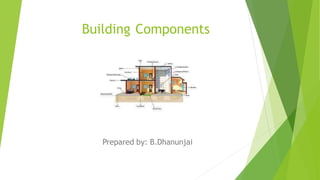
TYPES OF BULIDING COMPONENT
Roof
Parapet
Lintels
Beams
Columns
Damp proof course
(DPC)
Walls
WINDOWSANDDOOR
Floor
Stairs
Plinth Beam
Foundation
Plinth
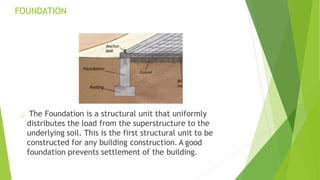
FOUNDATION
The Foundation is a structural unit that uniformly
distributes the load from the superstructure to the
underlying soil. This is the first structural unit to be
constructed for any building construction. A good
foundation prevents settlement of the building.
PLINTH BEAM
Plinth beam is a beam structure constructed either at or
above the ground level to take up the load of the wall
coming over it.
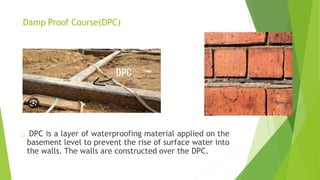
Damp Proof Course(DPC)
DPC is a layer of waterproofing material applied on the
basement level to prevent the rise of surface water into
the walls. The walls are constructed over the DPC.
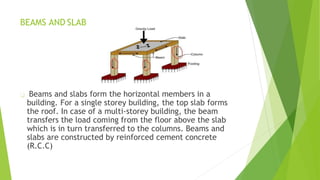
BEAMS AND SLAB
Beams and slabs form the horizontal members in a
building. For a single storey building, the top slab forms
the roof. In case of a multi-storey building, the beam
transfers the load coming from the floor above the slab
which is in turn transferred to the columns. Beams and
slabs are constructed by reinforced cement concrete
(R.C.C)
COLUMNS
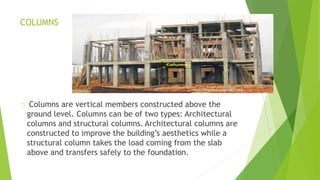
Columns are vertical members constructed above the
ground level. Columns can be of two types: Architectural
columns and structural columns. Architectural columns are
constructed to improve the building’s aesthetics while a
structural column takes the load coming from the slab
above and transfers safely to the foundation.
WALLS
Walls are vertical elements which support the roof. It can
be made from stones, bricks, concrete blocks, etc. Walls
provide an enclosure and protect against wind, sunshine,
rain etc. Openings are provided in the walls for ventilation
and access to the building.
LINTELS
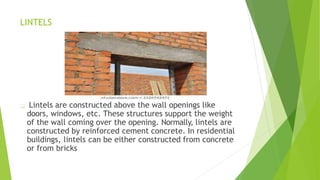
Lintels are constructed above the wall openings like
doors, windows, etc. These structures support the weight
of the wall coming over the opening. Normally, lintels are
constructed by reinforced cement concrete. In residential
buildings, lintels can be either constructed from concrete
or from bricks
ROOF
The roof forms the topmost component of a building
structure. It covers the top face of the building. Roofs can
be either flat or sloped based on the location and weather
conditions of the area.
PARAPETS
Parapets are short walls extended above the roofslab.
Parapets are installed for flat roofs. It acts as a safety wall
for people using the roof.
WINDOWS AND DOORS
A window is an opening in a wall, door
, roof or vehicle that
allows the passage of light, sound, and sometimes air. ...
In the 19th century American west, greased paper windows
came to be used by itinerant groups.
A door in a wall is a way of overcoming that limit, a way
out of the place confined by the walls. The walls here
symbolize the physical universe.
FLOORS
The floor is the surface laid on the plinth level. Flooring
can be done by a variety of materials like tiles, granites,
marbles, concrete, etc. Before flooring, the ground has to
be properly compacted and leveled.
STAIRS
A stair is a sequence of steps that connects different
floors in a building structure. The space occupied by a stair
is called as the stairway. There are different types of
stairs like a wooden stair
, R.C.C stair etc.

building components bce.pptx

  • 1.
  • 2.
    TYPES OF BULIDINGCOMPONENT Roof Parapet Lintels Beams Columns Damp proof course (DPC) Walls WINDOWSANDDOOR Floor Stairs Plinth Beam Foundation Plinth
  • 3.
    FOUNDATION The Foundation isa structural unit that uniformly distributes the load from the superstructure to the underlying soil. This is the first structural unit to be constructed for any building construction. A good foundation prevents settlement of the building.
  • 5.
    PLINTH BEAM Plinth beamis a beam structure constructed either at or above the ground level to take up the load of the wall coming over it.
  • 6.
    Damp Proof Course(DPC) DPCis a layer of waterproofing material applied on the basement level to prevent the rise of surface water into the walls. The walls are constructed over the DPC.
  • 7.
    BEAMS AND SLAB Beamsand slabs form the horizontal members in a building. For a single storey building, the top slab forms the roof. In case of a multi-storey building, the beam transfers the load coming from the floor above the slab which is in turn transferred to the columns. Beams and slabs are constructed by reinforced cement concrete (R.C.C)
  • 8.
    COLUMNS Columns are verticalmembers constructed above the ground level. Columns can be of two types: Architectural columns and structural columns. Architectural columns are constructed to improve the building’s aesthetics while a structural column takes the load coming from the slab above and transfers safely to the foundation.
  • 9.
    WALLS Walls are verticalelements which support the roof. It can be made from stones, bricks, concrete blocks, etc. Walls provide an enclosure and protect against wind, sunshine, rain etc. Openings are provided in the walls for ventilation and access to the building.
  • 10.
    LINTELS Lintels are constructedabove the wall openings like doors, windows, etc. These structures support the weight of the wall coming over the opening. Normally, lintels are constructed by reinforced cement concrete. In residential buildings, lintels can be either constructed from concrete or from bricks
  • 11.
    ROOF The roof formsthe topmost component of a building structure. It covers the top face of the building. Roofs can be either flat or sloped based on the location and weather conditions of the area.
  • 12.
    PARAPETS Parapets are shortwalls extended above the roofslab. Parapets are installed for flat roofs. It acts as a safety wall for people using the roof.
  • 13.
    WINDOWS AND DOORS Awindow is an opening in a wall, door , roof or vehicle that allows the passage of light, sound, and sometimes air. ... In the 19th century American west, greased paper windows came to be used by itinerant groups. A door in a wall is a way of overcoming that limit, a way out of the place confined by the walls. The walls here symbolize the physical universe.
  • 14.
    FLOORS The floor isthe surface laid on the plinth level. Flooring can be done by a variety of materials like tiles, granites, marbles, concrete, etc. Before flooring, the ground has to be properly compacted and leveled.
  • 15.
    STAIRS A stair isa sequence of steps that connects different floors in a building structure. The space occupied by a stair is called as the stairway. There are different types of stairs like a wooden stair , R.C.C stair etc.