SEMINAR
Superstructure
Presented by:
Rutwik Anil Ghadage
S.Y B-Tech
Civil Engineering Department
Guidance Facility : Mrs. A. S. Pawar
Jaywant College of Engineering &
Polytechnic,K.M.Gad
 Introduction:
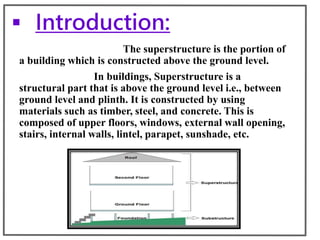
The superstructure is the portion of
a building which is constructed above the ground level.
In buildings, Superstructure is a
structural part that is above the ground level i.e., between
ground level and plinth. It is constructed by using
materials such as timber, steel, and concrete. This is
composed of upper floors, windows, external wall opening,
stairs, internal walls, lintel, parapet, sunshade, etc.
 Mentioned below are the basic components a
building’s superstructure:
1)Slab
2)Beams
3)Columns
4)Walls
5)Floor
6)Stair
7)Door
8)Window
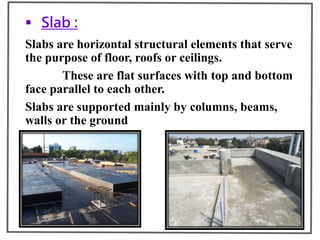
 Slab :
Slabs are horizontal structural elements that serve
the purpose of floor, roofs or ceilings.
These are flat surfaces with top and bottom
face parallel to each other.
Slabs are supported mainly by columns, beams,
walls or the ground
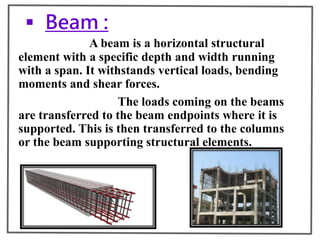
 Beam :
A beam is a horizontal structural
element with a specific depth and width running
with a span. It withstands vertical loads, bending
moments and shear forces.
The loads coming on the beams
are transferred to the beam endpoints where it is
supported. This is then transferred to the columns
or the beam supporting structural elements.
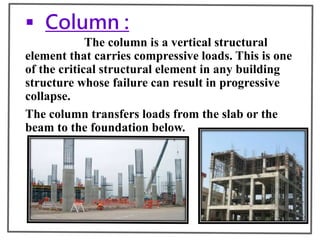
 Column :
The column is a vertical structural
element that carries compressive loads. This is one
of the critical structural element in any building
structure whose failure can result in progressive
collapse.
The column transfers loads from the slab or the
beam to the foundation below.
 ACCORDING TO A LENGTH:
1)SHORT COLUMNS:
• A column said to be short when its length is such
that the lateral buckling need not be considered.
• When the ratio of the effective length to the least
lateral dimensions of the column is less than the
12, then it is called a short column.
2) Long column :
When the ratio of the effective length to the least.
radius of gyration is greater than 45, then it is known as a
long column.
The load-carrying capacity of the long column is less than
the short columns.
Its load-carrying capacity depends on the slenderness ratio
(if the slenderness ratio of column increases than the load-
carrying capacity of column decreases).
When the length of the column is such that the buckling
need to be considered, and the column is referred to as a
slender column.
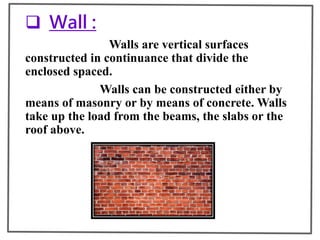
 Wall :
Walls are vertical surfaces
constructed in continuance that divide the
enclosed spaced.
Walls can be constructed either by
means of masonry or by means of concrete. Walls
take up the load from the beams, the slabs or the
roof above.
 Types of Walls :
1. Load Bearing Wall
a) Precast Concrete Wall
b)Retaining Wall
c)Masonry Wall
d)Stone Wall
2. Non Load Bearing Wall
a) Hollow Concrete Block
b) Hollow Bricks
c) Brick Wall
3. Cavity Walls
4. Shear Wall
5. Partition Wall
6. Panel Wall
7. Veneered Walls
8. Faced Wall
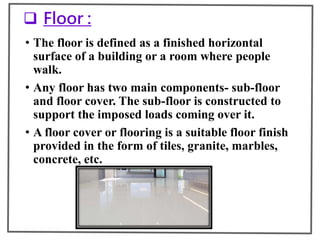
 Floor :
• The floor is defined as a finished horizontal
surface of a building or a room where people
walk.
• Any floor has two main components- sub-floor
and floor cover. The sub-floor is constructed to
support the imposed loads coming over it.
• A floor cover or flooring is a suitable floor finish
provided in the form of tiles, granite, marbles,
concrete, etc.
Types of flooring :
1. Carpet flooring
2. Tile flooring
3. Laminate flooring
4. Hardwood flooring
5. Marble flooring
6. vinyl flooring
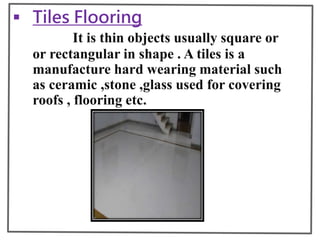
 Tiles Flooring
It is thin objects usually square or
or rectangular in shape . A tiles is a
manufacture hard wearing material such
as ceramic ,stone ,glass used for covering
roofs , flooring etc.
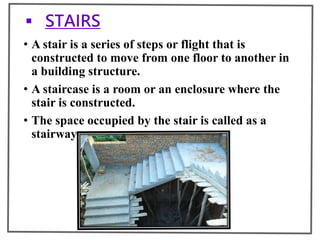
 STAIRS
• A stair is a series of steps or flight that is
constructed to move from one floor to another in
a building structure.
• A staircase is a room or an enclosure where the
stair is constructed.
• The space occupied by the stair is called as a
stairway
 Types of Staircase :
1. Straight stairs
2. Turning stairs
3. Quarter turn stairs
4. Half turn stairs
5. Three quarter turn stairs
6. Bifurcated stairs
7. Continuous stairs
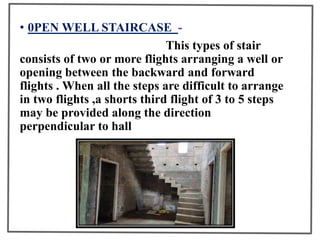
• 0PEN WELL STAIRCASE -
This types of stair
consists of two or more flights arranging a well or
opening between the backward and forward
flights . When all the steps are difficult to arrange
in two flights ,a shorts third flight of 3 to 5 steps
may be provided along the direction
perpendicular to hall
 Door :
• A door is a hinged or otherwise movable barrier
that allows ingress into and egress from an
enclosure.
• The created opening in the wall is a doorway or
portal. A door's essential and primary purpose is
to provide security by controlling access to the
doorway.
Types of Doors Used in Building
Construction
1. Battened and Ledged Doors
2. Battened, Ledged and Braced Doors
3. Battened, Ledged and Framed Doors
4. Battened, Ledged, Braced and Framed Doors
5. Glazed Doors
6.. Flush Doors
a) Solid Core or Laminated Core Flush Door
b) Hollow core and cellular core flush door
7.Panelled Doors
8. Revolving Doors
9. Sliding Doors
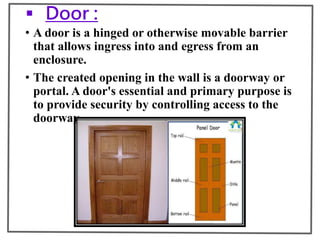
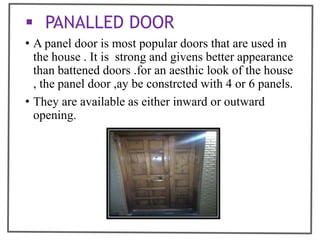
 PANALLED DOOR
• A panel door is most popular doors that are used in
the house . It is strong and givens better appearance
than battened doors .for an aesthic look of the house
, the panel door ,ay be constrcted with 4 or 6 panels.
• They are available as either inward or outward
opening.
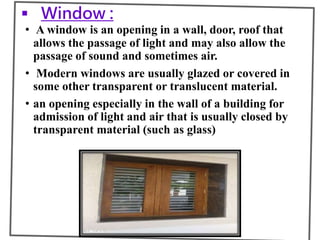
 Window :
• A window is an opening in a wall, door, roof that
allows the passage of light and may also allow the
passage of sound and sometimes air.
• Modern windows are usually glazed or covered in
some other transparent or translucent material.
• an opening especially in the wall of a building for
admission of light and air that is usually closed by
transparent material (such as glass)
Common Types of Windows :
1)Double-Hung and Single-Hung Windows
2)Casement Windows
3)Bay Windows
4)Slider Windows
5)Transom Windows
 SLIDING WINDOW
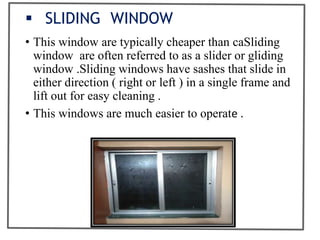
• This window are typically cheaper than caSliding
window are often referred to as a slider or gliding
window .Sliding windows have sashes that slide in
either direction ( right or left ) in a single frame and
lift out for easy cleaning .
• This windows are much easier to operate .
ELECTRIFICATION
Electrification is the process of powering by
electricity and, in many contexts, the introduction
of such power by changing over from an earlier
power source. The broad meaning of the term, such
as in the history of technology, economic history,
and economic development, usually applies to a
region or national economy.
PLUMBING
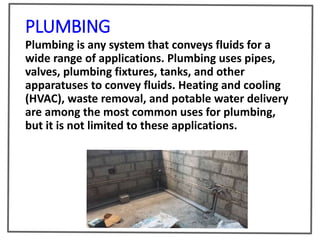
Plumbing is any system that conveys fluids for a
wide range of applications. Plumbing uses pipes,
valves, plumbing fixtures, tanks, and other
apparatuses to convey fluids. Heating and cooling
(HVAC), waste removal, and potable water delivery
are among the most common uses for plumbing,
but it is not limited to these applications.
120222 - Seminar on Superstructure.pptx

120222 - Seminar on Superstructure.pptx

  • 1.
    SEMINAR Superstructure Presented by: Rutwik AnilGhadage S.Y B-Tech Civil Engineering Department Guidance Facility : Mrs. A. S. Pawar Jaywant College of Engineering & Polytechnic,K.M.Gad
  • 2.
     Introduction: The superstructureis the portion of a building which is constructed above the ground level. In buildings, Superstructure is a structural part that is above the ground level i.e., between ground level and plinth. It is constructed by using materials such as timber, steel, and concrete. This is composed of upper floors, windows, external wall opening, stairs, internal walls, lintel, parapet, sunshade, etc.
  • 3.
     Mentioned beloware the basic components a building’s superstructure: 1)Slab 2)Beams 3)Columns 4)Walls 5)Floor 6)Stair 7)Door 8)Window
  • 4.
     Slab : Slabsare horizontal structural elements that serve the purpose of floor, roofs or ceilings. These are flat surfaces with top and bottom face parallel to each other. Slabs are supported mainly by columns, beams, walls or the ground
  • 6.
     Beam : Abeam is a horizontal structural element with a specific depth and width running with a span. It withstands vertical loads, bending moments and shear forces. The loads coming on the beams are transferred to the beam endpoints where it is supported. This is then transferred to the columns or the beam supporting structural elements.
  • 8.
     Column : Thecolumn is a vertical structural element that carries compressive loads. This is one of the critical structural element in any building structure whose failure can result in progressive collapse. The column transfers loads from the slab or the beam to the foundation below.
  • 9.
     ACCORDING TOA LENGTH: 1)SHORT COLUMNS: • A column said to be short when its length is such that the lateral buckling need not be considered. • When the ratio of the effective length to the least lateral dimensions of the column is less than the 12, then it is called a short column.
  • 10.
    2) Long column: When the ratio of the effective length to the least. radius of gyration is greater than 45, then it is known as a long column. The load-carrying capacity of the long column is less than the short columns. Its load-carrying capacity depends on the slenderness ratio (if the slenderness ratio of column increases than the load- carrying capacity of column decreases). When the length of the column is such that the buckling need to be considered, and the column is referred to as a slender column.
  • 11.
     Wall : Wallsare vertical surfaces constructed in continuance that divide the enclosed spaced. Walls can be constructed either by means of masonry or by means of concrete. Walls take up the load from the beams, the slabs or the roof above.
  • 12.
     Types ofWalls : 1. Load Bearing Wall a) Precast Concrete Wall b)Retaining Wall c)Masonry Wall d)Stone Wall 2. Non Load Bearing Wall a) Hollow Concrete Block b) Hollow Bricks c) Brick Wall 3. Cavity Walls 4. Shear Wall 5. Partition Wall 6. Panel Wall 7. Veneered Walls 8. Faced Wall
  • 13.
     Floor : •The floor is defined as a finished horizontal surface of a building or a room where people walk. • Any floor has two main components- sub-floor and floor cover. The sub-floor is constructed to support the imposed loads coming over it. • A floor cover or flooring is a suitable floor finish provided in the form of tiles, granite, marbles, concrete, etc.
  • 14.
    Types of flooring: 1. Carpet flooring 2. Tile flooring 3. Laminate flooring 4. Hardwood flooring 5. Marble flooring 6. vinyl flooring
  • 15.
     Tiles Flooring Itis thin objects usually square or or rectangular in shape . A tiles is a manufacture hard wearing material such as ceramic ,stone ,glass used for covering roofs , flooring etc.
  • 16.
     STAIRS • Astair is a series of steps or flight that is constructed to move from one floor to another in a building structure. • A staircase is a room or an enclosure where the stair is constructed. • The space occupied by the stair is called as a stairway
  • 17.
     Types ofStaircase : 1. Straight stairs 2. Turning stairs 3. Quarter turn stairs 4. Half turn stairs 5. Three quarter turn stairs 6. Bifurcated stairs 7. Continuous stairs
  • 18.
    • 0PEN WELLSTAIRCASE - This types of stair consists of two or more flights arranging a well or opening between the backward and forward flights . When all the steps are difficult to arrange in two flights ,a shorts third flight of 3 to 5 steps may be provided along the direction perpendicular to hall
  • 19.
     Door : •A door is a hinged or otherwise movable barrier that allows ingress into and egress from an enclosure. • The created opening in the wall is a doorway or portal. A door's essential and primary purpose is to provide security by controlling access to the doorway.
  • 20.
    Types of DoorsUsed in Building Construction 1. Battened and Ledged Doors 2. Battened, Ledged and Braced Doors 3. Battened, Ledged and Framed Doors 4. Battened, Ledged, Braced and Framed Doors 5. Glazed Doors 6.. Flush Doors a) Solid Core or Laminated Core Flush Door b) Hollow core and cellular core flush door 7.Panelled Doors 8. Revolving Doors 9. Sliding Doors
  • 21.
     PANALLED DOOR •A panel door is most popular doors that are used in the house . It is strong and givens better appearance than battened doors .for an aesthic look of the house , the panel door ,ay be constrcted with 4 or 6 panels. • They are available as either inward or outward opening.
  • 22.
     Window : •A window is an opening in a wall, door, roof that allows the passage of light and may also allow the passage of sound and sometimes air. • Modern windows are usually glazed or covered in some other transparent or translucent material. • an opening especially in the wall of a building for admission of light and air that is usually closed by transparent material (such as glass)
  • 23.
    Common Types ofWindows : 1)Double-Hung and Single-Hung Windows 2)Casement Windows 3)Bay Windows 4)Slider Windows 5)Transom Windows
  • 24.
     SLIDING WINDOW •This window are typically cheaper than caSliding window are often referred to as a slider or gliding window .Sliding windows have sashes that slide in either direction ( right or left ) in a single frame and lift out for easy cleaning . • This windows are much easier to operate .
  • 25.
    ELECTRIFICATION Electrification is theprocess of powering by electricity and, in many contexts, the introduction of such power by changing over from an earlier power source. The broad meaning of the term, such as in the history of technology, economic history, and economic development, usually applies to a region or national economy.
  • 26.
    PLUMBING Plumbing is anysystem that conveys fluids for a wide range of applications. Plumbing uses pipes, valves, plumbing fixtures, tanks, and other apparatuses to convey fluids. Heating and cooling (HVAC), waste removal, and potable water delivery are among the most common uses for plumbing, but it is not limited to these applications.