ROBOTS
What is a robot?
A robot is a machine designed to
execute one or more tasks repeatedly,
with speed and precision.
Different types of robots?
There are as many different types of
robots as there are tasks for them to
perform.
In The Next Few
Slides We Will
Show Some
Different Types Of
Robots
Industry robots make cars
and other consumer and
business products.
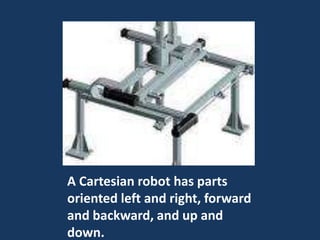
A Cartesian robot has parts
oriented left and right, forward
and backward, and up and
down.
A cylindrical robot is a robot
whose movement traces a
cylinder outline.
A polar robot's movement traces a sphere in
the air. One type of robot operates remotely
but is controlled from another location. The
Mars rovers, armed drones and underwater
explorer vehicles are examples.
The Scribbler is a fully programmable, intelligent
robot with multiple sensor systems that let it
interact with people and objects. It navigates on
its own as it explores its surroundings, and then
reports back about what it senses using light and
sound.
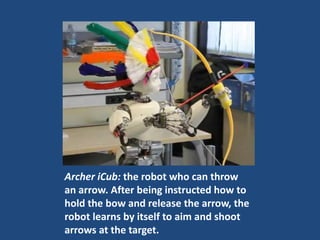
Archer iCub: the robot who can throw
an arrow. After being instructed how to
hold the bow and release the arrow, the
robot learns by itself to aim and shoot
arrows at the target.
Big Dog: the military pack robotic
animal. The robot is capable of carrying
over 300 lbs of cargo and would seem
to be useful for army missions,
planetary exploration, and several other
situations.
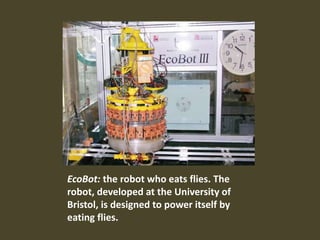
EcoBot: the robot who eats flies. The
robot, developed at the University of
Bristol, is designed to power itself by
eating flies.
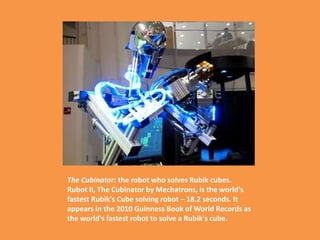
The Cubinator: the robot who solves Rubik cubes.
Rubot II, The Cubinator by Mechatrons, is the world's
fastest Rubik's Cube solving robot – 18.2 seconds. It
appears in the 2010 Guinness Book of World Records as
the world's fastest robot to solve a Rubik's cube.
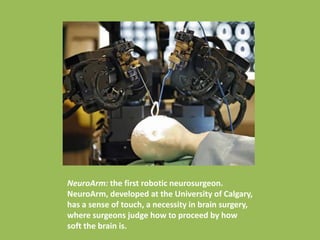
NeuroArm: the first robotic neurosurgeon.
NeuroArm, developed at the University of Calgary,
has a sense of touch, a necessity in brain surgery,
where surgeons judge how to proceed by how
soft the brain is.
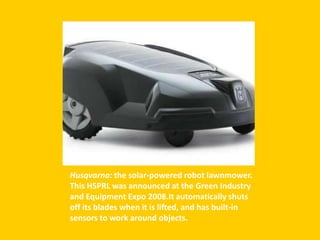
Husqvarna: the solar-powered robot lawnmower.
This HSPRL was announced at the Green Industry
and Equipment Expo 2008.It automatically shuts
off its blades when it is lifted, and has built-in
sensors to work around objects.
Panasonic Hair-Washing: the robot who washes and rinses
your hair. Designed for Japan's growing elderly and bedridden
population, the device consists of a reclining chair and a
computerized washbasin. The machine incorporates robot
hand technology, with 16 mechatronic magic fingers that rinse
and wash hair. It also remembers each user's individual data,
such as head shape and massage preferences.
Shirt Folding Robot: the DIY Lego folding machine.This
LEGO ‘bot is interesting in that all you have to do is
place your t-shirt on the flat cardboard box and hit a
button. The robot then flips the flaps of the box and
perfectly folds the shirt.
Uses of robots
Robots can be found in the manufacturing
industry, the military, space exploration,
transportation, and medical applications.
1.a) Industrial robots are widely used for
manufacturing stuff, faster and with more
more quality control .
b)Typical industrial robots do jobs that are
difficult, dangerous or dull. They lift heavy
objects, paint, handle chemicals, and perform
assembly work.
c)They don't get tired and they don't make errors
associated with fatigue and so are ideally
suited to performing repetitive tasks.
Uses of robots
2.a)Military and police organizations use robots to assist in
dangerous situations. Robots are being used to search for
and defuse bombs , land mine detection.
b) They could also be used to investigate a car with hostile
occupants.
c)They've worked as part of military checkpoints.
3. Human space travel beyond the moon provides other
challenges. Scientists are grappling with ways to protect
humans once they leave the Earth's magnetic belt. Robots
could operate in this area.
Uses of robots
4) Robots are helping doctors in surgeries that,
among other things, can equalize little jiggles
and movements of a surgeon's hands when
doing delicate procedures, such as
microscopically aided surgery or brain surgery,
etc.
You Guys Have Seen That
Robots Are Used Almost
Everywhere And In Every
Field. So This Is The End Of
This Presentation. I Hope
You Liked It.
THE END
BY: Rithik Kapoor

Robots Uses, Pictures, Types and More

  • 1.
    ROBOTS What is arobot? A robot is a machine designed to execute one or more tasks repeatedly, with speed and precision. Different types of robots? There are as many different types of robots as there are tasks for them to perform.
  • 2.
    In The NextFew Slides We Will Show Some Different Types Of Robots
  • 3.
    Industry robots makecars and other consumer and business products.
  • 4.
    A Cartesian robothas parts oriented left and right, forward and backward, and up and down.
  • 5.
    A cylindrical robotis a robot whose movement traces a cylinder outline.
  • 6.
    A polar robot'smovement traces a sphere in the air. One type of robot operates remotely but is controlled from another location. The Mars rovers, armed drones and underwater explorer vehicles are examples.
  • 7.
    The Scribbler isa fully programmable, intelligent robot with multiple sensor systems that let it interact with people and objects. It navigates on its own as it explores its surroundings, and then reports back about what it senses using light and sound.
  • 8.
    Archer iCub: therobot who can throw an arrow. After being instructed how to hold the bow and release the arrow, the robot learns by itself to aim and shoot arrows at the target.
  • 9.
    Big Dog: themilitary pack robotic animal. The robot is capable of carrying over 300 lbs of cargo and would seem to be useful for army missions, planetary exploration, and several other situations.
  • 10.
    EcoBot: the robotwho eats flies. The robot, developed at the University of Bristol, is designed to power itself by eating flies.
  • 11.
    The Cubinator: therobot who solves Rubik cubes. Rubot II, The Cubinator by Mechatrons, is the world's fastest Rubik's Cube solving robot – 18.2 seconds. It appears in the 2010 Guinness Book of World Records as the world's fastest robot to solve a Rubik's cube.
  • 12.
    NeuroArm: the firstrobotic neurosurgeon. NeuroArm, developed at the University of Calgary, has a sense of touch, a necessity in brain surgery, where surgeons judge how to proceed by how soft the brain is.
  • 13.
    Husqvarna: the solar-poweredrobot lawnmower. This HSPRL was announced at the Green Industry and Equipment Expo 2008.It automatically shuts off its blades when it is lifted, and has built-in sensors to work around objects.
  • 14.
    Panasonic Hair-Washing: therobot who washes and rinses your hair. Designed for Japan's growing elderly and bedridden population, the device consists of a reclining chair and a computerized washbasin. The machine incorporates robot hand technology, with 16 mechatronic magic fingers that rinse and wash hair. It also remembers each user's individual data, such as head shape and massage preferences.
  • 15.
    Shirt Folding Robot:the DIY Lego folding machine.This LEGO ‘bot is interesting in that all you have to do is place your t-shirt on the flat cardboard box and hit a button. The robot then flips the flaps of the box and perfectly folds the shirt.
  • 16.
    Uses of robots Robotscan be found in the manufacturing industry, the military, space exploration, transportation, and medical applications. 1.a) Industrial robots are widely used for manufacturing stuff, faster and with more more quality control . b)Typical industrial robots do jobs that are difficult, dangerous or dull. They lift heavy objects, paint, handle chemicals, and perform assembly work. c)They don't get tired and they don't make errors associated with fatigue and so are ideally suited to performing repetitive tasks.
  • 17.
    Uses of robots 2.a)Militaryand police organizations use robots to assist in dangerous situations. Robots are being used to search for and defuse bombs , land mine detection. b) They could also be used to investigate a car with hostile occupants. c)They've worked as part of military checkpoints. 3. Human space travel beyond the moon provides other challenges. Scientists are grappling with ways to protect humans once they leave the Earth's magnetic belt. Robots could operate in this area.
  • 18.
    Uses of robots 4)Robots are helping doctors in surgeries that, among other things, can equalize little jiggles and movements of a surgeon's hands when doing delicate procedures, such as microscopically aided surgery or brain surgery, etc.
  • 19.
    You Guys HaveSeen That Robots Are Used Almost Everywhere And In Every Field. So This Is The End Of This Presentation. I Hope You Liked It.
  • 20.