AGV
• What is AGV?
• AGV System
• Types Of AGV
• Types of navigations
in AGV’s
• Safety And Functions
Of AGV
• Why consider AGV’s
?
• Applications of AGV’s
AS/RS
• What Is AS/RS ?
• Objectives Of AS/RS
• Types Of AS/RS
• Components Of
AS/RS
• Application Of
AS/RS
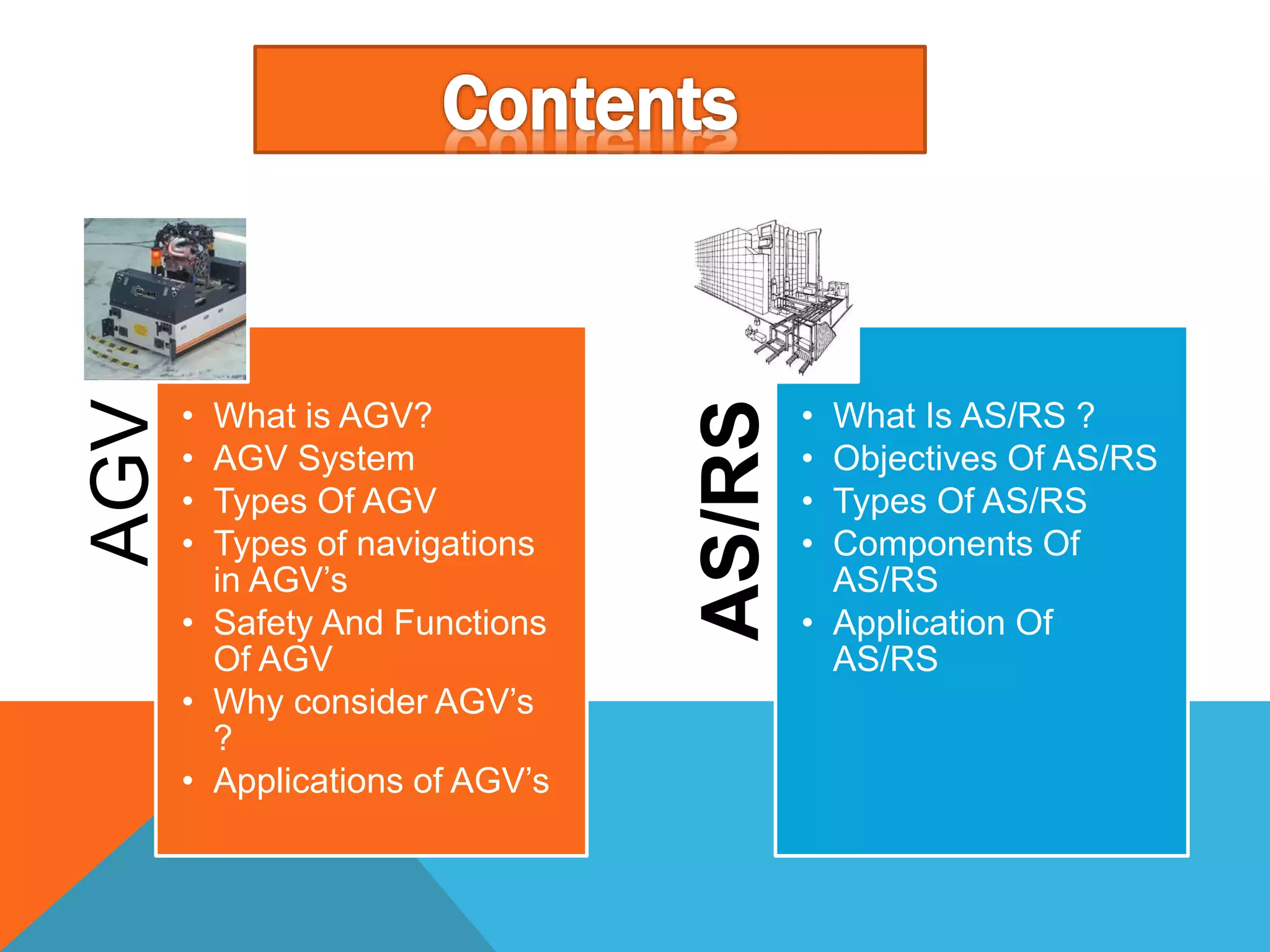
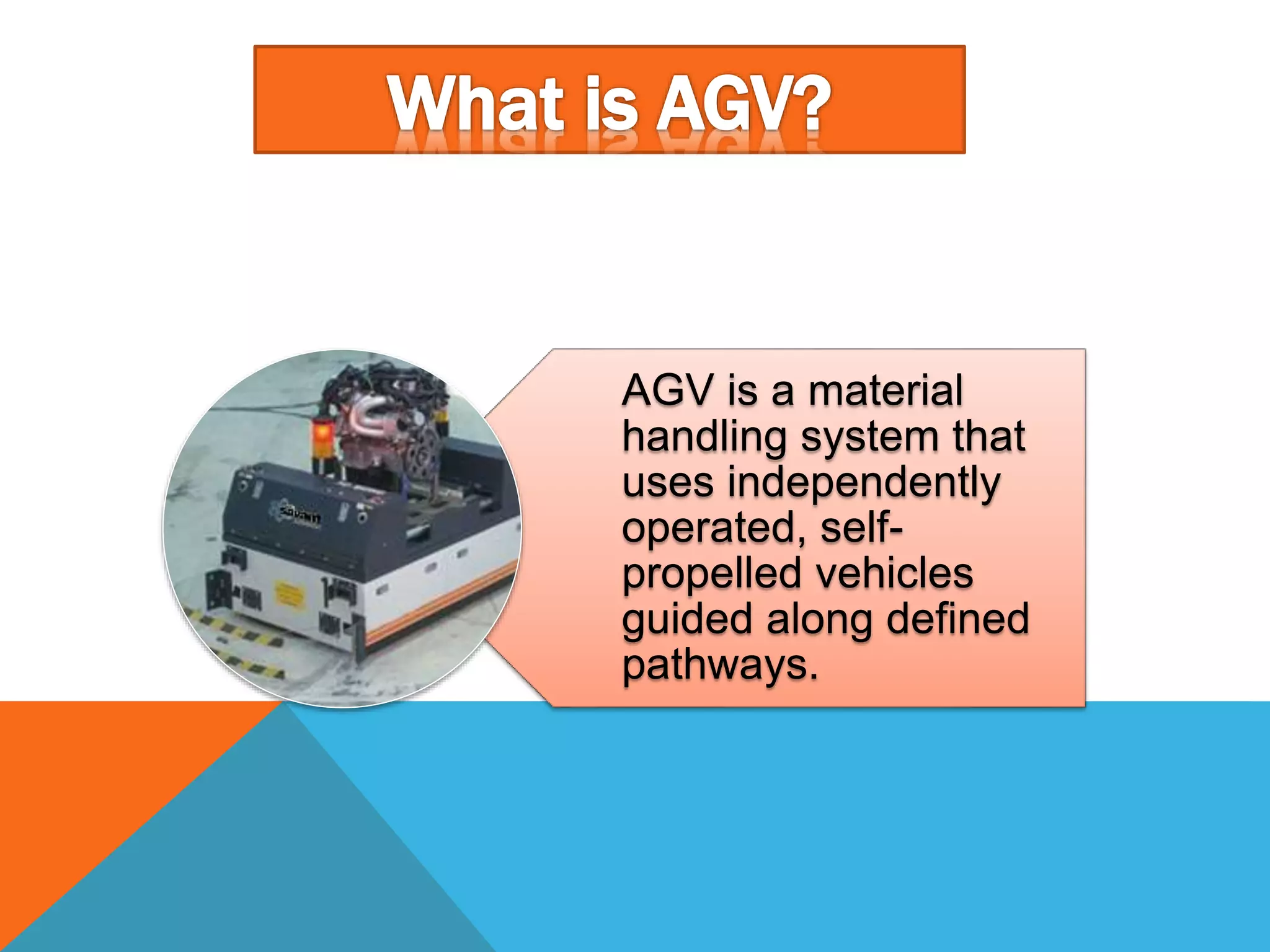
AGV is a material
handling system that
uses independently
operated, self-
propelled vehicles
guided along defined
pathways.
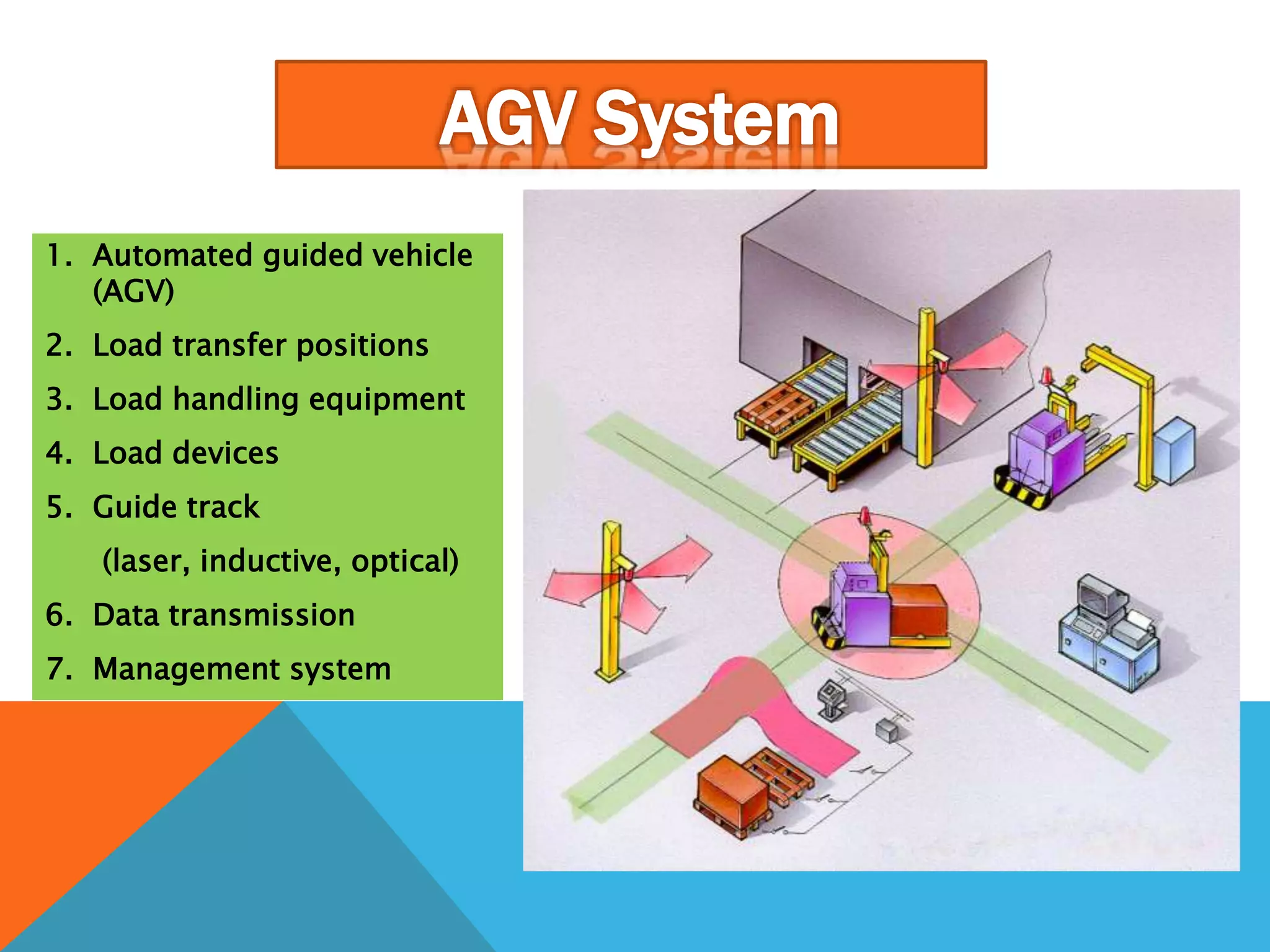
1. Automated guided vehicle
(AGV)
2. Load transfer positions
3. Load handling equipment
4. Load devices
5. Guide track
(laser, inductive, optical)
6. Data transmission
7. Management system
1
2
2
3 4
5
5
6
6
6
7
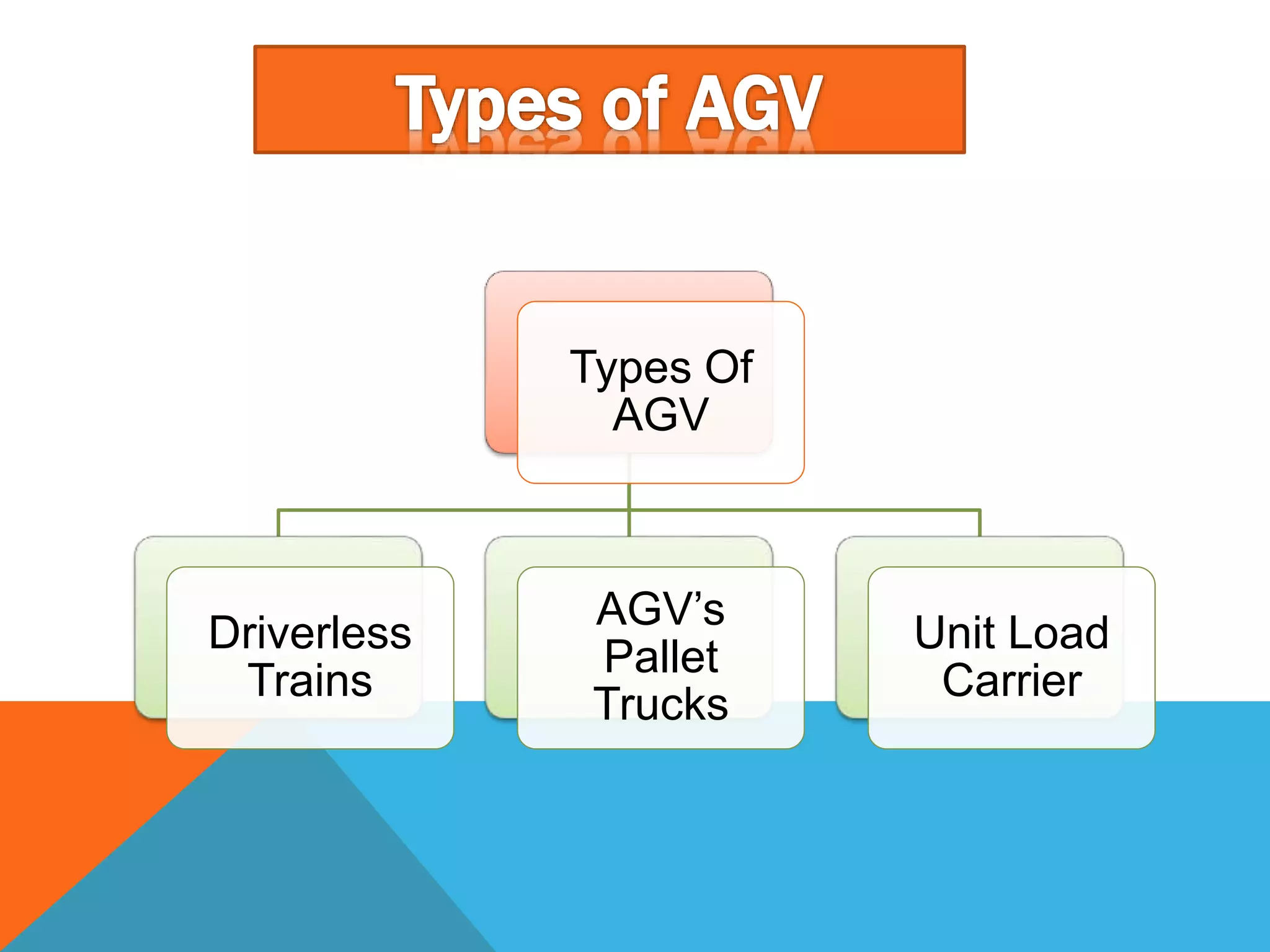
Types Of
AGV
Driverless
Trains
AGV’s
Pallet
Trucks
Unit Load
Carrier
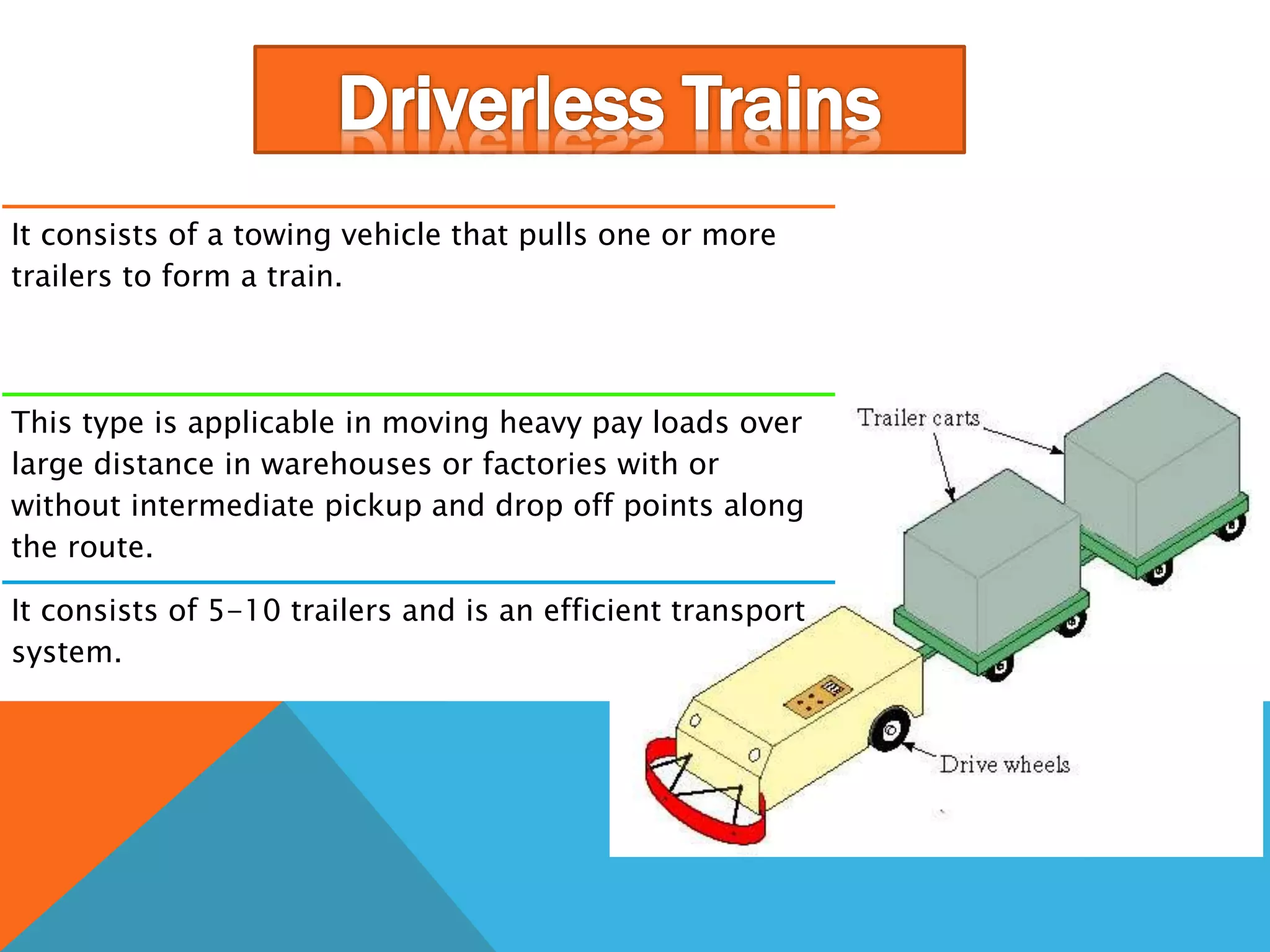
It consists of a towing vehicle that pulls one or more
trailers to form a train.
This type is applicable in moving heavy pay loads over
large distance in warehouses or factories with or
without intermediate pickup and drop off points along
the route.
It consists of 5-10 trailers and is an efficient transport
system.
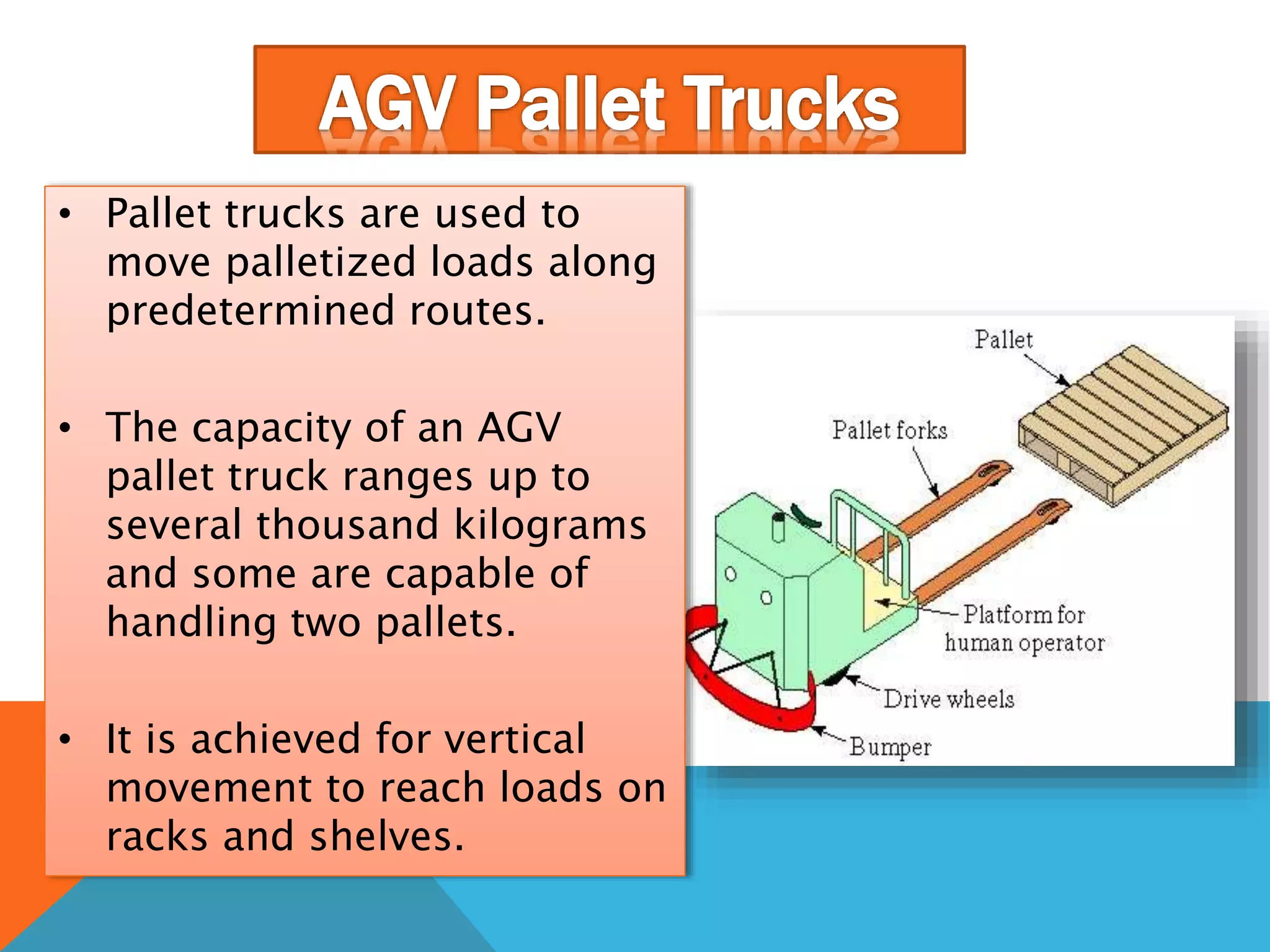
• Pallet trucks are used to
move palletized loads along
predetermined routes.
• The capacity of an AGV
pallet truck ranges up to
several thousand kilograms
and some are capable of
handling two pallets.
• It is achieved for vertical
movement to reach loads on
racks and shelves.
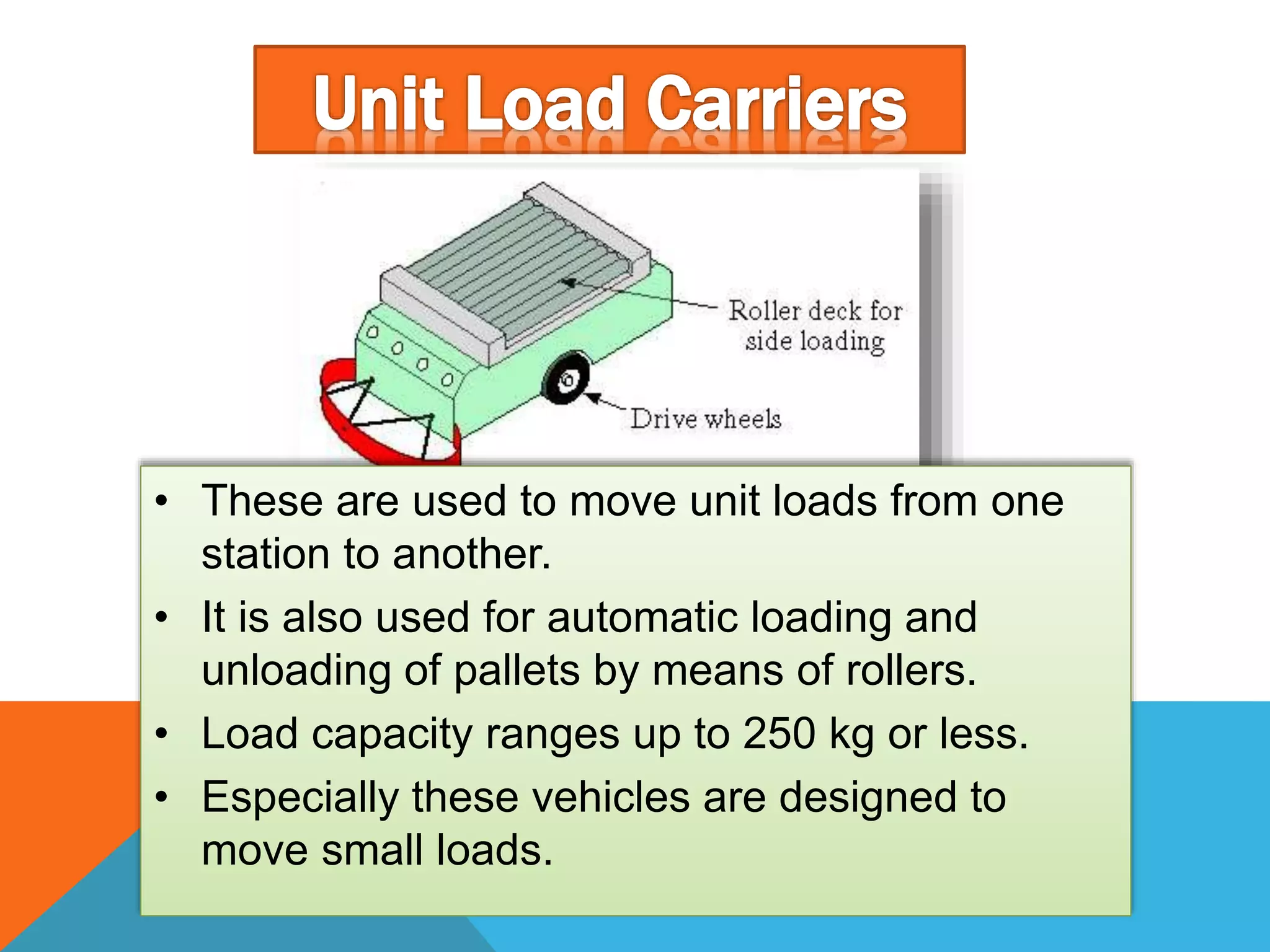
• These are used to move unit loads from one
station to another.
• It is also used for automatic loading and
unloading of pallets by means of rollers.
• Load capacity ranges up to 250 kg or less.
• Especially these vehicles are designed to
move small loads.
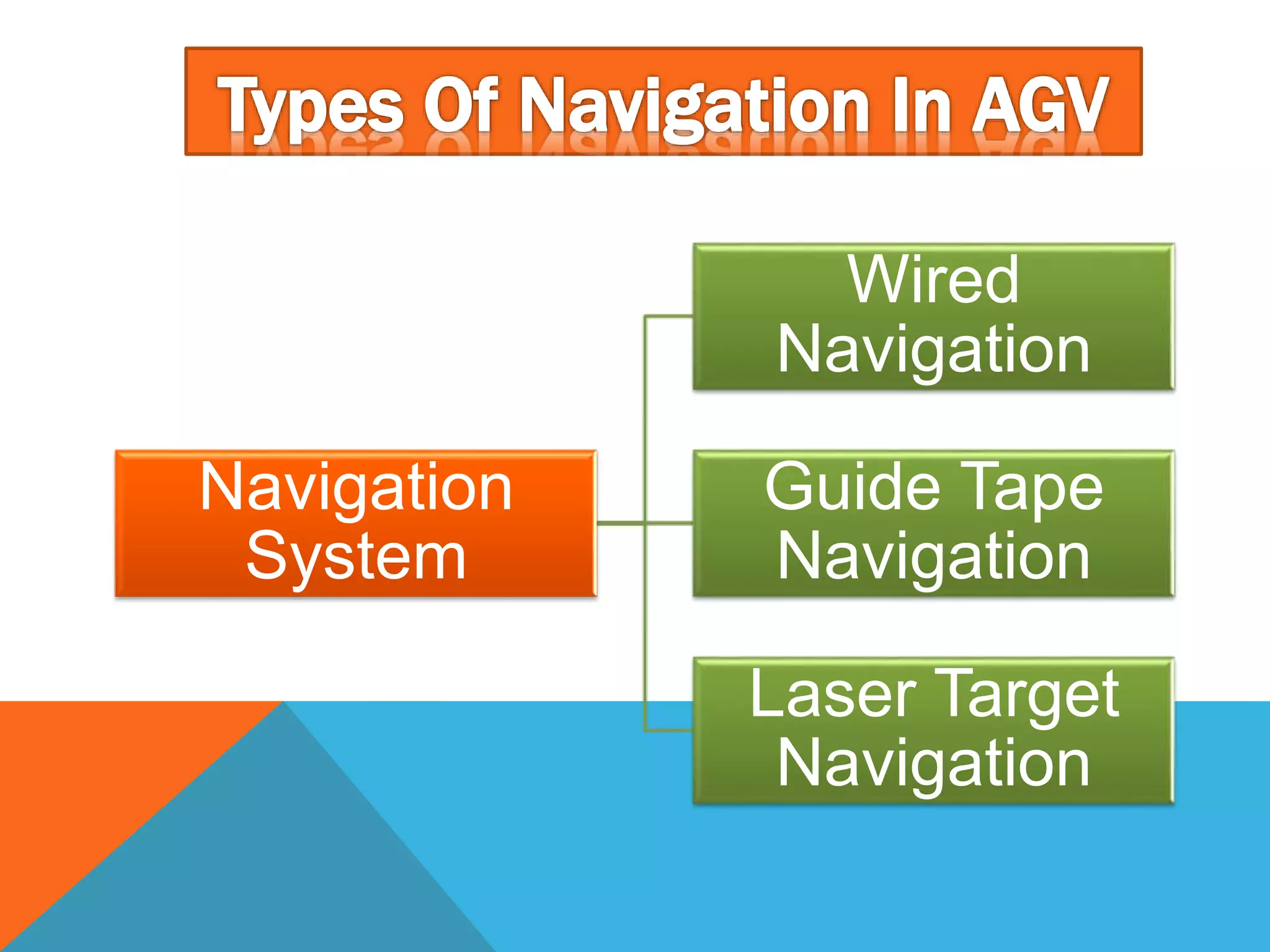
Navigation
System
Wired
Navigation
Guide Tape
Navigation
Laser Target
Navigation
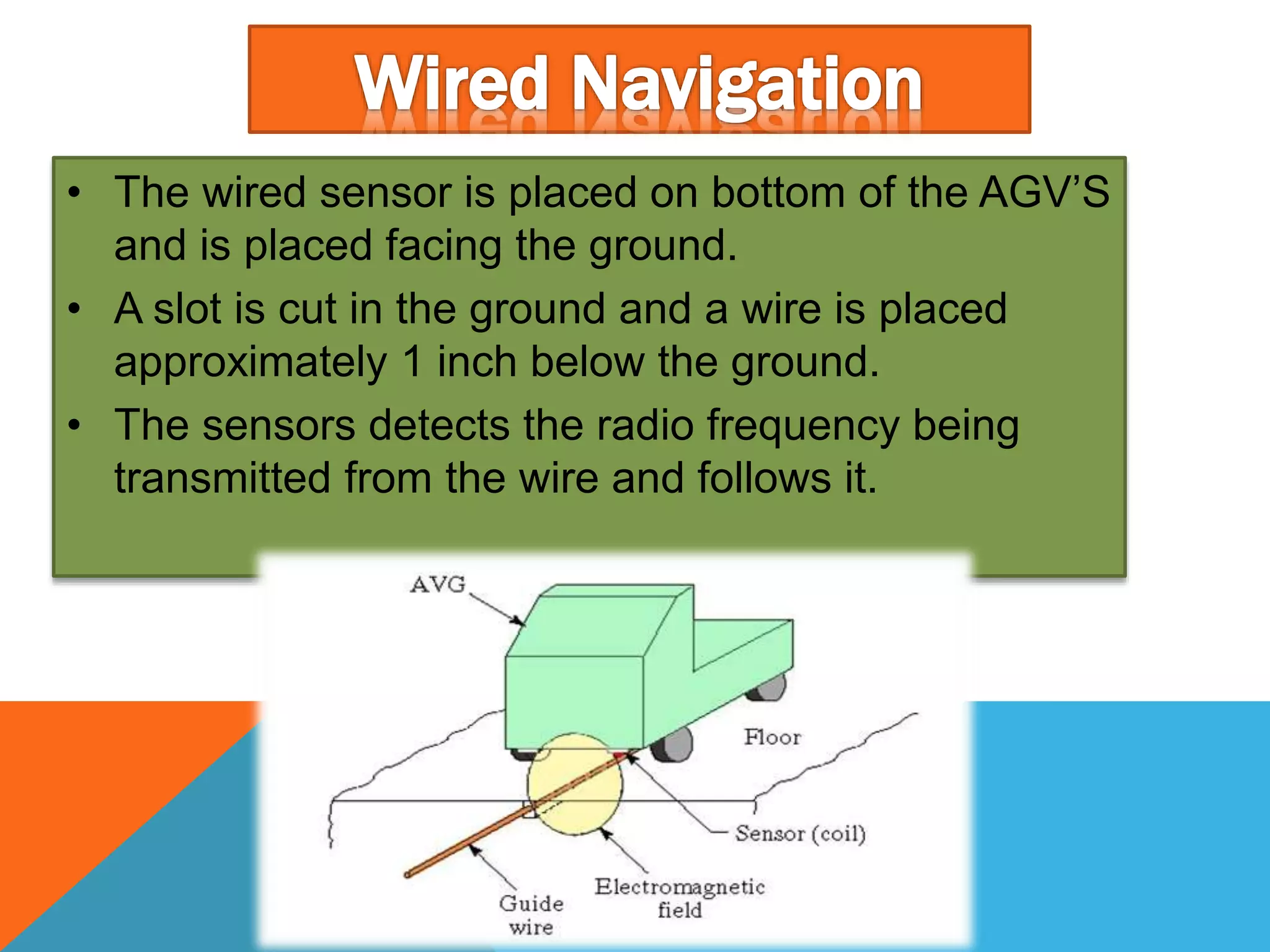
• The wired sensor is placed on bottom of the AGV’S
and is placed facing the ground.
• A slot is cut in the ground and a wire is placed
approximately 1 inch below the ground.
• The sensors detects the radio frequency being
transmitted from the wire and follows it.
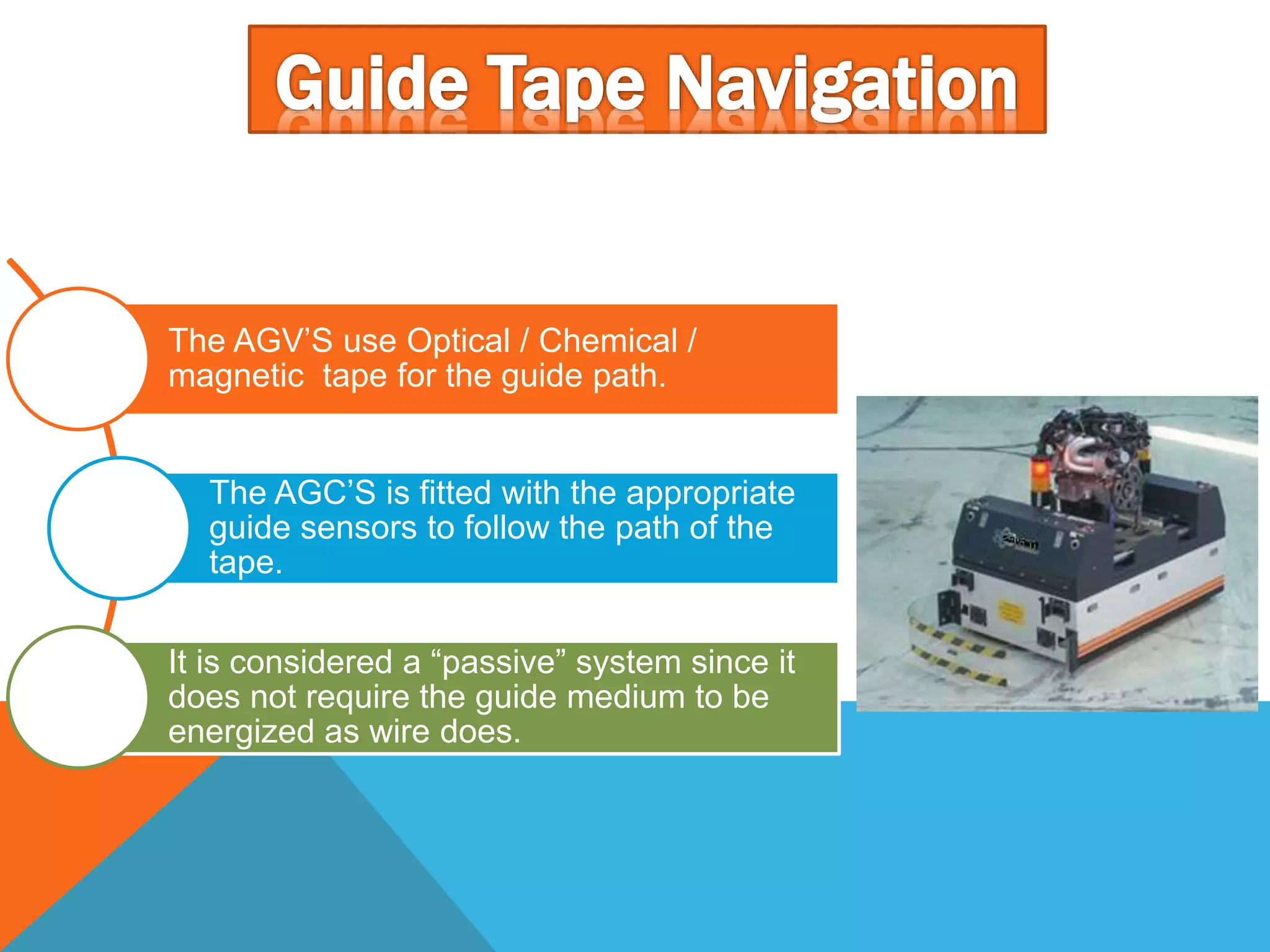
The AGV’S use Optical / Chemical /
magnetic tape for the guide path.
The AGC’S is fitted with the appropriate
guide sensors to follow the path of the
tape.
It is considered a “passive” system since it
does not require the guide medium to be
energized as wire does.
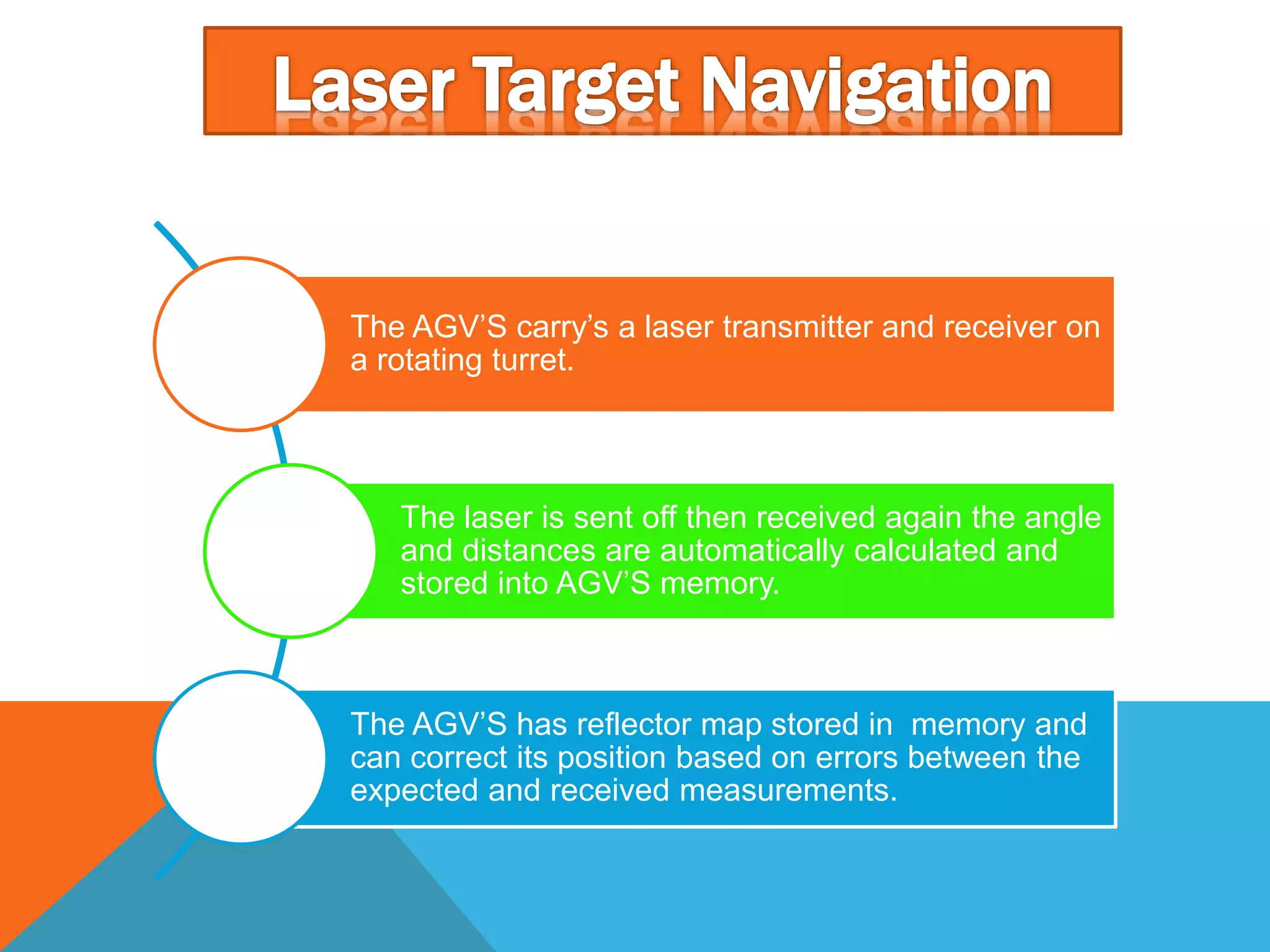
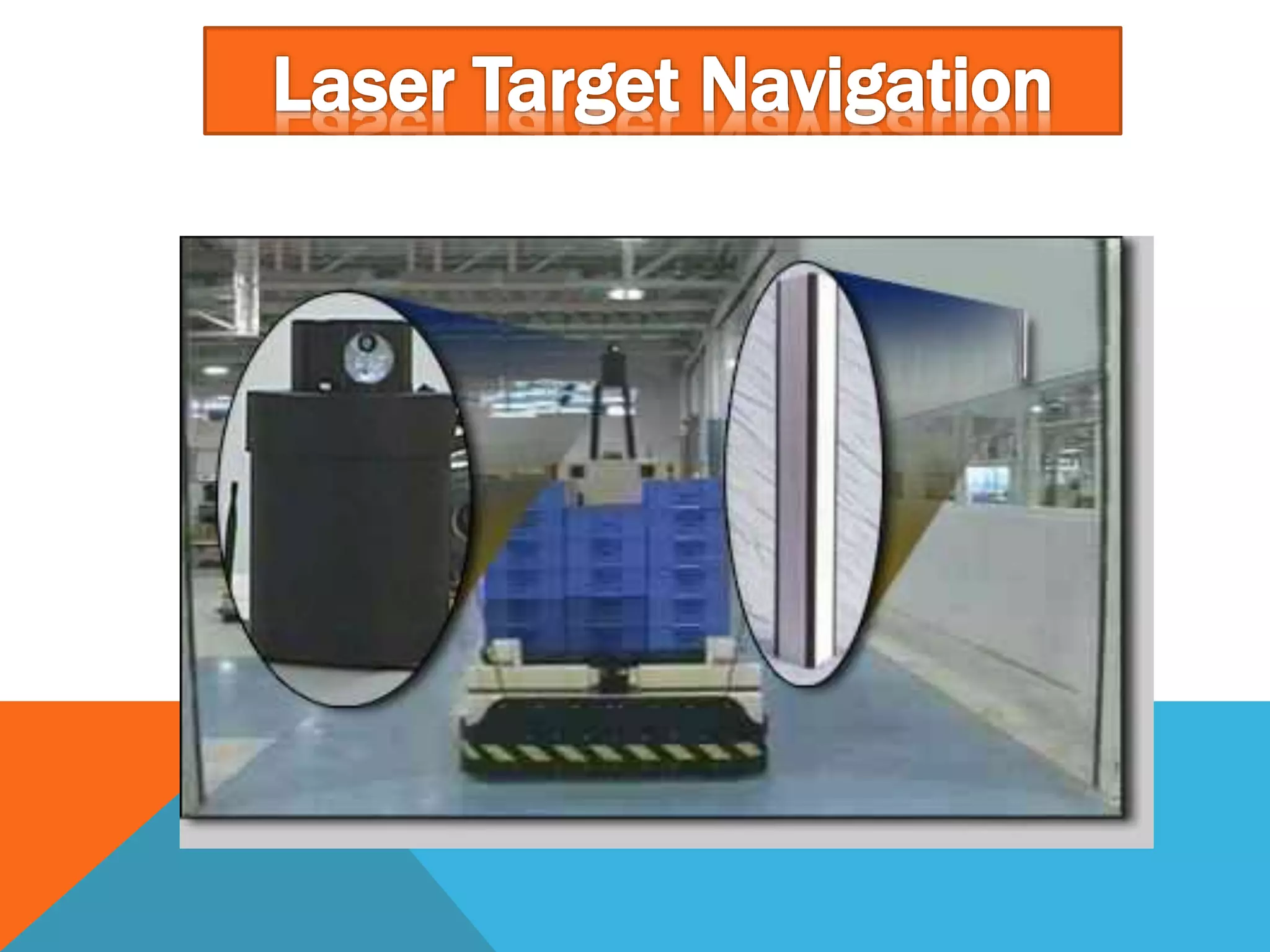
The AGV’S carry’s a laser transmitter and receiver on
a rotating turret.
The laser is sent off then received again the angle
and distances are automatically calculated and
stored into AGV’S memory.
The AGV’S has reflector map stored in memory and
can correct its position based on errors between the
expected and received measurements.
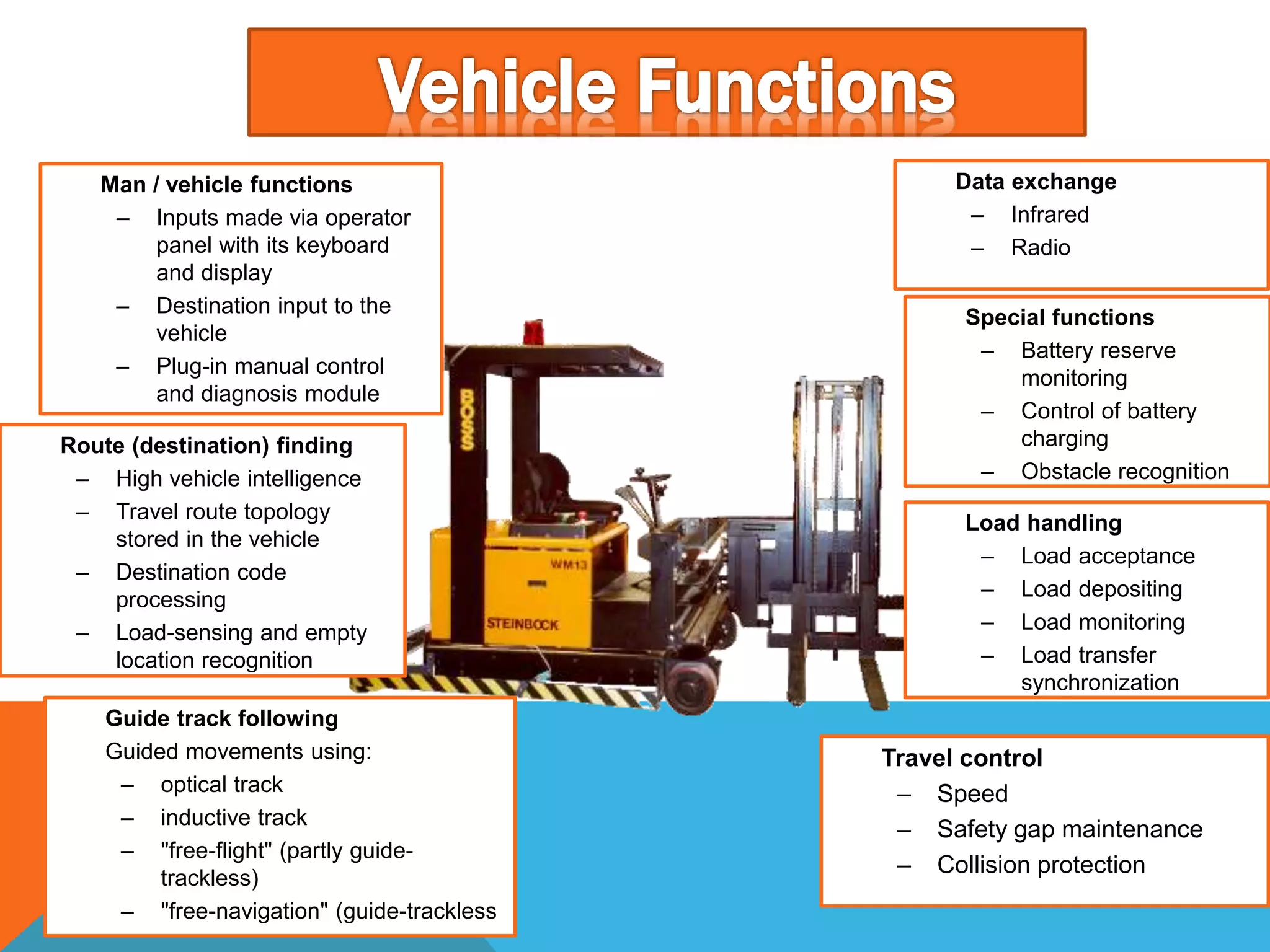
Man / vehicle functions
– Inputs made via operator
panel with its keyboard
and display
– Destination input to the
vehicle
– Plug-in manual control
and diagnosis module
Route (destination) finding
– High vehicle intelligence
– Travel route topology
stored in the vehicle
– Destination code
processing
– Load-sensing and empty
location recognition
Guide track following
Guided movements using:
– optical track
– inductive track
– "free-flight" (partly guide-
trackless)
– "free-navigation" (guide-trackless
Data exchange
– Infrared
– Radio
Special functions
– Battery reserve
monitoring
– Control of battery
charging
– Obstacle recognition
Load handling
– Load acceptance
– Load depositing
– Load monitoring
– Load transfer
synchronization
Travel control
– Speed
– Safety gap maintenance
– Collision protection
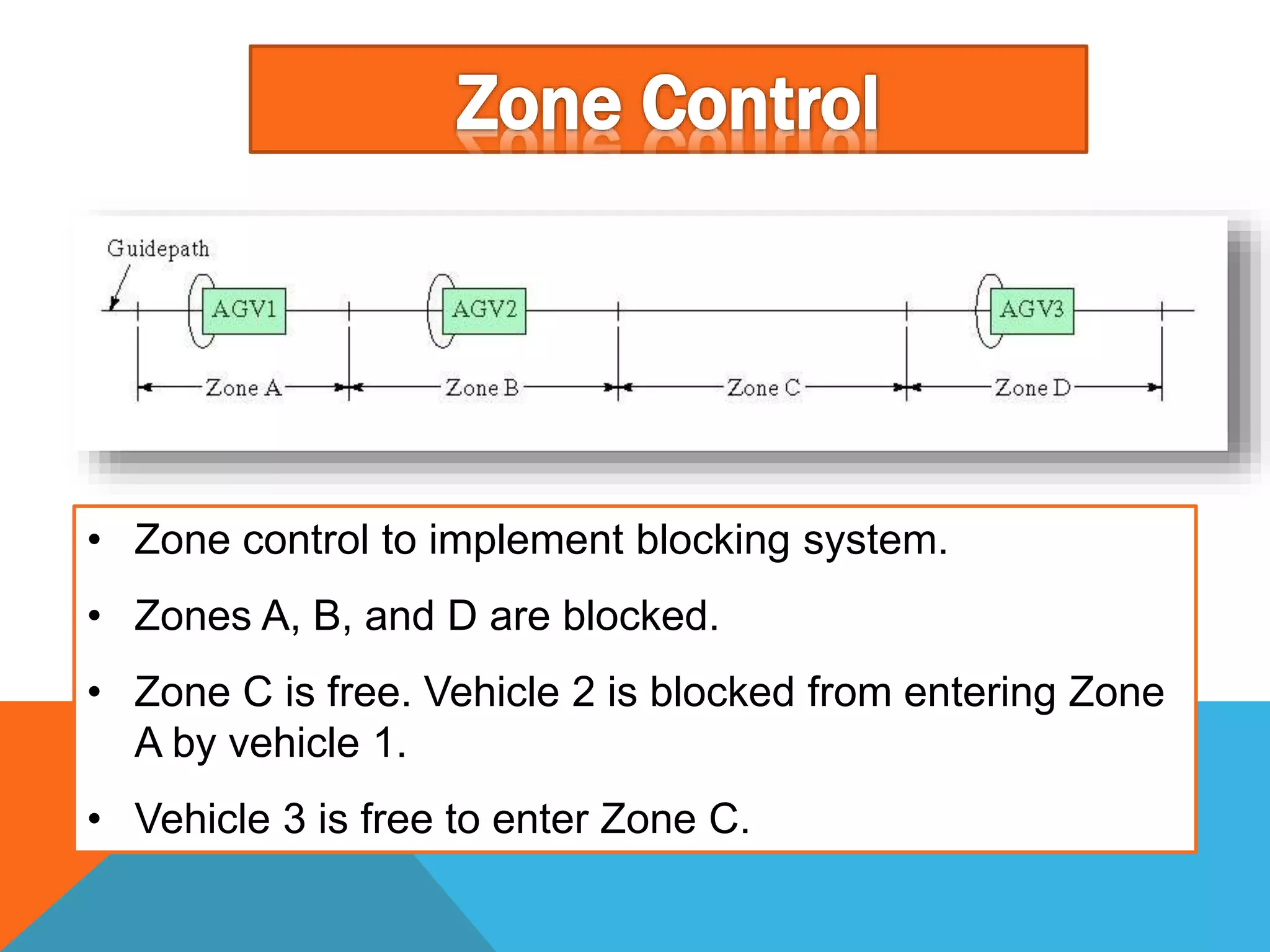
Zone Control
• Zone control to implement blocking system.
• Zones A, B, and D are blocked.
• Zone C is free. Vehicle 2 is blocked from entering Zone
A by vehicle 1.
• Vehicle 3 is free to enter Zone C.
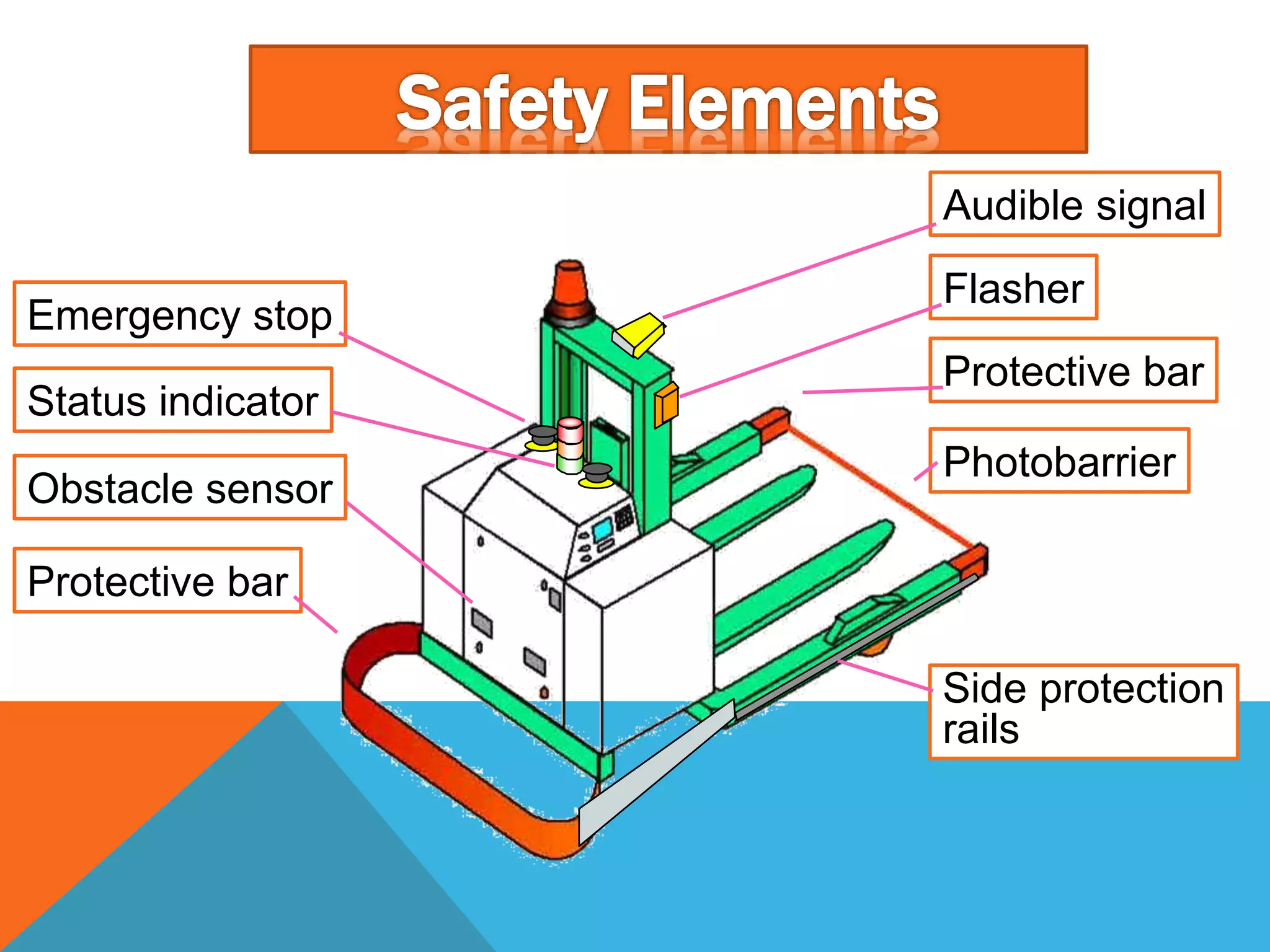
Emergency stop
Status indicator
Obstacle sensor
Protective bar
Flasher
Protective bar
Photobarrier
Audible signal
Side protection
rails
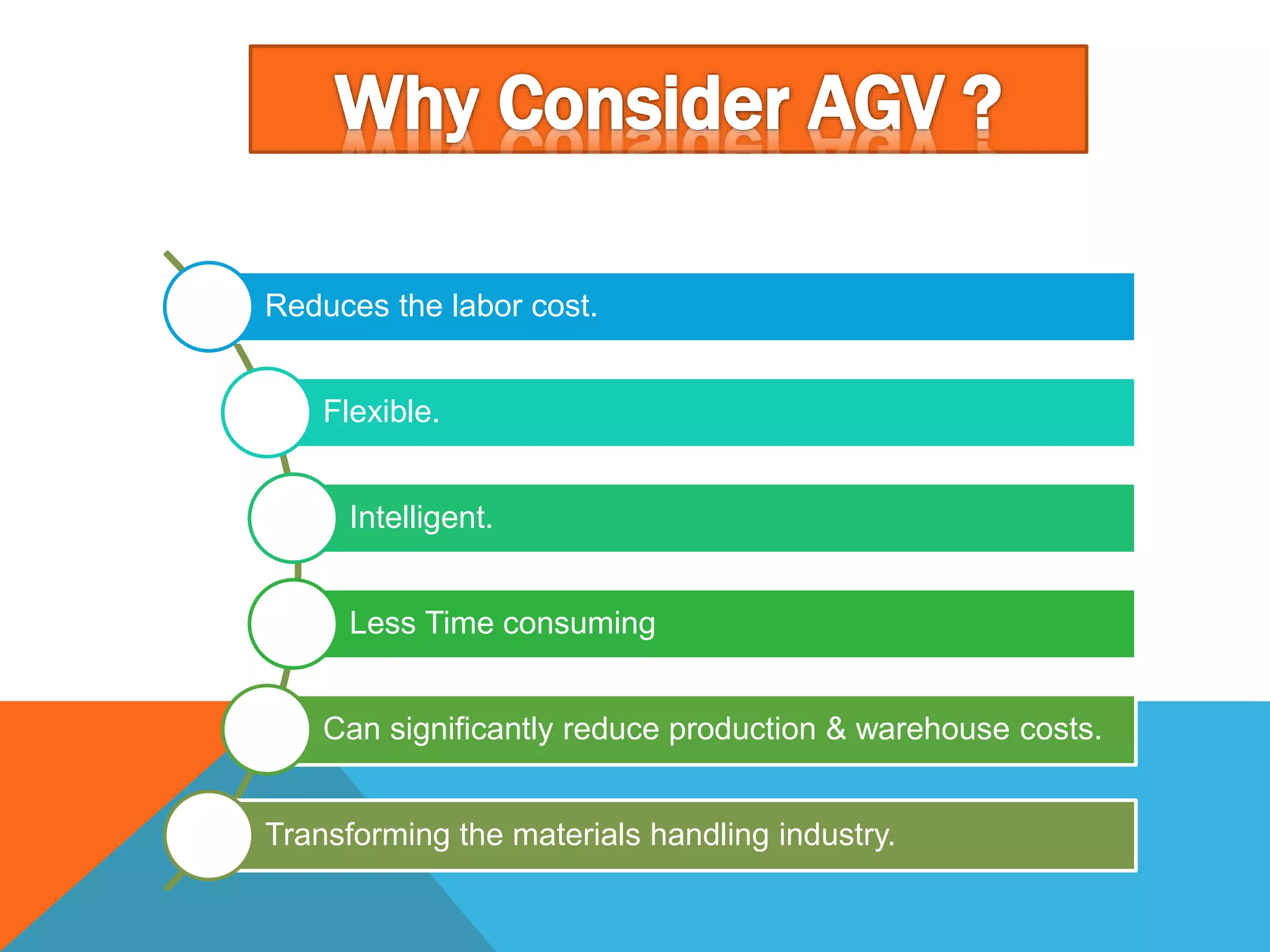
Reduces the labor cost.
Flexible.
Intelligent.
Less Time consuming
Can significantly reduce production & warehouse costs.
Transforming the materials handling industry.
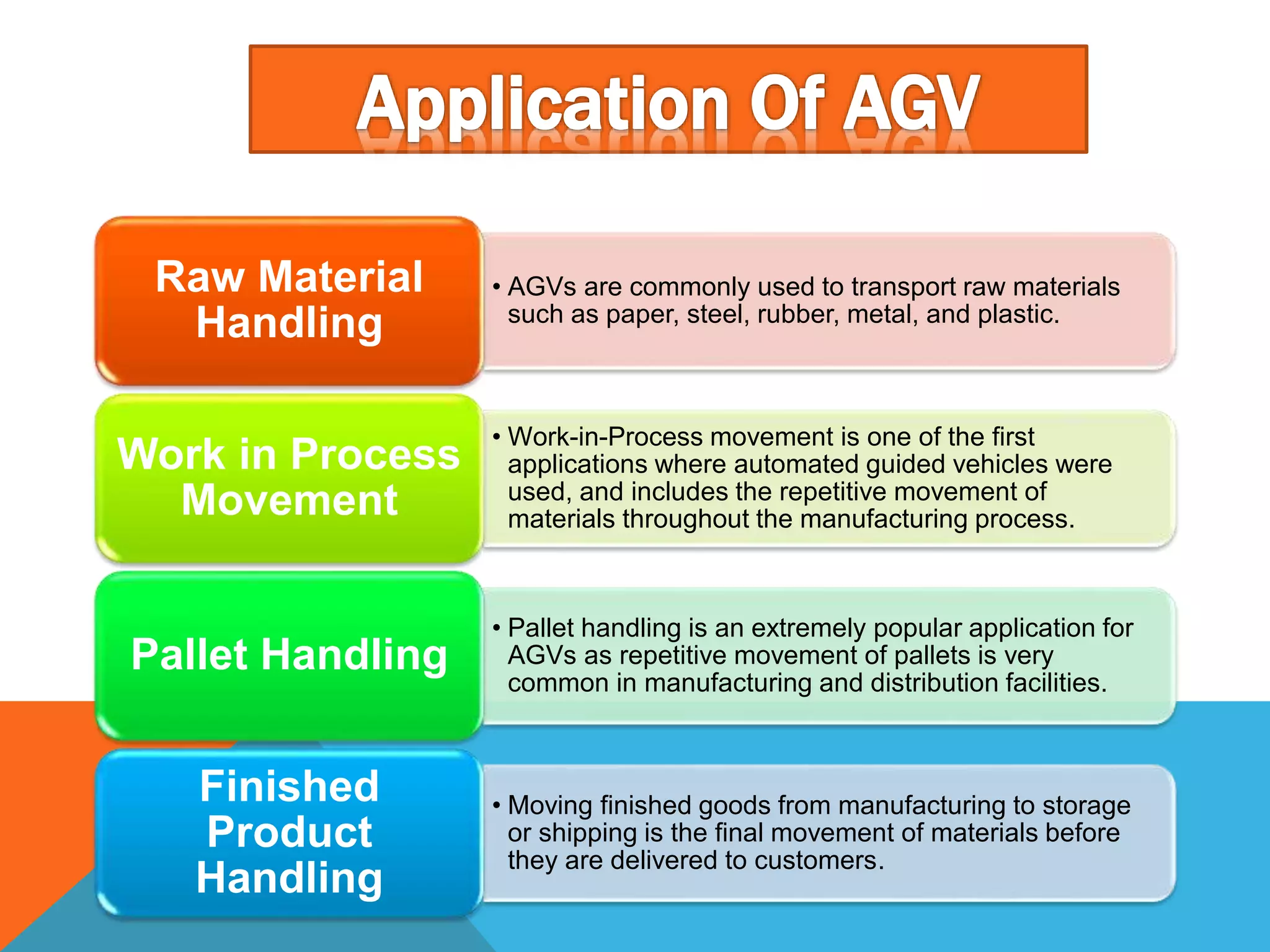
• AGVs are commonly used to transport raw materials
such as paper, steel, rubber, metal, and plastic.
Raw Material
Handling
• Work-in-Process movement is one of the first
applications where automated guided vehicles were
used, and includes the repetitive movement of
materials throughout the manufacturing process.
Work in Process
Movement
• Pallet handling is an extremely popular application for
AGVs as repetitive movement of pallets is very
common in manufacturing and distribution facilities.
Pallet Handling
• Moving finished goods from manufacturing to storage
or shipping is the final movement of materials before
they are delivered to customers.
Finished
Product
Handling
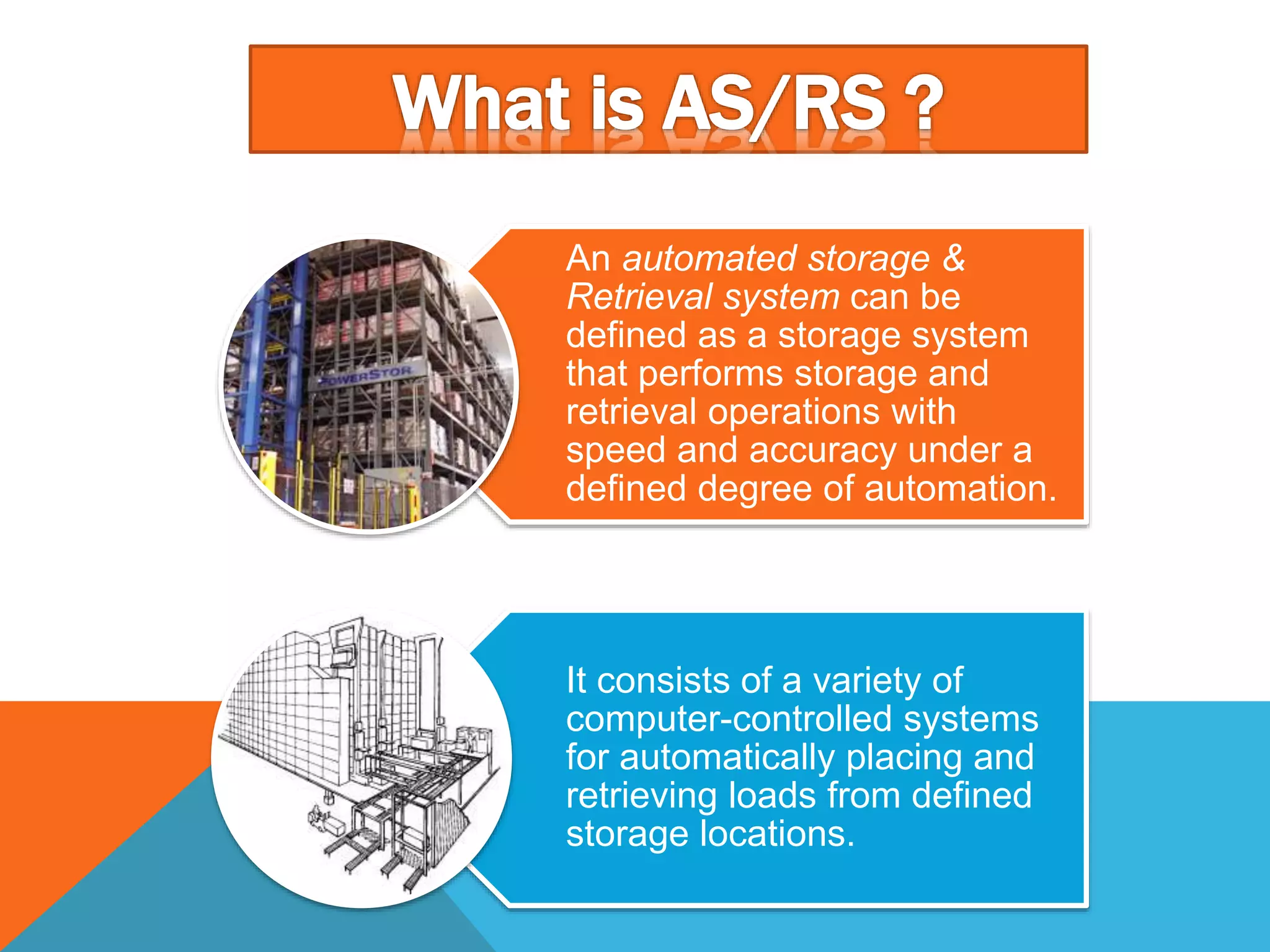
An automated storage &
Retrieval system can be
defined as a storage system
that performs storage and
retrieval operations with
speed and accuracy under a
defined degree of automation.
It consists of a variety of
computer-controlled systems
for automatically placing and
retrieving loads from defined
storage locations.
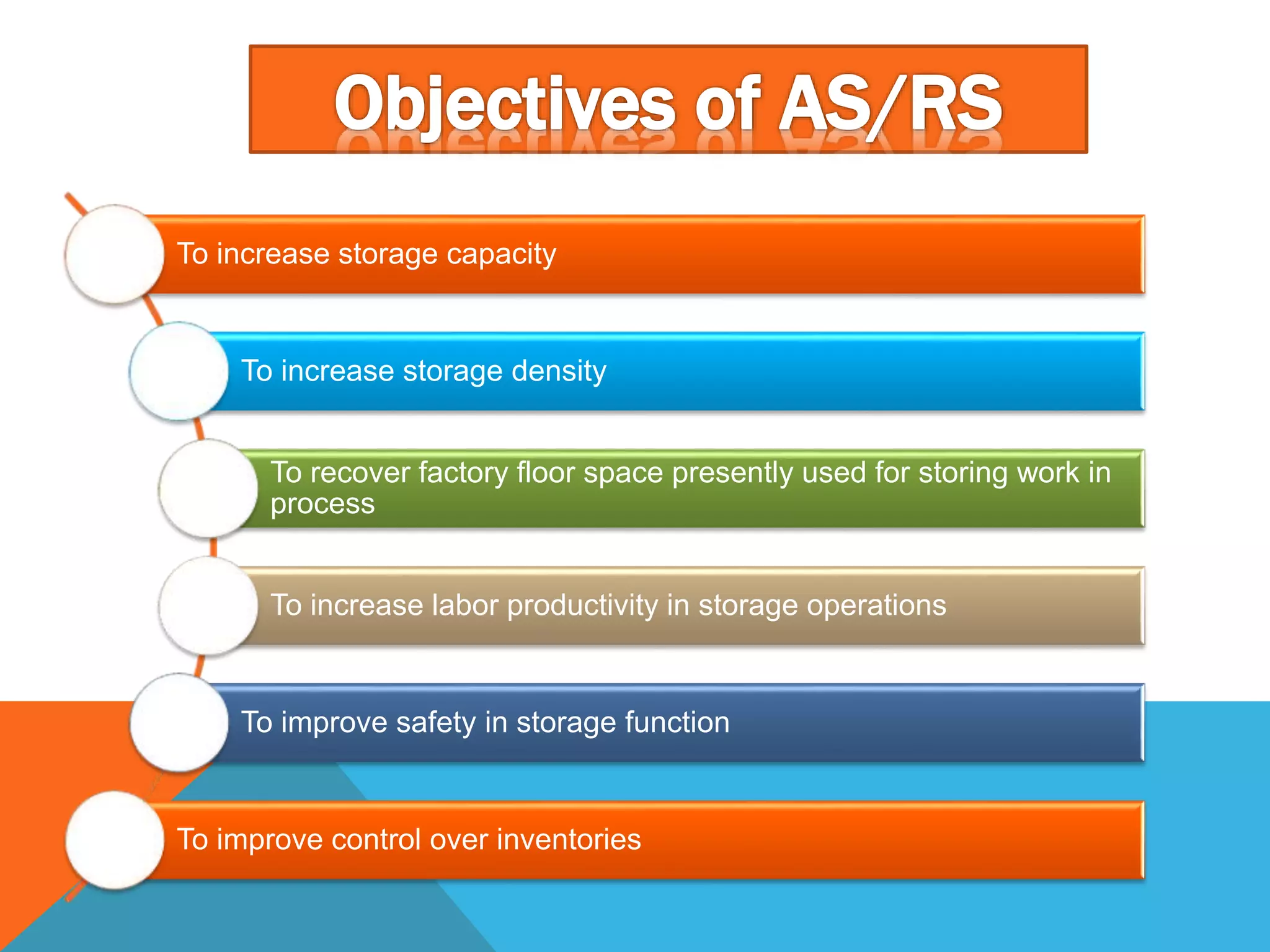
To increase storage capacity
To increase storage density
To recover factory floor space presently used for storing work in
process
To increase labor productivity in storage operations
To improve safety in storage function
To improve control over inventories
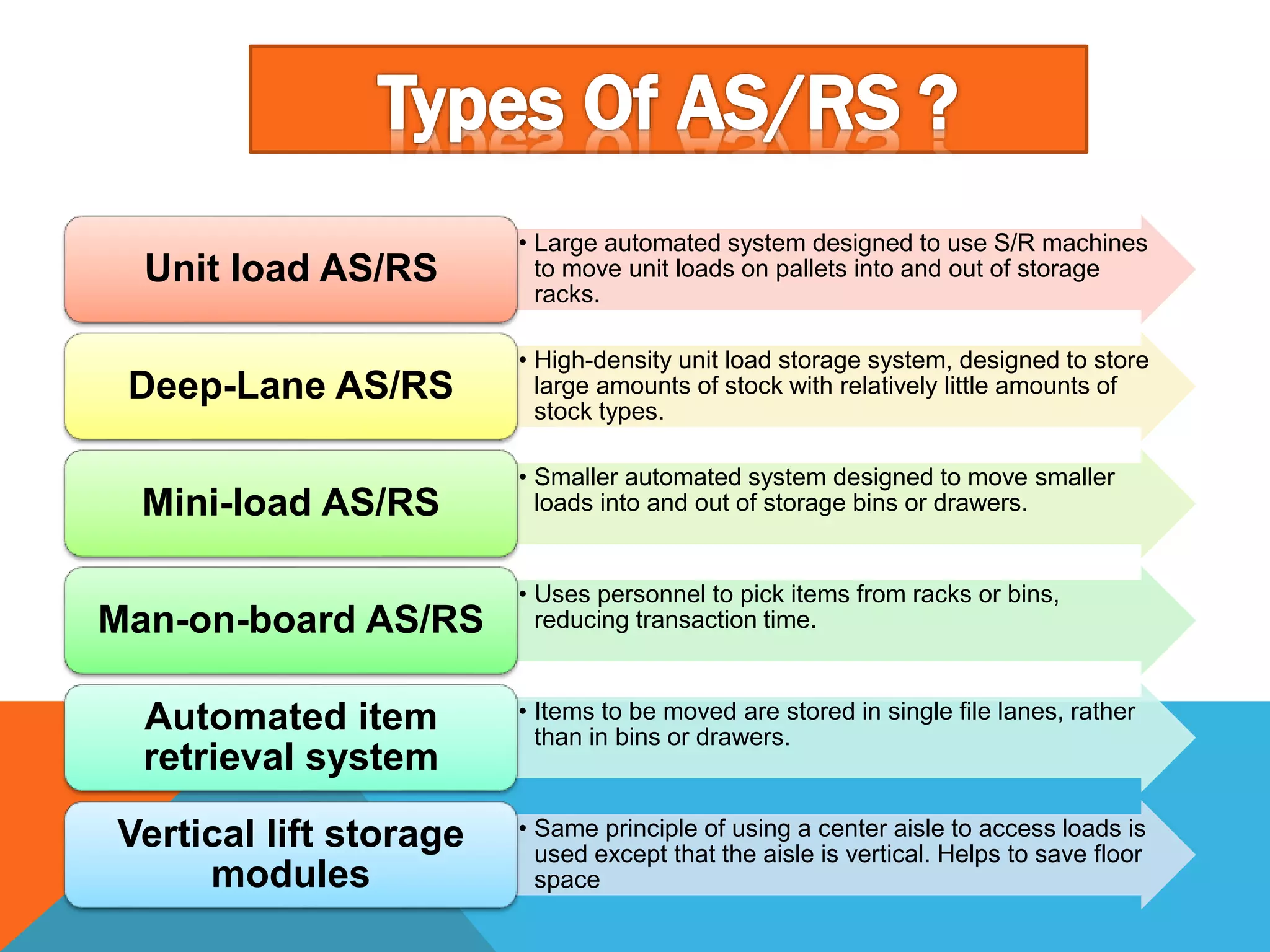
• Large automated system designed to use S/R machines
to move unit loads on pallets into and out of storage
racks.
Unit load AS/RS
• High-density unit load storage system, designed to store
large amounts of stock with relatively little amounts of
stock types.
Deep-Lane AS/RS
• Smaller automated system designed to move smaller
loads into and out of storage bins or drawers.Mini-load AS/RS
• Uses personnel to pick items from racks or bins,
reducing transaction time.Man-on-board AS/RS
• Items to be moved are stored in single file lanes, rather
than in bins or drawers.
Automated item
retrieval system
• Same principle of using a center aisle to access loads is
used except that the aisle is vertical. Helps to save floor
space
Vertical lift storage
modules
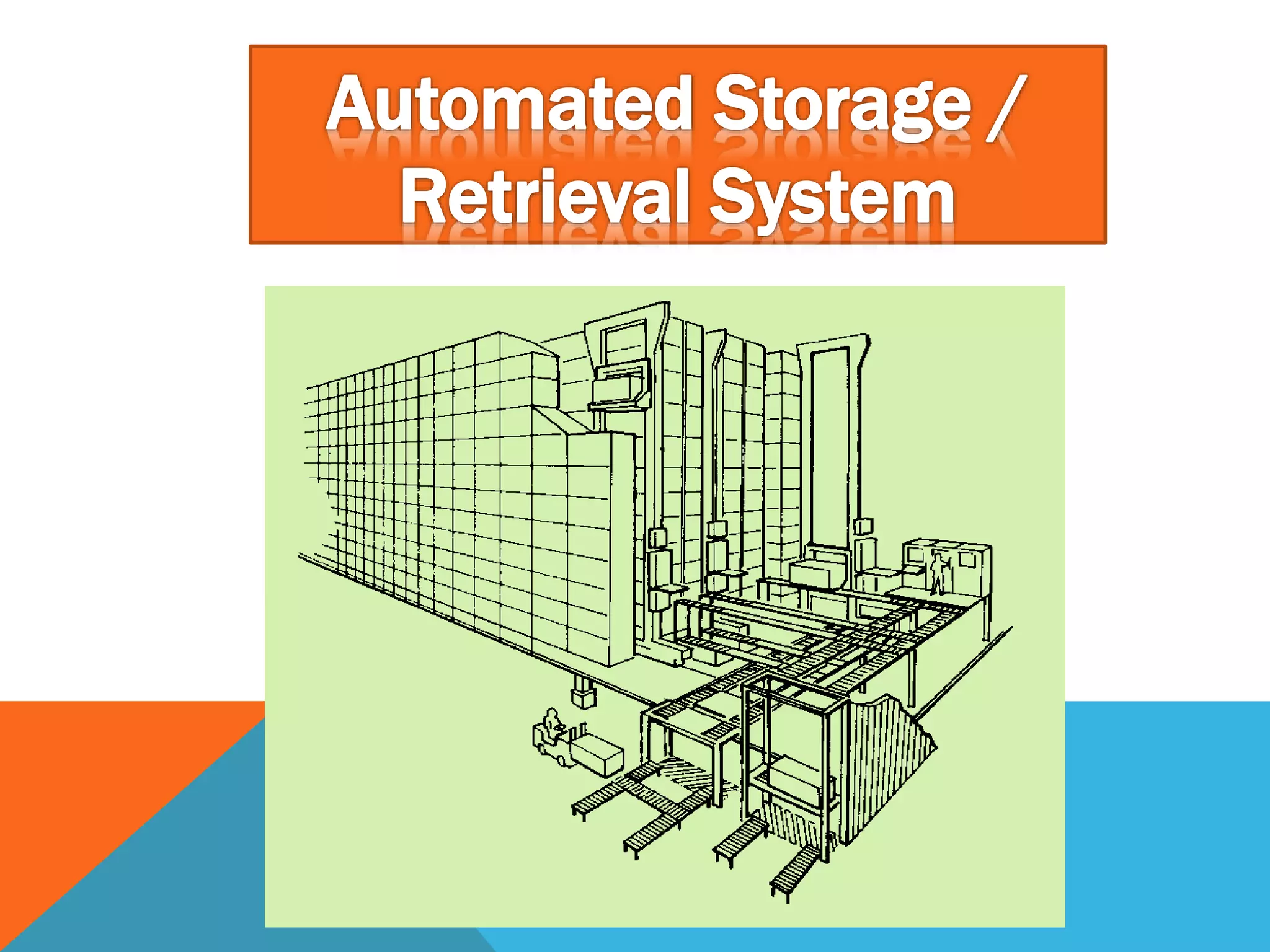
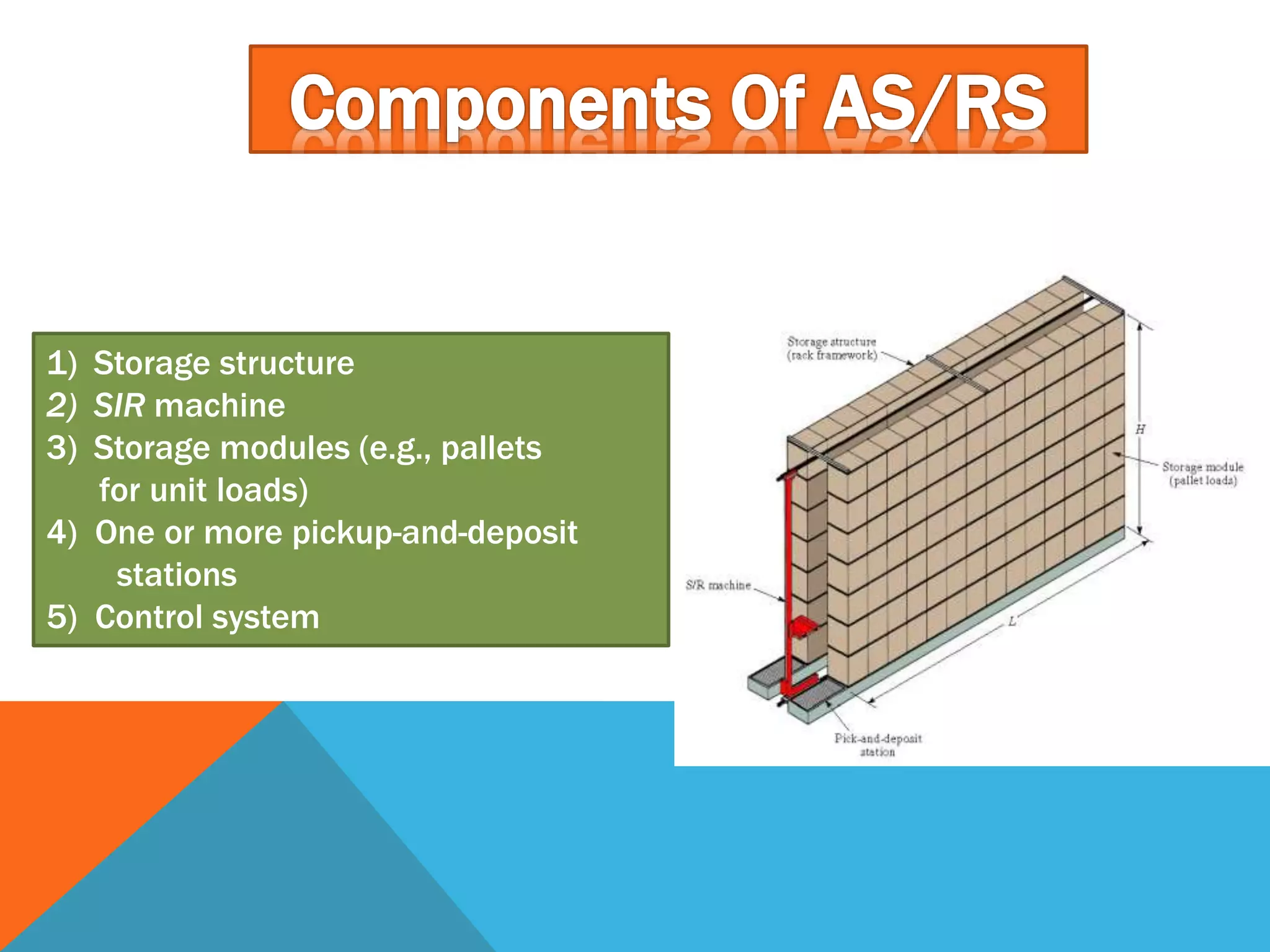
1) Storage structure
2) SIR machine
3) Storage modules (e.g., pallets
for unit loads)
4) One or more pickup-and-deposit
stations
5) Control system
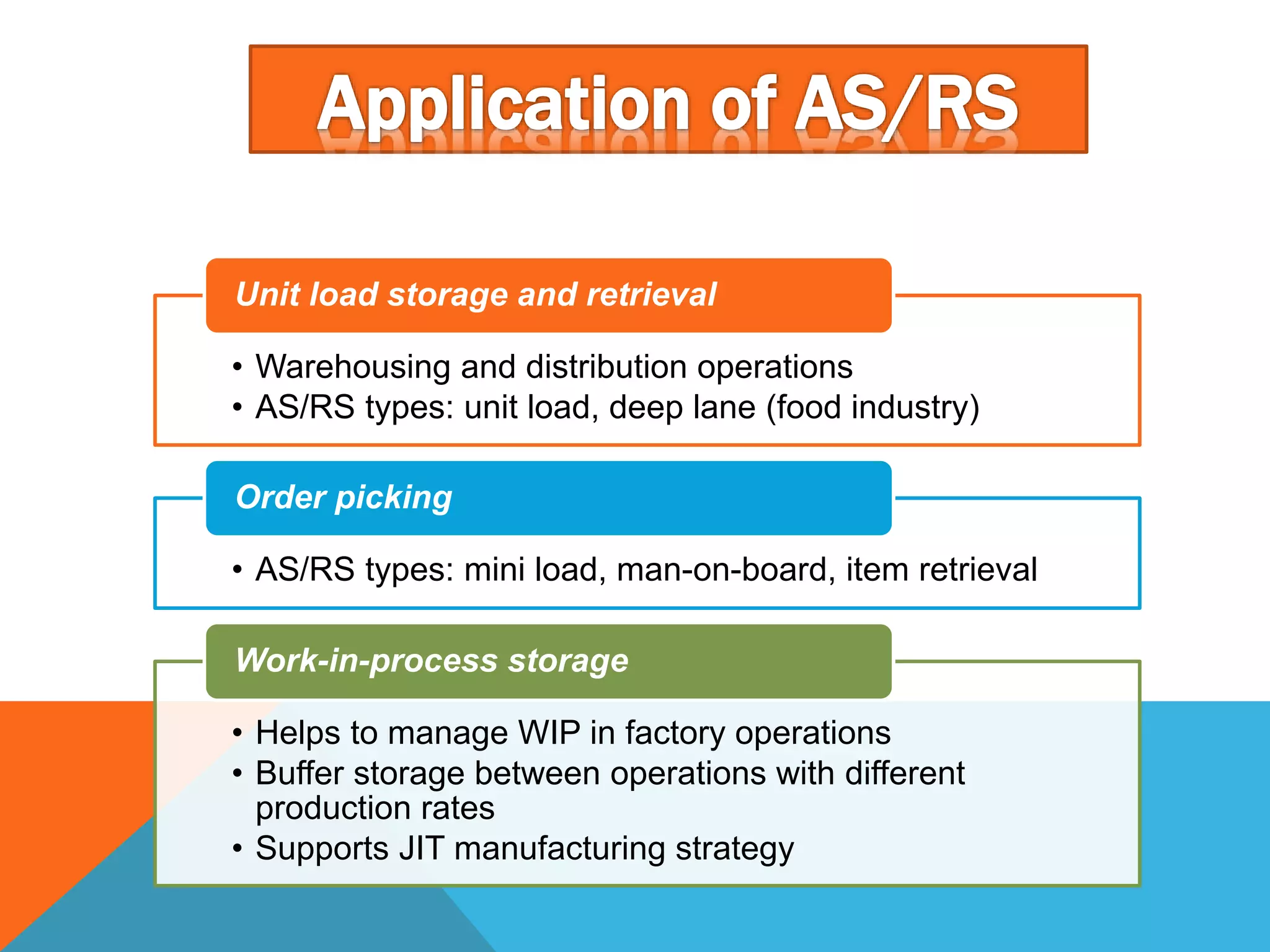
• Warehousing and distribution operations
• AS/RS types: unit load, deep lane (food industry)
Unit load storage and retrieval
• AS/RS types: mini load, man-on-board, item retrieval
Order picking
• Helps to manage WIP in factory operations
• Buffer storage between operations with different
production rates
• Supports JIT manufacturing strategy
Work-in-process storage
Agv and asrs

Agv and asrs

  • 2.
    AGV • What isAGV? • AGV System • Types Of AGV • Types of navigations in AGV’s • Safety And Functions Of AGV • Why consider AGV’s ? • Applications of AGV’s AS/RS • What Is AS/RS ? • Objectives Of AS/RS • Types Of AS/RS • Components Of AS/RS • Application Of AS/RS
  • 3.
    AGV is amaterial handling system that uses independently operated, self- propelled vehicles guided along defined pathways.
  • 4.
    1. Automated guidedvehicle (AGV) 2. Load transfer positions 3. Load handling equipment 4. Load devices 5. Guide track (laser, inductive, optical) 6. Data transmission 7. Management system 1 2 2 3 4 5 5 6 6 6 7
  • 5.
  • 6.
    It consists ofa towing vehicle that pulls one or more trailers to form a train. This type is applicable in moving heavy pay loads over large distance in warehouses or factories with or without intermediate pickup and drop off points along the route. It consists of 5-10 trailers and is an efficient transport system.
  • 7.
    • Pallet trucksare used to move palletized loads along predetermined routes. • The capacity of an AGV pallet truck ranges up to several thousand kilograms and some are capable of handling two pallets. • It is achieved for vertical movement to reach loads on racks and shelves.
  • 8.
    • These areused to move unit loads from one station to another. • It is also used for automatic loading and unloading of pallets by means of rollers. • Load capacity ranges up to 250 kg or less. • Especially these vehicles are designed to move small loads.
  • 9.
  • 10.
    • The wiredsensor is placed on bottom of the AGV’S and is placed facing the ground. • A slot is cut in the ground and a wire is placed approximately 1 inch below the ground. • The sensors detects the radio frequency being transmitted from the wire and follows it.
  • 11.
    The AGV’S useOptical / Chemical / magnetic tape for the guide path. The AGC’S is fitted with the appropriate guide sensors to follow the path of the tape. It is considered a “passive” system since it does not require the guide medium to be energized as wire does.
  • 12.
    The AGV’S carry’sa laser transmitter and receiver on a rotating turret. The laser is sent off then received again the angle and distances are automatically calculated and stored into AGV’S memory. The AGV’S has reflector map stored in memory and can correct its position based on errors between the expected and received measurements.
  • 14.
    Man / vehiclefunctions – Inputs made via operator panel with its keyboard and display – Destination input to the vehicle – Plug-in manual control and diagnosis module Route (destination) finding – High vehicle intelligence – Travel route topology stored in the vehicle – Destination code processing – Load-sensing and empty location recognition Guide track following Guided movements using: – optical track – inductive track – "free-flight" (partly guide- trackless) – "free-navigation" (guide-trackless Data exchange – Infrared – Radio Special functions – Battery reserve monitoring – Control of battery charging – Obstacle recognition Load handling – Load acceptance – Load depositing – Load monitoring – Load transfer synchronization Travel control – Speed – Safety gap maintenance – Collision protection
  • 15.
    Zone Control • Zonecontrol to implement blocking system. • Zones A, B, and D are blocked. • Zone C is free. Vehicle 2 is blocked from entering Zone A by vehicle 1. • Vehicle 3 is free to enter Zone C.
  • 16.
    Emergency stop Status indicator Obstaclesensor Protective bar Flasher Protective bar Photobarrier Audible signal Side protection rails
  • 17.
    Reduces the laborcost. Flexible. Intelligent. Less Time consuming Can significantly reduce production & warehouse costs. Transforming the materials handling industry.
  • 18.
    • AGVs arecommonly used to transport raw materials such as paper, steel, rubber, metal, and plastic. Raw Material Handling • Work-in-Process movement is one of the first applications where automated guided vehicles were used, and includes the repetitive movement of materials throughout the manufacturing process. Work in Process Movement • Pallet handling is an extremely popular application for AGVs as repetitive movement of pallets is very common in manufacturing and distribution facilities. Pallet Handling • Moving finished goods from manufacturing to storage or shipping is the final movement of materials before they are delivered to customers. Finished Product Handling
  • 20.
    An automated storage& Retrieval system can be defined as a storage system that performs storage and retrieval operations with speed and accuracy under a defined degree of automation. It consists of a variety of computer-controlled systems for automatically placing and retrieving loads from defined storage locations.
  • 21.
    To increase storagecapacity To increase storage density To recover factory floor space presently used for storing work in process To increase labor productivity in storage operations To improve safety in storage function To improve control over inventories
  • 22.
    • Large automatedsystem designed to use S/R machines to move unit loads on pallets into and out of storage racks. Unit load AS/RS • High-density unit load storage system, designed to store large amounts of stock with relatively little amounts of stock types. Deep-Lane AS/RS • Smaller automated system designed to move smaller loads into and out of storage bins or drawers.Mini-load AS/RS • Uses personnel to pick items from racks or bins, reducing transaction time.Man-on-board AS/RS • Items to be moved are stored in single file lanes, rather than in bins or drawers. Automated item retrieval system • Same principle of using a center aisle to access loads is used except that the aisle is vertical. Helps to save floor space Vertical lift storage modules
  • 23.
    1) Storage structure 2)SIR machine 3) Storage modules (e.g., pallets for unit loads) 4) One or more pickup-and-deposit stations 5) Control system
  • 24.
    • Warehousing anddistribution operations • AS/RS types: unit load, deep lane (food industry) Unit load storage and retrieval • AS/RS types: mini load, man-on-board, item retrieval Order picking • Helps to manage WIP in factory operations • Buffer storage between operations with different production rates • Supports JIT manufacturing strategy Work-in-process storage