Fire guidelines by NBC(part-2)
Maneesh kumar Reddy
Ps no 20092039
Hci metros
contents
 Introduction
 Types of construction
 Commonly used building materials
 Fire resistant building materials
 Fire Resistance Ratings of Structural Elements
 Designing of a fire-resistive building
 Conclusions
 References
Introduction
 Construction in which the floors, walls, roof, and other components are built
exclusively of non combustible materials, with fire-endurance ratings equal to
or greater than those mandated by law.
 In a fire resistant construction, the maximum use of non-combustible
materials should be encouraged. All the structural elements such as beams,
columns, lintel, floors and roofs, load bearing walls or partition walls etc.
Should be constructed in such a way that they should continue to function as
structural members at least for the period which may be sufficient for the
occupants to escape.
 The load bearing walls or columns of masonry should be thicker in section so
that they may successfully act as fire barrier for a considerable time
 So far as possible fire resisting materials should be used in construction
 TYPES OF CONSTRUCTION :
1. Fireproof construction
2. Noncombustible construction
3. Exterior protected construction
4. Wood construction
 TYPE 1. FIREPROOF CONSTRUCTION (Fire Resistive Construction)
 Construction of buildings that resist fire damage and prevent the spread of fire.
 Fireproof building containing only no burning components, Such as steel, terra-cotta, plaster, and
concrete
 Fire-resistance requirements can range from 3 to 4 hour.
 Buildings may be used as high-rise office buildings, shopping centers, or residential units.
 For buildings 15 m in height or above.
 Buildings may be used as high-rise office buildings, shopping centers, or residential units.
 Fire-resistance requirements have the following ratings as a range.
 Exterior bearing walls: 3 to 4 hours.
 Interior bearing walls: 2 to 4 hours.
 Columns: 2 to 4 hours.
 Beams, girders, trusses, and arches: 2 to 4 hours.
 Floors: 2 to 3 hours.
 Roof: 1-1/2 to 2 hours.
 TYPE 2. NONCOMBUSTIBLE CONSTRUCTION
 Construction using masonry materials, Brick or concrete, on the outside walls of the structure,
 And noncombustible materials for the roof and floor.
 For buildings 15 m in height or above
 Fire-resistance requirements can range from 2 to 3 hour.
 Construction using masonry materials, Brick or concrete, on the outside walls of the structure, And
noncombustible materials for the roof and floor.
 Buildings may be used as office buildings.
 Fire-resistance requirements shall have, as a minimum, the following ratings:
 Exterior bearing walls: 0 to 2 hours.
 Interior bearing walls: 0 to 2 hours.
 Columns: 0 to 2 hours.
 Beams, girders, trusses, arches: 0 to 2 hours.
 Floors: 0 to 2 hours.
 Roof: 0 to 1 hour.
 TYPE 3. EXTERIOR PROTECTED CONSTRUCTION (Ordinary Building)
 Construction in which all structural elements of exterior walls are of non-combustible materials
 Fire-resistance requirements for all elements can range from 0 to 1 hour.
 Buildings may be retail stores, mixed occupancy, dwellings, and apartment buildings.
 Only the exterior load-bearing walls shall be noncombustible or limited combustible, and shall have as
a minimum a 1-hour rating.
 They also may be required to be protected and to have the following fire-resistance ratings:
 Interior bearing walls: 0 to 1 hour.
 Columns: 0 to 1 hour.
 Beams, girders, trusses, arches: 0 to 1 hour.
 Floors: 0 to 1 hour.
 Roof: 0 to 1 hour.
 TYPE 4. WOOD CONSTRUCTION
 The construction in which the exterior wall or bearing wall, roof and floor wholly or partially of
wood
 Structural members are entirely or partially made from wood or other approved combustible
material.
 Fire-resistance requirements for all elements can range from 0 to 1 hour.
 Exterior and interior bearing walls shall have, as a minimum, the following fire-resistance
ratings:

 Exterior bearing walls: 2 hours.
 Interior bearing walls: 1 to 2 hours
 TYPE 4. WOOD CONSTRUCTION
 The construction in which the exterior wall or bearing wall, roof and floor wholly or partially of
wood
 Structural members are entirely or partially made from wood or other approved combustible
material.
 Fire-resistance requirements for all elements can range from 0 to 1 hour.
 Exterior and interior bearing walls shall have, as a minimum, the following fire-resistance
ratings:

 Exterior bearing walls: 2 hours.
 Interior bearing walls: 1 to 2 hours
1.TIMBER
2.BRICK
3.STONE
4.STEEL
5.CONCRETE
6.GLASS
7.PLASTER OR MORTAR
Timber
 Wood is the oldest material used by humans for
construction after stone.
 Exceptionally strong relative to its weight
 A good heat and electrical insulator
 It is a renewable and biodegradable resource.
 Environmentally friendly
 Strong and lightweight
 Easy to install, Durable, Cost effective, Flexible
 Timber has a unique property of self insulation and slow burning and offers
considerable resistance to fire
 Additional fire resistance is achieved through impregnation of timber with large
quantities of fire-retarding chemicals
 The commonly used chemical for this purpose are ammonium phosphate and sulphate ,
borax and boric acid, zinc chloride etc.
 This treatment retards increase in temperature during fire, decrease rate of flame spread
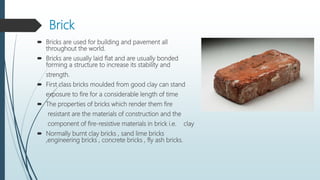
Brick
 Bricks are used for building and pavement all
throughout the world.
 Bricks are usually laid flat and are usually bonded
forming a structure to increase its stability and
strength.
 First class bricks moulded from good clay can stand
exposure to fire for a considerable length of time
 The properties of bricks which render them fire
resistant are the materials of construction and the
component of fire-resistive materials in brick i.e. clay
 Normally burnt clay bricks , sand lime bricks
,engineering bricks , concrete bricks , fly ash bricks.
stone
 The usage of stone in a fire resistive construction
should be strictly restricted to the minimum
 Hot stone when subjected to sudden cooling
develops crack and can lead to failure of structure
 Lime stone is least recommended as it get ruined
by an ordinary fire
 Only compact sand stone having fine grains may
be used as it can stand the exposure to moderate
fire without serious cracks
steel
 Steel has a very low fire resistance
value
 With increase in temperature, the co-
efficient of elasticity of metal falls
appreciably rendering the structural
members soft and free to expand
 When the members in this state came
in contact with water used for
extinguishing the fire, they tend to
contract, twist or distort and thus the
stability of the entire structure is
endangered.
concrete
 Concrete is a composite material composed mainly of water, aggregate, and cement. Often, additives and
reinforcements (such as rebar) are included in the mixture to achieve the desired physical properties of the
finished material.
 Normal concrete
 High Strength Concrete
 High Performance Concrete
 Light Weight Concrete
 Self-Compacting Concrete
 Shotcrete
 Pervious Concrete
 The influence of fire on concrete varies with the nature of its coarse aggregate and its density
 it has been noticed that in an average fire, the concrete surface gets disintegrated for a depth of
about 25mm
 This is due to the de hydration of mortar in concrete by the fire
 Hence in a reinforced concrete fire resistant construction, the thickness of clear cover should be more
High strength concrete
shortcrete
glass
 Glass is an amorphous solid material which is often transparent and has widespread practical, technological,
and decorative usage
 Flat Glass
 Fiber Glass
 Laminated Safety Glass
 Tempered Safety Glass
 Colored Structural Glass
 Glass Building Blocks
 Heat-Resistant Glass
 Glass for Electrical Uses
 Glass conduct heat faster than metal because of its low thermal conductivity
 When glass is subjected to sudden and extreme variation of temperature, it fractures or cracks.
 By the use of glass reinforced with steel wire netting, such cracks can be minimized
 The reinforced glass has a higher melting point then the ordinary glass, and such it is commonly used for
fire resisting doors, windows, sky-lights etc.
Flat glass Fiber glass Laminated safety glass Tempered safety
glass
Coloured glass Glass building blocks Heat resistant glass
Plaster or mortar
 Plaster Is a building material used for coating walls and ceilings.
 Mortar Is a workable paste used to bind building blocks such
as stones, bricks, and concrete masonry units together, fill and seal the
irregular gaps between them, and sometimes add decorative colors or
patterns in masonry walls.
 Plaster or mortar are incombustible and as such, by suitable choice of the
type of mortar, the walls or ceiling of a building can be made more fire
resistant
 The resistance of the plaster to fire hazards can be increased by using it in
thicker layer
SNo. Structural Element Type Of Construction
Type 1 Type 2 Type 3 Type 4
1 Exterior walls :
a) Fire separation less than 3.7 m i) Bearing 4 2 2 1
ii) Nonbearing 2 1½ 1 1
b) Fire separation of 3.7 m or more
but
less than 9 m
i) Bearing 4 2 2 1
ii) Nonbearing 1½ 1½ 1 1
c) Fire separation of 9 m or more i) Bearing 4 2 2 1
ii) Nonbearing 1 1 1 1
2 Fire walls 4 2 2 2
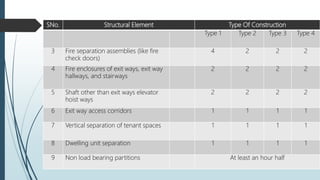
SNo. Structural Element Type Of Construction
Type 1 Type 2 Type 3 Type 4
3 Fire separation assemblies (like fire
check doors)
4 2 2 2
4 Fire enclosures of exit ways, exit way
hallways, and stairways
2 2 2 2
5 Shaft other than exit ways elevator
hoist ways
2 2 2 2
6 Exit way access corridors 1 1 1 1
7 Vertical separation of tenant spaces 1 1 1 1
8 Dwelling unit separation 1 1 1 1
9 Non load bearing partitions At least an hour half
SNo. Structural Element Type Of Construction
Type 1 Type
2
Type
3
Type
4
9 Interior bearing walls, bearing
partitions, columns, girders, trusses(other
than roof trusses) and framing
i) Supporting more than one
floor
4 2 2 2
ii) Supporting one floor
only
3 1½ 1 1
iii) Supporting a roof only 3 1½ 1 1
10 Structural members support walls 3 1½ 1 1
11 Floor construction including walls 3 1½ 1 1
12 Roof construction i) 5 m or less in height to
lowest member
2 1½ 1 1
ii) More than 5 m but
less than 6.7 m in
height to lowest member
1 1 1 1
iii) 6.7 m or more in
height to lowest member
0 2 0 0
Fire resistant glass for windows
 Glass is a poor conductor of heat and expends little during heating. Cracks are
formed in glass when it is cooled after heating.
 Windows, important for visibility and light, can nonetheless be a fire hazard.
 Even before a window is in direct contact with flames, the intense heat of a nearby
fire can cause the glass to break. And a broken window allows flames to enter a
building easily.
 In addition, the heat from a fire outside might be enough to simply ignite flammable
items inside a home without direct contact.
 To protect your house, consider installing fire-resistant windows.
 One example is dual-paned glass windows, which double the time it would take for
fire to break the windows.
 The outer layer will break first before the inner layer
Concrete
 It is one of the most common building materials,
 is also an excellent fire-resistant material.
 It is noncombustible and has low thermal conductivity, meaning that it takes
a long time for fire to affect its structural, load-bearing ability, and it protects
from the spread of fire.
 It's actually significantly more fire-resistant than steel, and often used to
reinforce and protect steel from fire.
 The exact fire-resistance properties change depending on the type and
amount of aggregate used.
 Concrete is often listed among the best fire-resistant roofing materials
stucco
 Stucco is a material made of an aggregate, a binder,
and water.
 It is used as decorative coating for walls and ceilings
and as a sculptural and artistic material in
architecture. Stucco may be used to cover less visually
appealing construction materials such
as metal, concrete or clay brick and adobe.
 Modern stucco is made of Portland cement, sand and
lime, and it serves as an excellent and durable fire-
resistant finish material for buildings.
 It can cover any structural material, such as brick or
wood.
 It usually consists of two or three coats over metal
reinforcing mesh. A one-inch (2.54-centimeter) layer
of stucco can easily lend a 1-hour fire rating to a wall
gypsum
 Many structural materials will require underlying
gypsum sheathing in order to achieve a good fire-
resistant rating, and gypsum board is the most
commonly used fire-resistant interior finish.
 Gypsum board, also known as drywall, consists of a
layer of gypsum sandwiched between two sheets of
paper.
 In addition, gypsum board has a noncombustible
core that contains chemically combined water (in
calcium sulfate). When affected by fire, the first thing
that happens is that this water comes out as steam.
This effectively impedes the transfer of heat through
the gypsum board. And even after the water is gone,
the gypsum core continues to resist fire penetration
for a time.
 Builders often use multiple layers of gypsum board
to increase the fire-resistance rating.
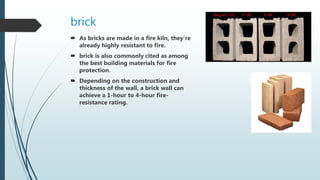
brick
 As bricks are made in a fire kiln, they're
already highly resistant to fire.
 brick is also commonly cited as among
the best building materials for fire
protection.
 Depending on the construction and
thickness of the wall, a brick wall can
achieve a 1-hour to 4-hour fire-
resistance rating.
Pressurization:
The establishment of a pressure difference across a barrier to protect a stairway, lobby escape route, or room of a
building from smoke penetration.
Pressurization Level:
The pressure difference between the pressurized space and the area served by the pressurized
escape route, expressed in Pascal's (Pa)
“The technique adopted is to create a higher
pressure in an escape route by mechanical
ventilation, thus preventing the ingress of smoke
and toxic gases into the protected area. The most
common method is by use of centrifugal or axial
fans driven by an electric motor. The basic design
considerations are:
The pressure required in the escape route and
the leakage paths. To be effective, the system should
operate when required at a higher pressure than that
developed by the fire and weather conditions.”
Fire guidelines by nbc part 2

Fire guidelines by nbc part 2

  • 1.
    Fire guidelines byNBC(part-2) Maneesh kumar Reddy Ps no 20092039 Hci metros
  • 2.
    contents  Introduction  Typesof construction  Commonly used building materials  Fire resistant building materials  Fire Resistance Ratings of Structural Elements  Designing of a fire-resistive building  Conclusions  References
  • 3.
    Introduction  Construction inwhich the floors, walls, roof, and other components are built exclusively of non combustible materials, with fire-endurance ratings equal to or greater than those mandated by law.  In a fire resistant construction, the maximum use of non-combustible materials should be encouraged. All the structural elements such as beams, columns, lintel, floors and roofs, load bearing walls or partition walls etc. Should be constructed in such a way that they should continue to function as structural members at least for the period which may be sufficient for the occupants to escape.  The load bearing walls or columns of masonry should be thicker in section so that they may successfully act as fire barrier for a considerable time  So far as possible fire resisting materials should be used in construction
  • 4.
     TYPES OFCONSTRUCTION : 1. Fireproof construction 2. Noncombustible construction 3. Exterior protected construction 4. Wood construction
  • 5.
     TYPE 1.FIREPROOF CONSTRUCTION (Fire Resistive Construction)  Construction of buildings that resist fire damage and prevent the spread of fire.  Fireproof building containing only no burning components, Such as steel, terra-cotta, plaster, and concrete  Fire-resistance requirements can range from 3 to 4 hour.  Buildings may be used as high-rise office buildings, shopping centers, or residential units.  For buildings 15 m in height or above.  Buildings may be used as high-rise office buildings, shopping centers, or residential units.  Fire-resistance requirements have the following ratings as a range.  Exterior bearing walls: 3 to 4 hours.  Interior bearing walls: 2 to 4 hours.  Columns: 2 to 4 hours.  Beams, girders, trusses, and arches: 2 to 4 hours.  Floors: 2 to 3 hours.  Roof: 1-1/2 to 2 hours.
  • 6.
     TYPE 2.NONCOMBUSTIBLE CONSTRUCTION  Construction using masonry materials, Brick or concrete, on the outside walls of the structure,  And noncombustible materials for the roof and floor.  For buildings 15 m in height or above  Fire-resistance requirements can range from 2 to 3 hour.  Construction using masonry materials, Brick or concrete, on the outside walls of the structure, And noncombustible materials for the roof and floor.  Buildings may be used as office buildings.  Fire-resistance requirements shall have, as a minimum, the following ratings:  Exterior bearing walls: 0 to 2 hours.  Interior bearing walls: 0 to 2 hours.  Columns: 0 to 2 hours.  Beams, girders, trusses, arches: 0 to 2 hours.  Floors: 0 to 2 hours.  Roof: 0 to 1 hour.
  • 7.
     TYPE 3.EXTERIOR PROTECTED CONSTRUCTION (Ordinary Building)  Construction in which all structural elements of exterior walls are of non-combustible materials  Fire-resistance requirements for all elements can range from 0 to 1 hour.  Buildings may be retail stores, mixed occupancy, dwellings, and apartment buildings.  Only the exterior load-bearing walls shall be noncombustible or limited combustible, and shall have as a minimum a 1-hour rating.  They also may be required to be protected and to have the following fire-resistance ratings:  Interior bearing walls: 0 to 1 hour.  Columns: 0 to 1 hour.  Beams, girders, trusses, arches: 0 to 1 hour.  Floors: 0 to 1 hour.  Roof: 0 to 1 hour.
  • 8.
     TYPE 4.WOOD CONSTRUCTION  The construction in which the exterior wall or bearing wall, roof and floor wholly or partially of wood  Structural members are entirely or partially made from wood or other approved combustible material.  Fire-resistance requirements for all elements can range from 0 to 1 hour.  Exterior and interior bearing walls shall have, as a minimum, the following fire-resistance ratings:   Exterior bearing walls: 2 hours.  Interior bearing walls: 1 to 2 hours
  • 9.
     TYPE 4.WOOD CONSTRUCTION  The construction in which the exterior wall or bearing wall, roof and floor wholly or partially of wood  Structural members are entirely or partially made from wood or other approved combustible material.  Fire-resistance requirements for all elements can range from 0 to 1 hour.  Exterior and interior bearing walls shall have, as a minimum, the following fire-resistance ratings:   Exterior bearing walls: 2 hours.  Interior bearing walls: 1 to 2 hours
  • 10.
  • 11.
    Timber  Wood isthe oldest material used by humans for construction after stone.  Exceptionally strong relative to its weight  A good heat and electrical insulator  It is a renewable and biodegradable resource.  Environmentally friendly  Strong and lightweight  Easy to install, Durable, Cost effective, Flexible  Timber has a unique property of self insulation and slow burning and offers considerable resistance to fire  Additional fire resistance is achieved through impregnation of timber with large quantities of fire-retarding chemicals  The commonly used chemical for this purpose are ammonium phosphate and sulphate , borax and boric acid, zinc chloride etc.  This treatment retards increase in temperature during fire, decrease rate of flame spread
  • 12.
    Brick  Bricks areused for building and pavement all throughout the world.  Bricks are usually laid flat and are usually bonded forming a structure to increase its stability and strength.  First class bricks moulded from good clay can stand exposure to fire for a considerable length of time  The properties of bricks which render them fire resistant are the materials of construction and the component of fire-resistive materials in brick i.e. clay  Normally burnt clay bricks , sand lime bricks ,engineering bricks , concrete bricks , fly ash bricks.
  • 13.
    stone  The usageof stone in a fire resistive construction should be strictly restricted to the minimum  Hot stone when subjected to sudden cooling develops crack and can lead to failure of structure  Lime stone is least recommended as it get ruined by an ordinary fire  Only compact sand stone having fine grains may be used as it can stand the exposure to moderate fire without serious cracks
  • 14.
    steel  Steel hasa very low fire resistance value  With increase in temperature, the co- efficient of elasticity of metal falls appreciably rendering the structural members soft and free to expand  When the members in this state came in contact with water used for extinguishing the fire, they tend to contract, twist or distort and thus the stability of the entire structure is endangered.
  • 15.
    concrete  Concrete isa composite material composed mainly of water, aggregate, and cement. Often, additives and reinforcements (such as rebar) are included in the mixture to achieve the desired physical properties of the finished material.  Normal concrete  High Strength Concrete  High Performance Concrete  Light Weight Concrete  Self-Compacting Concrete  Shotcrete  Pervious Concrete  The influence of fire on concrete varies with the nature of its coarse aggregate and its density  it has been noticed that in an average fire, the concrete surface gets disintegrated for a depth of about 25mm  This is due to the de hydration of mortar in concrete by the fire  Hence in a reinforced concrete fire resistant construction, the thickness of clear cover should be more
  • 16.
  • 17.
    glass  Glass isan amorphous solid material which is often transparent and has widespread practical, technological, and decorative usage  Flat Glass  Fiber Glass  Laminated Safety Glass  Tempered Safety Glass  Colored Structural Glass  Glass Building Blocks  Heat-Resistant Glass  Glass for Electrical Uses  Glass conduct heat faster than metal because of its low thermal conductivity  When glass is subjected to sudden and extreme variation of temperature, it fractures or cracks.  By the use of glass reinforced with steel wire netting, such cracks can be minimized  The reinforced glass has a higher melting point then the ordinary glass, and such it is commonly used for fire resisting doors, windows, sky-lights etc.
  • 18.
    Flat glass Fiberglass Laminated safety glass Tempered safety glass Coloured glass Glass building blocks Heat resistant glass
  • 19.
    Plaster or mortar Plaster Is a building material used for coating walls and ceilings.  Mortar Is a workable paste used to bind building blocks such as stones, bricks, and concrete masonry units together, fill and seal the irregular gaps between them, and sometimes add decorative colors or patterns in masonry walls.  Plaster or mortar are incombustible and as such, by suitable choice of the type of mortar, the walls or ceiling of a building can be made more fire resistant  The resistance of the plaster to fire hazards can be increased by using it in thicker layer
  • 20.
    SNo. Structural ElementType Of Construction Type 1 Type 2 Type 3 Type 4 1 Exterior walls : a) Fire separation less than 3.7 m i) Bearing 4 2 2 1 ii) Nonbearing 2 1½ 1 1 b) Fire separation of 3.7 m or more but less than 9 m i) Bearing 4 2 2 1 ii) Nonbearing 1½ 1½ 1 1 c) Fire separation of 9 m or more i) Bearing 4 2 2 1 ii) Nonbearing 1 1 1 1 2 Fire walls 4 2 2 2
  • 21.
    SNo. Structural ElementType Of Construction Type 1 Type 2 Type 3 Type 4 3 Fire separation assemblies (like fire check doors) 4 2 2 2 4 Fire enclosures of exit ways, exit way hallways, and stairways 2 2 2 2 5 Shaft other than exit ways elevator hoist ways 2 2 2 2 6 Exit way access corridors 1 1 1 1 7 Vertical separation of tenant spaces 1 1 1 1 8 Dwelling unit separation 1 1 1 1 9 Non load bearing partitions At least an hour half
  • 22.
    SNo. Structural ElementType Of Construction Type 1 Type 2 Type 3 Type 4 9 Interior bearing walls, bearing partitions, columns, girders, trusses(other than roof trusses) and framing i) Supporting more than one floor 4 2 2 2 ii) Supporting one floor only 3 1½ 1 1 iii) Supporting a roof only 3 1½ 1 1 10 Structural members support walls 3 1½ 1 1 11 Floor construction including walls 3 1½ 1 1 12 Roof construction i) 5 m or less in height to lowest member 2 1½ 1 1 ii) More than 5 m but less than 6.7 m in height to lowest member 1 1 1 1 iii) 6.7 m or more in height to lowest member 0 2 0 0
  • 23.
    Fire resistant glassfor windows  Glass is a poor conductor of heat and expends little during heating. Cracks are formed in glass when it is cooled after heating.  Windows, important for visibility and light, can nonetheless be a fire hazard.  Even before a window is in direct contact with flames, the intense heat of a nearby fire can cause the glass to break. And a broken window allows flames to enter a building easily.  In addition, the heat from a fire outside might be enough to simply ignite flammable items inside a home without direct contact.  To protect your house, consider installing fire-resistant windows.  One example is dual-paned glass windows, which double the time it would take for fire to break the windows.  The outer layer will break first before the inner layer
  • 24.
    Concrete  It isone of the most common building materials,  is also an excellent fire-resistant material.  It is noncombustible and has low thermal conductivity, meaning that it takes a long time for fire to affect its structural, load-bearing ability, and it protects from the spread of fire.  It's actually significantly more fire-resistant than steel, and often used to reinforce and protect steel from fire.  The exact fire-resistance properties change depending on the type and amount of aggregate used.  Concrete is often listed among the best fire-resistant roofing materials
  • 25.
    stucco  Stucco isa material made of an aggregate, a binder, and water.  It is used as decorative coating for walls and ceilings and as a sculptural and artistic material in architecture. Stucco may be used to cover less visually appealing construction materials such as metal, concrete or clay brick and adobe.  Modern stucco is made of Portland cement, sand and lime, and it serves as an excellent and durable fire- resistant finish material for buildings.  It can cover any structural material, such as brick or wood.  It usually consists of two or three coats over metal reinforcing mesh. A one-inch (2.54-centimeter) layer of stucco can easily lend a 1-hour fire rating to a wall
  • 26.
    gypsum  Many structuralmaterials will require underlying gypsum sheathing in order to achieve a good fire- resistant rating, and gypsum board is the most commonly used fire-resistant interior finish.  Gypsum board, also known as drywall, consists of a layer of gypsum sandwiched between two sheets of paper.  In addition, gypsum board has a noncombustible core that contains chemically combined water (in calcium sulfate). When affected by fire, the first thing that happens is that this water comes out as steam. This effectively impedes the transfer of heat through the gypsum board. And even after the water is gone, the gypsum core continues to resist fire penetration for a time.  Builders often use multiple layers of gypsum board to increase the fire-resistance rating.
  • 27.
    brick  As bricksare made in a fire kiln, they're already highly resistant to fire.  brick is also commonly cited as among the best building materials for fire protection.  Depending on the construction and thickness of the wall, a brick wall can achieve a 1-hour to 4-hour fire- resistance rating.
  • 28.
    Pressurization: The establishment ofa pressure difference across a barrier to protect a stairway, lobby escape route, or room of a building from smoke penetration. Pressurization Level: The pressure difference between the pressurized space and the area served by the pressurized escape route, expressed in Pascal's (Pa) “The technique adopted is to create a higher pressure in an escape route by mechanical ventilation, thus preventing the ingress of smoke and toxic gases into the protected area. The most common method is by use of centrifugal or axial fans driven by an electric motor. The basic design considerations are: The pressure required in the escape route and the leakage paths. To be effective, the system should operate when required at a higher pressure than that developed by the fire and weather conditions.”