INTRODUCTION TO STEEL
CONCRETE COMPOSITE
STRUCTURE
A PRESENTATION BY STUDENT OF DAY-7TH
BATCH
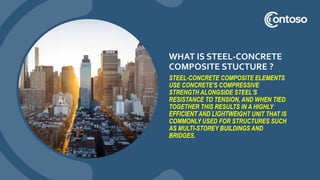
WHAT IS STEEL-CONCRETE
COMPOSITE STUCTURE ?
STEEL-CONCRETE COMPOSITE ELEMENTS
USE CONCRETE'S COMPRESSIVE
STRENGTH ALONGSIDE STEEL'S
RESISTANCE TO TENSION, AND WHEN TIED
TOGETHER THIS RESULTS IN A HIGHLY
EFFICIENT AND LIGHTWEIGHT UNIT THAT IS
COMMONLY USED FOR STRUCTURES SUCH
AS MULTI-STOREY BUILDINGS AND
BRIDGES.
ADVANTAGES & DISADVANTAGES OF RCC STRUCTURE
ADVANTAGES
Reinforced Cement Concrete has good
compressive stress (because of concrete).
RCC also has high tensile stress (because of
steel).
 It has good resistance to damage by fire and
weathering (because of concrete).
RCC protects steel bars from buckling and
twisting at the high temperature.
RCC prevents steel from rusting
DISADVANTAGES
The tensile strength of reinforced concrete is
about one-tenth of its compressive strength.
The main steps of using reinforced concrete
are mixing, casting, and curing. All of this affect
the final strength.
The cost of the forms used for casting is
relatively higher.
For multi-storied building the RCC column
section for is larger than steel section as the
compressive strength is lower in the case of .
Shrinkage causes crack development and
strength loss.
3
Sydney Opera House, Australia
ADVANTAGES & DISADVANTAGES OF STEEL
STRUCTURE
ADVANTAGES
Lower Project Costs.
Aesthetic Appeal.
High Strength.
Sustainable.
Innovative.
Modifiable.
Efficient.
DISADVANTAGES
 Steel is an alloy of iron.
 It has high maintenance costs as it has to be
painted to make it corrosion-resistant.
 There are extensive fireproofing costs
involved as steel is not fireproof.
 Buckling is an issue with steel structures.
 Steel has a high expansion rate with
changing temperatures.
4
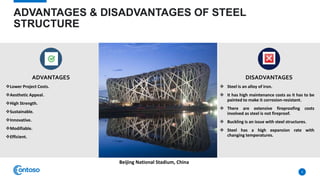
Beijing National Stadium, China
ADVANTAGES & DISADVANTAGES OF STEEL-CONCRETE
COMPOSITE STRUCTURE
ADVANTAGES
The concrete acts together with the steel to
create a stiffer, lighter, less expensive
structure.
Speed and simplicity of construction- faster
to erect, nearly 25% faster then traditional
construction.
Has better ductility and hence superior
lateral load behavior; better earthquake
resister.
Ability to cover large column free area in
buildings and longer span for bridges/flyovers.
DISADVANTAGES
 Provide misleading messages about quality
if poorly constructed or misinterpreted.
 Lead to simplistic policy conclusions.
 Can be misused, if the construction process
is not transparent and lacks sound statistical
or conceptual principles.
 Selection of metrics and weights can be
challenged by other stakeholders.
5
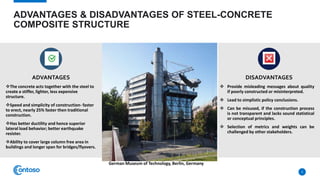
German Museum of Technology, Berlin, Germany
6
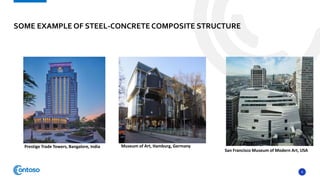
SOME EXAMPLE OF STEEL-CONCRETE COMPOSITE STRUCTURE
Prestige Trade Towers, Bangalore, India Museum of Art, Hamburg, Germany
San Francisco Museum of Modern Art, USA
THANKYOU!

Introduction to steel concrete composite structure

  • 1.
    INTRODUCTION TO STEEL CONCRETECOMPOSITE STRUCTURE A PRESENTATION BY STUDENT OF DAY-7TH BATCH
  • 2.
    WHAT IS STEEL-CONCRETE COMPOSITESTUCTURE ? STEEL-CONCRETE COMPOSITE ELEMENTS USE CONCRETE'S COMPRESSIVE STRENGTH ALONGSIDE STEEL'S RESISTANCE TO TENSION, AND WHEN TIED TOGETHER THIS RESULTS IN A HIGHLY EFFICIENT AND LIGHTWEIGHT UNIT THAT IS COMMONLY USED FOR STRUCTURES SUCH AS MULTI-STOREY BUILDINGS AND BRIDGES.
  • 3.
    ADVANTAGES & DISADVANTAGESOF RCC STRUCTURE ADVANTAGES Reinforced Cement Concrete has good compressive stress (because of concrete). RCC also has high tensile stress (because of steel).  It has good resistance to damage by fire and weathering (because of concrete). RCC protects steel bars from buckling and twisting at the high temperature. RCC prevents steel from rusting DISADVANTAGES The tensile strength of reinforced concrete is about one-tenth of its compressive strength. The main steps of using reinforced concrete are mixing, casting, and curing. All of this affect the final strength. The cost of the forms used for casting is relatively higher. For multi-storied building the RCC column section for is larger than steel section as the compressive strength is lower in the case of . Shrinkage causes crack development and strength loss. 3 Sydney Opera House, Australia
  • 4.
    ADVANTAGES & DISADVANTAGESOF STEEL STRUCTURE ADVANTAGES Lower Project Costs. Aesthetic Appeal. High Strength. Sustainable. Innovative. Modifiable. Efficient. DISADVANTAGES  Steel is an alloy of iron.  It has high maintenance costs as it has to be painted to make it corrosion-resistant.  There are extensive fireproofing costs involved as steel is not fireproof.  Buckling is an issue with steel structures.  Steel has a high expansion rate with changing temperatures. 4 Beijing National Stadium, China
  • 5.
    ADVANTAGES & DISADVANTAGESOF STEEL-CONCRETE COMPOSITE STRUCTURE ADVANTAGES The concrete acts together with the steel to create a stiffer, lighter, less expensive structure. Speed and simplicity of construction- faster to erect, nearly 25% faster then traditional construction. Has better ductility and hence superior lateral load behavior; better earthquake resister. Ability to cover large column free area in buildings and longer span for bridges/flyovers. DISADVANTAGES  Provide misleading messages about quality if poorly constructed or misinterpreted.  Lead to simplistic policy conclusions.  Can be misused, if the construction process is not transparent and lacks sound statistical or conceptual principles.  Selection of metrics and weights can be challenged by other stakeholders. 5 German Museum of Technology, Berlin, Germany
  • 6.
    6 SOME EXAMPLE OFSTEEL-CONCRETE COMPOSITE STRUCTURE Prestige Trade Towers, Bangalore, India Museum of Art, Hamburg, Germany San Francisco Museum of Modern Art, USA
  • 7.