1of 
Corridor Pressurization System Performance in Multi-UnitResidential Buildings 
ASHRAE ANNUAL CONFERENCE 2014 
JULY 2, 2014 
PRESENTED BY LORNE RICKETTS, MASC, EIT
2of 
Learning Objectives & ASHRAE Disclaimer 
Learning Objectives: 
Explain how faults in residential HVAC systems can cause excess energy consumption in homes 
Describe how energy consumption data can be used to detect faults in residential HVAC systems 
Define the need for occupancy education related to hybrid home operation and need for commissioning and advanced control strategies 
Explain the complex interaction between active and passive HVAC systems for a net zero energy home 
Describe the importance of carbon emission reduction in built environment and Singapore’s Green Mark approach in assessing energy efficiency of air-conditioning systems 
Familiarise themselves with the approach surrounding successful implementation of low-cost measures as part of retro- commissioning process 
Understand typical ventilation practices for high-rise multi-unit residential buildings including corridor pressurization systems 
Understand performance issues with corridor pressurization based ventilation systems 
ASHRAE is a Registered Provider with The American Institute of Architects Continuing Education Systems. Credit earned on completion of this program will be reported to ASHRAE Records for AIA members. Certificates of Completion for non-AIA members are available on request. This program is registered with the AIA/ASHRAE for continuing professional education. As such, it does not include content thatmay be deemed or construed to be an approval or endorsement by the AIA of any material of construction or any method or manner of handling, using, distributing, or dealing in any material or product. Questions related to specific materials, methods, and services willbe addressed at the conclusion of this presentation.
3of 
Outline 
Introduction & Background 
Testing and Measurement Program 
Measured Ventilation Rates (PFT testing) 
Cause of Ventilation Rates 
Extension of Study Findings 
Conclusions & Recommendations
4of 
Introduction & Background 
Most apartments/condos (multi-unit residential buildings) are ventilated using pressurized corridor systems 
Decades of research and experience indicates that this system likely does not work very well 
Still most common system 
Few physical measurements 
Particularly relevant now, as newer more airtight building have less tolerance for poorly performing ventilation systems 
Less infiltration and exfiltration to supplement ventilation
5of 
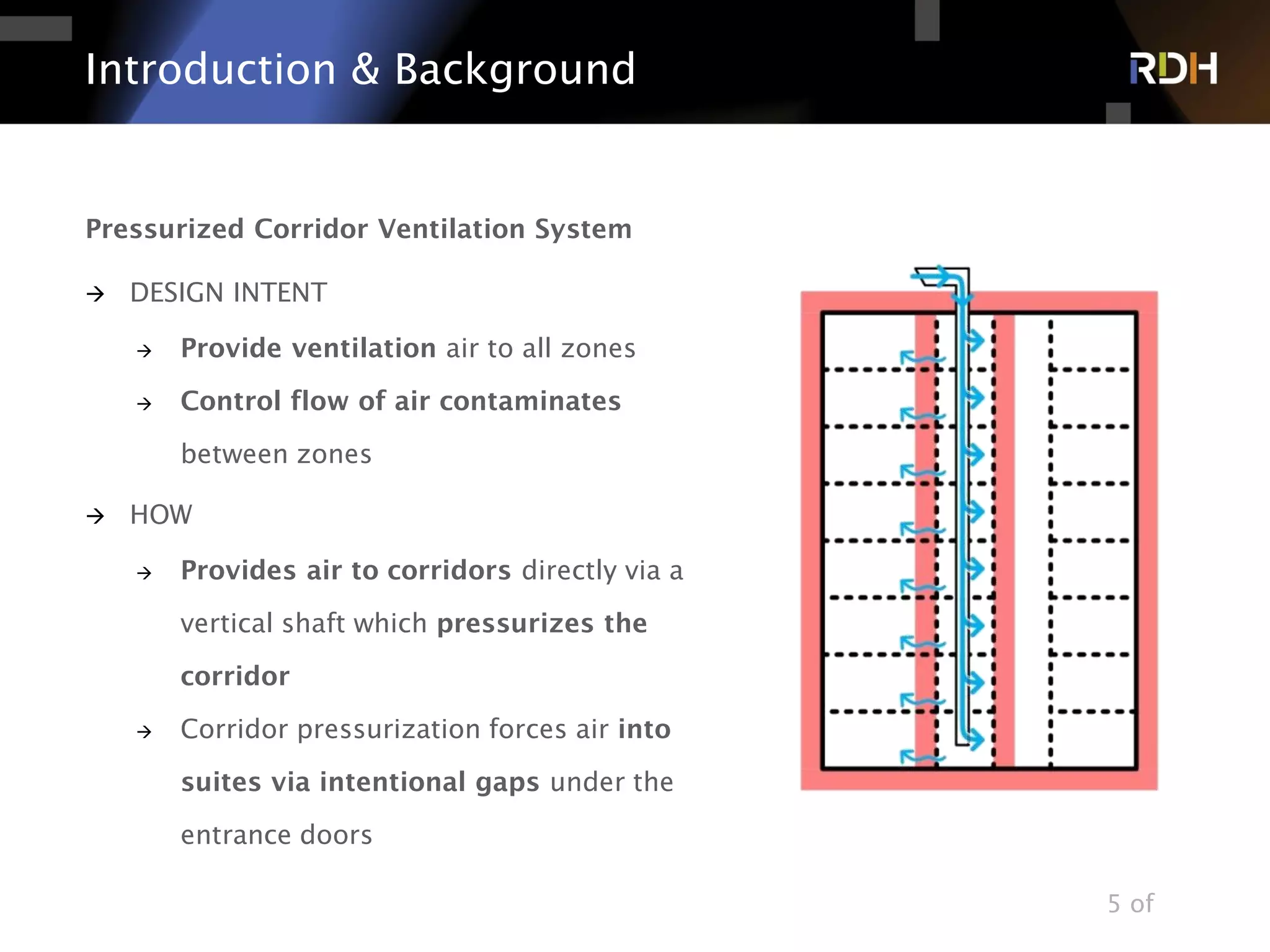
Pressurized Corridor Ventilation System 
DESIGN INTENT 
Provide ventilation air to all zones 
Control flow of air contaminates between zones 
HOW 
Provides air to corridors directly via a vertical shaft whichpressurizes the corridor 
Corridor pressurization forces air into suites via intentional gapsunder the entrance doors 
Introduction & Background
6of 
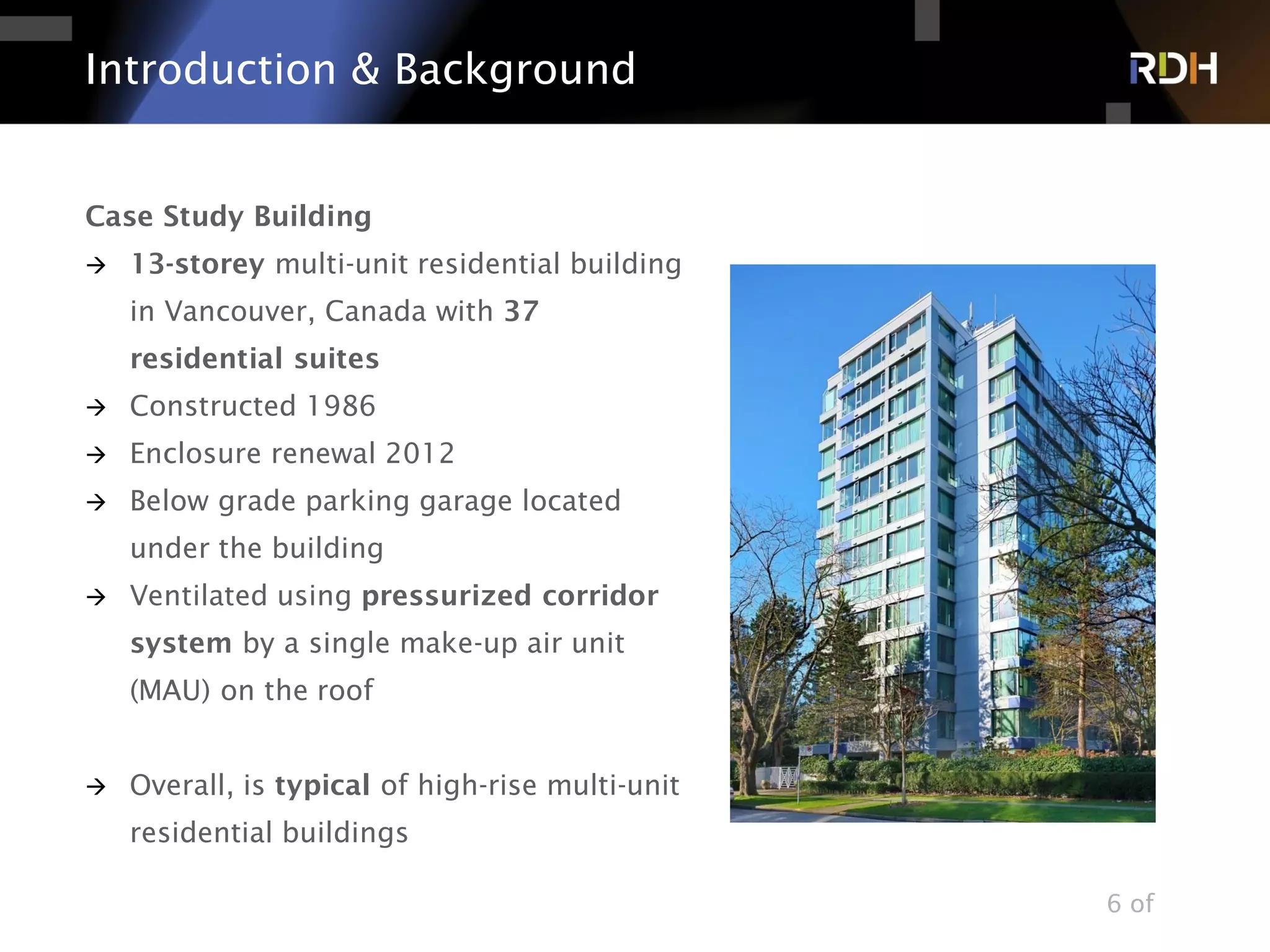
Case Study Building 
13-storey multi-unit residential building in Vancouver, Canada with 37 residential suites 
Constructed 1986 
Enclosure renewal 2012 
Below grade parking garage located under the building 
Ventilated using pressurized corridor system by a single make-up air unit (MAU) on the roof 
Overall, is typicalof high-rise multi-unit residential buildings 
Introduction & Background
7of 
Perfluorocarbon(PFT) Testing 
Two component system: 
PFT Sources (7 distinct types) 
Capillary absorption tube samplers(CATS) 
Sources release distinct PFT tracer gasses in different zonesand use CATS to sample the concentrations 
Measured Ventilation Rates 
Sources 
CATS
8of 
Order of magnitude variation in the ventilation rates 
Significantly higher rates for upper suites than lower suites 
Most suites under-ventilated or over-ventilated 
Measured Ventilation Rates 
ASHRAE 62.1-2010≈ 40 L/s per suite 
Waste of Energy 
Indoor Air Quality Issues
9of 
Measured Ventilation Rates 
PMCP Released in MAU
10of 
Carbon dioxide concentration were monitored as an indicator of indoor air quality (IAQ) 
Significantly higher concentration in the lower suites 
Measured Ventilation Rates
11of 
Summary: 
Over ventilation and under ventilation of most suites 
Higher ventilation rates in upper suites than lower suites 
Better indoor air quality in upper suites than lower suites 
Why is this happening? 
Measured Ventilation Rates
12of 
Maybe the MAU isn’t working correctly? 
Custom powered flow hood used to measure intake flow rate of the make-up air unit 
MAU airflow approximately the sameas design flow rate of 1,560 L/s (3,300 cfm) 
Cause of Ventilation Rates
13 of 
Maybe the ventilation air isn’t reaching the corridors? 
 Only 40% of intake flow reaches the corridors directly 
Cause of Ventilation Rates 
0 
2 
4 
6 
8 
10 
12 
14 
0 25 50 75 100 125 150 
Floor Number 
Flow Rate [L/s] 
MAU Supply to Corridors 
Pre-Retrofit (21°C) Post-Retrofit (6°C) Post-Retrofit (16°C) 
Pre-Retrofit (21°C) Total = 593 L/s 
Post-Retrofit (6°C) Total = 559 L/s 
Post-Retrofit (16°C) Total = 580 L/s 
Fire Damper noted to be 
closed on Floors 4, 8, & 12. 
1 L/s ≈ 2 cfm
14of 
Maybe the air isn’t reaching the suites from the corridors? 
Airtightness tested corridors and found significant flow paths other than to the suites through the suite entrance doors. Only 20% to the suites 
Cause of Ventilation Rates 
1 L/s ≈ 2 cfm
15of 
Theoretically, only 8%of intended ventilation actually goes where it is supposed to! Waste of ventilation air, and the energy needed to move and condition it. 
Cause of Ventilation Rates 
If only 40% of the flow rate reaches the corridorsAnd, only 20% of that air reaches the suites… 
Leakage of air along ventilation flow path is a major issue. 
ퟒퟎ%×ퟐퟎ%=ퟖ%
16of 
Pressure differences were monitored with a focus on an upper floor and a lower floor (Floors 11 & 3) 
Assessed relationship between exterior temperature (stack effect) and wind events using a weather station on the roof 
Maybe pressure differencesare an important factor? 
Cause of Ventilation Rates
17 of 
 Mechanical ventilation system creates pressure of 5 to 10 Pa 
Cause of Ventilation Rates 
-20 
-15 
-10 
-5 
0 
5 
10 
15 
20 
Feb 8 6:00 Feb 8 8:00 Feb 8 10:00 Feb 8 12:00 Feb 8 14:00 Feb 8 16:00 Feb 8 18:00 
Pressure Difference [Pa] 
Average Corridor to Suite Pressure by Floor when MAU Off 
Floor 02 Floor 03 Floor 04 Floor 10 Floor 11 Floor 12 
Measurement with MAU Off 
Measurement with MAU Recently Turned On 
Corridor-to-Suite Pressure Difference [Pa]
18 of 
 Pressures created by stack effect found to be of similar 
magnitude (10 to 15 Pa) as mechanical pressures 
Cause of Ventilation Rates 
-5 
0 
5 
10 
15 
20 
25 
-10 
-5 
0 
5 
10 
15 
20 
Exterior Temperature [°C] 
Pressure Difference [Pa] 
Average Suite to Corridor Pressures by Floor and Exterior 
Temperature - 24 Hour Moving Average 
Floor 02 Floor 03 Floor 04 
Floor 10 Floor 11 Floor 12 
Temp - WS' [°C] 
Corridor-to-Suite Pressure Difference [Pa]
19of 
Stack effect pressures found to distribute 69% across the corridor to suite boundary and 9% across exterior enclosure 
Stack effect pressure acts primarily in the same location as mechanical pressures intended to provide ventilation and control contaminate flow 
Cause of Ventilation Rates
20of 
Vancouver is a relatively moderate climate 
Should considerother climates 
Case study building is13 storeys 
Should consider different building heights 
Extension of Study Findings
21of 
Extension of Study Findings 
Stack effect is more significant in taller buildings 
Proportion of wind pressures remains relatively the same 
Relative magnitude of mechanical pressures decreases as height increases 
0% 10% 20% 30% 40% 50% 60% 70% Stack EffectWindMechanical(10 Pa) Percentage of Driving Force Pressure Average Proportions of Driving Force Pressure Differences -Vancouver20 m40 m60 m80 m100 mBuildingHeight
22of 
Extension of Study Findings 
Stack effect more significant in cold climates 
Wind highly variable, but typically more significant in warm climates 
0% 10% 20% 30% 40% 50% 60% 70% Stack EffectWindMechanical(10 Pa) Percentage of Driving Force Pressure Average Proportions of Driving Force Pressure Differnces -40m Tall BuildingMiamiHoustonLos AngelesNew YorkVancouverTorontoCalgaryFairbanks
23of 
Comparison of Driving Forces 
Since all of the pressure differences created by the driving forces (stack effect, wind, & mechanical systems) are of similar magnitude, it is possible that any one could dominate 
This is exaggerated for buildings in more extreme climates than Vancouver 
Ventilation system can not practically overwhelm nature.
24of 
Conclusion 
Corridor pressurization does not provide intended ventilation ratesto a large number of suites 
Some significantly over ventilated while others significantly under ventilated 
Significant leakage along the ventilation air flow path from the duct and the corridor (wasted ventilation) 
Uncontrolled airflow wastes energy and provides poor ventilation 
Stack effect and wind pressures are often similar or greater than mechanically-induced pressures 
Ventilation system can not practically overwhelm nature
25of 
Recommendations for Ventilation System Design 
Ventilation air should be directly supplied to suites to limit the potential of loss along the flow path and of the system being overwhelmed by stack effect and wind 
The exterior enclosure should be airtight, and suites and vertical shafts should be compartmentalized(airtight) to limit the impact of wind and stack effect on ventilation
26of 
References 
Ricketts, L. A Field Study of Airflow in a High-Rise Multi-Unit Residential Building. MAScThesis, Department of Civil Engineering, University of Waterloo, Waterloo, 2014.
27of 
rdh.com 
Discussion + Questions 
FOR FURTHER INFORMATION PLEASE VISIT

Corridor Pressurization System Performance in MURBS

  • 1.
    1of Corridor PressurizationSystem Performance in Multi-UnitResidential Buildings ASHRAE ANNUAL CONFERENCE 2014 JULY 2, 2014 PRESENTED BY LORNE RICKETTS, MASC, EIT
  • 2.
    2of Learning Objectives& ASHRAE Disclaimer Learning Objectives: Explain how faults in residential HVAC systems can cause excess energy consumption in homes Describe how energy consumption data can be used to detect faults in residential HVAC systems Define the need for occupancy education related to hybrid home operation and need for commissioning and advanced control strategies Explain the complex interaction between active and passive HVAC systems for a net zero energy home Describe the importance of carbon emission reduction in built environment and Singapore’s Green Mark approach in assessing energy efficiency of air-conditioning systems Familiarise themselves with the approach surrounding successful implementation of low-cost measures as part of retro- commissioning process Understand typical ventilation practices for high-rise multi-unit residential buildings including corridor pressurization systems Understand performance issues with corridor pressurization based ventilation systems ASHRAE is a Registered Provider with The American Institute of Architects Continuing Education Systems. Credit earned on completion of this program will be reported to ASHRAE Records for AIA members. Certificates of Completion for non-AIA members are available on request. This program is registered with the AIA/ASHRAE for continuing professional education. As such, it does not include content thatmay be deemed or construed to be an approval or endorsement by the AIA of any material of construction or any method or manner of handling, using, distributing, or dealing in any material or product. Questions related to specific materials, methods, and services willbe addressed at the conclusion of this presentation.
  • 3.
    3of Outline Introduction& Background Testing and Measurement Program Measured Ventilation Rates (PFT testing) Cause of Ventilation Rates Extension of Study Findings Conclusions & Recommendations
  • 4.
    4of Introduction &Background Most apartments/condos (multi-unit residential buildings) are ventilated using pressurized corridor systems Decades of research and experience indicates that this system likely does not work very well Still most common system Few physical measurements Particularly relevant now, as newer more airtight building have less tolerance for poorly performing ventilation systems Less infiltration and exfiltration to supplement ventilation
  • 5.
    5of Pressurized CorridorVentilation System DESIGN INTENT Provide ventilation air to all zones Control flow of air contaminates between zones HOW Provides air to corridors directly via a vertical shaft whichpressurizes the corridor Corridor pressurization forces air into suites via intentional gapsunder the entrance doors Introduction & Background
  • 6.
    6of Case StudyBuilding 13-storey multi-unit residential building in Vancouver, Canada with 37 residential suites Constructed 1986 Enclosure renewal 2012 Below grade parking garage located under the building Ventilated using pressurized corridor system by a single make-up air unit (MAU) on the roof Overall, is typicalof high-rise multi-unit residential buildings Introduction & Background
  • 7.
    7of Perfluorocarbon(PFT) Testing Two component system: PFT Sources (7 distinct types) Capillary absorption tube samplers(CATS) Sources release distinct PFT tracer gasses in different zonesand use CATS to sample the concentrations Measured Ventilation Rates Sources CATS
  • 8.
    8of Order ofmagnitude variation in the ventilation rates Significantly higher rates for upper suites than lower suites Most suites under-ventilated or over-ventilated Measured Ventilation Rates ASHRAE 62.1-2010≈ 40 L/s per suite Waste of Energy Indoor Air Quality Issues
  • 9.
    9of Measured VentilationRates PMCP Released in MAU
  • 10.
    10of Carbon dioxideconcentration were monitored as an indicator of indoor air quality (IAQ) Significantly higher concentration in the lower suites Measured Ventilation Rates
  • 11.
    11of Summary: Overventilation and under ventilation of most suites Higher ventilation rates in upper suites than lower suites Better indoor air quality in upper suites than lower suites Why is this happening? Measured Ventilation Rates
  • 12.
    12of Maybe theMAU isn’t working correctly? Custom powered flow hood used to measure intake flow rate of the make-up air unit MAU airflow approximately the sameas design flow rate of 1,560 L/s (3,300 cfm) Cause of Ventilation Rates
  • 13.
    13 of Maybethe ventilation air isn’t reaching the corridors?  Only 40% of intake flow reaches the corridors directly Cause of Ventilation Rates 0 2 4 6 8 10 12 14 0 25 50 75 100 125 150 Floor Number Flow Rate [L/s] MAU Supply to Corridors Pre-Retrofit (21°C) Post-Retrofit (6°C) Post-Retrofit (16°C) Pre-Retrofit (21°C) Total = 593 L/s Post-Retrofit (6°C) Total = 559 L/s Post-Retrofit (16°C) Total = 580 L/s Fire Damper noted to be closed on Floors 4, 8, & 12. 1 L/s ≈ 2 cfm
  • 14.
    14of Maybe theair isn’t reaching the suites from the corridors? Airtightness tested corridors and found significant flow paths other than to the suites through the suite entrance doors. Only 20% to the suites Cause of Ventilation Rates 1 L/s ≈ 2 cfm
  • 15.
    15of Theoretically, only8%of intended ventilation actually goes where it is supposed to! Waste of ventilation air, and the energy needed to move and condition it. Cause of Ventilation Rates If only 40% of the flow rate reaches the corridorsAnd, only 20% of that air reaches the suites… Leakage of air along ventilation flow path is a major issue. ퟒퟎ%×ퟐퟎ%=ퟖ%
  • 16.
    16of Pressure differenceswere monitored with a focus on an upper floor and a lower floor (Floors 11 & 3) Assessed relationship between exterior temperature (stack effect) and wind events using a weather station on the roof Maybe pressure differencesare an important factor? Cause of Ventilation Rates
  • 17.
    17 of Mechanical ventilation system creates pressure of 5 to 10 Pa Cause of Ventilation Rates -20 -15 -10 -5 0 5 10 15 20 Feb 8 6:00 Feb 8 8:00 Feb 8 10:00 Feb 8 12:00 Feb 8 14:00 Feb 8 16:00 Feb 8 18:00 Pressure Difference [Pa] Average Corridor to Suite Pressure by Floor when MAU Off Floor 02 Floor 03 Floor 04 Floor 10 Floor 11 Floor 12 Measurement with MAU Off Measurement with MAU Recently Turned On Corridor-to-Suite Pressure Difference [Pa]
  • 18.
    18 of Pressures created by stack effect found to be of similar magnitude (10 to 15 Pa) as mechanical pressures Cause of Ventilation Rates -5 0 5 10 15 20 25 -10 -5 0 5 10 15 20 Exterior Temperature [°C] Pressure Difference [Pa] Average Suite to Corridor Pressures by Floor and Exterior Temperature - 24 Hour Moving Average Floor 02 Floor 03 Floor 04 Floor 10 Floor 11 Floor 12 Temp - WS' [°C] Corridor-to-Suite Pressure Difference [Pa]
  • 19.
    19of Stack effectpressures found to distribute 69% across the corridor to suite boundary and 9% across exterior enclosure Stack effect pressure acts primarily in the same location as mechanical pressures intended to provide ventilation and control contaminate flow Cause of Ventilation Rates
  • 20.
    20of Vancouver isa relatively moderate climate Should considerother climates Case study building is13 storeys Should consider different building heights Extension of Study Findings
  • 21.
    21of Extension ofStudy Findings Stack effect is more significant in taller buildings Proportion of wind pressures remains relatively the same Relative magnitude of mechanical pressures decreases as height increases 0% 10% 20% 30% 40% 50% 60% 70% Stack EffectWindMechanical(10 Pa) Percentage of Driving Force Pressure Average Proportions of Driving Force Pressure Differences -Vancouver20 m40 m60 m80 m100 mBuildingHeight
  • 22.
    22of Extension ofStudy Findings Stack effect more significant in cold climates Wind highly variable, but typically more significant in warm climates 0% 10% 20% 30% 40% 50% 60% 70% Stack EffectWindMechanical(10 Pa) Percentage of Driving Force Pressure Average Proportions of Driving Force Pressure Differnces -40m Tall BuildingMiamiHoustonLos AngelesNew YorkVancouverTorontoCalgaryFairbanks
  • 23.
    23of Comparison ofDriving Forces Since all of the pressure differences created by the driving forces (stack effect, wind, & mechanical systems) are of similar magnitude, it is possible that any one could dominate This is exaggerated for buildings in more extreme climates than Vancouver Ventilation system can not practically overwhelm nature.
  • 24.
    24of Conclusion Corridorpressurization does not provide intended ventilation ratesto a large number of suites Some significantly over ventilated while others significantly under ventilated Significant leakage along the ventilation air flow path from the duct and the corridor (wasted ventilation) Uncontrolled airflow wastes energy and provides poor ventilation Stack effect and wind pressures are often similar or greater than mechanically-induced pressures Ventilation system can not practically overwhelm nature
  • 25.
    25of Recommendations forVentilation System Design Ventilation air should be directly supplied to suites to limit the potential of loss along the flow path and of the system being overwhelmed by stack effect and wind The exterior enclosure should be airtight, and suites and vertical shafts should be compartmentalized(airtight) to limit the impact of wind and stack effect on ventilation
  • 26.
    26of References Ricketts,L. A Field Study of Airflow in a High-Rise Multi-Unit Residential Building. MAScThesis, Department of Civil Engineering, University of Waterloo, Waterloo, 2014.
  • 27.
    27of rdh.com Discussion+ Questions FOR FURTHER INFORMATION PLEASE VISIT