Strategic and Tactical
Considerations on the Fireground
4th Edition
Chapter 5 — Building Construction
Learning Objectives
5.1 Identify and discuss the five basic types of building
construction.
5.2 Discuss the benefits and safety concerns with fires
involving timber trusses.
5.3 Discuss the benefits and safety concerns of lightweight
building components.
Building Construction
‣ Type 1: Fire-resistive
‣ Type 2: Noncombustible/limited combustible
‣ Type 3: Ordinary
‣ Type 4: Heavy timber
‣ Type 5: Frame
Fire-Resistive Construction (1 of 4)
‣ Question to ask students:
‣ Though steel will not burn, what problems do
firefighters face at a fire in a fire-resistive building?
Fire-Resistive Construction (2 of 4)
‣ The structural members are of noncombustible materials
that meet or exceed requirements prescribed by the
applicable code.
‣ Noncombustible material: “a material which in the form in
which it is used and under the conditions anticipated, will
not ignite, burn, support combustion, or release
flammable vapors, when subjected to fire and heat” (NFP
A).
Fire-Resistive Construction (3 of 4)
‣ Steel
‣ Concrete
‣ New concrete
Fire-Resistive Construction (4 of 4)
‣ Firefighting
‣ Structural components will resist the effects of fire for
a period of time.
‣ While they withstand fire, extensive damage can
occur.
‣ Fire in a fire-resistive building can complicate the
situation.
‣ Time delays, high temperatures, faster spread of fire
Noncombustible/Limited-Combustible
Construction (1 of 5)
‣ Question to ask students:
‣ What problems will firefighters find when operating
on an insulated steel bar joist roof?
Noncombustible/Limited-Combustible
Construction (2 of 5)
‣ Employs materials that do not contribute to the
development or spread of fire.
‣ Though it offers little fire resistance, it does not contribute
fuel to a fire.
‣ There are various types of these structures.
Noncombustible/Limited-Combustible
Construction (3 of 5)
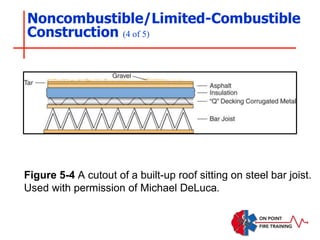
‣ Built-up roof
‣ Common method of roof installation
‣ Tar adhesive used can break down into flammable
gas.
‣ Combustible metal deck roof fire
‣ Operating on a bar joist roof
‣ Difficult to determine the location of the fire below.
‣ Bar joist can be placed farther apart.
Noncombustible/Limited-Combustible
Construction (4 of 5)
Figure 5-4 A cutout of a built-up roof sitting on steel bar joist.
Used with permission of Michael DeLuca.
Noncombustible/Limited-Combustible
Construction (5 of 5)
‣ Operating on a bar joist roof
‣ Ventilation
‣ The roof opening should be made adjacent to the
bar joist.
‣ Collapse
‣ Steel fails at 1100 degrees Fahrenheit.
Ordinary Construction (1 of 4)
‣ Question to ask students:
‣ Recently, have there been any buildings constructed
in your response district, city, or town in which
ordinary construction was employed? List three
locations.
Ordinary Construction (2 of 4)
‣ Contains exterior masonry walls and interior floors and
roofs constructed of wood.
‣ Walls
‣ Thickness depends on the building’s height.
‣ Can be constructed of concrete, stone, brick, or
concrete block or concrete masonry units.
‣ Bearing and nonbearing walls
‣ Common bearing walls or party walls
Ordinary Construction (3 of 4)
‣ Floor and roof joist
‣ Constructed of wood joist
‣ Floorboards
‣ Roof coverings
‣ Fire-cut joist
‣ The fire cut allows the floor to collapse down into the
building without pushing the masonry wall outward.
‣ Beneficial to owners
‣ Deadly to firefighters
Ordinary Construction (4 of 4)
‣ Lintels and arches
‣ Void spaces
‣ Firefighting
‣ Fires can be extinguished with an offensive attack.
‣ Void spaces will necessitate opening walls and
ceilings to ensure complete extinguishment.
Heavy Timber Construction (1 of 4)
‣ Question to ask students:
‣ How can compartmentation be utilized in fighting a
fire in a heavy timber building?
Heavy Timber Construction (2 of 4)
‣ This type is constructed with wooden timbers of large-
dimension lumber.
‣ It can provide an excellent degree of fire resistance.
‣ Fire walls are commonly thicker, bearing masonry walls.
‣ Roof
‣ Floors
Heavy Timber Construction (3 of 4)
‣ Building modifications
‣ Can create problems for firefighters.
‣ Building deterioration
‣ Can result in serious problems.
‣ Firefighting in mill buildings
‣ Presents fire problem due to contents, methods of
stock storage, and large amount of exposed wood.
‣ Fire spreads rapidly.
Heavy Timber Construction (4 of 4)
‣ Fire attack
‣ From unburned side
‣ Consider access, fire wall locations, etc.
‣ Compartmentation
‣ Accomplished through the use of fire walls and
properly functioning fire doors; will assist in
confinement efforts.
Frame Buildings (1 of 6)
‣ Question to ask students:
‣ What is nominal-sized lumber? What difference does
it make to firefighters?
Frame Buildings (2 of 6)
‣ A wood frame building is one in which all members are
wooden or a similar material.
‣ Types of frame buildings
‣ Balloon frame
‣ Platform frame
‣ Post and beam
‣ Log
‣ Plank and beam
Frame Buildings (3 of 6)
‣ Balloon and platform
‣ Frame row dwellings
‣ Nominal-sized lumber
‣ Wood deterioration
‣ Wood treatments
‣ Attacking fires in frame buildings
‣ Exterior walls
‣ Chimney fires
Frame Buildings (4 of 6)
‣ Question to ask students:
‣ What is the purpose of a split ring connector?
Frame Buildings (5 of 6)
‣ Timber truss
‣ Wood truss constructions
‣ Lightweight truss
‣ Timber truss
‣ Benefits of a truss
‣ Identification of the timber truss
Frame Buildings (6 of 6)
‣ Reasons for truss failure
‣ Connection points
‣ Use of steel
‣ Failure of timber truss roofs
‣ All types of roofs fail.
‣ A heavy body of fire in the truss area must act as a
warning sign.
‣ Overloading of supporting members
Lightweight Building Components
(1 of 11)
‣ Question to ask students:
‣ Why is it dangerous to have a fire burning in a void
space containing lightweight building components?
Lightweight Building Components
(2 of 11)
‣ Lightweight building components have come to replace
full-dimensional lumber in both frame and ordinary-
constructed buildings because of their lower cost and
faster assembly.
‣ They fail more readily than conventional construction
when under attack by fire.
Lightweight Building Components
(3 of 11)
‣ Sheet metal surface fasteners
‣ Plywood and oriented strand board
‣ Wooden gusset plates
‣ Failure under fire conditions
‣ Finger-jointed trusses
Lightweight Building Components
(4 of 11)
‣ Wooden I-beams (I-joint)
‣ Steel bar joist
‣ Construction site dangers
‣ Increasing the carrying capacity
Lightweight Building Components
(5 of 11)
‣ Truss void areas
‣ When solid joist lumber is used in a floor or roof
system, a void area is created between each joist.
‣ Void space fires
‣ They attack lightweight components vulnerable to fire,
causing them to fail readily and with little warning.
Lightweight Building Components
(6 of 11)
‣ Site inspections
‣ Preplanning and documentation during construction
‣ Reacting under fire conditions
‣ Attempt to contain the fire to a small area while
protecting the firefighters.
‣ When safety permits, fight the fire from the interior.
‣ Continuous monitoring of the building’s stability is
crucial.
Lightweight Building Components
(7 of 11)
‣ Firefighters’ actions
‣ Let the authority having jurisdiction realize the
dangers of lightweight components.
‣ Get involved. Push for laws requiring sprinklers in
certain areas.
‣ Read a building for indicators that would denote the
presence of a truss.
Lightweight Building Components
(8 of 11)
‣ Identify buildings having lightweight components.
‣ Study their weaknesses.
‣ Visit construction sites.
‣ Lightweight components may fail in less than two
minutes.
Lightweight Building Components
(9 of 11)
‣ Draft-stopping and fire-stopping
‣ Educate firefighters about the signs of failure and
collapse indicators.
‣ Get feedback.
‣ Be concerned when operating in an altered or
renovated building.
Lightweight Building Components
(10 of 11)
‣ Anticipate the interconnection of void spaces in a
building.
‣ Distribute the weight of the firefighters over a greater
area.
‣ Attempt to pull or open ceilings from doorways.
‣ Be alert to firefighters who may fall through weakened
floors.
Lightweight Building Components
(11 of 11)
‣ Do not underestimate the amount of fire involvement
and the seriousness of the situation.
‣ Anticipate rapid failure of lightweight assemblies.
‣ Realize that sheet metal surface fasteners will be
attacked by the fire.
‣ Do not cut through the top chord or any part of the
truss when ventilating a roof or cutting through a floor.
‣ Be cognizant of dead loads on roofs.

1810 Ch 5 PowerPoint.pptx

  • 1.
    Strategic and Tactical Considerationson the Fireground 4th Edition Chapter 5 — Building Construction
  • 2.
    Learning Objectives 5.1 Identifyand discuss the five basic types of building construction. 5.2 Discuss the benefits and safety concerns with fires involving timber trusses. 5.3 Discuss the benefits and safety concerns of lightweight building components.
  • 3.
    Building Construction ‣ Type1: Fire-resistive ‣ Type 2: Noncombustible/limited combustible ‣ Type 3: Ordinary ‣ Type 4: Heavy timber ‣ Type 5: Frame
  • 4.
    Fire-Resistive Construction (1of 4) ‣ Question to ask students: ‣ Though steel will not burn, what problems do firefighters face at a fire in a fire-resistive building?
  • 5.
    Fire-Resistive Construction (2of 4) ‣ The structural members are of noncombustible materials that meet or exceed requirements prescribed by the applicable code. ‣ Noncombustible material: “a material which in the form in which it is used and under the conditions anticipated, will not ignite, burn, support combustion, or release flammable vapors, when subjected to fire and heat” (NFP A).
  • 6.
    Fire-Resistive Construction (3of 4) ‣ Steel ‣ Concrete ‣ New concrete
  • 7.
    Fire-Resistive Construction (4of 4) ‣ Firefighting ‣ Structural components will resist the effects of fire for a period of time. ‣ While they withstand fire, extensive damage can occur. ‣ Fire in a fire-resistive building can complicate the situation. ‣ Time delays, high temperatures, faster spread of fire
  • 8.
    Noncombustible/Limited-Combustible Construction (1 of5) ‣ Question to ask students: ‣ What problems will firefighters find when operating on an insulated steel bar joist roof?
  • 9.
    Noncombustible/Limited-Combustible Construction (2 of5) ‣ Employs materials that do not contribute to the development or spread of fire. ‣ Though it offers little fire resistance, it does not contribute fuel to a fire. ‣ There are various types of these structures.
  • 10.
    Noncombustible/Limited-Combustible Construction (3 of5) ‣ Built-up roof ‣ Common method of roof installation ‣ Tar adhesive used can break down into flammable gas. ‣ Combustible metal deck roof fire ‣ Operating on a bar joist roof ‣ Difficult to determine the location of the fire below. ‣ Bar joist can be placed farther apart.
  • 11.
    Noncombustible/Limited-Combustible Construction (4 of5) Figure 5-4 A cutout of a built-up roof sitting on steel bar joist. Used with permission of Michael DeLuca.
  • 12.
    Noncombustible/Limited-Combustible Construction (5 of5) ‣ Operating on a bar joist roof ‣ Ventilation ‣ The roof opening should be made adjacent to the bar joist. ‣ Collapse ‣ Steel fails at 1100 degrees Fahrenheit.
  • 13.
    Ordinary Construction (1of 4) ‣ Question to ask students: ‣ Recently, have there been any buildings constructed in your response district, city, or town in which ordinary construction was employed? List three locations.
  • 14.
    Ordinary Construction (2of 4) ‣ Contains exterior masonry walls and interior floors and roofs constructed of wood. ‣ Walls ‣ Thickness depends on the building’s height. ‣ Can be constructed of concrete, stone, brick, or concrete block or concrete masonry units. ‣ Bearing and nonbearing walls ‣ Common bearing walls or party walls
  • 15.
    Ordinary Construction (3of 4) ‣ Floor and roof joist ‣ Constructed of wood joist ‣ Floorboards ‣ Roof coverings ‣ Fire-cut joist ‣ The fire cut allows the floor to collapse down into the building without pushing the masonry wall outward. ‣ Beneficial to owners ‣ Deadly to firefighters
  • 16.
    Ordinary Construction (4of 4) ‣ Lintels and arches ‣ Void spaces ‣ Firefighting ‣ Fires can be extinguished with an offensive attack. ‣ Void spaces will necessitate opening walls and ceilings to ensure complete extinguishment.
  • 17.
    Heavy Timber Construction(1 of 4) ‣ Question to ask students: ‣ How can compartmentation be utilized in fighting a fire in a heavy timber building?
  • 18.
    Heavy Timber Construction(2 of 4) ‣ This type is constructed with wooden timbers of large- dimension lumber. ‣ It can provide an excellent degree of fire resistance. ‣ Fire walls are commonly thicker, bearing masonry walls. ‣ Roof ‣ Floors
  • 19.
    Heavy Timber Construction(3 of 4) ‣ Building modifications ‣ Can create problems for firefighters. ‣ Building deterioration ‣ Can result in serious problems. ‣ Firefighting in mill buildings ‣ Presents fire problem due to contents, methods of stock storage, and large amount of exposed wood. ‣ Fire spreads rapidly.
  • 20.
    Heavy Timber Construction(4 of 4) ‣ Fire attack ‣ From unburned side ‣ Consider access, fire wall locations, etc. ‣ Compartmentation ‣ Accomplished through the use of fire walls and properly functioning fire doors; will assist in confinement efforts.
  • 21.
    Frame Buildings (1of 6) ‣ Question to ask students: ‣ What is nominal-sized lumber? What difference does it make to firefighters?
  • 22.
    Frame Buildings (2of 6) ‣ A wood frame building is one in which all members are wooden or a similar material. ‣ Types of frame buildings ‣ Balloon frame ‣ Platform frame ‣ Post and beam ‣ Log ‣ Plank and beam
  • 23.
    Frame Buildings (3of 6) ‣ Balloon and platform ‣ Frame row dwellings ‣ Nominal-sized lumber ‣ Wood deterioration ‣ Wood treatments ‣ Attacking fires in frame buildings ‣ Exterior walls ‣ Chimney fires
  • 24.
    Frame Buildings (4of 6) ‣ Question to ask students: ‣ What is the purpose of a split ring connector?
  • 25.
    Frame Buildings (5of 6) ‣ Timber truss ‣ Wood truss constructions ‣ Lightweight truss ‣ Timber truss ‣ Benefits of a truss ‣ Identification of the timber truss
  • 26.
    Frame Buildings (6of 6) ‣ Reasons for truss failure ‣ Connection points ‣ Use of steel ‣ Failure of timber truss roofs ‣ All types of roofs fail. ‣ A heavy body of fire in the truss area must act as a warning sign. ‣ Overloading of supporting members
  • 27.
    Lightweight Building Components (1of 11) ‣ Question to ask students: ‣ Why is it dangerous to have a fire burning in a void space containing lightweight building components?
  • 28.
    Lightweight Building Components (2of 11) ‣ Lightweight building components have come to replace full-dimensional lumber in both frame and ordinary- constructed buildings because of their lower cost and faster assembly. ‣ They fail more readily than conventional construction when under attack by fire.
  • 29.
    Lightweight Building Components (3of 11) ‣ Sheet metal surface fasteners ‣ Plywood and oriented strand board ‣ Wooden gusset plates ‣ Failure under fire conditions ‣ Finger-jointed trusses
  • 30.
    Lightweight Building Components (4of 11) ‣ Wooden I-beams (I-joint) ‣ Steel bar joist ‣ Construction site dangers ‣ Increasing the carrying capacity
  • 31.
    Lightweight Building Components (5of 11) ‣ Truss void areas ‣ When solid joist lumber is used in a floor or roof system, a void area is created between each joist. ‣ Void space fires ‣ They attack lightweight components vulnerable to fire, causing them to fail readily and with little warning.
  • 32.
    Lightweight Building Components (6of 11) ‣ Site inspections ‣ Preplanning and documentation during construction ‣ Reacting under fire conditions ‣ Attempt to contain the fire to a small area while protecting the firefighters. ‣ When safety permits, fight the fire from the interior. ‣ Continuous monitoring of the building’s stability is crucial.
  • 33.
    Lightweight Building Components (7of 11) ‣ Firefighters’ actions ‣ Let the authority having jurisdiction realize the dangers of lightweight components. ‣ Get involved. Push for laws requiring sprinklers in certain areas. ‣ Read a building for indicators that would denote the presence of a truss.
  • 34.
    Lightweight Building Components (8of 11) ‣ Identify buildings having lightweight components. ‣ Study their weaknesses. ‣ Visit construction sites. ‣ Lightweight components may fail in less than two minutes.
  • 35.
    Lightweight Building Components (9of 11) ‣ Draft-stopping and fire-stopping ‣ Educate firefighters about the signs of failure and collapse indicators. ‣ Get feedback. ‣ Be concerned when operating in an altered or renovated building.
  • 36.
    Lightweight Building Components (10of 11) ‣ Anticipate the interconnection of void spaces in a building. ‣ Distribute the weight of the firefighters over a greater area. ‣ Attempt to pull or open ceilings from doorways. ‣ Be alert to firefighters who may fall through weakened floors.
  • 37.
    Lightweight Building Components (11of 11) ‣ Do not underestimate the amount of fire involvement and the seriousness of the situation. ‣ Anticipate rapid failure of lightweight assemblies. ‣ Realize that sheet metal surface fasteners will be attacked by the fire. ‣ Do not cut through the top chord or any part of the truss when ventilating a roof or cutting through a floor. ‣ Be cognizant of dead loads on roofs.