Essentials of Fire Fighting
6th Edition
Firefighter I
Chapter 2 — Firefighter
Safety and Health
List the main types of job-related
firefighter fatalities, injuries, and
illnesses.
Learning Objective 1
2–2
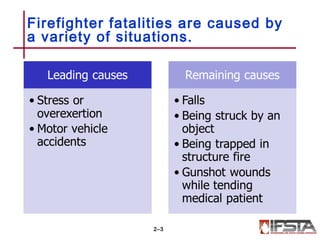
Firefighter fatalities are caused by
a variety of situations.
2–3
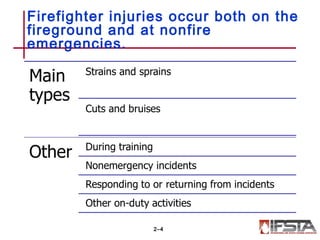
Firefighter injuries occur both on the
fireground and at nonfire
emergencies.
2–4
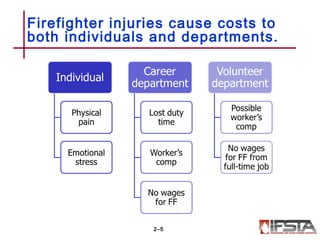
Firefighter injuries cause costs to
both individuals and departments.
2–5
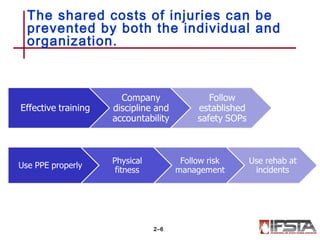
The shared costs of injuries can be
prevented by both the individual and
organization.
2–6
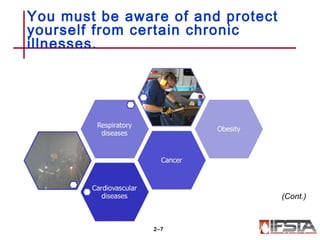
You must be aware of and protect
yourself from certain chronic
illnesses.
2–7
(Cont.)
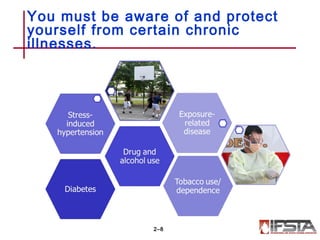
You must be aware of and protect
yourself from certain chronic
illnesses.
2–8
REVIEW QUESTION
What types of job-related injuries and
illnesses can a firefighter expect to
encounter?
2–9
Learning Objective 2
Describe the National Fire Protection
Association®
standards related to
firefighter safety and health.
2–10
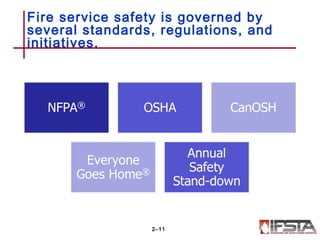
Fire service safety is governed by
several standards, regulations, and
initiatives.
2–11
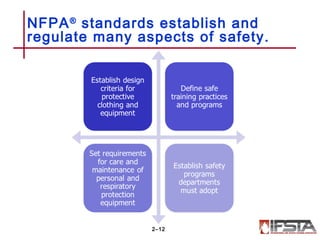
NFPA®
standards establish and
regulate many aspects of safety.
2–12
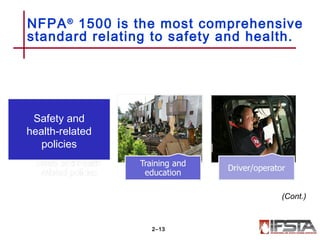
NFPA®
1500 is the most comprehensive
standard relating to safety and health.
2–13
(Cont.)
Safety and
health-related
policies
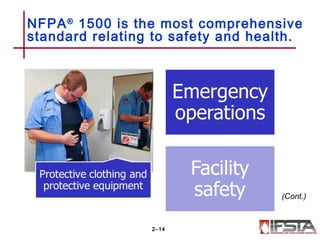
NFPA®
1500 is the most comprehensive
standard relating to safety and health.
2–14
(Cont.)
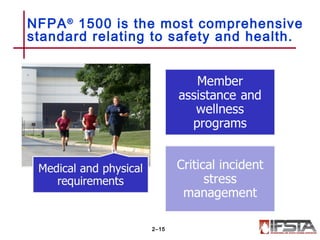
NFPA®
1500 is the most comprehensive
standard relating to safety and health.
2–15
REVIEW QUESTION
What topics does NFPA®
1500 cover
regarding firefighter safety and health?
2–16
Identify Occupational Safety and
Health Administration (OSHA)
regulations that relate to firefighters.
Learning Objective 3
2–17
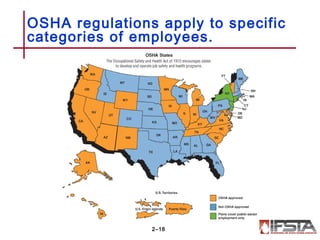
OSHA regulations apply to specific
categories of employees.
2–18
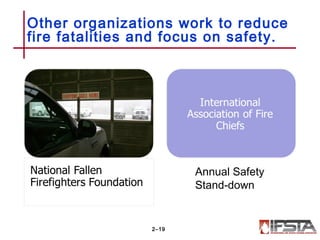
Other organizations work to reduce
fire fatalities and focus on safety.
2–19
Annual Safety
Stand-down
REVIEW QUESTION
Federal OSHA regulations apply to what
specific groups of firefighters?
2–20
Learning Objective 4
Summarize the model that supports
the concept of risk management.
2–21
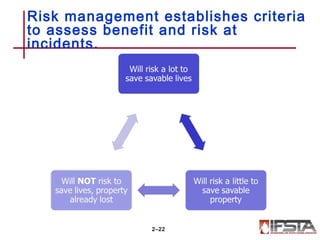
Risk management establishes criteria
to assess benefit and risk at
incidents.
2–22
REVIEW QUESTION
How do the key behaviors of driving
defensively, keeping the crew intact, and
following standard fireground procedures
support the concept of risk management?
2–23
Learning Objective 5
Describe fire department safety and
health programs.
2–24
Learning Objective 6
Summarize firefighter health
awareness issues.
2–25
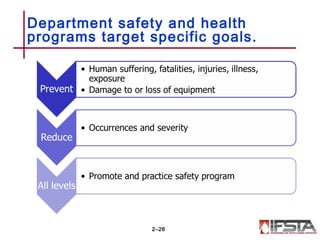
Department safety and health
programs target specific goals.
2–26
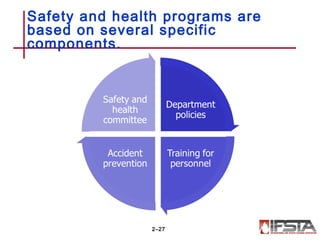
Safety and health programs are
based on several specific
components.
2–27
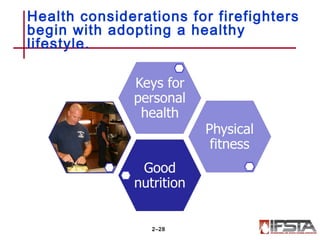
Health considerations for firefighters
begin with adopting a healthy
lifestyle.
2–28
REVIEW QUESTION
What are the main goals of a safety
and health program?
2–29
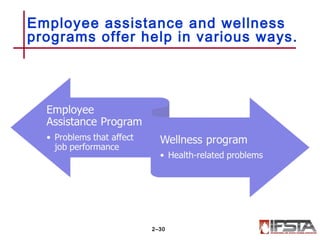
Employee assistance and wellness
programs offer help in various ways.
2–30
REVIEW QUESTION
What areas can an Employee
Assistance and Wellness program assist
with?
2–31
Learning Objective 7
Summarize safe vehicle operations.
2–32
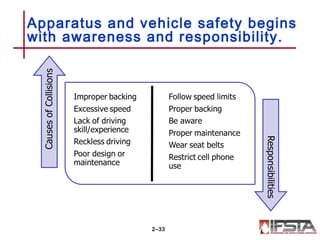
Apparatus and vehicle safety begins
with awareness and responsibility.
2–33
REVIEW QUESTION
What key defensive driving skills can
help promote safe vehicle operations?
2–34
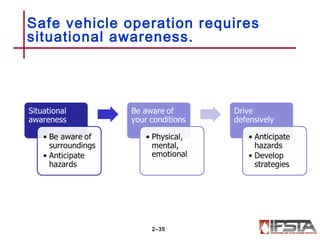
Safe vehicle operation requires
situational awareness.
2–35
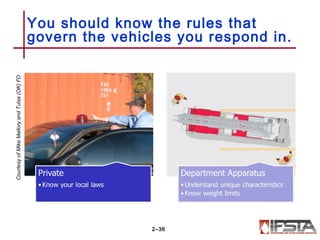
You should know the rules that
govern the vehicles you respond in.
2–36
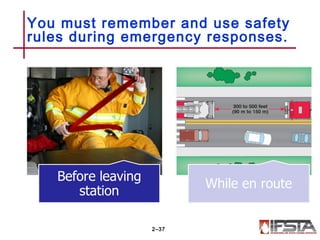
CourtesyofMikeMalloryandTulsa(OK)FD
You must remember and use safety
rules during emergency responses.
2–37
Braking and stopping an apparatus
requires practice and safety.
2–38
Click for
next slide
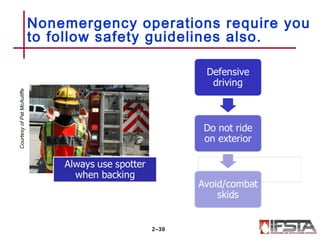
Nonemergency operations require you
to follow safety guidelines also.
2–39
CourtesyofPatMcAuliffe
Learning Objective 8
Summarize guidelines for riding safely
on the apparatus.
2–40
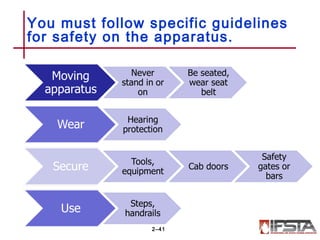
You must follow specific guidelines
for safety on the apparatus.
2–41
REVIEW QUESTION
What are the guidelines for safely
riding on, mounting, and dismounting an
apparatus?
2–42
Learning Objective 9
Describe ways to help prevent
accidents and injuries in fire stations
and facilities.
2–43
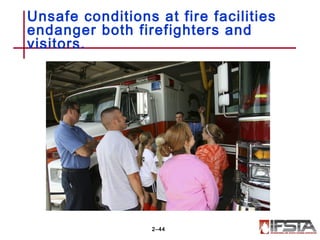
Unsafe conditions at fire facilities
endanger both firefighters and
visitors.
2–44
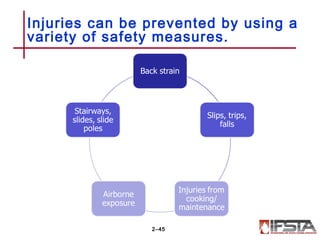
Injuries can be prevented by using a
variety of safety measures.
2–45
REVIEW QUESTION
How can firefighters prevent most
back and leg strains related to injuries at
fire stations and facilities?
2–46
Learning Objective 10
Explain general guidelines for tool and
equipment safety.
2–47
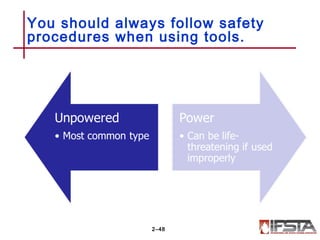
You should always follow safety
procedures when using tools.
2–48
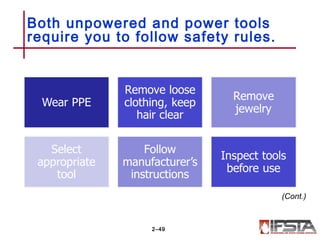
Both unpowered and power tools
require you to follow safety rules.
2–49
(Cont.)
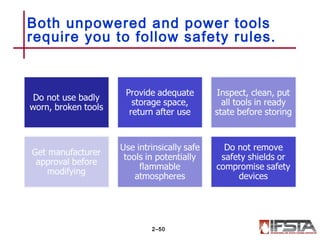
Both unpowered and power tools
require you to follow safety rules.
2–50
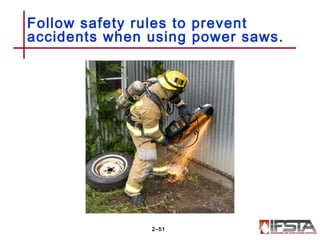
Follow safety rules to prevent
accidents when using power saws.
2–51
REVIEW QUESTION
What are two general guidelines to
follow that can improve tool and
equipment safety?
2–52
Learning Objective 11
Describe ways to maintain safety in
training.
2–53
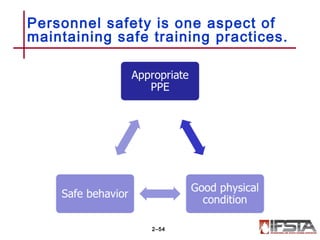
Personnel safety is one aspect of
maintaining safe training practices.
2–54
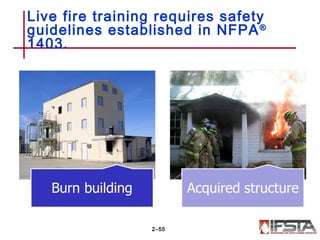
Live fire training requires safety
guidelines established in NFPA®
1403.
2–55
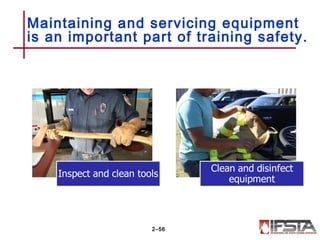
Maintaining and servicing equipment
is an important part of training safety.
2–56
REVIEW QUESTION
What three steps can you take to
maintain personnel safety during training?
2–57
Learning Objective 12
State the practices a Firefighter I uses
for emergency scene preparedness
and safety.
2–58
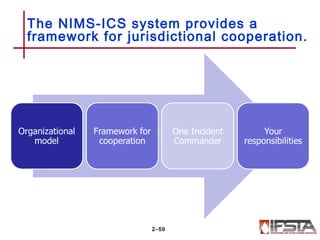
The NIMS-ICS system provides a
framework for jurisdictional cooperation.
2–59
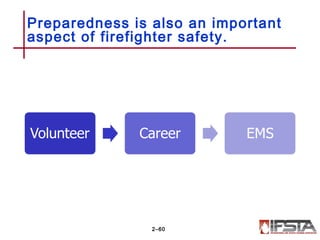
Preparedness is also an important
aspect of firefighter safety.
2–60
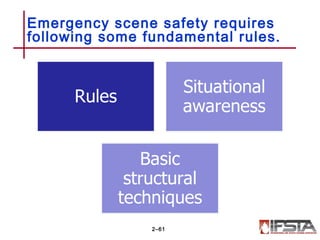
Emergency scene safety requires
following some fundamental rules.
2–61
REVIEW QUESTION
What fundamental rules can help
minimize risks at an emergency scene?
2–62
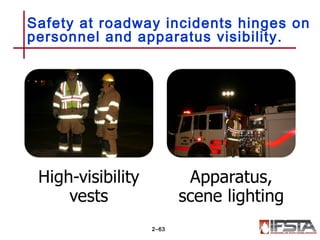
Safety at roadway incidents hinges on
personnel and apparatus visibility.
2–63
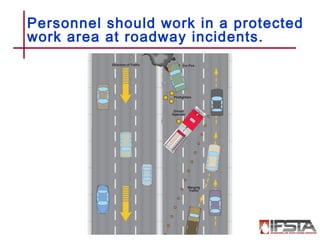
Personnel should work in a protected
work area at roadway incidents.
•1–64
REVIEW QUESTION
What protective equipment is
available to increase your safety at
emergency scenes?
2–65
Learning Objective 13
Summarize general guidelines for
scene management including highway
incidents, crowd control, and
cordoning off emergency scenes.
2–66
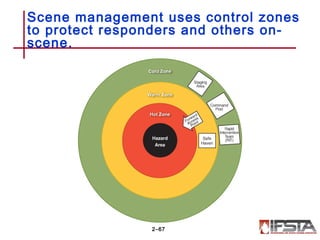
Scene management uses control zones
to protect responders and others on-
scene.
2–67
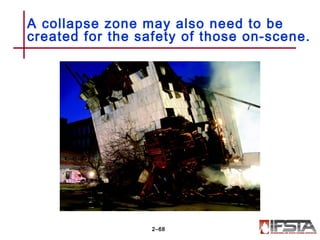
A collapse zone may also need to be
created for the safety of those on-scene.
2–68
REVIEW QUESTION
What types of control zones may be
used to establish scene security?
2–69
Learning Objective 14
Explain the importance of personnel
accountability.
2–70
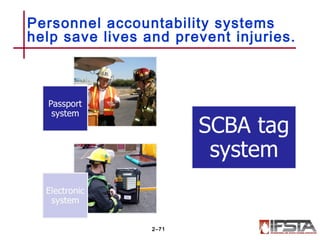
Personnel accountability systems
help save lives and prevent injuries.
2–71
REVIEW QUESTION
Why is proper use of your personnel
accountability system so important?
2–72
Respond to an incident, correctly
mounting and dismounting an
apparatus.
This objective is measured in Skill
Sheet 2-I-1.
Learning Objective 15
2–73
Wearing appropriate PPE, including
reflective vest, demonstrate scene
management at roadway incidents
using traffic and scene control
devices.
This objective is measured in Skill
Sheet 2-I-2.
Learning Objective 16
2–74
Summary
• Safety is essential to your mission of
protecting the public.
• Protect yourself by relying on
situational awareness, wearing
required PPE, following orders, and
following departmental safety policies
and procedures.
2–75
(Cont.)
Summary
• Take responsibility for your own safety
– you cannot protect the community
unless you first protect yourself.
2–76

Chapter 02 ffi