Aircraft Rescue and Fire
Fighting,
5th
Edition
Chapter 8 — Rescue Tools and
Equipment
ARFF
8–2
Chapter 8 Lesson Goal
• After completing this lesson, the student
shall be able to describe rescue tools
and equipment and their uses in ARFF
operations.
ARFF
8–3
Objectives
1. Discuss the use of ARFF
rescue tools and equipment.
2. Describe hand tools used in
ARFF rescue operations.
3. Describe power tools used in
ARFF rescue operations.
(Continued)
ARFF
8–4
Objectives
4. Discuss lifting and pulling tools
and equipment used in ARFF rescue
operations.
5. Discuss lighting and electrical
equipment used in ARFF rescue
operations.
(Continued)
ARFF
8–5
Objectives
6. Discuss other common types of
equipment used in ARFF rescue
operations.
ARFF
8–6
Rescue Tools and Equipment
• Include both hand and power tools
• Divided into four main groups
– Cutting
– Prying
– Pushing/pulling
– Striking
(Continued)
ARFF
8–7
Rescue Tools and Equipment
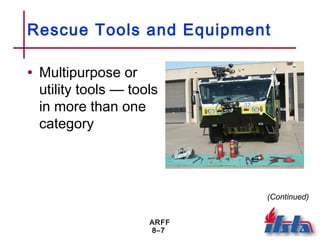
• Multipurpose or
utility tools — tools
in more than one
category
(Continued)
ARFF
8–8
Rescue Tools and Equipment
• Power tools
– May be easier for rescue work
– Mechanical advantage
• Hand tools
– Restricted access
– Mobility
ARFF
8–9
Tool and Equipment Safety
• Limit personnel in operational area
• Wear full protective gear
• Maintain low span of control
• Coordinate rescue efforts
(Continued)
ARFF
8–10
Tool and Equipment Safety
• SAFETY — number one priority
• Follow manufacturer’s guidelines
• Use tools only for intended tasks
ARFF
8–11
Flammable Atmospheres
• Aircraft incident scene
– Must be rendered safe
– Monitor work areas
– Identify, stop, or control fuel leaks
• Cover spilled fuel
– Foam blanket
– Other absorbent materials
(Continued)
ARFF
8–12
Flammable Atmospheres
• Eliminate ignition sources
– Aircraft power on flight deck
– Disconnect batteries
– Runway or taxiway lighting
(Continued)
ARFF
8–13
Flammable Atmospheres
• WARNING! ARFF personnel should
use a flammable metering device when
entering a flammable atmosphere.
ARFF
8–14
Stability of Aircraft
• Aircraft that is not stabilized
– Move, shift, roll
– Trap/injure occupants and rescuers
• Monitor structural conditions of aircraft
(Continued)
ARFF
8–15
Stability of Aircraft
• Positioning apparatus — consider
structural integrity of aircraft
• Stabilizing tools and equipment —
brought to the scene
ARFF
8–16
Assorted Rescue Tools and
Equipment
• Conventional tools and equipment
– Used in structural fire fighting
– Can be adapted to ARFF
• Conventional and specialized tools for
ARFF uses
• Establish an “equipment resource pool”
ARFF
8–17
Hand Tools Used in ARFF
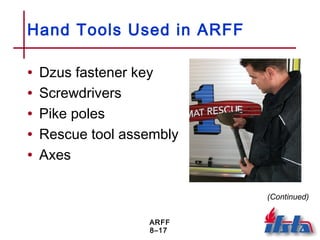
• Dzus fastener key
• Screwdrivers
• Pike poles
• Rescue tool assembly
• Axes
(Continued)
ARFF
8–18
Hand Tools Used in ARFF
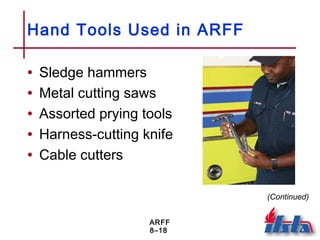
• Sledge hammers
• Metal cutting saws
• Assorted prying tools
• Harness-cutting knife
• Cable cutters
(Continued)
ARFF
8–19
Hand Tools Used in ARFF
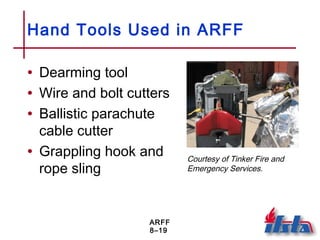
• Dearming tool
• Wire and bolt cutters
• Ballistic parachute
cable cutter
• Grappling hook and
rope sling
Courtesy of Tinker Fire and
Emergency Services.
ARFF
8–20
Power Tools Used in ARFF
Operations
• Power tools
– Gasoline powered
– Electric
– Hydraulic
– Pneumatic
ARFF
8–21
Power Tools Used in ARFF
Operations — Saws
• Many types of saws used in ARFF
• Characteristics needed for aircraft
operations
– Forcible entry — blades capable of cutting
metal
– Circular and rescue saws — rated heavy
duty
(Continued)
ARFF
8–22
Power Tools Used in ARFF
Operations — Saws
• Rotary saw blades
– Types
–Multipurpose or composite
–Carbide- and diamond-tipped
–Serrated
– Should be color-coded
– Are not interchangeable
(Continued)
ARFF
8–23
Power Tools Used in ARFF
Operations — Saws
• Rotary saws
– Tool of choice for rapid, clean cuts
– Drawbacks
–Excessive noise
–Possibility of sparks
(Continued)
ARFF
8–24
Power Tools Used in ARFF
Operations — Saws
• Inspect metal blades
– Teeth present and sharp
– Replace blades if needed
• Rotary saw blades and surfaces — cool
with water spray during long operations
(Continued)
ARFF
8–25
Power Tools Used in ARFF
Operations — Saws
• Reciprocating saws — straight blade
that moves back and forth
– Cutting aircraft skin/structural members
– Heavier the gauge of metal, the slower the
cut
(Continued)
ARFF
8–26
Power Tools Used in ARFF
Operations — Saws
• Reciprocating saws
– More controllable, lightweight
– Can be used from a ladder/confined
spaces
– Use spray bottle to apply water and soap
to blade
ARFF
8–27
Power Tools Used in ARFF
Operations — Drills/Drivers
• Battery-powered/electric or pneumatic
• With a socket drive, open a variety of
compartments
ARFF
8–28
Power Tools Used in ARFF
Operations —
Spreaders/Cutters
• Hydraulically operated tools
– Spreading or forcing apart structural
members
– Extrication operations
• Hydraulic pressure
– Manually through a pump
– Power unit
(Continued)
ARFF
8–29
Power Tools Used in ARFF
Operations —
Spreaders/Cutters
• Hydraulic spreaders and cutters used in
auto extrication — some application in
aircraft incidents
• Spreaders
– Prying
– Pushing
– Crushing
ARFF
8–30
Power Tools Used in ARFF
Operations — Pneumatic Tools
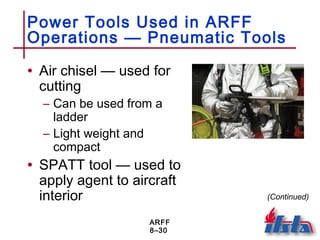
• Air chisel — used for
cutting
– Can be used from a
ladder
– Light weight and
compact
• SPATT tool — used to
apply agent to aircraft
interior (Continued)
ARFF
8–31
Power Tools Used in ARFF
Operations — Pneumatic Tools
• WARNING! Never use compressed
oxygen to power pneumatic tools.
Mixing pure oxygen and grease or oils
found on the tools will result in a fire or
violent explosion.
ARFF
8–32
Lifting and Pulling Tools and
Equipment
• Truck-mounted winch
– Limited applications
– Critical in some situations
(Continued)
ARFF
8–33
Lifting and Pulling Tools and
Equipment
• WARNING! Operate any truck-
mounted winch in accordance with the
manufacturer’s recommendations.
Failure to follow such specifications as
the maximum weight limits may cause a
winch to fail, injuring or killing the
operators or personnel in the immediate
area. (Continued)
ARFF
8–34
Lifting and Pulling Tools and
Equipment
• Come-along
– Same application as truck-mounted winch
– Portable
– Uses a ratchet and pully
(Continued)
ARFF
8–35
Lifting and Pulling Tools and
Equipment
• Rope — ARFF applications are same as
other fire service applications
• Chains — Used primarily in conjunction
with other devices/tools
• Webbing — Should be carried by ARFF
personnel
(Continued)
ARFF
8–36
Lifting and Pulling Tools and
Equipment
• Pneumatic lifting bags
– Easily applied to rescue and aircraft
stabilization
– Also have risks
(Continued)
ARFF
8–37
Lifting and Pulling Tools and
Equipment
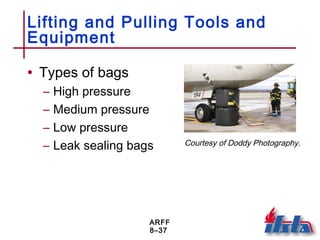
• Types of bags
– High pressure
– Medium pressure
– Low pressure
– Leak sealing bags Courtesy of Doddy Photography.
ARFF
8–38
High-pressure Air Bags
• Have distinct characteristics
– Neoprene rubber construction
– Inflation pressure is 116-145 psi
(812 – 1 015 kPa)
– May inflate to 20 inches (500 mm)
– Largest can lift approximately 75 tons
• Use cribbing or another suitable base
ARFF
8–39
Low- and Medium-pressure Air
Bags
• Used to lift or temporarily stabilize large
vehicles or objects
– Larger than high-pressure bags
– Greater lifting range than high-pressure
bags
– Safer than stacking high-pressure bags
(Continued)
ARFF
8–40
Low- and Medium-pressure Air
Bags
• Disadvantages
– Lift less weight than a high-pressure bag
– Require more space for insertion
– More vulnerable to puncture
– Do not operate like high-pressure bags
– Cannot lift a load straight up
– Must have base or foundation point
(Continued)
ARFF
8–41
Low- and Medium-pressure Air
Bags
• May be capable of lifting an object 6
feet (2 m)
• Low-pressure bags operate on 7 to 10
psi (49 kPa to 70 kPa)
• Medium-pressure bags use 12 to 15 psi
(84 kPa to 105 kPa)
ARFF
8–42
Leak-sealing Bags
• Designed to be inserted into cracks or
holes
• Constructed like high-pressure bags but
inflated at much lower pressure
ARFF
8–43
Jacks
• Used for lifting and stabilizing objects
• Types
– Screw
– Ratchet-lever
– Hydraulic types
(Continued)
ARFF
8–44
Jacks
• Use on flat, level footing in conjunction
with cribbing
• On soft surfaces use a flat board or
steel plate under jack
ARFF
8–45
Lighting and Electrical
Equipment
• Critical during night operations
• Know how to set up and operate
lighting
• Avoid using in flammable atmospheres
ARFF
8–46
Lighting and Electrical
Equipment Safety Tips
• Maintain a safety zone
• Guard against electrical shock
• Treat all wires as “hot”
• Use only approved devices
• Wear full protective clothing
(Continued)
ARFF
8–47
Lighting and Electrical
Equipment Safety Tips
• Use only insulated tools
• Exercise care near electrical
lines/appliances
• Ensure proper ground wire and GFCI
(Continued)
ARFF
8–48
Lighting and Electrical
Equipment Safety Tips
• Do NOT touch any item in contact with
electrical wires
• Do NOT drape cords across fences,
metal guardrails, or through water
ARFF
8–49
Electrical Generators
• Used to illuminate forcible entry and
rescue points
• Used to operate power tools
• Should be removable from apparatus
• Receptacles should be equipped with
GFCIs
ARFF
8–50
Portable Lights
• Should be readily available
• Should be carried to the scene along
with a generator
ARFF
8–51
Vehicle-mounted Lights
• High-powered floodlights mounted in
front
• Side- and rear-mounted lights
• Elevating or extending lights
ARFF
8–52
Extension Cords
• Provide power to portable equipment
– Waterproof
– Adequate insulation
– No exposed wires
• Junction boxes — may be provided with
multiple outlets
ARFF
8–53
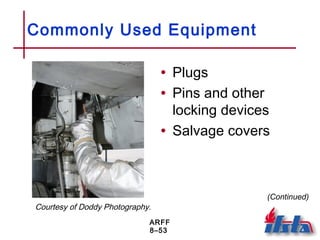
Commonly Used Equipment
• Plugs
• Pins and other
locking devices
• Salvage covers
(Continued)
Courtesy of Doddy Photography.
ARFF
8–54
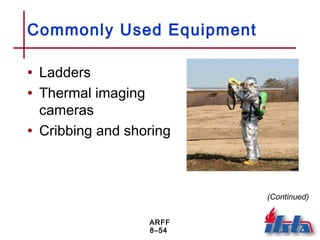
Commonly Used Equipment
• Ladders
• Thermal imaging
cameras
• Cribbing and shoring
(Continued)
ARFF
8–55
Commonly Used Equipment
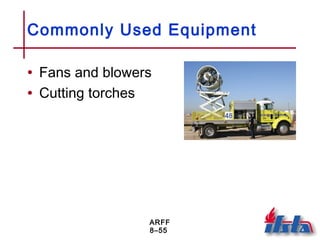
• Fans and blowers
• Cutting torches
ARFF
8–56
Summary
• ARFF personnel utilize a wide variety of
hand tools and power tools at
emergency scenes. All ARFF personnel
should be well trained with the tools
they will be using.
(Continued)
ARFF
8–57
Summary
• ARFF departments should assess what
tools they are likely to need before an
incident and ensure all necessary tools
are accessible and in working order at
all times.
(Continued)
ARFF
8–58
Summary
• ARFF personnel should always use
tools safely and in accordance with the
manufacturer’s instructions. A special
safety consideration for tool use in an
aircraft emergency is flammable
conditions.
(Continued)
ARFF
8–59
Summary
• ARFF personnel should understand the
safe usage of all portable electrical and
lighting equipment needed in ARFF
operations.
ARFF
8–60
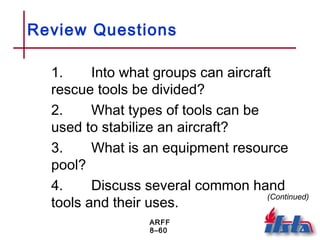
Review Questions
1. Into what groups can aircraft
rescue tools be divided?
2. What types of tools can be
used to stabilize an aircraft?
3. What is an equipment resource
pool?
4. Discuss several common hand
tools and their uses.
(Continued)
ARFF
8–61
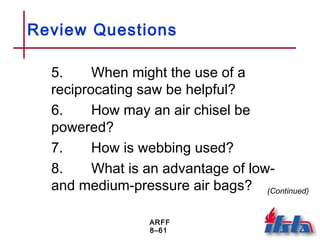
Review Questions
5. When might the use of a
reciprocating saw be helpful?
6. How may an air chisel be
powered?
7. How is webbing used?
8. What is an advantage of low-
and medium-pressure air bags? (Continued)
ARFF
8–62
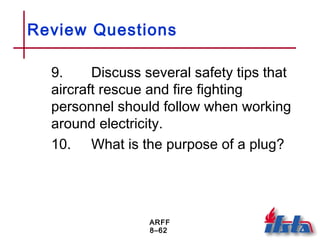
Review Questions
9. Discuss several safety tips that
aircraft rescue and fire fighting
personnel should follow when working
around electricity.
10. What is the purpose of a plug?

Chapter 08 Rescue Tools and Equipment

  • 1.
    Aircraft Rescue andFire Fighting, 5th Edition Chapter 8 — Rescue Tools and Equipment
  • 2.
    ARFF 8–2 Chapter 8 LessonGoal • After completing this lesson, the student shall be able to describe rescue tools and equipment and their uses in ARFF operations.
  • 3.
    ARFF 8–3 Objectives 1. Discuss theuse of ARFF rescue tools and equipment. 2. Describe hand tools used in ARFF rescue operations. 3. Describe power tools used in ARFF rescue operations. (Continued)
  • 4.
    ARFF 8–4 Objectives 4. Discuss liftingand pulling tools and equipment used in ARFF rescue operations. 5. Discuss lighting and electrical equipment used in ARFF rescue operations. (Continued)
  • 5.
    ARFF 8–5 Objectives 6. Discuss othercommon types of equipment used in ARFF rescue operations.
  • 6.
    ARFF 8–6 Rescue Tools andEquipment • Include both hand and power tools • Divided into four main groups – Cutting – Prying – Pushing/pulling – Striking (Continued)
  • 7.
    ARFF 8–7 Rescue Tools andEquipment • Multipurpose or utility tools — tools in more than one category (Continued)
  • 8.
    ARFF 8–8 Rescue Tools andEquipment • Power tools – May be easier for rescue work – Mechanical advantage • Hand tools – Restricted access – Mobility
  • 9.
    ARFF 8–9 Tool and EquipmentSafety • Limit personnel in operational area • Wear full protective gear • Maintain low span of control • Coordinate rescue efforts (Continued)
  • 10.
    ARFF 8–10 Tool and EquipmentSafety • SAFETY — number one priority • Follow manufacturer’s guidelines • Use tools only for intended tasks
  • 11.
    ARFF 8–11 Flammable Atmospheres • Aircraftincident scene – Must be rendered safe – Monitor work areas – Identify, stop, or control fuel leaks • Cover spilled fuel – Foam blanket – Other absorbent materials (Continued)
  • 12.
    ARFF 8–12 Flammable Atmospheres • Eliminateignition sources – Aircraft power on flight deck – Disconnect batteries – Runway or taxiway lighting (Continued)
  • 13.
    ARFF 8–13 Flammable Atmospheres • WARNING!ARFF personnel should use a flammable metering device when entering a flammable atmosphere.
  • 14.
    ARFF 8–14 Stability of Aircraft •Aircraft that is not stabilized – Move, shift, roll – Trap/injure occupants and rescuers • Monitor structural conditions of aircraft (Continued)
  • 15.
    ARFF 8–15 Stability of Aircraft •Positioning apparatus — consider structural integrity of aircraft • Stabilizing tools and equipment — brought to the scene
  • 16.
    ARFF 8–16 Assorted Rescue Toolsand Equipment • Conventional tools and equipment – Used in structural fire fighting – Can be adapted to ARFF • Conventional and specialized tools for ARFF uses • Establish an “equipment resource pool”
  • 17.
    ARFF 8–17 Hand Tools Usedin ARFF • Dzus fastener key • Screwdrivers • Pike poles • Rescue tool assembly • Axes (Continued)
  • 18.
    ARFF 8–18 Hand Tools Usedin ARFF • Sledge hammers • Metal cutting saws • Assorted prying tools • Harness-cutting knife • Cable cutters (Continued)
  • 19.
    ARFF 8–19 Hand Tools Usedin ARFF • Dearming tool • Wire and bolt cutters • Ballistic parachute cable cutter • Grappling hook and rope sling Courtesy of Tinker Fire and Emergency Services.
  • 20.
    ARFF 8–20 Power Tools Usedin ARFF Operations • Power tools – Gasoline powered – Electric – Hydraulic – Pneumatic
  • 21.
    ARFF 8–21 Power Tools Usedin ARFF Operations — Saws • Many types of saws used in ARFF • Characteristics needed for aircraft operations – Forcible entry — blades capable of cutting metal – Circular and rescue saws — rated heavy duty (Continued)
  • 22.
    ARFF 8–22 Power Tools Usedin ARFF Operations — Saws • Rotary saw blades – Types –Multipurpose or composite –Carbide- and diamond-tipped –Serrated – Should be color-coded – Are not interchangeable (Continued)
  • 23.
    ARFF 8–23 Power Tools Usedin ARFF Operations — Saws • Rotary saws – Tool of choice for rapid, clean cuts – Drawbacks –Excessive noise –Possibility of sparks (Continued)
  • 24.
    ARFF 8–24 Power Tools Usedin ARFF Operations — Saws • Inspect metal blades – Teeth present and sharp – Replace blades if needed • Rotary saw blades and surfaces — cool with water spray during long operations (Continued)
  • 25.
    ARFF 8–25 Power Tools Usedin ARFF Operations — Saws • Reciprocating saws — straight blade that moves back and forth – Cutting aircraft skin/structural members – Heavier the gauge of metal, the slower the cut (Continued)
  • 26.
    ARFF 8–26 Power Tools Usedin ARFF Operations — Saws • Reciprocating saws – More controllable, lightweight – Can be used from a ladder/confined spaces – Use spray bottle to apply water and soap to blade
  • 27.
    ARFF 8–27 Power Tools Usedin ARFF Operations — Drills/Drivers • Battery-powered/electric or pneumatic • With a socket drive, open a variety of compartments
  • 28.
    ARFF 8–28 Power Tools Usedin ARFF Operations — Spreaders/Cutters • Hydraulically operated tools – Spreading or forcing apart structural members – Extrication operations • Hydraulic pressure – Manually through a pump – Power unit (Continued)
  • 29.
    ARFF 8–29 Power Tools Usedin ARFF Operations — Spreaders/Cutters • Hydraulic spreaders and cutters used in auto extrication — some application in aircraft incidents • Spreaders – Prying – Pushing – Crushing
  • 30.
    ARFF 8–30 Power Tools Usedin ARFF Operations — Pneumatic Tools • Air chisel — used for cutting – Can be used from a ladder – Light weight and compact • SPATT tool — used to apply agent to aircraft interior (Continued)
  • 31.
    ARFF 8–31 Power Tools Usedin ARFF Operations — Pneumatic Tools • WARNING! Never use compressed oxygen to power pneumatic tools. Mixing pure oxygen and grease or oils found on the tools will result in a fire or violent explosion.
  • 32.
    ARFF 8–32 Lifting and PullingTools and Equipment • Truck-mounted winch – Limited applications – Critical in some situations (Continued)
  • 33.
    ARFF 8–33 Lifting and PullingTools and Equipment • WARNING! Operate any truck- mounted winch in accordance with the manufacturer’s recommendations. Failure to follow such specifications as the maximum weight limits may cause a winch to fail, injuring or killing the operators or personnel in the immediate area. (Continued)
  • 34.
    ARFF 8–34 Lifting and PullingTools and Equipment • Come-along – Same application as truck-mounted winch – Portable – Uses a ratchet and pully (Continued)
  • 35.
    ARFF 8–35 Lifting and PullingTools and Equipment • Rope — ARFF applications are same as other fire service applications • Chains — Used primarily in conjunction with other devices/tools • Webbing — Should be carried by ARFF personnel (Continued)
  • 36.
    ARFF 8–36 Lifting and PullingTools and Equipment • Pneumatic lifting bags – Easily applied to rescue and aircraft stabilization – Also have risks (Continued)
  • 37.
    ARFF 8–37 Lifting and PullingTools and Equipment • Types of bags – High pressure – Medium pressure – Low pressure – Leak sealing bags Courtesy of Doddy Photography.
  • 38.
    ARFF 8–38 High-pressure Air Bags •Have distinct characteristics – Neoprene rubber construction – Inflation pressure is 116-145 psi (812 – 1 015 kPa) – May inflate to 20 inches (500 mm) – Largest can lift approximately 75 tons • Use cribbing or another suitable base
  • 39.
    ARFF 8–39 Low- and Medium-pressureAir Bags • Used to lift or temporarily stabilize large vehicles or objects – Larger than high-pressure bags – Greater lifting range than high-pressure bags – Safer than stacking high-pressure bags (Continued)
  • 40.
    ARFF 8–40 Low- and Medium-pressureAir Bags • Disadvantages – Lift less weight than a high-pressure bag – Require more space for insertion – More vulnerable to puncture – Do not operate like high-pressure bags – Cannot lift a load straight up – Must have base or foundation point (Continued)
  • 41.
    ARFF 8–41 Low- and Medium-pressureAir Bags • May be capable of lifting an object 6 feet (2 m) • Low-pressure bags operate on 7 to 10 psi (49 kPa to 70 kPa) • Medium-pressure bags use 12 to 15 psi (84 kPa to 105 kPa)
  • 42.
    ARFF 8–42 Leak-sealing Bags • Designedto be inserted into cracks or holes • Constructed like high-pressure bags but inflated at much lower pressure
  • 43.
    ARFF 8–43 Jacks • Used forlifting and stabilizing objects • Types – Screw – Ratchet-lever – Hydraulic types (Continued)
  • 44.
    ARFF 8–44 Jacks • Use onflat, level footing in conjunction with cribbing • On soft surfaces use a flat board or steel plate under jack
  • 45.
    ARFF 8–45 Lighting and Electrical Equipment •Critical during night operations • Know how to set up and operate lighting • Avoid using in flammable atmospheres
  • 46.
    ARFF 8–46 Lighting and Electrical EquipmentSafety Tips • Maintain a safety zone • Guard against electrical shock • Treat all wires as “hot” • Use only approved devices • Wear full protective clothing (Continued)
  • 47.
    ARFF 8–47 Lighting and Electrical EquipmentSafety Tips • Use only insulated tools • Exercise care near electrical lines/appliances • Ensure proper ground wire and GFCI (Continued)
  • 48.
    ARFF 8–48 Lighting and Electrical EquipmentSafety Tips • Do NOT touch any item in contact with electrical wires • Do NOT drape cords across fences, metal guardrails, or through water
  • 49.
    ARFF 8–49 Electrical Generators • Usedto illuminate forcible entry and rescue points • Used to operate power tools • Should be removable from apparatus • Receptacles should be equipped with GFCIs
  • 50.
    ARFF 8–50 Portable Lights • Shouldbe readily available • Should be carried to the scene along with a generator
  • 51.
    ARFF 8–51 Vehicle-mounted Lights • High-poweredfloodlights mounted in front • Side- and rear-mounted lights • Elevating or extending lights
  • 52.
    ARFF 8–52 Extension Cords • Providepower to portable equipment – Waterproof – Adequate insulation – No exposed wires • Junction boxes — may be provided with multiple outlets
  • 53.
    ARFF 8–53 Commonly Used Equipment •Plugs • Pins and other locking devices • Salvage covers (Continued) Courtesy of Doddy Photography.
  • 54.
    ARFF 8–54 Commonly Used Equipment •Ladders • Thermal imaging cameras • Cribbing and shoring (Continued)
  • 55.
    ARFF 8–55 Commonly Used Equipment •Fans and blowers • Cutting torches
  • 56.
    ARFF 8–56 Summary • ARFF personnelutilize a wide variety of hand tools and power tools at emergency scenes. All ARFF personnel should be well trained with the tools they will be using. (Continued)
  • 57.
    ARFF 8–57 Summary • ARFF departmentsshould assess what tools they are likely to need before an incident and ensure all necessary tools are accessible and in working order at all times. (Continued)
  • 58.
    ARFF 8–58 Summary • ARFF personnelshould always use tools safely and in accordance with the manufacturer’s instructions. A special safety consideration for tool use in an aircraft emergency is flammable conditions. (Continued)
  • 59.
    ARFF 8–59 Summary • ARFF personnelshould understand the safe usage of all portable electrical and lighting equipment needed in ARFF operations.
  • 60.
    ARFF 8–60 Review Questions 1. Intowhat groups can aircraft rescue tools be divided? 2. What types of tools can be used to stabilize an aircraft? 3. What is an equipment resource pool? 4. Discuss several common hand tools and their uses. (Continued)
  • 61.
    ARFF 8–61 Review Questions 5. Whenmight the use of a reciprocating saw be helpful? 6. How may an air chisel be powered? 7. How is webbing used? 8. What is an advantage of low- and medium-pressure air bags? (Continued)
  • 62.
    ARFF 8–62 Review Questions 9. Discussseveral safety tips that aircraft rescue and fire fighting personnel should follow when working around electricity. 10. What is the purpose of a plug?