Essentials of Fire Fighting
6th Edition
Firefighter I
Chapter 3 — Fire Department
Communications
Explain the procedures for receiving
emergency and nonemergency
external communications.
Learning Objective 1
3–2
Describe the information required to
dispatch emergency services.
Learning Objective 2
3–3
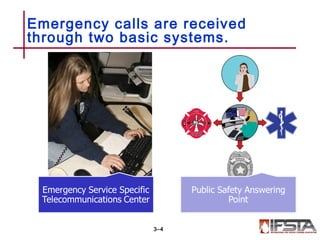
Emergency calls are received
through two basic systems.
3–4
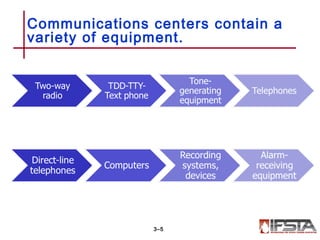
Communications centers contain a
variety of equipment.
3–5
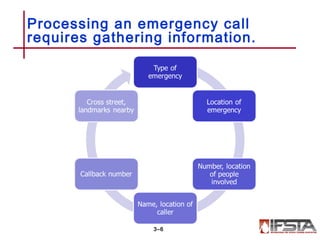
Processing an emergency call
requires gathering information.
3–6
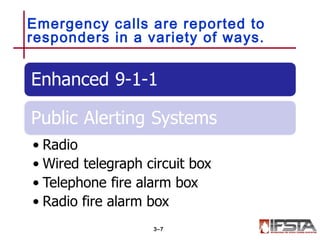
Emergency calls are reported to
responders in a variety of ways.
3–7
REVIEW QUESTION
What is the procedure for receiving
an emergency external
communication?
3–8
Receiving nonemergency calls is
also a part of station life.
3–9
You must remain calm and
courteous when handling angry
calls.
3–10
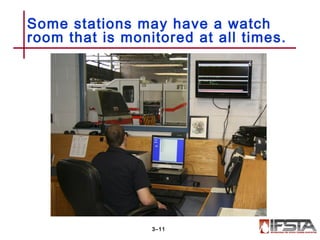
Some stations may have a watch
room that is monitored at all times.
3–11
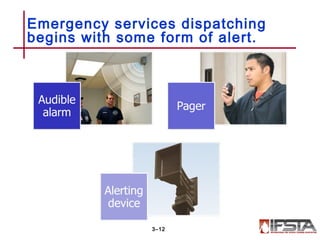
Emergency services dispatching
begins with some form of alert.
3–12
REVIEW QUESTION
What is the procedure for receiving
a nonemergency external
communication?
3–13
Describe the systems used for
internal communications.
Learning Objective 3
3–14
Internal communications are
transmitted to specific groups.
3–15
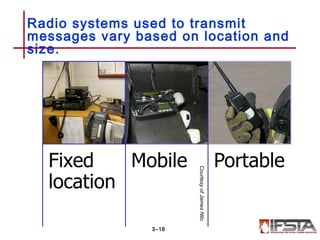
Radio systems used to transmit
messages vary based on location and
size.
3–16
CourtesyofJamesNilo
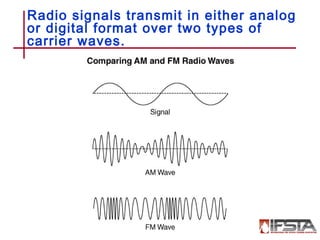
Radio signals transmit in either analog
or digital format over two types of
carrier waves.
3–17
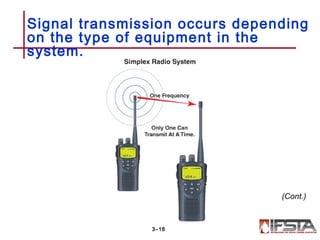
Signal transmission occurs depending
on the type of equipment in the
system.
3–18
(Cont.)
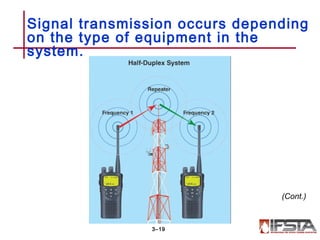
Signal transmission occurs depending
on the type of equipment in the
system.
3–19
(Cont.)
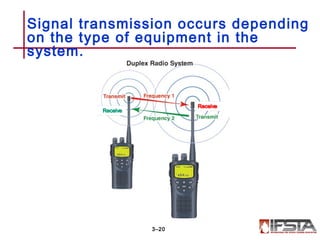
Signal transmission occurs depending
on the type of equipment in the
system.
3–20
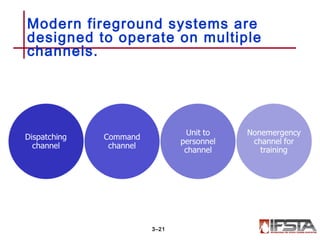
Modern fireground systems are
designed to operate on multiple
channels.
3–21
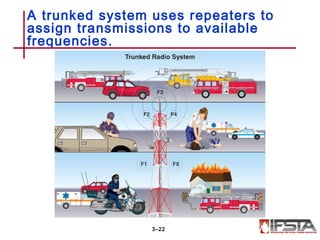
A trunked system uses repeaters to
assign transmissions to available
frequencies.
3–22
REVIEW QUESTION
What types of systems are used for
internal communication?
3–23
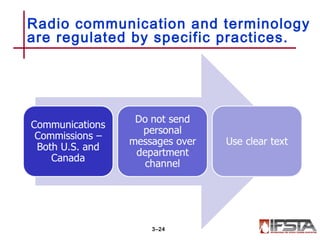
Radio communication and terminology
are regulated by specific practices.
3–24
Explain radio limitations that may
impact internal communications.
Learning Objective 4
3–25
There are several radio limitations
that can impact internal
communications.
3–26
Click for
next slide
REVIEW QUESTION
What radio limitations can impact
internal communications?
3–27
Describe radio procedures used for
internal communications.
Learning Objective 5
3–28
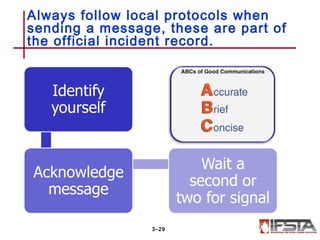
Always follow local protocols when
sending a message, these are part of
the official incident record.
3–29
WARNING
DO NOT REMOVE YOUR
FACEPIECE TO TALK INTO THE MIC.
1–30
REVIEW QUESTION
What radio procedures must be
followed for internal communications?
3–31
• Fire department communications are a
critical factor in the successful outcome
of any incident.
• There is a direct connection between
fireground communications and
fireground safety: The better the
communications, the safer the incident.
Summary
3–32
Handle emergency and
nonemergency calls.
This objective is measured in Skill
Sheet 3-I-1.
Learning Objective 6
3–33
Use a portable radio for routine and
emergency traffic.
This objective is measured in Skill
Sheet 3-I-2.
Learning Objective 7
3–34

Chapter 03 ffi