2
Objectives (1 of4)
• List safety precautions you need to take
during training, during emergency
responses, at emergency incidents, at the
fire station, and outside your workplace.
• Describe the protection provided by
personal protective equipment (PPE).
• Explain the importance of standards for
PPE.
3.
2
Objectives (2 of4)
• Describe the limitations of PPE.
• Describe how to properly maintain PPE.
• Describe the hazards of smoke and other
toxic environments.
• Explain why respiratory protection is
needed in the fire service.
4.
2
Objectives (3 of4)
• Describe the differences between open-
circuit breathing apparatus and closed-
circuit breathing apparatus.
• Describe the limitations associated with
self-contained breathing apparatus
(SCBA).
• List and describe the major components of
SCBA.
5.
2
Objectives (4 of4)
• Explain the skip-breathing technique
• Explain safety precautions when using SCBA
• Describe importance of daily, weekly, monthly
and annual inspections
• Explain the procedures for refilling SCBA
cylinders.
• List the steps for donning a complete PPE
ensemble.
6.
2
Fire Fighter Safety
•Fire fighter safety is paramount in all
operations.
• Fire fighters must be trained and proficient
in the use of personal protective clothing
and respiratory protection equipment.
7.
2
Fire Fighter Safety(1 of 2)
• Firefighting is inherently dangerous.
• Departments must do what they can to
reduce known hazards and dangers.
8.
2
Fire Fighter Safety(2 of 2)
• Incident command (IC) has ultimate
responsibility for the overall safety of every
operation.
• Safety officer is responsible for evaluating
hazards and recommending appropriate
safety measures.
• Final responsibility for personal safety falls
to the individual fire fighter.
9.
2
Causes of FireFighter
Deaths and Injuries (1 of 5)
• Each year in the United States about 100
fire fighters are killed in the line of duty.
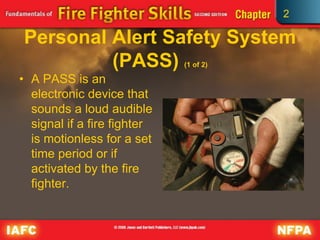
• Deaths occur:
– At emergency incidents
– In the station
– During training
– Responding to or returning from emergencies
10.
2
Causes of FireFighter
Deaths and Injuries (2 of 5)
• Heart attacks are the leading cause of fire
fighter deaths.
– Both on and off the fire ground
11.
2
Causes of FireFighter
Deaths and Injuries (3 of 5)
• Vehicle collisions
– One emergency vehicle collision per 1000
responses
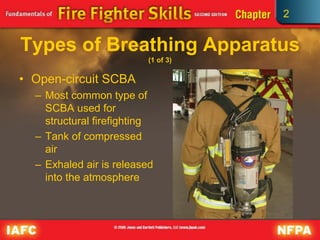
– 39% of fatalities involved failure to use seat
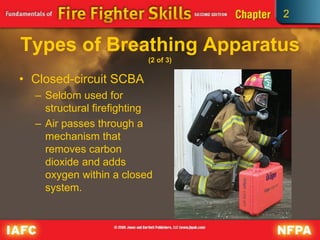
belts.
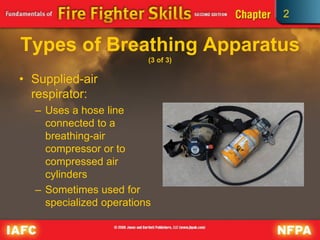
– Seat belt usage is key!
12.
2
Causes of FireFighter
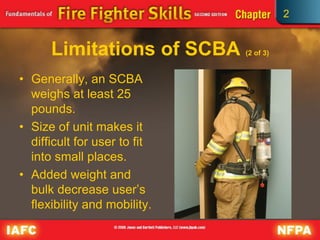
Deaths and Injuries (4 of 5)
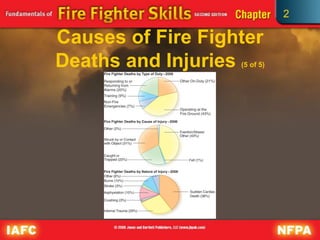
• 80,100 injuries incurred in the line of duty
in 2005 (Source: NFPA)
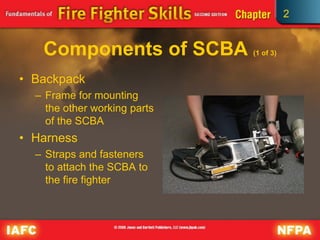
– Strains, sprains, and soft-tissue injuries most
common
– Burns and smoke and gas inhalation only a
small percentage
2
Injury Prevention (1of 2)
• Every team member is responsible for
preventing injuries.
• Priority of safety on the fire ground is:
– Self (personal safety)
– Other team members
– Everyone else
15.
2
Injury Prevention (2of 2)
• A successful safety program will address:
– Standards and procedures
– Personnel
– Training
– Equipment
16.
2
Standards and Procedures(1 of 2)
• Fire service safety is governed by:
– National Fire Protection Association (NFPA)
1500
– State and federal agencies programs such as
the Occupational Safety and Health
Administration (OSHA)
• Every department should have standard
operating procedures (SOPs)
17.
2
Standards and Procedures(2 of 2)
• Incidence command system (ICS) used in
the command and control of emergency
incidents to ensure safe operations.
• Each department should have (or consider
having) a health and safety committee.
18.
2
Personnel (1 of2)
• A safety program is only as effective as
the individuals who implement it.
• Teamwork is essential to safe operations.
• Freelancing is acting independently of
orders or SOPs or SOGs.
• Freelancing is extremely dangerous and
has no place on the fire ground.
19.
2
Personnel (2 of2)
• Safety officer
– Designated member of the fire department
– Primary responsibility is safety.
– Reports directly to the IC
– Has the authority to stop any action deemed
to be unsafe
20.
2
Training
• Knowledge andskills from training are
essential for safety.
• Fire fighters must continually seek out
additional courses and work to keep their
skills current.
21.
2
Equipment
• Fire fightersmust know how to use
equipment properly and operate it safely.
• Equipment must be properly maintained.
• Follow manufacturers’ operating
instructions and safety procedures.
22.
2
Reducing Injuries andDeaths
• Requires the dedicated effort of every
firefighter and every fire department
• In 1992 Congress created the National
Fallen Firefighters Foundation (NFFF).
• 16 Fire Fighter Life Safety Initiatives
• National Fire Fighter Near-Miss Reporting
System
23.
2
Safety and Health(1 of 4)
• A healthful lifestyle includes:
– A balanced diet
– Weight training
– Cardiovascular exercises
• A healthful lifestyle:
– Helps reduce risk factors for heart disease
– Enables fire fighters to meet the physical
demands of the job
24.
2
Safety and Health(2 of 4)
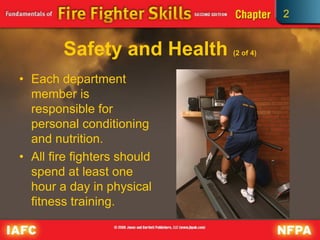
• Each department
member is
responsible for
personal conditioning
and nutrition.
• All fire fighters should
spend at least one
hour a day in physical
fitness training.
25.
2
Safety and Health(3 of 4)
• Drink up to a gallon of water each day to
keep properly hydrated.
• Diet is an important aspect of physical
fitness.
• Avoid tobacco products entirely for both
health and insurance reasons.
26.
2
Safety and Health(4 of 4)
• Never work under the effects of alcohol or
drugs.
– Ensure off-duty alcohol consumption is within
reason and never less than 8 hours before
going on duty.
27.
2
Employee Assistance
Programs (EAP)
•Provide help with a wide range of
problems
• Fire fighters who use an EAP can do so
with complete confidentiality and without
fear of retribution.
28.
2
Safety During Training(1 of 3)
• Average of nine fire fighters are fatally
injured during training exercises every
year (Source: NFPA).
• Proper protective gear and teamwork are
as important during training as they are on
the fire ground.
• Follow safe working habits during training
to ensure safety on the fire ground.
29.
2
Safety During Training(2 of 3)
• Do not attempt anything you feel is beyond
your ability or knowledge.
• Bring unsafe practices to the attention of
your instructors or designated safety
officer.
30.
2
Safety During Training(3 of 3)
• No freelancing during training (or any
other time)!
• Work as a team!
• A fire fighter injured during training should
not return to work until medically cleared
for duty.
31.
2
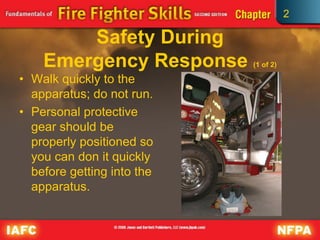
Safety During
Emergency Response(1 of 2)
• Walk quickly to the
apparatus; do not run.
• Personal protective
gear should be
properly positioned so
you can don it quickly
before getting into the
apparatus.
32.
2
Safety During
Emergency Response(2 of 2)
• Be sure that seat belts are properly
fastened before the apparatus begins to
move.
• Know how to don seat-mounted SCBA
without compromising safety.
• Do not speed!
• Comply with all applicable traffic laws.
33.
2
Safe Driving ofPrivate
Vehicles (1 of 3)
• Motor vehicle accidents are the second
leading cause of fire fighter deaths.
• Emergency driving requires added
considerations.
• Collisions consist of a series of separate
collision events.
34.
2
Safe Driving ofPrivate
Vehicles (2 of 3)
• Laws governing emergency vehicle
operation vary from one state to another.
• Fire departments should have SOPs that
dictate the usage of personal vehicles.
• Safe driving begins with you.
– Attitude and ability
– Emergency driving requires good reactions
and alertness.
35.
2
Safe Driving ofPrivate
Vehicles (3 of 3)
• Safe driving practices will prevent most
vehicle collisions.
• Anticipate the road and road conditions.
• Make allowances for weather conditions.
36.
2
Safety at Emergency
Incidents(1 of 2)
• Wait for officer in command to “size up” the
situation.
• Use the buddy system.
• Adhere to a personnel accountability system.
• Understand incident scene hazards.
• Use tools and equipment safely.
• Take precautions for electrical safety.
37.
2
Safety at Emergency
Incidents(2 of 2)
• Practice good lifting and moving techniques.
• Use caution in adverse weather.
• Ensure sufficient time is spent in
rehabilitation.
• Know how to cope with violent scenes.
• Understand critical incident stress debriefing
38.
2
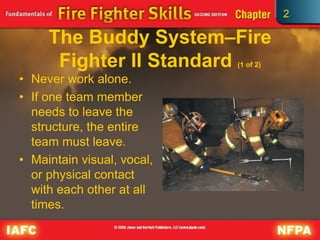
The Buddy System–Fire
FighterII Standard (1 of 2)
• Never work alone.
• If one team member
needs to leave the
structure, the entire
team must leave.
• Maintain visual, vocal,
or physical contact
with each other at all
times.
39.
2
The Buddy System–Fire
FighterII Standard (2 of 2)
• Buddies check each other’s PPE to ensure
it is on and working correctly.
• At least one team member should have a
portable two-way radio.
• Have a back-up team ready.
40.
2
Accountability (1 of2)
• Personnel accountability system:
– Provides an up-to-date accounting of
everyone at the incident and how they are
organized
• Fire fighters must learn their department’s
system, how to work within it, and how it
works within IMS.
41.
2
Accountability (2 of2)
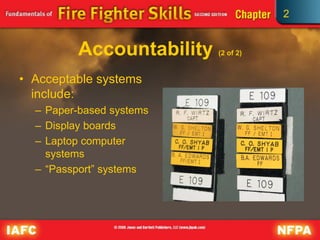
• Acceptable systems
include:
– Paper-based systems
– Display boards
– Laptop computer
systems
– “Passport” systems
42.
2
Incident Scene Hazards
•Be aware of your surroundings.
• Always operate within established
boundaries and protected work areas.
• Changing fire conditions will affect safety.
• Do not let down your safety guard even
though the main part of the fire is over.
43.
2
Using Tools and
EquipmentSafely (1 of 2)
• Learn to use tools and equipment properly
and safely before using them at an
emergency incident.
• Use protective gear such as PPE, safety
glasses, and hearing protection.
44.
2
Using Tools and
EquipmentSafely (2 of 2)
• Equipment should always be in excellent
condition and ready for use.
• Practice doing basic repairs on tools and
equipment at the fire station.
45.
2
Electrical Safety–Fire Fighter
IIStandard (1 of 2)
• Energized power lines may be present on
the fire ground.
• Always check for overhead power lines
when raising ladders.
• Electric power supply to the building
should be turned off.
46.
2
Electrical Safety–Fire Fighter
IIStandard (2 of 2)
• Park apparatus outside the area and away
from power lines.
• A downed power line should be
considered energized until the power
company confirms that it is dead.
• Do not use water to suppress fires near
downed power lines.
47.
2
Lifting and Moving
•Do not try to move something that is too
heavy alone—ask for help.
• Prevent back injuries by always bending at
the knees and using the legs to lift.
48.
2
Working in Adverse
WeatherConditions
• Dress appropriately for adverse weather
conditions.
• Watch your footing on slippery surfaces.
49.
2
Rehabilitation (1 of3)
• Fatigued fire fighters are more prone to
making mistakes and becoming injured.
• Rehabilitation is a systematic process to
provide periods of rest and recovery for
emergency workers during an incident.
50.
2
Rehabilitation (2 of3)
• “Rehab” time can be used to:
– Replace SCBA cylinders.
– Obtain new batteries for portable radios.
– Make repairs or adjustments to tools or
equipment.
51.
2
Rehabilitation (3 of3)
• Personnel should not return to duty until
they are rested and refreshed.
• Any fire fighter exhibiting signs and
symptoms of heat exhaustion, chest pain,
or discomfort should stop and seek
medical attention immediately.
52.
2
Violence at theScene
• Fire fighters must sometimes contend with
violent scenes.
• Do not proceed to the scene until the
police have declared it safe.
• If confronted with a potentially violent
situation, do not respond violently.
53.
2
Critical Incident Stress
Debriefing(CSID)
• CISD provides a forum for personnel to
discuss anxieties, stress, and emotions
triggered by difficult calls.
• Most departments have CISD staff
available 24 hours a day.
54.
2
Safety at theFire Station
• Be careful when working with power tools,
ladders, electrical appliances, pressurized
cylinders, and hot surfaces.
• Injuries that occur at the firehouse can be
just as devastating as those that occur at
an emergency incident scene.
55.
2
Safety Outside Your
Workplace
•Follow safe practices when you are off-
duty.
• An accident or injury, regardless of where
it happens, can end your career as a fire
fighter.
56.
2
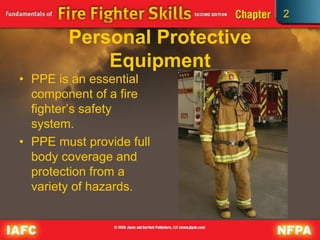
Personal Protective
Equipment
• PPEis an essential
component of a fire
fighter’s safety
system.
• PPE must provide full
body coverage and
protection from a
variety of hazards.
57.
2
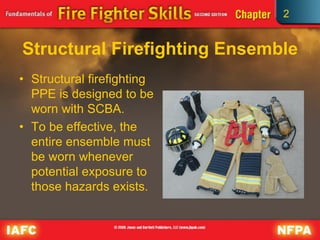
Structural Firefighting Ensemble
•Structural firefighting
PPE is designed to be
worn with SCBA.
• To be effective, the
entire ensemble must
be worn whenever
potential exposure to
those hazards exists.
58.
2
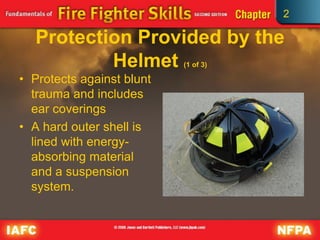
Protection Provided bythe
Helmet (1 of 3)
• Protects against blunt
trauma and includes
ear coverings
• A hard outer shell is
lined with energy-
absorbing material
and a suspension
system.
59.
2
Protection Provided bythe
Helmet (2 of 3)
• The shape of the helmet deflects water
from the head and neck.
• A face shield, goggles, or both, protect the
eyes.
• A chin strap keeps the helmet in the
proper position.
60.
2
Protection Provided bythe
Helmet (3 of 3)
• When entering a burning building, the fire
fighter should pull down the ear tabs for
maximum protection.
• Helmet shells are often color-coded
according to the fire fighter’s rank and
function.
61.
2
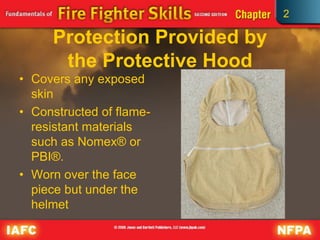
Protection Provided by
theProtective Hood
• Covers any exposed
skin
• Constructed of flame-
resistant materials
such as Nomex® or
PBI®.
• Worn over the face
piece but under the
helmet
62.
2
Protection Provided by
TurnoutGear (1 of 4)
• Turnout coat and bunker pants have tough
outer shells.
– Can withstand high temperatures
– Repel water
– Protect against abrasions and sharp objects
• Leather pads on knees for protection when
crawling.
63.
2
Protection Provided by
TurnoutGear (2 of 4)
• Reflective trim adds visibility.
• Insulating layers of fire-resistant materials
protect from high heat.
• Moisture barrier keeps hot liquids and
vapors from reaching the skin.
64.
2
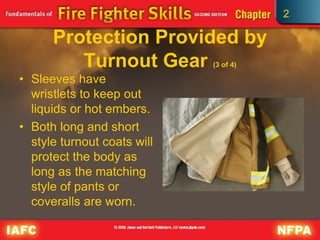
Protection Provided by
TurnoutGear (3 of 4)
• Sleeves have
wristlets to keep out
liquids or hot embers.
• Both long and short
style turnout coats will
protect the body as
long as the matching
style of pants or
coveralls are worn.
65.
2
Protection Provided by
TurnoutGear (4 of 4)
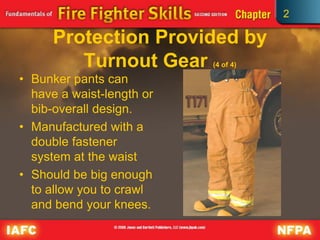
• Bunker pants can
have a waist-length or
bib-overall design.
• Manufactured with a
double fastener
system at the waist
• Should be big enough
to allow you to crawl
and bend your knees.
66.
2
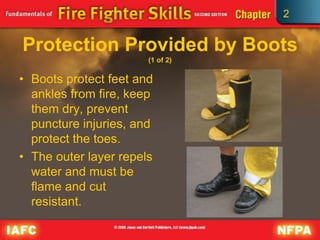
Protection Provided byBoots
(1 of 2)
• Boots protect feet and
ankles from fire, keep
them dry, prevent
puncture injuries, and
protect the toes.
• The outer layer repels
water and must be
flame and cut
resistant.
67.
2
Protection Provided byBoots
(2 of 2)
• Boots must have:
– A heavy sole with a slip-resistant design
– A puncture-resistant sole
– A reinforced toe to prevent injury from falling
objects
• An inner liner constructed of materials
such as Nomex or Kevlar adds thermal
protection.
68.
2
Protection Provided by
Gloves(1 of 2)
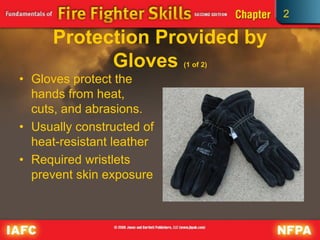
• Gloves protect the
hands from heat,
cuts, and abrasions.
• Usually constructed of
heat-resistant leather
• Required wristlets
prevent skin exposure
69.
2
Protection Provided by
Gloves(2 of 2)
• A liner adds thermal protection and serves
as a moisture barrier.
• Fire fighters need to practice manual skills
while wearing gloves to become
accustomed to them and to adjust
movement accordingly.
70.
2
Respiratory Protection
• SCBAprovides respiratory protection
through an independent air supply.
• PPE ensemble for structural firefighting is
not complete without respiratory
protection.
71.
2
Personal Alert SafetySystem
(PASS) (1 of 2)
• A PASS is an
electronic device that
sounds a loud audible
signal if a fire fighter
is motionless for a set
time period or if
activated by the fire
fighter.
72.
2
PASS (2 of2)
• A PASS can be separate from or
integrated into the SCBA unit.
– Integrated PASS automatically turns on when
the SCBA is activated.
– Separate PASS often worn on the SCBA
harness and must be turned on manually.
73.
2
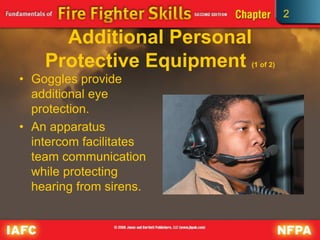
Additional Personal
Protective Equipment(1 of 2)
• Goggles provide
additional eye
protection.
• An apparatus
intercom facilitates
team communication
while protecting
hearing from sirens.
74.
2
Additional Personal
Protective Equipment(2 of 2)
• Flexible ear plugs are useful in other
situations involving loud sounds.
• A fire fighter should always carry a hand
light.
• At least one member of each team in a
hazardous area should have a radio.
75.
2
Limitations of theStructural
Firefighting Ensemble (1 of 3)
• Each component must be properly donned
and worn to provide complete protection.
• Components must be put on in the proper
order and correctly secured.
76.
2
Limitations of theStructural
Firefighting Ensemble (2 of 3)
• PPE is heavy and can cause fatigue.
• PPE retains body heat and perspiration.
– Fire fighters in full PPE can rapidly develop
elevated body temperatures.
77.
2
Limitations of theStructural
Firefighting Ensemble (3 of 3)
• PPE limits mobility and range of motion.
• PPE also decreases normal sensory
abilities.
78.
2
Work Uniforms
• Awork uniform is also part of the personal
protective package.
• Clothing containing nylon or polyester may
melt.
• Volunteer fire fighters should consider
these fabric properties when selecting
their wardrobe.
79.
2
Donning and DoffingPPE
• Donning PPE must be done in a specific
order to obtain maximum protection.
• Fire fighters should be able to don PPE in
1 minute or less.
• To doff PPE, reverse the procedure used
in getting dressed.
80.
2
Care of PPE(1 of 2)
• A complete set of PPE (excluding SCBA)
costs more than $1000.
• Check the condition of PPE regularly.
• Repair worn or damaged PPE at once.
81.
2
Care of PPE(2 of 2)
• Clean PPE when necessary.
– When badly soiled by exposure to smoke or
other contaminants
– PPE exposed to chemicals or hazardous
materials may have to be impounded for
decontamination or disposal.
– Follow the manufacturer’s cleaning
instructions.
82.
2
Specialized Protective
Clothing
(1 of2)
• Vehicle extrication PPE
– Most fire fighters will wear full turnout gear.
– Some PPE is specifically designed for vehicle
extrication and is generally lighter in weight and
more flexible than structural firefighting PPE.
– Latex gloves should be worn when providing
patient treatment.
– Eye protection also should be worn.
83.
2
Specialized Protective
Clothing
(2 of2)
• Wildland fires
– PPE must meet NFPA 1977.
– Wildland PPE is made of fire-resistant materials
and designed for comfort and maneuverability.
– Fire fighters wear a helmet, eye protection,
gloves, and boots designed for comfort and sure
footing while hiking.
84.
2
Respiratory Protection
• Theinterior atmosphere of a burning
building is considered immediately
dangerous to life and health (IDLH).
• Fire fighters must be proficient in using
SCBA before engaging in interior fire-
suppression activities.
• Using SCBA confidently requires practice.
85.
2
Respiratory Hazards ofFires
• Three primary respiratory hazards of fires:
– Superheated air and gases
– Smoke and by-products of combustion
– Oxygen-deficient atmospheres
86.
2
Smoke
• Smoke particlesare unburned, partially
burned, and completely burned
substances that can be toxic or irritating.
• Smoke vapors can be toxic or irritating.
• Toxic gases in smoke include:
– Carbon monoxide
– Hydrogen cyanide
– Phosgene
87.
2
Oxygen Deficiency
• Airis normally about 21% oxygen.
• Oxygen deficiency in an enclosed area
occurs in two ways:
– Fire consumes large quantities of the
available oxygen, decreasing the
concentration of oxygen.
– Fire produces large quantities of other gases,
which displace the oxygen that would
otherwise be present.
88.
2
Other Toxic Environments
•Fire fighters will encounter toxic gases or
oxygen-deficient atmospheres in many
emergency situations, including:
– Hazardous materials releases
– Confined-space or below-grade structures
89.
2
Conditions that Require
RespiratoryProtection
• SCBA must be used:
– In enclosed areas where there is smoke
– During overhaul until the air has been tested
and deemed safe by the safety officer
– Whenever toxic gases or an oxygen-deficient
atmosphere is possible
• Golden rule: Always assume that the
atmosphere is hazardous!
90.
2
Types of BreathingApparatus
(1 of 3)
• Open-circuit SCBA
– Most common type of
SCBA used for
structural firefighting
– Tank of compressed
air
– Exhaled air is released
into the atmosphere
91.
2
Types of BreathingApparatus
(2 of 3)
• Closed-circuit SCBA
– Seldom used for
structural firefighting
– Air passes through a
mechanism that
removes carbon
dioxide and adds
oxygen within a closed
system.
92.
2
Types of BreathingApparatus
(3 of 3)
• Supplied-air
respirator:
– Uses a hose line
connected to a
breathing-air
compressor or to
compressed air
cylinders
– Sometimes used for
specialized operations
93.
2
SCBA Standards and
Regulations(1 of 2)
• National Institute for Occupational Safety
and Health (NIOSH)
– Sets the design, testing, and certification
requirements for SCBA
• OSHA and state agencies
– Responsible for establishing and enforcing
regulations for respiratory protection
programs
94.
2
SCBA Standards and
Regulations(2 of 2)
• NFPA standards related to SCBA:
– NFPA 1500: Basic requirements
– NFPA 1404: Requirements for SCBA training
– NFPA 1981: Requirements for design,
performance, testing, and certification of
open-circuit SCBA
95.
2
Limitations of SCBA(1 of 3)
• Duration of work using SCBA limited by
the capacity of the cylinder
– SCBA for structural firefighting must carry
enough air for a minimum of 30 minutes.
– Duration ratings are based on ideal laboratory
conditions.
96.
2
Limitations of SCBA(2 of 3)
• Generally, an SCBA
weighs at least 25
pounds.
• Size of unit makes it
difficult for user to fit
into small places.
• Added weight and
bulk decrease user’s
flexibility and mobility.
97.
2
Limitations of SCBA(3 of 3)
• Face piece can limit visibility, particularly
peripheral vision.
• Face piece may fog up under some
conditions.
• SCBA also may affect the user’s ability to
communicate.
• SCBA is noisy during breathing, which
may limit the user’s hearing.
98.
2
Physical Limitations ofthe
User
• Moving with the extra weight of SCBA and
PPE requires additional energy, which
increases air consumption and body
temperature.
99.
2
Psychological Limitations
of theUser
• Breathing through an SCBA is different
from normal breathing and can be very
stressful.
• The surrounding environment, which is
often dark and filled with smoke, is foreign
as well.
• Fire fighters must adjust to these stressful
conditions.
100.
2
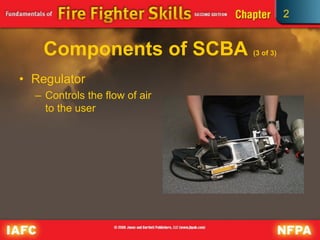
Components of SCBA(1 of 3)
• Backpack
– Frame for mounting
the other working parts
of the SCBA
• Harness
– Straps and fasteners
to attach the SCBA to
the fire fighter
101.
2
Components of SCBA(2 of 3)
• Air cylinder
– Holds breathing air for an SCBA
– Neck equipped with a hand-operated shut-off
valve
– Pressure gauge located near the shut-off
valve that shows amount of pressure currently
in cylinder
2
SCBA Regulator Operation(1 of 3)
• Inhaling
– Decreases the air pressure in the face piece,
which opens the regulator and releases air
from the cylinder into the face piece
• Exhaling
– Opens the exhalation valve, which exhausts
used air into the atmosphere
104.
2
SCBA Regulator Operation(2 of 3)
• SCBA regulators maintain a slightly
positive air pressure in the face piece.
• Normal operational mode
– Regulator supplies breathing air during
inhalation, stops when inhalation stops, then
opens an exhalation valve to exhaust used air
into the atmosphere.
– Controlled using the yellow-colored on/off
valve
105.
2
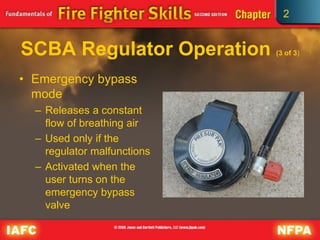
SCBA Regulator Operation(3 of 3)
• Emergency bypass
mode
– Releases a constant
flow of breathing air
– Used only if the
regulator malfunctions
– Activated when the
user turns on the
emergency bypass
valve
106.
2
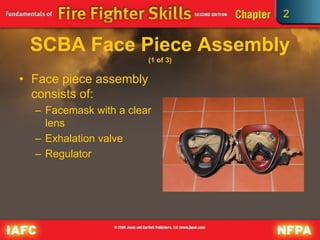
SCBA Face PieceAssembly
(1 of 3)
• Face piece assembly
consists of:
– Facemask with a clear
lens
– Exhalation valve
– Regulator
107.
2
SCBA Face PieceAssembly
(2 of 3)
• Models with harness-mounted regulator
face pieces have a flexible low-pressure
hose.
• Later models will have the regulator
attached directly to the face piece.
108.
2
SCBA Face PieceAssembly
(3 of 3)
• Face piece should cover the entire face.
• Some models have a voice amplification
device to improve communication.
• Face pieces manufactured in several
sizes.
109.
2
Pathway of AirThrough an
SCBA (1 of 2)
• Air passes through the cylinder shut-off
valve into the high-pressure hose that
takes it to the regulator.
• Regulator reduces high pressure air to low
pressure.
• Air next goes directly into the face piece.
110.
2
Pathway of AirThrough an
SCBA (2 of 2)
• From the face piece, the air is inhaled
through the user’s air passages and into
the lungs.
• When the user exhales, used air is
returned to the face piece.
• Exhaled air is exhausted from the face
piece through the exhalation valve.
111.
2
Skip-Breathing Technique
• Skip-breathinghelps conserve air.
• Take a short breath, hold, take a second
short breath (do not exhale in between
breaths).
• Relax with a long exhale.
• Each breath should take 5 seconds.
112.
2
Mounting Breathing
Apparatus
• SCBAshould be located so that fire
fighters can don it quickly when they arrive
at the scene of a fire.
• Exterior-mounted SCBA should be
protected from weather and dirt by a
secure cover.
113.
2
Donning SCBA
• Firefighters must be able to don and
activate SCBA in 1 minute.
• Fire fighters must be wearing full PPE
before donning SCBA.
• Check the SCBA to ensure it is ready for
operation before donning it.
114.
2
Readiness SCBA Check(1 of 2)
• Check that air cylinder has at least 90% of
its rated pressure.
• If the SCBA has a donning/doffing switch,
be sure that it is activated.
• Open the cylinder valve two or three turns,
listen for the low-air alarm to sound, and
then open the valve fully.
115.
2
Readiness SCBA Check(2 of 2)
• Check that pressure gauges on both the
regulator and cylinder read within 100 psi
of each other.
• Check that all harness straps are fully
extended.
• Check that all valves are in the correct
position.
– An open bypass valve will waste air.
116.
2
Safety Precautions forSCBA
(1 of 2)
• Learn to recognize the low-air alarm.
• As soon as your alarm goes off, you must
exit the hazardous environment.
• Before you enter a hazardous
environment, make sure your PASS
device is activated.
117.
2
Safety Precautions forSCBA
(2 of 2)
• Be sure you are properly logged into your
accountability system.
• Always work in teams of two.
• Always have at least two fire fighters
outside at the ready.
118.
2
Preparing for Emergency
Situations
•Be prepared to react if an emergency
occurs while using SCBA.
• Keep calm, stop, and think.
• Exit the hostile environment.
• If in danger, activate your PASS.
• Use your hand light to attract attention.
• Use a portable radio to call for help.
119.
2
Doffing SCBA
• Followprocedures recommended by the
manufacturer and your department’s
SOPs.
• In general, you should reverse the steps
for donning SCBA.
120.
2
Putting It AllTogether
• Complete PPE ensemble consists of
personal protective clothing and SCBA.
• You must be able to integrate donning
PPE and donning SCBA.
121.
2
SCBA Inspection and
Maintenance(1 of 4)
• SCBA must be properly serviced and
prepared for the next use each time it is
used.
• Air cylinder must be changed or refilled.
122.
2
SCBA Inspection and
Maintenance(2 of 4)
• Face piece and regulator must be
sanitized according to the manufacturer’s
instructions.
• Unit must be cleaned, inspected, and
checked for proper operation.
123.
2
SCBA Inspection and
Maintenance(3 of 4)
• It is the user’s responsibility to ensure that
the SCBA is in ready condition before it is
returned to the fire apparatus.
• The daily inspection procedure should be
used when restoring a unit to service after
it has been used.
124.
2
SCBA Inspection and
Maintenance(4 of 4)
• If an SCBA inspection reveals any
problems that cannot be remedied by
routine maintenance, the SCBA must be
removed from service for repair.
• Only properly trained and certified
personnel are authorized to repair SCBA.
125.
2
Daily Inspection
• EachSCBA unit should be inspected daily
or at the beginning of each shift.
• When fire stations are not staffed, SCBA
should be inspected at least once a week.
126.
2
Monthly Inspection
• SCBAshould be completely checked each
month for proper operation, for leaks, and
for any deterioration.
127.
2
Annual Inspection
• Completeannual inspection and
maintenance must be performed on each
SCBA.
• Annual inspection must be performed by a
certified manufacturer’s representative or
a person who has been trained and
certified to perform this work.
128.
2
Servicing SCBA Cylinders
•Cylinders must be visually inspected
during daily and monthly inspections.
• Federal law requires periodic hydrostatic
testing and limits the number of years a
cylinder can be used.
129.
2
Replacing SCBA Cylinders
•A single fire fighter must doff SCBA to
replace the air cylinder.
• Two fire fighters working together can
change cylinders without removing SCBA.
• A fire fighter should be able to change
cylinders in the dark and while wearing
gloves.
130.
2
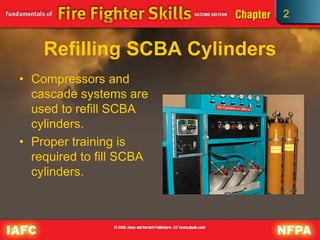
Refilling SCBA Cylinders
•Compressors and
cascade systems are
used to refill SCBA
cylinders.
• Proper training is
required to fill SCBA
cylinders.
131.
2
Cleaning and SanitizingSCBA
(1 of 2)
• Follow manufacturers’ specific instructions
for care and cleaning of SCBA.
• Rinse entire unit using a hose with clean
water.
• Clean harness assembly and cylinder with
a mild soap and water solution.
132.
2
Cleaning and SanitizingSCBA
(2 of 2)
• Clean face pieces and regulators with mild
soap and warm water or disinfectant
cleaning solution.
133.
2
Summary (1 of4)
• Safety is a critical part of a fire fighter’s job.
• Preventing injuries is always preferable to treating
them.
• Injury prevention measures extend to standards and
procedures, personnel, training, and the department’s
equipment.
• It is important to exercise good safety practices during
training, during responses, at emergency incidents, at
the fire station, and outside the workplace.
134.
2
Summary (2 of4)
• PPE must meet NFPA standards to ensure your
safety.
• The PPE includes a helmet, a protective hood, a
turnout coat, bunker pants, boots, gloves, SCBA, and
a PASS device.
• All parts of the PPE ensemble must be donned and in
place for maximum protection. Fire fighters must be
able to don PPE in 1 minute or less.
• Fire fighters must properly care for and maintain PPE
135.
2
Summary (3 of4)
• Fire fighters must understand the major parts of
SCBA and be able to don the equipment
quickly—in 1 minute or less.
• Regular inspection and proper maintenance of
SCBA is vital to the fire fighter’s safety.
136.
2
Summary (4 of4)
• Understanding the uses and limitations of
SCBA is essential for your safety at fire scenes.
• Fires produce smoke particles, smoke vapors,
toxic gases, oxygen-deficient atmospheres, and
high temperatures. These conditions require fire
fighters to use respiratory protection.