Occupational Safety and Health
for Emergency Services
Fourth Edition
Course Overview
Course Description
‣ This course is designed to cover both national and Florida
specific information relating to the Health and Safety Officer.
Topics include: Introduction to Emergency Services
Occupational Safety and Health; Review of Safety-Related
Regulations and Standards; Risk Management; Pre-Incident
Safety; Safety at Fire Emergencies; Safety at Medical or
Rescue Emergencies; Safety at Specialized Incidents; Post-
Incident Safety Management; Personnel Roles and
Responsibilities; Safety Program Evaluation; Information
Management; and Special Topics in Emergency Services
Occupational Safety and Health.
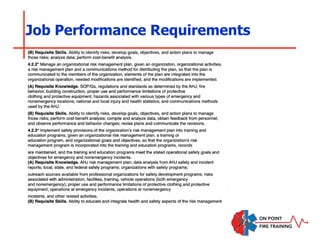
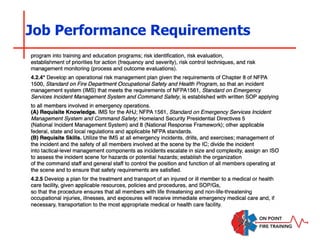
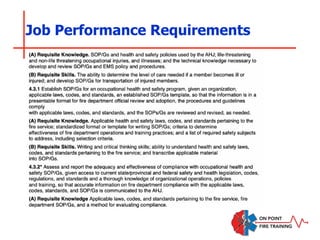
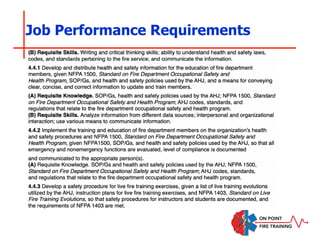
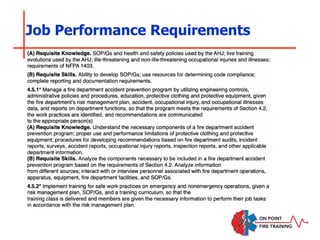
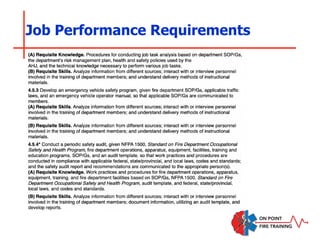
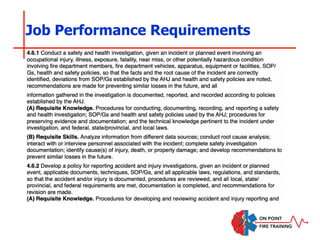
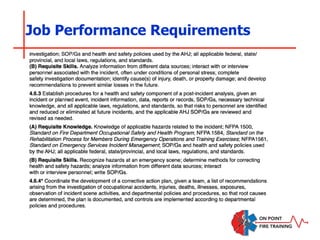
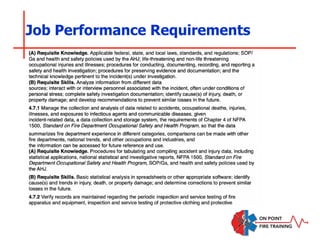
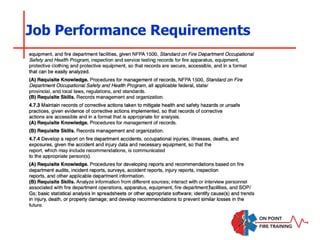
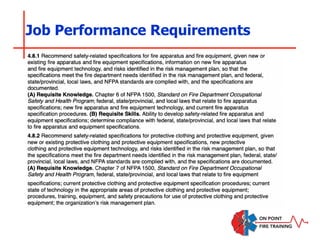
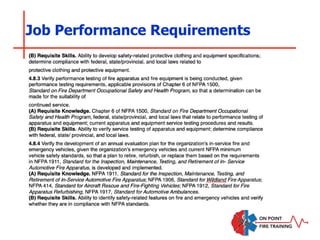
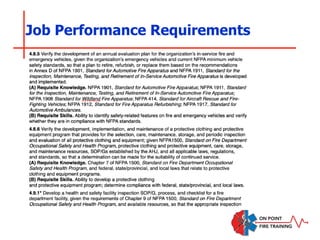
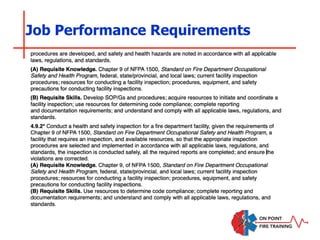
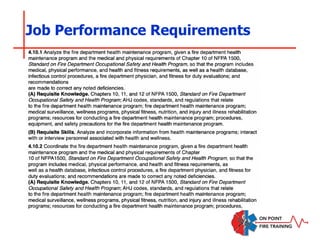
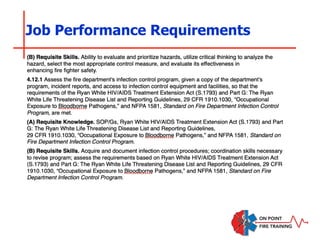
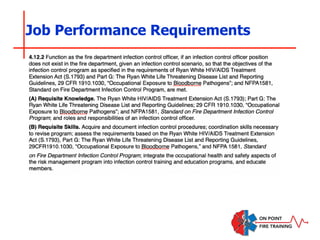
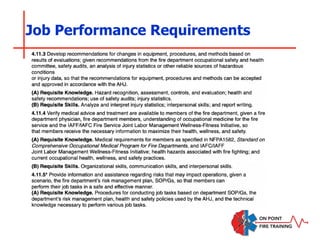
Job Performance Requirements
‣ Given information from discussion and reading
materials, the student will satisfy the Job Performance
Requirements (JPR) of the applicable National Fire
Protection Association (NFPA) standards, any
applicable skill sheets, and the applicable Fire and Life
Safety Initiatives of the National Fallen Firefighters
Foundation Everyone Goes Home program.
‣ NFPA, Standard for Fire and Emergency Service
Instructor Professional Qualifications, 2019 Edition
Job Performance Requirements
Chapter 1
‣ This chapter discusses the history of occupational safety and
health in the emergency services and describes efforts that have
been made to address the safety and health problems among
emergency services occupations.
Chapter Overview
Chapter 1
‣ Discuss the history of occupational safety and health in industry.
‣ Discuss the history of emergency services safety and health programs.
‣ Identify, through the use of historical data, the safety and health problem
among emergency services occupations today.
‣ Describe the efforts that have been made to address the safety and health
problem among emergency services occupations.
‣ Describe the 16 Firefighter Life Safety Initiatives.
‣ List the national agencies that produce annual injury and fatality reports
for emergency services.
‣ Identify the information that can be obtained from annual injury and
fatality reports.
‣ Discuss the culture of the emergency services and the need for change.
‣ Discuss how the changes to emergency services safety and health are
working.
Learning Objective
Chapter 2
‣ This chapter discusses the federal regulations, NFPA standards,
and other regulations and standards impacting emergency
responder safety and health.
Chapter Overview
Chapter 2
‣Discuss the difference between regulations and standards.
‣Discuss the concept of standard of care.
‣List and discuss federal regulations that have an impact on
emergency responder safety and health programs.
‣Describe the Occupational Safety and Health Administration’s
General Duty Clause.
‣List and discuss the major National Fire Protection Association
standards that have an impact on emergency responder
occupational safety and health programs.
‣Discuss the role of related regulations and standards and their
safety and health implications.
Learning Objective
Chapter 3
‣ This chapter discusses risk and risk management, including
strategies for the identification, evaluation, and control of risks.
Chapter Overview
Chapter 3
‣ Define risk.
‣ Define risk management.
‣ Discuss the meaning of and the process for risk identification.
‣ Discuss the meaning of and the process for risk evaluation.
‣ Discuss the meaning of and the process for risk control.
‣ Discuss the use of a cause-and-effect diagram.
‣ Explain the process of interrupting the accident sequence.
‣ Discuss the components and use of the Haddon matrix.
‣ Differentiate between passive and active, and voluntary and mandatory
risk reduction strategies.
‣ Apply risk control strategies to an injury problem.
Learning Objective
Chapter 4
‣ This chapter discusses elements of a safety and health program,
including the development of goals and objectives, performing a
cost-benefit analysis, and developing standard operating
procedures.
Chapter Overview
Chapter 4
‣ List the essential elements of a safety and health program.
‣ Describe the process required for the development of goals and
objectives.
‣ Develop an action plan based on goals and objectives.
‣ Perform a cost–benefit analysis.
‣ Describe the relationship of training to the safety and health program.
‣ Describe the process for developing standard operating procedures.
Learning Objective
Chapter 5
‣ This chapter discusses safety considerations in preincident aspects
of emergency response, including safety plans for the emergency
response station and vehicle, preincident planning, and safety
while training.
Chapter Overview
Chapter 5
‣Describe safety considerations for the emergency response station.
‣Explain safety considerations as they apply to the emergency
response vehicle.
‣List the components of an effective response safety plan.
‣Describe the components of a preincident planning process.
‣List the information that should be provided by the preincident
plan.
‣Describe the considerations for safety while training.
‣Define the components of a wellness/fitness plan.
‣Describe the considerations for interagency coordination as it
applies to safety and health.
Learning Objective
Chapter 6
‣ This chapter discusses safety at fire incidents, including incident
priorities, hazards faced by responders, personal protective
equipment, incident management systems, rapid interview crews,
and incident rehabilitation.
Chapter Overview
Chapter 6
‣ List the three incident priorities.
‣ Explain the relationship between the three incident priorities and their
relationship to safety and health.
‣ Discuss in general terms the hazards faced by responders to fire incidents.
‣ List the components of personal protective equipment used for fire
incidents.
‣ Discuss the need for and the components of an effective accountability
system.
‣ Discuss the types of and the relationship between incident management
systems and the safety and health of the responder.
‣ Describe the concept of and need for fireground air management.
‣ Define the need for and uses of a rapid intervention crew.
‣ Discuss the components of incident rehabilitation.
Learning Objective
Chapter 7
‣ This chapter discusses the hazards faced by responders at
emergency medical incidents, methods of minimizing and
preventing injuries, personal protective equipment, and infection
control.
Chapter Overview
Chapter 7
‣Discuss the hazards faced by responders at emergency medical or
rescue incidents.
‣Explain methods of minimizing and preventing injuries associated with
hazards found at emergency medical incidents.
‣List various requirements and uses of commonly used personal
protective equipment.
‣Explain the requirements for infection control.
‣Discuss procedures that can be used to meet the requirements of
infection control.
‣Discuss the systems used for scene accountability and incident
management.
Learning Objective
Chapter 8
‣ This chapter discusses safety issues related to hazardous materials
incidents, technical rescue operations, helicopter landing zones,
operations at civil disturbances, terrorism events, and natural
disasters.
Chapter Overview
Chapter 8
‣Describe the safety issues related to hazardous materials incident
responses.
‣Describe the safety issues relating to technical rescue operations.
‣Explain safe procedures to be used during helicopter landing zone
operations.
‣List specific safety issues relating to operations at civil
disturbances.
‣List specific safety concerns when responding to terrorism events.
‣List specific safety concerns when responding to natural disasters.
Learning Objective
Chapter 9
‣ This chapter discusses the safety and health considerations of
incident termination and demobilization as well as postincident
analysis and critical incident stress management programs.
Chapter Overview
Chapter 9
‣ List the safety and health considerations of incident termination.
‣ Describe the demobilization process.
‣ Compare the concepts of first in/last out with first in/first out.
‣ Explain the need for and the process used for postincident analysis.
‣ List the components of a postincident analysis.
‣ Describe the advantages of a critical incident stress management
program.
‣ List the key components of a critical incident stress management program.
Learning Objective
Chapter 10
‣ This chapter discusses the roles and responsibilities of individual
responders, supervisors, management teams, incident
commanders, safety and health program managers, safety
officers, and safety committees.
Chapter Overview
Chapter 10
‣ List the roles and responsibilities of individual responders and their relationship to
the overall safety and health program.
‣ List the roles and responsibilities of supervisors and their relationship to the overall
safety and health program.
‣ List the roles and responsibilities of the emergency services management team and
their relationship to the overall safety and health program.
‣ List the roles and responsibilities of the incident commander and his or her
relationship to the overall safety and health program.
‣ List the roles and responsibilities of the safety and health program manager and his
or her relationship to the overall safety and health program.
‣ List the roles and responsibilities of incident safety officers and their relationship to
the overall safety and health program.
‣ List the roles and responsibilities of the safety committee and its relationship to the
overall safety and health program.
‣ List the reasons that crew resource management can improve safety in operations.
Learning Objective
Chapter 11
‣ This chapter discusses the evaluation of a safety and health
program, including processes and outcomes, who is responsible
for the evaluations, and frequency of evaluations.
Chapter Overview
Chapter 11
‣Describe the purpose of evaluating the safety and health program.
‣Compare the two types of evaluations—process and outcome.
‣Explain who is responsible for evaluating the safety and health
program.
‣Describe the recommended frequency of evaluation and the factors
that affect the frequency.
Learning Objective
Chapter 12
‣ This chapter discusses purpose of data collection as well as what
data should be collected, the purpose and process for publishing
reports, and the use of the Internet as a safety and health
information source.
Chapter Overview
Chapter 12
‣Describe the purpose of data collection and reporting.
‣Identify the data that should be collected within the organization.
‣Identify the data that should be collected for outside organizations.
‣Describe the purpose and process for publishing an internal safety
and health report.
‣Describe the use of the Internet as a safety and health information
source.
Learning Objective
Chapter 13
‣ This chapter discusses legal, ethical, and financial issues affecting
safety and health programs, as well as diversification, new
technologies, and other future trends relating to safety and health
programs.
Chapter Overview
Chapter 13
‣ Describe legal considerations of the safety and health program.
‣ Describe ethical considerations of the safety and health program.
‣ Describe financial considerations of the safety and health program.
‣ Describe health and safety considerations in the diversified
workforce.
‣ Describe the implications of future trends and technologies on the
safety and health program.
Learning Objective

6741 Course Overview JPR

  • 1.
    Occupational Safety andHealth for Emergency Services Fourth Edition Course Overview
  • 2.
    Course Description ‣ Thiscourse is designed to cover both national and Florida specific information relating to the Health and Safety Officer. Topics include: Introduction to Emergency Services Occupational Safety and Health; Review of Safety-Related Regulations and Standards; Risk Management; Pre-Incident Safety; Safety at Fire Emergencies; Safety at Medical or Rescue Emergencies; Safety at Specialized Incidents; Post- Incident Safety Management; Personnel Roles and Responsibilities; Safety Program Evaluation; Information Management; and Special Topics in Emergency Services Occupational Safety and Health.
  • 3.
    Job Performance Requirements ‣Given information from discussion and reading materials, the student will satisfy the Job Performance Requirements (JPR) of the applicable National Fire Protection Association (NFPA) standards, any applicable skill sheets, and the applicable Fire and Life Safety Initiatives of the National Fallen Firefighters Foundation Everyone Goes Home program. ‣ NFPA, Standard for Fire and Emergency Service Instructor Professional Qualifications, 2019 Edition
  • 4.
  • 5.
  • 6.
  • 7.
  • 8.
  • 9.
  • 10.
  • 11.
  • 12.
  • 13.
  • 14.
  • 15.
  • 16.
  • 17.
  • 18.
  • 19.
  • 20.
  • 21.
  • 22.
  • 23.
  • 24.
    Chapter 1 ‣ Thischapter discusses the history of occupational safety and health in the emergency services and describes efforts that have been made to address the safety and health problems among emergency services occupations. Chapter Overview
  • 25.
    Chapter 1 ‣ Discussthe history of occupational safety and health in industry. ‣ Discuss the history of emergency services safety and health programs. ‣ Identify, through the use of historical data, the safety and health problem among emergency services occupations today. ‣ Describe the efforts that have been made to address the safety and health problem among emergency services occupations. ‣ Describe the 16 Firefighter Life Safety Initiatives. ‣ List the national agencies that produce annual injury and fatality reports for emergency services. ‣ Identify the information that can be obtained from annual injury and fatality reports. ‣ Discuss the culture of the emergency services and the need for change. ‣ Discuss how the changes to emergency services safety and health are working. Learning Objective
  • 26.
    Chapter 2 ‣ Thischapter discusses the federal regulations, NFPA standards, and other regulations and standards impacting emergency responder safety and health. Chapter Overview
  • 27.
    Chapter 2 ‣Discuss thedifference between regulations and standards. ‣Discuss the concept of standard of care. ‣List and discuss federal regulations that have an impact on emergency responder safety and health programs. ‣Describe the Occupational Safety and Health Administration’s General Duty Clause. ‣List and discuss the major National Fire Protection Association standards that have an impact on emergency responder occupational safety and health programs. ‣Discuss the role of related regulations and standards and their safety and health implications. Learning Objective
  • 28.
    Chapter 3 ‣ Thischapter discusses risk and risk management, including strategies for the identification, evaluation, and control of risks. Chapter Overview
  • 29.
    Chapter 3 ‣ Definerisk. ‣ Define risk management. ‣ Discuss the meaning of and the process for risk identification. ‣ Discuss the meaning of and the process for risk evaluation. ‣ Discuss the meaning of and the process for risk control. ‣ Discuss the use of a cause-and-effect diagram. ‣ Explain the process of interrupting the accident sequence. ‣ Discuss the components and use of the Haddon matrix. ‣ Differentiate between passive and active, and voluntary and mandatory risk reduction strategies. ‣ Apply risk control strategies to an injury problem. Learning Objective
  • 30.
    Chapter 4 ‣ Thischapter discusses elements of a safety and health program, including the development of goals and objectives, performing a cost-benefit analysis, and developing standard operating procedures. Chapter Overview
  • 31.
    Chapter 4 ‣ Listthe essential elements of a safety and health program. ‣ Describe the process required for the development of goals and objectives. ‣ Develop an action plan based on goals and objectives. ‣ Perform a cost–benefit analysis. ‣ Describe the relationship of training to the safety and health program. ‣ Describe the process for developing standard operating procedures. Learning Objective
  • 32.
    Chapter 5 ‣ Thischapter discusses safety considerations in preincident aspects of emergency response, including safety plans for the emergency response station and vehicle, preincident planning, and safety while training. Chapter Overview
  • 33.
    Chapter 5 ‣Describe safetyconsiderations for the emergency response station. ‣Explain safety considerations as they apply to the emergency response vehicle. ‣List the components of an effective response safety plan. ‣Describe the components of a preincident planning process. ‣List the information that should be provided by the preincident plan. ‣Describe the considerations for safety while training. ‣Define the components of a wellness/fitness plan. ‣Describe the considerations for interagency coordination as it applies to safety and health. Learning Objective
  • 34.
    Chapter 6 ‣ Thischapter discusses safety at fire incidents, including incident priorities, hazards faced by responders, personal protective equipment, incident management systems, rapid interview crews, and incident rehabilitation. Chapter Overview
  • 35.
    Chapter 6 ‣ Listthe three incident priorities. ‣ Explain the relationship between the three incident priorities and their relationship to safety and health. ‣ Discuss in general terms the hazards faced by responders to fire incidents. ‣ List the components of personal protective equipment used for fire incidents. ‣ Discuss the need for and the components of an effective accountability system. ‣ Discuss the types of and the relationship between incident management systems and the safety and health of the responder. ‣ Describe the concept of and need for fireground air management. ‣ Define the need for and uses of a rapid intervention crew. ‣ Discuss the components of incident rehabilitation. Learning Objective
  • 36.
    Chapter 7 ‣ Thischapter discusses the hazards faced by responders at emergency medical incidents, methods of minimizing and preventing injuries, personal protective equipment, and infection control. Chapter Overview
  • 37.
    Chapter 7 ‣Discuss thehazards faced by responders at emergency medical or rescue incidents. ‣Explain methods of minimizing and preventing injuries associated with hazards found at emergency medical incidents. ‣List various requirements and uses of commonly used personal protective equipment. ‣Explain the requirements for infection control. ‣Discuss procedures that can be used to meet the requirements of infection control. ‣Discuss the systems used for scene accountability and incident management. Learning Objective
  • 38.
    Chapter 8 ‣ Thischapter discusses safety issues related to hazardous materials incidents, technical rescue operations, helicopter landing zones, operations at civil disturbances, terrorism events, and natural disasters. Chapter Overview
  • 39.
    Chapter 8 ‣Describe thesafety issues related to hazardous materials incident responses. ‣Describe the safety issues relating to technical rescue operations. ‣Explain safe procedures to be used during helicopter landing zone operations. ‣List specific safety issues relating to operations at civil disturbances. ‣List specific safety concerns when responding to terrorism events. ‣List specific safety concerns when responding to natural disasters. Learning Objective
  • 40.
    Chapter 9 ‣ Thischapter discusses the safety and health considerations of incident termination and demobilization as well as postincident analysis and critical incident stress management programs. Chapter Overview
  • 41.
    Chapter 9 ‣ Listthe safety and health considerations of incident termination. ‣ Describe the demobilization process. ‣ Compare the concepts of first in/last out with first in/first out. ‣ Explain the need for and the process used for postincident analysis. ‣ List the components of a postincident analysis. ‣ Describe the advantages of a critical incident stress management program. ‣ List the key components of a critical incident stress management program. Learning Objective
  • 42.
    Chapter 10 ‣ Thischapter discusses the roles and responsibilities of individual responders, supervisors, management teams, incident commanders, safety and health program managers, safety officers, and safety committees. Chapter Overview
  • 43.
    Chapter 10 ‣ Listthe roles and responsibilities of individual responders and their relationship to the overall safety and health program. ‣ List the roles and responsibilities of supervisors and their relationship to the overall safety and health program. ‣ List the roles and responsibilities of the emergency services management team and their relationship to the overall safety and health program. ‣ List the roles and responsibilities of the incident commander and his or her relationship to the overall safety and health program. ‣ List the roles and responsibilities of the safety and health program manager and his or her relationship to the overall safety and health program. ‣ List the roles and responsibilities of incident safety officers and their relationship to the overall safety and health program. ‣ List the roles and responsibilities of the safety committee and its relationship to the overall safety and health program. ‣ List the reasons that crew resource management can improve safety in operations. Learning Objective
  • 44.
    Chapter 11 ‣ Thischapter discusses the evaluation of a safety and health program, including processes and outcomes, who is responsible for the evaluations, and frequency of evaluations. Chapter Overview
  • 45.
    Chapter 11 ‣Describe thepurpose of evaluating the safety and health program. ‣Compare the two types of evaluations—process and outcome. ‣Explain who is responsible for evaluating the safety and health program. ‣Describe the recommended frequency of evaluation and the factors that affect the frequency. Learning Objective
  • 46.
    Chapter 12 ‣ Thischapter discusses purpose of data collection as well as what data should be collected, the purpose and process for publishing reports, and the use of the Internet as a safety and health information source. Chapter Overview
  • 47.
    Chapter 12 ‣Describe thepurpose of data collection and reporting. ‣Identify the data that should be collected within the organization. ‣Identify the data that should be collected for outside organizations. ‣Describe the purpose and process for publishing an internal safety and health report. ‣Describe the use of the Internet as a safety and health information source. Learning Objective
  • 48.
    Chapter 13 ‣ Thischapter discusses legal, ethical, and financial issues affecting safety and health programs, as well as diversification, new technologies, and other future trends relating to safety and health programs. Chapter Overview
  • 49.
    Chapter 13 ‣ Describelegal considerations of the safety and health program. ‣ Describe ethical considerations of the safety and health program. ‣ Describe financial considerations of the safety and health program. ‣ Describe health and safety considerations in the diversified workforce. ‣ Describe the implications of future trends and technologies on the safety and health program. Learning Objective