Aircraft Rescue and Fire
Fighting,
5th
Edition
Chapter 7 — Apparatus
ARFF
7–2
Chapter 7 Lesson Goal
• After completing this lesson, the student
shall be able to describe ARFF
apparatus and how it is used in fire
fighting operations.
ARFF
7–3
Objectives
1. Discuss ARFF apparatus.
2. Describe the types of ARFF
apparatus.
3. Identify ARFF apparatus
features and options.
(Continued)
ARFF
7–4
Objectives
4. Describe ARFF apparatus fire
suppression equipment.
5. Explain ARFF apparatus agent
resupply methods.
6. Discuss ARFF apparatus
maintenance.
ARFF
7–5
ARFF Apparatus Requirements
• Airports — identify required ARFF
protection
• ARFF personnel — identify level of
protection/examine standards
– FAA
– ICAO
– NFPA®
ARFF
7–6
Levels of Protection
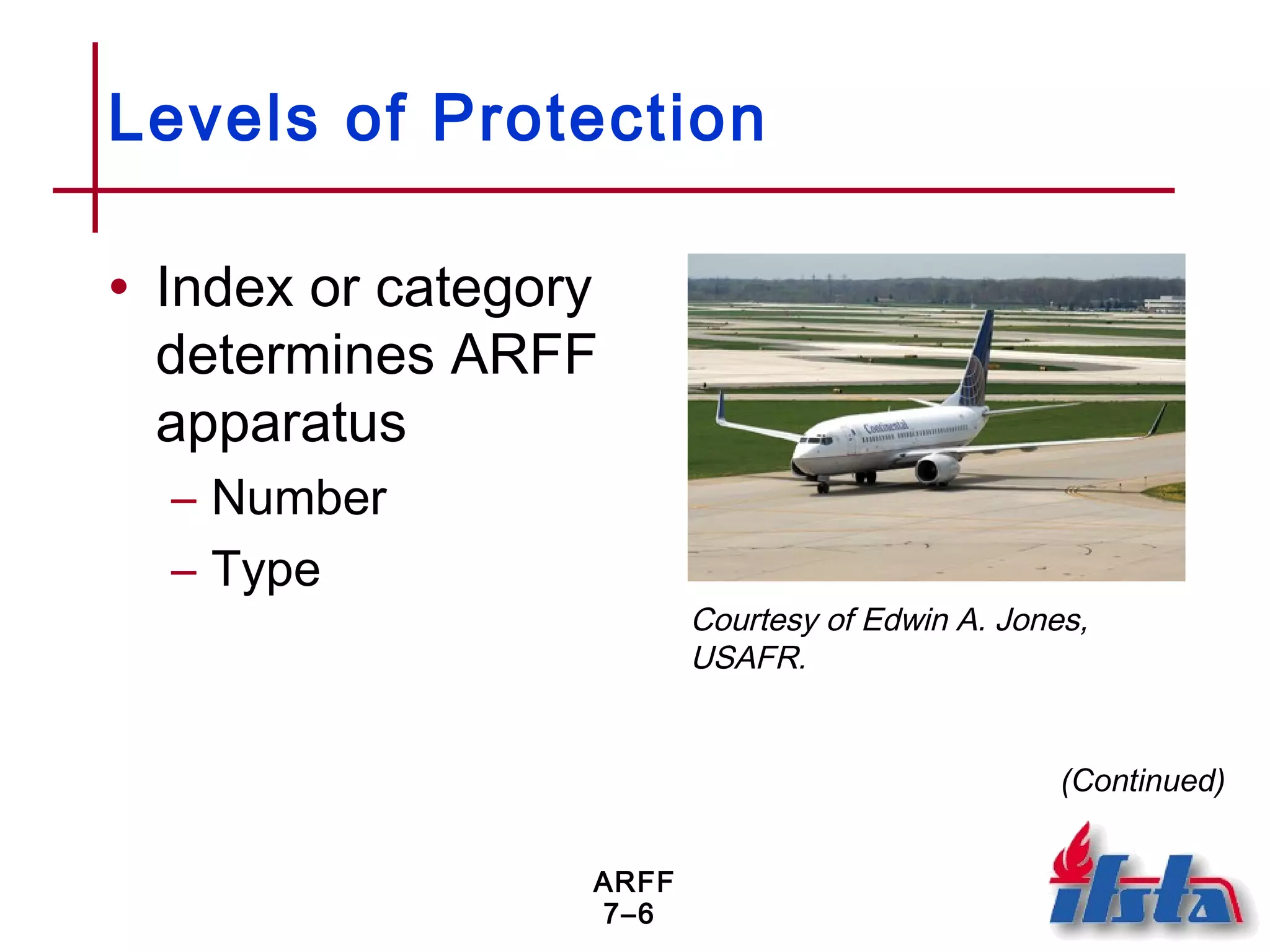
• Index or category
determines ARFF
apparatus
– Number
– Type
(Continued)
Courtesy of Edwin A. Jones,
USAFR.
ARFF
7–7
Levels of Protection
• Airports categories/indexed based on
factors
– Type or length of aircraft
– Daily average number of departures
(Continued)
ARFF
7–8
Levels of Protection
• Different rating systems
– FAA
– NFPA®
– U.S. military
– Canada
– ICAO
(Continued)
ARFF
7–9
Levels of Protection
• ARFF requirements — based on index,
set, category
– Maintain minimum protection
– Follow procedures for protection
(Continued)
ARFF
7–10
Levels of Protection
• Methods to determine number of
vehicles and amount of extinguishing
agent are similar
– NFPA®
– FAA
– ICAO
(Continued)
ARFF
7–11
Levels of Protection
• U.S. Department of Defense — specific
requirements pertaining to aircraft sizes
and configurations
– NFPA®
403
– Aircraft being protected
(Continued)
ARFF
7–12
Levels of Protection
• NFPA®
403 — requirements for airports
based on NFPA®
categories
– Amount of foam and auxiliary extinguishing
agents
– Number of ARFF apparatus
ARFF
7–13
Apparatus Design
• Agencies and standards cover ARFF
apparatus
– FAA
– ICAO
– NFPA®
403
– NFPA®
412
– NFPA®
414
(Continued)
ARFF
7–14
Apparatus Design
• ARFF apparatus
– Painted/marked to optimize visibility
– Equipped with appropriate emergency
lights
ARFF
7–15
Aircraft Rescue and Fire
Fighting Apparatus
• Designed to meet
aviation/airport needs
• Must operate in
paved/unpaved areas
• Mass application of
agents required
(Continued)
ARFF
7–16
Aircraft Rescue and Fire
Fighting Apparatus
• ARFF vehicles equipped with features
– Turrets
– Handlines
– Ground sweeps
– Undertruck nozzles
– Extendable turrets
(Continued)
ARFF
7–17
Aircraft Rescue and Fire
Fighting Apparatus
• Carry medical supplies, ladders, rescue
tools and equipment
• NFPA®
414 divides into three groups
• FAA rating system — based on amount
of water and dry chemical or clean
agent
ARFF
7–18
Combined Agent Vehicles
(Rapid Intervention Vehicles)
• Smaller than typical
ARFF vehicles
• Outfitted with combined
agent systems
• Designed for rapid
response
(Continued)
ARFF
7–19
Combined Agent Vehicles
(Rapid Intervention Vehicles)
• Can operate in areas unsuitable for
larger ARFF vehicles
• Can be equipped with a water pump
and tank or skid unit
ARFF
7–20
Structural Apparatus
• May be adapted and
equipped for ARFF
• Fixed foam
proportioning system
— trend in structural
fire fighting
Courtesy of Edwin A. Jones,
USAFR.
(Continued)
ARFF
7–21
Structural Apparatus
• Can be ordered with various features
• Difficult to meet NFPA®
414
• Hose threads/couplings must be same
as ARFF apparatus
• Batch mixing can be used
ARFF
7–22
Support Vehicles and
Equipment
• Vehicles/equipment
– Command vehicles
– Command post
vehicles
– Mobile water supply
vehicles
– Foam supply vehicles
and trailers (Continued)
ARFF
7–23
Support Vehicles and
Equipment
• Vehicles/equipment
– Hazardous materials
vehicles/trailers
– Ambulances
– Mass-casualty
vehicles/trailers
– Decontamination trailers
– Heavy rescue apparatus
– Buses (Continued)
ARFF
7–24
Support Vehicles and
Equipment
• Interior access vehicles
– Adapted for use as
elevated platforms
– Can be quickly
positioned
– Can be custom
designed
ARFF
7–25
Antilock Brake Systems
• Required by NFPA®
414
• Monitors and controls wheel speed
during braking
• Improves vehicle stability and control
(Continued)
ARFF
7–26
Antilock Brake Systems
• Provide driver with greater control
• Keep vehicle wheels from skidding
• Can give false sense of security
ARFF
7–27
Central Inflation/Deflation
System (CIDS)
• Allows driver to deflate tires to improve
vehicle traction
• Can be operated without interrupting fire
fighting capability
(Continued)
ARFF
7–28
Central Inflation/Deflation
System (CIDS)
• Deflation
– Increases traction
– Greater maneuverability
– Aids in removing mud and debris from tread
(Continued)
ARFF
7–29
Central Inflation/Deflation
System (CIDS)
• Operated from control panel in cab
• Four terrain settings
– Highway
– Off-road
– Soft terrain
– Emergency
(Continued)
ARFF
7–30
Central Inflation/Deflation
System (CIDS)
• WARNING! It is dangerous to be
driving an ARFF vehicle at faster
speeds with tires inadequately inflated
or with different pressures. An accident
may occur resulting in vehicle damage
and injury to personnel.
ARFF
7–31
Driver’s Enhanced Vision
System (DEVS)
• Allows drivers to use modern technology
to make a safer response
• Cameras mounted on apparatus;
display screens in cab
(Continued)
ARFF
7–32
Driver’s Enhanced Vision
System (DEVS)
• Three subsystems
– Night vision
– Navigation
– Tracking
ARFF
7–33
Vehicle Rear View Backup
Camera Systems
• Assists drivers in
backing safely
• Includes a camera
and monitor
ARFF
7–34
Apparatus Mounted Video
Cameras
• Front-mounted video cameras and
remote recording units
• Record throughout emergency
response
• Provide documentation
ARFF
7–35
High-Mobility Suspension
Systems
• Gives ARFF vehicles greater mobility
• Keeps wheels in as much contact with
the surface as possible
• Each wheel and axle is independent
from the others
ARFF
7–36
Monitoring and Data
Acquisition System (MADAS)
• Collects minimum vehicle performance
measurements
• Must store information at least 120
seconds before and 15 seconds after
accident
ARFF
7–37
Lateral Acceleration Indicator
(LAI)
• Early alert system to assist drivers in
recognizing when vehicle is
approaching maneuvering limits
• Will not prevent vehicle from rolling over
ARFF
7–38
Fire Pumps
• Every major ARFF vehicle has a fire
pump
• All ARFF vehicles are capable of
delivering large quantities of water
• Can operate while vehicle is in motion
(Continued)
ARFF
7–39
Fire Pumps
• Method of transferring
power between pump
and engine for pump-
and-roll varies
• Switch or buttons activate
fire pump from cab
(Continued)
ARFF
7–40
Fire Pumps
• Some ARFF apparatus have structural
fire fighting capability
• Advantages to structural systems on an
ARFF vehicle
ARFF
7–41
Turrets
• Should have one or more turrets for
application of agents
• Auto-oscillating turrets — allow operator
to set range of sweep
(Continued)
ARFF
7–42
Turrets
• Bumper turrets —
allow for improved
visibility for
driver/operator
• “Dual flow” — allows
selection of low or
high flow
(Continued)
ARFF
7–43
Turrets
• Two turrets — allow for backup in case
of failure
• Primary turrets — must be power-
assisted
ARFF
7–44
Handlines
• Needed for several reasons in fire
fighting operations
– Extinguish interior fires in fuselage
– Provide protection for rescue personnel
– Extinguish peripheral fires
(Continued)
ARFF
7–45
Handlines
• Most ARFF vehicles are equipped with
handlines
– Preconnected noncollapsible booster hose
stored on a reel
– Standard collapsible hose stored in a hose
bed
(Continued)
ARFF
7–46
Handlines
• Larger hose require
two personnel
• Preconnect
discharge valves
require valve turned
on
• Additional features
available
ARFF
7–47
Ground-Sweep and Undertruck
Nozzles
• Ground sweep nozzles — lay a blanket
or path of foam in front of vehicle
(Continued)
ARFF
7–48
Ground-Sweep and Undertruck
Nozzles
• Undertruck nozzles —
discharge
extinguishing agents
directly beneath the
vehicle chassis
ARFF
7–49
Extendable Turrets
• Capable of attacking a
fire at the base of the
flames
• Features
– Piercing nozzle
– Forward Looking Infrared
(FLIR)
– Color video
ARFF
7–50
Elevated Waterways
• Articulating boom design — most
common
• Can be manipulated and agent
discharged while apparatus is in motion
• Leftover agent in piping system creates
problems
(Continued)
ARFF
7–51
Elevated Waterways
• Various nozzles used
• Boom allows
– Greater visibility
– Greater control
– Efficient application of agent
• ASPN — can be installed on end of
boom
ARFF
7–52
Agent Resupply Methods
• ARFF vehicles — should have ability to
resupply with water and foam
concentrate
(Continued)
Courtesy of John Demyan, LVI Airport.
ARFF
7–53
Agent Resupply Methods
• Methods to resupply
– Rapid resupply
– Sustained resupply
– Resupply point
• Resupply procedures should
incorporate all three methods
ARFF
7–54
Water-fill Methods
• Primary method — through hose intake
connections on side or rear of
apparatus
(Continued)
ARFF
7–55
Water-fill Methods
• Methods of resupplying water to tank
inlets
– Directly from fire hydrant, mobile water
supply, supply line
– Fixed, overhead-fill hose
–Not as fast or safe
(Continued)
ARFF
7–56
Water-fill Methods
• Auto shut-off system — automatically
closes tank fill valve when tank is full
• Water tank level control — available on
newer apparatus
ARFF
7–57
Foam Resupply
• Methods of resupply
– Direct filling from 5-gallon (20 L) containers
– Overhead gravity filling
– Mechanical or hand foam concentrate
pump transfer
(Continued)
ARFF
7–58
Foam Resupply
• Least desired method — direct filling
with 5-gallon (20 L) containers
• Filling with foam tenders
– More convenient
– Allows servicing closer to incident site
• Follow proper procedures
ARFF
7–59
Auxiliary Agent System
Servicing
• Agent stored in pressurized containers
• Personnel must know type(s) of agent
• Follow manufacturer’s directions
(Continued)
ARFF
7–60
Auxiliary Agent System
Servicing
• Dry-chemical systems
– Serviced in well-
ventilated area
– Respiratory protection
used
• Flush agent systems
after use
(Continued)
ARFF
7–61
Auxiliary Agent System
Servicing
• Completely flush dry-chemical piping
and hoselines after discharge
ARFF
7–62
Maintenance Requirements
• Apparatus must be maintained
– Always in operational condition during air
carrier operations
– Regularly inspected and serviced
(Continued)
ARFF
7–63
Maintenance Requirements
• Fire apparatus
mechanic —
occasionally monitor
routine preventive
maintenance
inspections
(Continued)
ARFF
7–64
Maintenance Requirements
• Maintain adequate reserve apparatus
• Keep complete record of vehicle
information
ARFF
7–65
Summary
• There are many types of ARFF
vehicles. ARFF departments should
consider all applicable regulations and
standards when designing the type of
ARFF apparatus required for their
jurisdiction.
(Continued)
ARFF
7–66
Summary
• ARFF departments should take an all
hazards approach to determine what
support vehicles and equipment are
necessary for a successful response
outcome.
(Continued)
ARFF
7–67
Summary
• ARFF jurisdictions must provide
adequate resources and establish
agreements with other agencies as
necessary to meet the needs of their
airfields.
(Continued)
ARFF
7–68
Summary
• ARFF departments should also develop
appropriate procedures and training
evaluations to ensure personnel are
proficient with ARFF vehicle operations.
(Continued)
ARFF
7–69
Summary
• ARFF personnel must become
proficient in the operation of each
assigned vehicle; having a thorough
understanding of the vehicle and
associated systems is vital for
successful response and operations.
ARFF
7–70
Review Questions
1. What determines the minimum
types of aircraft rescue and fire
fighting apparatus required at an
airport?
2. What are the specifications of a
Capacity II aircraft rescue and fire
fighting apparatus?
3. What is batch mixing? (Continued)
ARFF
7–71
Review Questions
4. What is the purpose of an
antilock brake system?
5. What are the three subsystems
of a driver’s enhanced vision system
(DEVS)?
6. What is the purpose of a turret?
(Continued)
ARFF
7–72
Review Questions
7. How are pre-connect discharge
valves operated?
8. What is sustained resupply?
9. In what ways can aircraft
rescue and fire fighting apparatus be
resupplied with foam concentrate?
10. When should aircraft rescue
and fire fighting apparatus be
inspected?

Chapter 07 Apparatus