5

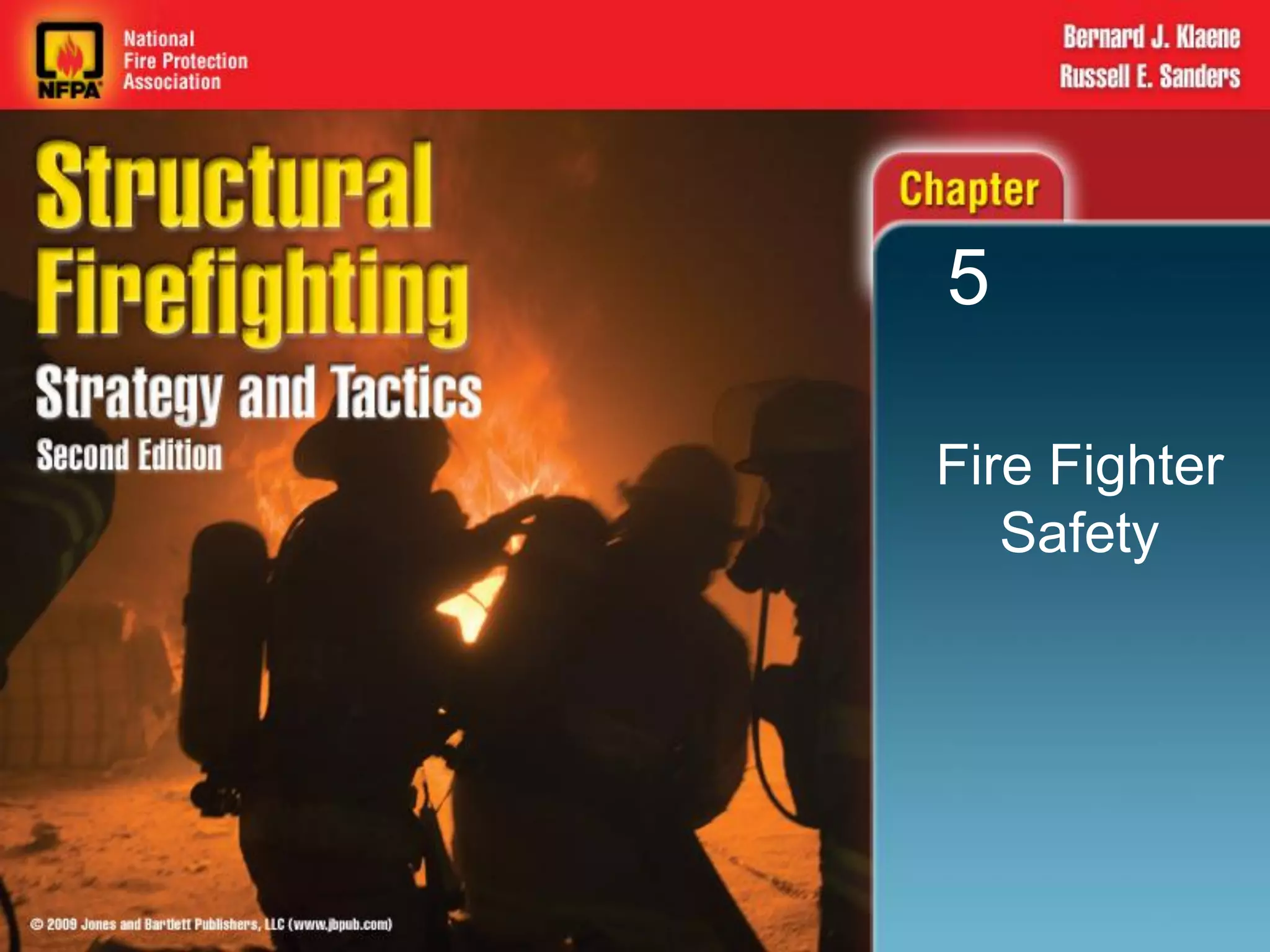
Fire Fighter
   Safety
5
     Learning Objectives (1 of 13)
• Identify and analyze the major causes
  involved in on-duty fire fighter fatalities
  related to health, wellness, fitness, and
  vehicle operations.
• Analyze the trend in the number of fire
  fighter on-duty deaths over a 30-year
  period.
• Define frequency and severity as they
  relate to fire fighter injuries.
5
     Learning Objectives (2 of 13)
• Enumerate fire-ground safety issues
  addressed in NFPA 1500.
• Compare and contrast fire trends and
  fire fighter on duty deaths.
• Describe the relative risk to fire fighters
  combating fires in different occupancy
  types.
5
    Learning Objectives (3 of 13)
• Analyze the trend in number of fire
  fighter injuries.
• Discuss risk management principles
  applied to the fire ground.
• Discuss and give an example of an
  imminent life-threatening situation.
5
    Learning Objectives (4 of 13)
• Use a probability analysis to assess the
  occupied status of a building based on
  time and occupancy.
• Estimate the collapse time based on
  burn time, fire intensity, content load,
  and construction type.
5
     Learning Objectives (5 of 13)
• Examine the difference between a managed
  retreat and an evacuation due to an imminent
  hazard.
• Evaluate the difference between lightweight
  and heavy structural components.
• Discuss and contrast pre-fire and fire
  conditions that contribute to structural
  collapse.
• Examine hazards presented by suspended
  ceilings.
5
     Learning Objectives (6 of 13)
• Compare construction methods in terms
  of structural stability, fire extension, and
  fuel contribution.
• Review the basics of building
  construction and how they relate to pre-
  fire planning.
• Estimate the collapse zone for a
  building in imminent danger of collapse.
5
     Learning Objectives (7 of 13)
• Describe exclusion zones other than collapse
  zones.
• Develop zones and perimeters around a
  structure fire.
• Define and explain the five time segments
  from ignition to effective action.
• Evaluate the survivability, structural stability,
  and flashover from ignition to effective action.
5
     Learning Objectives (8 of 13)
• Evaluate set-up time in regard to staffing on
  the first-arriving engine company.
• Compute the staffing necessary to achieve
  the tasks enumerated in NFPA 1710.
• Define and compare flashover and backdraft.
• Explain the relationship between NIMS and a
  fire fighter accountability system.
5
     Learning Objectives (9 of 13)
• List situations when a personal accountability
  report (PAR) should be initiated.
• Explain the importance of alternative egress
  for fire fighters conducting an offensive
  attack.
• Define rapid intervention crew (RIC).
• Explain the role of the RIC.
• Explain the importance of having a RIC
  immediately available from initial attack and
  throughout the operation.
5
    Learning Objectives (10 of 13)
• Determine the number of personnel to
  be assigned to the RIC based on the
  size and complexity of the building and
  incident.
• Describe safe interior operations.
• Construct an emergency message for a
  disoriented fire fighter needing
  assistance.
5
    Learning Objectives (11 of 13)
• Explain measures that can be taken to
  improve the chances of survival when fire
  fighters are lost and out of air in a large
  building.
• Describe methods used to supply air to a
  trapped fire fighter who has exhausted his or
  her air supply.
• List tools that should be available to a RIC.
5
    Learning Objectives (12 of 13)
• Compare the advantages and disadvantages
  of a mobile RIC versus a stationary RIC.
• Recognize hazards in operating opposing fire
  lines.
• Evaluate hazards to fire fighters during
  overhaul operations.
• Define immediately dangerous to life and
  health (IDLH) atmospheres and the
  relationship to SCBA usage.
5
    Learning Objectives (13 of 13)
• List factors the IC should consider when
  formulating an incident action plan to be used
  during overhaul.
• Describe informal rehabilitation at the fire
  scene.
• Describe hot weather rehabilitation
• Describe cold weather rehabilitation.
• List the signs of critical incident stress.
5
               Overview
• Fire departments
  – Dedicated to saving lives and property
  – Saving lives is the highest priority.
• Safety closely related to risk-versus-
  benefit analysis.
5

    Fire Fighter Injuries and
            Fatalities
• Identifying/analyzing data
  – Critically important to reducing fire fighter
    injuries and deaths
  – The National Fire Protection Association
    (NFPA) has compiled fire fighter fatality
    statistics for 30 years—downward trend
5
   Fire Investigative Reports
• National Fire Protection Association
  (NFPA)
• National Institute for Occupational
  Safety and Health (NIOSH)
• U.S. Fire Administration (USFA)
5
           NFPA 1500 (1 of 5)
• Standard on Fire Department
  Occupational Safety and Health
  Program
• Can substantially reduce injury
  frequency and severity
  – Minimum safety measures
  – ICs and safety officers must be familiar
    with this standard.
5
            NFPA 1500 (2 of 5)
• Important fire-ground safety issues:
  – Risk management principles
  – IC responsible for overall safety
  – Incident management system must be
    used at all scenes
  – IC maintains command and control.
     • Common strategy
     • Based on situation analysis
5
            NFPA 1500 (3 of 5)
• Important fire-ground safety issues
  (continued):
  – Situation analysis must be ongoing
     • Changes in strategy consistent with the
       changing situation
  – Pre-established SOPs must be
    implemented.
5
          NFPA 1500 (4 of 5)
• Important fire-ground safety issues
  (continued):
  – Accountability system
  – Rapid Intervention Crews (RIC)
  – Inexperienced members must be directly
    supervised.
5
            NFPA 1500 (5 of 5)
• Important fire-ground safety issues
  (continued):
  – Medical treatment and rehab must be available as
    needed.
  – PPE must be worn.
  – SCBA
  – PASS devices
  – CISD
  – Post-incident analysis
5
        Fire-Ground Safety
• Improvements
  – Attention to safety
  – Safe operation attitude
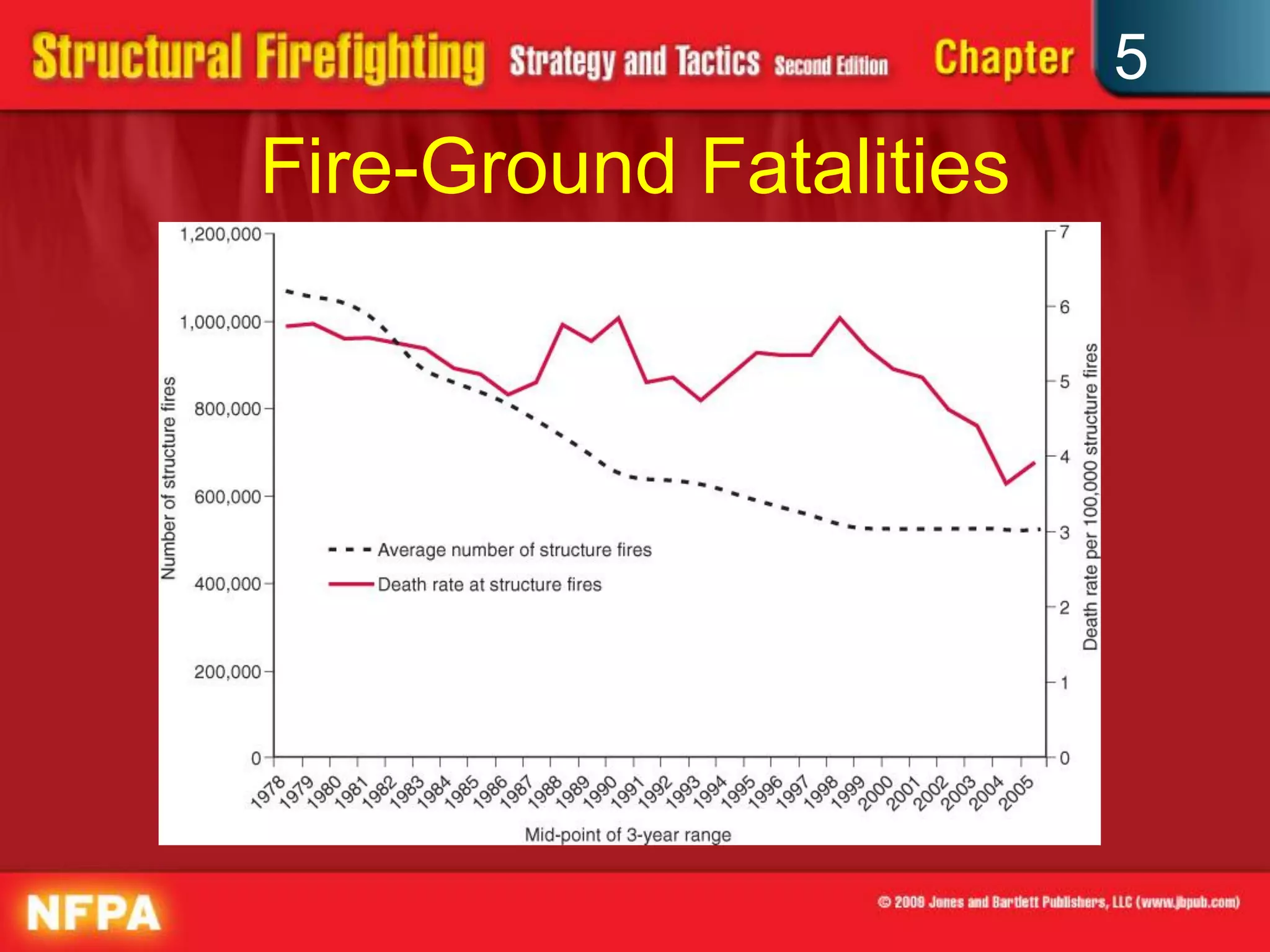
• Still experiencing a large number of
  on-duty deaths
  – Responding to fewer fires
  – Dying at nearly same rate
5
Fire-Ground Fatalities
5
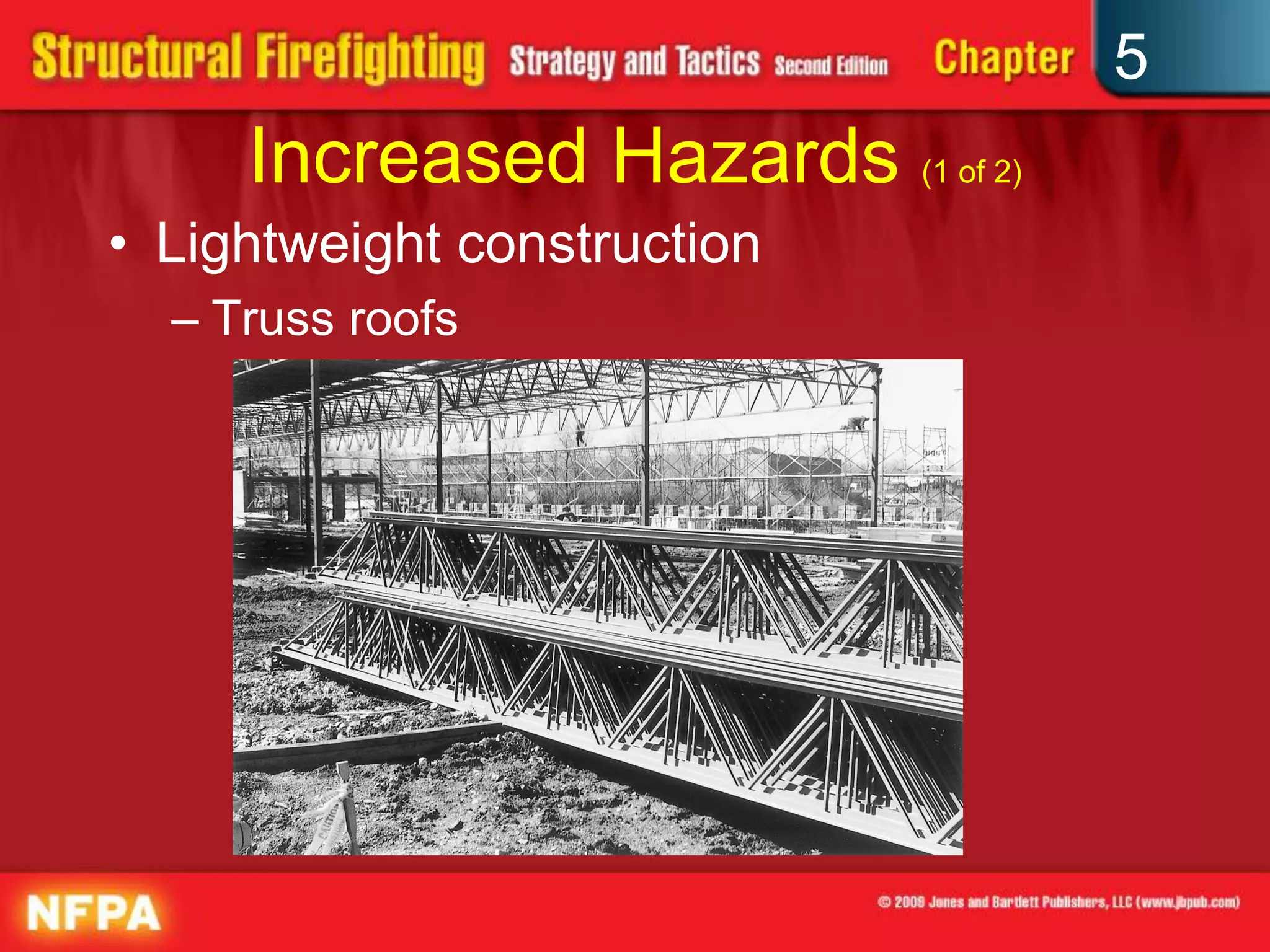
     Increased Hazards (1 of 2)
• Lightweight construction
  – Truss roofs
5
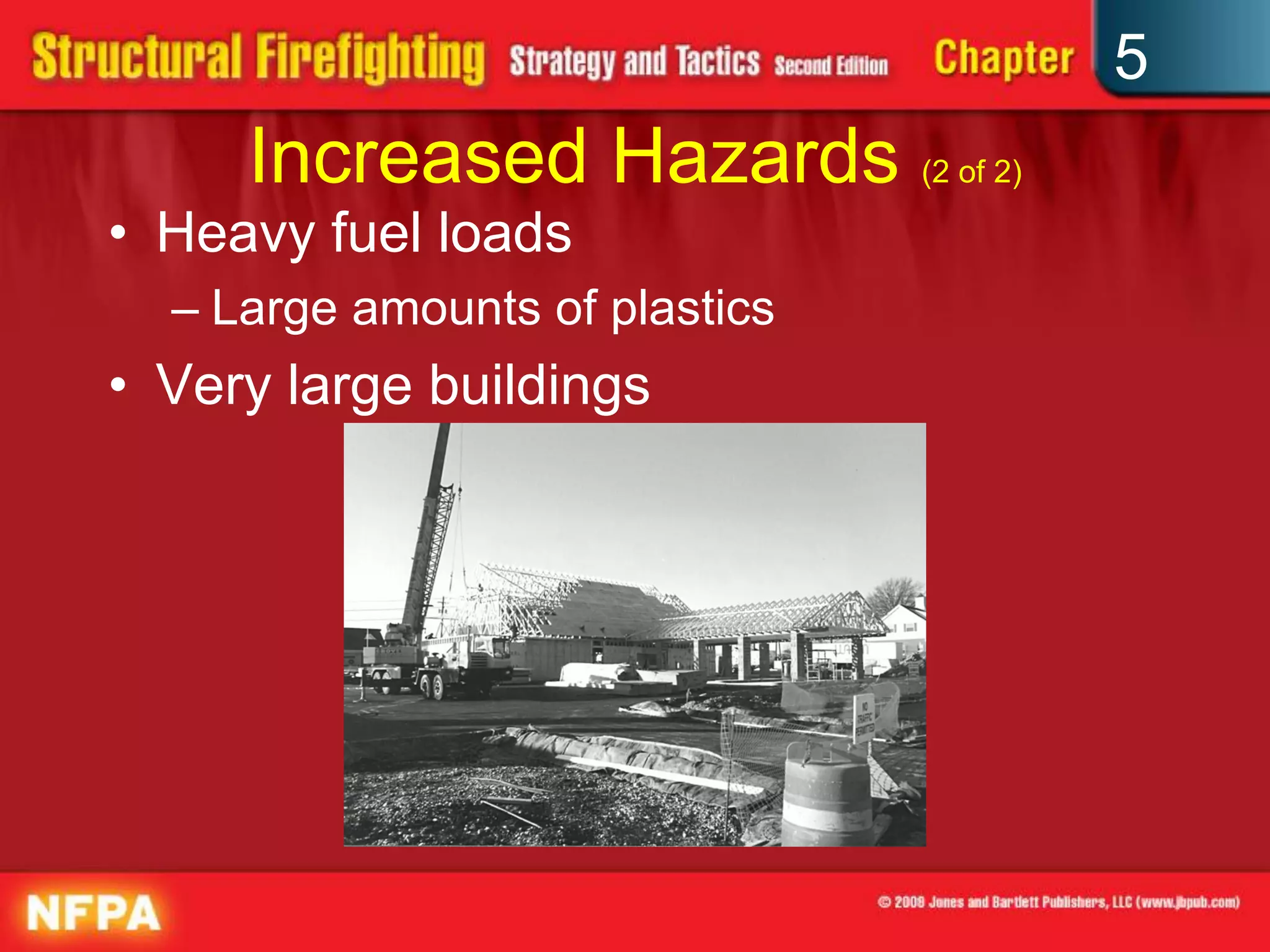
     Increased Hazards (2 of 2)
• Heavy fuel loads
  – Large amounts of plastics
• Very large buildings
5
                Occupancy
•   Plays a role in fire fighter safety
•   No routine fires
•   Most fatalities occur in residential fires.
•   Risk increases twofold in a
    manufacturing setting.
5
     Single-Family Mindset
• Must be avoided
• Escape routes are closer and easier to
  find.
• SCBA depletion or failure
5
          On-Duty Deaths
• Leading causes:
  – Sudden cardiac death
    • Preventable
  – Asphyxiation
  – Crushing injuries and burns
5
            Responsibility
• Administration
• Procedures
  – Training
  – Equipment
• ICs have overall safety responsibility.
  – Must monitor, organize, coordinate, and
    provide adequate safety measures
5
    Personal Responsibility
• Fire fighters must take personal
  responsibility through:
  – Following procedures
  – Maintaining firefighting skills
  – Proper use of equipment
5
        Risk Management
• Most important element
• NFPA 1500
  – Risk management principles
  – Must be applied to every situation
• IC weighs risk against possible benefits.
5
      Two-in, Two-out Rule
• Exception:
  – Imminent life-threatening situation
  – Definition is not completely understood
• IC expected to exercise judgment
5
              Probability
• Important concept to risk management
  and size-up processes
  – People being in the building considered as
    a degree of probability
  – Determining factors: time of day, day of
    week, time of year
• Primary search is the only sure way of
  knowing.
5
             Fire Intensity
• Important in determining what there is to
  save.
• Hazards increase as fire progresses
  towards flashover.
  – Building is getting weaker
  – Flashover is unpredictable.
5
           Flashover (1 of 2)
• Time to flashover depends on:
  – Compartment size
  – Ventilation
  – Ignition source
  – Fuel supply
  – Fuel geometry
5
            Flashover (2 of 2)
• Time to flashover depends on
  (continued):
  – Distance between fuel cells
  – Location of the fuel
  – Heat capacity of the fuel
  – Geometry of the enclosure
5
      Building Design Loads
• Loads imposed on buildings:
  – Live loads
  – Dead loads
  – Seismic, wind, snow, and ice loads
• Affect structural stability
  – High loads can result in premature
    collapse.
  – Loads placed on lightweight roof structures
5
                  Fuel Load
• Consists of fuels provided by:
  – Contents
     • Primary fuel load in structure fires
  – Combustible building materials
     • Wood frame construction
5
      Structural Stability (1 of 4)
• IC/safety officer must watch for signs of
  structural failure
• Should be considered in size up
  – Failure can occur at any time.
• Must understand collapse dynamics
5
      Structural Stability (2 of 4)
• IC must take into account when:
  – Deciding on strategy
  – Placing companies
• Cannot be reliably predicted
  – No building is immune.
  – Some withstand a large fire without
    collapse.
  – Others experience early collapse.
5
      Structural Stability (3 of 4)
• Stability affected by:
  – Fire intensity
  – Burn time
  – Content loads
  – Construction methods and materials
5
      Structural Stability (4 of 4)
• 20-minute rule
  – Ordinary construction
  – Structural collapse anticipated:
     • Heavy volume of fire
     • Two or more floors
     • 20 minutes or longer
5
         Time and Intensity
• Is it safe to enter?
  – IC should “start the clock.”
  – If fire is still not under control:
     • IAP should be reviewed.
     • Operation possibly changed to defensive
5
          Managed Retreat
• When changing from offensive to defensive
  – Engine companies provide protection.
• If collapse is imminent, the offensive
  operation should be abandoned immediately.
• All units notified by:
  – Radio announcement
  – Pre-planned signal
5
   Construction Materials (1 of 2)
• Wide variety in use
  – Behavior of buildings will vary significantly.
  – Lighter weight structural members
     • Provide same load-bearing capabilities
     • Truss construction takes the place of large
       wood beams or steel I-beams
     • Structurally sound under normal conditions
5
   Construction Materials (2 of 2)
• Lightweight members are affected by
  fire sooner.
  – Trusses lose load-bearing capacity once
    they lose their triangular configuration.
  – Failure with little warning
5
   Structural Connections (1 of 2)
• Play a critical role in a building fire
  – Gusset plates used in place of nails
     • Nails form a stronger connection.
  – Penetrate only a fraction of an inch
  – Form a large surface area to collect heat
5
   Structural Connections (2 of 2)
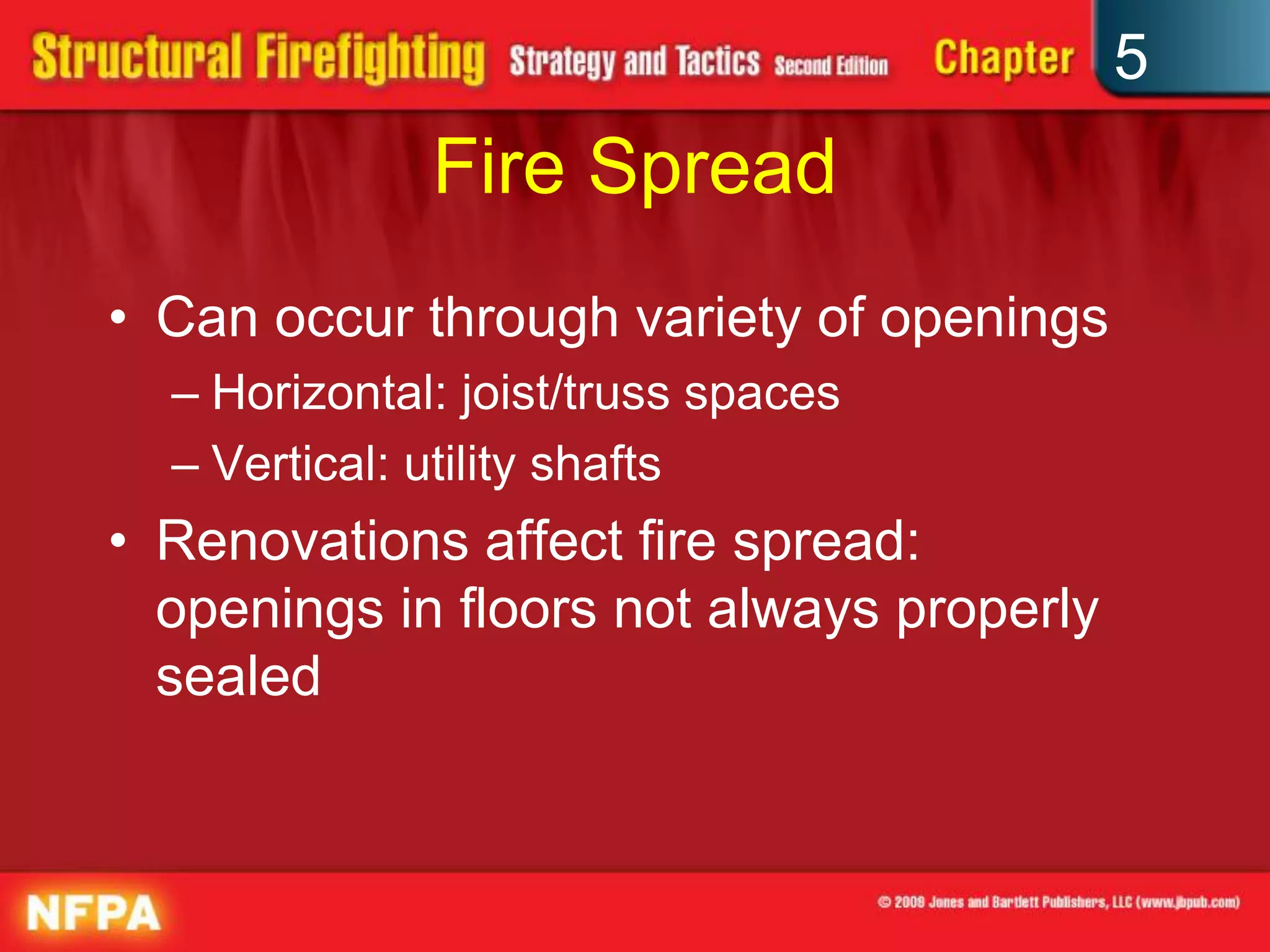
• Wood truss loses its stability as:
  – Gusset plate teeth lose strength
  – Fire burns through the wood connecting
    surfaces
5
Gusset Plate Failure
5
              Fire Spread
• Can occur through variety of openings
  – Horizontal: joist/truss spaces
  – Vertical: utility shafts
• Renovations affect fire spread:
  openings in floors not always properly
  sealed
5
          Roof Operations
• Conscious decision regarding roof
  safety
  – Lightweight truss roofs are dangerous.
• Risk-versus-benefit decision
  – Must be made before placing fire fighters
    on or under roof
5
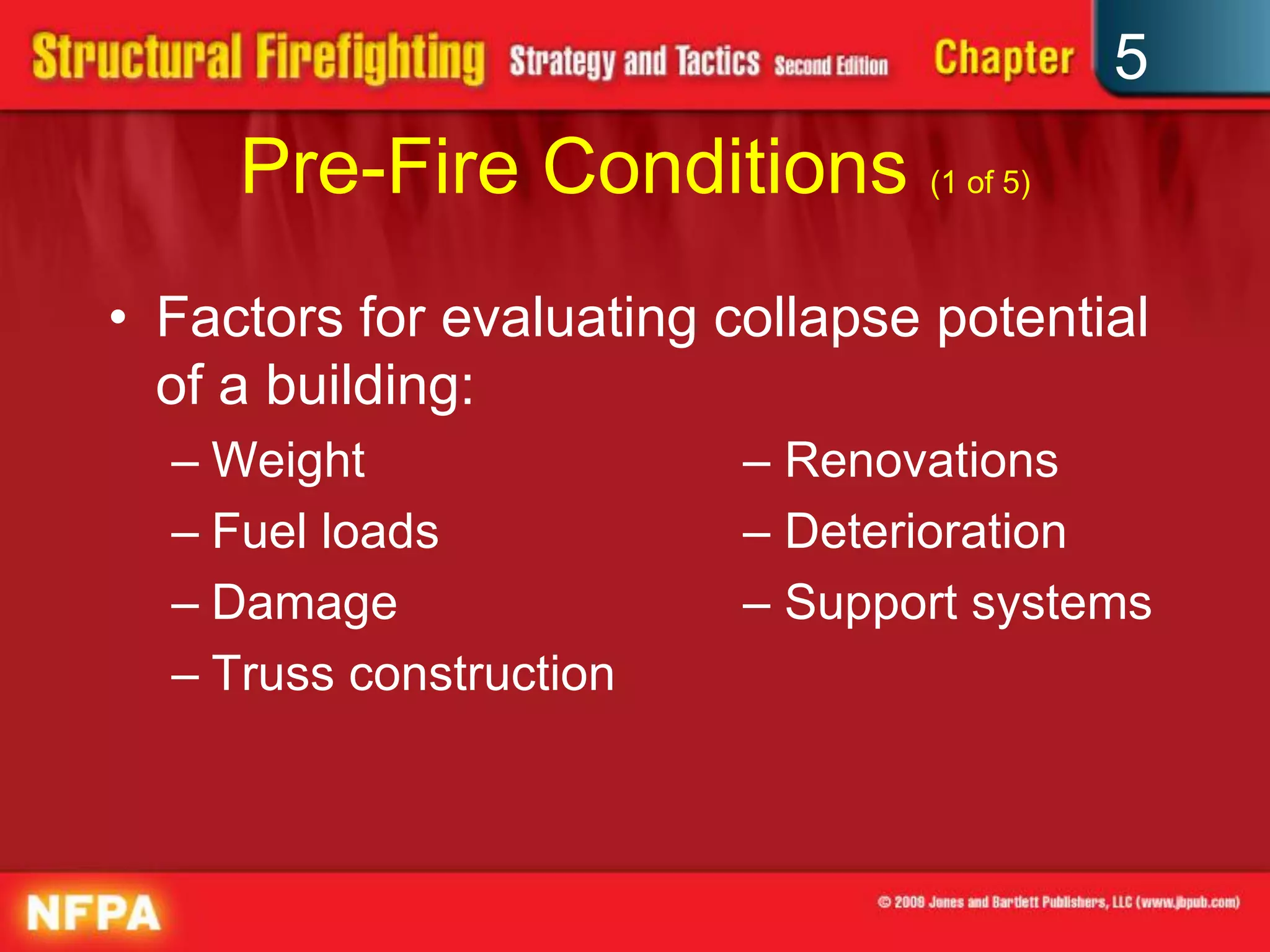
     Pre-Fire Conditions (1 of 5)
• Factors for evaluating collapse potential
  of a building:
  – Weight                – Renovations
  – Fuel loads            – Deterioration
  – Damage                – Support systems
  – Truss construction
5
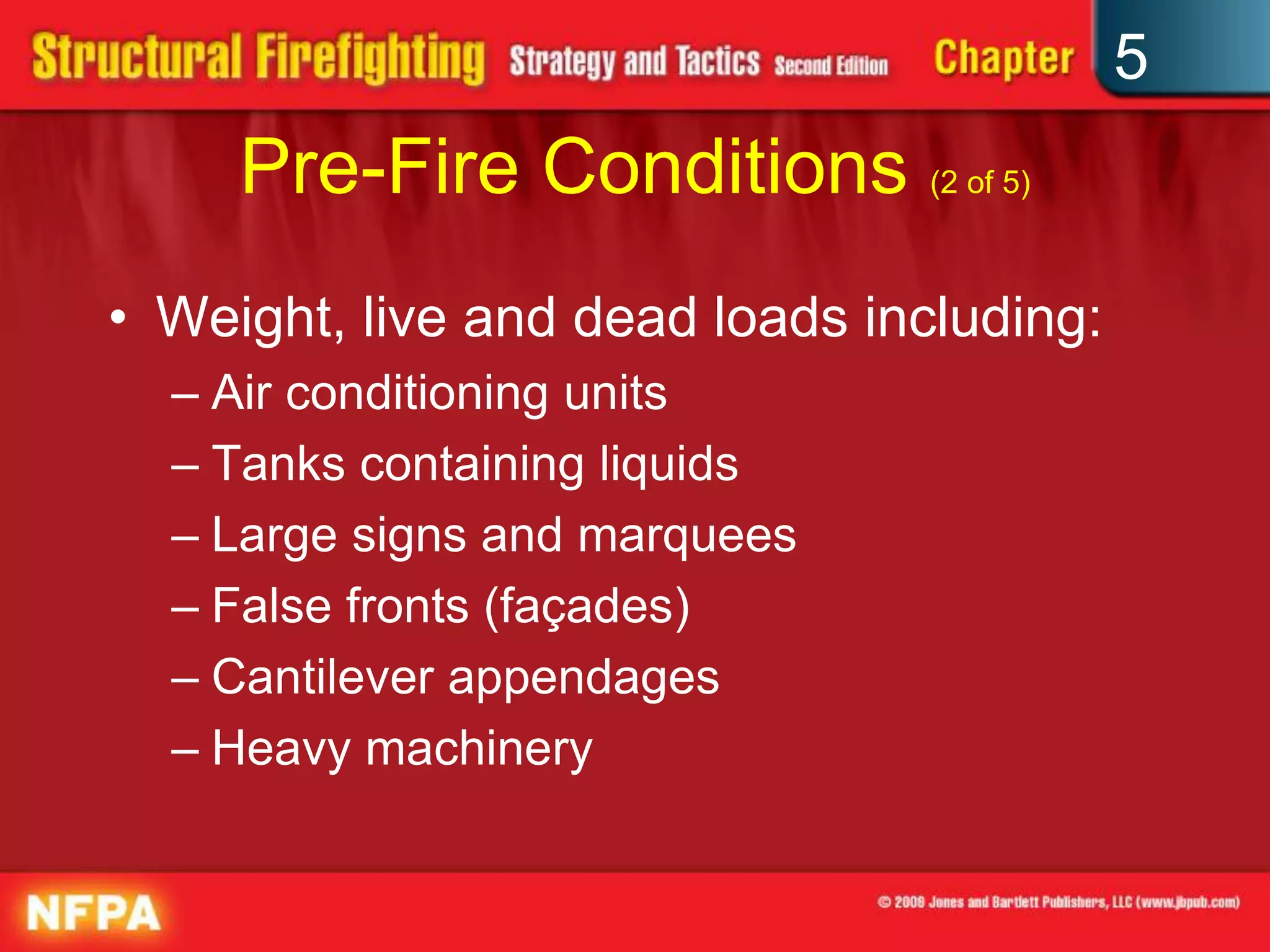
     Pre-Fire Conditions (2 of 5)
• Weight, live and dead loads including:
  – Air conditioning units
  – Tanks containing liquids
  – Large signs and marquees
  – False fronts (façades)
  – Cantilever appendages
  – Heavy machinery
5
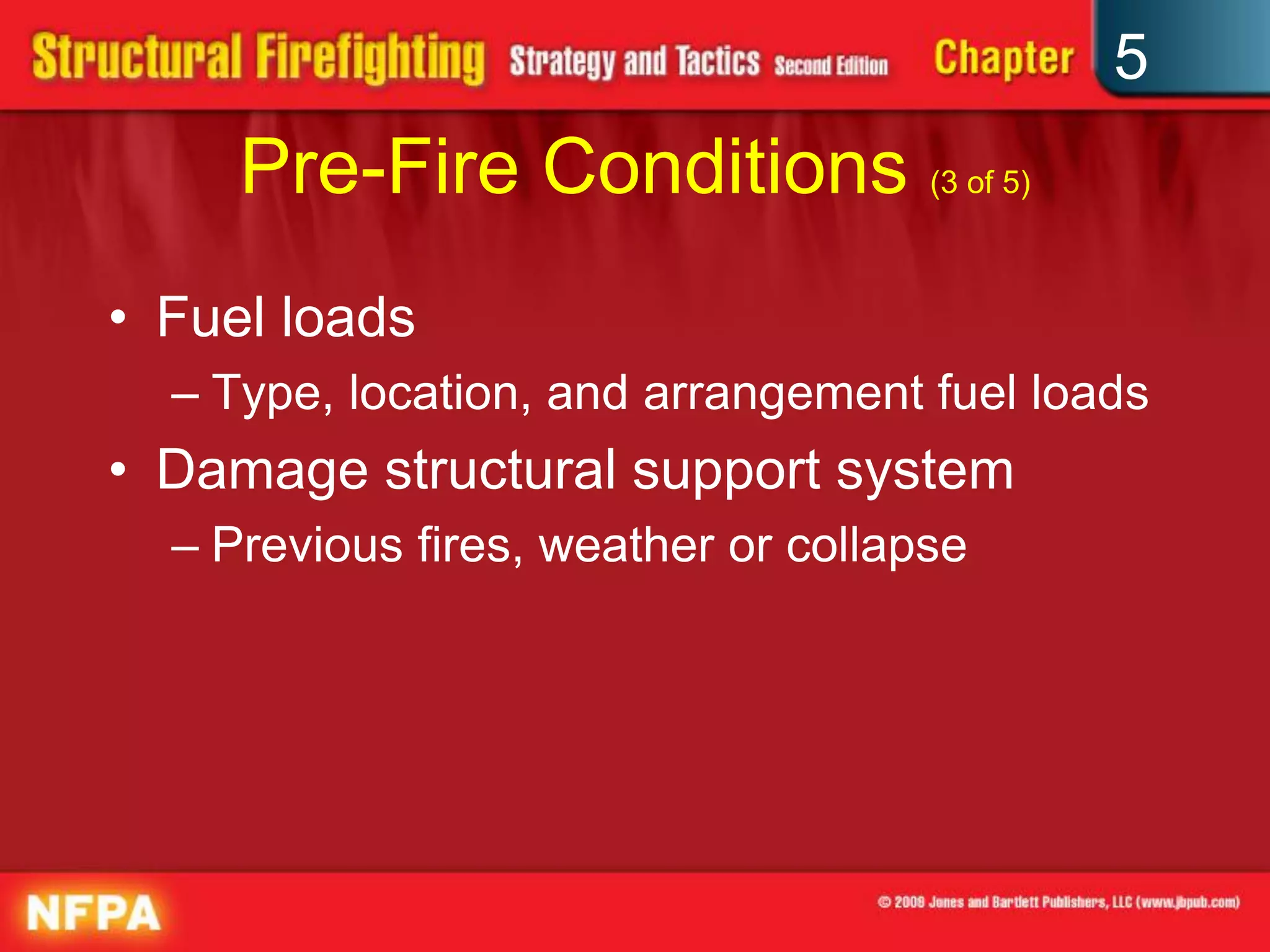
     Pre-Fire Conditions (3 of 5)
• Fuel loads
  – Type, location, and arrangement fuel loads
• Damage structural support system
  – Previous fires, weather or collapse
5
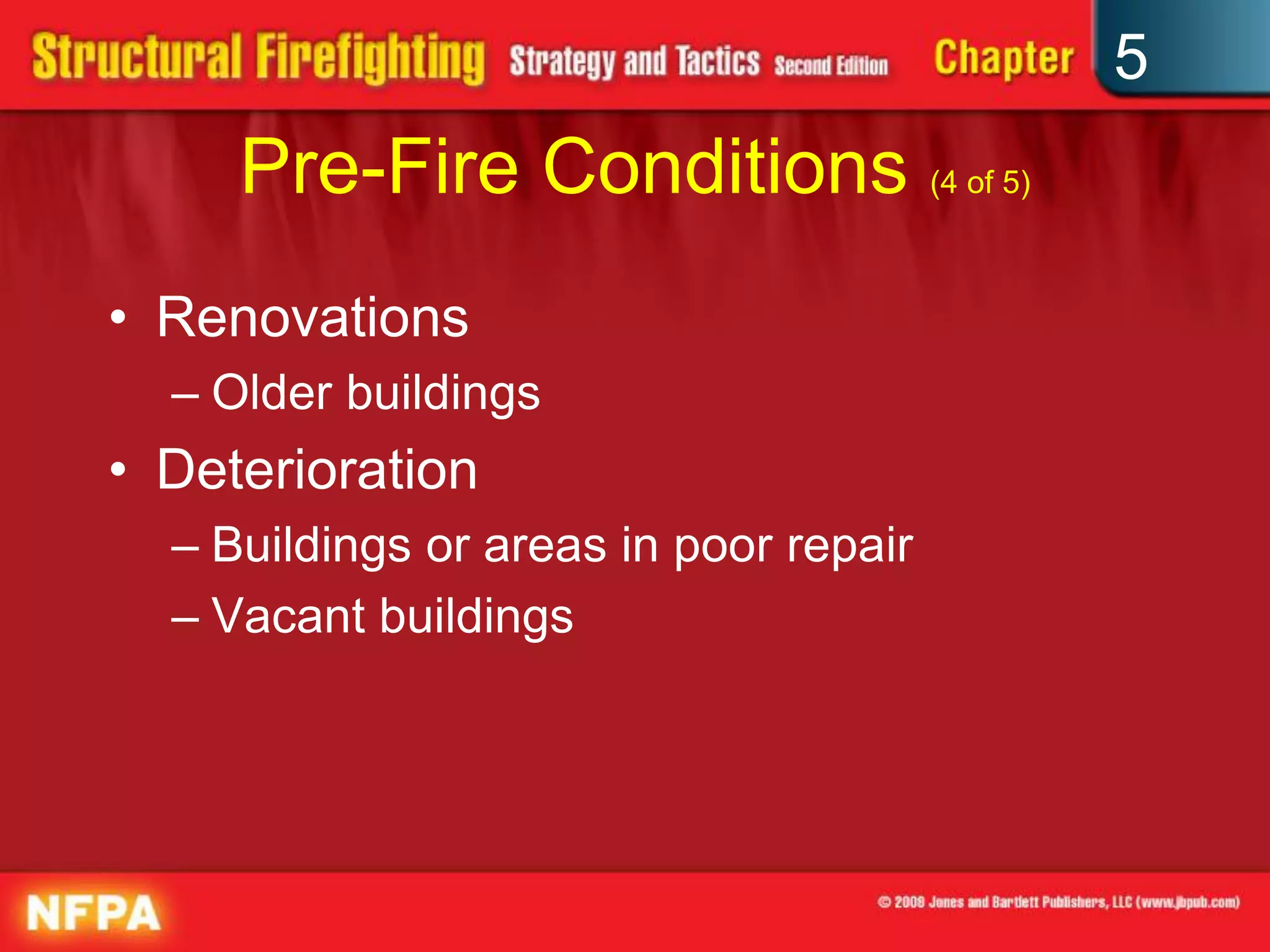
     Pre-Fire Conditions (4 of 5)
• Renovations
  – Older buildings
• Deterioration
  – Buildings or areas in poor repair
  – Vacant buildings
5
     Pre-Fire Conditions (5 of 5)
• Support systems
  – Long spans (churches, warehouses)
• Truss construction
  – Identified through pre-planning
5
           Fire Conditions
• Sometimes difficult to read
• Failures occur without warning.
• Must recognize signs of imminent
  collapse
  – Maintain span of control
• Time and fire intensity are major factors.
5
Signs of Structural Collapse (1 of 2)
•   Bulging, cracked, or unsupported walls
•   Walls leaking water or smoke
•   Falling bricks
•   Floors holding large volumes of water or
    stock soaked with water
5
Signs of Structural Collapse (2 of 2)
• Movement in floors or roof
• Other signs of structural movement,
  including unusual noises
• Vertical structural members that are out
  of plumb (columns, walls, etc.)
5
             Fire Extension
• Some buildings limit fire spread better
  than others.
• Concealed spaces
  – Fire can extend to remote locations
     • Results in a sudden increase in heat intensity
     • Can break out at multiple locations
5
     Concealed Spaces (1 of 2)
• Fire fighters without a hose line are at
  high risk.
• Fire extension can cut off primary
  means of egress.
• Proper venting will direct fire.
• Improper venting pulls fire.
5
     Concealed Spaces (2 of 2)
• Fires in concealed ceiling areas can get
  behind fire fighters.
  – Hose streams can accelerate movement of
    fire.
• Must be checked
  – Thermal imaging cameras
  – Opened up with tools
5
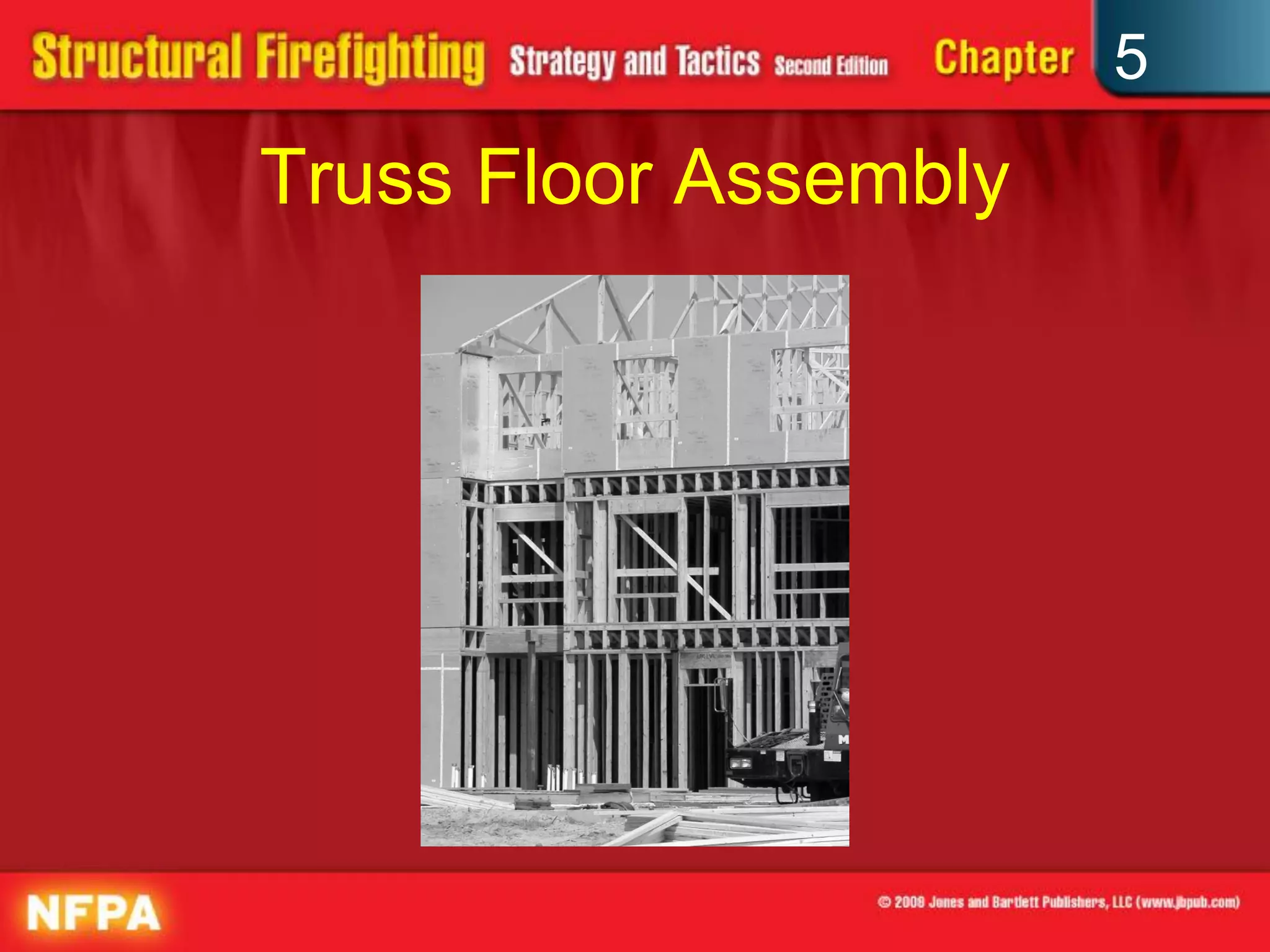
         Truss Assemblies
• Floor assemblies
  – Used to reduce construction costs
  – Creates concealed space
  – Less fire-resistive than heavier, solid beam
    construction
• Have played a major role in fire fighter
  fatalities
5
Truss Floor Assembly
5
  Non-Combustible Buildings
• Mistaken for fire-resistive
  – Modern, big-box retail stores
  – May be masonry or metal on the exterior
  – Lightweight metal truss roof structure
• Large open areas with long spans
  – Expect imminent roof collapse if fire enters
    spaces.
5
 Automatic Sprinkler Systems
• Usually control fires
  – Consider code variances or “trade-ups”
  – If system is not controlling fire, consider
    hazards in entering large-span truss space
    with heavy fire load.
5
  Fire Zones and Perimeters
• Establish collapse zone
• Collapse indicated by:
  – Construction features
  – Fire factors
• Cannot accurately predict:
  – Type of collapse
  – Collapse zone
5
          Exclusion Zones
• Collapse zones = exclusion zones
  – No one permitted to enter
  – Can exist in buildings (suspect roof
    structures)
  – Other areas:
    • Falling glass
    • Flammable/combustible atmospheres
5
              Cold Zone
• PPE is not required.
• Location of command post
  – Staff and command functions
• Includes rehab and medical areas
5
              Hot Zone
• Safe only when wearing appropriate
  PPE
• Established and enforced by IC and
  safety officer; everyone must abide by
  their decision.
5
             Warm Zone
• Not always necessary during a structure
  fire
• Established as an intermediate zone
  – Between hot and cold zones
  – When different levels of PPE are needed
    for various areas
5
      Accountability System
• Must be established on the fire-ground:
  – Ensures everyone entering the area has a
    specific assignment
     • Eliminates freelancing
  – Tracks all personnel
     • Identifies the location of any missing personnel
5
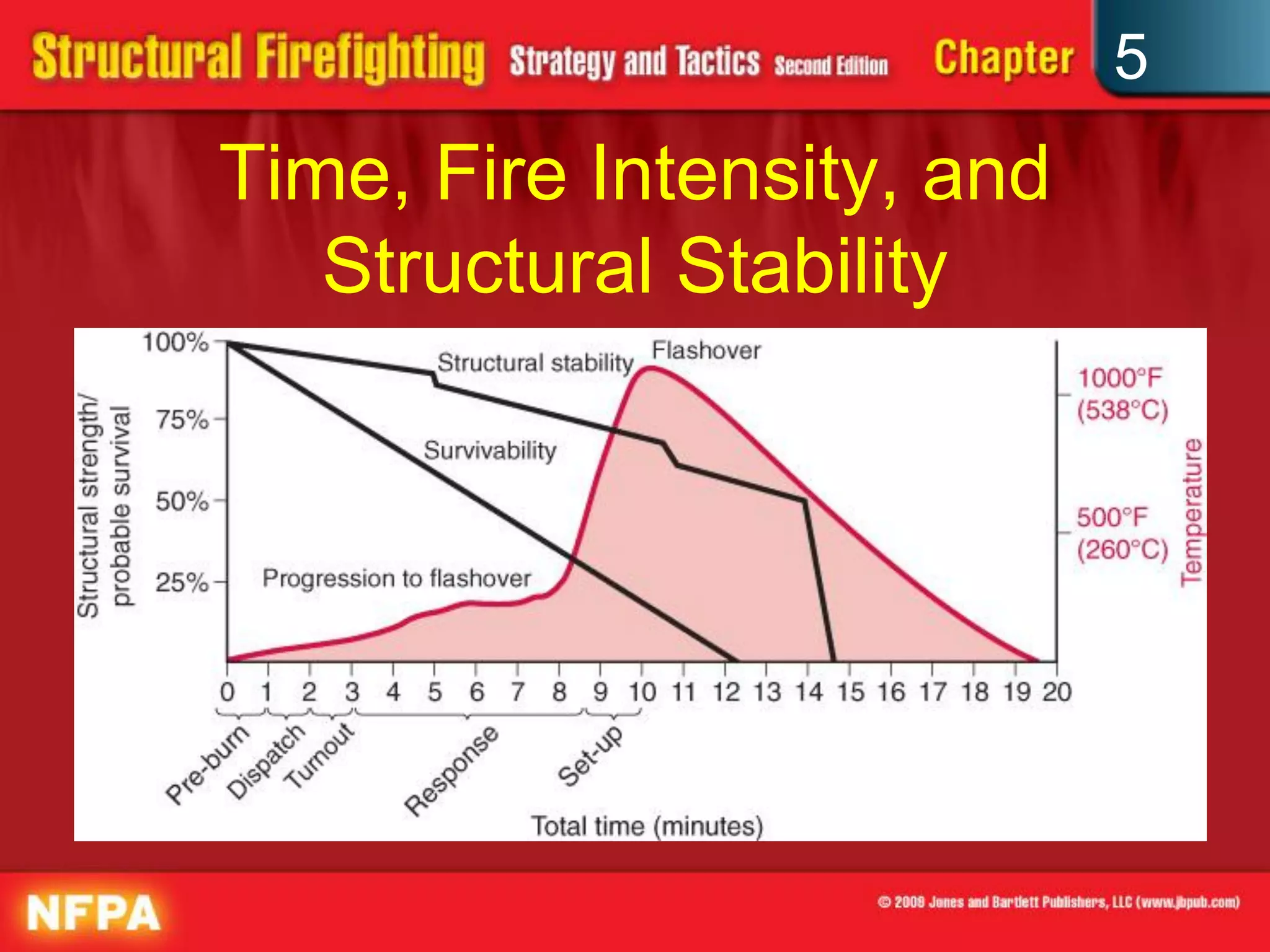
Time, Fire Intensity, and
   Structural Stability
5

   Time: Ignition to Effective
            Actions
• Goal: To arrive prior to flashover and
  intervene
  – Interrupts fire’s progression
  – Progression in small enclosures can be
    fast.
     • May occur prior to the arrival
     • Objective is to contain the fire
5
          Analyzing Time
• It is necessary to consider the following
  five components:
  – Pre-burn time
  – Dispatch time
  – Turnout time
  – Response time
  – Set-up time
5
Detection/Transmission Time
• Pre-burn time
  – Time from ignition until fire is reported
     • Will vary greatly
     • Is unknown until the alarm occurs
  – Dependent upon discovery and reporting
     • Unless equipped with a detection/alarm system
  – Can be estimated based on experience
5
           Dispatch Time
• NFPA 1221: Installation, Maintenance,
  and Use of Emergency Services
  Communications Systems sets time
  goals for dispatch centers.
• Includes time for the dispatcher to:
  – Take the call
  – Select units for the assignment
  – Dispatch companies
5
            Turnout Time
• Time from alarm receipt until apparatus
  leaves station
• Can differ greatly between fully staffed
  stations and on-call stations
5
            NFPA 1710
• Standard for the Organization and
  Deployment of Fire Suppression
  Operations, Emergency Medical
  Operations, and Special Operations to
  the Public by Career Fire Departments
  defines turnout time
• Time beginning when units
  acknowledge notification to beginning
  point of response time
• Time objective = one minute
5
            NFPA 1720
• Standard for the Organization and
  Deployment of Fire Suppression
  Operations, Emergency Medical
  Operations, and Special Operations to
  the Public by Volunteer Fire
  Departments does not address turnout
  time.
5
          Response Time
• Dependant on road conditions, terrain,
  distance, traffic, and other factors
• Averages can be established using
  computer models.
5
              NFPA 1710
• NFPA 1710 establishes two response
  time goals:
  – Four minutes (240 seconds) or less for
    arrival of the first engine company
  – Eight minutes (480 seconds) or less for the
    deployment of a full first alarm assignment
  – No less than 90 percent within time goal
5
          Response Safety
• Many fire fighters are killed or injured
  while responding to incidents.
  – Response/travel time improvements
     • Realized by reducing distance from fire station
       to response area
     • Not by increasing speed of apparatus or
       ignoring negative right-of-way situations
5
              Set-Up Time
• Time necessary to position apparatus,
  advance hose line and apply water
• Affected by staffing levels and training
  – Two-in/two-out rule changes setup time
     • Four people must be on the scene.
     • Two must be positioned outside the hazard
       area.
5
              NFPA 1410
• Standard on Training for Initial
  Emergency Scene Operations sets
  training goals.
  – 3 to 6 minutes to establish water supply
    and discharge water
  – Improvement through training
5
      Initial Response Only
• Times are valid for initial response only
  – Less dispatch time when units are on-
    scene, calling for help.
  – Reduce for subsequent calls by:
     • Placing units on alert status
     • Moving into vacated stations
     • Placing units in staging areas
  – Set-up time will change depending on task
    assignment
5

       Adequate Number of
           Personnel
• Set-up time is related to staffing.
  – Initial attack should be delayed if:
     • Company staffing is less than four
     • Imminent life-threatening situation does not
       exist
5
              NFPA 1500
• Stipulates a minimum of four fire
  fighters as an initial crew at a working
  structure fire
  – Unless imminent life-threatening situation
    exists
  – Three is acceptable in situations of
    imminent danger
5
     Fire-Ground Tasks (1 of 3)
• Required to save lives and protect
  property
• Additional attack lines
• Attack line above the fire
• Attack line to concealed spaces
• Backup for the initial attack line
5
       Fire-Ground Tasks (2 of 3)
•   Exposure protection
•   Forcing entry
•   Laddering the building
•   Opening up concealed spaces
•   Salvage or property conservation
5
     Fire-Ground Tasks (3 of 3)
• Search and rescue of area around the
  fire
• Search and rescue of area above the
  fire
• Search and rescue of other areas
• Utility control
• Ventilation
5
                NFPA 1710
• Establishes minimum staffing levels
  – Tasks to be accomplished
  – Personnel needed
  – Minimum of 14 personnel
     • 15 if an aerial device is used
5
         Tactical Reserve
• Planning is crucial.
• Tactical efficiency can reduce number
  of people necessary.
• Size of tactical reserve force depends
  on:
  – Stage and type of incident
  – Number of units working
5
 Elapsed Time and Flashover
• Time is a critical factor.
• Longer the fire burns:
  – Less chance for rescue
  – Greater chance of structural collapse
  – Post-flashover chance for survival = near
    zero
  – Risk to fire fighters increases
5
         Communications
• Lifeblood of any command organization
• Situation could be chaotic without
  communications.
  – Each crew should have a radio.
5
          Radio Discipline
• Significant challenge
• Imperative when everyone is assigned a
  radio
  – Proper use of the radio
    • Clear
    • Calm
    • Concise
5
         Progress Reports
• Essential to the IC
• Interior crews = eyes and ears of the IC
• Provide information to everyone on fire-
  ground
5
     Emergency Operations
• Mayday is used to indicate that a fire
  fighter is in trouble.
• SOPs should define response to a
  Mayday
  – Critical functions will not be accomplished
    if all personnel begin focusing on the
    rescue operation.
5
              Mayday
• IC must remain in total control.
• Officers must remain within the ICS.
• Specific assignments should be made
  for the rescue operation.
5
        Evacuation Signal
• Should be established through SOPs
  – 10 three-second blasts of air horns
  – Emergency evacuation radio message
5
              Evacuation
• “Drop everything and run”
  – Seldom warranted
  – Used during defensive operations
• Offensive operations
  – Organized retreat is better alternative
5
     Command and Control
• Common goal
  – Organized fashion
  – Safe and effective operation
• Freelancing leads to injuries and
  fatalities.
5
             Accountability
• A good organizational structure:
  – Accounts for all personnel at scene
  – Maintains reasonable span of control
     • Crew unity is essential.
• Crew members should not be separated
  within the structure.
5

    Personnel Accountability
          Report (1 of 2)
• Often referred to as a PAR.
• SOPs call for PARs in the following
  situations when:
  – IC thinks it is necessary
  – Safety officer requests one
  – IC changes from an offensive to a
    defensive attack
5

      Personnel Accountability
            Report (2 of 2)
•   Sudden changes occur.
•   Entire building has been searched.
•   Fire is extinguished.
•   Called for at prescribed times
    – NFPA 1500: Every 10 minutes
5
   Accountability Procedures
• More important as incident increases in
  size and complexity
  – Mutual aid resources
  – A regional approach is logical
5
      Accountability Officer
• Should not be the safety officer
  – Safety officer is mobile.
  – Accountability officer is stationary.
• The accountability officer is an
  informational resource for the safety
  officer, RIC, and IC.
5
            Safety Officer
• Safety is everyone’s responsibility.
  – Whether or not a safety officer has been
    assigned
• Safety officer monitors all areas.
• SOPs outline when position is
  established
  – When IC can no longer effectively monitor
    safety at the scene
5
      Alternative Egress (1 of 2)
• Interior stairs
  – Preferred means of access and egress
• Fire escapes
  – Additional means
  – Provide access to upper floors
5
     Alternative Egress (2 of 2)
• Proper laddering
  – Should be accomplished early in operation
• Provides alternative means of egress
• Addressed in SOPs
• Location of ladders must be
  communicated to crews.
5
    Rapid Intervention Crews
• Staffing is not sufficient until:
  – Safety and tactical positions are covered
  – Tactical reserve is available.
• Critical need to provide rescuers for fire
  crews
  – RIC: no substitute for safe and effective
    operations
5
       Fire Fighter Rescue
• IAP will reduce the need for emergency
  rescues.
  – Risk-versus-benefit analysis
  – Good tactics
  – Company-level attention to safety
5
    Safe Interior Operations (1 of 2)
•   Maintain crew integrity
•   Provide hose line protection
•   Provide means of communications
•   Maintain contact with the hose line
5
  Safe Interior Operations (2 of 2)
• Maintain contact with a wall or rope
• Indicate door leading to where fire
  fighters are working
• Learn self-survival techniques
5
                  RIC Officer
• Determines need for special tools
  – Based on:
     •   Construction type
     •   Occupancy
     •   Fire location
     •   Other factors
  – Could be identified through pre-planning
5
    Common RIC Tools (1 of 2)
• Rescue ropes, search ropes, guideline
  ropes
• Thermal imaging camera
• Patient carrier, webbing, or harness
• Portable ladders for above- and below-
  grade rescues
5
    Common RIC Tools (2 of 2)
• Forcible entry tools
• Wire cutters and other hand tools
• Lighting equipment
5
           RIC Operations
• RIC should have access to pre-plans.
• Critically important to train and practice
  – Preferably under live fire conditions
5
             Hose Lines
• Avoid opposing hose lines.
• Interior hose lines should attack from
  same point.
  – Communications between units is
    essential.
5
          Master Streams
• Improperly operated on the exterior will
  push fire into the building, endangering
  anyone inside
5

       Personal Protective
        Equipment (PPE)
• Appropriate level established by IC and
  safety officer
• Overhaul phase
  – Removing SCBA is questionable
• Removing PPE inside fire building is
  unsafe
5
       Overhaul Safety (1 of 2)
• Safety considerations:
  – Structural damage/stability
  – Smoke and airborne contaminants
  – Cutting hazards
  – Holes in floors
5
       Overhaul Safety (2 of 2)
• Safety considerations (continued):
  – Damaged stairways
  – Utility hazards
  – Overhead hazards
  – Visibility
5
            Rehabilitation
• NFPA 1584: Recommended Practice on
  the Rehabilitation of Members
  Operating at Incident Scene Operations
  and Training Exercises
  – Provides guidelines for hot and cold
    weather rehabilitation
5
             Three Phases
•   Pre-incident hydration and preparation
•   Incident rehabilitation
•   Post-incident recovery
•   Dependant on:
    – Weather conditions
    – Length of time on the scene
    – Activity level
5
          Informal Rehab
• Takes place at the company apparatus
  – Should be in cold zone
  – Members can “dress down” while resting
    and rehydrating
  – Should not be placed near exhaust fumes
5
            Formal Rehab
• Established area for rehab
  – Should provide shade and mechanical
    cooling or heating
     • Dependant on weather conditions
  – Water or sports drinks and healthy food
    should be available.
5
        Two-Cylinder Rule
• Requires Rehab after a second,
  30-minute SCBA cylinder
• Rest period should be at least 20
  minutes
5
     Critical Incident Stress
• Stress management is related to rehab.
  – Best to take action at incident scene
  – Critical incidents
    • Fire in which fire fighters are seriously injured
      or killed
    • Fire in which children are seriously injured
    • Fire that results in one or more fatalities
5
      Signs of Critical Incident
               Stress
•   Shaking or trembling
•   Loss of muscular control
•   Blurred vision
•   Respiratory difficulties
•   Confusion and disorientation
•   Chills
•   Signs and symptoms of shock
5
       Proactive Measures
• Schedule breaks
  – Designated rehab area
• Rotate frontline personnel
• Check personnel for signs and
  symptoms.
5
            Summary (1 of 2)
• The primary rescue technique is
  extinguishing fire.
  – Heat, smoke, and toxic gases must be
    vented.
• Structure becomes safer once fire is
  extinguished.
5
            Summary (2 of 2)
• Measures to reduce fire fighter injuries
  and deaths:
  – Improved PPE
  – PASS devices
  – Rapid intervention crews
  – Accountability systems
  – NIMS
  – Rehab

Chapter 5

  • 1.
  • 2.
    5 Learning Objectives (1 of 13) • Identify and analyze the major causes involved in on-duty fire fighter fatalities related to health, wellness, fitness, and vehicle operations. • Analyze the trend in the number of fire fighter on-duty deaths over a 30-year period. • Define frequency and severity as they relate to fire fighter injuries.
  • 3.
    5 Learning Objectives (2 of 13) • Enumerate fire-ground safety issues addressed in NFPA 1500. • Compare and contrast fire trends and fire fighter on duty deaths. • Describe the relative risk to fire fighters combating fires in different occupancy types.
  • 4.
    5 Learning Objectives (3 of 13) • Analyze the trend in number of fire fighter injuries. • Discuss risk management principles applied to the fire ground. • Discuss and give an example of an imminent life-threatening situation.
  • 5.
    5 Learning Objectives (4 of 13) • Use a probability analysis to assess the occupied status of a building based on time and occupancy. • Estimate the collapse time based on burn time, fire intensity, content load, and construction type.
  • 6.
    5 Learning Objectives (5 of 13) • Examine the difference between a managed retreat and an evacuation due to an imminent hazard. • Evaluate the difference between lightweight and heavy structural components. • Discuss and contrast pre-fire and fire conditions that contribute to structural collapse. • Examine hazards presented by suspended ceilings.
  • 7.
    5 Learning Objectives (6 of 13) • Compare construction methods in terms of structural stability, fire extension, and fuel contribution. • Review the basics of building construction and how they relate to pre- fire planning. • Estimate the collapse zone for a building in imminent danger of collapse.
  • 8.
    5 Learning Objectives (7 of 13) • Describe exclusion zones other than collapse zones. • Develop zones and perimeters around a structure fire. • Define and explain the five time segments from ignition to effective action. • Evaluate the survivability, structural stability, and flashover from ignition to effective action.
  • 9.
    5 Learning Objectives (8 of 13) • Evaluate set-up time in regard to staffing on the first-arriving engine company. • Compute the staffing necessary to achieve the tasks enumerated in NFPA 1710. • Define and compare flashover and backdraft. • Explain the relationship between NIMS and a fire fighter accountability system.
  • 10.
    5 Learning Objectives (9 of 13) • List situations when a personal accountability report (PAR) should be initiated. • Explain the importance of alternative egress for fire fighters conducting an offensive attack. • Define rapid intervention crew (RIC). • Explain the role of the RIC. • Explain the importance of having a RIC immediately available from initial attack and throughout the operation.
  • 11.
    5 Learning Objectives (10 of 13) • Determine the number of personnel to be assigned to the RIC based on the size and complexity of the building and incident. • Describe safe interior operations. • Construct an emergency message for a disoriented fire fighter needing assistance.
  • 12.
    5 Learning Objectives (11 of 13) • Explain measures that can be taken to improve the chances of survival when fire fighters are lost and out of air in a large building. • Describe methods used to supply air to a trapped fire fighter who has exhausted his or her air supply. • List tools that should be available to a RIC.
  • 13.
    5 Learning Objectives (12 of 13) • Compare the advantages and disadvantages of a mobile RIC versus a stationary RIC. • Recognize hazards in operating opposing fire lines. • Evaluate hazards to fire fighters during overhaul operations. • Define immediately dangerous to life and health (IDLH) atmospheres and the relationship to SCBA usage.
  • 14.
    5 Learning Objectives (13 of 13) • List factors the IC should consider when formulating an incident action plan to be used during overhaul. • Describe informal rehabilitation at the fire scene. • Describe hot weather rehabilitation • Describe cold weather rehabilitation. • List the signs of critical incident stress.
  • 15.
    5 Overview • Fire departments – Dedicated to saving lives and property – Saving lives is the highest priority. • Safety closely related to risk-versus- benefit analysis.
  • 16.
    5 Fire Fighter Injuries and Fatalities • Identifying/analyzing data – Critically important to reducing fire fighter injuries and deaths – The National Fire Protection Association (NFPA) has compiled fire fighter fatality statistics for 30 years—downward trend
  • 17.
    5 Fire Investigative Reports • National Fire Protection Association (NFPA) • National Institute for Occupational Safety and Health (NIOSH) • U.S. Fire Administration (USFA)
  • 18.
    5 NFPA 1500 (1 of 5) • Standard on Fire Department Occupational Safety and Health Program • Can substantially reduce injury frequency and severity – Minimum safety measures – ICs and safety officers must be familiar with this standard.
  • 19.
    5 NFPA 1500 (2 of 5) • Important fire-ground safety issues: – Risk management principles – IC responsible for overall safety – Incident management system must be used at all scenes – IC maintains command and control. • Common strategy • Based on situation analysis
  • 20.
    5 NFPA 1500 (3 of 5) • Important fire-ground safety issues (continued): – Situation analysis must be ongoing • Changes in strategy consistent with the changing situation – Pre-established SOPs must be implemented.
  • 21.
    5 NFPA 1500 (4 of 5) • Important fire-ground safety issues (continued): – Accountability system – Rapid Intervention Crews (RIC) – Inexperienced members must be directly supervised.
  • 22.
    5 NFPA 1500 (5 of 5) • Important fire-ground safety issues (continued): – Medical treatment and rehab must be available as needed. – PPE must be worn. – SCBA – PASS devices – CISD – Post-incident analysis
  • 23.
    5 Fire-Ground Safety • Improvements – Attention to safety – Safe operation attitude • Still experiencing a large number of on-duty deaths – Responding to fewer fires – Dying at nearly same rate
  • 24.
  • 25.
    5 Increased Hazards (1 of 2) • Lightweight construction – Truss roofs
  • 26.
    5 Increased Hazards (2 of 2) • Heavy fuel loads – Large amounts of plastics • Very large buildings
  • 27.
    5 Occupancy • Plays a role in fire fighter safety • No routine fires • Most fatalities occur in residential fires. • Risk increases twofold in a manufacturing setting.
  • 28.
    5 Single-Family Mindset • Must be avoided • Escape routes are closer and easier to find. • SCBA depletion or failure
  • 29.
    5 On-Duty Deaths • Leading causes: – Sudden cardiac death • Preventable – Asphyxiation – Crushing injuries and burns
  • 30.
    5 Responsibility • Administration • Procedures – Training – Equipment • ICs have overall safety responsibility. – Must monitor, organize, coordinate, and provide adequate safety measures
  • 31.
    5 Personal Responsibility • Fire fighters must take personal responsibility through: – Following procedures – Maintaining firefighting skills – Proper use of equipment
  • 32.
    5 Risk Management • Most important element • NFPA 1500 – Risk management principles – Must be applied to every situation • IC weighs risk against possible benefits.
  • 33.
    5 Two-in, Two-out Rule • Exception: – Imminent life-threatening situation – Definition is not completely understood • IC expected to exercise judgment
  • 34.
    5 Probability • Important concept to risk management and size-up processes – People being in the building considered as a degree of probability – Determining factors: time of day, day of week, time of year • Primary search is the only sure way of knowing.
  • 35.
    5 Fire Intensity • Important in determining what there is to save. • Hazards increase as fire progresses towards flashover. – Building is getting weaker – Flashover is unpredictable.
  • 36.
    5 Flashover (1 of 2) • Time to flashover depends on: – Compartment size – Ventilation – Ignition source – Fuel supply – Fuel geometry
  • 37.
    5 Flashover (2 of 2) • Time to flashover depends on (continued): – Distance between fuel cells – Location of the fuel – Heat capacity of the fuel – Geometry of the enclosure
  • 38.
    5 Building Design Loads • Loads imposed on buildings: – Live loads – Dead loads – Seismic, wind, snow, and ice loads • Affect structural stability – High loads can result in premature collapse. – Loads placed on lightweight roof structures
  • 39.
    5 Fuel Load • Consists of fuels provided by: – Contents • Primary fuel load in structure fires – Combustible building materials • Wood frame construction
  • 40.
    5 Structural Stability (1 of 4) • IC/safety officer must watch for signs of structural failure • Should be considered in size up – Failure can occur at any time. • Must understand collapse dynamics
  • 41.
    5 Structural Stability (2 of 4) • IC must take into account when: – Deciding on strategy – Placing companies • Cannot be reliably predicted – No building is immune. – Some withstand a large fire without collapse. – Others experience early collapse.
  • 42.
    5 Structural Stability (3 of 4) • Stability affected by: – Fire intensity – Burn time – Content loads – Construction methods and materials
  • 43.
    5 Structural Stability (4 of 4) • 20-minute rule – Ordinary construction – Structural collapse anticipated: • Heavy volume of fire • Two or more floors • 20 minutes or longer
  • 44.
    5 Time and Intensity • Is it safe to enter? – IC should “start the clock.” – If fire is still not under control: • IAP should be reviewed. • Operation possibly changed to defensive
  • 45.
    5 Managed Retreat • When changing from offensive to defensive – Engine companies provide protection. • If collapse is imminent, the offensive operation should be abandoned immediately. • All units notified by: – Radio announcement – Pre-planned signal
  • 46.
    5 Construction Materials (1 of 2) • Wide variety in use – Behavior of buildings will vary significantly. – Lighter weight structural members • Provide same load-bearing capabilities • Truss construction takes the place of large wood beams or steel I-beams • Structurally sound under normal conditions
  • 47.
    5 Construction Materials (2 of 2) • Lightweight members are affected by fire sooner. – Trusses lose load-bearing capacity once they lose their triangular configuration. – Failure with little warning
  • 48.
    5 Structural Connections (1 of 2) • Play a critical role in a building fire – Gusset plates used in place of nails • Nails form a stronger connection. – Penetrate only a fraction of an inch – Form a large surface area to collect heat
  • 49.
    5 Structural Connections (2 of 2) • Wood truss loses its stability as: – Gusset plate teeth lose strength – Fire burns through the wood connecting surfaces
  • 50.
  • 51.
    5 Fire Spread • Can occur through variety of openings – Horizontal: joist/truss spaces – Vertical: utility shafts • Renovations affect fire spread: openings in floors not always properly sealed
  • 52.
    5 Roof Operations • Conscious decision regarding roof safety – Lightweight truss roofs are dangerous. • Risk-versus-benefit decision – Must be made before placing fire fighters on or under roof
  • 53.
    5 Pre-Fire Conditions (1 of 5) • Factors for evaluating collapse potential of a building: – Weight – Renovations – Fuel loads – Deterioration – Damage – Support systems – Truss construction
  • 54.
    5 Pre-Fire Conditions (2 of 5) • Weight, live and dead loads including: – Air conditioning units – Tanks containing liquids – Large signs and marquees – False fronts (façades) – Cantilever appendages – Heavy machinery
  • 55.
    5 Pre-Fire Conditions (3 of 5) • Fuel loads – Type, location, and arrangement fuel loads • Damage structural support system – Previous fires, weather or collapse
  • 56.
    5 Pre-Fire Conditions (4 of 5) • Renovations – Older buildings • Deterioration – Buildings or areas in poor repair – Vacant buildings
  • 57.
    5 Pre-Fire Conditions (5 of 5) • Support systems – Long spans (churches, warehouses) • Truss construction – Identified through pre-planning
  • 58.
    5 Fire Conditions • Sometimes difficult to read • Failures occur without warning. • Must recognize signs of imminent collapse – Maintain span of control • Time and fire intensity are major factors.
  • 59.
    5 Signs of StructuralCollapse (1 of 2) • Bulging, cracked, or unsupported walls • Walls leaking water or smoke • Falling bricks • Floors holding large volumes of water or stock soaked with water
  • 60.
    5 Signs of StructuralCollapse (2 of 2) • Movement in floors or roof • Other signs of structural movement, including unusual noises • Vertical structural members that are out of plumb (columns, walls, etc.)
  • 61.
    5 Fire Extension • Some buildings limit fire spread better than others. • Concealed spaces – Fire can extend to remote locations • Results in a sudden increase in heat intensity • Can break out at multiple locations
  • 62.
    5 Concealed Spaces (1 of 2) • Fire fighters without a hose line are at high risk. • Fire extension can cut off primary means of egress. • Proper venting will direct fire. • Improper venting pulls fire.
  • 63.
    5 Concealed Spaces (2 of 2) • Fires in concealed ceiling areas can get behind fire fighters. – Hose streams can accelerate movement of fire. • Must be checked – Thermal imaging cameras – Opened up with tools
  • 64.
    5 Truss Assemblies • Floor assemblies – Used to reduce construction costs – Creates concealed space – Less fire-resistive than heavier, solid beam construction • Have played a major role in fire fighter fatalities
  • 65.
  • 66.
    5 Non-CombustibleBuildings • Mistaken for fire-resistive – Modern, big-box retail stores – May be masonry or metal on the exterior – Lightweight metal truss roof structure • Large open areas with long spans – Expect imminent roof collapse if fire enters spaces.
  • 67.
    5 Automatic SprinklerSystems • Usually control fires – Consider code variances or “trade-ups” – If system is not controlling fire, consider hazards in entering large-span truss space with heavy fire load.
  • 68.
    5 FireZones and Perimeters • Establish collapse zone • Collapse indicated by: – Construction features – Fire factors • Cannot accurately predict: – Type of collapse – Collapse zone
  • 69.
    5 Exclusion Zones • Collapse zones = exclusion zones – No one permitted to enter – Can exist in buildings (suspect roof structures) – Other areas: • Falling glass • Flammable/combustible atmospheres
  • 70.
    5 Cold Zone • PPE is not required. • Location of command post – Staff and command functions • Includes rehab and medical areas
  • 71.
    5 Hot Zone • Safe only when wearing appropriate PPE • Established and enforced by IC and safety officer; everyone must abide by their decision.
  • 72.
    5 Warm Zone • Not always necessary during a structure fire • Established as an intermediate zone – Between hot and cold zones – When different levels of PPE are needed for various areas
  • 73.
    5 Accountability System • Must be established on the fire-ground: – Ensures everyone entering the area has a specific assignment • Eliminates freelancing – Tracks all personnel • Identifies the location of any missing personnel
  • 74.
    5 Time, Fire Intensity,and Structural Stability
  • 75.
    5 Time: Ignition to Effective Actions • Goal: To arrive prior to flashover and intervene – Interrupts fire’s progression – Progression in small enclosures can be fast. • May occur prior to the arrival • Objective is to contain the fire
  • 76.
    5 Analyzing Time • It is necessary to consider the following five components: – Pre-burn time – Dispatch time – Turnout time – Response time – Set-up time
  • 77.
    5 Detection/Transmission Time • Pre-burntime – Time from ignition until fire is reported • Will vary greatly • Is unknown until the alarm occurs – Dependent upon discovery and reporting • Unless equipped with a detection/alarm system – Can be estimated based on experience
  • 78.
    5 Dispatch Time • NFPA 1221: Installation, Maintenance, and Use of Emergency Services Communications Systems sets time goals for dispatch centers. • Includes time for the dispatcher to: – Take the call – Select units for the assignment – Dispatch companies
  • 79.
    5 Turnout Time • Time from alarm receipt until apparatus leaves station • Can differ greatly between fully staffed stations and on-call stations
  • 80.
    5 NFPA 1710 • Standard for the Organization and Deployment of Fire Suppression Operations, Emergency Medical Operations, and Special Operations to the Public by Career Fire Departments defines turnout time • Time beginning when units acknowledge notification to beginning point of response time • Time objective = one minute
  • 81.
    5 NFPA 1720 • Standard for the Organization and Deployment of Fire Suppression Operations, Emergency Medical Operations, and Special Operations to the Public by Volunteer Fire Departments does not address turnout time.
  • 82.
    5 Response Time • Dependant on road conditions, terrain, distance, traffic, and other factors • Averages can be established using computer models.
  • 83.
    5 NFPA 1710 • NFPA 1710 establishes two response time goals: – Four minutes (240 seconds) or less for arrival of the first engine company – Eight minutes (480 seconds) or less for the deployment of a full first alarm assignment – No less than 90 percent within time goal
  • 84.
    5 Response Safety • Many fire fighters are killed or injured while responding to incidents. – Response/travel time improvements • Realized by reducing distance from fire station to response area • Not by increasing speed of apparatus or ignoring negative right-of-way situations
  • 85.
    5 Set-Up Time • Time necessary to position apparatus, advance hose line and apply water • Affected by staffing levels and training – Two-in/two-out rule changes setup time • Four people must be on the scene. • Two must be positioned outside the hazard area.
  • 86.
    5 NFPA 1410 • Standard on Training for Initial Emergency Scene Operations sets training goals. – 3 to 6 minutes to establish water supply and discharge water – Improvement through training
  • 87.
    5 Initial Response Only • Times are valid for initial response only – Less dispatch time when units are on- scene, calling for help. – Reduce for subsequent calls by: • Placing units on alert status • Moving into vacated stations • Placing units in staging areas – Set-up time will change depending on task assignment
  • 88.
    5 Adequate Number of Personnel • Set-up time is related to staffing. – Initial attack should be delayed if: • Company staffing is less than four • Imminent life-threatening situation does not exist
  • 89.
    5 NFPA 1500 • Stipulates a minimum of four fire fighters as an initial crew at a working structure fire – Unless imminent life-threatening situation exists – Three is acceptable in situations of imminent danger
  • 90.
    5 Fire-Ground Tasks (1 of 3) • Required to save lives and protect property • Additional attack lines • Attack line above the fire • Attack line to concealed spaces • Backup for the initial attack line
  • 91.
    5 Fire-Ground Tasks (2 of 3) • Exposure protection • Forcing entry • Laddering the building • Opening up concealed spaces • Salvage or property conservation
  • 92.
    5 Fire-Ground Tasks (3 of 3) • Search and rescue of area around the fire • Search and rescue of area above the fire • Search and rescue of other areas • Utility control • Ventilation
  • 93.
    5 NFPA 1710 • Establishes minimum staffing levels – Tasks to be accomplished – Personnel needed – Minimum of 14 personnel • 15 if an aerial device is used
  • 94.
    5 Tactical Reserve • Planning is crucial. • Tactical efficiency can reduce number of people necessary. • Size of tactical reserve force depends on: – Stage and type of incident – Number of units working
  • 95.
    5 Elapsed Timeand Flashover • Time is a critical factor. • Longer the fire burns: – Less chance for rescue – Greater chance of structural collapse – Post-flashover chance for survival = near zero – Risk to fire fighters increases
  • 96.
    5 Communications • Lifeblood of any command organization • Situation could be chaotic without communications. – Each crew should have a radio.
  • 97.
    5 Radio Discipline • Significant challenge • Imperative when everyone is assigned a radio – Proper use of the radio • Clear • Calm • Concise
  • 98.
    5 Progress Reports • Essential to the IC • Interior crews = eyes and ears of the IC • Provide information to everyone on fire- ground
  • 99.
    5 Emergency Operations • Mayday is used to indicate that a fire fighter is in trouble. • SOPs should define response to a Mayday – Critical functions will not be accomplished if all personnel begin focusing on the rescue operation.
  • 100.
    5 Mayday • IC must remain in total control. • Officers must remain within the ICS. • Specific assignments should be made for the rescue operation.
  • 101.
    5 Evacuation Signal • Should be established through SOPs – 10 three-second blasts of air horns – Emergency evacuation radio message
  • 102.
    5 Evacuation • “Drop everything and run” – Seldom warranted – Used during defensive operations • Offensive operations – Organized retreat is better alternative
  • 103.
    5 Command and Control • Common goal – Organized fashion – Safe and effective operation • Freelancing leads to injuries and fatalities.
  • 104.
    5 Accountability • A good organizational structure: – Accounts for all personnel at scene – Maintains reasonable span of control • Crew unity is essential. • Crew members should not be separated within the structure.
  • 105.
    5 Personnel Accountability Report (1 of 2) • Often referred to as a PAR. • SOPs call for PARs in the following situations when: – IC thinks it is necessary – Safety officer requests one – IC changes from an offensive to a defensive attack
  • 106.
    5 Personnel Accountability Report (2 of 2) • Sudden changes occur. • Entire building has been searched. • Fire is extinguished. • Called for at prescribed times – NFPA 1500: Every 10 minutes
  • 107.
    5 Accountability Procedures • More important as incident increases in size and complexity – Mutual aid resources – A regional approach is logical
  • 108.
    5 Accountability Officer • Should not be the safety officer – Safety officer is mobile. – Accountability officer is stationary. • The accountability officer is an informational resource for the safety officer, RIC, and IC.
  • 109.
    5 Safety Officer • Safety is everyone’s responsibility. – Whether or not a safety officer has been assigned • Safety officer monitors all areas. • SOPs outline when position is established – When IC can no longer effectively monitor safety at the scene
  • 110.
    5 Alternative Egress (1 of 2) • Interior stairs – Preferred means of access and egress • Fire escapes – Additional means – Provide access to upper floors
  • 111.
    5 Alternative Egress (2 of 2) • Proper laddering – Should be accomplished early in operation • Provides alternative means of egress • Addressed in SOPs • Location of ladders must be communicated to crews.
  • 112.
    5 Rapid Intervention Crews • Staffing is not sufficient until: – Safety and tactical positions are covered – Tactical reserve is available. • Critical need to provide rescuers for fire crews – RIC: no substitute for safe and effective operations
  • 113.
    5 Fire Fighter Rescue • IAP will reduce the need for emergency rescues. – Risk-versus-benefit analysis – Good tactics – Company-level attention to safety
  • 114.
    5 Safe Interior Operations (1 of 2) • Maintain crew integrity • Provide hose line protection • Provide means of communications • Maintain contact with the hose line
  • 115.
    5 SafeInterior Operations (2 of 2) • Maintain contact with a wall or rope • Indicate door leading to where fire fighters are working • Learn self-survival techniques
  • 116.
    5 RIC Officer • Determines need for special tools – Based on: • Construction type • Occupancy • Fire location • Other factors – Could be identified through pre-planning
  • 117.
    5 Common RIC Tools (1 of 2) • Rescue ropes, search ropes, guideline ropes • Thermal imaging camera • Patient carrier, webbing, or harness • Portable ladders for above- and below- grade rescues
  • 118.
    5 Common RIC Tools (2 of 2) • Forcible entry tools • Wire cutters and other hand tools • Lighting equipment
  • 119.
    5 RIC Operations • RIC should have access to pre-plans. • Critically important to train and practice – Preferably under live fire conditions
  • 120.
    5 Hose Lines • Avoid opposing hose lines. • Interior hose lines should attack from same point. – Communications between units is essential.
  • 121.
    5 Master Streams • Improperly operated on the exterior will push fire into the building, endangering anyone inside
  • 122.
    5 Personal Protective Equipment (PPE) • Appropriate level established by IC and safety officer • Overhaul phase – Removing SCBA is questionable • Removing PPE inside fire building is unsafe
  • 123.
    5 Overhaul Safety (1 of 2) • Safety considerations: – Structural damage/stability – Smoke and airborne contaminants – Cutting hazards – Holes in floors
  • 124.
    5 Overhaul Safety (2 of 2) • Safety considerations (continued): – Damaged stairways – Utility hazards – Overhead hazards – Visibility
  • 125.
    5 Rehabilitation • NFPA 1584: Recommended Practice on the Rehabilitation of Members Operating at Incident Scene Operations and Training Exercises – Provides guidelines for hot and cold weather rehabilitation
  • 126.
    5 Three Phases • Pre-incident hydration and preparation • Incident rehabilitation • Post-incident recovery • Dependant on: – Weather conditions – Length of time on the scene – Activity level
  • 127.
    5 Informal Rehab • Takes place at the company apparatus – Should be in cold zone – Members can “dress down” while resting and rehydrating – Should not be placed near exhaust fumes
  • 128.
    5 Formal Rehab • Established area for rehab – Should provide shade and mechanical cooling or heating • Dependant on weather conditions – Water or sports drinks and healthy food should be available.
  • 129.
    5 Two-Cylinder Rule • Requires Rehab after a second, 30-minute SCBA cylinder • Rest period should be at least 20 minutes
  • 130.
    5 Critical Incident Stress • Stress management is related to rehab. – Best to take action at incident scene – Critical incidents • Fire in which fire fighters are seriously injured or killed • Fire in which children are seriously injured • Fire that results in one or more fatalities
  • 131.
    5 Signs of Critical Incident Stress • Shaking or trembling • Loss of muscular control • Blurred vision • Respiratory difficulties • Confusion and disorientation • Chills • Signs and symptoms of shock
  • 132.
    5 Proactive Measures • Schedule breaks – Designated rehab area • Rotate frontline personnel • Check personnel for signs and symptoms.
  • 133.
    5 Summary (1 of 2) • The primary rescue technique is extinguishing fire. – Heat, smoke, and toxic gases must be vented. • Structure becomes safer once fire is extinguished.
  • 134.
    5 Summary (2 of 2) • Measures to reduce fire fighter injuries and deaths: – Improved PPE – PASS devices – Rapid intervention crews – Accountability systems – NIMS – Rehab