Essentials of Fire Fighting
6th Edition
Firefighter I
Chapter 9 — Structural Search,
Victim Removal, and Firefighter
Survival
Summarize the impact of building
construction and floor plans on
structural search techniques.
Learning Objective 1
9–2
Explain size-up and situational
awareness considerations during
structural searches.
Learning Objective 2
9–3
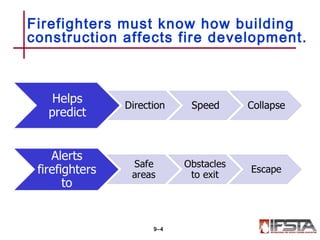
Firefighters must know how building
construction affects fire development.
9–4
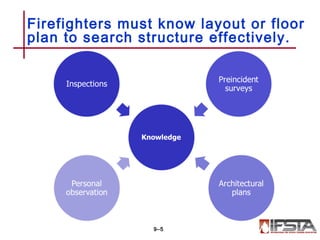
Firefighters must know layout or floor
plan to search structure effectively.
9–5
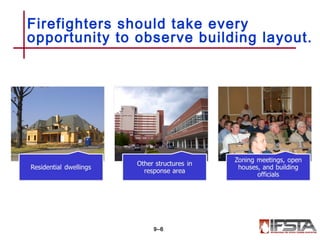
Firefighters should take every
opportunity to observe building layout.
9–6
REVIEW QUESTION
How do building construction and
floor plans impact structural search
techniques?
9–7
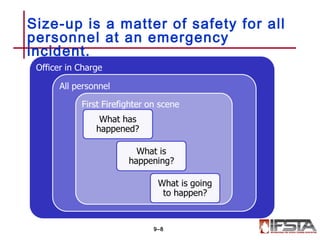
Size-up is a matter of safety for all
personnel at an emergency
incident.
9–8
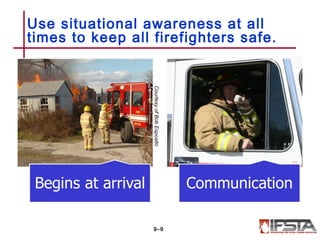
Use situational awareness at all
times to keep all firefighters safe.
9–9
CourtesyofBobEsposito
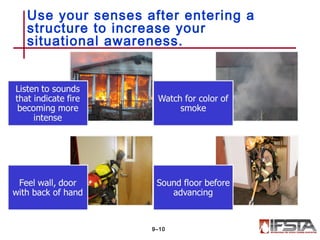
Use your senses after entering a
structure to increase your
situational awareness.
9–10
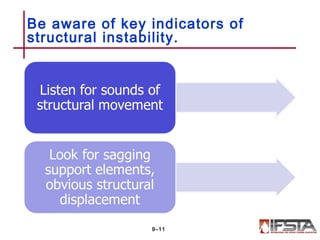
Be aware of key indicators of
structural instability.
9–11
REVIEW QUESTION
What information can size-up and
situational awareness provide during
structural searches?
9–12
Summarize safety guidelines for
structural search and rescue.
Learning Objective 3
9–13
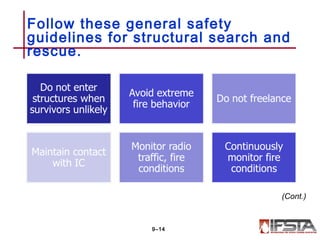
Follow these general safety
guidelines for structural search and
rescue.
9–14
(Cont.)
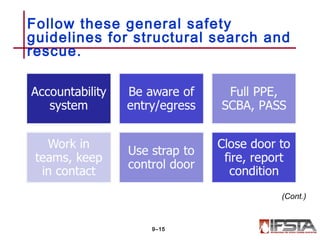
Follow these general safety
guidelines for structural search and
rescue.
9–15
(Cont.)
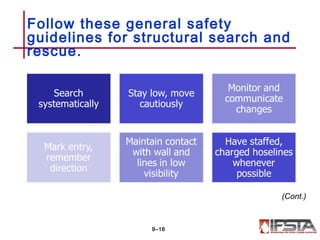
Follow these general safety
guidelines for structural search and
rescue.
9–16
(Cont.)
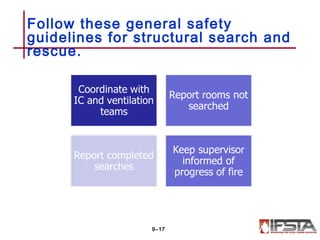
Follow these general safety
guidelines for structural search and
rescue.
9–17
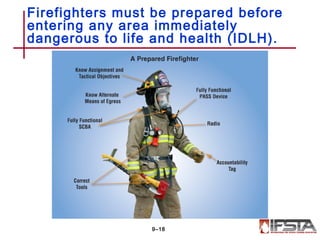
Firefighters must be prepared before
entering any area immediately
dangerous to life and health (IDLH).
9–18
REVIEW QUESTION
What are five safety guidelines that
should be followed during structural
search and rescue?
9–19
Differentiate between primary and
secondary search techniques.
Learning Objective 4
9–20
Recognize basic search methods.
Learning Objective 5
9–21
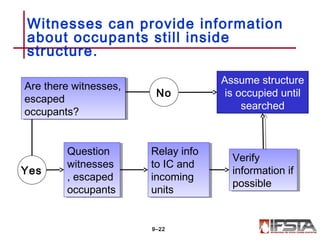
Witnesses can provide information
about occupants still inside
structure.
9–22
Are there witnesses,
escaped
occupants?
Yes
No
Assume structure
is occupied until
searched
Are there witnesses,
escaped
occupants?
Are there witnesses,
escaped
occupants?
Question
witnesses
, escaped
occupants
Question
witnesses
, escaped
occupants
Relay info
to IC and
incoming
units
Relay info
to IC and
incoming
units
Verify
information if
possible
Verify
information if
possible
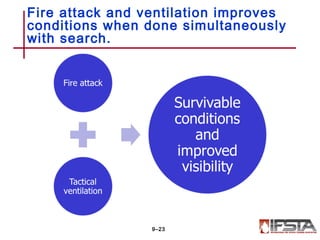
Fire attack and ventilation improves
conditions when done simultaneously
with search.
9–23
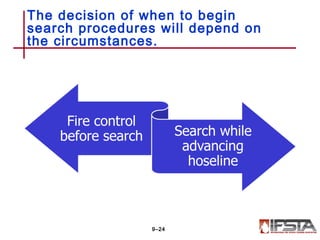
The decision of when to begin
search procedures will depend on
the circumstances.
9–24
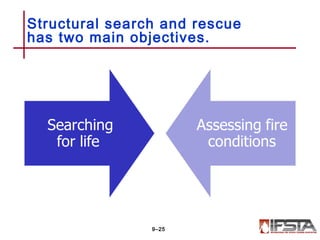
Structural search and rescue
has two main objectives.
9–25
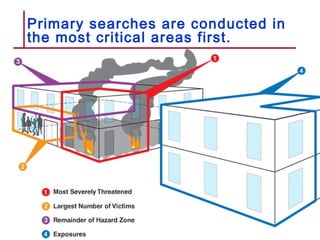
Primary searches are conducted in
the most critical areas first.
9–26
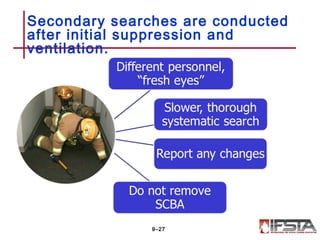
Secondary searches are conducted
after initial suppression and
ventilation.
9–27
REVIEW QUESTION
What are the main differences
between primary and secondary
search techniques?
9–28
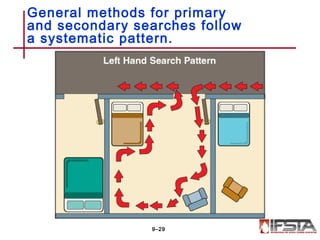
General methods for primary
and secondary searches follow
a systematic pattern.
9–29
Once on fire floor, start the search
as close to the fire as possible.
9–30
Click
image to
play
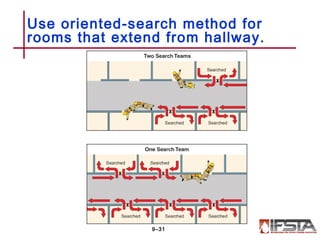
Use oriented-search method for
rooms that extend from hallway.
9–31
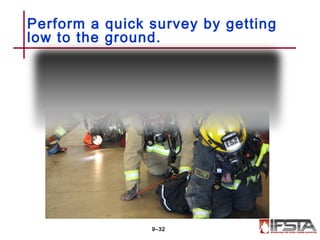
Perform a quick survey by getting
low to the ground.
9–32
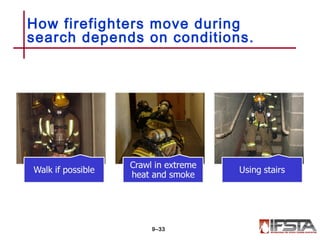
How firefighters move during
search depends on conditions.
9–33
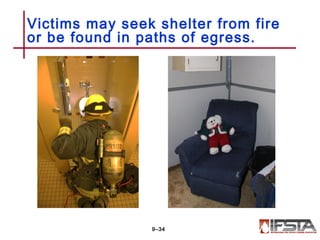
Victims may seek shelter from fire
or be found in paths of egress.
9–34
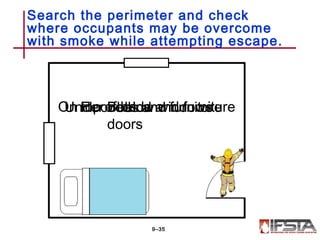
Search the perimeter and check
where occupants may be overcome
with smoke while attempting escape.
9–35
Floor below windowsUnder beds and furnitureBehind
doors
On top of beds and furniture
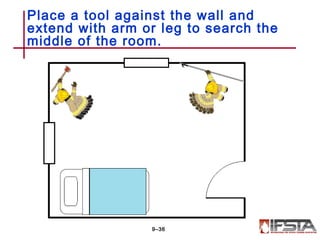
Place a tool against the wall and
extend with arm or leg to search the
middle of the room.
9–36
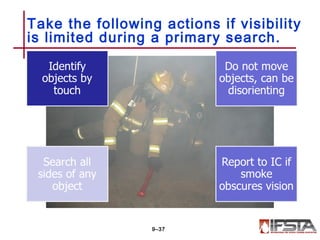
Take the following actions if visibility
is limited during a primary search.
9–37
Remember the following actions while
conducting structural searches.
9–38
REVIEW QUESTION
What is the general search method
used during structural search?
9–39
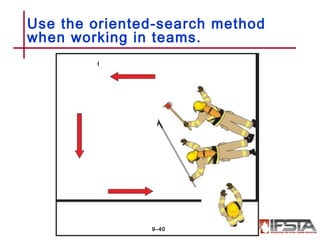
Use the oriented-search method
when working in teams.
9–40
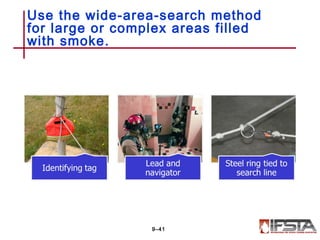
Use the wide-area-search method
for large or complex areas filled
with smoke.
9–41
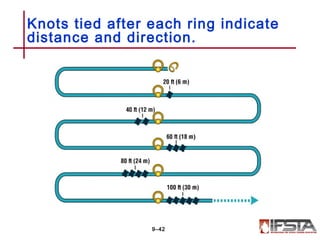
Knots tied after each ring indicate
distance and direction.
9–42
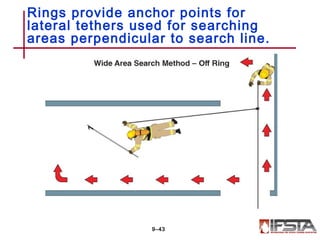
Rings provide anchor points for
lateral tethers used for searching
areas perpendicular to search line.
9–43
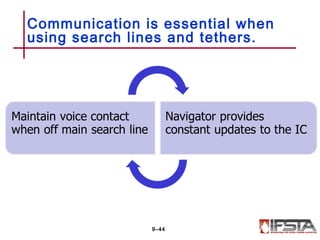
Communication is essential when
using search lines and tethers.
9–44
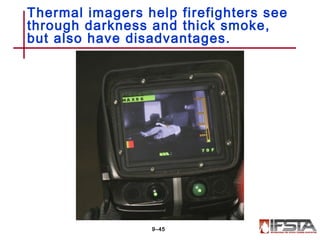
Thermal imagers help firefighters see
through darkness and thick smoke,
but also have disadvantages.
9–45
REVIEW QUESTION
When is the appropriate time to use
the oriented-search method, wide-
area-search method, and thermal-
imager-search method?
9–46
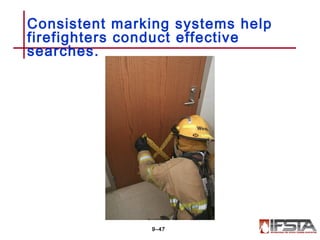
Consistent marking systems help
firefighters conduct effective
searches.
9–47
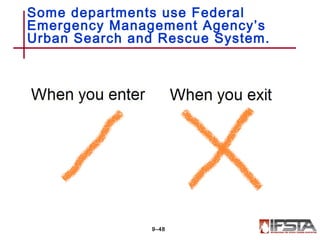
Some departments use Federal
Emergency Management Agency’s
Urban Search and Rescue System.
9–48
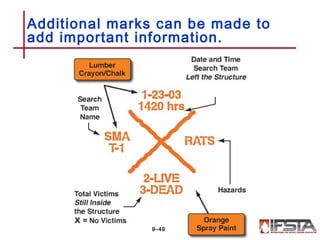
Additional marks can be made to
add important information.
9–49
Describe victim removal methods.
Learning Objective 6
9–50
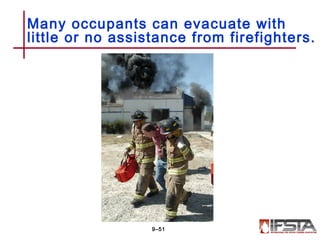
Many occupants can evacuate with
little or no assistance from firefighters.
9–51
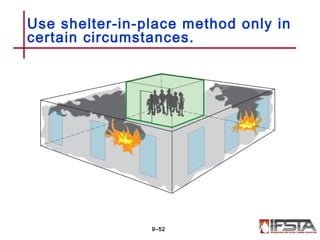
Use shelter-in-place method only in
certain circumstances.
9–52
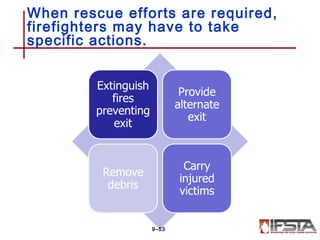
When rescue efforts are required,
firefighters may have to take
specific actions.
9–53
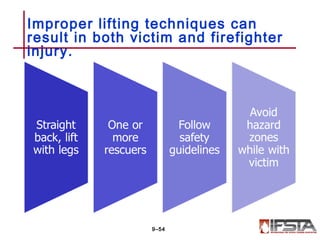
Improper lifting techniques can
result in both victim and firefighter
injury.
9–54
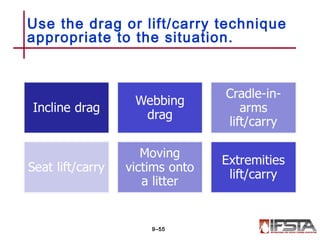
Use the drag or lift/carry technique
appropriate to the situation.
9–55
REVIEW QUESTION
What are the main differences in the
three types of victim removal
methods?
9–56
Explain firefighter survival methods.
Learning Objective 7
9–57
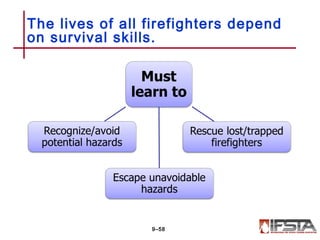
The lives of all firefighters depend
on survival skills.
9–58
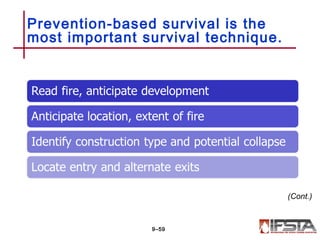
Prevention-based survival is the
most important survival technique.
9–59
(Cont.)
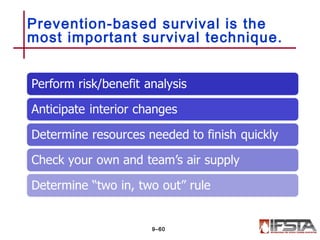
Prevention-based survival is the
most important survival technique.
9–60
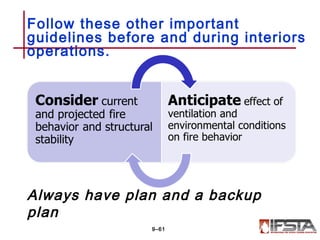
Follow these other important
guidelines before and during interiors
operations.
9–61
Always have plan and a backup
plan
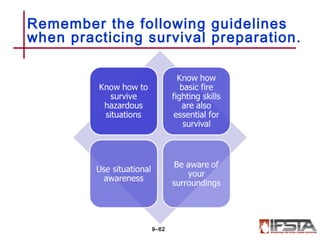
Remember the following guidelines
when practicing survival preparation.
9–62
REVIEW QUESTION
What are the three behaviors
firefighters must learn and follow to
ensure their own survival and that of
fellow firefighters?
9–63
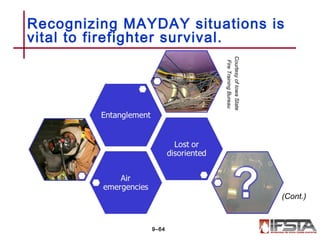
Recognizing MAYDAY situations is
vital to firefighter survival.
9–64
(Cont.)
CourtesyofIowaState
FireTrainingBureau
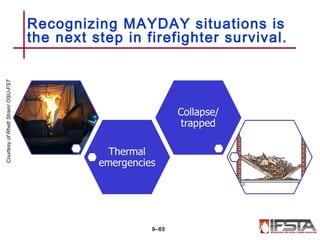
Recognizing MAYDAY situations is
the next step in firefighter survival.
9–65
CourtesyofRhettStrain/OSU-FST
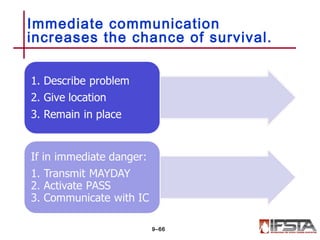
Immediate communication
increases the chance of survival.
9–66
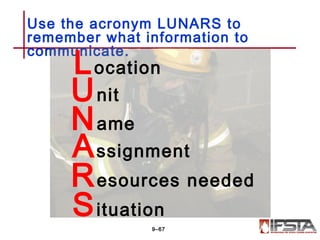
Use the acronym LUNARS to
remember what information to
communicate.
9–67
Location
Unit
Name
Assignment
Resources needed
Situation
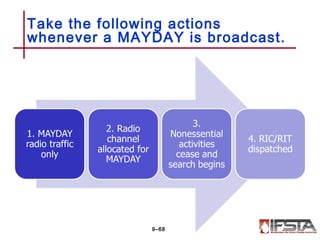
Take the following actions
whenever a MAYDAY is broadcast.
9–68
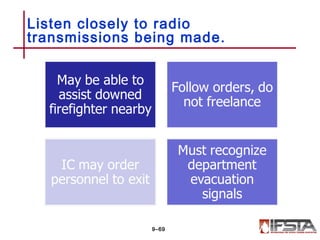
Listen closely to radio
transmissions being made.
9–69
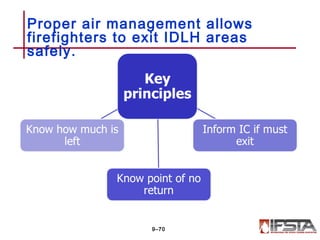
Proper air management allows
firefighters to exit IDLH areas
safely.
9–70
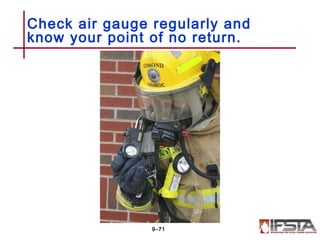
Check air gauge regularly and
know your point of no return.
9–71
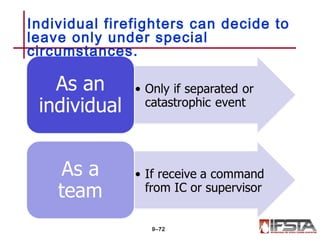
Individual firefighters can decide to
leave only under special
circumstances.
9–72
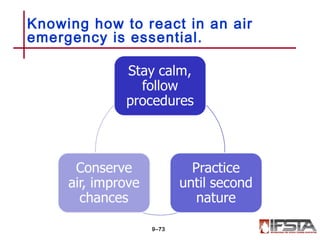
Knowing how to react in an air
emergency is essential.
9–73
Explain what survival actions
firefighters can take when needed.
Learning Objective 8
9–74
Describe the actions of a rapid
intervention crew or team (RIC/RIT)
when locating a downed firefighter.
Learning Objective 9
9–75
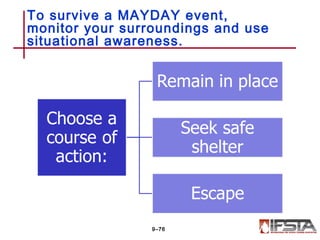
To survive a MAYDAY event,
monitor your surroundings and use
situational awareness.
9–76
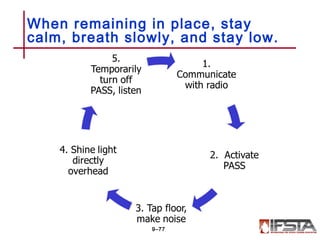
When remaining in place, stay
calm, breath slowly, and stay low.
9–77
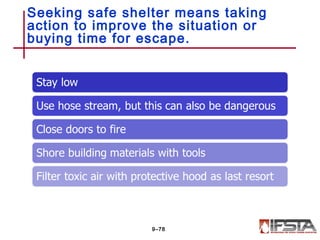
Seeking safe shelter means taking
action to improve the situation or
buying time for escape.
9–78
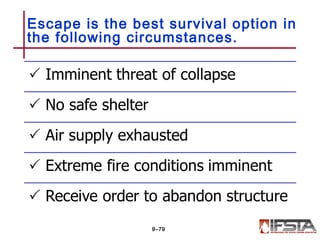
Escape is the best survival option in
the following circumstances.
9–79
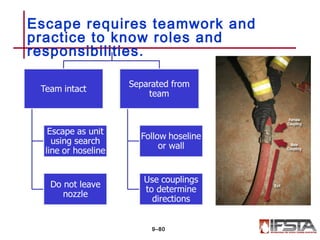
Escape requires teamwork and
practice to know roles and
responsibilities.
9–80
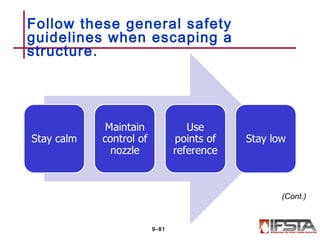
Follow these general safety
guidelines when escaping a
structure.
9–81
(Cont.)
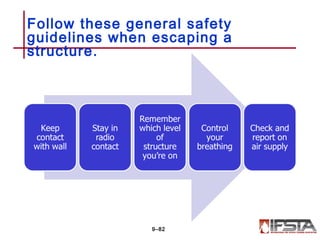
Follow these general safety
guidelines when escaping a
structure.
9–82
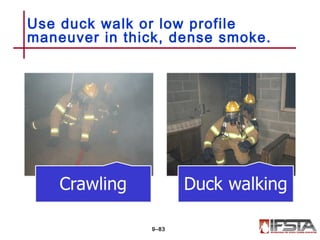
Use duck walk or low profile
maneuver in thick, dense smoke.
9–83
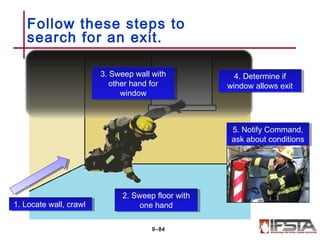
Follow these steps to
search for an exit.
9–84
1. Locate wall, crawl1. Locate wall, crawl
2. Sweep floor with
one hand
2. Sweep floor with
one hand
3. Sweep wall with
other hand for
window
3. Sweep wall with
other hand for
window
4. Determine if
window allows exit
4. Determine if
window allows exit
5. Notify Command,
ask about conditions
5. Notify Command,
ask about conditions
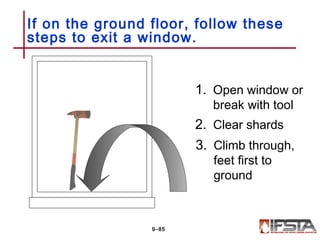
If on the ground floor, follow these
steps to exit a window.
9–85
1. Open window or
break with tool
2. Clear shards
3. Climb through,
feet first to
ground
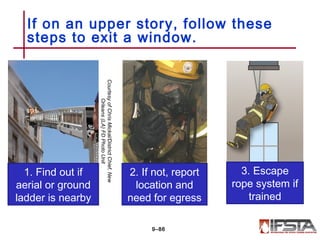
If on an upper story, follow these
steps to exit a window.
9–86
CourtesyofChrisMickal/DistrictChief,New
Orleans(LA)FDPhotoUnit
1. Find out if
aerial or ground
ladder is nearby
2. If not, report
location and
need for egress
3. Escape
rope system if
trained
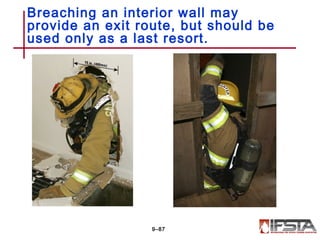
Breaching an interior wall may
provide an exit route, but should be
used only as a last resort.
9–87
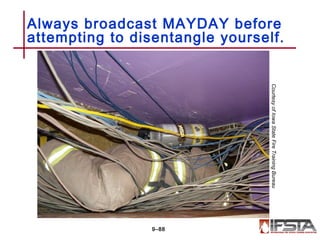
Always broadcast MAYDAY before
attempting to disentangle yourself.
9–88
CourtesyofIowaStateFireTrainingBureau
REVIEW QUESTION
How does a firefighter decide on the
best survival action to take if a
MAYDAY event does occur?
9–89
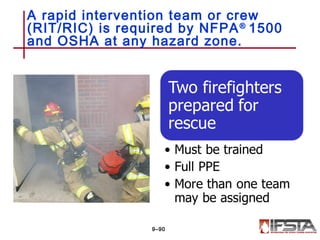
A rapid intervention team or crew
(RIT/RIC) is required by NFPA®
1500
and OSHA at any hazard zone.
9–90
CAUTION!
Do not underestimate the time and
personnel required to rescue a downed
firefighter. Carrying one unconscious
firefighter can require four rescuers, and
fully removing the firefighter from the
hazard zone can require up to twelve
rescuers. This process can take as long
as 20 minutes to complete.
9–91
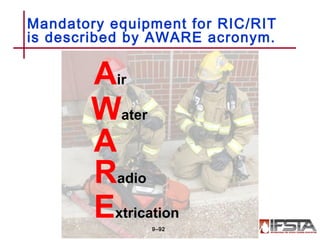
Mandatory equipment for RIC/RIT
is described by AWARE acronym.
9–92
Air
Water
A
Extrication
Radio
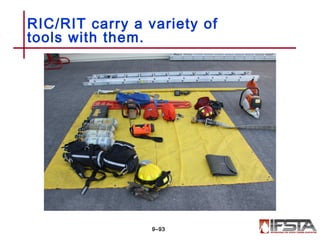
RIC/RIT carry a variety of
tools with them.
9–93
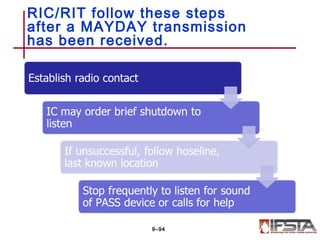
RIC/RIT follow these steps
after a MAYDAY transmission
has been received.
9–94
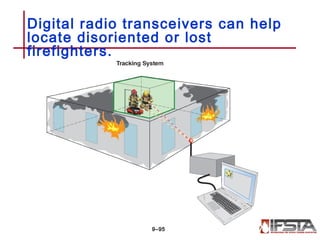
Digital radio transceivers can help
locate disoriented or lost
firefighters.
9–95
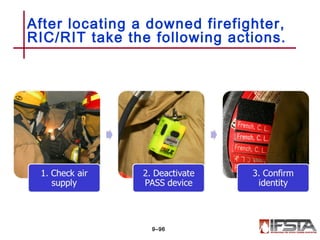
After locating a downed firefighter,
RIC/RIT take the following actions.
9–96
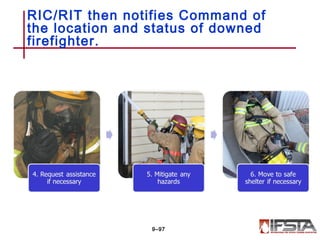
RIC/RIT then notifies Command of
the location and status of downed
firefighter.
9–97
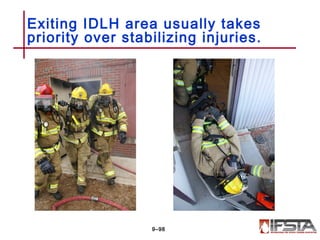
Exiting IDLH area usually takes
priority over stabilizing injuries.
9–98
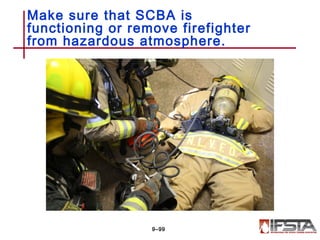
Make sure that SCBA is
functioning or remove firefighter
from hazardous atmosphere.
9–99
WARNING!
Never remove your facepiece or
compromise the proper operation of
your SCBA to share your air supply—
not even with another firefighter.
9–100
REVIEW QUESTION
When does a rapid intervention crew
or team (RIC/RIT) begin work on an
incident scene?
9–101
• The first priority at any structural fire is
that of survival, both for the individual
and of fellow firefighters.
• In order to meet this goal firefighters
must learn to size up a situation,
practice situational awareness,
manage air supply, and remove victims
to safety.
Summary
9–102
(Cont.)
• Firefighters also must know MAYDAY
procedures, master self-rescue
techniques, and be able to locate and
rescue downed firefighters as part of a
rapid intervention crew or team.
Summary
9–103
Demonstrate the procedure for
conducting a primary search.
This objective is measured in Skill
Sheet 9-I-1.
Learning Objective 10
9–104
Demonstrate the procedure for
conducting a secondary search.
This objective is measured in Skill
Sheet 9-I-2.
Learning Objective 11
9–105
Demonstrate the incline drag.
This objective is measured in Skill
Sheet 9-I-3.
Learning Objective 12
9–106
Demonstrate the webbing drag.
This objective is measured in Skill
Sheet 9-I-4.
Learning Objective 13
9–107
Demonstrate the cradle-in-arms
lift/carry — One-rescuer method.
This objective is measured in Skill
Sheet 9-I-5.
Learning Objective 14
9–108
Demonstrate the seat lift/carry — Two-
rescuer method.
This objective is measured in Skill
Sheet 9-I-6.
Learning Objective 15
9–109
Demonstrate the extremities lift/carry
— Two-rescuer method.
This objective is measured in Skill
Sheet 9-I-7.
Learning Objective 16
9–110
Demonstrate the actions required for
transmitting a MAYDAY report.
This objective is measured in Skill
Sheet 9-I-8.
Learning Objective 17
9–111
Demonstrate the proper procedures
for an SCBA air emergency.
This objective is measured in Skill
Sheet 9-I-9.
Learning Objective 18
9–112
Demonstrate the actions required for
withdrawing from a hostile
environment with a hoseline.
This objective is measured in Skill
Sheet 9-I-10.
Learning Objective 19
9–113
Demonstrate the side technique for
low profile maneuvers without
removing SCBA.
This objective is measured in Skill
Sheet 9-I-11.
Learning Objective 20
9–114
Perform the SCBA-first technique for
low profile maneuvers without
removing SCBA.
This objective is measured in Skill
Sheet 9-I-12.
Learning Objective 21
9–115
Demonstrate the method for breaching
an interior wall.
This objective is measured in Skill
Sheet 9-I-13.
Learning Objective 22
9–116
Demonstrate the steps for
disentangling from debris or wires.
This objective is measured in Skill
Sheet 9-I-14.
Learning Objective 23
9–117

Chapter 9 fire fighter

  • 1.
    Essentials of FireFighting 6th Edition Firefighter I Chapter 9 — Structural Search, Victim Removal, and Firefighter Survival
  • 2.
    Summarize the impactof building construction and floor plans on structural search techniques. Learning Objective 1 9–2
  • 3.
    Explain size-up andsituational awareness considerations during structural searches. Learning Objective 2 9–3
  • 4.
    Firefighters must knowhow building construction affects fire development. 9–4
  • 5.
    Firefighters must knowlayout or floor plan to search structure effectively. 9–5
  • 6.
    Firefighters should takeevery opportunity to observe building layout. 9–6
  • 7.
    REVIEW QUESTION How dobuilding construction and floor plans impact structural search techniques? 9–7
  • 8.
    Size-up is amatter of safety for all personnel at an emergency incident. 9–8
  • 9.
    Use situational awarenessat all times to keep all firefighters safe. 9–9 CourtesyofBobEsposito
  • 10.
    Use your sensesafter entering a structure to increase your situational awareness. 9–10
  • 11.
    Be aware ofkey indicators of structural instability. 9–11
  • 12.
    REVIEW QUESTION What informationcan size-up and situational awareness provide during structural searches? 9–12
  • 13.
    Summarize safety guidelinesfor structural search and rescue. Learning Objective 3 9–13
  • 14.
    Follow these generalsafety guidelines for structural search and rescue. 9–14 (Cont.)
  • 15.
    Follow these generalsafety guidelines for structural search and rescue. 9–15 (Cont.)

  • 16.
    Follow these generalsafety guidelines for structural search and rescue. 9–16 (Cont.)
  • 17.
    Follow these generalsafety guidelines for structural search and rescue. 9–17
  • 18.
    Firefighters must beprepared before entering any area immediately dangerous to life and health (IDLH). 9–18
  • 19.
    REVIEW QUESTION What arefive safety guidelines that should be followed during structural search and rescue? 9–19
  • 20.
    Differentiate between primaryand secondary search techniques. Learning Objective 4 9–20
  • 21.
    Recognize basic searchmethods. Learning Objective 5 9–21
  • 22.
    Witnesses can provideinformation about occupants still inside structure. 9–22 Are there witnesses, escaped occupants? Yes No Assume structure is occupied until searched Are there witnesses, escaped occupants? Are there witnesses, escaped occupants? Question witnesses , escaped occupants Question witnesses , escaped occupants Relay info to IC and incoming units Relay info to IC and incoming units Verify information if possible Verify information if possible
  • 23.
    Fire attack andventilation improves conditions when done simultaneously with search. 9–23
  • 24.
    The decision ofwhen to begin search procedures will depend on the circumstances. 9–24
  • 25.
    Structural search andrescue has two main objectives. 9–25
  • 26.
    Primary searches areconducted in the most critical areas first. 9–26
  • 27.
    Secondary searches areconducted after initial suppression and ventilation. 9–27
  • 28.
    REVIEW QUESTION What arethe main differences between primary and secondary search techniques? 9–28
  • 29.
    General methods forprimary and secondary searches follow a systematic pattern. 9–29
  • 30.
    Once on firefloor, start the search as close to the fire as possible. 9–30 Click image to play
  • 31.
    Use oriented-search methodfor rooms that extend from hallway. 9–31
  • 32.
    Perform a quicksurvey by getting low to the ground. 9–32
  • 33.
    How firefighters moveduring search depends on conditions. 9–33
  • 34.
    Victims may seekshelter from fire or be found in paths of egress. 9–34
  • 35.
    Search the perimeterand check where occupants may be overcome with smoke while attempting escape. 9–35 Floor below windowsUnder beds and furnitureBehind doors On top of beds and furniture
  • 36.
    Place a toolagainst the wall and extend with arm or leg to search the middle of the room. 9–36
  • 37.
    Take the followingactions if visibility is limited during a primary search. 9–37
  • 38.
    Remember the followingactions while conducting structural searches. 9–38
  • 39.
    REVIEW QUESTION What isthe general search method used during structural search? 9–39
  • 40.
    Use the oriented-searchmethod when working in teams. 9–40
  • 41.
    Use the wide-area-searchmethod for large or complex areas filled with smoke. 9–41
  • 42.
    Knots tied aftereach ring indicate distance and direction. 9–42
  • 43.
    Rings provide anchorpoints for lateral tethers used for searching areas perpendicular to search line. 9–43
  • 44.
    Communication is essentialwhen using search lines and tethers. 9–44
  • 45.
    Thermal imagers helpfirefighters see through darkness and thick smoke, but also have disadvantages. 9–45
  • 46.
    REVIEW QUESTION When isthe appropriate time to use the oriented-search method, wide- area-search method, and thermal- imager-search method? 9–46
  • 47.
    Consistent marking systemshelp firefighters conduct effective searches. 9–47
  • 48.
    Some departments useFederal Emergency Management Agency’s Urban Search and Rescue System. 9–48
  • 49.
    Additional marks canbe made to add important information. 9–49
  • 50.
    Describe victim removalmethods. Learning Objective 6 9–50
  • 51.
    Many occupants canevacuate with little or no assistance from firefighters. 9–51
  • 52.
    Use shelter-in-place methodonly in certain circumstances. 9–52
  • 53.
    When rescue effortsare required, firefighters may have to take specific actions. 9–53
  • 54.
    Improper lifting techniquescan result in both victim and firefighter injury. 9–54
  • 55.
    Use the dragor lift/carry technique appropriate to the situation. 9–55
  • 56.
    REVIEW QUESTION What arethe main differences in the three types of victim removal methods? 9–56
  • 57.
    Explain firefighter survivalmethods. Learning Objective 7 9–57
  • 58.
    The lives ofall firefighters depend on survival skills. 9–58
  • 59.
    Prevention-based survival isthe most important survival technique. 9–59 (Cont.)
  • 60.
    Prevention-based survival isthe most important survival technique. 9–60
  • 61.
    Follow these otherimportant guidelines before and during interiors operations. 9–61 Always have plan and a backup plan
  • 62.
    Remember the followingguidelines when practicing survival preparation. 9–62
  • 63.
    REVIEW QUESTION What arethe three behaviors firefighters must learn and follow to ensure their own survival and that of fellow firefighters? 9–63
  • 64.
    Recognizing MAYDAY situationsis vital to firefighter survival. 9–64 (Cont.) CourtesyofIowaState FireTrainingBureau
  • 65.
    Recognizing MAYDAY situationsis the next step in firefighter survival. 9–65 CourtesyofRhettStrain/OSU-FST
  • 66.
    Immediate communication increases thechance of survival. 9–66
  • 67.
    Use the acronymLUNARS to remember what information to communicate. 9–67 Location Unit Name Assignment Resources needed Situation
  • 68.
    Take the followingactions whenever a MAYDAY is broadcast. 9–68
  • 69.
    Listen closely toradio transmissions being made. 9–69
  • 70.
    Proper air managementallows firefighters to exit IDLH areas safely. 9–70
  • 71.
    Check air gaugeregularly and know your point of no return. 9–71
  • 72.
    Individual firefighters candecide to leave only under special circumstances. 9–72
  • 73.
    Knowing how toreact in an air emergency is essential. 9–73
  • 74.
    Explain what survivalactions firefighters can take when needed. Learning Objective 8 9–74
  • 75.
    Describe the actionsof a rapid intervention crew or team (RIC/RIT) when locating a downed firefighter. Learning Objective 9 9–75
  • 76.
    To survive aMAYDAY event, monitor your surroundings and use situational awareness. 9–76
  • 77.
    When remaining inplace, stay calm, breath slowly, and stay low. 9–77
  • 78.
    Seeking safe sheltermeans taking action to improve the situation or buying time for escape. 9–78
  • 79.
    Escape is thebest survival option in the following circumstances. 9–79
  • 80.
    Escape requires teamworkand practice to know roles and responsibilities. 9–80
  • 81.
    Follow these generalsafety guidelines when escaping a structure. 9–81 (Cont.)
  • 82.
    Follow these generalsafety guidelines when escaping a structure. 9–82
  • 83.
    Use duck walkor low profile maneuver in thick, dense smoke. 9–83
  • 84.
    Follow these stepsto search for an exit. 9–84 1. Locate wall, crawl1. Locate wall, crawl 2. Sweep floor with one hand 2. Sweep floor with one hand 3. Sweep wall with other hand for window 3. Sweep wall with other hand for window 4. Determine if window allows exit 4. Determine if window allows exit 5. Notify Command, ask about conditions 5. Notify Command, ask about conditions
  • 85.
    If on theground floor, follow these steps to exit a window. 9–85 1. Open window or break with tool 2. Clear shards 3. Climb through, feet first to ground
  • 86.
    If on anupper story, follow these steps to exit a window. 9–86 CourtesyofChrisMickal/DistrictChief,New Orleans(LA)FDPhotoUnit 1. Find out if aerial or ground ladder is nearby 2. If not, report location and need for egress 3. Escape rope system if trained
  • 87.
    Breaching an interiorwall may provide an exit route, but should be used only as a last resort. 9–87
  • 88.
    Always broadcast MAYDAYbefore attempting to disentangle yourself. 9–88 CourtesyofIowaStateFireTrainingBureau
  • 89.
    REVIEW QUESTION How doesa firefighter decide on the best survival action to take if a MAYDAY event does occur? 9–89
  • 90.
    A rapid interventionteam or crew (RIT/RIC) is required by NFPA® 1500 and OSHA at any hazard zone. 9–90
  • 91.
    CAUTION! Do not underestimatethe time and personnel required to rescue a downed firefighter. Carrying one unconscious firefighter can require four rescuers, and fully removing the firefighter from the hazard zone can require up to twelve rescuers. This process can take as long as 20 minutes to complete. 9–91
  • 92.
    Mandatory equipment forRIC/RIT is described by AWARE acronym. 9–92 Air Water A Extrication Radio
  • 93.
    RIC/RIT carry avariety of tools with them. 9–93
  • 94.
    RIC/RIT follow thesesteps after a MAYDAY transmission has been received. 9–94
  • 95.
    Digital radio transceiverscan help locate disoriented or lost firefighters. 9–95
  • 96.
    After locating adowned firefighter, RIC/RIT take the following actions. 9–96
  • 97.
    RIC/RIT then notifiesCommand of the location and status of downed firefighter. 9–97
  • 98.
    Exiting IDLH areausually takes priority over stabilizing injuries. 9–98
  • 99.
    Make sure thatSCBA is functioning or remove firefighter from hazardous atmosphere. 9–99
  • 100.
    WARNING! Never remove yourfacepiece or compromise the proper operation of your SCBA to share your air supply— not even with another firefighter. 9–100
  • 101.
    REVIEW QUESTION When doesa rapid intervention crew or team (RIC/RIT) begin work on an incident scene? 9–101
  • 102.
    • The firstpriority at any structural fire is that of survival, both for the individual and of fellow firefighters. • In order to meet this goal firefighters must learn to size up a situation, practice situational awareness, manage air supply, and remove victims to safety. Summary 9–102 (Cont.)
  • 103.
    • Firefighters alsomust know MAYDAY procedures, master self-rescue techniques, and be able to locate and rescue downed firefighters as part of a rapid intervention crew or team. Summary 9–103
  • 104.
    Demonstrate the procedurefor conducting a primary search. This objective is measured in Skill Sheet 9-I-1. Learning Objective 10 9–104
  • 105.
    Demonstrate the procedurefor conducting a secondary search. This objective is measured in Skill Sheet 9-I-2. Learning Objective 11 9–105
  • 106.
    Demonstrate the inclinedrag. This objective is measured in Skill Sheet 9-I-3. Learning Objective 12 9–106
  • 107.
    Demonstrate the webbingdrag. This objective is measured in Skill Sheet 9-I-4. Learning Objective 13 9–107
  • 108.
    Demonstrate the cradle-in-arms lift/carry— One-rescuer method. This objective is measured in Skill Sheet 9-I-5. Learning Objective 14 9–108
  • 109.
    Demonstrate the seatlift/carry — Two- rescuer method. This objective is measured in Skill Sheet 9-I-6. Learning Objective 15 9–109
  • 110.
    Demonstrate the extremitieslift/carry — Two-rescuer method. This objective is measured in Skill Sheet 9-I-7. Learning Objective 16 9–110
  • 111.
    Demonstrate the actionsrequired for transmitting a MAYDAY report. This objective is measured in Skill Sheet 9-I-8. Learning Objective 17 9–111
  • 112.
    Demonstrate the properprocedures for an SCBA air emergency. This objective is measured in Skill Sheet 9-I-9. Learning Objective 18 9–112
  • 113.
    Demonstrate the actionsrequired for withdrawing from a hostile environment with a hoseline. This objective is measured in Skill Sheet 9-I-10. Learning Objective 19 9–113
  • 114.
    Demonstrate the sidetechnique for low profile maneuvers without removing SCBA. This objective is measured in Skill Sheet 9-I-11. Learning Objective 20 9–114
  • 115.
    Perform the SCBA-firsttechnique for low profile maneuvers without removing SCBA. This objective is measured in Skill Sheet 9-I-12. Learning Objective 21 9–115
  • 116.
    Demonstrate the methodfor breaching an interior wall. This objective is measured in Skill Sheet 9-I-13. Learning Objective 22 9–116
  • 117.
    Demonstrate the stepsfor disentangling from debris or wires. This objective is measured in Skill Sheet 9-I-14. Learning Objective 23 9–117