Essentials of Fire Fighting
6th Edition
Firefighter I
Chapter 7 — Portable Fire
Extinguishers
Explain portable fire extinguisher
classifications.
Learning Objective 1
7–2
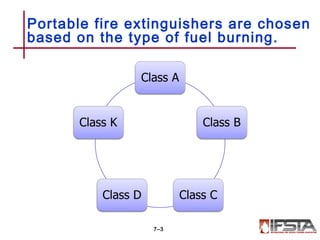
Portable fire extinguishers are chosen
based on the type of fuel burning.
7–3
Fuel
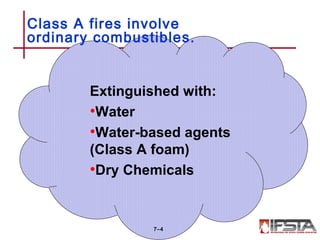
• Textiles
• Paper
• Plastics
• Rubber
• Wood
Extinguished with:
•Water
•Water-based agents
(Class A foam)
•Dry Chemicals
Class A fires involve
ordinary combustibles.
7–4
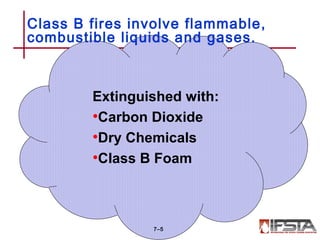
Fuel
• Alcohol
• Gasoline
• Lubricating Oils
• Liquefied petroleum
gas (LPG)
Extinguished with:
•Carbon Dioxide
•Dry Chemicals
•Class B Foam
7–5
Class B fires involve flammable,
combustible liquids and gases.
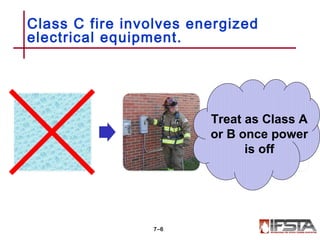
Class C fire involves energized
electrical equipment.
7–6
Treat as Class A
or B once power
is off
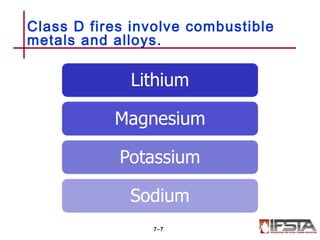
Class D fires involve combustible
metals and alloys.
7–7
CAUTION!
The use of water or water-based agents
on Class D fires will cause the fire to
react violently, emit bits of molten metal,
and possibly injure firefighters close by.
7–8
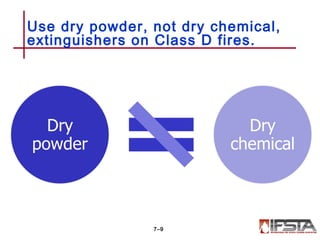
Use dry powder, not dry chemical,
extinguishers on Class D fires.
7–9
CAUTION!
Do not use a dry chemical extinguisher
on Class D fire. The dry chemical often
reacts violently with burning metals.
7–10
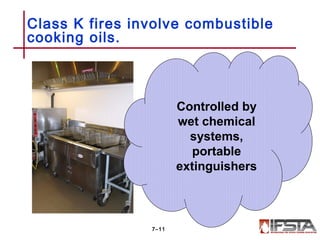
Class K fires involve combustible
cooking oils.
7–11
• Vegetable or animal
fats
• Burn at extreme
temperatures
• Found at commercial,
institutional,
industrial, home
Controlled by
wet chemical
systems,
portable
extinguishers
REVIEW QUESTION
How are the classifications for
portable fire extinguishers divided?
7–12
Describe types of portable fire
extinguishers.
Learning Objective 2
7–13
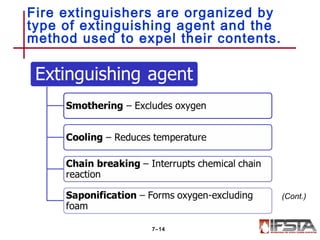
Fire extinguishers are organized by
type of extinguishing agent and the
method used to expel their contents.
7–14
(Cont.)
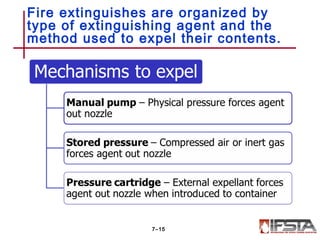
Fire extinguishes are organized by
type of extinguishing agent and the
method used to expel their contents.
7–15
7–16
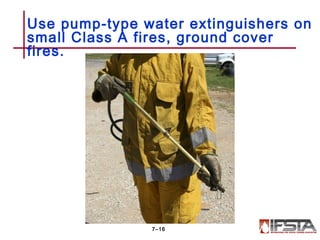
Use pump-type water extinguishers on
small Class A fires, ground cover
fires.
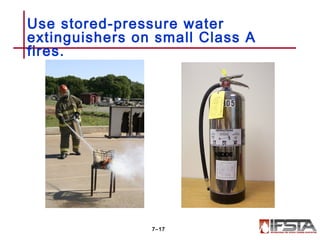
Use stored-pressure water
extinguishers on small Class A
fires.
7–17
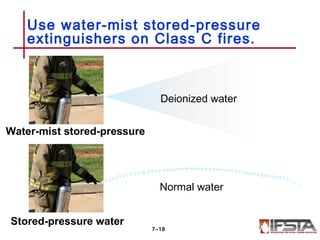
Use water-mist stored-pressure
extinguishers on Class C fires.
7–18
Deionized water
Normal water
Water-mist stored-pressure
Stored-pressure water
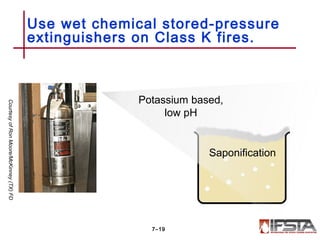
Use wet chemical stored-pressure
extinguishers on Class K fires.
7–19
Potassium based,
low pH
Saponification
CourtesyofRonMoore/McKinney(TX)FD
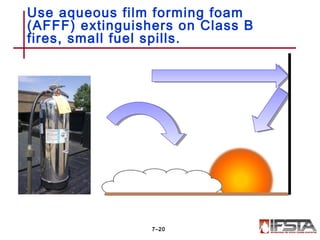
Use aqueous film forming foam
(AFFF) extinguishers on Class B
fires, small fuel spills.
7–20
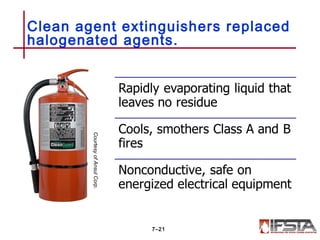
Clean agent extinguishers replaced
halogenated agents.
7–21
CourtesyofAnsulCorp.
REVIEW QUESTION
What are the differences between
wet chemical stored-pressure,
aqueous film forming foam (AFFF),
and clean agent extinguishers?
7–22
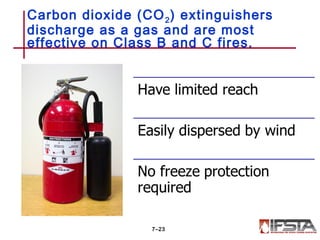
Carbon dioxide (CO2) extinguishers
discharge as a gas and are most
effective on Class B and C fires.
7–23
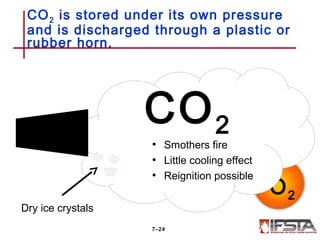
CO2 is stored under its own pressure
and is discharged through a plastic or
rubber horn.
7–24
O2
CO2
Dry ice crystals
• Smothers fire
• Little cooling effect
• Reignition possible
CAUTION!
When carbon dioxide is discharged, a
static electrical charge builds up on the
discharge horn. Touching the horn
before the charge has dissipated can
result in a shock.
7–25
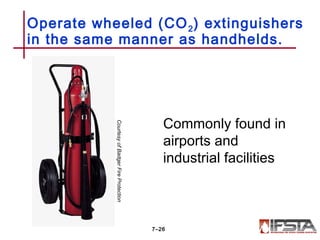
Operate wheeled (CO2) extinguishers
in the same manner as handhelds.
7–26
CourtesyofBadgerFireProtection
Commonly found in
airports and
industrial facilities
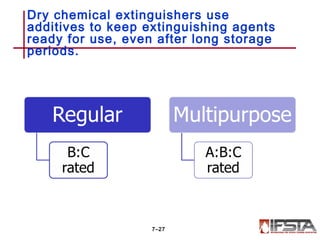
Dry chemical extinguishers use
additives to keep extinguishing agents
ready for use, even after long storage
periods.
7–27
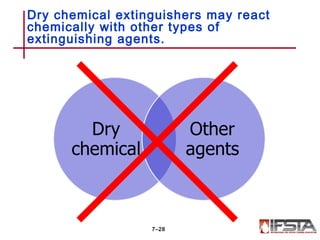
Dry chemical extinguishers may react
chemically with other types of
extinguishing agents.
7–28
WARNING!
Never mix or contaminate dry chemicals
with any other type of agent.
7–29
Dry chemical agents are
considered nontoxic and safe for
use.
7–30
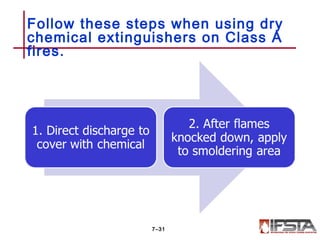
Follow these steps when using dry
chemical extinguishers on Class A
fires.
7–31
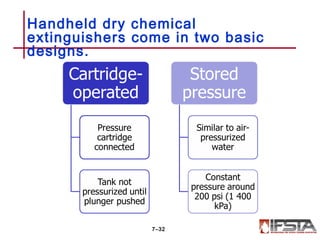
Handheld dry chemical
extinguishers come in two basic
designs.
7–32
CAUTION!
When pressurizing a cartridge-type
extinguisher, do not place your head or
any other part of your body above the
top of the extinguisher. If the fill cap was
not properly screwed back on, the cap
and/or a cloud of agent can be forcibly
discharged.
7–33
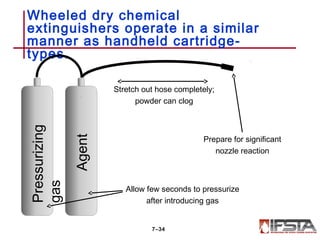
Wheeled dry chemical
extinguishers operate in a similar
manner as handheld cartridge-
types.
7–34
Agent
Pressurizing
gas
Stretch out hose completely;
powder can clog
Allow few seconds to pressurize
after introducing gas
Prepare for significant
nozzle reaction
CAUTION!
The top of the extinguisher should be
pointed away from the operator and any
other nearby personnel when
pressurizing the unit.
7–35
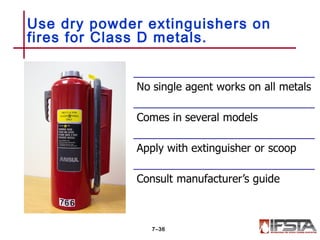
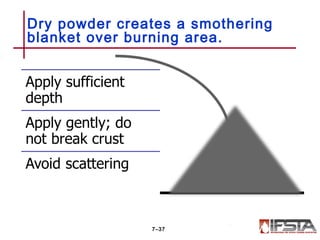
Use dry powder extinguishers on
fires for Class D metals.
7–36
Dry powder creates a smothering
blanket over burning area.
7–37
CAUTION!
Water applied to a combustible metal
fire results in a violent reaction that
intensifies the combustion and causes
bits of molten material to spatter in
every direction.
7–38
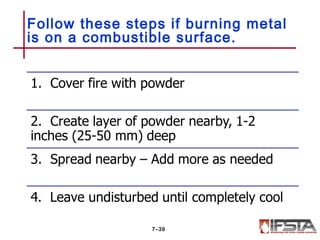
Follow these steps if burning metal
is on a combustible surface.
7–39
REVIEW QUESTION
How do carbon dioxide (CO2), dry
chemical, and dry powder
extinguishers differ?
7–40
Define the ratings in a portable fire
extinguisher rating system.
Learning Objective 3
7–41
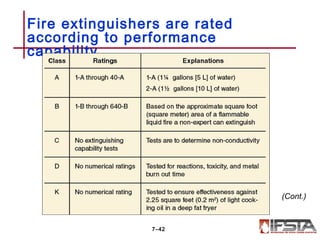
Fire extinguishers are rated
according to performance
capability.
7–42
(Cont.)
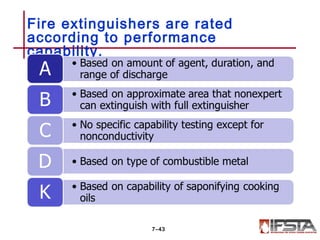
Fire extinguishers are rated
according to performance
capability.
7–43
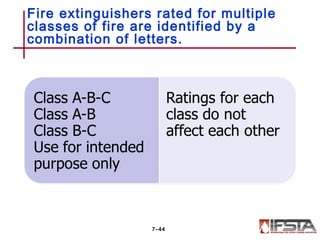
Fire extinguishers rated for multiple
classes of fire are identified by a
combination of letters.
7–44
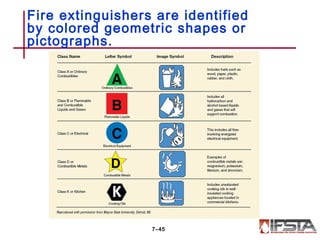
Fire extinguishers are identified
by colored geometric shapes or
pictographs.
7–45
REVIEW QUESTION
How are the ratings used for
portable fire extinguishers
determined?
7–46
Explain the considerations taken
when selecting and using portable fire
extinguishers.
Learning Objective 4
7–47
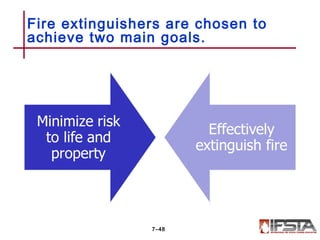
Fire extinguishers are chosen to
achieve two main goals.
7–48
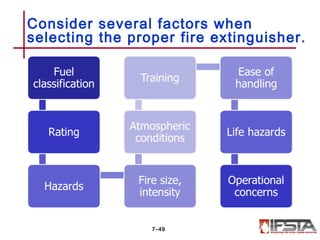
Consider several factors when
selecting the proper fire extinguisher.
7–49
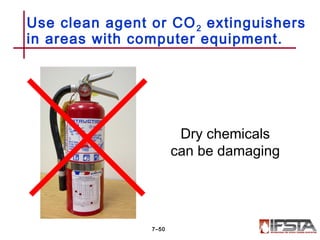
Use clean agent or CO2 extinguishers
in areas with computer equipment.
7–50
Dry chemicals
can be damaging
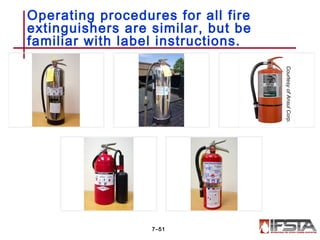
Operating procedures for all fire
extinguishers are similar, but be
familiar with label instructions.
7–51
CourtesyofAnsulCorp.
Note
Wear full structural or wildland fire
fighting personal protective equipment
including appropriate respiratory
protection when operating any portable
fire extinguisher. Even small incipient
fires will produce toxic gases that can
injure you.
7–52
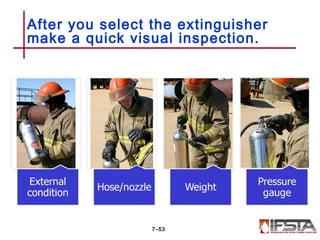
After you select the extinguisher
make a quick visual inspection.
7–53
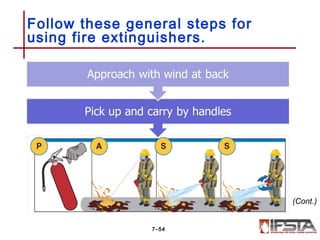
Follow these general steps for
using fire extinguishers.
7–54
(Cont.)
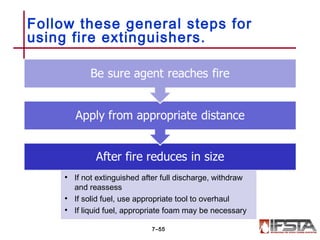
Follow these general steps for
using fire extinguishers.
7–55
• If not extinguished after full discharge, withdraw
and reassess
• If solid fuel, use appropriate tool to overhaul
• If liquid fuel, appropriate foam may be necessary
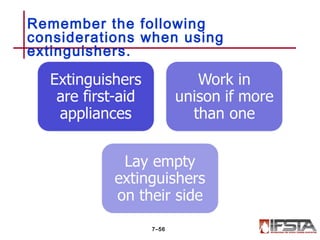
Remember the following
considerations when using
extinguishers.
7–56
REVIEW QUESTION
When using a portable fire
extinguisher, how can you determine
the best way to use it?
7–57
Identify procedures used for the
inspection, care, and maintenance of
portable fire extinguishers.
Learning Objective 5
7–58
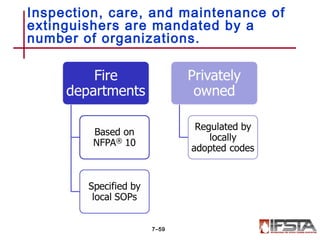
Inspection, care, and maintenance of
extinguishers are mandated by a
number of organizations.
7–59
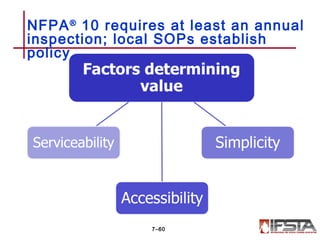
NFPA®
10 requires at least an annual
inspection; local SOPs establish
policy.
7–60
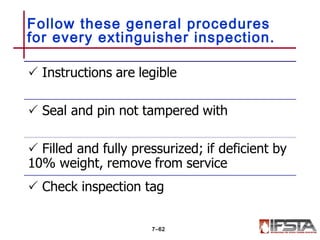
Follow these general procedures
for every extinguisher inspection.
7–61
(Cont.)
Follow these general procedures
for every extinguisher inspection.
7–62
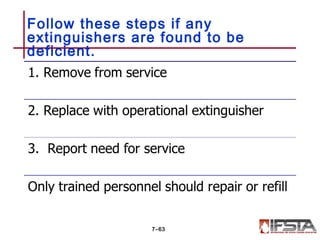
Follow these steps if any
extinguishers are found to be
deficient.
7–63
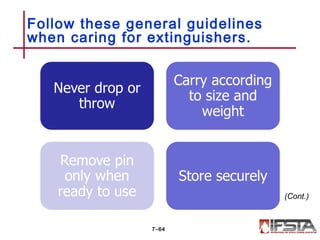
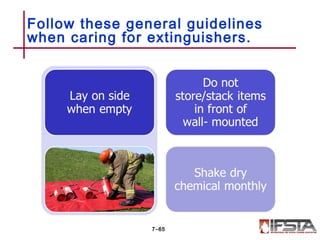
Follow these general guidelines
when caring for extinguishers.
7–64
(Cont.)
Follow these general guidelines
when caring for extinguishers.
7–65
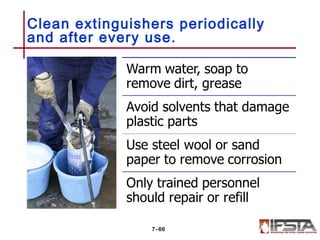
Clean extinguishers periodically
and after every use.
7–66
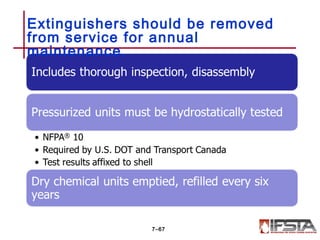
Extinguishers should be removed
from service for annual
maintenance.
7–67
CAUTION!
Never attempt to repair the shell or
cylinder of a defective fire extinguisher.
Contact the manufacturer for
instructions on where to have it repaired
or replaced.
7–68
REVIEW QUESTION
What are the basic procedures for
the care and maintenance of portable
fire extinguishers?
7–69
• Portable fire extinguishers can control
or extinguish small incipient or early
growth stage fires quickly in the hands
of trained personnel; you must be
familiar with their characteristics and be
able to select and use them properly.
Summary
7–70
(Cont.)
• Not only should you be familiar with
their characteristics and be able to
select and use them properly, you must
also be able to educate the public.
• Inspecting, caring for, maintaining
extinguishers assigned to your
apparatus and facility are also
important skills for you to have.
Summary
7–71
Operate a stored-pressure water
extinguisher.
This objective is measured in Skill
Sheet 7-I-1.
Learning Objective 6
7–72
Operate a dry chemical (ABC)
extinguisher.
This objective is measured in Skill
Sheet 7-I-2.
Learning Objective 7
7–73
Operate a carbon dioxide (CO2)
extinguisher.
This objective is measured in Skill
Sheet 7-I-3.
Learning Objective 8
7–74

Chapter 7 ffi

  • 1.
    Essentials of FireFighting 6th Edition Firefighter I Chapter 7 — Portable Fire Extinguishers
  • 2.
    Explain portable fireextinguisher classifications. Learning Objective 1 7–2
  • 3.
    Portable fire extinguishersare chosen based on the type of fuel burning. 7–3
  • 4.
    Fuel • Textiles • Paper •Plastics • Rubber • Wood Extinguished with: •Water •Water-based agents (Class A foam) •Dry Chemicals Class A fires involve ordinary combustibles. 7–4
  • 5.
    Fuel • Alcohol • Gasoline •Lubricating Oils • Liquefied petroleum gas (LPG) Extinguished with: •Carbon Dioxide •Dry Chemicals •Class B Foam 7–5 Class B fires involve flammable, combustible liquids and gases.
  • 6.
    Class C fireinvolves energized electrical equipment. 7–6 Treat as Class A or B once power is off
  • 7.
    Class D firesinvolve combustible metals and alloys. 7–7
  • 8.
    CAUTION! The use ofwater or water-based agents on Class D fires will cause the fire to react violently, emit bits of molten metal, and possibly injure firefighters close by. 7–8
  • 9.
    Use dry powder,not dry chemical, extinguishers on Class D fires. 7–9
  • 10.
    CAUTION! Do not usea dry chemical extinguisher on Class D fire. The dry chemical often reacts violently with burning metals. 7–10
  • 11.
    Class K firesinvolve combustible cooking oils. 7–11 • Vegetable or animal fats • Burn at extreme temperatures • Found at commercial, institutional, industrial, home Controlled by wet chemical systems, portable extinguishers
  • 12.
    REVIEW QUESTION How arethe classifications for portable fire extinguishers divided? 7–12
  • 13.
    Describe types ofportable fire extinguishers. Learning Objective 2 7–13
  • 14.
    Fire extinguishers areorganized by type of extinguishing agent and the method used to expel their contents. 7–14 (Cont.)
  • 15.
    Fire extinguishes areorganized by type of extinguishing agent and the method used to expel their contents. 7–15
  • 16.
    7–16 Use pump-type waterextinguishers on small Class A fires, ground cover fires.
  • 17.
    Use stored-pressure water extinguisherson small Class A fires. 7–17
  • 18.
    Use water-mist stored-pressure extinguisherson Class C fires. 7–18 Deionized water Normal water Water-mist stored-pressure Stored-pressure water
  • 19.
    Use wet chemicalstored-pressure extinguishers on Class K fires. 7–19 Potassium based, low pH Saponification CourtesyofRonMoore/McKinney(TX)FD
  • 20.
    Use aqueous filmforming foam (AFFF) extinguishers on Class B fires, small fuel spills. 7–20
  • 21.
    Clean agent extinguishersreplaced halogenated agents. 7–21 CourtesyofAnsulCorp.
  • 22.
    REVIEW QUESTION What arethe differences between wet chemical stored-pressure, aqueous film forming foam (AFFF), and clean agent extinguishers? 7–22
  • 23.
    Carbon dioxide (CO2)extinguishers discharge as a gas and are most effective on Class B and C fires. 7–23
  • 24.
    CO2 is storedunder its own pressure and is discharged through a plastic or rubber horn. 7–24 O2 CO2 Dry ice crystals • Smothers fire • Little cooling effect • Reignition possible
  • 25.
    CAUTION! When carbon dioxideis discharged, a static electrical charge builds up on the discharge horn. Touching the horn before the charge has dissipated can result in a shock. 7–25
  • 26.
    Operate wheeled (CO2)extinguishers in the same manner as handhelds. 7–26 CourtesyofBadgerFireProtection Commonly found in airports and industrial facilities
  • 27.
    Dry chemical extinguishersuse additives to keep extinguishing agents ready for use, even after long storage periods. 7–27
  • 28.
    Dry chemical extinguishersmay react chemically with other types of extinguishing agents. 7–28
  • 29.
    WARNING! Never mix orcontaminate dry chemicals with any other type of agent. 7–29
  • 30.
    Dry chemical agentsare considered nontoxic and safe for use. 7–30
  • 31.
    Follow these stepswhen using dry chemical extinguishers on Class A fires. 7–31
  • 32.
    Handheld dry chemical extinguisherscome in two basic designs. 7–32
  • 33.
    CAUTION! When pressurizing acartridge-type extinguisher, do not place your head or any other part of your body above the top of the extinguisher. If the fill cap was not properly screwed back on, the cap and/or a cloud of agent can be forcibly discharged. 7–33
  • 34.
    Wheeled dry chemical extinguishersoperate in a similar manner as handheld cartridge- types. 7–34 Agent Pressurizing gas Stretch out hose completely; powder can clog Allow few seconds to pressurize after introducing gas Prepare for significant nozzle reaction
  • 35.
    CAUTION! The top ofthe extinguisher should be pointed away from the operator and any other nearby personnel when pressurizing the unit. 7–35
  • 36.
    Use dry powderextinguishers on fires for Class D metals. 7–36
  • 37.
    Dry powder createsa smothering blanket over burning area. 7–37
  • 38.
    CAUTION! Water applied toa combustible metal fire results in a violent reaction that intensifies the combustion and causes bits of molten material to spatter in every direction. 7–38
  • 39.
    Follow these stepsif burning metal is on a combustible surface. 7–39
  • 40.
    REVIEW QUESTION How docarbon dioxide (CO2), dry chemical, and dry powder extinguishers differ? 7–40
  • 41.
    Define the ratingsin a portable fire extinguisher rating system. Learning Objective 3 7–41
  • 42.
    Fire extinguishers arerated according to performance capability. 7–42 (Cont.)
  • 43.
    Fire extinguishers arerated according to performance capability. 7–43
  • 44.
    Fire extinguishers ratedfor multiple classes of fire are identified by a combination of letters. 7–44
  • 45.
    Fire extinguishers areidentified by colored geometric shapes or pictographs. 7–45
  • 46.
    REVIEW QUESTION How arethe ratings used for portable fire extinguishers determined? 7–46
  • 47.
    Explain the considerationstaken when selecting and using portable fire extinguishers. Learning Objective 4 7–47
  • 48.
    Fire extinguishers arechosen to achieve two main goals. 7–48
  • 49.
    Consider several factorswhen selecting the proper fire extinguisher. 7–49
  • 50.
    Use clean agentor CO2 extinguishers in areas with computer equipment. 7–50 Dry chemicals can be damaging
  • 51.
    Operating procedures forall fire extinguishers are similar, but be familiar with label instructions. 7–51 CourtesyofAnsulCorp.
  • 52.
    Note Wear full structuralor wildland fire fighting personal protective equipment including appropriate respiratory protection when operating any portable fire extinguisher. Even small incipient fires will produce toxic gases that can injure you. 7–52
  • 53.
    After you selectthe extinguisher make a quick visual inspection. 7–53
  • 54.
    Follow these generalsteps for using fire extinguishers. 7–54 (Cont.)
  • 55.
    Follow these generalsteps for using fire extinguishers. 7–55 • If not extinguished after full discharge, withdraw and reassess • If solid fuel, use appropriate tool to overhaul • If liquid fuel, appropriate foam may be necessary
  • 56.
    Remember the following considerationswhen using extinguishers. 7–56
  • 57.
    REVIEW QUESTION When usinga portable fire extinguisher, how can you determine the best way to use it? 7–57
  • 58.
    Identify procedures usedfor the inspection, care, and maintenance of portable fire extinguishers. Learning Objective 5 7–58
  • 59.
    Inspection, care, andmaintenance of extinguishers are mandated by a number of organizations. 7–59
  • 60.
    NFPA® 10 requires atleast an annual inspection; local SOPs establish policy. 7–60
  • 61.
    Follow these generalprocedures for every extinguisher inspection. 7–61 (Cont.)
  • 62.
    Follow these generalprocedures for every extinguisher inspection. 7–62
  • 63.
    Follow these stepsif any extinguishers are found to be deficient. 7–63
  • 64.
    Follow these generalguidelines when caring for extinguishers. 7–64 (Cont.)
  • 65.
    Follow these generalguidelines when caring for extinguishers. 7–65
  • 66.
    Clean extinguishers periodically andafter every use. 7–66
  • 67.
    Extinguishers should beremoved from service for annual maintenance. 7–67
  • 68.
    CAUTION! Never attempt torepair the shell or cylinder of a defective fire extinguisher. Contact the manufacturer for instructions on where to have it repaired or replaced. 7–68
  • 69.
    REVIEW QUESTION What arethe basic procedures for the care and maintenance of portable fire extinguishers? 7–69
  • 70.
    • Portable fireextinguishers can control or extinguish small incipient or early growth stage fires quickly in the hands of trained personnel; you must be familiar with their characteristics and be able to select and use them properly. Summary 7–70 (Cont.)
  • 71.
    • Not onlyshould you be familiar with their characteristics and be able to select and use them properly, you must also be able to educate the public. • Inspecting, caring for, maintaining extinguishers assigned to your apparatus and facility are also important skills for you to have. Summary 7–71
  • 72.
    Operate a stored-pressurewater extinguisher. This objective is measured in Skill Sheet 7-I-1. Learning Objective 6 7–72
  • 73.
    Operate a drychemical (ABC) extinguisher. This objective is measured in Skill Sheet 7-I-2. Learning Objective 7 7–73
  • 74.
    Operate a carbondioxide (CO2) extinguisher. This objective is measured in Skill Sheet 7-I-3. Learning Objective 8 7–74