McGraw-Hill/IrwinMcGraw-Hill/Irwin Copyright © 2008 by The McGraw-Hill Companies, Inc. All rights reserved.Copyright © 2008 by The McGraw-Hill Companies, Inc. All rights reserved.
1818
Dividends and
Dividend Policy
18-2
Key Concepts and SkillsKey Concepts and Skills
 Understand dividend types and how
they are paid
 Understand the issues surrounding
dividend policy decisions
 Understand the difference between
cash and stock dividends
 Understand why share repurchases
are an alternative to dividends
18-3
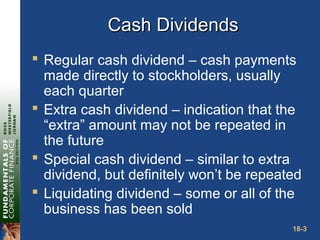
Cash DividendsCash Dividends
 Regular cash dividend – cash payments
made directly to stockholders, usually
each quarter
 Extra cash dividend – indication that the
“extra” amount may not be repeated in
the future
 Special cash dividend – similar to extra
dividend, but definitely won’t be repeated
 Liquidating dividend – some or all of the
business has been sold
18-4
Dividend PaymentDividend Payment
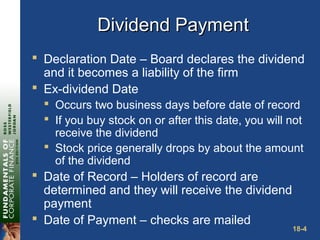
 Declaration Date – Board declares the dividend
and it becomes a liability of the firm
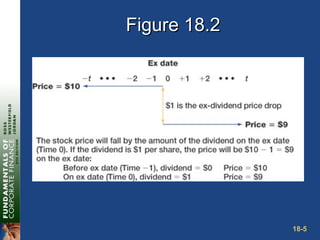
 Ex-dividend Date
 Occurs two business days before date of record
 If you buy stock on or after this date, you will not
receive the dividend
 Stock price generally drops by about the amount
of the dividend
 Date of Record – Holders of record are
determined and they will receive the dividend
payment
 Date of Payment – checks are mailed
18-5
Figure 18.2Figure 18.2
18-6
Does Dividend Policy Matter?Does Dividend Policy Matter?
 Dividends matter – the value of the stock
is based on the present value of
expected future dividends
 Dividend policy may not matter
 Dividend policy is the decision to pay
dividends versus retaining funds to reinvest
in the firm
 In theory, if the firm reinvests capital now, it
will grow and can pay higher dividends in the
future
18-7
Illustration of IrrelevanceIllustration of Irrelevance
 Consider a firm that can either pay out
dividends of $10,000 per year for each of the
next two years or can pay $9,000 this year,
reinvest the other $1,000 into the firm and then
pay $11,120 next year. Investors require a 12%
return.
 Market Value with constant dividend =
$16,900.51
 Market Value with reinvestment = $16,900.51
 If the company will earn the required return,
then it doesn’t matter when it pays the
dividends
18-8
Low Payout PleaseLow Payout Please
 Why might a low payout be desirable?
 Individuals in upper income tax brackets
might prefer lower dividend payouts, given
the immediate tax liability, in favor of higher
capital gains with the deferred tax liability
 Flotation costs – low payouts can decrease
the amount of capital that needs to be raised,
thereby lowering flotation costs
 Dividend restrictions – debt contracts might
limit the percentage of income that can be
paid out as dividends
18-9
High Payout PleaseHigh Payout Please
 Why might a high payout be desirable?
 Desire for current income
 Individuals that need current income, i.e. retirees
 Groups that are prohibited from spending principal
(trusts and endowments)
 Uncertainty resolution – no guarantee that
the higher future dividends will materialize
 Taxes
 Dividend exclusion for corporations
 Tax-exempt investors don’t have to worry about
differential treatment between dividends and capital
gains
18-10
Dividends and SignalsDividends and Signals
 Asymmetric information – managers
have more information about the health
of the company than investors
 Changes in dividends convey information
 Dividend increases
 Management believes it can be sustained
 Expectation of higher future dividends, increasing present
value
 Signal of a healthy, growing firm
 Dividend decreases
 Management believes it can no longer sustain the current
level of dividends
 Expectation of lower dividends indefinitely; decreasing
present value
 Signal of a firm that is having financial difficulties
18-11
Clientele EffectClientele Effect
 Some investors prefer low dividend
payouts and will buy stock in those
companies that offer low dividend
payouts
 Some investors prefer high dividend
payouts and will buy stock in those
companies that offer high dividend
payouts
18-12
Implications of the Clientele EffectImplications of the Clientele Effect
 What do you think will happen if a
firm changes its policy from a high
payout to a low payout?
 What do you think will happen if a
firm changes its policy from a low
payout to a high payout?
 If this is the case, does dividend
POLICY matter?
18-13
Dividend Policy in PracticeDividend Policy in Practice
 Residual dividend policy
 Constant growth dividend policy –
dividends increased at a constant
rate each year
 Constant payout ratio – pay a
constant percent of earnings each
year
 Compromise dividend policy
18-14
Residual Dividend PolicyResidual Dividend Policy
 Determine capital budget
 Determine target capital structure
 Finance investments with a combination
of debt and equity in line with the target
capital structure
 Remember that retained earnings are equity
 If additional equity is needed, issue new
shares
 If there are excess earnings, then pay
the remainder out in dividends
18-15
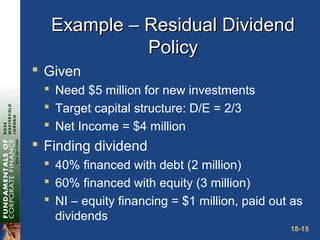
Example – Residual DividendExample – Residual Dividend
PolicyPolicy
 Given
 Need $5 million for new investments
 Target capital structure: D/E = 2/3
 Net Income = $4 million
 Finding dividend
 40% financed with debt (2 million)
 60% financed with equity (3 million)
 NI – equity financing = $1 million, paid out as
dividends
18-16
Compromise Dividend PolicyCompromise Dividend Policy
 Goals, ranked in order of importance
 Avoid cutting back on positive NPV projects
to pay a dividend
 Avoid dividend cuts
 Avoid the need to sell equity
 Maintain a target debt/equity ratio
 Maintain a target dividend payout ratio
 Companies want to accept positive NPV
projects, while avoiding negative signals
18-17
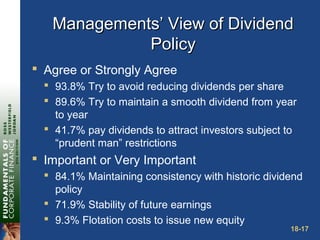
Managements’ View of DividendManagements’ View of Dividend
PolicyPolicy
 Agree or Strongly Agree
 93.8% Try to avoid reducing dividends per share
 89.6% Try to maintain a smooth dividend from year
to year
 41.7% pay dividends to attract investors subject to
“prudent man” restrictions
 Important or Very Important
 84.1% Maintaining consistency with historic dividend
policy
 71.9% Stability of future earnings
 9.3% Flotation costs to issue new equity
18-18
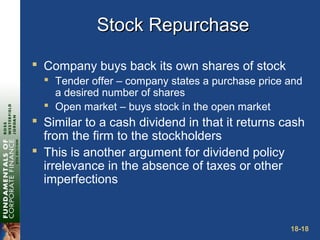
Stock RepurchaseStock Repurchase
 Company buys back its own shares of stock
 Tender offer – company states a purchase price and
a desired number of shares
 Open market – buys stock in the open market
 Similar to a cash dividend in that it returns cash
from the firm to the stockholders
 This is another argument for dividend policy
irrelevance in the absence of taxes or other
imperfections
18-19
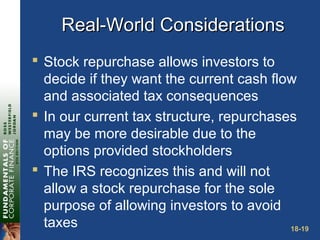
Real-World ConsiderationsReal-World Considerations
 Stock repurchase allows investors to
decide if they want the current cash flow
and associated tax consequences
 In our current tax structure, repurchases
may be more desirable due to the
options provided stockholders
 The IRS recognizes this and will not
allow a stock repurchase for the sole
purpose of allowing investors to avoid
taxes
18-20
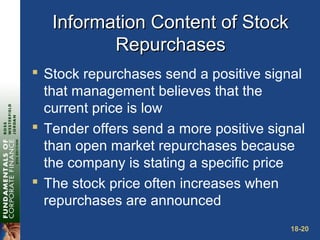
Information Content of StockInformation Content of Stock
RepurchasesRepurchases
 Stock repurchases send a positive signal
that management believes that the
current price is low
 Tender offers send a more positive signal
than open market repurchases because
the company is stating a specific price
 The stock price often increases when
repurchases are announced
18-21
Example: RepurchaseExample: Repurchase
AnnouncementAnnouncement
“America West Airlines announced that its Board of Directors
has authorized the purchase of up to 2.5 million shares of its
Class B common stock on the open market as
circumstances warrant over the next two years …
“Following the approval of the stock repurchase program by
the company’s Board of Directors earlier today. W. A.
Franke, chairman and chief officer said ‘The stock
repurchase program reflects our belief that America West
stock may be an attractive investment opportunity for the
Company, and it underscores our commitment to enhancing
long-term shareholder value.’
“The shares will be repurchased with cash on hand, but only
if and to the extent the Company holds unrestricted cash in
excess of $200 million to ensure that an adequate level of
cash and cash equivalents is maintained.”
18-22
Stock DividendsStock Dividends
 Pay additional shares of stock instead of
cash
 Increases the number of outstanding shares
 Small stock dividend
 Less than 20 to 25%
 If you own 100 shares and the company
declared a 10% stock dividend, you would
receive an additional 10 shares
 Large stock dividend – more than 20 to 25%
18-23
Stock SplitsStock Splits
 Stock splits – essentially the same as a stock
dividend except expressed as a ratio
 For example, a 2 for 1 stock split is the same as a
100% stock dividend
 Stock price is reduced when the stock splits
 Common explanation for split is to return price
to a “more desirable trading range”
McGraw-Hill/IrwinMcGraw-Hill/Irwin Copyright © 2008 by The McGraw-Hill Companies, Inc. All rights reserved.Copyright © 2008 by The McGraw-Hill Companies, Inc. All rights reserved.
1818
End of Chapter

Dividends and _dividend_policy_powerpoint_presentation[1]

  • 1.
    McGraw-Hill/IrwinMcGraw-Hill/Irwin Copyright ©2008 by The McGraw-Hill Companies, Inc. All rights reserved.Copyright © 2008 by The McGraw-Hill Companies, Inc. All rights reserved. 1818 Dividends and Dividend Policy
  • 2.
    18-2 Key Concepts andSkillsKey Concepts and Skills  Understand dividend types and how they are paid  Understand the issues surrounding dividend policy decisions  Understand the difference between cash and stock dividends  Understand why share repurchases are an alternative to dividends
  • 3.
    18-3 Cash DividendsCash Dividends Regular cash dividend – cash payments made directly to stockholders, usually each quarter  Extra cash dividend – indication that the “extra” amount may not be repeated in the future  Special cash dividend – similar to extra dividend, but definitely won’t be repeated  Liquidating dividend – some or all of the business has been sold
  • 4.
    18-4 Dividend PaymentDividend Payment Declaration Date – Board declares the dividend and it becomes a liability of the firm  Ex-dividend Date  Occurs two business days before date of record  If you buy stock on or after this date, you will not receive the dividend  Stock price generally drops by about the amount of the dividend  Date of Record – Holders of record are determined and they will receive the dividend payment  Date of Payment – checks are mailed
  • 5.
  • 6.
    18-6 Does Dividend PolicyMatter?Does Dividend Policy Matter?  Dividends matter – the value of the stock is based on the present value of expected future dividends  Dividend policy may not matter  Dividend policy is the decision to pay dividends versus retaining funds to reinvest in the firm  In theory, if the firm reinvests capital now, it will grow and can pay higher dividends in the future
  • 7.
    18-7 Illustration of IrrelevanceIllustrationof Irrelevance  Consider a firm that can either pay out dividends of $10,000 per year for each of the next two years or can pay $9,000 this year, reinvest the other $1,000 into the firm and then pay $11,120 next year. Investors require a 12% return.  Market Value with constant dividend = $16,900.51  Market Value with reinvestment = $16,900.51  If the company will earn the required return, then it doesn’t matter when it pays the dividends
  • 8.
    18-8 Low Payout PleaseLowPayout Please  Why might a low payout be desirable?  Individuals in upper income tax brackets might prefer lower dividend payouts, given the immediate tax liability, in favor of higher capital gains with the deferred tax liability  Flotation costs – low payouts can decrease the amount of capital that needs to be raised, thereby lowering flotation costs  Dividend restrictions – debt contracts might limit the percentage of income that can be paid out as dividends
  • 9.
    18-9 High Payout PleaseHighPayout Please  Why might a high payout be desirable?  Desire for current income  Individuals that need current income, i.e. retirees  Groups that are prohibited from spending principal (trusts and endowments)  Uncertainty resolution – no guarantee that the higher future dividends will materialize  Taxes  Dividend exclusion for corporations  Tax-exempt investors don’t have to worry about differential treatment between dividends and capital gains
  • 10.
    18-10 Dividends and SignalsDividendsand Signals  Asymmetric information – managers have more information about the health of the company than investors  Changes in dividends convey information  Dividend increases  Management believes it can be sustained  Expectation of higher future dividends, increasing present value  Signal of a healthy, growing firm  Dividend decreases  Management believes it can no longer sustain the current level of dividends  Expectation of lower dividends indefinitely; decreasing present value  Signal of a firm that is having financial difficulties
  • 11.
    18-11 Clientele EffectClientele Effect Some investors prefer low dividend payouts and will buy stock in those companies that offer low dividend payouts  Some investors prefer high dividend payouts and will buy stock in those companies that offer high dividend payouts
  • 12.
    18-12 Implications of theClientele EffectImplications of the Clientele Effect  What do you think will happen if a firm changes its policy from a high payout to a low payout?  What do you think will happen if a firm changes its policy from a low payout to a high payout?  If this is the case, does dividend POLICY matter?
  • 13.
    18-13 Dividend Policy inPracticeDividend Policy in Practice  Residual dividend policy  Constant growth dividend policy – dividends increased at a constant rate each year  Constant payout ratio – pay a constant percent of earnings each year  Compromise dividend policy
  • 14.
    18-14 Residual Dividend PolicyResidualDividend Policy  Determine capital budget  Determine target capital structure  Finance investments with a combination of debt and equity in line with the target capital structure  Remember that retained earnings are equity  If additional equity is needed, issue new shares  If there are excess earnings, then pay the remainder out in dividends
  • 15.
    18-15 Example – ResidualDividendExample – Residual Dividend PolicyPolicy  Given  Need $5 million for new investments  Target capital structure: D/E = 2/3  Net Income = $4 million  Finding dividend  40% financed with debt (2 million)  60% financed with equity (3 million)  NI – equity financing = $1 million, paid out as dividends
  • 16.
    18-16 Compromise Dividend PolicyCompromiseDividend Policy  Goals, ranked in order of importance  Avoid cutting back on positive NPV projects to pay a dividend  Avoid dividend cuts  Avoid the need to sell equity  Maintain a target debt/equity ratio  Maintain a target dividend payout ratio  Companies want to accept positive NPV projects, while avoiding negative signals
  • 17.
    18-17 Managements’ View ofDividendManagements’ View of Dividend PolicyPolicy  Agree or Strongly Agree  93.8% Try to avoid reducing dividends per share  89.6% Try to maintain a smooth dividend from year to year  41.7% pay dividends to attract investors subject to “prudent man” restrictions  Important or Very Important  84.1% Maintaining consistency with historic dividend policy  71.9% Stability of future earnings  9.3% Flotation costs to issue new equity
  • 18.
    18-18 Stock RepurchaseStock Repurchase Company buys back its own shares of stock  Tender offer – company states a purchase price and a desired number of shares  Open market – buys stock in the open market  Similar to a cash dividend in that it returns cash from the firm to the stockholders  This is another argument for dividend policy irrelevance in the absence of taxes or other imperfections
  • 19.
    18-19 Real-World ConsiderationsReal-World Considerations Stock repurchase allows investors to decide if they want the current cash flow and associated tax consequences  In our current tax structure, repurchases may be more desirable due to the options provided stockholders  The IRS recognizes this and will not allow a stock repurchase for the sole purpose of allowing investors to avoid taxes
  • 20.
    18-20 Information Content ofStockInformation Content of Stock RepurchasesRepurchases  Stock repurchases send a positive signal that management believes that the current price is low  Tender offers send a more positive signal than open market repurchases because the company is stating a specific price  The stock price often increases when repurchases are announced
  • 21.
    18-21 Example: RepurchaseExample: Repurchase AnnouncementAnnouncement “AmericaWest Airlines announced that its Board of Directors has authorized the purchase of up to 2.5 million shares of its Class B common stock on the open market as circumstances warrant over the next two years … “Following the approval of the stock repurchase program by the company’s Board of Directors earlier today. W. A. Franke, chairman and chief officer said ‘The stock repurchase program reflects our belief that America West stock may be an attractive investment opportunity for the Company, and it underscores our commitment to enhancing long-term shareholder value.’ “The shares will be repurchased with cash on hand, but only if and to the extent the Company holds unrestricted cash in excess of $200 million to ensure that an adequate level of cash and cash equivalents is maintained.”
  • 22.
    18-22 Stock DividendsStock Dividends Pay additional shares of stock instead of cash  Increases the number of outstanding shares  Small stock dividend  Less than 20 to 25%  If you own 100 shares and the company declared a 10% stock dividend, you would receive an additional 10 shares  Large stock dividend – more than 20 to 25%
  • 23.
    18-23 Stock SplitsStock Splits Stock splits – essentially the same as a stock dividend except expressed as a ratio  For example, a 2 for 1 stock split is the same as a 100% stock dividend  Stock price is reduced when the stock splits  Common explanation for split is to return price to a “more desirable trading range”
  • 24.
    McGraw-Hill/IrwinMcGraw-Hill/Irwin Copyright ©2008 by The McGraw-Hill Companies, Inc. All rights reserved.Copyright © 2008 by The McGraw-Hill Companies, Inc. All rights reserved. 1818 End of Chapter

Editor's Notes

  • #4 14. Cash dividends reduce cash and retained earnings (and liquidating dividends may also reduce paid-in capital)
  • #8 14. Assuming that the second dividend is a liquidating dividend and the firm ceases to exist after period 2. PV = 10,000 / 1.12 + 10,000 / 1.12 2 = 16,900.51 PV = 9,000 / 1.12 + 11,120 / 1.12 2 = 16,900.51
  • #13 14. If a firm changes its policy, it will just have different investors. Consequently, dividend policy won’t affect the value of the stock.
  • #14 14. We will talk about the residual policy and the compromise policy in more detail Given the information content of dividends, will a constant growth policy be good for the stockholders? Given the information content of dividends – will a constant payout ratio be good for stockholders?
  • #16 14. Remind students how to get % debt and % equity given D/E: If D/E = 2/3, then V = 2 + 3 = 5, so D/V = 2/5 = 40% and E/V = 3/5 = 60%
  • #18 14. See Tables 18.2 and 18.3
  • #24 14. www: Click on the web surfer icon to find out about upcoming stock splits and dividends