Immunity and Serology Chapter 20
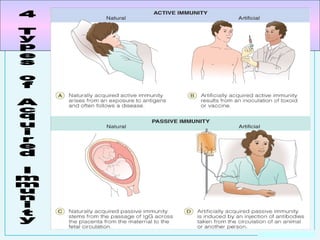
Immunity is a condition under which an individual is protected from the disease Two general types of immunity Innate Immunity Acquired Immunity Types of Acquired Immunity ACTIVE IMMUNITY Naturally Acquired Active Immunity Artificially Acquired Active Immunity PASSIVE IMMUNITY Naturally Acquired Passive Immunity Artificially Acquired Passive Immunity Immunity to Disease
4 Types of Acquired Immunity
Naturally acquired active immunity  develops from exposure to an infectious agent Active immunity occurs when the body’s immune system responds to antigens by producing antibodies and lymphocytes Naturally acquired active immunity follows illness or pathogen exposure Artificially acquired active immunity  occurs through vaccination Vaccines contain treated or altered microbes, toxins, or parts of microbes a primary immune response occurs memory cells are formed the person does not usually become ill Active Immunity
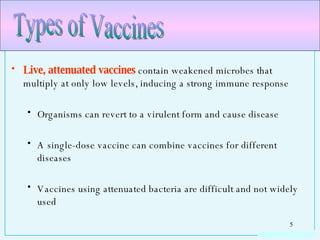
Live, attenuated vaccines  contain weakened microbes that multiply at only low levels, inducing a strong immune response Organisms can revert to a virulent form and cause disease A single-dose vaccine can combine vaccines for different diseases Vaccines using attenuated bacteria are difficult and not widely used Types of Vaccines
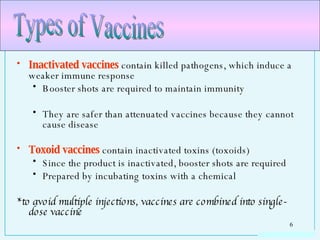
Inactivated vaccines  contain killed pathogens, which induce a weaker immune response Booster shots are required to maintain immunity They are safer than attenuated vaccines because they cannot cause disease Toxoid vaccines  contain inactivated toxins (toxoids) Since the product is inactivated, booster shots are required Prepared by incubating toxins with a chemical  *to avoid multiple injections, vaccines are combined into single-dose vaccine Types of Vaccines
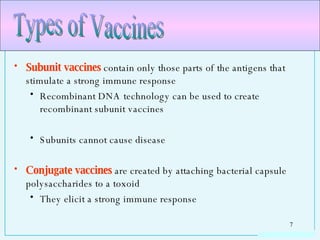
Subunit vaccines  contain only those parts of the antigens that stimulate a strong immune response Recombinant DNA technology can be used to create recombinant subunit vaccines Subunits cannot cause disease Conjugate vaccines  are created by attaching bacterial capsule polysaccharides to a toxoid They elicit a strong immune response Types of Vaccines
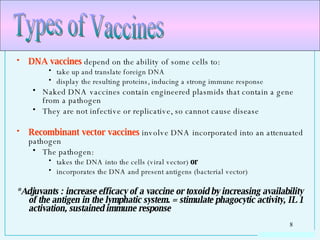
DNA vaccines  depend on the ability of some cells to: take up and translate foreign DNA  display the resulting proteins, inducing a strong immune response Naked DNA vaccines contain engineered plasmids that contain a gene from a pathogen They are not infective or replicative, so cannot cause disease Recombinant vector vaccines  involve DNA incorporated into an attenuated pathogen The pathogen:  takes the DNA into the cells (viral vector)  or   incorporates the DNA and present antigens (bacterial vector) *Adjuvants : increase efficacy of a vaccine or toxoid by increasing availability of the antigen in the lymphatic system. = stimulate phagocytic activity, IL 1 activation, sustained immune response Types of Vaccines
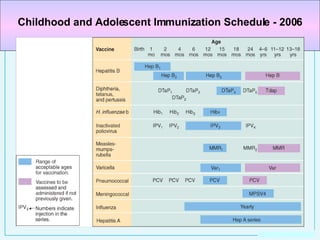
Childhood and Adolescent Immunization Schedule - 2006
Passive Immunity develops when  antibodies  enter the body from outside source Two Types: NATURAL OR ARTIFICIAL Naturally acquired passive immunity  (congenital immunity) occurs when antibodies pass from mother to fetus Maternal IgG antibodies remain in the child 3-6 months after birth  Maternal antibodies also pass to the newborn through: first milk (colostrum)  breast milk Passive Immunity
Artificially acquired passive immunity  involves injection of antibody-rich serum into a body The serum can be used to: prevent disease (prophylactic)  treat disease (therapeutic serum) Antiserum: hyperimmune serum or convalescent serum The immune system may recognize foreign serum proteins as “nonself” and mount an allergic reaction Immune complexes may form and serum sickness may develop Passive Immunity
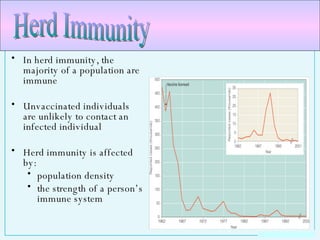
In herd immunity, the majority of a population are immune Unvaccinated individuals are unlikely to contact an infected individual Herd immunity is affected by: population density  the strength of a person’s immune system Herd Immunity
People with egg allergies should not take flu vaccinations The risk of contracting a disease is much greater than any risk associated with vaccines Thimerosal Do vaccines have dangerous side effects?
Serology: branch of immunology that studies serological reactions Serological reactions can help diagnose microbial infections Ag-Ab reactions are studied under laboratory conditions Uses patient’s serum Function: confirmatory test, detect organism in tissue, aid MD in following course of disease and determine immune states  Serological Reactions
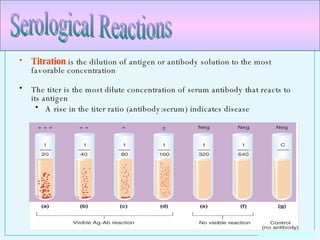
Titration  is the dilution of antigen or antibody solution to the most favorable concentration The titer is the most dilute concentration of serum antibody that reacts to its antigen A rise in the titer ratio (antibody:serum) indicates disease Serological Reactions
Neutralization  Involves Antigen-Antibody Reactions Neutralization is used to identify toxins and antitoxins, viruses and viral antibodies If a specific agent is suspected, to determine if the toxin has been neutralized, a sample can be: mixed with an antitoxin  injected into a lab animal Example: detection of botulinum toxin in food The Schick test is used to determine if a person is immune to diphtheria (intradermal test) Serological Reactions
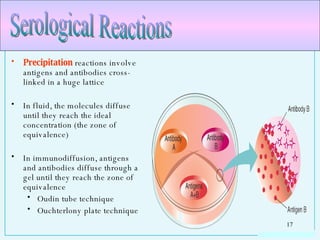
Precipitation  reactions involve antigens and antibodies cross-linked in a huge lattice In fluid, the molecules diffuse until they reach the ideal concentration (the zone of equivalence) In immunodiffusion, antigens and antibodies diffuse through a gel until they reach the zone of equivalence Oudin tube technique Ouchterlony plate technique Serological Reactions
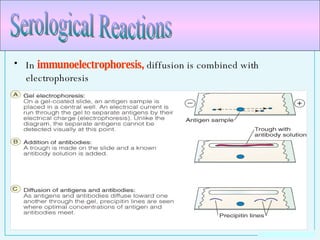
In  immunoelectrophoresis,  diffusion is combined with electrophoresis Serological Reactions
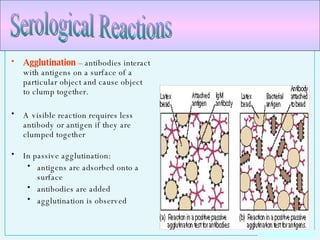
Agglutination  – antibodies interact with antigens on a surface of a particular object and cause object to clump together. A visible reaction requires less antibody or antigen if they are clumped together In passive agglutination: antigens are adsorbed onto a surface antibodies are added agglutination is observed Serological Reactions
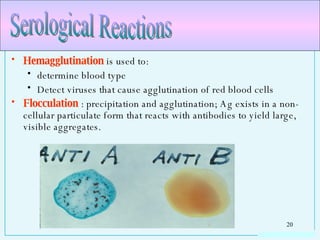
Hemagglutination  is used to: determine blood type  Detect viruses that cause agglutination of red blood cells Flocculation  : precipitation and agglutination; Ag exists in a non-cellular particulate form that reacts with antibodies to yield large, visible aggregates. Serological Reactions
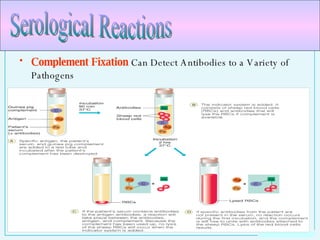
Complement Fixation  Can Detect Antibodies to a Variety of Pathogens Serological Reactions
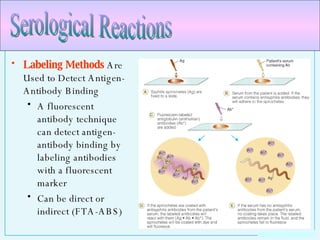
Labeling Methods  Are Used to Detect Antigen-Antibody Binding A fluorescent antibody technique can detect antigen-antibody binding by labeling antibodies with a fluorescent marker Can be direct or indirect (FTA-ABS) Serological Reactions
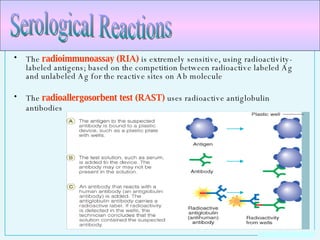
The  radioimmunoassay (RIA)  is extremely sensitive, using radioactivity-labeled antigens; based on the competition between radioactive labeled Ag and unlabeled Ag for the reactive sites on Ab molecule The  radioallergosorbent test (RAST)  uses radioactive antiglobulin antibodies   Serological Reactions
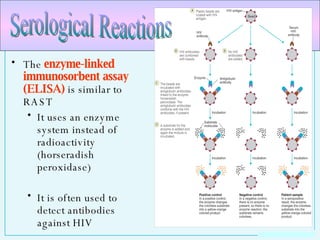
The  enzyme-linked immunosorbent assay (ELISA)  is similar to RAST  It uses an enzyme system instead of radioactivity (horseradish peroxidase) It is often used to detect antibodies against HIV Serological Reactions
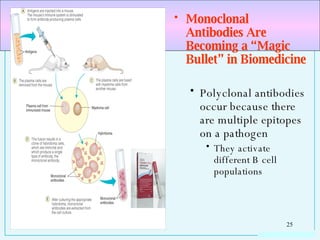
Monoclonal Antibodies Are Becoming a “Magic Bullet” in Biomedicine Polyclonal antibodies occur because there are multiple epitopes on a pathogen They activate different B cell populations
In the lab, antibodies recognizing one epitope (monoclonal antibodies [mAb]) are produced using myelomas Myeloma cells are fused to and activated B cell to form a hybridoma A hybridoma producing the desired mAb can be cloned  MAbs can be used in: disease prevention immunomodulation (controlling overactive inflammatory responses)
Gene Probes Are Single-Stranded DNA segments They hunt down complementary DNA fragment and emit a signal The polymerase chain reaction (PCR) is used to increase the amount of DNA to be searched Gene probes and PCR are use in: HIV and HPV detection  water-quality tests

Chap20 Immunology & Serology

  • 1.
  • 2.
    Immunity is acondition under which an individual is protected from the disease Two general types of immunity Innate Immunity Acquired Immunity Types of Acquired Immunity ACTIVE IMMUNITY Naturally Acquired Active Immunity Artificially Acquired Active Immunity PASSIVE IMMUNITY Naturally Acquired Passive Immunity Artificially Acquired Passive Immunity Immunity to Disease
  • 3.
    4 Types ofAcquired Immunity
  • 4.
    Naturally acquired activeimmunity develops from exposure to an infectious agent Active immunity occurs when the body’s immune system responds to antigens by producing antibodies and lymphocytes Naturally acquired active immunity follows illness or pathogen exposure Artificially acquired active immunity occurs through vaccination Vaccines contain treated or altered microbes, toxins, or parts of microbes a primary immune response occurs memory cells are formed the person does not usually become ill Active Immunity
  • 5.
    Live, attenuated vaccines contain weakened microbes that multiply at only low levels, inducing a strong immune response Organisms can revert to a virulent form and cause disease A single-dose vaccine can combine vaccines for different diseases Vaccines using attenuated bacteria are difficult and not widely used Types of Vaccines
  • 6.
    Inactivated vaccines contain killed pathogens, which induce a weaker immune response Booster shots are required to maintain immunity They are safer than attenuated vaccines because they cannot cause disease Toxoid vaccines contain inactivated toxins (toxoids) Since the product is inactivated, booster shots are required Prepared by incubating toxins with a chemical *to avoid multiple injections, vaccines are combined into single-dose vaccine Types of Vaccines
  • 7.
    Subunit vaccines contain only those parts of the antigens that stimulate a strong immune response Recombinant DNA technology can be used to create recombinant subunit vaccines Subunits cannot cause disease Conjugate vaccines are created by attaching bacterial capsule polysaccharides to a toxoid They elicit a strong immune response Types of Vaccines
  • 8.
    DNA vaccines depend on the ability of some cells to: take up and translate foreign DNA display the resulting proteins, inducing a strong immune response Naked DNA vaccines contain engineered plasmids that contain a gene from a pathogen They are not infective or replicative, so cannot cause disease Recombinant vector vaccines involve DNA incorporated into an attenuated pathogen The pathogen: takes the DNA into the cells (viral vector) or incorporates the DNA and present antigens (bacterial vector) *Adjuvants : increase efficacy of a vaccine or toxoid by increasing availability of the antigen in the lymphatic system. = stimulate phagocytic activity, IL 1 activation, sustained immune response Types of Vaccines
  • 9.
    Childhood and AdolescentImmunization Schedule - 2006
  • 10.
    Passive Immunity developswhen antibodies enter the body from outside source Two Types: NATURAL OR ARTIFICIAL Naturally acquired passive immunity (congenital immunity) occurs when antibodies pass from mother to fetus Maternal IgG antibodies remain in the child 3-6 months after birth Maternal antibodies also pass to the newborn through: first milk (colostrum) breast milk Passive Immunity
  • 11.
    Artificially acquired passiveimmunity involves injection of antibody-rich serum into a body The serum can be used to: prevent disease (prophylactic) treat disease (therapeutic serum) Antiserum: hyperimmune serum or convalescent serum The immune system may recognize foreign serum proteins as “nonself” and mount an allergic reaction Immune complexes may form and serum sickness may develop Passive Immunity
  • 12.
    In herd immunity,the majority of a population are immune Unvaccinated individuals are unlikely to contact an infected individual Herd immunity is affected by: population density the strength of a person’s immune system Herd Immunity
  • 13.
    People with eggallergies should not take flu vaccinations The risk of contracting a disease is much greater than any risk associated with vaccines Thimerosal Do vaccines have dangerous side effects?
  • 14.
    Serology: branch ofimmunology that studies serological reactions Serological reactions can help diagnose microbial infections Ag-Ab reactions are studied under laboratory conditions Uses patient’s serum Function: confirmatory test, detect organism in tissue, aid MD in following course of disease and determine immune states Serological Reactions
  • 15.
    Titration isthe dilution of antigen or antibody solution to the most favorable concentration The titer is the most dilute concentration of serum antibody that reacts to its antigen A rise in the titer ratio (antibody:serum) indicates disease Serological Reactions
  • 16.
    Neutralization InvolvesAntigen-Antibody Reactions Neutralization is used to identify toxins and antitoxins, viruses and viral antibodies If a specific agent is suspected, to determine if the toxin has been neutralized, a sample can be: mixed with an antitoxin injected into a lab animal Example: detection of botulinum toxin in food The Schick test is used to determine if a person is immune to diphtheria (intradermal test) Serological Reactions
  • 17.
    Precipitation reactionsinvolve antigens and antibodies cross-linked in a huge lattice In fluid, the molecules diffuse until they reach the ideal concentration (the zone of equivalence) In immunodiffusion, antigens and antibodies diffuse through a gel until they reach the zone of equivalence Oudin tube technique Ouchterlony plate technique Serological Reactions
  • 18.
    In immunoelectrophoresis, diffusion is combined with electrophoresis Serological Reactions
  • 19.
    Agglutination –antibodies interact with antigens on a surface of a particular object and cause object to clump together. A visible reaction requires less antibody or antigen if they are clumped together In passive agglutination: antigens are adsorbed onto a surface antibodies are added agglutination is observed Serological Reactions
  • 20.
    Hemagglutination isused to: determine blood type Detect viruses that cause agglutination of red blood cells Flocculation : precipitation and agglutination; Ag exists in a non-cellular particulate form that reacts with antibodies to yield large, visible aggregates. Serological Reactions
  • 21.
    Complement Fixation Can Detect Antibodies to a Variety of Pathogens Serological Reactions
  • 22.
    Labeling Methods Are Used to Detect Antigen-Antibody Binding A fluorescent antibody technique can detect antigen-antibody binding by labeling antibodies with a fluorescent marker Can be direct or indirect (FTA-ABS) Serological Reactions
  • 23.
    The radioimmunoassay(RIA) is extremely sensitive, using radioactivity-labeled antigens; based on the competition between radioactive labeled Ag and unlabeled Ag for the reactive sites on Ab molecule The radioallergosorbent test (RAST) uses radioactive antiglobulin antibodies Serological Reactions
  • 24.
    The enzyme-linkedimmunosorbent assay (ELISA) is similar to RAST It uses an enzyme system instead of radioactivity (horseradish peroxidase) It is often used to detect antibodies against HIV Serological Reactions
  • 25.
    Monoclonal Antibodies AreBecoming a “Magic Bullet” in Biomedicine Polyclonal antibodies occur because there are multiple epitopes on a pathogen They activate different B cell populations
  • 26.
    In the lab,antibodies recognizing one epitope (monoclonal antibodies [mAb]) are produced using myelomas Myeloma cells are fused to and activated B cell to form a hybridoma A hybridoma producing the desired mAb can be cloned MAbs can be used in: disease prevention immunomodulation (controlling overactive inflammatory responses)
  • 27.
    Gene Probes AreSingle-Stranded DNA segments They hunt down complementary DNA fragment and emit a signal The polymerase chain reaction (PCR) is used to increase the amount of DNA to be searched Gene probes and PCR are use in: HIV and HPV detection water-quality tests