BY OT Marete
2014
• Immunity is a biological term that describes a
state of having sufficient biological defenses
to avoid infection, disease, or other unwanted
biological invasion.
• Immunity involves both specific and non-
specific components.
• The non-specific components act either as
barriers or as eliminators of wide range of
pathogens irrespective of antigenic specificity.
IMMUNITY
• Other components of the immune system
adapt themselves to each new disease
encountered and are able to generate
pathogen-specific immunity.
• Adaptive immunity is often sub-divided into
two major types (naturally acquired immunity
& artificially acquired immunity) depending
on how the immunity was introduced.
• Naturally acquired immunity occurs through
contact with a disease causing agent, when the
contact was not deliberate.
• Artificially acquired immunity develops only
through deliberate actions such as vaccination.
• Both can be further subdivided depending on
whether immunity is actively induced in the host
or passively transferred from a immune host.
Adaptive (specific) Immunity
• Passive immunity is acquired through transfer
of antibody or activated T-cells from an
immune host, and is short lived, usually lasts
only a few months.
• Active immunity is induced in the host itself
by antigen, and lasts much longer, sometimes
life-long.
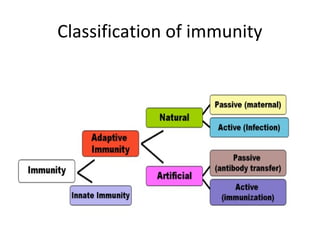
• The following illustration summarizes these
divisions of immunity.
Classification of immunity
• Passive immunity is the transfer of active
immunity, in the form of readymade
antibodies, from one individual to another.
• Passive immunity can occur naturally, when
maternal antibodies are transferred to the
fetus through the placenta, and can also be
induced artificially, when high levels of human
antibodies specific for a pathogen or toxin are
transferred to non-immune individuals.
Passive immunity
• Passive immunization is used when there is a
high risk of infection and insufficient time for
the body to develop its own immune
response, or to reduce the symptoms of
ongoing or immunosuppressive diseases.
• Passive immunity provides immediate
protection, but the body does not develop
memory, therefore the patient is at risk of
being infected by the same pathogen later.
• Maternal passive immunity is a type of
naturally acquired passive immunity, and
refers to antibody-mediated immunity
conveyed to a fetus by its mother during
pregnancy.
• Maternal antibodies (MatAb) are passed
through the placenta to the fetus by a
receptor on placental cells.
Naturally acquired passive immunity
• This occurs around the third month of
gestation.
• Passive immunity is also provided through the
transfer of antibodies found in breast milk
that are transferred to the gut of the infant,
protecting against bacterial infections, until
the newborn can synthesize its own
antibodies
• Artificially acquired passive immunity is a
short-term immunization induced by the
transfer of antibodies, which can be
administered in several forms; as human or
animal blood plasma for intravenous or
intramuscular use.
• Passive transfer is used prophylactically in
immunodeficiency diseases, in the treatment
of acute infection, & to treat poisoning
Artificially acquired passive immunity
• Immunity derived from passive immunization
lasts for only a short period of time, and there
is also a potential risk for hypersensitivity
reactions, and serum sickness, especially from
gamma globulin of non-human origin.
• The artificial induction of passive immunity
has been used for over a century to treat
infectious disease
• Prior to the advent of antibiotics, artificially
acquired passive immunity was often the only
specific treatment for certain infections.
• Immunoglobulin therapy continued to be a
first line therapy in the treatment of severe
respiratory diseases until the 1930’s, even
after sulfonamide antibiotics were introduced.
• Passive or "adoptive transfer" of cell-
mediated immunity, is conferred by the
transfer of "sensitized" or activated T-cells
from one individual into another.
• It is rarely used in humans because it requires
histocompatible (matched) donors, which are
often difficult to find.
• In unmatched donors this type of transfer
carries severe risks of graft versus host
disease.
• It has, however, been used to treat certain
diseases including some types of cancer and
immunodeficiency.
• This type of transfer differs from a bone
marrow transplant, in which
(undifferentiated) hematopoietic stem cells
are transferred.
• Active immunity is induced in the host itself
by an antigen.
• Due to the formation of immunological
memory, future re-infection leads to a rapid
increase in antibody production and T cell
activity.
• These later infections are therefore often mild
or even inapparent.
Active immunity
• When B cells and T cells are activated by a
pathogen, memory B-cells and T- cells develop.
• Throughout the lifetime of an animal these
memory cells will “remember” each specific
pathogen encountered, and are able to mount a
strong response if the pathogen is detected
again.
• This type of immunity is both active and adaptive
because the body's immune system prepares
itself for future challenges.
• Naturally acquired active immunity occurs
when a person is exposed to a live pathogen,
and develops a primary immune response,
which leads to immunological memory.
• This type of immunity is “natural” because it is
not induced by man.
• Many disorders of immune system function
can affect the formation of active immunity
e.g. immunodeficiency & immunosuppression.
Naturally acquired active immunity
• Artificially acquired active immunity can be
induced by a vaccine (a substance that
contains an antigen)
• A vaccine stimulates a primary response
against the antigen without causing symptoms
of the disease.
• The term vaccination was coined by Edward
Jenner and adapted by Louis Pasteur for his
pioneering work in vaccination.
Artificially acquired active
immunity
• The method Pasteur used entailed “treating”
the infectious agents for those diseases so
that they lost the ability to cause serious
disease.
• Pasteur adopted the name vaccine as a
generic term in honor of Jenner's discovery,
which Pasteur's work built upon.
• Inactivated vaccines are composed of micro-
organisms that have been killed with
chemicals and/or heat and are no longer
infectious.
• e.g. vaccines against flu, cholera, bubonic
plague, and hepatitis A.
• Most vaccines of this type are likely to require
booster shots.
Types of vaccines
• Live, attenuated vaccines are composed of
micro-organisms that have been cultivated
under conditions which disable their ability to
induce disease.
• These responses are more durable and do not
generally require booster shots.
• e.g. vaccines against yellow fever, measles,
rubella, and mumps.
• Toxoids are inactivated toxic compounds from
micro-organisms in cases where these toxins
(rather than the micro-organism itself) cause
illness
• They are used prior to an encounter with the
toxin of the micro-organism.
• Examples of toxoid-based vaccines include
tetanus and diphtheria.
• Subunit -vaccines are composed of small
fragments of disease causing organisms.
• A characteristic example is the subunit vaccine
against Hepatitis B virus.
• Most vaccines are given by hypodermic
injection as they are not absorbed reliably
through the gut.
• However, live attenuated Polio and some
Typhoid and Cholera vaccines are given orally
in order to produce immunity based in the
bowel.
END

Immunity

  • 1.
  • 2.
    • Immunity isa biological term that describes a state of having sufficient biological defenses to avoid infection, disease, or other unwanted biological invasion. • Immunity involves both specific and non- specific components. • The non-specific components act either as barriers or as eliminators of wide range of pathogens irrespective of antigenic specificity. IMMUNITY
  • 3.
    • Other componentsof the immune system adapt themselves to each new disease encountered and are able to generate pathogen-specific immunity. • Adaptive immunity is often sub-divided into two major types (naturally acquired immunity & artificially acquired immunity) depending on how the immunity was introduced.
  • 4.
    • Naturally acquiredimmunity occurs through contact with a disease causing agent, when the contact was not deliberate. • Artificially acquired immunity develops only through deliberate actions such as vaccination. • Both can be further subdivided depending on whether immunity is actively induced in the host or passively transferred from a immune host. Adaptive (specific) Immunity
  • 5.
    • Passive immunityis acquired through transfer of antibody or activated T-cells from an immune host, and is short lived, usually lasts only a few months. • Active immunity is induced in the host itself by antigen, and lasts much longer, sometimes life-long. • The following illustration summarizes these divisions of immunity.
  • 6.
  • 7.
    • Passive immunityis the transfer of active immunity, in the form of readymade antibodies, from one individual to another. • Passive immunity can occur naturally, when maternal antibodies are transferred to the fetus through the placenta, and can also be induced artificially, when high levels of human antibodies specific for a pathogen or toxin are transferred to non-immune individuals. Passive immunity
  • 8.
    • Passive immunizationis used when there is a high risk of infection and insufficient time for the body to develop its own immune response, or to reduce the symptoms of ongoing or immunosuppressive diseases. • Passive immunity provides immediate protection, but the body does not develop memory, therefore the patient is at risk of being infected by the same pathogen later.
  • 9.
    • Maternal passiveimmunity is a type of naturally acquired passive immunity, and refers to antibody-mediated immunity conveyed to a fetus by its mother during pregnancy. • Maternal antibodies (MatAb) are passed through the placenta to the fetus by a receptor on placental cells. Naturally acquired passive immunity
  • 10.
    • This occursaround the third month of gestation. • Passive immunity is also provided through the transfer of antibodies found in breast milk that are transferred to the gut of the infant, protecting against bacterial infections, until the newborn can synthesize its own antibodies
  • 11.
    • Artificially acquiredpassive immunity is a short-term immunization induced by the transfer of antibodies, which can be administered in several forms; as human or animal blood plasma for intravenous or intramuscular use. • Passive transfer is used prophylactically in immunodeficiency diseases, in the treatment of acute infection, & to treat poisoning Artificially acquired passive immunity
  • 12.
    • Immunity derivedfrom passive immunization lasts for only a short period of time, and there is also a potential risk for hypersensitivity reactions, and serum sickness, especially from gamma globulin of non-human origin. • The artificial induction of passive immunity has been used for over a century to treat infectious disease
  • 13.
    • Prior tothe advent of antibiotics, artificially acquired passive immunity was often the only specific treatment for certain infections. • Immunoglobulin therapy continued to be a first line therapy in the treatment of severe respiratory diseases until the 1930’s, even after sulfonamide antibiotics were introduced.
  • 14.
    • Passive or"adoptive transfer" of cell- mediated immunity, is conferred by the transfer of "sensitized" or activated T-cells from one individual into another. • It is rarely used in humans because it requires histocompatible (matched) donors, which are often difficult to find.
  • 15.
    • In unmatcheddonors this type of transfer carries severe risks of graft versus host disease. • It has, however, been used to treat certain diseases including some types of cancer and immunodeficiency. • This type of transfer differs from a bone marrow transplant, in which (undifferentiated) hematopoietic stem cells are transferred.
  • 16.
    • Active immunityis induced in the host itself by an antigen. • Due to the formation of immunological memory, future re-infection leads to a rapid increase in antibody production and T cell activity. • These later infections are therefore often mild or even inapparent. Active immunity
  • 17.
    • When Bcells and T cells are activated by a pathogen, memory B-cells and T- cells develop. • Throughout the lifetime of an animal these memory cells will “remember” each specific pathogen encountered, and are able to mount a strong response if the pathogen is detected again. • This type of immunity is both active and adaptive because the body's immune system prepares itself for future challenges.
  • 18.
    • Naturally acquiredactive immunity occurs when a person is exposed to a live pathogen, and develops a primary immune response, which leads to immunological memory. • This type of immunity is “natural” because it is not induced by man. • Many disorders of immune system function can affect the formation of active immunity e.g. immunodeficiency & immunosuppression. Naturally acquired active immunity
  • 19.
    • Artificially acquiredactive immunity can be induced by a vaccine (a substance that contains an antigen) • A vaccine stimulates a primary response against the antigen without causing symptoms of the disease. • The term vaccination was coined by Edward Jenner and adapted by Louis Pasteur for his pioneering work in vaccination. Artificially acquired active immunity
  • 20.
    • The methodPasteur used entailed “treating” the infectious agents for those diseases so that they lost the ability to cause serious disease. • Pasteur adopted the name vaccine as a generic term in honor of Jenner's discovery, which Pasteur's work built upon.
  • 21.
    • Inactivated vaccinesare composed of micro- organisms that have been killed with chemicals and/or heat and are no longer infectious. • e.g. vaccines against flu, cholera, bubonic plague, and hepatitis A. • Most vaccines of this type are likely to require booster shots. Types of vaccines
  • 22.
    • Live, attenuatedvaccines are composed of micro-organisms that have been cultivated under conditions which disable their ability to induce disease. • These responses are more durable and do not generally require booster shots. • e.g. vaccines against yellow fever, measles, rubella, and mumps.
  • 23.
    • Toxoids areinactivated toxic compounds from micro-organisms in cases where these toxins (rather than the micro-organism itself) cause illness • They are used prior to an encounter with the toxin of the micro-organism. • Examples of toxoid-based vaccines include tetanus and diphtheria.
  • 24.
    • Subunit -vaccinesare composed of small fragments of disease causing organisms. • A characteristic example is the subunit vaccine against Hepatitis B virus.
  • 25.
    • Most vaccinesare given by hypodermic injection as they are not absorbed reliably through the gut. • However, live attenuated Polio and some Typhoid and Cholera vaccines are given orally in order to produce immunity based in the bowel.
  • 26.