Immunology
AG( antigene)--AB(antibody) complex Serology
Introduction
The ability of an organism to resist a particular infection or toxin by the
action of specific cells and molecules.
The main function of the immune system is to prevent or limit infections,
fungi and parasites.
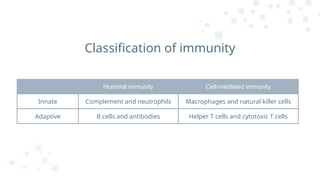
Humoral immunity Cell-mediated immunity
Innate Complement and neutrophils Macrophages and natural killer cells
Adaptive B cells and antibodies Helper T cells and cytotoxic T cells
Classification of immunity
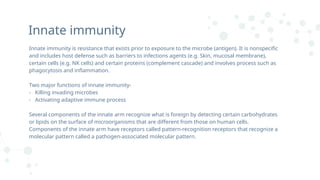
Innate immunity
Innate immunity is resistance that exists prior to exposure to the microbe (antigen). It is nonspecific
and includes host defense such as barriers to infections agents (e.g. Skin, mucosal membrane),
certain cells (e.g. NK cells) and certain proteins (complement cascade) and involves process such as
phagocytosis and inflammation.
Two major functions of innate immunity-
- Killing invading microbes
- Activating adaptive immune process
Several components of the innate arm recognize what is foreign by detecting certain carbohydrates
or lipids on the surface of microorganisms that are different from those on human cells.
Components of the innate arm have receptors called pattern-recognition receptors that recognize a
molecular pattern called a pathogen-associated molecular pattern.
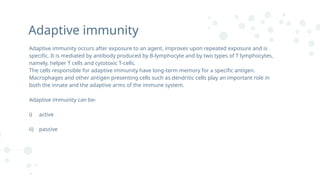
Adaptive immunity
Adaptive immunity occurs after exposure to an agent, improves upon repeated exposure and is
specific. It is mediated by antibody produced by B-lymphocyte and by two types of T lymphocytes,
namely, helper T cells and cytotoxic T-cells.
The cells responsible for adaptive immunity have long-term memory for a specific antigen.
Macrophages and other antigen presenting cells such as dendritic cells play an important role in
both the innate and the adaptive arms of the immune system.
Adaptive immunity can be-
i) active
ii) passive
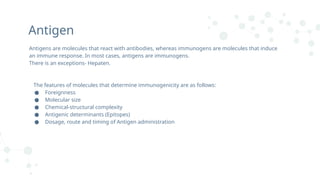
Antigen
Antigens are molecules that react with antibodies, whereas immunogens are molecules that induce
an immune response. In most cases, antigens are immunogens.
There is an exceptions- Hepaten.
The features of molecules that determine immunogenicity are as follows:
● Foreignness
● Molecular size
● Chemical-structural complexity
● Antigenic determinants (Epitopes)
● Dosage, route and timing of Antigen administration
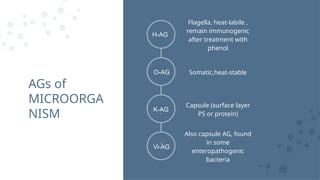
Somatic,heat-stable
Capsule (surface layer
PS or protein)
Also capsule AG, found
in some
enteropathogenic
bacteria
AGs of
MICROORGA
NISM
Flagella, heat-labile ,
remain immunogenic
after treatment with
phenol
H-AG
O-AG
K-AG
Vi-AG
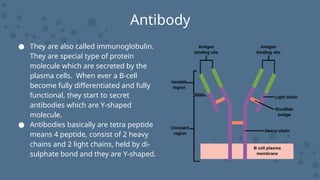
Antibody
● They are also called immunoglobulin.
They are special type of protein
molecule which are secreted by the
plasma cells. When ever a B-cell
become fully differentiated and fully
functional, they start to secret
antibodies which are Y-shaped
molecule.
● Antibodies basically are tetra peptide
means 4 peptide, consist of 2 heavy
chains and 2 light chains, held by di-
sulphate bond and they are Y-shaped.
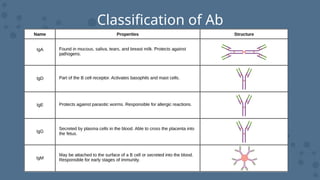
Classification of Ab
Antigen-Antibody reaction
Antigen and antibodies combine with each other specifically and in an observable
manner. The binding occurs between the antigen epitope and the variable domain of
the antibody. This exclusive reaction has led to the development of several
immunological assays to detect infectious diseases, monitor humoral immunity and
detect molecules of medical interest.
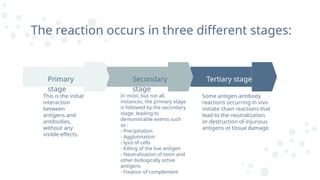
This is the initial
interaction
between
antigens and
antibodies,
without any
visible effects.
In most, but not all,
instances, the primary stage
is followed by the secondary
stage, leading to
demonstrable events such
as :
- Precipitation
- Agglutination
- lysis of cells
- Killing of the live antigen
- Neutralization of toxin and
other biologically active
antigens
- Fixation of complement
Some antigen-antibody
reactions occurring in vivo
initiate chain reactions that
lead to the neutralization
or destruction of injurious
antigens ot tissue damage.
Primary
stage
Secondary
stage
Tertiary stage
The reaction occurs in three different stages:
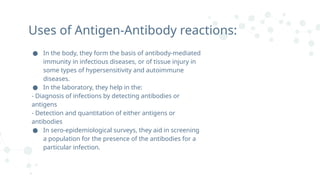
● In the body, they form the basis of antibody-mediated
immunity in infectious diseases, or of tissue injury in
some types of hypersensitivity and autoimmune
diseases.
● In the laboratory, they help in the:
- Diagnosis of infections by detecting antibodies or
antigens
- Detection and quantitation of either antigens or
antibodies
● In sero-epidemiological surveys, they aid in screening
a population for the presence of the antibodies for a
particular infection.
Uses of Antigen-Antibody reactions:
Agglutination reaction
When a particulate antigen is mixed with its antibody in the presence of electrolytes
at a suitable temperature and pH, the particles are clumped or agglutinated.
Agglutination occurs optimally when antigens and antibodies react in equivalent
proportions. The zone phenomenon may be seen when either an antibody or an
antigen is in excess. Incomplete or monovalent antibodies do not cause agglutination
though they combine with the antigen.
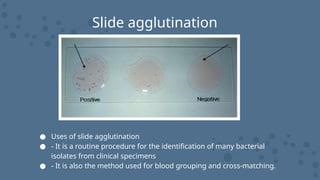
Slide agglutination
● Uses of slide agglutination
● - It is a routine procedure for the identification of many bacterial
isolates from clinical specimens
● - It is also the method used for blood grouping and cross-matching.
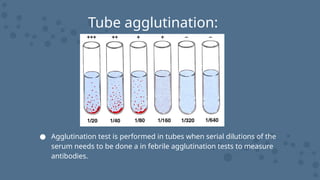
Tube agglutination:
● Agglutination test is performed in tubes when serial dilutions of the
serum needs to be done a in febrile agglutination tests to measure
antibodies.
● It is a routine procedure for the identification of many
bacterial isolates from clinical specimens
● It is also the method used for blood grouping and
cross-matching.
● It is riutinely used for the serological diagnosis of
typhoid brucellosis and typhus fever.
Uses of tube agglutination
CREDITS: This presentation template was
created by Slidesgo, including icons by
Flaticon, and infographics & images by
Freepik.
Please keep this slide for attribution.
Thanks!
DO YOU HAVE ANY QUESTIONS?
das-sh@rudn.ru

Microbiology 9.pptx miiiircroobbbbologyy

  • 1.
  • 2.
    Introduction The ability ofan organism to resist a particular infection or toxin by the action of specific cells and molecules. The main function of the immune system is to prevent or limit infections, fungi and parasites.
  • 3.
    Humoral immunity Cell-mediatedimmunity Innate Complement and neutrophils Macrophages and natural killer cells Adaptive B cells and antibodies Helper T cells and cytotoxic T cells Classification of immunity
  • 4.
    Innate immunity Innate immunityis resistance that exists prior to exposure to the microbe (antigen). It is nonspecific and includes host defense such as barriers to infections agents (e.g. Skin, mucosal membrane), certain cells (e.g. NK cells) and certain proteins (complement cascade) and involves process such as phagocytosis and inflammation. Two major functions of innate immunity- - Killing invading microbes - Activating adaptive immune process Several components of the innate arm recognize what is foreign by detecting certain carbohydrates or lipids on the surface of microorganisms that are different from those on human cells. Components of the innate arm have receptors called pattern-recognition receptors that recognize a molecular pattern called a pathogen-associated molecular pattern.
  • 5.
    Adaptive immunity Adaptive immunityoccurs after exposure to an agent, improves upon repeated exposure and is specific. It is mediated by antibody produced by B-lymphocyte and by two types of T lymphocytes, namely, helper T cells and cytotoxic T-cells. The cells responsible for adaptive immunity have long-term memory for a specific antigen. Macrophages and other antigen presenting cells such as dendritic cells play an important role in both the innate and the adaptive arms of the immune system. Adaptive immunity can be- i) active ii) passive
  • 6.
    Antigen Antigens are moleculesthat react with antibodies, whereas immunogens are molecules that induce an immune response. In most cases, antigens are immunogens. There is an exceptions- Hepaten. The features of molecules that determine immunogenicity are as follows: ● Foreignness ● Molecular size ● Chemical-structural complexity ● Antigenic determinants (Epitopes) ● Dosage, route and timing of Antigen administration
  • 7.
    Somatic,heat-stable Capsule (surface layer PSor protein) Also capsule AG, found in some enteropathogenic bacteria AGs of MICROORGA NISM Flagella, heat-labile , remain immunogenic after treatment with phenol H-AG O-AG K-AG Vi-AG
  • 8.
    Antibody ● They arealso called immunoglobulin. They are special type of protein molecule which are secreted by the plasma cells. When ever a B-cell become fully differentiated and fully functional, they start to secret antibodies which are Y-shaped molecule. ● Antibodies basically are tetra peptide means 4 peptide, consist of 2 heavy chains and 2 light chains, held by di- sulphate bond and they are Y-shaped.
  • 9.
  • 10.
    Antigen-Antibody reaction Antigen andantibodies combine with each other specifically and in an observable manner. The binding occurs between the antigen epitope and the variable domain of the antibody. This exclusive reaction has led to the development of several immunological assays to detect infectious diseases, monitor humoral immunity and detect molecules of medical interest.
  • 11.
    This is theinitial interaction between antigens and antibodies, without any visible effects. In most, but not all, instances, the primary stage is followed by the secondary stage, leading to demonstrable events such as : - Precipitation - Agglutination - lysis of cells - Killing of the live antigen - Neutralization of toxin and other biologically active antigens - Fixation of complement Some antigen-antibody reactions occurring in vivo initiate chain reactions that lead to the neutralization or destruction of injurious antigens ot tissue damage. Primary stage Secondary stage Tertiary stage The reaction occurs in three different stages:
  • 12.
    ● In thebody, they form the basis of antibody-mediated immunity in infectious diseases, or of tissue injury in some types of hypersensitivity and autoimmune diseases. ● In the laboratory, they help in the: - Diagnosis of infections by detecting antibodies or antigens - Detection and quantitation of either antigens or antibodies ● In sero-epidemiological surveys, they aid in screening a population for the presence of the antibodies for a particular infection. Uses of Antigen-Antibody reactions:
  • 13.
    Agglutination reaction When aparticulate antigen is mixed with its antibody in the presence of electrolytes at a suitable temperature and pH, the particles are clumped or agglutinated. Agglutination occurs optimally when antigens and antibodies react in equivalent proportions. The zone phenomenon may be seen when either an antibody or an antigen is in excess. Incomplete or monovalent antibodies do not cause agglutination though they combine with the antigen.
  • 14.
    Slide agglutination ● Usesof slide agglutination ● - It is a routine procedure for the identification of many bacterial isolates from clinical specimens ● - It is also the method used for blood grouping and cross-matching.
  • 15.
    Tube agglutination: ● Agglutinationtest is performed in tubes when serial dilutions of the serum needs to be done a in febrile agglutination tests to measure antibodies.
  • 16.
    ● It isa routine procedure for the identification of many bacterial isolates from clinical specimens ● It is also the method used for blood grouping and cross-matching. ● It is riutinely used for the serological diagnosis of typhoid brucellosis and typhus fever. Uses of tube agglutination
  • 17.
    CREDITS: This presentationtemplate was created by Slidesgo, including icons by Flaticon, and infographics & images by Freepik. Please keep this slide for attribution. Thanks! DO YOU HAVE ANY QUESTIONS? das-sh@rudn.ru