Dosage  and  Solutions
Definition of Terms Dosage:  accurate and proper way of giving medicines in prescribed doses. Dose:  exact amount of medicine to be given or taken by the patient at one time or at stated intervals
Administration of Drugs Oral Administration Parenteral Administration Intramuscular Intravenous Subcutaneous
Common Abbreviations BY ROUTE IM, IV, SC, SL, ID, p.o., p.r. FREQUENCY od, bid, tid, qid, qh (q4h), ac/pc, prn, qd
Drug Order The drug order consists of seven parts: Name of the  patient Name of the  drug Dosage  strength and form of the drug Route  by which the drug is to be administered Frequency , time and special instructions related to administration Date and time  when the order was written Signature  of the person writing the order Example:  Naproxen 250mg/tab 1 tab p.o. b.i.d.
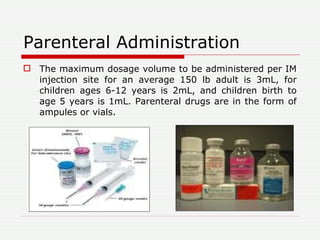
Parenteral Administration The maximum dosage volume to be administered per IM injection site for an average 150 lb adult is 3mL, for children ages 6-12 years is 2mL, and children birth to age 5 years is 1mL. Parenteral drugs are in the form of ampules or vials.
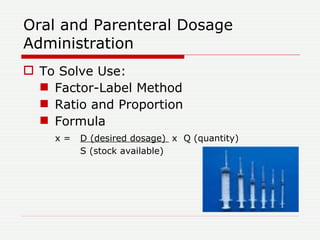
Oral and Parenteral Dosage Administration To Solve Use: Factor-Label Method Ratio and Proportion Formula x =  D (desired dosage)  x  Q (quantity)   S (stock available)
Exercises 1.  Order:  Furosemide, 160 mg, od Available:  40 mg tablets How many tablet/s should the patient receive?   D/S = 160mg/40mg   = 4 tablets 2.  Trisilate 1500mg, q12h for 5 days Available:  Trisilate liquid, 500mg/15mL a.  How many mL should the patient receive? D/S  =  1500mg ÷ 500mg/15mL =  45 mL b.  How many mL is consumed all in all 45 mL  x  (2x a day) x 5 days  =  450 mL
Exercises 3.  Order:  Phenobarbital grss, PO, qid Available:  Phenobarbital 15 mg tablet a.  How many tablet/s per dose? D/S = (1/2gr  x  60mg/1gr)  ÷  15 mg =  2 tablets b.  How many tablets per day? 2 tablets/day  x  4 times a day  =  8 tablets/day 4.  Order:  Dicloxacillin 100mg, PO, q8h, for 7 days Available:  Dicloxacillin 62.5mg/5mL  a.  How many mL should the client receive? D/S  =  100mg  ÷ (62.5mg/5mL) =  8mL b.  How many mL was actually consumed? 8 mL x 3 times a day x 7 days  =  168mL
Exercises 5.  Order:  Atropine sulfate gr 1/200, SC Available:  Atropine sulfate 0.4mg/mL How many mL should the patient receive? D/S  =  (1/200gr  x  60mg/1gr)  ÷  0.4mg/mL =  0.75 mL 6.  Order:  Aspirin grx, STAT Available:  Aspirin 325mg tablet How many tablets should the patient receive? D/S  =  (10gr  x  60mg/1gr)  ÷  325mg =  2 tablets (1.8)
Exercises 7.  Order:  Scopolamine 0.3mg, SC Available:  Scopolamine ampule in gr 1/200 per mL How many mL should the patient receive? D/S  =  0.3 mg ÷ (1/200 gr/mL  x  60mg/1gr) =  1 mL 8.  Order:  Cephalexin 40mg/kg/day, PO, q6h, 33 lb child Available:  Cephalexin 250mg/5mL a.  How many mg should the child receive per day? 33 lb = 15kg  x  40mg =  600mg/day b.  How many mL per dose? D/S = 600mg ÷ (250mg/5mL) ÷ 4 =  3mL/dose
Exercises 9.  Order:  Allopurinol 450mg, PO, qid Available:  Allopurinol 300mg tablet How many tablets should the patient receive? D/S  =  450mg  ÷  300mg   =  1.5 tablets per dose/ 6 tablets per day 10.  Order:  Sulfisoxazole 50mg/kg/day, PO, q6h, 44 lb child a.  How many mg per day? 44 lb = 20kg  x 50mg/kg/day  =  1,000 mg/day b.  How many mg per dose?   1000mg/day  ÷  4 doses/day  =  250mg/dose
Pediatric Dosages –  Based on Age Fried’s Rule – newborn to 2 y/o Age in months   x  normal adult dose 150 Example:  The physician prescribed Dolanex elixir for a 15-month old. The normal adult dose is 325 mg q4h to q6h. Dolanex elixir is available as 325mg/5mL. Young’s Rule – ages 1 to 12 y/o   Age in years___  x  normal adult dose age in years + 12 Example:  The physician prescribed Milk of Magnesia for an 8 year old patient. The normal adult dose is 30mL.
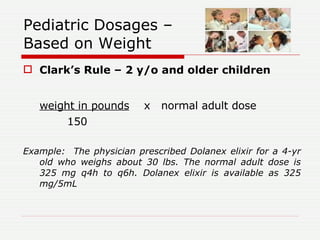
Pediatric Dosages –  Based on Weight Clark’s Rule – 2 y/o and older children weight in pounds   x  normal adult dose 150 Example:  The physician prescribed Dolanex elixir for a 4-yr old who weighs about 30 lbs. The normal adult dose is 325 mg q4h to q6h. Dolanex elixir is available as 325 mg/5mL
Insulin Administration Formula:  ____ Desired____  Stock / 16 minims Sample Problem: The patient needs 30U of insulin but the available stock is 80U. How much of the 80U will be given? If the stock is 100U, how much should be given to meet the patient’s needs?
Intravenous Infusion Calculating mL/hour Total volume to be infused (mL) Total time (hours) Sample Problem A patient is to receive 1 liter of Ringer’s solution over a 6-hour period. The patient would receive ____mL/hour
Intravenous Infusion Calculating mL/min Total volume to be infused (mL) Total time (in minutes) Sample Problem A patient is to receive 500mL of NSS over a period of 4 hours. The patient would receive ____mL/min.
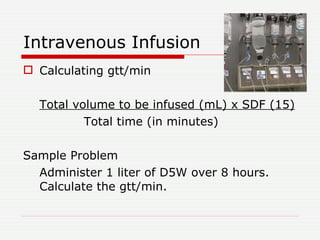
Intravenous Infusion Calculating gtt/min Total volume to be infused (mL) x SDF (15) Total time (in minutes) Sample Problem Administer 1 liter of D5W over 8 hours. Calculate the gtt/min.
Exercises The physician prescribed 800mL of RL to infuse over 12 hrs. You would give ___ mL/h.   = 800mL 12 hours   =  67 mL/hr The physician prescribed an IV of 100mL of D 5 W to run at 100mL/h. The drop factor is 10. Set the flow rate at ___gtt/min   =  _____ 100 mL x 10 gtt_____ 60 min =  17 gtt/min
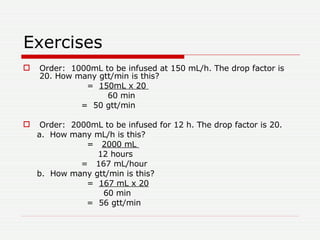
Exercises Order:  1000mL to be infused at 150 mL/h. The drop factor is 20. How many gtt/min is this? =  150mL x 20    60 min =  50 gtt/min Order:  2000mL to be infused for 12 h. The drop factor is 20. a.  How many mL/h is this? =  2000 mL  12 hours =  167 mL/hour b.  How many gtt/min is this? =  167 mL x 20 60 min =  56 gtt/min
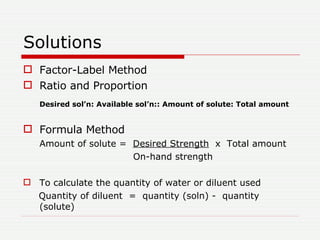
Solutions Factor-Label Method Ratio and Proportion Desired sol’n: Available sol’n:: Amount of solute: Total amount Formula Method Amount of solute =  Desired Strength   x  Total amount  On-hand strength To calculate the quantity of water or diluent used Quantity of diluent  =  quantity (soln) -  quantity (solute)
Sample Problems To prepare 400mL of a 2% sodium bicarbonate solution from a pure drug, you would need ___g of solute. Desired sol’n: Available sol’n:: Amount of solute: Total amount    (.02) : 1 :: x : 400    x = 8g To make 1.5L of a 5% solution from a 25% solution, you would need ___ mL of solute. Add ___mL of water to make 1.5L Amount of solute =  Desired Strength   x  Total amount  On-hand strength =  .05 / .25  x  (1.5L x 1000mL/1L) =  300 mL Quantity of diluent  =  quantity (soln) -  quantity (solute)   =  1500 mL  -  300 mL   =  1200 mL
Sample Problems There is 500mL of 40% magnesium sulfate solution available for a soak. To make 30% solution, you would need ___mL of solute. Add ___ mL of water to make 500mL. Amount of solute =  Desired Strength   x  Total amount  On-hand strength =  .30 / .40  x  500mL   =  375 mL Quantity of diluent  =  quantity (soln) -  quantity (solute)   =  500 mL  -  375 mL   =  125 mL
end…

Dosage And Solutions

  • 1.
    Dosage and Solutions
  • 2.
    Definition of TermsDosage: accurate and proper way of giving medicines in prescribed doses. Dose: exact amount of medicine to be given or taken by the patient at one time or at stated intervals
  • 3.
    Administration of DrugsOral Administration Parenteral Administration Intramuscular Intravenous Subcutaneous
  • 4.
    Common Abbreviations BYROUTE IM, IV, SC, SL, ID, p.o., p.r. FREQUENCY od, bid, tid, qid, qh (q4h), ac/pc, prn, qd
  • 5.
    Drug Order Thedrug order consists of seven parts: Name of the patient Name of the drug Dosage strength and form of the drug Route by which the drug is to be administered Frequency , time and special instructions related to administration Date and time when the order was written Signature of the person writing the order Example: Naproxen 250mg/tab 1 tab p.o. b.i.d.
  • 6.
    Parenteral Administration Themaximum dosage volume to be administered per IM injection site for an average 150 lb adult is 3mL, for children ages 6-12 years is 2mL, and children birth to age 5 years is 1mL. Parenteral drugs are in the form of ampules or vials.
  • 7.
    Oral and ParenteralDosage Administration To Solve Use: Factor-Label Method Ratio and Proportion Formula x = D (desired dosage) x Q (quantity) S (stock available)
  • 8.
    Exercises 1. Order: Furosemide, 160 mg, od Available: 40 mg tablets How many tablet/s should the patient receive? D/S = 160mg/40mg = 4 tablets 2. Trisilate 1500mg, q12h for 5 days Available: Trisilate liquid, 500mg/15mL a. How many mL should the patient receive? D/S = 1500mg ÷ 500mg/15mL = 45 mL b. How many mL is consumed all in all 45 mL x (2x a day) x 5 days = 450 mL
  • 9.
    Exercises 3. Order: Phenobarbital grss, PO, qid Available: Phenobarbital 15 mg tablet a. How many tablet/s per dose? D/S = (1/2gr x 60mg/1gr) ÷ 15 mg = 2 tablets b. How many tablets per day? 2 tablets/day x 4 times a day = 8 tablets/day 4. Order: Dicloxacillin 100mg, PO, q8h, for 7 days Available: Dicloxacillin 62.5mg/5mL a. How many mL should the client receive? D/S = 100mg ÷ (62.5mg/5mL) = 8mL b. How many mL was actually consumed? 8 mL x 3 times a day x 7 days = 168mL
  • 10.
    Exercises 5. Order: Atropine sulfate gr 1/200, SC Available: Atropine sulfate 0.4mg/mL How many mL should the patient receive? D/S = (1/200gr x 60mg/1gr) ÷ 0.4mg/mL = 0.75 mL 6. Order: Aspirin grx, STAT Available: Aspirin 325mg tablet How many tablets should the patient receive? D/S = (10gr x 60mg/1gr) ÷ 325mg = 2 tablets (1.8)
  • 11.
    Exercises 7. Order: Scopolamine 0.3mg, SC Available: Scopolamine ampule in gr 1/200 per mL How many mL should the patient receive? D/S = 0.3 mg ÷ (1/200 gr/mL x 60mg/1gr) = 1 mL 8. Order: Cephalexin 40mg/kg/day, PO, q6h, 33 lb child Available: Cephalexin 250mg/5mL a. How many mg should the child receive per day? 33 lb = 15kg x 40mg = 600mg/day b. How many mL per dose? D/S = 600mg ÷ (250mg/5mL) ÷ 4 = 3mL/dose
  • 12.
    Exercises 9. Order: Allopurinol 450mg, PO, qid Available: Allopurinol 300mg tablet How many tablets should the patient receive? D/S = 450mg ÷ 300mg = 1.5 tablets per dose/ 6 tablets per day 10. Order: Sulfisoxazole 50mg/kg/day, PO, q6h, 44 lb child a. How many mg per day? 44 lb = 20kg x 50mg/kg/day = 1,000 mg/day b. How many mg per dose? 1000mg/day ÷ 4 doses/day = 250mg/dose
  • 13.
    Pediatric Dosages – Based on Age Fried’s Rule – newborn to 2 y/o Age in months x normal adult dose 150 Example: The physician prescribed Dolanex elixir for a 15-month old. The normal adult dose is 325 mg q4h to q6h. Dolanex elixir is available as 325mg/5mL. Young’s Rule – ages 1 to 12 y/o Age in years___ x normal adult dose age in years + 12 Example: The physician prescribed Milk of Magnesia for an 8 year old patient. The normal adult dose is 30mL.
  • 14.
    Pediatric Dosages – Based on Weight Clark’s Rule – 2 y/o and older children weight in pounds x normal adult dose 150 Example: The physician prescribed Dolanex elixir for a 4-yr old who weighs about 30 lbs. The normal adult dose is 325 mg q4h to q6h. Dolanex elixir is available as 325 mg/5mL
  • 15.
    Insulin Administration Formula: ____ Desired____ Stock / 16 minims Sample Problem: The patient needs 30U of insulin but the available stock is 80U. How much of the 80U will be given? If the stock is 100U, how much should be given to meet the patient’s needs?
  • 16.
    Intravenous Infusion CalculatingmL/hour Total volume to be infused (mL) Total time (hours) Sample Problem A patient is to receive 1 liter of Ringer’s solution over a 6-hour period. The patient would receive ____mL/hour
  • 17.
    Intravenous Infusion CalculatingmL/min Total volume to be infused (mL) Total time (in minutes) Sample Problem A patient is to receive 500mL of NSS over a period of 4 hours. The patient would receive ____mL/min.
  • 18.
    Intravenous Infusion Calculatinggtt/min Total volume to be infused (mL) x SDF (15) Total time (in minutes) Sample Problem Administer 1 liter of D5W over 8 hours. Calculate the gtt/min.
  • 19.
    Exercises The physicianprescribed 800mL of RL to infuse over 12 hrs. You would give ___ mL/h. = 800mL 12 hours = 67 mL/hr The physician prescribed an IV of 100mL of D 5 W to run at 100mL/h. The drop factor is 10. Set the flow rate at ___gtt/min = _____ 100 mL x 10 gtt_____ 60 min = 17 gtt/min
  • 20.
    Exercises Order: 1000mL to be infused at 150 mL/h. The drop factor is 20. How many gtt/min is this? = 150mL x 20 60 min = 50 gtt/min Order: 2000mL to be infused for 12 h. The drop factor is 20. a. How many mL/h is this? = 2000 mL 12 hours = 167 mL/hour b. How many gtt/min is this? = 167 mL x 20 60 min = 56 gtt/min
  • 21.
    Solutions Factor-Label MethodRatio and Proportion Desired sol’n: Available sol’n:: Amount of solute: Total amount Formula Method Amount of solute = Desired Strength x Total amount On-hand strength To calculate the quantity of water or diluent used Quantity of diluent = quantity (soln) - quantity (solute)
  • 22.
    Sample Problems Toprepare 400mL of a 2% sodium bicarbonate solution from a pure drug, you would need ___g of solute. Desired sol’n: Available sol’n:: Amount of solute: Total amount (.02) : 1 :: x : 400 x = 8g To make 1.5L of a 5% solution from a 25% solution, you would need ___ mL of solute. Add ___mL of water to make 1.5L Amount of solute = Desired Strength x Total amount On-hand strength = .05 / .25 x (1.5L x 1000mL/1L) = 300 mL Quantity of diluent = quantity (soln) - quantity (solute) = 1500 mL - 300 mL = 1200 mL
  • 23.
    Sample Problems Thereis 500mL of 40% magnesium sulfate solution available for a soak. To make 30% solution, you would need ___mL of solute. Add ___ mL of water to make 500mL. Amount of solute = Desired Strength x Total amount On-hand strength = .30 / .40 x 500mL = 375 mL Quantity of diluent = quantity (soln) - quantity (solute) = 500 mL - 375 mL = 125 mL
  • 24.