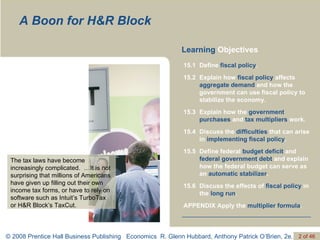
A Boon for H&R Block Learning  Objectives The tax laws have become increasingly complicated.  …It is not surprising that millions of Americans have given up filling out their own income tax forms, or have to rely on software such as Intuit’s TurboTax or H&R Block’s TaxCut. APPENDIX Apply the  multiplier formula . Discuss the effects of  fiscal policy  in the  long run . 15.6 Define federal  budget deficit  and  federal government debt  and explain how the federal budget can serve as an  automatic stabilizer . 15.5 Discuss the  difficulties  that can arise in  implementing fiscal policy . 15.4 Explain how the  government purchases  and  tax multipliers  work. 15.3 Explain how  fiscal policy  affects  aggregate demand  and how the government can use fiscal policy to stabilize the economy. 15.2 Define  fiscal policy . 15.1
Fiscal Policy Fiscal policy   Changes in federal taxes  and purchases that are intended to achieve macroeconomic policy objectives, such as high employment, price stability, and high rates of economic growth. Learning  Objective  15.1 What Fiscal Policy Is and What It Isn’t Automatic stabilizers   Government spending and taxes that automatically increase or decrease along with the business cycle. Automatic Stabilizers versus Discretionary Fiscal Policy
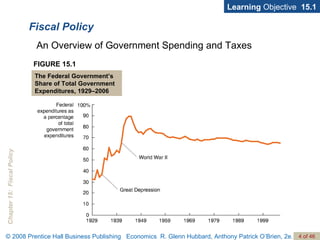
Fiscal Policy Learning  Objective  15.1 An Overview of Government Spending and Taxes FIGURE 15.1 The Federal Government’s Share of Total Government Expenditures, 1929–2006
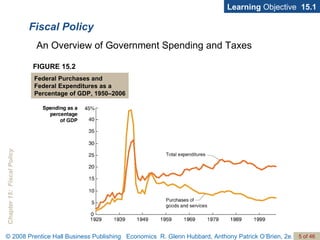
Fiscal Policy Learning  Objective  15.1 An Overview of Government Spending and Taxes FIGURE 15.2 Federal Purchases and Federal Expenditures as a Percentage of GDP, 1950–2006
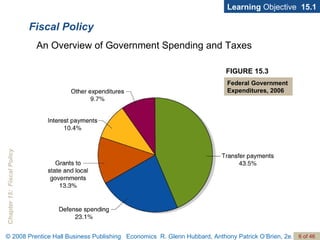
Fiscal Policy Learning  Objective  15.1 An Overview of Government Spending and Taxes FIGURE 15.3 Federal Government Expenditures, 2006
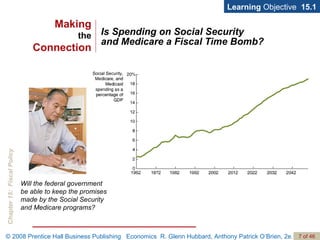
Is Spending on Social Security  and Medicare a Fiscal Time Bomb? Learning  Objective  15.1 Will the federal government be able to keep the promises made by the Social Security and Medicare programs? Making the Connection
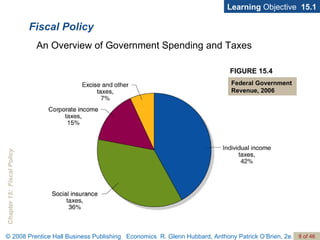
Fiscal Policy Learning  Objective  15.1 An Overview of Government Spending and Taxes FIGURE 15.4 Federal Government Revenue, 2006
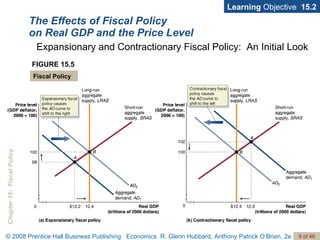
The Effects of Fiscal Policy on Real GDP and the Price Level Learning  Objective  15.2 Expansionary and Contractionary Fiscal Policy:  An Initial Look FIGURE 15.5 Fiscal Policy
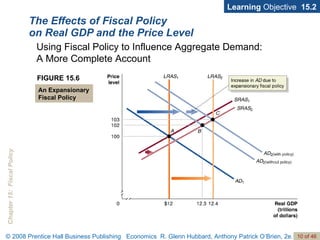
The Effects of Fiscal Policy on Real GDP and the Price Level Learning  Objective  15.2 Using Fiscal Policy to Influence Aggregate Demand:  A More Complete Account FIGURE 15.6 An Expansionary Fiscal Policy
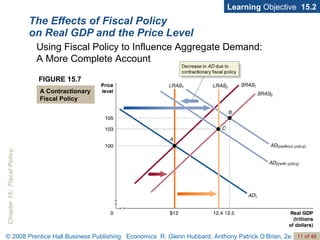
The Effects of Fiscal Policy on Real GDP and the Price Level Learning  Objective  15.2 Using Fiscal Policy to Influence Aggregate Demand:  A More Complete Account FIGURE 15.7 A Contractionary Fiscal Policy
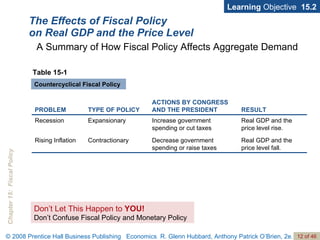
The Effects of Fiscal Policy on Real GDP and the Price Level Learning  Objective  15.2 A Summary of How Fiscal Policy Affects Aggregate Demand Table 15-1 Countercyclical Fiscal Policy Don’t Let This Happen to  YOU! Don’t Confuse Fiscal Policy and Monetary Policy Real GDP and the price level fall. Decrease government  spending or raise taxes Contractionary Rising Inflation  Real GDP and the price level rise. Increase government  spending or cut taxes Expansionary  Recession RESULT ACTIONS BY CONGRESS AND THE PRESIDENT TYPE OF POLICY PROBLEM
The Government Purchases and Tax Multipliers Multiplier effect  The series of induced increases in consumption spending that results from an initial increase in autonomous expenditures. Learning  Objective  15.3
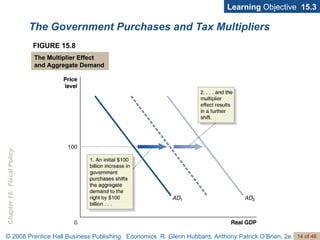
The Government Purchases and Tax Multipliers Learning  Objective  15.3 FIGURE 15.8 The Multiplier Effect and Aggregate Demand
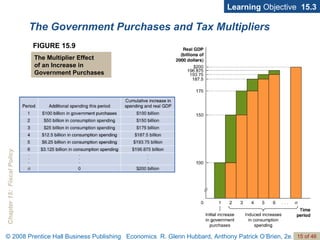
The Government Purchases and Tax Multipliers Learning  Objective  15.3 FIGURE 15.9 The Multiplier Effect  of an Increase in Government Purchases
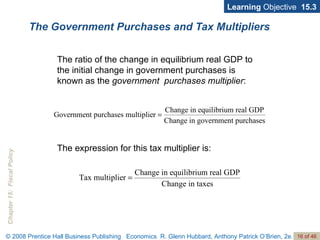
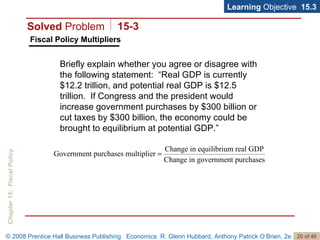
The Government Purchases and Tax Multipliers Learning  Objective  15.3 The ratio of the change in equilibrium real GDP to the initial change in government purchases is known as the  government  purchases multiplier : The expression for this tax multiplier is:
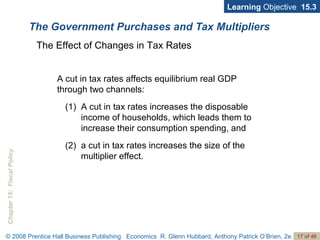
The Government Purchases and Tax Multipliers Learning  Objective  15.3 The Effect of Changes in Tax Rates A cut in tax rates affects equilibrium real GDP through two channels:  A cut in tax rates increases the disposable income of households, which leads them to increase their consumption spending, and  a cut in tax rates increases the size of the multiplier effect.
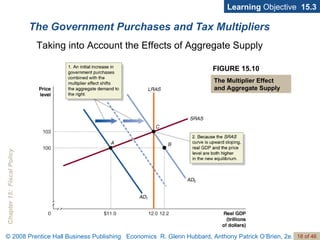
The Government Purchases and Tax Multipliers Learning  Objective  15.3 Taking into Account the Effects of Aggregate Supply FIGURE 15.10 The Multiplier Effect  and Aggregate Supply
The Government Purchases and Tax Multipliers Learning  Objective  15.3 The Multipliers Work in Both Directions Increases in government purchases and cuts in taxes have a positive multiplier effect on equilibrium real GDP. Decreases in government purchases and increases in taxes also have a multiplier effect on equilibrium real GDP, only in this case, the effect is negative.
Fiscal Policy Multipliers Learning  Objective  15.3 Briefly explain whether you agree or disagree with the following statement:  “Real GDP is currently $12.2 trillion, and potential real GDP is $12.5 trillion.  If Congress and the president would increase government purchases by $300 billion or cut taxes by $300 billion, the economy could be brought to equilibrium at potential GDP.” Solved  Problem 15-3
The Limits of Using Fiscal Policy  to Stabilize the Economy Crowding out   A decline in private expenditures as a result of an increase in government purchases. Learning  Objective  15.4 Does Government Spending Reduce Private Spending?
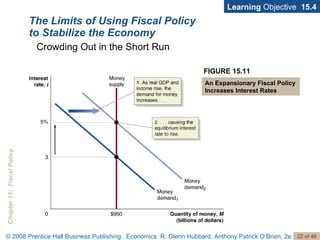
The Limits of Using Fiscal Policy to Stabilize the Economy Learning  Objective  15.4 Crowding Out in the Short Run FIGURE 15.11 An Expansionary Fiscal Policy Increases Interest Rates
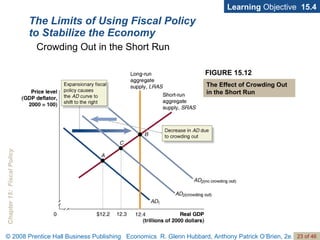
The Limits of Using Fiscal Policy to Stabilize the Economy Learning  Objective  15.4 Crowding Out in the Short Run FIGURE 15.12 The Effect of Crowding Out  in the Short Run
The Limits of Using Fiscal Policy to Stabilize the Economy To understand crowding out in the long run, recall from Chapter 24 that  in the long run, the economy returns to potential GDP . Learning  Objective  15.4 Crowding Out in the Long Run
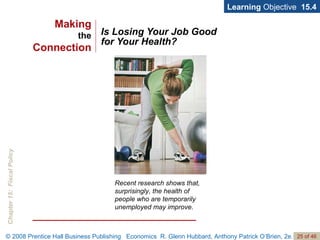
Is Losing Your Job Good  for Your Health? Learning  Objective  15.4 Recent research shows that, surprisingly, the health of people who are temporarily unemployed may improve. Making the Connection
Deficits, Surpluses, and Federal Government Debt Budget deficit   The situation in which the government’s expenditures are greater than its tax revenue. Budget surplus   The situation in which the government’s expenditures are less than its tax revenue. Learning  Objective  15.5
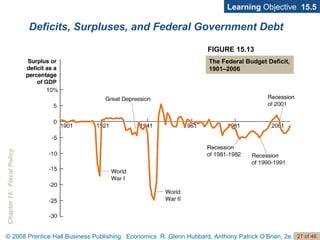
Deficits, Surpluses, and Federal Government Debt Learning  Objective  15.5 FIGURE 15.13 The Federal Budget Deficit, 1901–2006
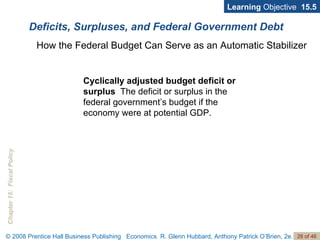
Deficits, Surpluses, and Federal Government Debt Cyclically adjusted budget deficit or surplus   The deficit or surplus in the federal government’s budget if the economy were at potential GDP. Learning  Objective  15.5 How the Federal Budget Can Serve as an Automatic Stabilizer
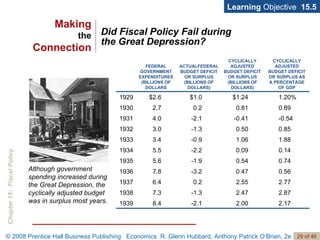
Did Fiscal Policy Fail during  the Great Depression? Learning  Objective  15.5 Although government spending increased during the Great Depression, the cyclically adjusted budget was in surplus most years. Making the Connection 2.17 2.00 -2.1 8.4 1939 2.87 2.47 -1.3 7.3 1938 2.77 2.55 0.2 6.4 1937 0.56 0.47 -3.2 7.8 1936 0.74 0.54 -1.9 5.6 1935 0.14 0.09 -2.2 5.5 1934 1.88 1.06 -0.9 3.4 1933 0.85 0.50 -1.3 3.0 1932 -0.54 -0.41 -2.1 4.0 1931 0.89 0.81 0.2 2.7 1930 1.20% $1.24 $1.0 $2.6 1929 CYCLICALLY ADJUSTED BUDGET DEFICIT OR SURPLUS AS A PERCENTAGE OF GDP CYCLICALLY ADJUSTED BUDGET DEFICIT OR SURPLUS (BILLIONS OF DOLLARS) ACTUALFEDERAL BUDGET DEFICIT OR SURPLUS (BILLIONS OF DOLLARS) FEDERAL GOVERNMENT EXPENDITURES (BILLIONS OF DOLLARS
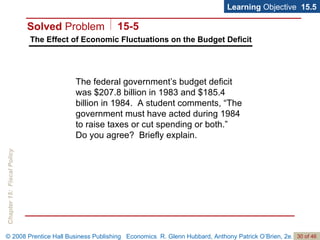
The Effect of Economic Fluctuations on the Budget Deficit Learning  Objective  15.5 The federal government’s budget deficit was $207.8 billion in 1983 and $185.4 billion in 1984.  A student comments, “The government must have acted during 1984 to raise taxes or cut spending or both.”  Do you agree?  Briefly explain. Solved  Problem 15-5
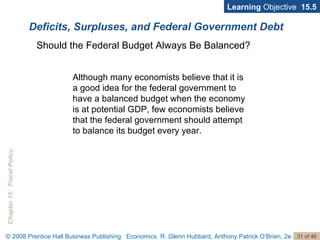
Deficits, Surpluses, and Federal Government Debt Although many economists believe that it is a good idea for the federal government to have a balanced budget when the economy is at potential GDP, few economists believe that the federal government should attempt to balance its budget every year. Learning  Objective  15.5 Should the Federal Budget Always Be Balanced?
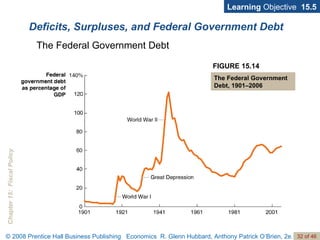
Deficits, Surpluses, and Federal Government Debt Learning  Objective  15.5 The Federal Government Debt FIGURE 15.14 The Federal Government Debt, 1901–2006
Deficits, Surpluses, and Federal Government Debt Debt can be a problem for a government for the same reasons that debt can be a problem for a household or a business. Learning  Objective  15.5 Is Government Debt a Problem?
The Effects of Fiscal Policy in the Long Run Tax wedge   The difference between the pretax and posttax return to an economic activity. Learning  Objective  15.6 The Long-Run Effects of Tax Policy •  Individual income tax. •  Corporate income tax. •  Taxes on dividends and capital gains. We can look briefly at the effects on aggregate supply of cutting each of the following taxes: In addition to the potential gains from cutting individual taxes, there are also gains from tax simplification. Tax Simplification
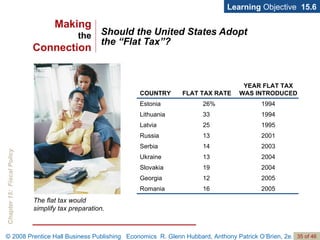
Should the United States Adopt  the “Flat Tax”? Learning  Objective  15.6 The flat tax would simplify tax preparation. Making the Connection 2005 16 Romania 2005 12 Georgia 2004 19 Slovakia 2004 13 Ukraine 2003 14 Serbia 2001 13 Russia 1995 25 Latvia 1994 33 Lithuania 1994 26% Estonia YEAR FLAT TAX WAS INTRODUCED FLAT TAX RATE COUNTRY
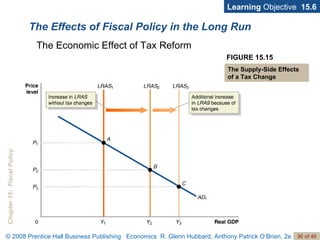
The Effects of Fiscal Policy in the Long Run Learning  Objective  15.6 The Economic Effect of Tax Reform FIGURE 15.15 The Supply-Side Effects of a Tax Change
The Effects of Fiscal Policy in the Long Run Most economists would agree that there are supply-side effects to reducing taxes:  Decreasing marginal income tax rates will increase the quantity of labor supplied, cutting the corporate income tax will increase investment spending, and so on. The magnitude of the effects is subject to considerable debate, however.  Learning  Objective  15.6 How Large Are Supply-Side Effects?
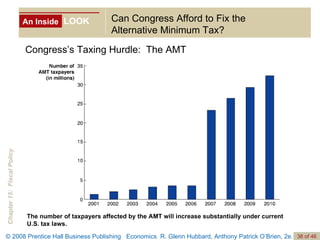
An Inside LOOK Can Congress Afford to Fix the Alternative Minimum Tax? Congress’s Taxing Hurdle:  The AMT The number of taxpayers affected by the AMT will increase substantially under current U.S. tax laws.
Automatic stabilizers Budget deficit Budget surplus Crowding out Cyclically adjusted budget deficit or surplus Fiscal policy Multiplier effect Tax wedge K e y  T e r m s
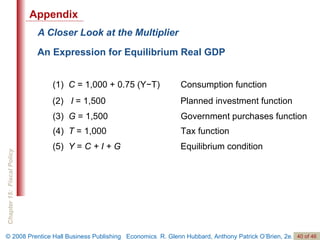
A Closer Look at the Multiplier An Expression for Equilibrium Real GDP (1)  C  = 1,000 + 0.75 (Y−T)  Consumption function (2)  I  = 1,500 Planned investment function (3)  G  = 1,500 Government purchases function (4)  T  = 1,000 Tax function (5)  Y  =  C + I + G Equilibrium condition Appendix
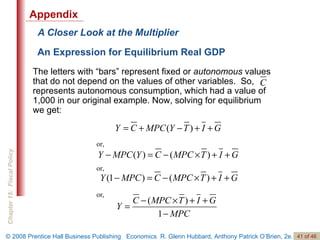
A Closer Look at the Multiplier An Expression for Equilibrium Real GDP Appendix The letters with “bars” represent fixed or  autonomous  values that do not depend on the values of other variables.  So,  represents autonomous consumption, which had a value of 1,000 in our original example. Now, solving for equilibrium  we get: or, or, or,
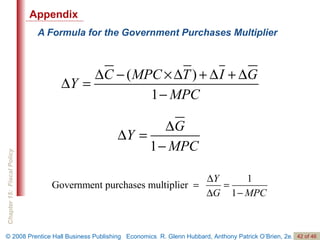
A Formula for the Government Purchases Multiplier Appendix
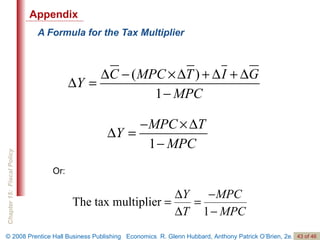
A Formula for the Tax Multiplier Or:  Appendix
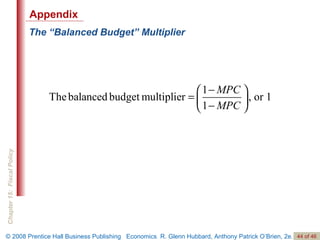
The “Balanced Budget” Multiplier Appendix
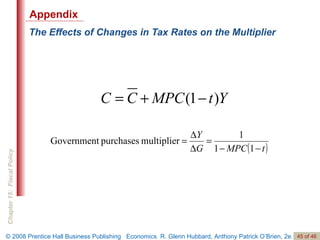
The Effects of Changes in Tax Rates on the Multiplier Appendix
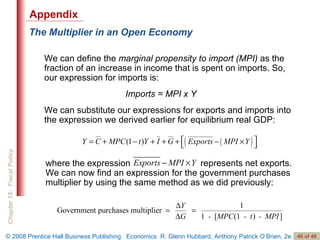
The Multiplier in an Open Economy We can define the  marginal propensity to import (MPI)  as the fraction of an increase in income that is spent on imports. So, our expression for imports is:    Imports = MPI x Y We can substitute our expressions for exports and imports into the expression we derived earlier for equilibrium real GDP: Appendix where the expression   represents net exports. We can now find an expression for the government purchases multiplier by using the same method as we did previously:

Chap15pp

  • 1.
  • 2.
    A Boon forH&R Block Learning Objectives The tax laws have become increasingly complicated. …It is not surprising that millions of Americans have given up filling out their own income tax forms, or have to rely on software such as Intuit’s TurboTax or H&R Block’s TaxCut. APPENDIX Apply the multiplier formula . Discuss the effects of fiscal policy in the long run . 15.6 Define federal budget deficit and federal government debt and explain how the federal budget can serve as an automatic stabilizer . 15.5 Discuss the difficulties that can arise in implementing fiscal policy . 15.4 Explain how the government purchases and tax multipliers work. 15.3 Explain how fiscal policy affects aggregate demand and how the government can use fiscal policy to stabilize the economy. 15.2 Define fiscal policy . 15.1
  • 3.
    Fiscal Policy Fiscalpolicy Changes in federal taxes and purchases that are intended to achieve macroeconomic policy objectives, such as high employment, price stability, and high rates of economic growth. Learning Objective 15.1 What Fiscal Policy Is and What It Isn’t Automatic stabilizers Government spending and taxes that automatically increase or decrease along with the business cycle. Automatic Stabilizers versus Discretionary Fiscal Policy
  • 4.
    Fiscal Policy Learning Objective 15.1 An Overview of Government Spending and Taxes FIGURE 15.1 The Federal Government’s Share of Total Government Expenditures, 1929–2006
  • 5.
    Fiscal Policy Learning Objective 15.1 An Overview of Government Spending and Taxes FIGURE 15.2 Federal Purchases and Federal Expenditures as a Percentage of GDP, 1950–2006
  • 6.
    Fiscal Policy Learning Objective 15.1 An Overview of Government Spending and Taxes FIGURE 15.3 Federal Government Expenditures, 2006
  • 7.
    Is Spending onSocial Security and Medicare a Fiscal Time Bomb? Learning Objective 15.1 Will the federal government be able to keep the promises made by the Social Security and Medicare programs? Making the Connection
  • 8.
    Fiscal Policy Learning Objective 15.1 An Overview of Government Spending and Taxes FIGURE 15.4 Federal Government Revenue, 2006
  • 9.
    The Effects ofFiscal Policy on Real GDP and the Price Level Learning Objective 15.2 Expansionary and Contractionary Fiscal Policy: An Initial Look FIGURE 15.5 Fiscal Policy
  • 10.
    The Effects ofFiscal Policy on Real GDP and the Price Level Learning Objective 15.2 Using Fiscal Policy to Influence Aggregate Demand: A More Complete Account FIGURE 15.6 An Expansionary Fiscal Policy
  • 11.
    The Effects ofFiscal Policy on Real GDP and the Price Level Learning Objective 15.2 Using Fiscal Policy to Influence Aggregate Demand: A More Complete Account FIGURE 15.7 A Contractionary Fiscal Policy
  • 12.
    The Effects ofFiscal Policy on Real GDP and the Price Level Learning Objective 15.2 A Summary of How Fiscal Policy Affects Aggregate Demand Table 15-1 Countercyclical Fiscal Policy Don’t Let This Happen to YOU! Don’t Confuse Fiscal Policy and Monetary Policy Real GDP and the price level fall. Decrease government spending or raise taxes Contractionary Rising Inflation Real GDP and the price level rise. Increase government spending or cut taxes Expansionary Recession RESULT ACTIONS BY CONGRESS AND THE PRESIDENT TYPE OF POLICY PROBLEM
  • 13.
    The Government Purchasesand Tax Multipliers Multiplier effect The series of induced increases in consumption spending that results from an initial increase in autonomous expenditures. Learning Objective 15.3
  • 14.
    The Government Purchasesand Tax Multipliers Learning Objective 15.3 FIGURE 15.8 The Multiplier Effect and Aggregate Demand
  • 15.
    The Government Purchasesand Tax Multipliers Learning Objective 15.3 FIGURE 15.9 The Multiplier Effect of an Increase in Government Purchases
  • 16.
    The Government Purchasesand Tax Multipliers Learning Objective 15.3 The ratio of the change in equilibrium real GDP to the initial change in government purchases is known as the government purchases multiplier : The expression for this tax multiplier is:
  • 17.
    The Government Purchasesand Tax Multipliers Learning Objective 15.3 The Effect of Changes in Tax Rates A cut in tax rates affects equilibrium real GDP through two channels: A cut in tax rates increases the disposable income of households, which leads them to increase their consumption spending, and a cut in tax rates increases the size of the multiplier effect.
  • 18.
    The Government Purchasesand Tax Multipliers Learning Objective 15.3 Taking into Account the Effects of Aggregate Supply FIGURE 15.10 The Multiplier Effect and Aggregate Supply
  • 19.
    The Government Purchasesand Tax Multipliers Learning Objective 15.3 The Multipliers Work in Both Directions Increases in government purchases and cuts in taxes have a positive multiplier effect on equilibrium real GDP. Decreases in government purchases and increases in taxes also have a multiplier effect on equilibrium real GDP, only in this case, the effect is negative.
  • 20.
    Fiscal Policy MultipliersLearning Objective 15.3 Briefly explain whether you agree or disagree with the following statement: “Real GDP is currently $12.2 trillion, and potential real GDP is $12.5 trillion. If Congress and the president would increase government purchases by $300 billion or cut taxes by $300 billion, the economy could be brought to equilibrium at potential GDP.” Solved Problem 15-3
  • 21.
    The Limits ofUsing Fiscal Policy to Stabilize the Economy Crowding out A decline in private expenditures as a result of an increase in government purchases. Learning Objective 15.4 Does Government Spending Reduce Private Spending?
  • 22.
    The Limits ofUsing Fiscal Policy to Stabilize the Economy Learning Objective 15.4 Crowding Out in the Short Run FIGURE 15.11 An Expansionary Fiscal Policy Increases Interest Rates
  • 23.
    The Limits ofUsing Fiscal Policy to Stabilize the Economy Learning Objective 15.4 Crowding Out in the Short Run FIGURE 15.12 The Effect of Crowding Out in the Short Run
  • 24.
    The Limits ofUsing Fiscal Policy to Stabilize the Economy To understand crowding out in the long run, recall from Chapter 24 that in the long run, the economy returns to potential GDP . Learning Objective 15.4 Crowding Out in the Long Run
  • 25.
    Is Losing YourJob Good for Your Health? Learning Objective 15.4 Recent research shows that, surprisingly, the health of people who are temporarily unemployed may improve. Making the Connection
  • 26.
    Deficits, Surpluses, andFederal Government Debt Budget deficit The situation in which the government’s expenditures are greater than its tax revenue. Budget surplus The situation in which the government’s expenditures are less than its tax revenue. Learning Objective 15.5
  • 27.
    Deficits, Surpluses, andFederal Government Debt Learning Objective 15.5 FIGURE 15.13 The Federal Budget Deficit, 1901–2006
  • 28.
    Deficits, Surpluses, andFederal Government Debt Cyclically adjusted budget deficit or surplus The deficit or surplus in the federal government’s budget if the economy were at potential GDP. Learning Objective 15.5 How the Federal Budget Can Serve as an Automatic Stabilizer
  • 29.
    Did Fiscal PolicyFail during the Great Depression? Learning Objective 15.5 Although government spending increased during the Great Depression, the cyclically adjusted budget was in surplus most years. Making the Connection 2.17 2.00 -2.1 8.4 1939 2.87 2.47 -1.3 7.3 1938 2.77 2.55 0.2 6.4 1937 0.56 0.47 -3.2 7.8 1936 0.74 0.54 -1.9 5.6 1935 0.14 0.09 -2.2 5.5 1934 1.88 1.06 -0.9 3.4 1933 0.85 0.50 -1.3 3.0 1932 -0.54 -0.41 -2.1 4.0 1931 0.89 0.81 0.2 2.7 1930 1.20% $1.24 $1.0 $2.6 1929 CYCLICALLY ADJUSTED BUDGET DEFICIT OR SURPLUS AS A PERCENTAGE OF GDP CYCLICALLY ADJUSTED BUDGET DEFICIT OR SURPLUS (BILLIONS OF DOLLARS) ACTUALFEDERAL BUDGET DEFICIT OR SURPLUS (BILLIONS OF DOLLARS) FEDERAL GOVERNMENT EXPENDITURES (BILLIONS OF DOLLARS
  • 30.
    The Effect ofEconomic Fluctuations on the Budget Deficit Learning Objective 15.5 The federal government’s budget deficit was $207.8 billion in 1983 and $185.4 billion in 1984. A student comments, “The government must have acted during 1984 to raise taxes or cut spending or both.” Do you agree? Briefly explain. Solved Problem 15-5
  • 31.
    Deficits, Surpluses, andFederal Government Debt Although many economists believe that it is a good idea for the federal government to have a balanced budget when the economy is at potential GDP, few economists believe that the federal government should attempt to balance its budget every year. Learning Objective 15.5 Should the Federal Budget Always Be Balanced?
  • 32.
    Deficits, Surpluses, andFederal Government Debt Learning Objective 15.5 The Federal Government Debt FIGURE 15.14 The Federal Government Debt, 1901–2006
  • 33.
    Deficits, Surpluses, andFederal Government Debt Debt can be a problem for a government for the same reasons that debt can be a problem for a household or a business. Learning Objective 15.5 Is Government Debt a Problem?
  • 34.
    The Effects ofFiscal Policy in the Long Run Tax wedge The difference between the pretax and posttax return to an economic activity. Learning Objective 15.6 The Long-Run Effects of Tax Policy • Individual income tax. • Corporate income tax. • Taxes on dividends and capital gains. We can look briefly at the effects on aggregate supply of cutting each of the following taxes: In addition to the potential gains from cutting individual taxes, there are also gains from tax simplification. Tax Simplification
  • 35.
    Should the UnitedStates Adopt the “Flat Tax”? Learning Objective 15.6 The flat tax would simplify tax preparation. Making the Connection 2005 16 Romania 2005 12 Georgia 2004 19 Slovakia 2004 13 Ukraine 2003 14 Serbia 2001 13 Russia 1995 25 Latvia 1994 33 Lithuania 1994 26% Estonia YEAR FLAT TAX WAS INTRODUCED FLAT TAX RATE COUNTRY
  • 36.
    The Effects ofFiscal Policy in the Long Run Learning Objective 15.6 The Economic Effect of Tax Reform FIGURE 15.15 The Supply-Side Effects of a Tax Change
  • 37.
    The Effects ofFiscal Policy in the Long Run Most economists would agree that there are supply-side effects to reducing taxes: Decreasing marginal income tax rates will increase the quantity of labor supplied, cutting the corporate income tax will increase investment spending, and so on. The magnitude of the effects is subject to considerable debate, however. Learning Objective 15.6 How Large Are Supply-Side Effects?
  • 38.
    An Inside LOOKCan Congress Afford to Fix the Alternative Minimum Tax? Congress’s Taxing Hurdle: The AMT The number of taxpayers affected by the AMT will increase substantially under current U.S. tax laws.
  • 39.
    Automatic stabilizers Budgetdeficit Budget surplus Crowding out Cyclically adjusted budget deficit or surplus Fiscal policy Multiplier effect Tax wedge K e y T e r m s
  • 40.
    A Closer Lookat the Multiplier An Expression for Equilibrium Real GDP (1) C = 1,000 + 0.75 (Y−T) Consumption function (2) I = 1,500 Planned investment function (3) G = 1,500 Government purchases function (4) T = 1,000 Tax function (5) Y = C + I + G Equilibrium condition Appendix
  • 41.
    A Closer Lookat the Multiplier An Expression for Equilibrium Real GDP Appendix The letters with “bars” represent fixed or autonomous values that do not depend on the values of other variables. So, represents autonomous consumption, which had a value of 1,000 in our original example. Now, solving for equilibrium we get: or, or, or,
  • 42.
    A Formula forthe Government Purchases Multiplier Appendix
  • 43.
    A Formula forthe Tax Multiplier Or: Appendix
  • 44.
    The “Balanced Budget”Multiplier Appendix
  • 45.
    The Effects ofChanges in Tax Rates on the Multiplier Appendix
  • 46.
    The Multiplier inan Open Economy We can define the marginal propensity to import (MPI) as the fraction of an increase in income that is spent on imports. So, our expression for imports is: Imports = MPI x Y We can substitute our expressions for exports and imports into the expression we derived earlier for equilibrium real GDP: Appendix where the expression represents net exports. We can now find an expression for the government purchases multiplier by using the same method as we did previously: