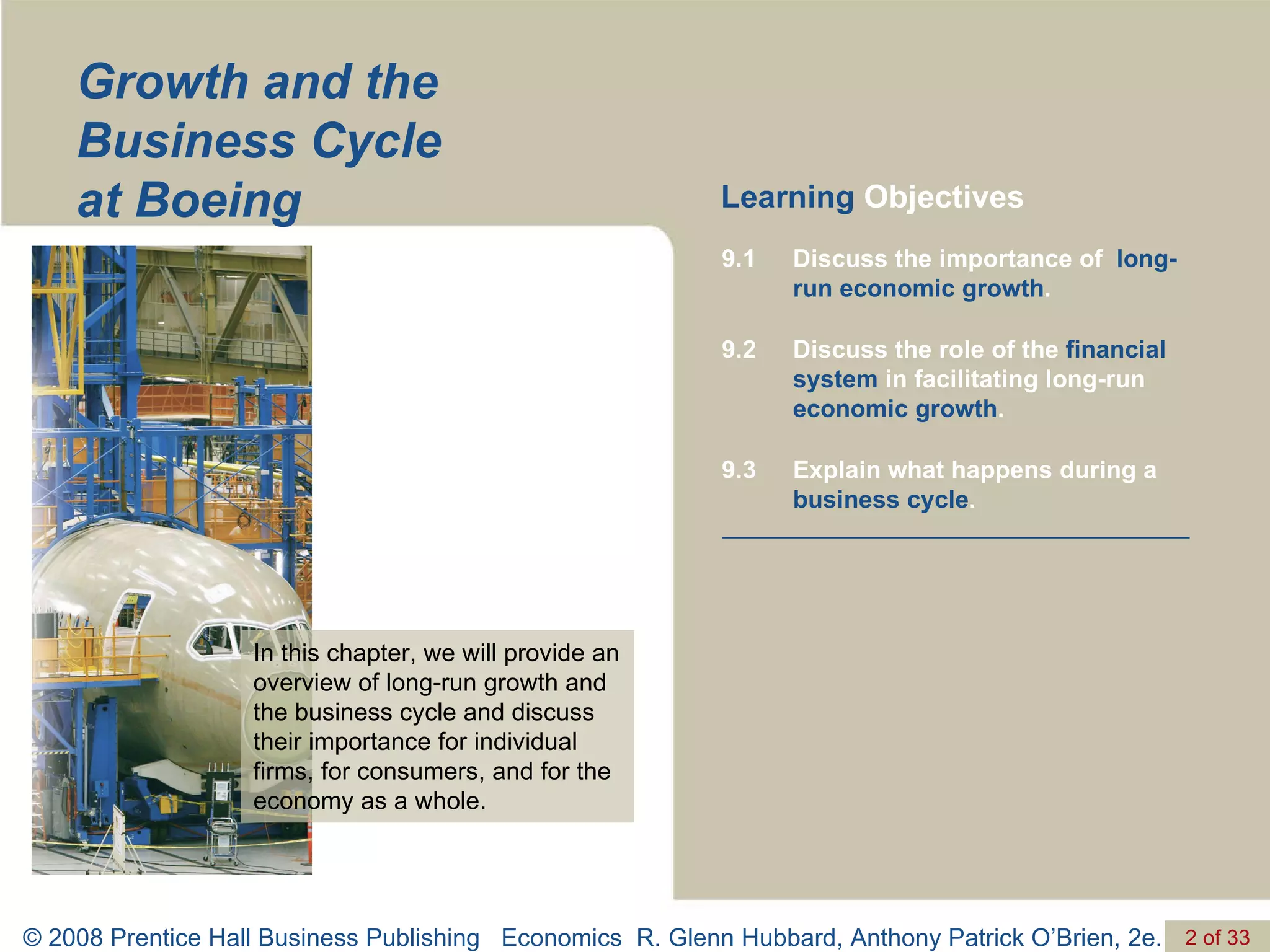
Growth and the Business Cycle  at Boeing Learning  Objectives In this chapter, we will provide an overview of long-run growth and the business cycle and discuss their importance for individual firms, for consumers, and for the economy as a whole. Explain what happens during a  business cycle . 9.3 Discuss the role of the  financial system  in facilitating long-run  economic growth . 9.2 Discuss the importance of  long-run economic growth . 9.1
Economic Growth, the Financial System,  and Business Cycles Business cycle  Alternating periods of economic expansion and economic recession.
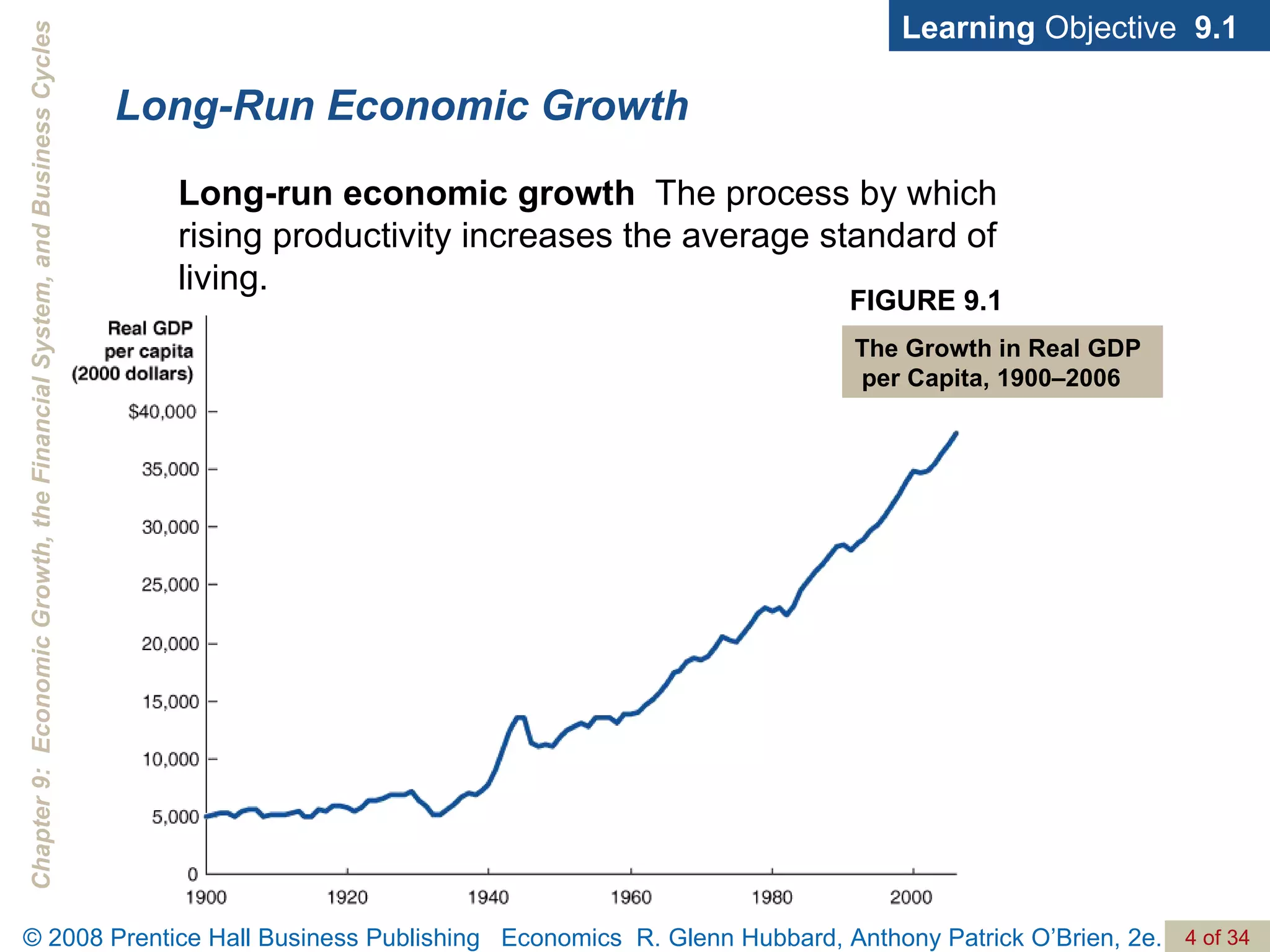
Long-Run Economic Growth Learning  Objective  9.1 Long-run economic growth   The process by which rising productivity increases the average standard of living. FIGURE 9.1 The Growth in Real GDP  per Capita, 1900–2006
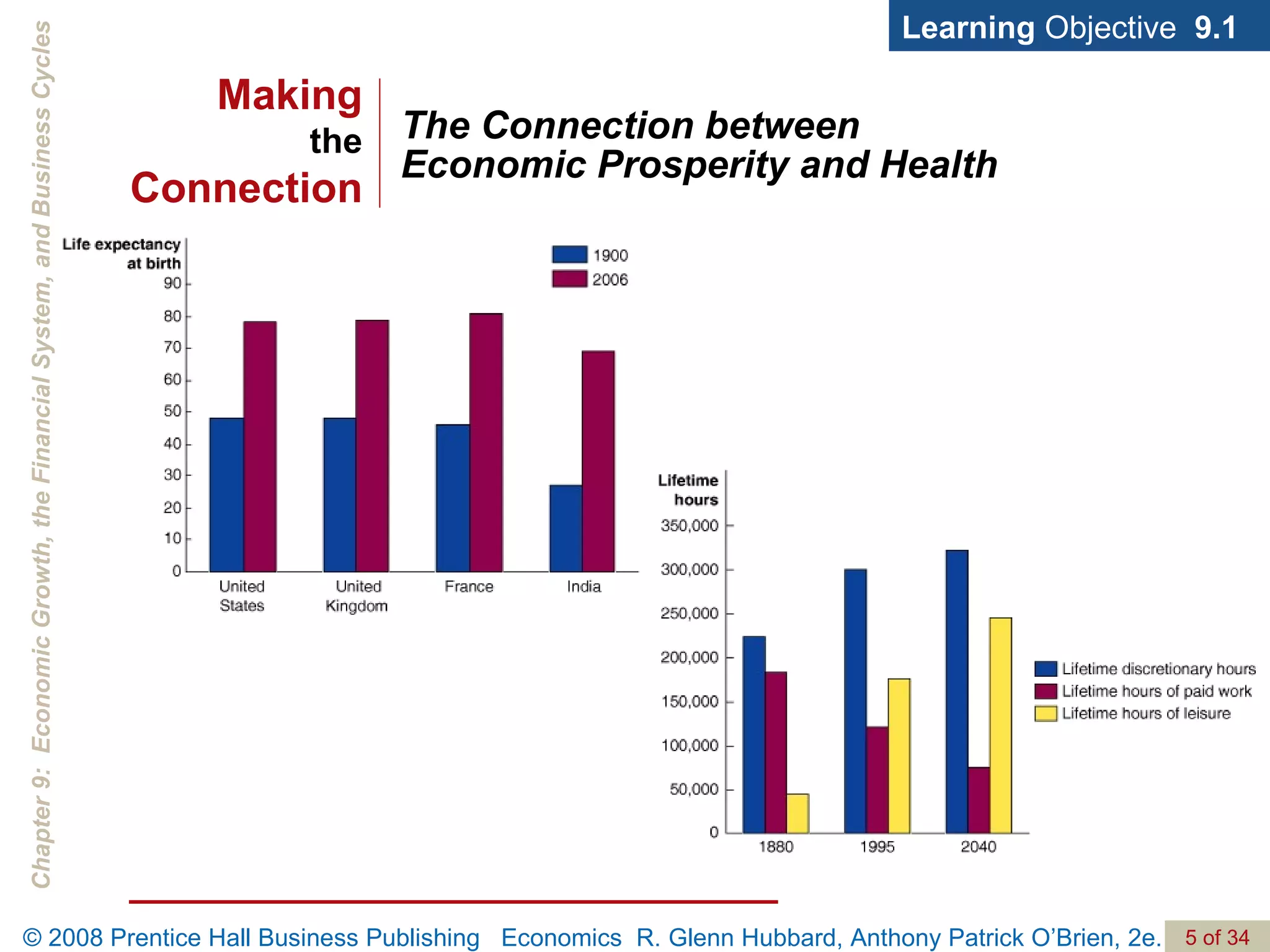
The Connection between  Economic Prosperity and Health Learning  Objective  9.1 Making the Connection
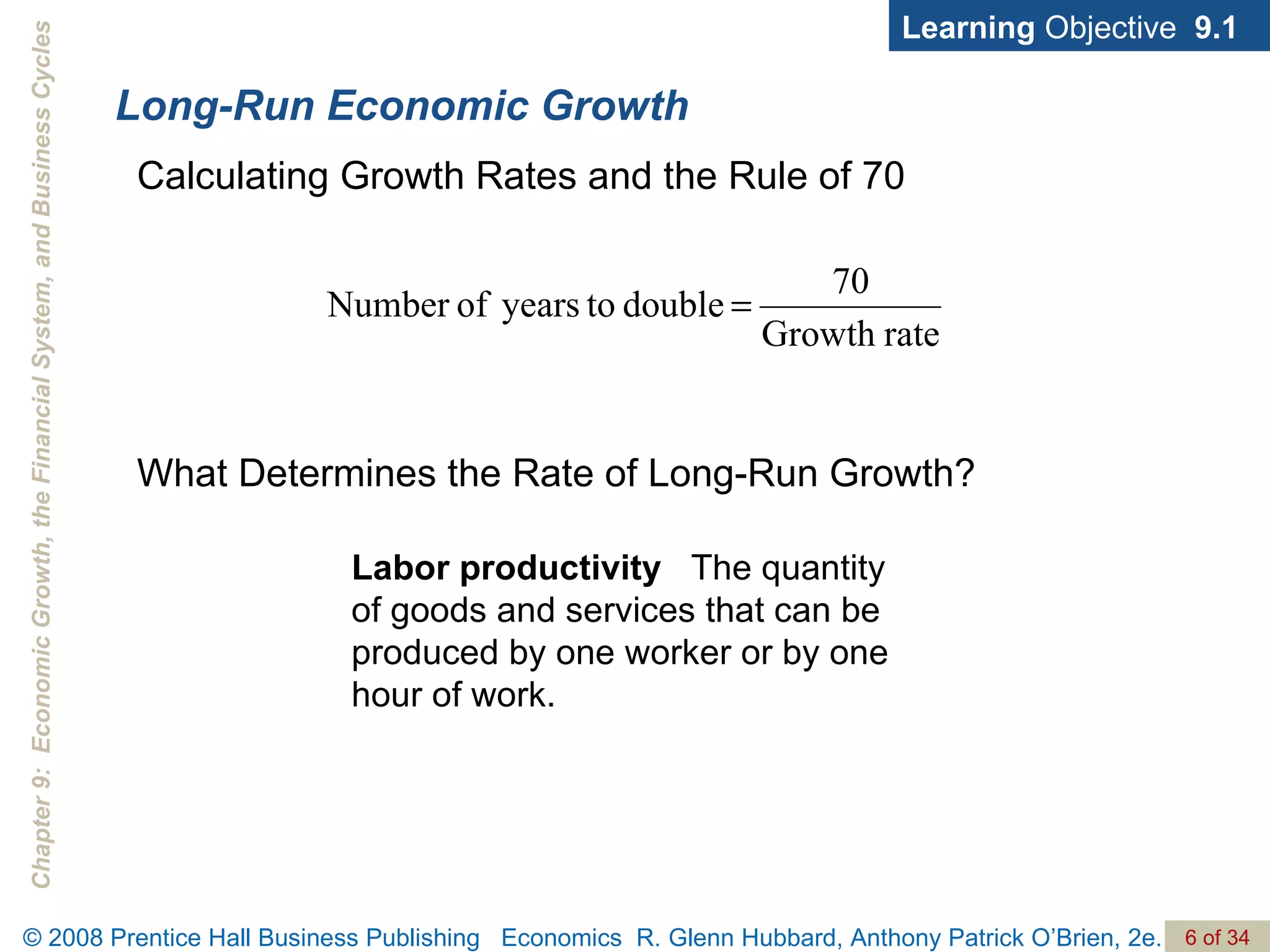
Long-Run Economic Growth Learning  Objective  9.1 Calculating Growth Rates and the Rule of 70 What Determines the Rate of Long-Run Growth? Labor productivity   The quantity of goods and services that can be produced by one worker or by one hour of work.
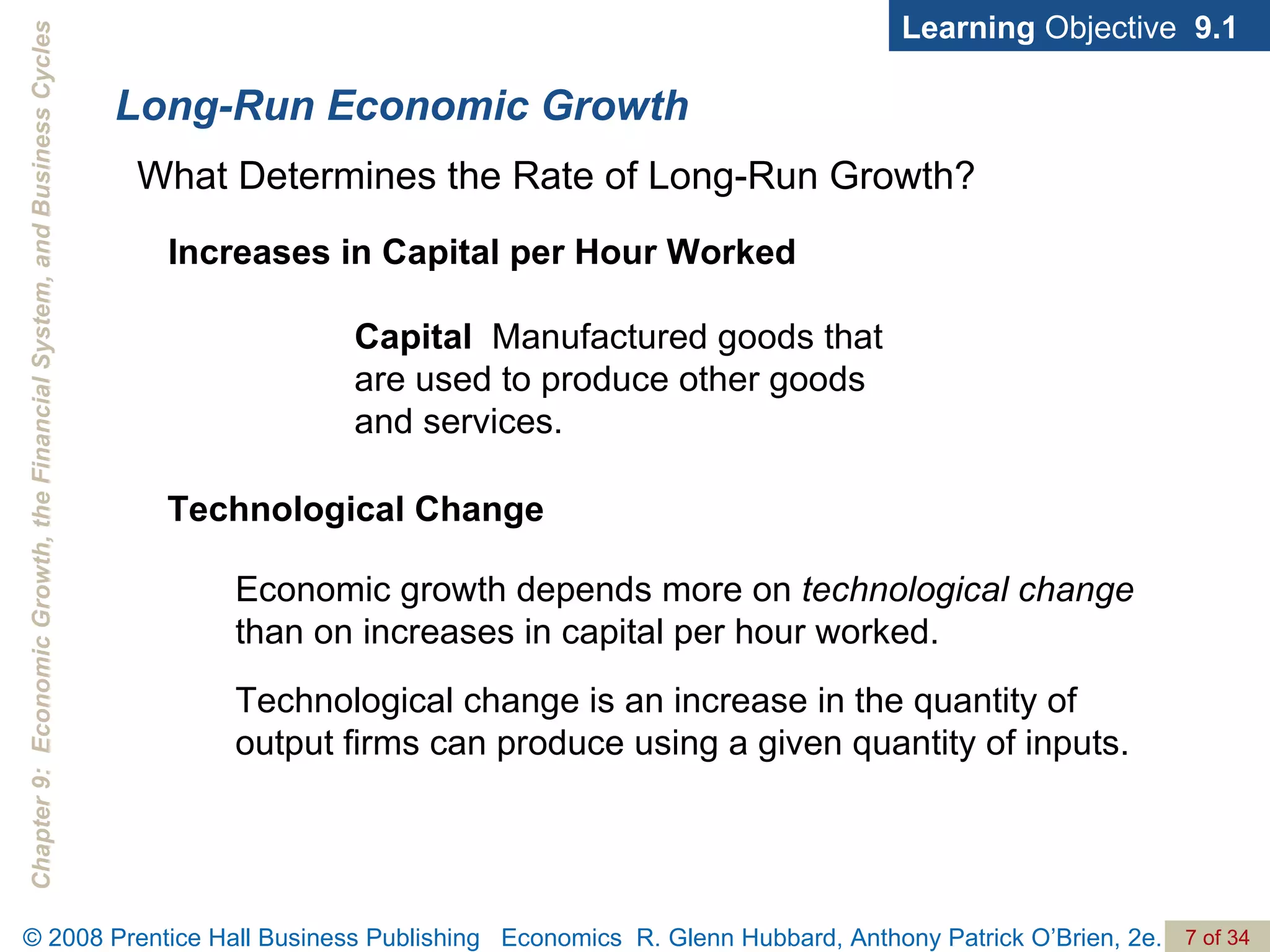
Long-Run Economic Growth Learning  Objective  9.1 What Determines the Rate of Long-Run Growth? Capital   Manufactured goods that are used to produce other goods and services. Increases in Capital per Hour Worked Technological Change Economic growth depends more on  technological change  than on increases in capital per hour worked.  Technological change is an increase in the quantity of output firms can produce using a given quantity of inputs.
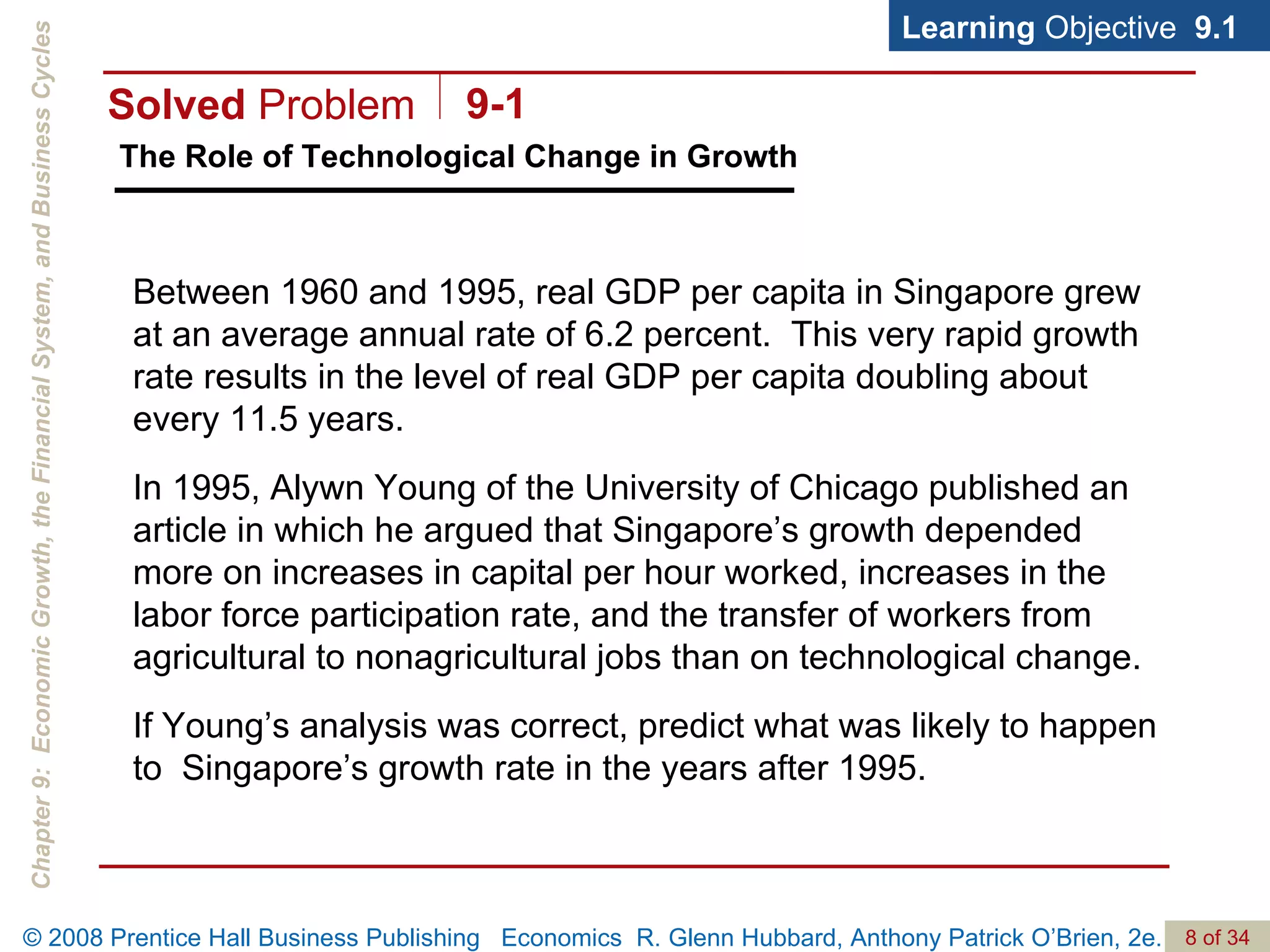
The Role of Technological Change in Growth Learning  Objective  9.1 Between 1960 and 1995, real GDP per capita in Singapore grew at an average annual rate of 6.2 percent.  This very rapid growth rate results in the level of real GDP per capita doubling about every 11.5 years. In 1995, Alywn Young of the University of Chicago published an article in which he argued that Singapore’s growth depended more on increases in capital per hour worked, increases in the labor force participation rate, and the transfer of workers from agricultural to nonagricultural jobs than on technological change. If Young’s analysis was correct, predict what was likely to happen to  Singapore’s growth rate in the years after 1995. Solved  Problem 9-1
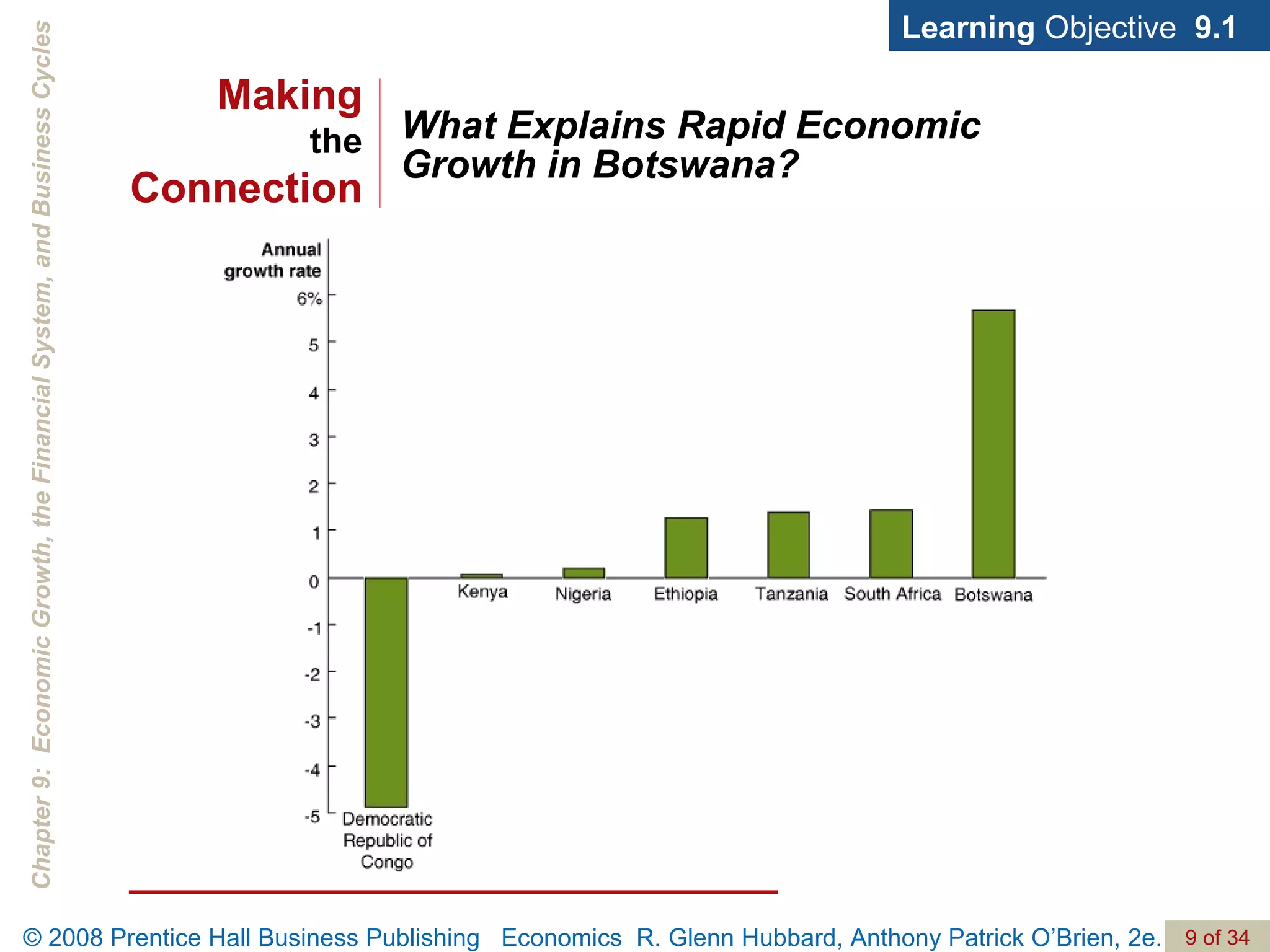
What Explains Rapid Economic Growth in Botswana? Learning  Objective  9.1 Making the Connection
Long-Run Economic Growth Learning  Objective  9.1 Potential Real GDP Potential GDP   The level of GDP attained when all firms are producing at capacity.
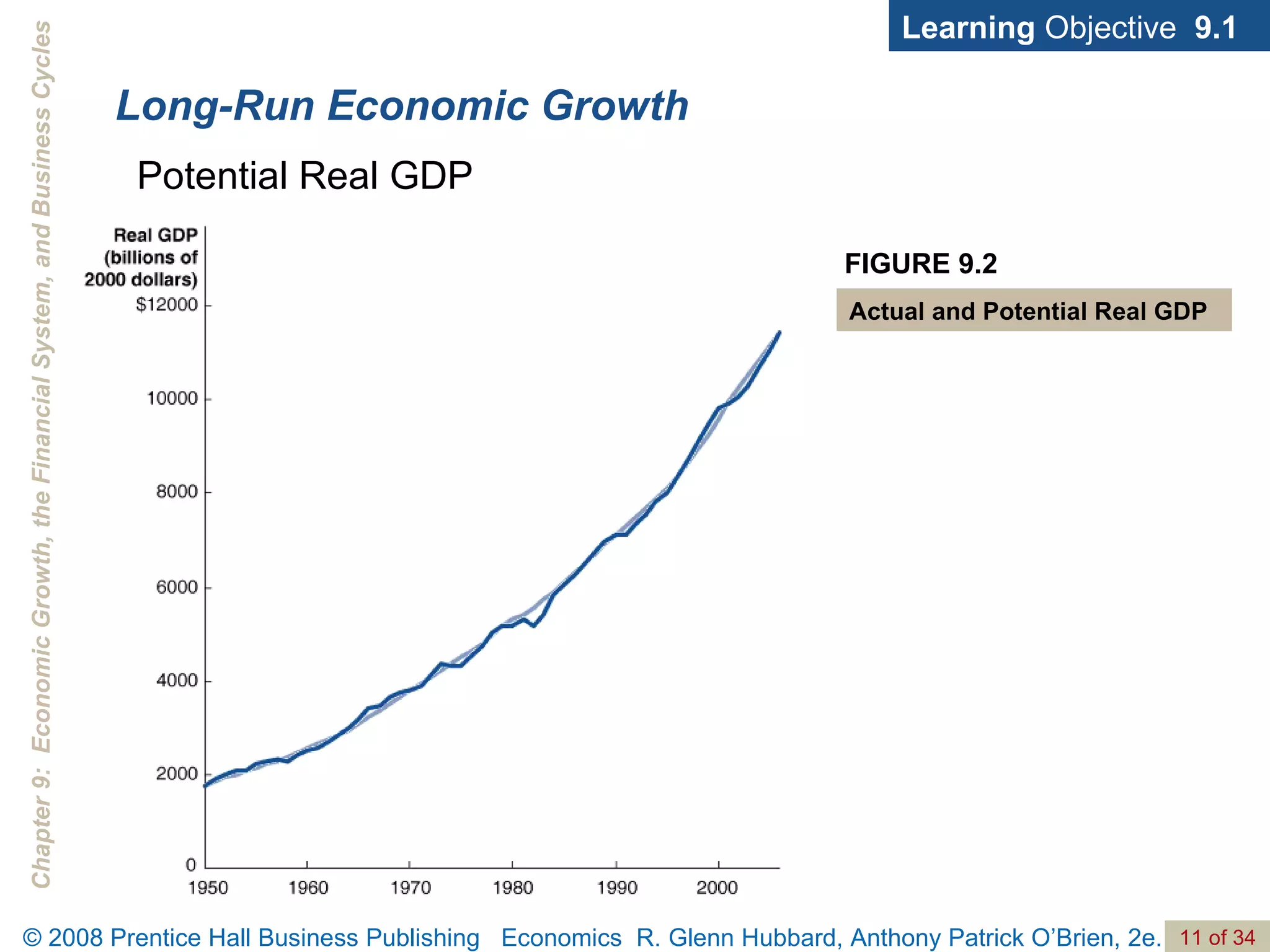
Long-Run Economic Growth Learning  Objective  9.1 Potential Real GDP FIGURE 9.2 Actual and Potential Real GDP
Saving, Investment, and the Financial System Learning  Objective  9.2 An Overview of the Financial System Financial markets  Markets where financial securities, such as stocks and bonds, are bought and sold. Financial intermediaries  Firms, such as banks, mutual funds, pension funds, and insurance companies, that borrow funds from savers and lend them to borrowers. Financial system  The system of financial markets and financial intermediaries through which firms acquire funds from households.
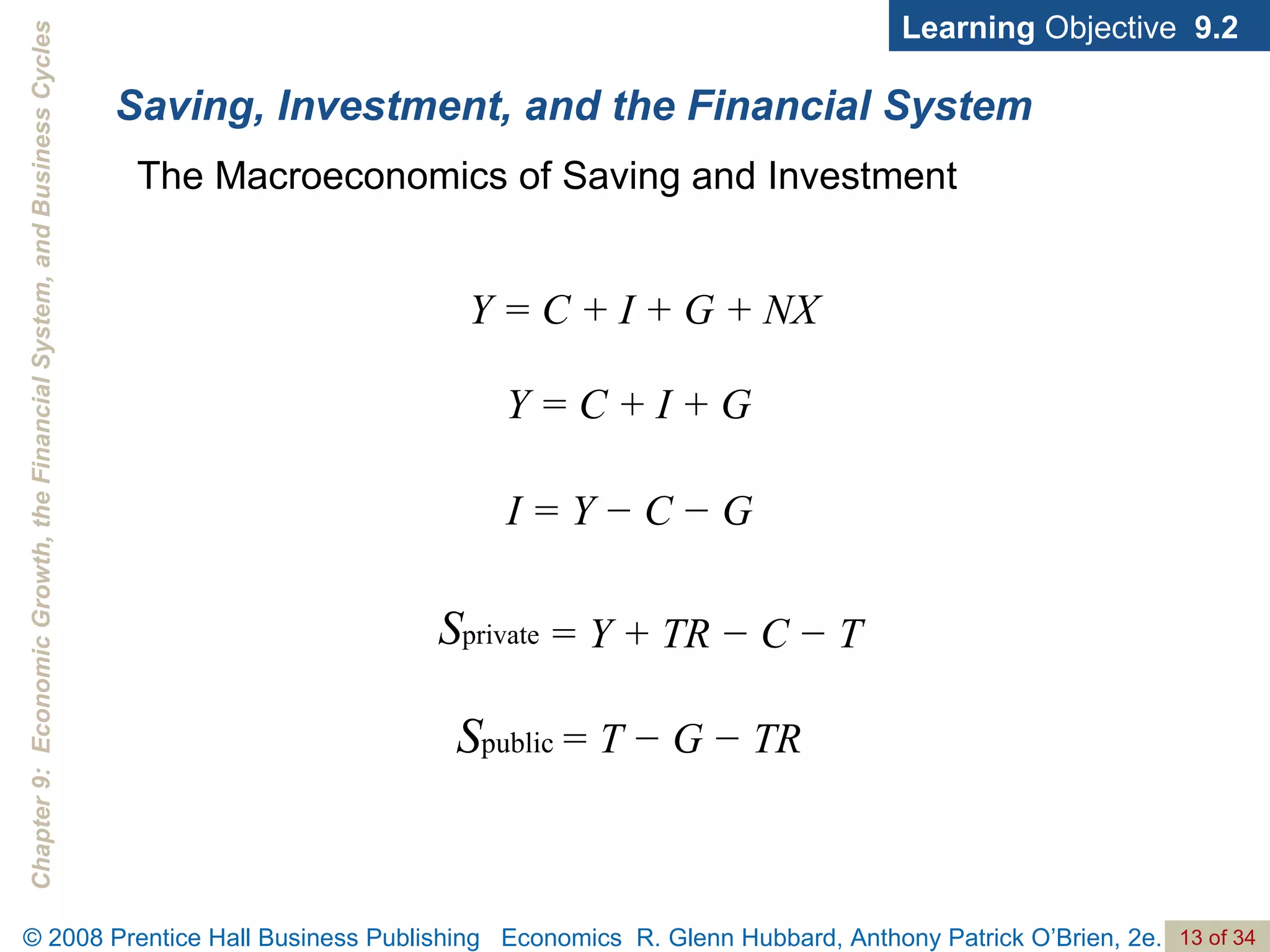
Saving, Investment, and the Financial System Learning  Objective  9.2 The Macroeconomics of Saving and Investment Y = C + I + G + NX Y = C + I + G I = Y − C − G = Y + TR − C − T = T − G − TR
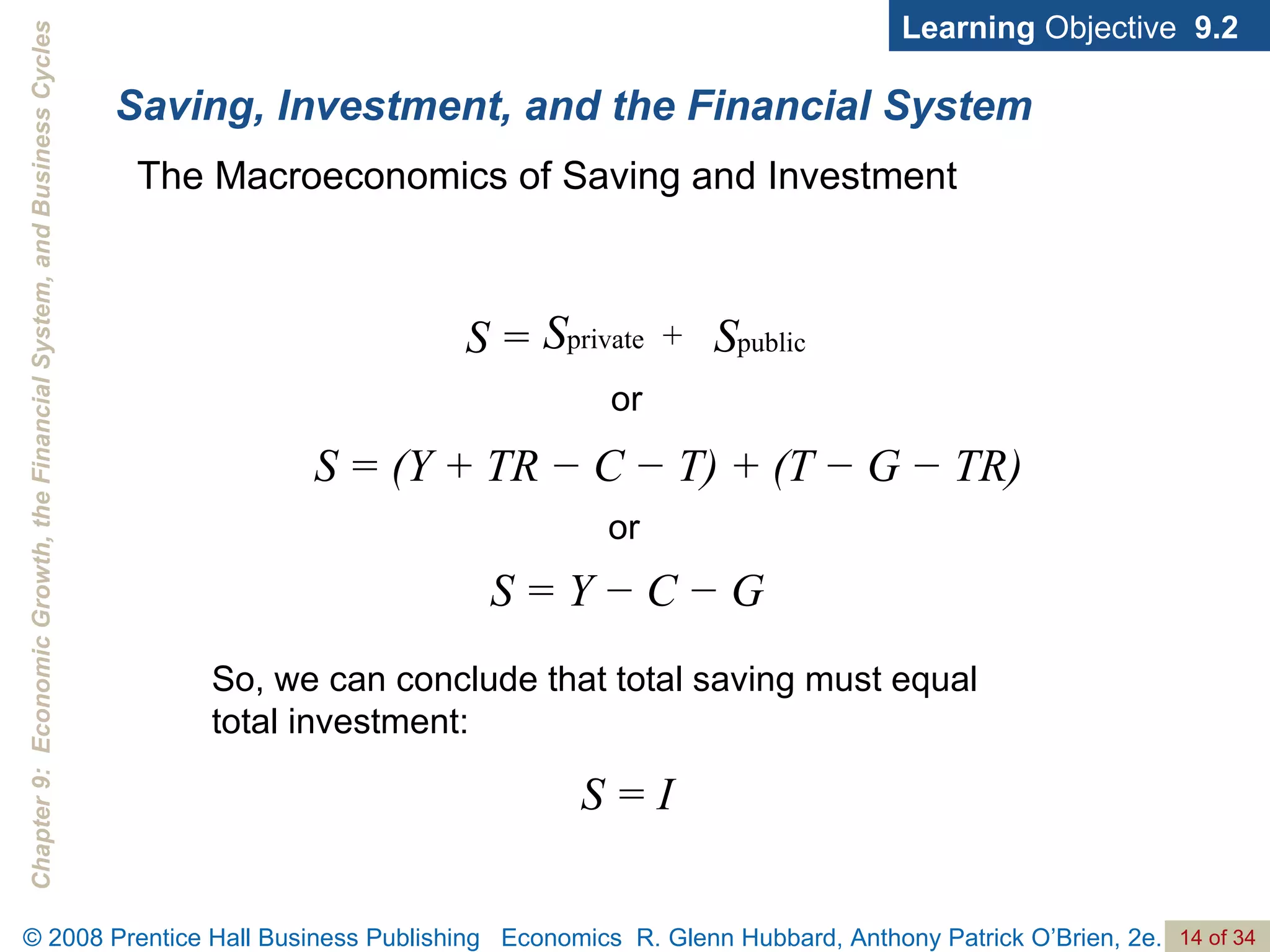
Saving, Investment, and the Financial System Learning  Objective  9.2 S = (Y + TR − C − T) + (T − G − TR) S = Y − C − G S = I or or So, we can conclude that total saving must equal total investment: The Macroeconomics of Saving and Investment S = +
Saving, Investment, and the Financial System Learning  Objective  9.2 The Market for Loanable Funds Market for loanable funds   The interaction of borrowers and lenders that determines the market interest rate and the quantity of loanable funds exchanged.
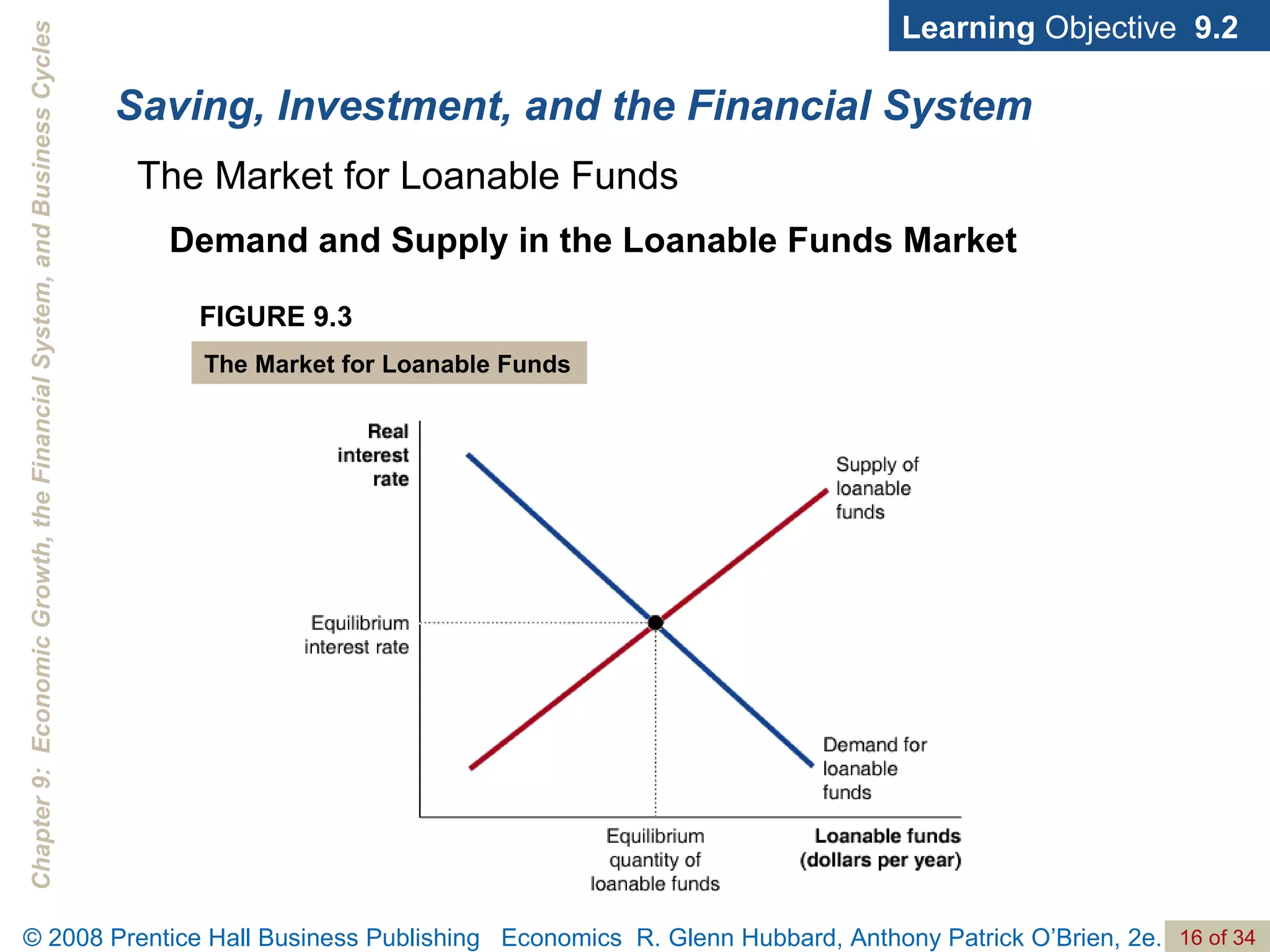
Saving, Investment, and the Financial System Learning  Objective  9.2 Demand and Supply in the Loanable Funds Market FIGURE 9.3 The Market for Loanable Funds The Market for Loanable Funds
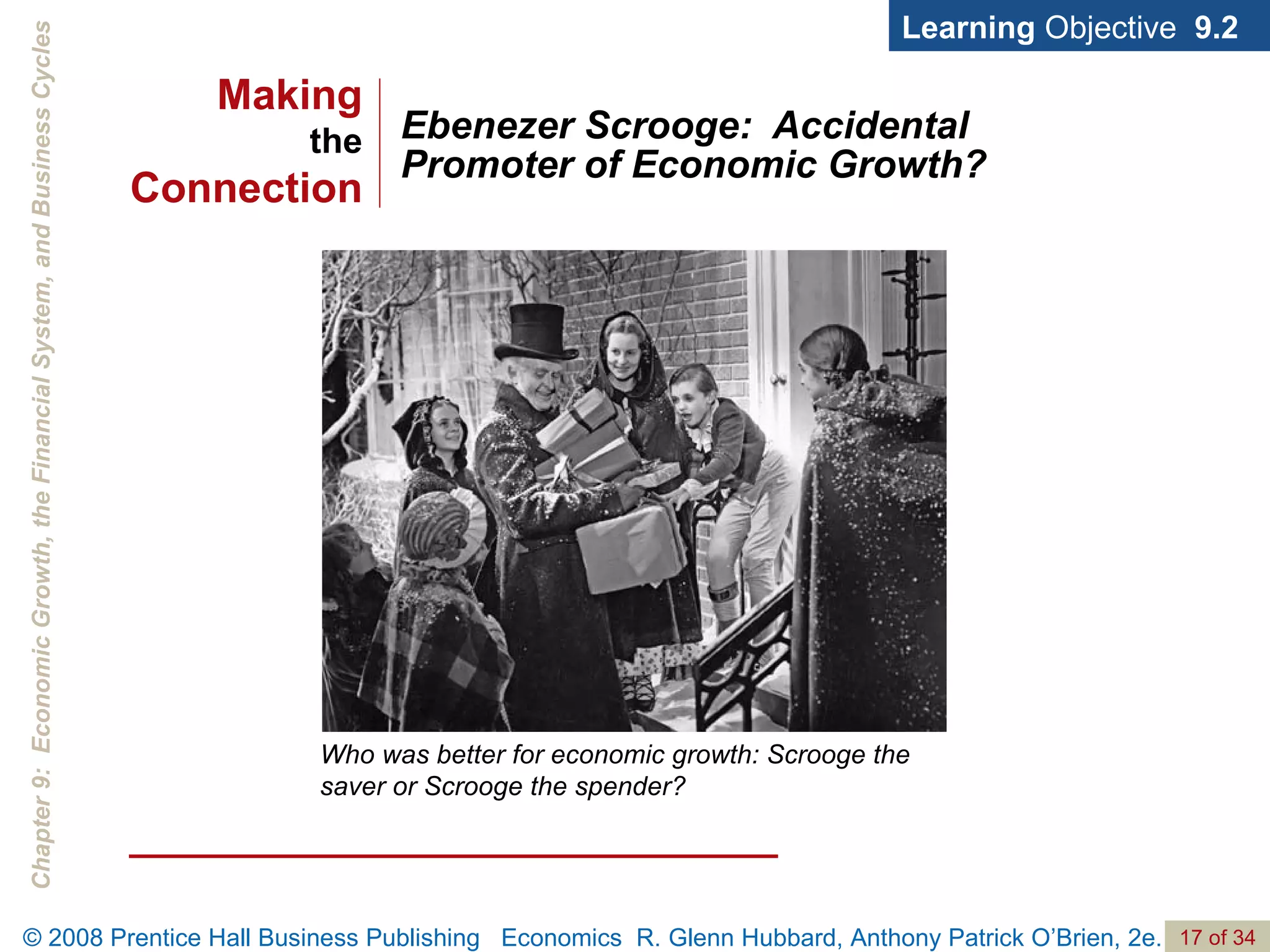
Ebenezer Scrooge:  Accidental Promoter of Economic Growth? Learning  Objective  9.2 Who was better for economic growth: Scrooge the  saver or Scrooge the spender? Making the Connection
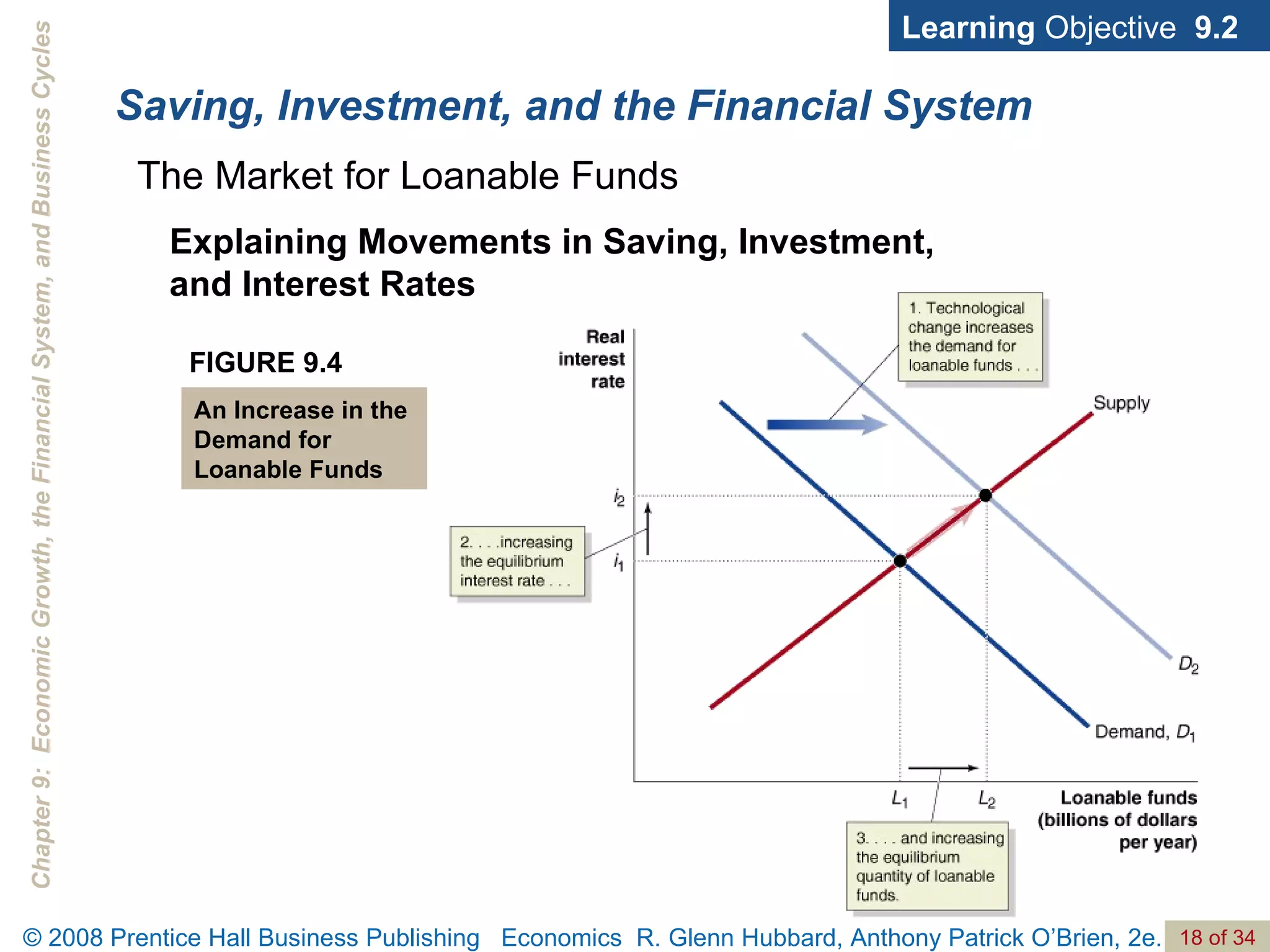
Saving, Investment, and the Financial System Learning  Objective  9.2 Explaining Movements in Saving, Investment,  and Interest Rates FIGURE 9.4 An Increase in the  Demand for Loanable Funds The Market for Loanable Funds
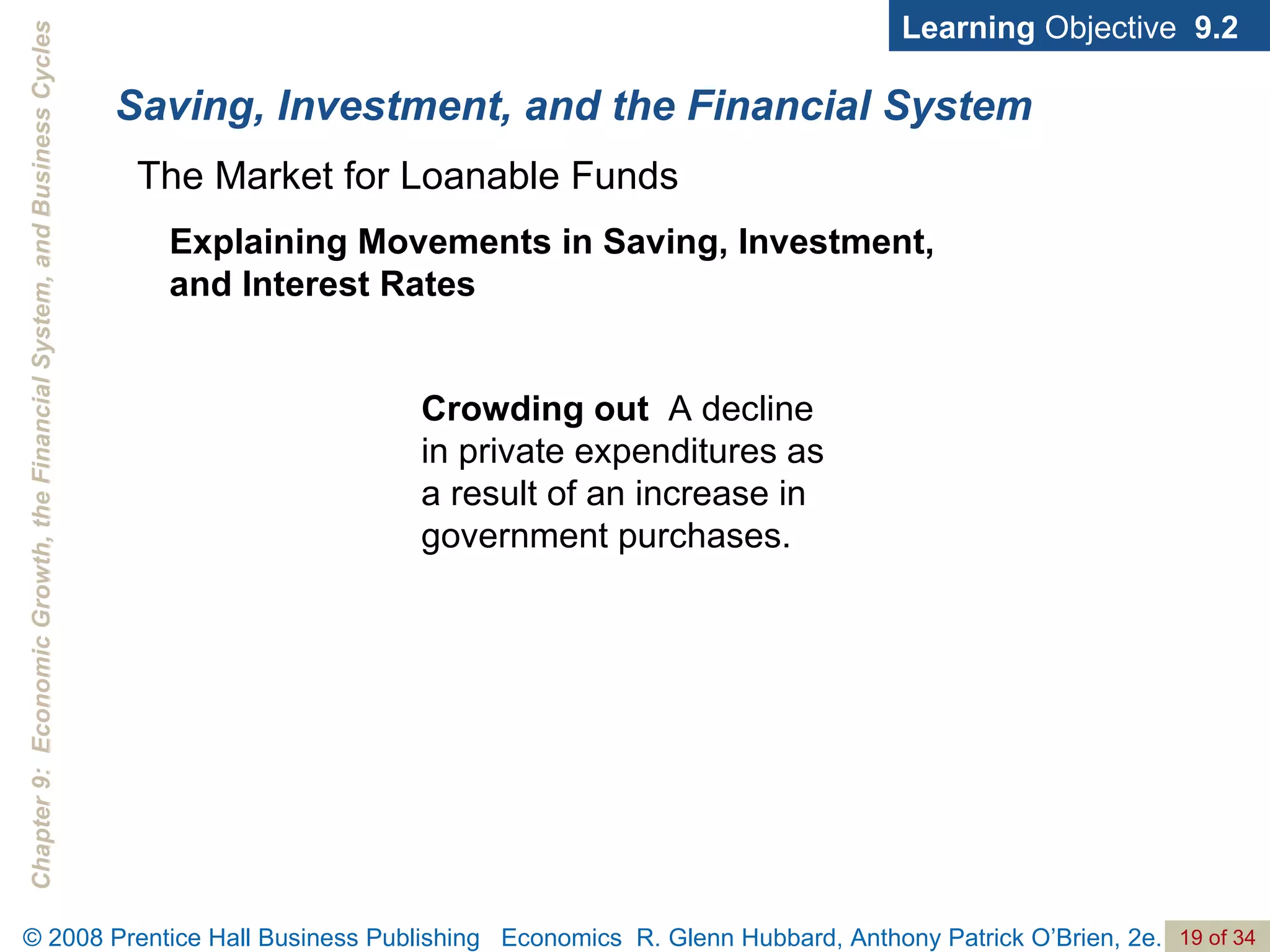
Saving, Investment, and the Financial System Learning  Objective  9.2 Crowding out   A decline in private expenditures as a result of an increase in government purchases. Explaining Movements in Saving, Investment,  and Interest Rates The Market for Loanable Funds
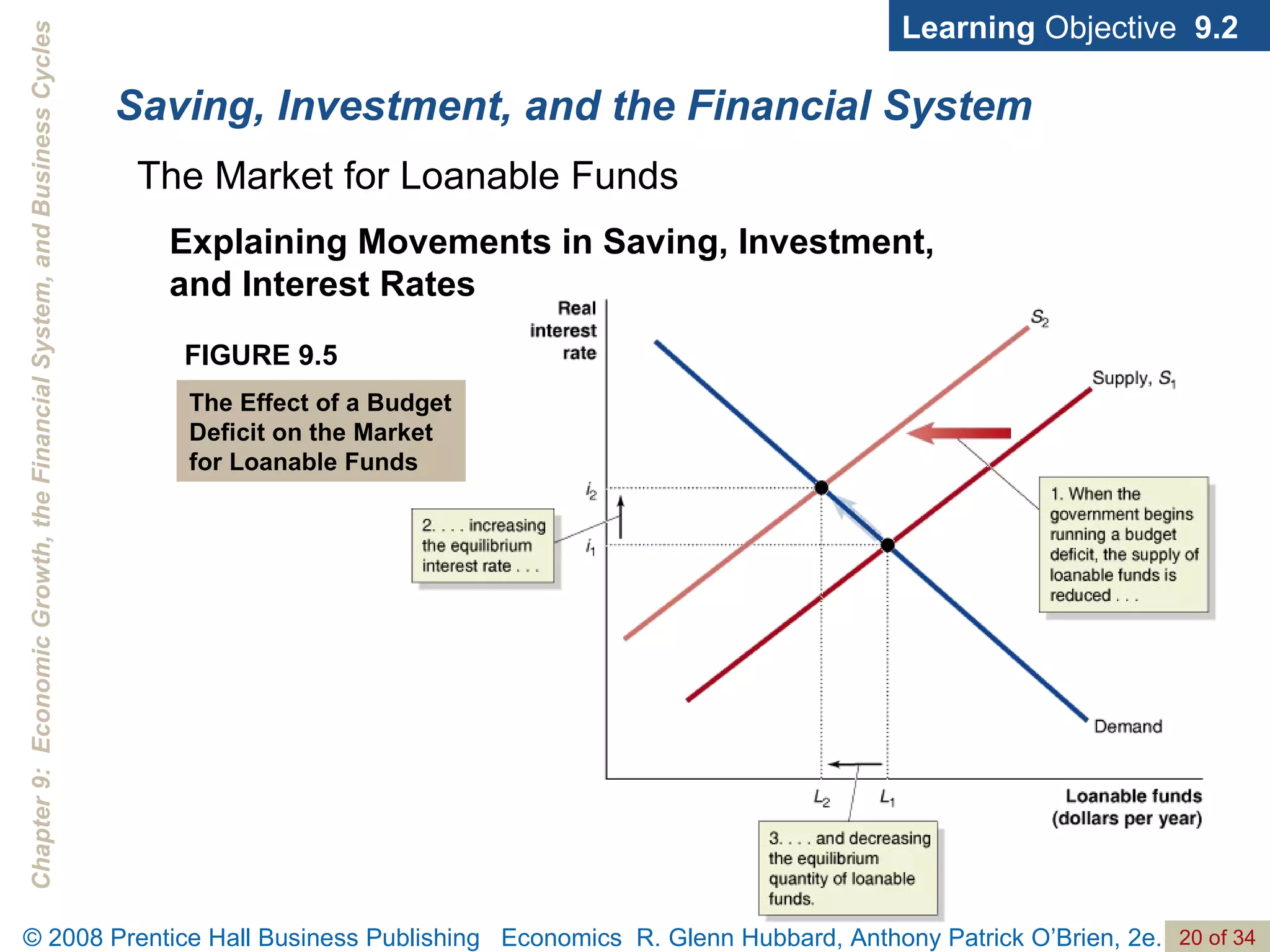
Saving, Investment, and the Financial System Learning  Objective  9.2 Explaining Movements in Saving, Investment,  and Interest Rates FIGURE 9.5 The Effect of a Budget Deficit on the Market for Loanable Funds The Market for Loanable Funds
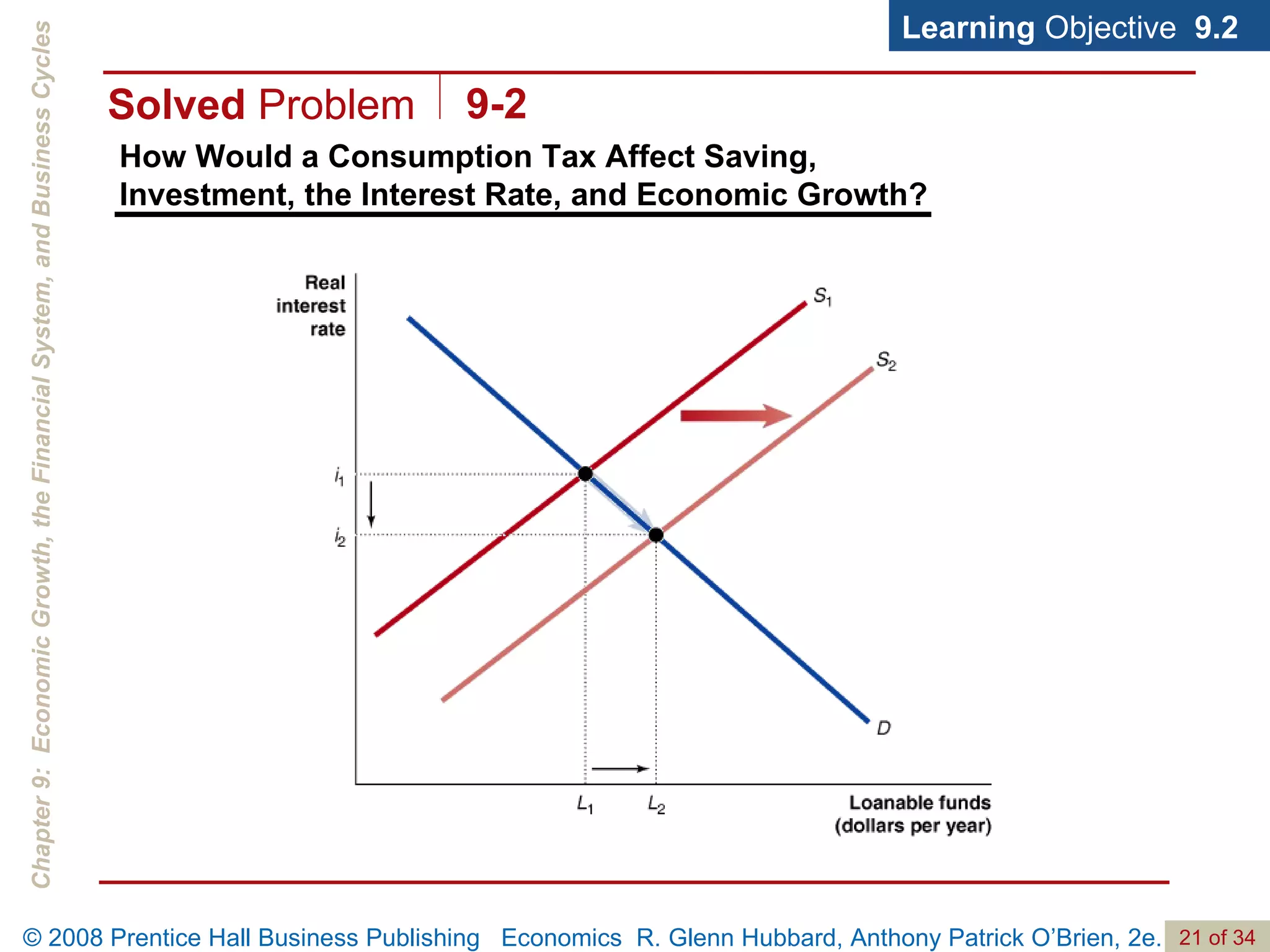
How Would a Consumption Tax Affect Saving,  Investment, the Interest Rate, and Economic Growth? Learning  Objective  9.2 Solved  Problem 9-2
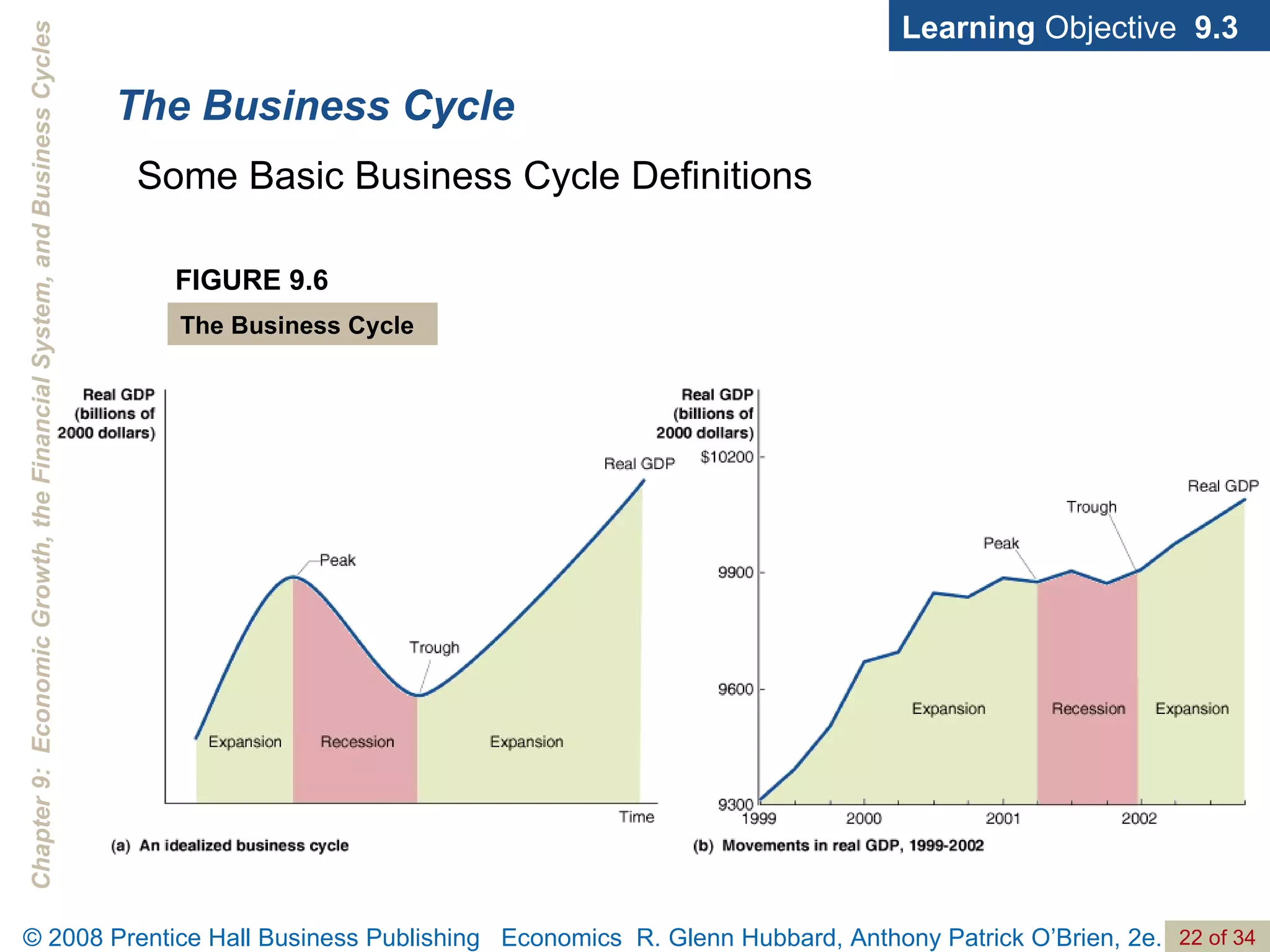
The Business Cycle Learning  Objective  9.3 FIGURE 9.6 The Business Cycle Some Basic Business Cycle Definitions
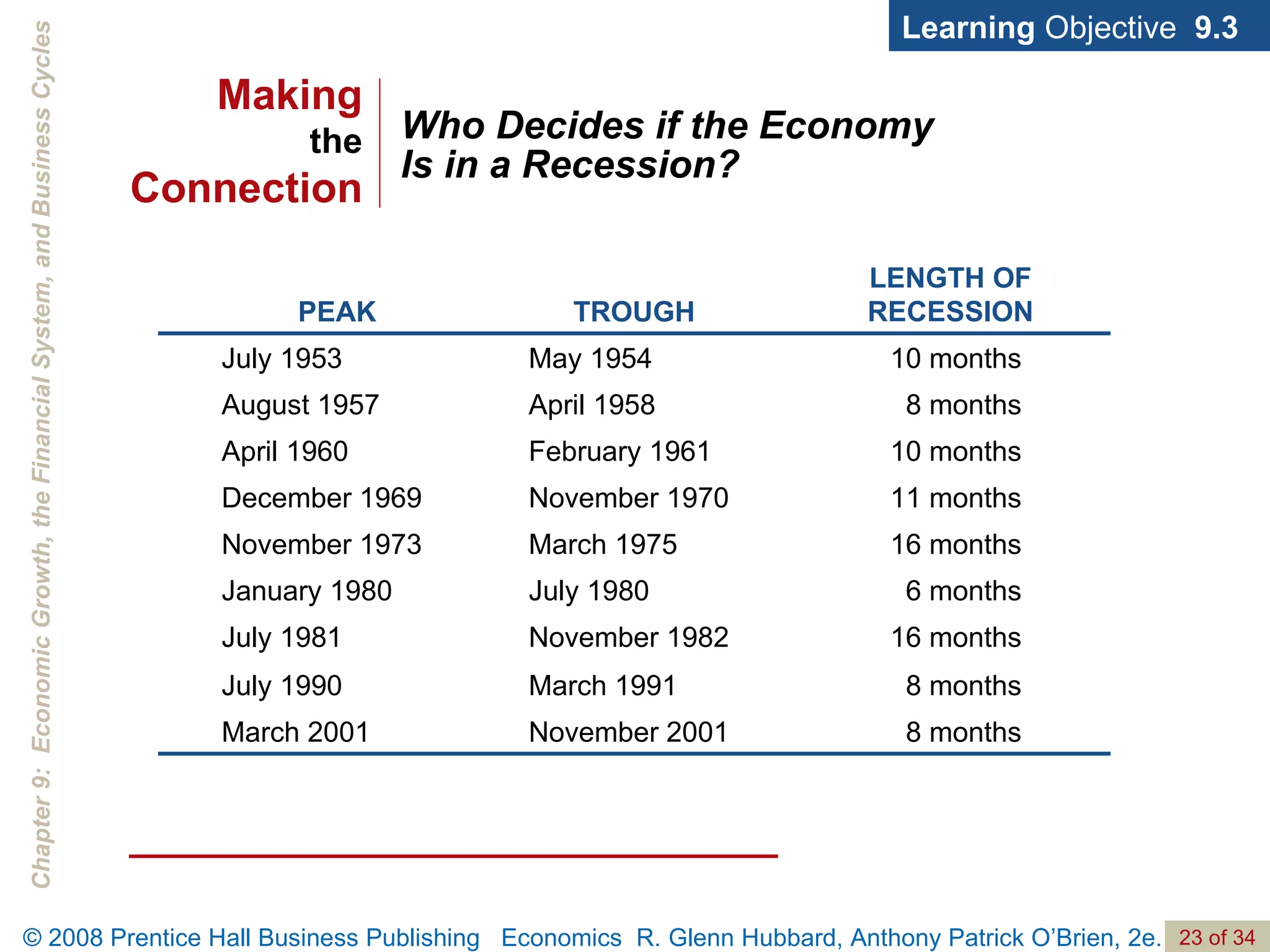
Who Decides if the Economy  Is in a Recession? Learning  Objective  9.3 Making the Connection 16 months March 1975 November 1973 8 months March 1991 July 1990 16 months November 1982 July 1981 8 months November 2001 March 2001 6 months July 1980 January 1980 11 months November 1970 December 1969 10 months February 1961 April 1960 8 months April 1958 August 1957 10 months May 1954 July 1953 LENGTH OF RECESSION TROUGH PEAK
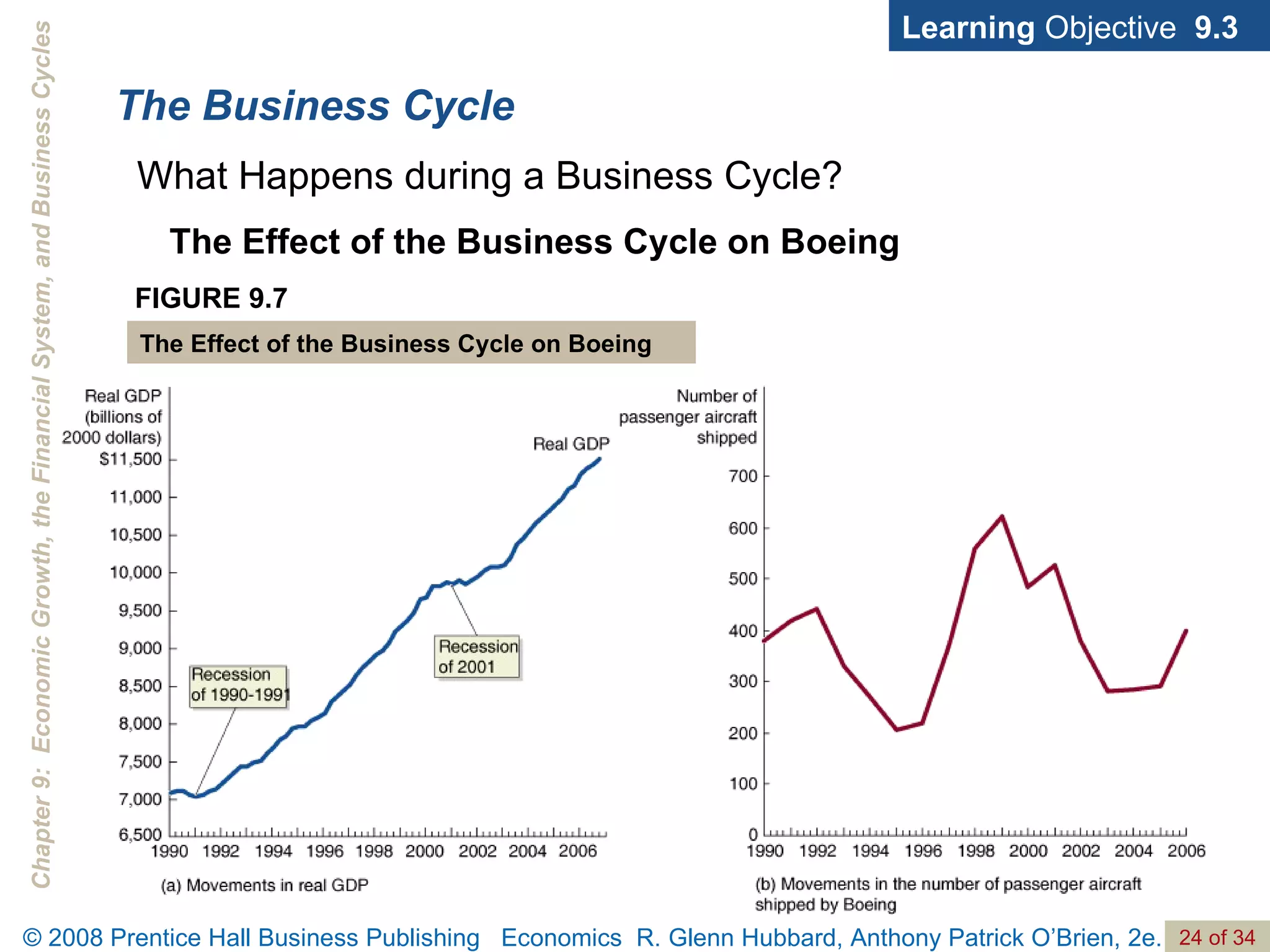
The Business Cycle Learning  Objective  9.3 FIGURE 9.7 The Effect of the Business Cycle on Boeing What Happens during a Business Cycle? The Effect of the Business Cycle on Boeing
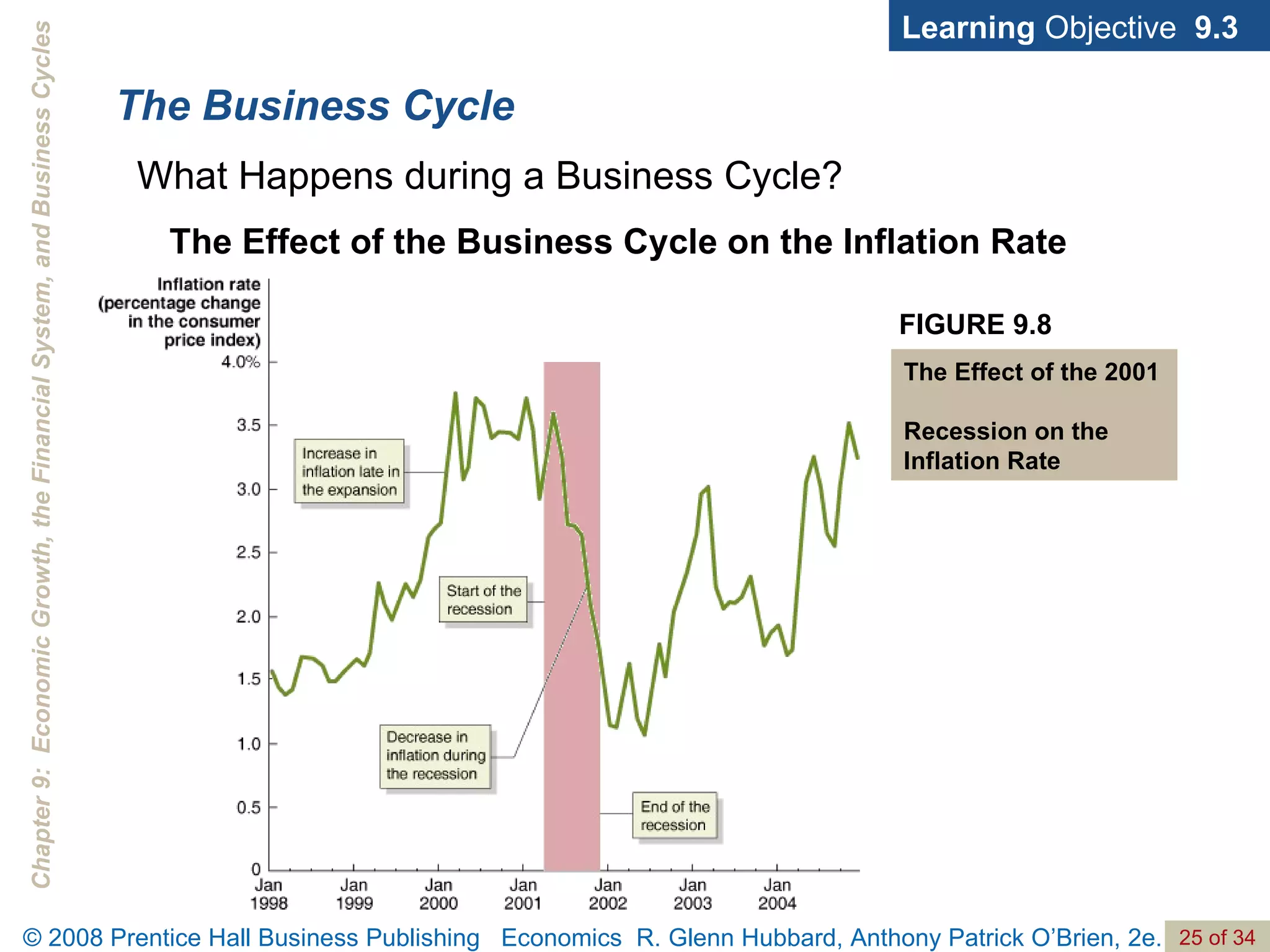
The Business Cycle Learning  Objective  9.3 FIGURE 9.8 The Effect of the 2001  Recession on the Inflation Rate The Effect of the Business Cycle on the Inflation Rate What Happens during a Business Cycle?
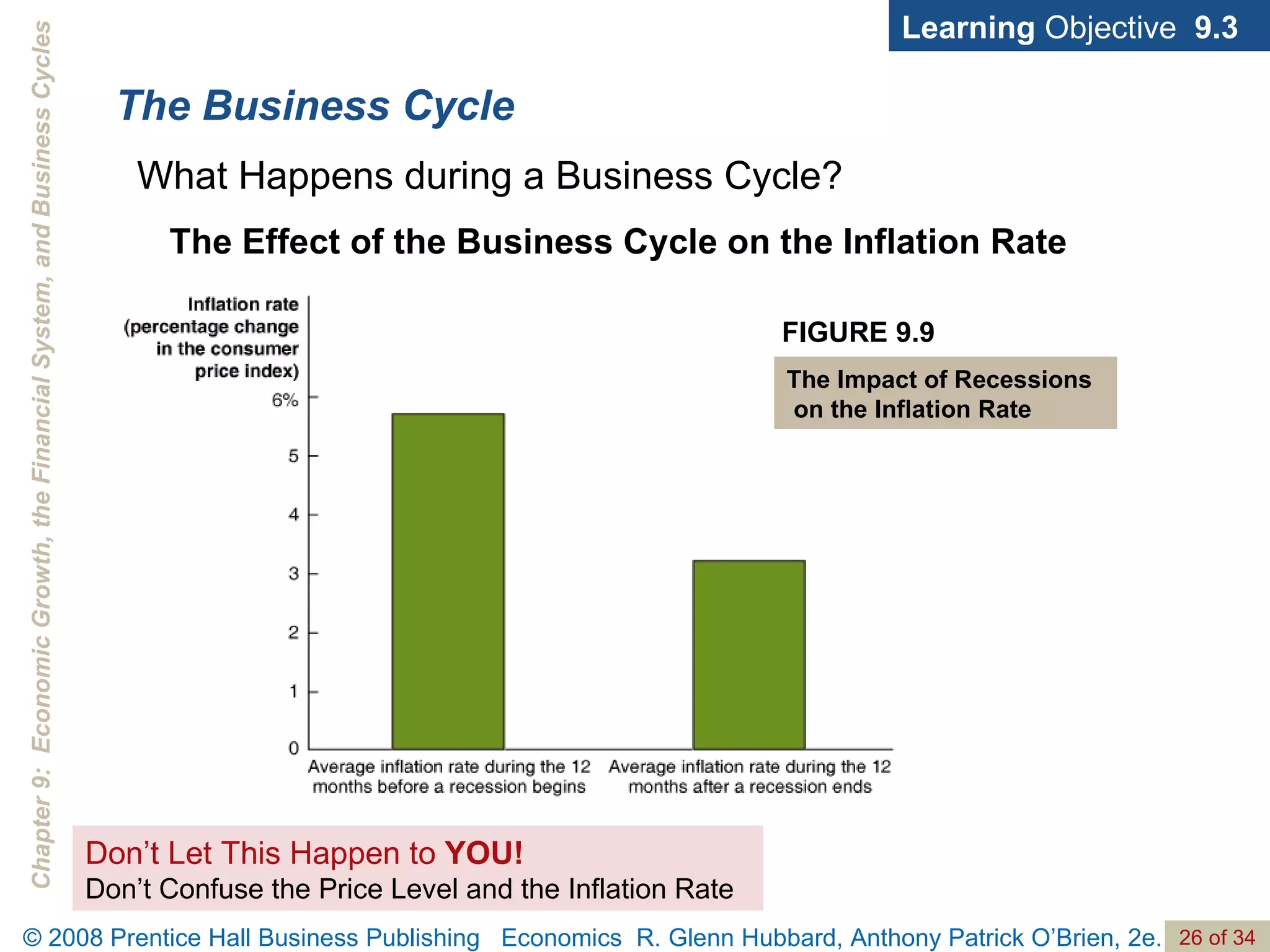
The Business Cycle Learning  Objective  9.3 FIGURE 9.9 The Impact of Recessions  on the Inflation Rate The Effect of the Business Cycle on the Inflation Rate Don’t Let This Happen to  YOU! Don’t Confuse the Price Level and the Inflation Rate What Happens during a Business Cycle?
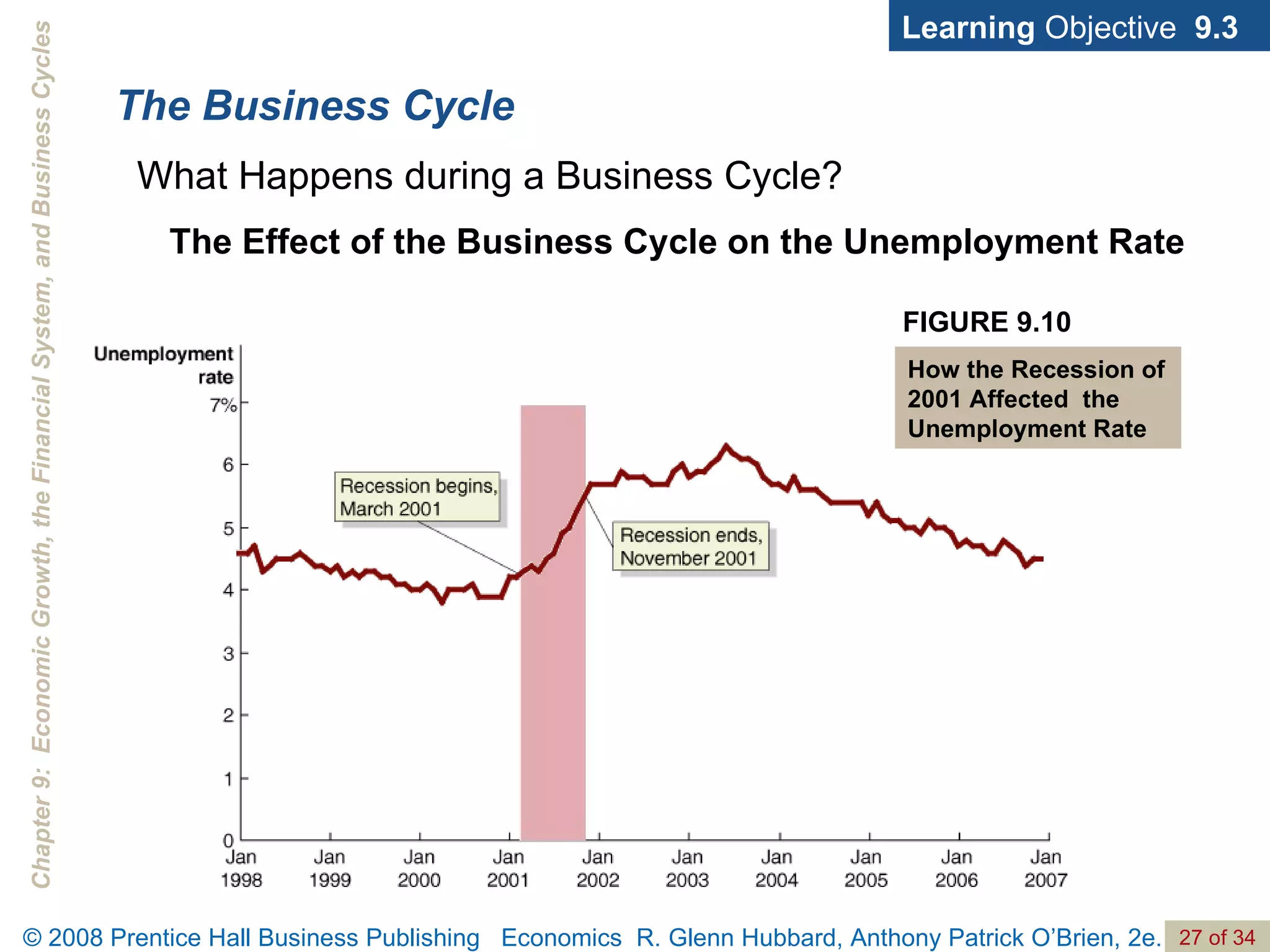
The Business Cycle Learning  Objective  9.3 FIGURE 9.10 How the Recession of 2001 Affected  the Unemployment Rate The Effect of the Business Cycle on the Unemployment Rate What Happens during a Business Cycle?
The Business Cycle Learning  Objective  9.3 FIGURE 9.11 The Impact of Recessions  on the Unemployment Rate The Effect of the Business Cycle on the Unemployment Rate What Happens during a Business Cycle?
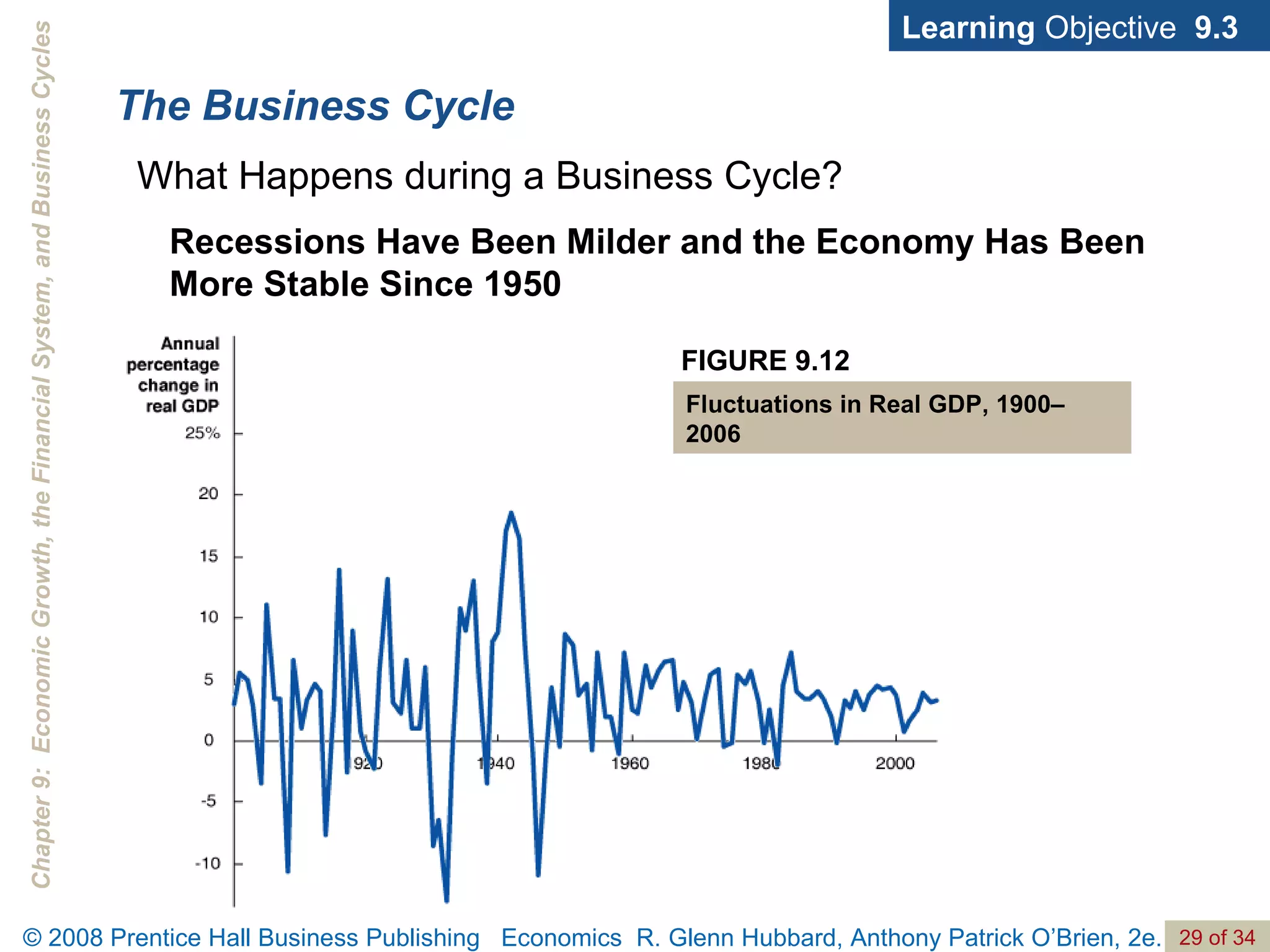
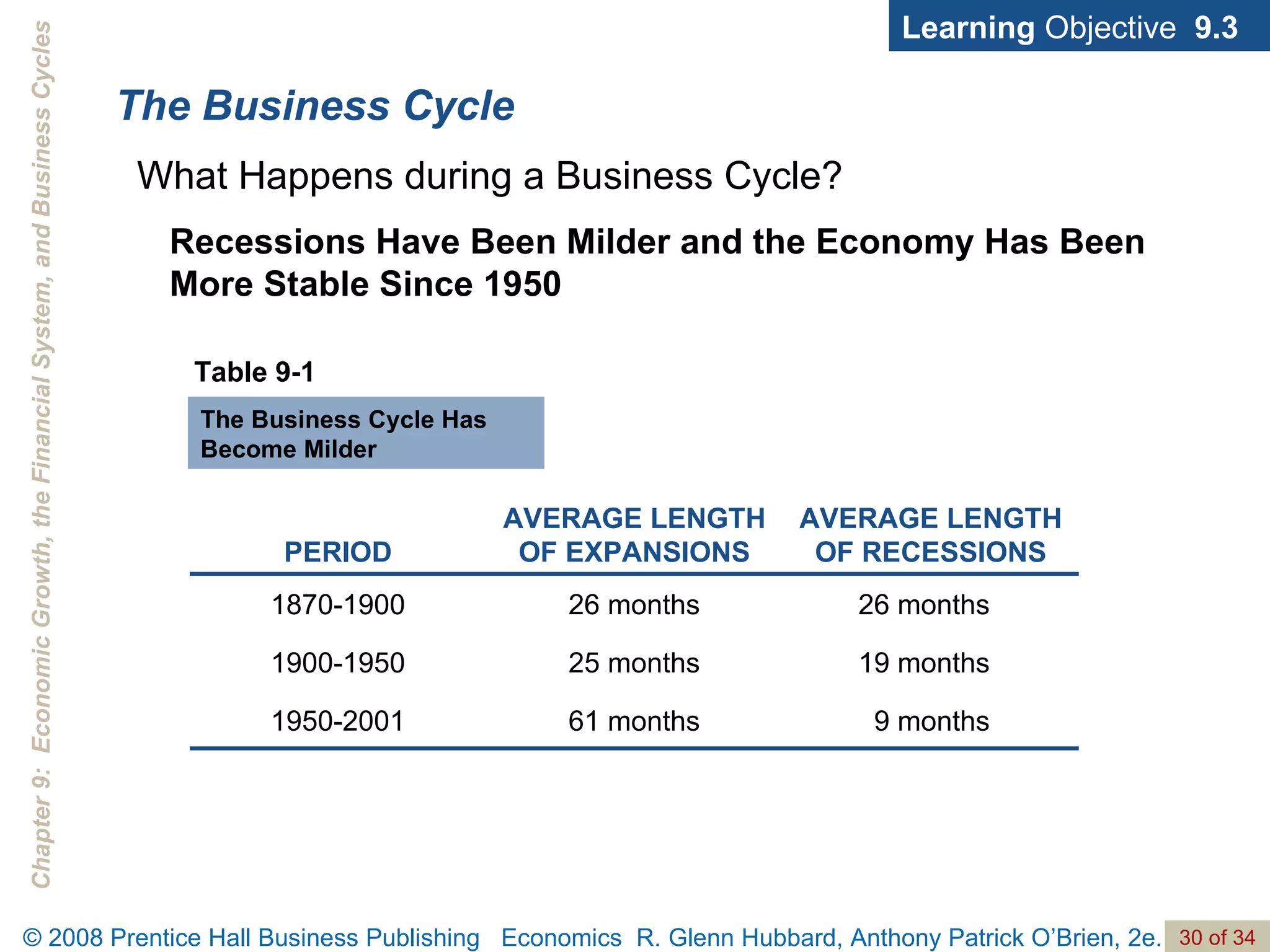
The Business Cycle Learning  Objective  9.3 FIGURE 9.12 Fluctuations in Real GDP, 1900–2006 Recessions Have Been Milder and the Economy Has Been More Stable Since 1950 What Happens during a Business Cycle?
The Business Cycle Learning  Objective  9.3 Recessions Have Been Milder and the Economy Has Been More Stable Since 1950 Table 9-1 The Business Cycle Has Become Milder What Happens during a Business Cycle? 9 months 61 months 1950-2001 19 months 25 months 1900-1950 26 months 26 months 1870-1900 AVERAGE LENGTH OF RECESSIONS AVERAGE LENGTH OF EXPANSIONS PERIOD
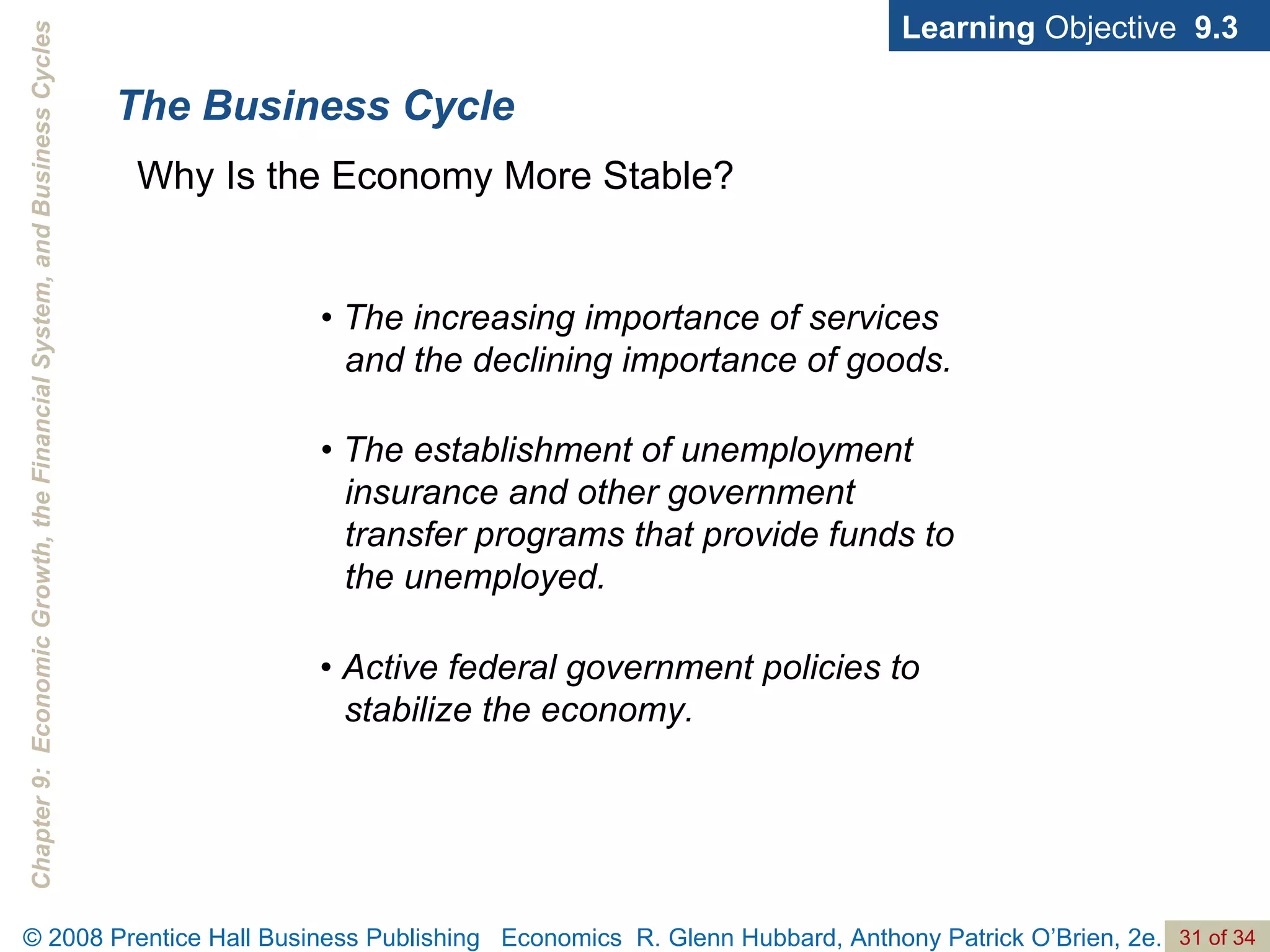
The Business Cycle Learning  Objective  9.3 •  The increasing importance of services  and the declining importance of goods. •  The establishment of unemployment insurance and other government transfer programs that provide funds to the unemployed. •  Active federal government policies to stabilize the economy. Why Is the Economy More Stable?
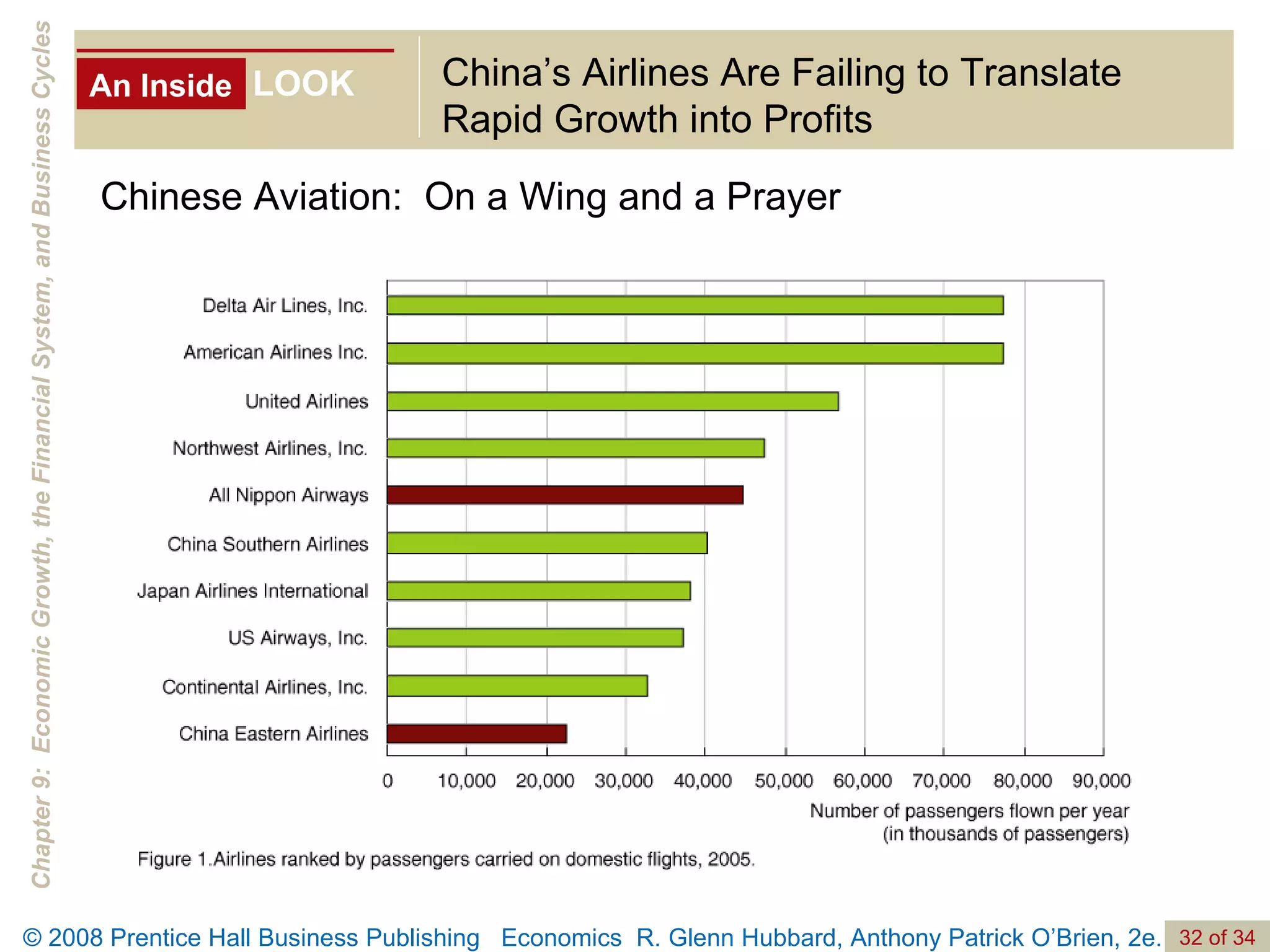
An Inside LOOK China’s Airlines Are Failing to Translate Rapid Growth into Profits Chinese Aviation:  On a Wing and a Prayer
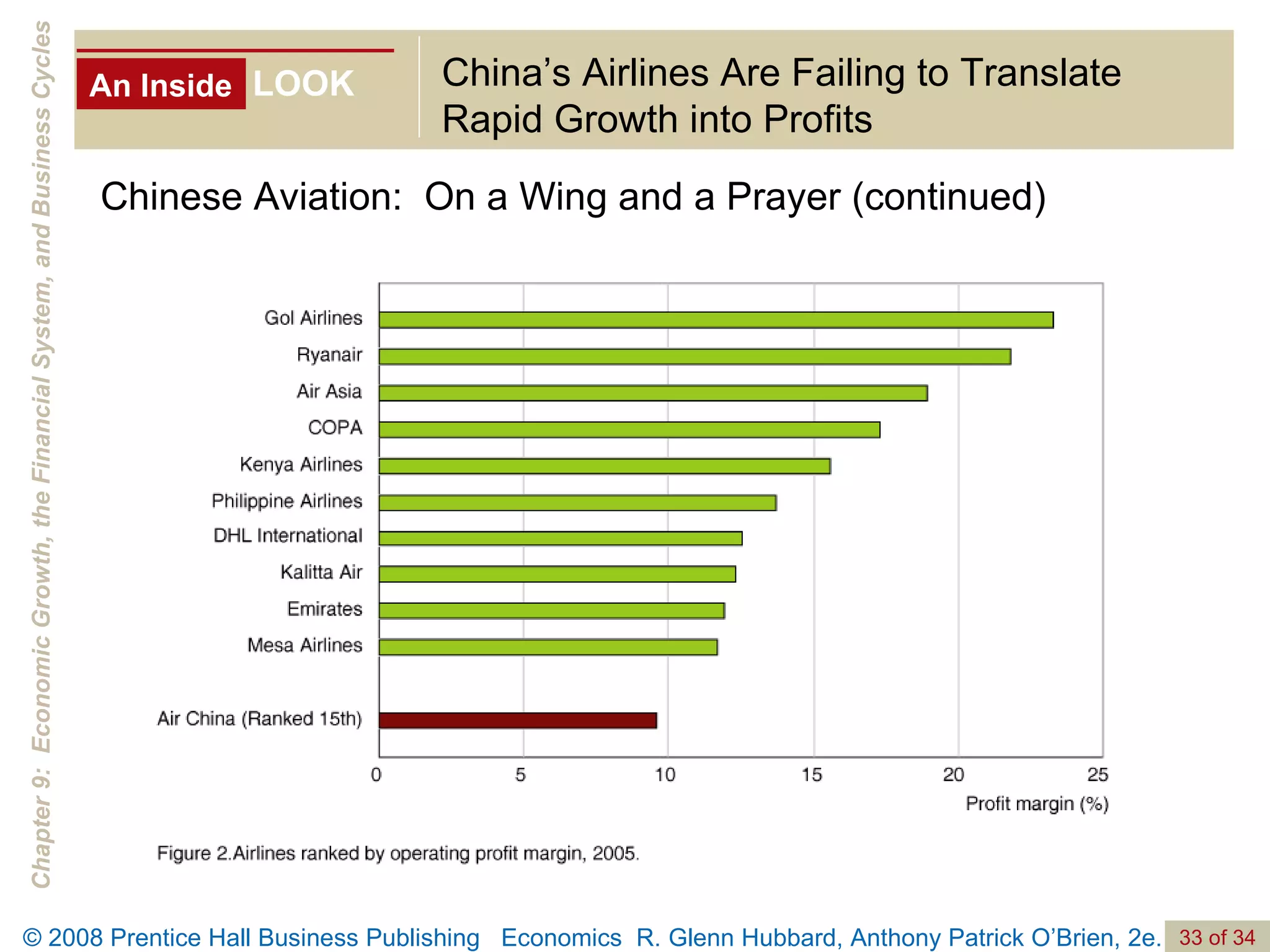
An Inside LOOK China’s Airlines Are Failing to Translate Rapid Growth into Profits Chinese Aviation:  On a Wing and a Prayer (continued)
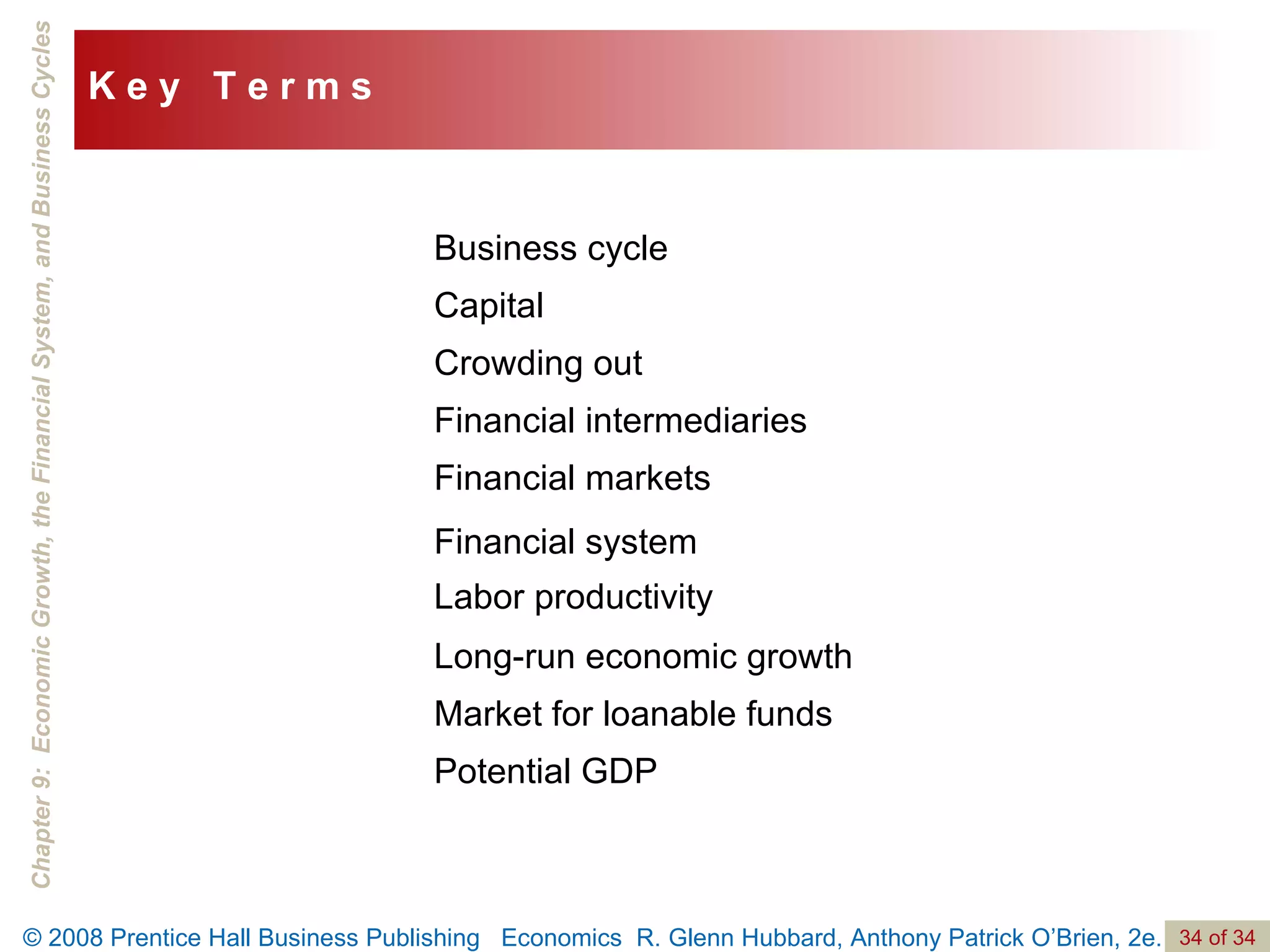
Business cycle Capital Crowding out Financial intermediaries Financial markets Financial system Labor productivity Long-run economic growth Market for loanable funds Potential GDP K e y  T e r m s

Chap9pp

  • 1.
  • 2.
    Growth and theBusiness Cycle at Boeing Learning Objectives In this chapter, we will provide an overview of long-run growth and the business cycle and discuss their importance for individual firms, for consumers, and for the economy as a whole. Explain what happens during a business cycle . 9.3 Discuss the role of the financial system in facilitating long-run economic growth . 9.2 Discuss the importance of long-run economic growth . 9.1
  • 3.
    Economic Growth, theFinancial System, and Business Cycles Business cycle Alternating periods of economic expansion and economic recession.
  • 4.
    Long-Run Economic GrowthLearning Objective 9.1 Long-run economic growth The process by which rising productivity increases the average standard of living. FIGURE 9.1 The Growth in Real GDP per Capita, 1900–2006
  • 5.
    The Connection between Economic Prosperity and Health Learning Objective 9.1 Making the Connection
  • 6.
    Long-Run Economic GrowthLearning Objective 9.1 Calculating Growth Rates and the Rule of 70 What Determines the Rate of Long-Run Growth? Labor productivity The quantity of goods and services that can be produced by one worker or by one hour of work.
  • 7.
    Long-Run Economic GrowthLearning Objective 9.1 What Determines the Rate of Long-Run Growth? Capital Manufactured goods that are used to produce other goods and services. Increases in Capital per Hour Worked Technological Change Economic growth depends more on technological change than on increases in capital per hour worked. Technological change is an increase in the quantity of output firms can produce using a given quantity of inputs.
  • 8.
    The Role ofTechnological Change in Growth Learning Objective 9.1 Between 1960 and 1995, real GDP per capita in Singapore grew at an average annual rate of 6.2 percent. This very rapid growth rate results in the level of real GDP per capita doubling about every 11.5 years. In 1995, Alywn Young of the University of Chicago published an article in which he argued that Singapore’s growth depended more on increases in capital per hour worked, increases in the labor force participation rate, and the transfer of workers from agricultural to nonagricultural jobs than on technological change. If Young’s analysis was correct, predict what was likely to happen to Singapore’s growth rate in the years after 1995. Solved Problem 9-1
  • 9.
    What Explains RapidEconomic Growth in Botswana? Learning Objective 9.1 Making the Connection
  • 10.
    Long-Run Economic GrowthLearning Objective 9.1 Potential Real GDP Potential GDP The level of GDP attained when all firms are producing at capacity.
  • 11.
    Long-Run Economic GrowthLearning Objective 9.1 Potential Real GDP FIGURE 9.2 Actual and Potential Real GDP
  • 12.
    Saving, Investment, andthe Financial System Learning Objective 9.2 An Overview of the Financial System Financial markets Markets where financial securities, such as stocks and bonds, are bought and sold. Financial intermediaries Firms, such as banks, mutual funds, pension funds, and insurance companies, that borrow funds from savers and lend them to borrowers. Financial system The system of financial markets and financial intermediaries through which firms acquire funds from households.
  • 13.
    Saving, Investment, andthe Financial System Learning Objective 9.2 The Macroeconomics of Saving and Investment Y = C + I + G + NX Y = C + I + G I = Y − C − G = Y + TR − C − T = T − G − TR
  • 14.
    Saving, Investment, andthe Financial System Learning Objective 9.2 S = (Y + TR − C − T) + (T − G − TR) S = Y − C − G S = I or or So, we can conclude that total saving must equal total investment: The Macroeconomics of Saving and Investment S = +
  • 15.
    Saving, Investment, andthe Financial System Learning Objective 9.2 The Market for Loanable Funds Market for loanable funds The interaction of borrowers and lenders that determines the market interest rate and the quantity of loanable funds exchanged.
  • 16.
    Saving, Investment, andthe Financial System Learning Objective 9.2 Demand and Supply in the Loanable Funds Market FIGURE 9.3 The Market for Loanable Funds The Market for Loanable Funds
  • 17.
    Ebenezer Scrooge: Accidental Promoter of Economic Growth? Learning Objective 9.2 Who was better for economic growth: Scrooge the saver or Scrooge the spender? Making the Connection
  • 18.
    Saving, Investment, andthe Financial System Learning Objective 9.2 Explaining Movements in Saving, Investment, and Interest Rates FIGURE 9.4 An Increase in the Demand for Loanable Funds The Market for Loanable Funds
  • 19.
    Saving, Investment, andthe Financial System Learning Objective 9.2 Crowding out A decline in private expenditures as a result of an increase in government purchases. Explaining Movements in Saving, Investment, and Interest Rates The Market for Loanable Funds
  • 20.
    Saving, Investment, andthe Financial System Learning Objective 9.2 Explaining Movements in Saving, Investment, and Interest Rates FIGURE 9.5 The Effect of a Budget Deficit on the Market for Loanable Funds The Market for Loanable Funds
  • 21.
    How Would aConsumption Tax Affect Saving, Investment, the Interest Rate, and Economic Growth? Learning Objective 9.2 Solved Problem 9-2
  • 22.
    The Business CycleLearning Objective 9.3 FIGURE 9.6 The Business Cycle Some Basic Business Cycle Definitions
  • 23.
    Who Decides ifthe Economy Is in a Recession? Learning Objective 9.3 Making the Connection 16 months March 1975 November 1973 8 months March 1991 July 1990 16 months November 1982 July 1981 8 months November 2001 March 2001 6 months July 1980 January 1980 11 months November 1970 December 1969 10 months February 1961 April 1960 8 months April 1958 August 1957 10 months May 1954 July 1953 LENGTH OF RECESSION TROUGH PEAK
  • 24.
    The Business CycleLearning Objective 9.3 FIGURE 9.7 The Effect of the Business Cycle on Boeing What Happens during a Business Cycle? The Effect of the Business Cycle on Boeing
  • 25.
    The Business CycleLearning Objective 9.3 FIGURE 9.8 The Effect of the 2001 Recession on the Inflation Rate The Effect of the Business Cycle on the Inflation Rate What Happens during a Business Cycle?
  • 26.
    The Business CycleLearning Objective 9.3 FIGURE 9.9 The Impact of Recessions on the Inflation Rate The Effect of the Business Cycle on the Inflation Rate Don’t Let This Happen to YOU! Don’t Confuse the Price Level and the Inflation Rate What Happens during a Business Cycle?
  • 27.
    The Business CycleLearning Objective 9.3 FIGURE 9.10 How the Recession of 2001 Affected the Unemployment Rate The Effect of the Business Cycle on the Unemployment Rate What Happens during a Business Cycle?
  • 28.
    The Business CycleLearning Objective 9.3 FIGURE 9.11 The Impact of Recessions on the Unemployment Rate The Effect of the Business Cycle on the Unemployment Rate What Happens during a Business Cycle?
  • 29.
    The Business CycleLearning Objective 9.3 FIGURE 9.12 Fluctuations in Real GDP, 1900–2006 Recessions Have Been Milder and the Economy Has Been More Stable Since 1950 What Happens during a Business Cycle?
  • 30.
    The Business CycleLearning Objective 9.3 Recessions Have Been Milder and the Economy Has Been More Stable Since 1950 Table 9-1 The Business Cycle Has Become Milder What Happens during a Business Cycle? 9 months 61 months 1950-2001 19 months 25 months 1900-1950 26 months 26 months 1870-1900 AVERAGE LENGTH OF RECESSIONS AVERAGE LENGTH OF EXPANSIONS PERIOD
  • 31.
    The Business CycleLearning Objective 9.3 • The increasing importance of services and the declining importance of goods. • The establishment of unemployment insurance and other government transfer programs that provide funds to the unemployed. • Active federal government policies to stabilize the economy. Why Is the Economy More Stable?
  • 32.
    An Inside LOOKChina’s Airlines Are Failing to Translate Rapid Growth into Profits Chinese Aviation: On a Wing and a Prayer
  • 33.
    An Inside LOOKChina’s Airlines Are Failing to Translate Rapid Growth into Profits Chinese Aviation: On a Wing and a Prayer (continued)
  • 34.
    Business cycle CapitalCrowding out Financial intermediaries Financial markets Financial system Labor productivity Long-run economic growth Market for loanable funds Potential GDP K e y T e r m s