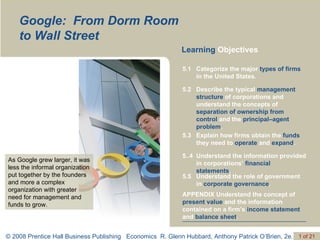
Google:  From Dorm Room to Wall Street Learning  Objectives As Google grew larger, it was less the informal organization put together by the founders and more a complex organization with greater need for management and funds to grow. APPENDIX Understand the concept of  present value  and the information contained on a firm’s  income statement  and  balance sheet .  Understand the role of government in  corporate governance . 5.5 Understand the information provided in corporations’  financial statements . 5..4 Explain how firms obtain the  funds  they need to  operate  and  expand . 5.3 Describe the typical  management structure  of corporations and understand the concepts of  separation of ownership from control  and the  principal–agent problem . 5.2 Categorize the major  types of firms  in the United States. 5.1
Sole proprietorship   A firm owned by a single individual and not organized as a corporation. Partnership   A firm owned jointly by two or more persons and not organized as a corporation. Corporation   A legal form of business that provides the owners with limited liability. Types of Firms Learning  Objective  5.1
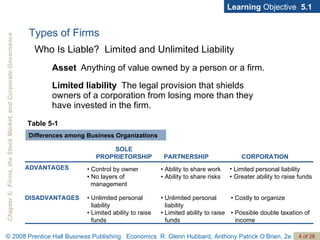
Asset   Anything of value owned by a person or a firm.  Limited liability   The legal provision that shields owners of a corporation from losing more than they have invested in the firm. Who Is Liable?  Limited and Unlimited Liability Learning  Objective  5.1 Table 5-1 Differences among Business Organizations Types of Firms DISADVANTAGES ADVANTAGES Limited personal liability • Greater ability to raise funds •  Ability to share work • Ability to share risks •  Control by owner • No layers of   management •  Possible double taxation of income •  Limited ability to raise funds •  Limited ability to raise funds •  Costly to organize •  Unlimited personal liability •  Unlimited personal liability CORPORATION PARTNERSHIP SOLE PROPRIETORSHIP
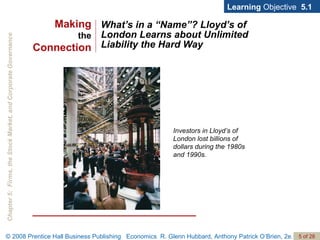
What’s in a “Name”? Lloyd’s of London Learns about Unlimited Liability the Hard Way Learning  Objective  5.1 Investors in Lloyd’s of London lost billions of dollars during the 1980s and 1990s. Making the Connection
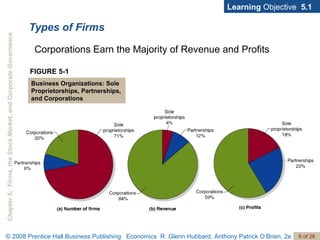
Types of Firms Corporations Earn the Majority of Revenue and Profits Learning  Objective  5.1 FIGURE 5-1 Business Organizations: Sole Proprietorships, Partnerships, and Corporations
The Structure of Corporations and the Principal–Agent Problem Corporate Structure and Corporate Governance Learning  Objective  5.2 Separation of ownership from control   A situation in a corporation in which the top management, rather than the shareholders, control day-to-day operations. Corporate governance  The way in which a corporation is structured and the effect a corporation’s structure has on the firm’s behavior. Principal–agent problem   A problem caused by an agent pursuing his own interests rather than the interests of the principal who hired him.
Does the Principal–Agent  Problem Apply to the Relationship between Managers and Workers? Learning  Objective  5.2 Briefly explain whether you agree or disagree with the following argument: The principal–agent problem applies not just to the relationship between shareholders and top managers.  It also applies to the relationship between managers and workers.  Just as shareholders have trouble monitoring whether top managers are earning as much profit as possible, managers have trouble monitoring whether workers are working as hard as possible. Solved  Problem 5-2
How Firms Raise Funds Learning  Objective  5.3 If you are making a profit, you could reinvest the profits back into your firm. Profits that are reinvested in a firm rather than taken out of a firm and paid to the firm’s owners are retained earnings. You could obtain funds by taking on one or more partners who invest in the firm.  This arrangement would increase the firm’s financial capital. Finally, you could borrow the funds from relatives, friends, or a bank.
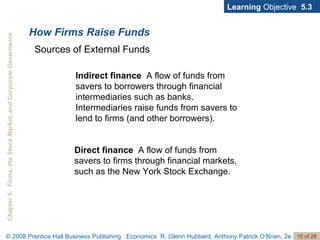
How Firms Raise Funds Learning  Objective  5.3 Sources of External Funds Indirect finance   A flow of funds from savers to borrowers through financial intermediaries such as banks.  Intermediaries raise funds from savers to lend to firms (and other borrowers). Direct finance   A flow of funds from savers to firms through financial markets, such as the New York Stock Exchange.
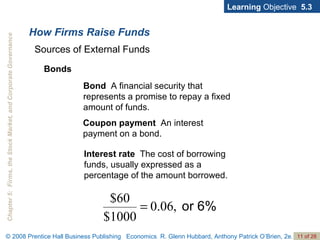
How Firms Raise Funds Learning  Objective  5.3 Sources of External Funds Bond  A financial security that represents a promise to repay a fixed amount of funds. Bonds Coupon payment   An interest payment on a bond. Interest rate   The cost of borrowing funds, usually expressed as a percentage of the amount borrowed.
How Firms Raise Funds Learning  Objective  5.3 Sources of External Funds Stock   A financial security that represents partial ownership of a firm.  Stocks Dividends   Payments by a corporation to its shareholders.
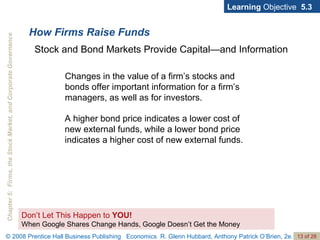
How Firms Raise Funds Learning  Objective  5.3 Don’t Let This Happen to  YOU! When Google Shares Change Hands, Google Doesn’t Get the Money Changes in the value of a firm’s stocks and bonds offer important information for a firm’s managers, as well as for investors. Stock and Bond Markets Provide Capital—and Information A higher bond price indicates a lower cost of new external funds, while a lower bond price indicates a higher cost of new external funds.
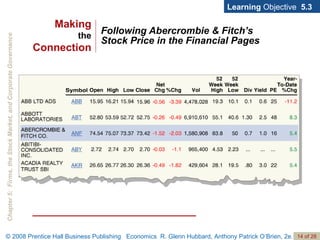
Following Abercrombie & Fitch’s Stock Price in the Financial Pages Learning  Objective  5.3 Making the Connection
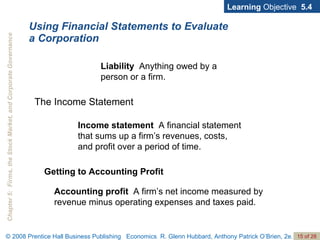
Using Financial Statements to Evaluate a Corporation Learning  Objective  5.4 Liability   Anything owed by a person or a firm. Income statement  A financial statement that sums up a firm’s revenues, costs, and profit over a period of time. The Income Statement Getting to Accounting Profit Accounting profit   A firm’s net income measured by revenue minus operating expenses and taxes paid.
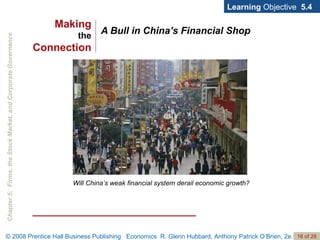
A Bull in China’s Financial Shop Learning  Objective  5.4 Will China’s weak financial system derail economic growth? Making the Connection
Using Financial Statements to Evaluate a Corporation Learning  Objective  5.4 . . . And Economic Profit Opportunity cost  The highest valued alternative that must be given up to engage in an activity. The Income Statement Explicit cost   A cost that involves spending money. Implicit cost   A nonmonetary opportunity cost. Economic profit  A firm’s revenues minus all of its implicit and explicit costs.
Using Financial Statements to Evaluate a Corporation Learning  Objective  5.4 Balance sheet  A financial statement that sums up a firm’s financial position on a particular day, usually the end of a quarter or year. The Balance Sheet
Corporate Governance Policy Learning  Objective  5.5 The landmark Sarbanes-Oxley Act of 2002 requires that corporate directors have a certain level of expertise with financial information and mandates that CEOs personally certify the accuracy of financial statements.  Perhaps the most noticeable corporate governance reform under the Sarbanes-Oxley Act is the creation of the Public Company Accounting Oversight Board, a national board that oversees the auditing of public companies’ financial reports.
What Makes a Good Board of Directors? Learning  Objective  5.5 What is an “independent outsider” on a board of directors? Why is it good for a firm to have a large majority of independent outsiders on the board of directors? Why would it be good for a firm to have the auditing and compensation committees composed of outsiders? Why would it be good for a firm if its directors own the firm’s stock? Solved  Problem 5-5
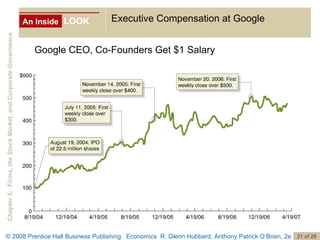
An Inside LOOK Executive Compensation at Google Google CEO, Co-Founders Get $1 Salary
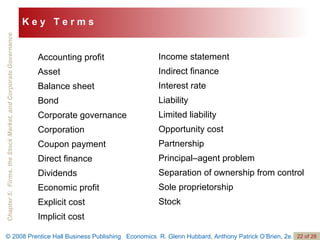
Accounting profit Asset Balance sheet Bond Corporate governance Corporation Coupon payment Direct finance Dividends Economic profit Explicit cost Implicit cost Income statement Indirect finance Interest rate Liability Limited liability Opportunity cost Partnership Principal–agent problem Separation of ownership from control Sole proprietorship Stock K e y  T e r m s
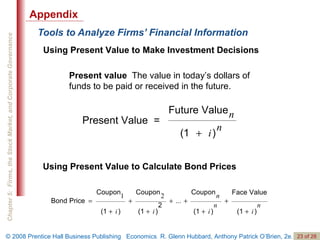
Tools to Analyze Firms’ Financial Information Using Present Value to Make Investment Decisions Present value  The value in today’s dollars of funds to be paid or received in the future. Using Present Value to Calculate Bond Prices Appendix
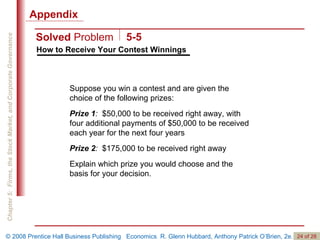
How to Receive Your Contest Winnings Suppose you win a contest and are given the choice of the following prizes:  Prize 1 :   $50,000 to be received right away, with four additional payments of $50,000 to be received each year for the next four years Prize 2 :   $175,000 to be received right away Explain which prize you would choose and the basis for your decision.  Solved  Problem 5-5 Appendix
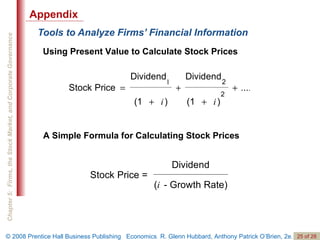
Tools to Analyze Firms’ Financial Information Using Present Value to Calculate Stock Prices A Simple Formula for Calculating Stock Prices Appendix
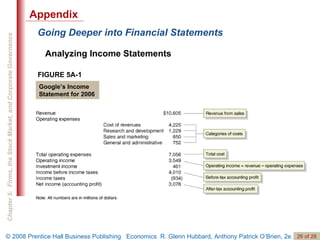
Going Deeper into Financial Statements Analyzing Income Statements FIGURE 5A-1 Google’s Income Statement for 2006 Appendix
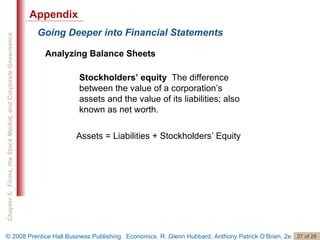
Going Deeper into Financial Statements Analyzing Balance Sheets Stockholders’ equity   The difference between the value of a corporation’s assets and the value of its liabilities; also known as net worth.  Assets = Liabilities + Stockholders’ Equity Appendix
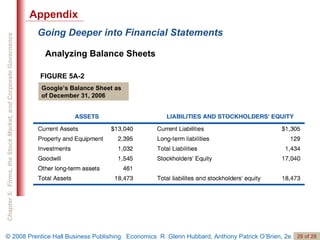
Going Deeper into Financial Statements Analyzing Balance Sheets FIGURE 5A-2 Google’s Balance Sheet as of December 31, 2006 Appendix

Chap5pp

  • 1.
  • 2.
    Google: FromDorm Room to Wall Street Learning Objectives As Google grew larger, it was less the informal organization put together by the founders and more a complex organization with greater need for management and funds to grow. APPENDIX Understand the concept of present value and the information contained on a firm’s income statement and balance sheet . Understand the role of government in corporate governance . 5.5 Understand the information provided in corporations’ financial statements . 5..4 Explain how firms obtain the funds they need to operate and expand . 5.3 Describe the typical management structure of corporations and understand the concepts of separation of ownership from control and the principal–agent problem . 5.2 Categorize the major types of firms in the United States. 5.1
  • 3.
    Sole proprietorship A firm owned by a single individual and not organized as a corporation. Partnership A firm owned jointly by two or more persons and not organized as a corporation. Corporation A legal form of business that provides the owners with limited liability. Types of Firms Learning Objective 5.1
  • 4.
    Asset Anything of value owned by a person or a firm. Limited liability The legal provision that shields owners of a corporation from losing more than they have invested in the firm. Who Is Liable? Limited and Unlimited Liability Learning Objective 5.1 Table 5-1 Differences among Business Organizations Types of Firms DISADVANTAGES ADVANTAGES Limited personal liability • Greater ability to raise funds • Ability to share work • Ability to share risks • Control by owner • No layers of management • Possible double taxation of income • Limited ability to raise funds • Limited ability to raise funds • Costly to organize • Unlimited personal liability • Unlimited personal liability CORPORATION PARTNERSHIP SOLE PROPRIETORSHIP
  • 5.
    What’s in a“Name”? Lloyd’s of London Learns about Unlimited Liability the Hard Way Learning Objective 5.1 Investors in Lloyd’s of London lost billions of dollars during the 1980s and 1990s. Making the Connection
  • 6.
    Types of FirmsCorporations Earn the Majority of Revenue and Profits Learning Objective 5.1 FIGURE 5-1 Business Organizations: Sole Proprietorships, Partnerships, and Corporations
  • 7.
    The Structure ofCorporations and the Principal–Agent Problem Corporate Structure and Corporate Governance Learning Objective 5.2 Separation of ownership from control A situation in a corporation in which the top management, rather than the shareholders, control day-to-day operations. Corporate governance The way in which a corporation is structured and the effect a corporation’s structure has on the firm’s behavior. Principal–agent problem A problem caused by an agent pursuing his own interests rather than the interests of the principal who hired him.
  • 8.
    Does the Principal–Agent Problem Apply to the Relationship between Managers and Workers? Learning Objective 5.2 Briefly explain whether you agree or disagree with the following argument: The principal–agent problem applies not just to the relationship between shareholders and top managers. It also applies to the relationship between managers and workers. Just as shareholders have trouble monitoring whether top managers are earning as much profit as possible, managers have trouble monitoring whether workers are working as hard as possible. Solved Problem 5-2
  • 9.
    How Firms RaiseFunds Learning Objective 5.3 If you are making a profit, you could reinvest the profits back into your firm. Profits that are reinvested in a firm rather than taken out of a firm and paid to the firm’s owners are retained earnings. You could obtain funds by taking on one or more partners who invest in the firm. This arrangement would increase the firm’s financial capital. Finally, you could borrow the funds from relatives, friends, or a bank.
  • 10.
    How Firms RaiseFunds Learning Objective 5.3 Sources of External Funds Indirect finance A flow of funds from savers to borrowers through financial intermediaries such as banks. Intermediaries raise funds from savers to lend to firms (and other borrowers). Direct finance A flow of funds from savers to firms through financial markets, such as the New York Stock Exchange.
  • 11.
    How Firms RaiseFunds Learning Objective 5.3 Sources of External Funds Bond A financial security that represents a promise to repay a fixed amount of funds. Bonds Coupon payment An interest payment on a bond. Interest rate The cost of borrowing funds, usually expressed as a percentage of the amount borrowed.
  • 12.
    How Firms RaiseFunds Learning Objective 5.3 Sources of External Funds Stock A financial security that represents partial ownership of a firm. Stocks Dividends Payments by a corporation to its shareholders.
  • 13.
    How Firms RaiseFunds Learning Objective 5.3 Don’t Let This Happen to YOU! When Google Shares Change Hands, Google Doesn’t Get the Money Changes in the value of a firm’s stocks and bonds offer important information for a firm’s managers, as well as for investors. Stock and Bond Markets Provide Capital—and Information A higher bond price indicates a lower cost of new external funds, while a lower bond price indicates a higher cost of new external funds.
  • 14.
    Following Abercrombie &Fitch’s Stock Price in the Financial Pages Learning Objective 5.3 Making the Connection
  • 15.
    Using Financial Statementsto Evaluate a Corporation Learning Objective 5.4 Liability Anything owed by a person or a firm. Income statement A financial statement that sums up a firm’s revenues, costs, and profit over a period of time. The Income Statement Getting to Accounting Profit Accounting profit A firm’s net income measured by revenue minus operating expenses and taxes paid.
  • 16.
    A Bull inChina’s Financial Shop Learning Objective 5.4 Will China’s weak financial system derail economic growth? Making the Connection
  • 17.
    Using Financial Statementsto Evaluate a Corporation Learning Objective 5.4 . . . And Economic Profit Opportunity cost The highest valued alternative that must be given up to engage in an activity. The Income Statement Explicit cost A cost that involves spending money. Implicit cost A nonmonetary opportunity cost. Economic profit A firm’s revenues minus all of its implicit and explicit costs.
  • 18.
    Using Financial Statementsto Evaluate a Corporation Learning Objective 5.4 Balance sheet A financial statement that sums up a firm’s financial position on a particular day, usually the end of a quarter or year. The Balance Sheet
  • 19.
    Corporate Governance PolicyLearning Objective 5.5 The landmark Sarbanes-Oxley Act of 2002 requires that corporate directors have a certain level of expertise with financial information and mandates that CEOs personally certify the accuracy of financial statements. Perhaps the most noticeable corporate governance reform under the Sarbanes-Oxley Act is the creation of the Public Company Accounting Oversight Board, a national board that oversees the auditing of public companies’ financial reports.
  • 20.
    What Makes aGood Board of Directors? Learning Objective 5.5 What is an “independent outsider” on a board of directors? Why is it good for a firm to have a large majority of independent outsiders on the board of directors? Why would it be good for a firm to have the auditing and compensation committees composed of outsiders? Why would it be good for a firm if its directors own the firm’s stock? Solved Problem 5-5
  • 21.
    An Inside LOOKExecutive Compensation at Google Google CEO, Co-Founders Get $1 Salary
  • 22.
    Accounting profit AssetBalance sheet Bond Corporate governance Corporation Coupon payment Direct finance Dividends Economic profit Explicit cost Implicit cost Income statement Indirect finance Interest rate Liability Limited liability Opportunity cost Partnership Principal–agent problem Separation of ownership from control Sole proprietorship Stock K e y T e r m s
  • 23.
    Tools to AnalyzeFirms’ Financial Information Using Present Value to Make Investment Decisions Present value The value in today’s dollars of funds to be paid or received in the future. Using Present Value to Calculate Bond Prices Appendix
  • 24.
    How to ReceiveYour Contest Winnings Suppose you win a contest and are given the choice of the following prizes: Prize 1 : $50,000 to be received right away, with four additional payments of $50,000 to be received each year for the next four years Prize 2 : $175,000 to be received right away Explain which prize you would choose and the basis for your decision. Solved Problem 5-5 Appendix
  • 25.
    Tools to AnalyzeFirms’ Financial Information Using Present Value to Calculate Stock Prices A Simple Formula for Calculating Stock Prices Appendix
  • 26.
    Going Deeper intoFinancial Statements Analyzing Income Statements FIGURE 5A-1 Google’s Income Statement for 2006 Appendix
  • 27.
    Going Deeper intoFinancial Statements Analyzing Balance Sheets Stockholders’ equity The difference between the value of a corporation’s assets and the value of its liabilities; also known as net worth. Assets = Liabilities + Stockholders’ Equity Appendix
  • 28.
    Going Deeper intoFinancial Statements Analyzing Balance Sheets FIGURE 5A-2 Google’s Balance Sheet as of December 31, 2006 Appendix