FISCAL POLICY BY PRIYANKA JAIN ANOOP SHARMA
Fiscal Policy-Meaning The word  fisc  means ‘ state treasury ’ and fiscal policy refers to policy concerning the use of ‘state treasury’ or the govt. finances to achieve the macroeconomic goals. “ any decision to change the level, composition or timing of  govt. expenditure  or to vary the burden ,the structure or frequency of the  tax payment  is fiscal policy.”   -  G.K. Shaw The fiscal policy is concerned with the raising of government revenue and incurring of government expenditure.
Objectives of Fiscal Policy Development by effective Mobilisation of Resources. 2.  Efficient allocation of Financial Resources 3.  Reduction in inequalities of Income and Wealth 4.  Price Stability and Control of Inflation Employment Generation Capital Formation Development of Infrastructure
THREE MAIN STANCES OF FISCAL POLICY NEUTRAL STANCE: This results in large tax revenue Government. Spending is fully funded by Tax revenues and overall budget has a neutral effect on level of economic activity.(G=T) EXPANSIONARY STANCE: government expenditure is more than taxes reciepts CONTRATIONARY STANCE: Government expenditure is less than the taxes and revenues received.
FUNDING The expenditure of government can be funded in different ways : Taxation Borrowing Consumption fiscal reserves Sale of fixed assets.
Instruments of Fiscal Policy Budgetary surplus and deficit Government expenditure Taxation- direct and indirect Public debt
Budgetary surplus and deficit “ A budget is a detailed plan of operations for some specific future period” An accumulated deficit over several years (or centuries) is referred to as the government debt  A deficit is a flow. And a debt is a stock. Debt is essentially an accumulated flow of deficits
Government Expenditure It includes : Government spending on the purchase of goods & services. Payment of wages and salaries of government servants Public investment Transfer payments
Taxation Meaning : Non quid pro quo transfer of private income to public coffers by means of taxes. Classified into 1.  Direct taxes-  Corporate tax, Tax, Personal Income Tax, Fringe Benefit taxes, Banking Cash Transaction Tax 2.  Indirect taxes-  Central Sales Tax, Customs, Service Tax, excise duty.
Public debt Internal  borrowings  Borrowings from the public by means of treasury bills and govt. bonds Borrowings from the central bank ( monetized deficit financing)   External  borrowings  foreign investments international organizations like World Bank & IMF market borrowings
BUDGET  “ A budget is a detailed plan of operations for some specific future period” It is an estimate prepared in advance of the period to which it applies.  It is also known as Annual Financial Statement of the year.
TWO TYPES OF BUDGET IN INDIA UNION BUDGET STATE BUDGET
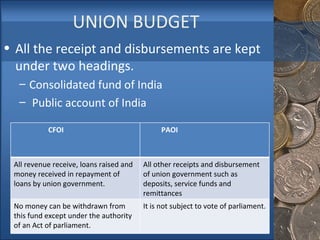
UNION BUDGET All the receipt and disbursements are kept under two headings. Consolidated fund of India Public account of India CFOI PAOI All revenue receive, loans raised and money received in repayment of loans by union government. All other receipts and disbursement of union government such as deposits, service funds and remittances No money can be withdrawn from this fund except under the authority of an Act of parliament. It is not subject to vote of parliament.
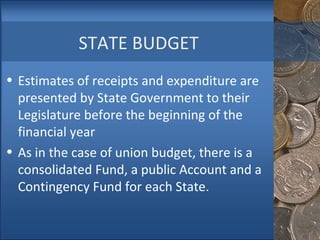
STATE BUDGET Estimates of receipts and expenditure are presented by State Government to their Legislature before the beginning of the financial year As in the case of union budget, there is a consolidated Fund, a public Account and a Contingency Fund for each State.
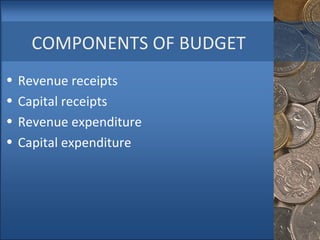
COMPONENTS OF BUDGET Revenue receipts Capital receipts Revenue expenditure Capital expenditure
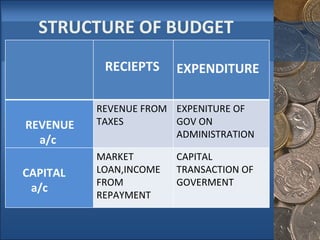
STRUCTURE OF BUDGET RECIEPTS EXPENDITURE REVENUE  a/c REVENUE FROM TAXES EXPENITURE OF GOV ON ADMINISTRATION CAPITAL  a/c MARKET LOAN,INCOME FROM REPAYMENT CAPITAL TRANSACTION OF GOVERMENT
AFTER PRESENTING BUDGET GENERAL DISCUSSION ON BUDGET IS HELD IN BOTH THE HOUSES OF PARLIAMENT. ESTIMATES OF EXPENDITURE FROM CONSOLIDATED FUND IS THEN PLACED BEFORE LOK SABHA IN THE FORM OF DEMANDS OF GRANTS. ALL WITHDRAWAL OF MONEY FROM CONSOLIDATED FUND ARE THEEREAFTER AUTHORISED BY AN APPROPRIATION ACT PASSED. RECEIPTS AND EXPENDITURE OF CENTRAL AND STATE GOVERNMENT  ARE AUDITED BY CAG AND REPORT IFS PRESENTED TO P.M
BUDGET FINANCIALS  2011
HIGHLIGHTS OF BUDGET 2011 BORROWINGS Net market borrowing for 2011-12 seen at 3.43 trillion rupees, down from 3.45 trillion rupees in 2010-11  POLICY REFORMS  To create infrastructure debt funds  FDI policy being liberalised.  To boost infrastructure development with tax-free bonds of 300 billion rupees  Food security bill to be introduced this year  Raised foreign institutional investor limit in 5-year corporate bonds for investment in infrastructure by $20 billion  Setting up independent debt management office; Public debt bill  introduced in parliament . Bills on insurance, pension funds, banking  introduced.  
BUDGET 2011  FISCAL DEFICIT  Fiscal deficit seen at 5.1 percent of GDP in 2010-11  Fiscal deficit seen at 4.6 percent of GDP in 2011-12   Fiscal deficit seen at 3.5 percent of GDP in 2013-14 
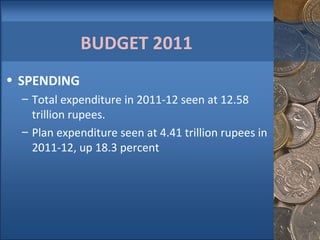
BUDGET 2011  SPENDING  Total expenditure in 2011-12 seen at 12.58 trillion rupees. Plan expenditure seen at 4.41 trillion rupees in 2011-12, up 18.3 percent 
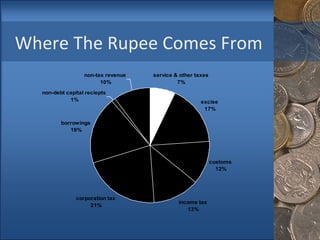
Where The Rupee Comes From
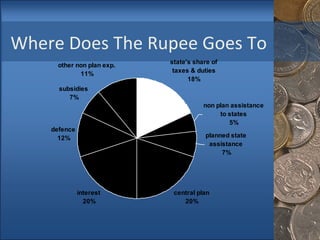
Where Does The Rupee Goes To
Fiscal Responsibility And Budget Management (FRBM) Bill Introduced in Lok Sabha in December 2000. Objectives include: Long-term macroeconomic stability Inter-generational equity in fiscal management. It aimed at: Reducing revenue deficit Reducing gross fiscal deficit Reducing the Public debt No Borrowing from the RBI
Thank You “ We need faster growth because, at our level of incomes, there can be no doubt that we must expand the production base of the economy if we want to provide broad-based improvement in the material conditions of living of our population, .......... But growth alone is not enough if it does not produce a flow of benefits that is sufficiently wide-spread. We, therefore, need a growth process that is much more inclusive, .......... and which also ensures access to essential services such as health and education for all sections of the community”. -Dr. Manmohan Singh,   Prime Minister

Fiscal ppt

  • 1.
    FISCAL POLICY BYPRIYANKA JAIN ANOOP SHARMA
  • 2.
    Fiscal Policy-Meaning Theword fisc means ‘ state treasury ’ and fiscal policy refers to policy concerning the use of ‘state treasury’ or the govt. finances to achieve the macroeconomic goals. “ any decision to change the level, composition or timing of govt. expenditure or to vary the burden ,the structure or frequency of the tax payment is fiscal policy.” - G.K. Shaw The fiscal policy is concerned with the raising of government revenue and incurring of government expenditure.
  • 3.
    Objectives of FiscalPolicy Development by effective Mobilisation of Resources. 2. Efficient allocation of Financial Resources 3. Reduction in inequalities of Income and Wealth 4. Price Stability and Control of Inflation Employment Generation Capital Formation Development of Infrastructure
  • 4.
    THREE MAIN STANCESOF FISCAL POLICY NEUTRAL STANCE: This results in large tax revenue Government. Spending is fully funded by Tax revenues and overall budget has a neutral effect on level of economic activity.(G=T) EXPANSIONARY STANCE: government expenditure is more than taxes reciepts CONTRATIONARY STANCE: Government expenditure is less than the taxes and revenues received.
  • 5.
    FUNDING The expenditureof government can be funded in different ways : Taxation Borrowing Consumption fiscal reserves Sale of fixed assets.
  • 6.
    Instruments of FiscalPolicy Budgetary surplus and deficit Government expenditure Taxation- direct and indirect Public debt
  • 7.
    Budgetary surplus anddeficit “ A budget is a detailed plan of operations for some specific future period” An accumulated deficit over several years (or centuries) is referred to as the government debt A deficit is a flow. And a debt is a stock. Debt is essentially an accumulated flow of deficits
  • 8.
    Government Expenditure Itincludes : Government spending on the purchase of goods & services. Payment of wages and salaries of government servants Public investment Transfer payments
  • 9.
    Taxation Meaning :Non quid pro quo transfer of private income to public coffers by means of taxes. Classified into 1. Direct taxes- Corporate tax, Tax, Personal Income Tax, Fringe Benefit taxes, Banking Cash Transaction Tax 2. Indirect taxes- Central Sales Tax, Customs, Service Tax, excise duty.
  • 10.
    Public debt Internal borrowings Borrowings from the public by means of treasury bills and govt. bonds Borrowings from the central bank ( monetized deficit financing) External borrowings foreign investments international organizations like World Bank & IMF market borrowings
  • 11.
    BUDGET “A budget is a detailed plan of operations for some specific future period” It is an estimate prepared in advance of the period to which it applies. It is also known as Annual Financial Statement of the year.
  • 12.
    TWO TYPES OFBUDGET IN INDIA UNION BUDGET STATE BUDGET
  • 13.
    UNION BUDGET Allthe receipt and disbursements are kept under two headings. Consolidated fund of India Public account of India CFOI PAOI All revenue receive, loans raised and money received in repayment of loans by union government. All other receipts and disbursement of union government such as deposits, service funds and remittances No money can be withdrawn from this fund except under the authority of an Act of parliament. It is not subject to vote of parliament.
  • 14.
    STATE BUDGET Estimatesof receipts and expenditure are presented by State Government to their Legislature before the beginning of the financial year As in the case of union budget, there is a consolidated Fund, a public Account and a Contingency Fund for each State.
  • 15.
    COMPONENTS OF BUDGETRevenue receipts Capital receipts Revenue expenditure Capital expenditure
  • 16.
    STRUCTURE OF BUDGETRECIEPTS EXPENDITURE REVENUE a/c REVENUE FROM TAXES EXPENITURE OF GOV ON ADMINISTRATION CAPITAL a/c MARKET LOAN,INCOME FROM REPAYMENT CAPITAL TRANSACTION OF GOVERMENT
  • 17.
    AFTER PRESENTING BUDGETGENERAL DISCUSSION ON BUDGET IS HELD IN BOTH THE HOUSES OF PARLIAMENT. ESTIMATES OF EXPENDITURE FROM CONSOLIDATED FUND IS THEN PLACED BEFORE LOK SABHA IN THE FORM OF DEMANDS OF GRANTS. ALL WITHDRAWAL OF MONEY FROM CONSOLIDATED FUND ARE THEEREAFTER AUTHORISED BY AN APPROPRIATION ACT PASSED. RECEIPTS AND EXPENDITURE OF CENTRAL AND STATE GOVERNMENT ARE AUDITED BY CAG AND REPORT IFS PRESENTED TO P.M
  • 18.
  • 19.
    HIGHLIGHTS OF BUDGET2011 BORROWINGS Net market borrowing for 2011-12 seen at 3.43 trillion rupees, down from 3.45 trillion rupees in 2010-11  POLICY REFORMS  To create infrastructure debt funds  FDI policy being liberalised.  To boost infrastructure development with tax-free bonds of 300 billion rupees  Food security bill to be introduced this year  Raised foreign institutional investor limit in 5-year corporate bonds for investment in infrastructure by $20 billion  Setting up independent debt management office; Public debt bill introduced in parliament . Bills on insurance, pension funds, banking introduced.  
  • 20.
    BUDGET 2011 FISCAL DEFICIT  Fiscal deficit seen at 5.1 percent of GDP in 2010-11  Fiscal deficit seen at 4.6 percent of GDP in 2011-12   Fiscal deficit seen at 3.5 percent of GDP in 2013-14 
  • 21.
    BUDGET 2011 SPENDING  Total expenditure in 2011-12 seen at 12.58 trillion rupees. Plan expenditure seen at 4.41 trillion rupees in 2011-12, up 18.3 percent 
  • 22.
    Where The RupeeComes From
  • 23.
    Where Does TheRupee Goes To
  • 24.
    Fiscal Responsibility AndBudget Management (FRBM) Bill Introduced in Lok Sabha in December 2000. Objectives include: Long-term macroeconomic stability Inter-generational equity in fiscal management. It aimed at: Reducing revenue deficit Reducing gross fiscal deficit Reducing the Public debt No Borrowing from the RBI
  • 25.
    Thank You “We need faster growth because, at our level of incomes, there can be no doubt that we must expand the production base of the economy if we want to provide broad-based improvement in the material conditions of living of our population, .......... But growth alone is not enough if it does not produce a flow of benefits that is sufficiently wide-spread. We, therefore, need a growth process that is much more inclusive, .......... and which also ensures access to essential services such as health and education for all sections of the community”. -Dr. Manmohan Singh, Prime Minister