The Fortunes of FedEx Follow the Business Cycle Learning  Objectives To understand why FedEx and other firms are affected by the business cycle, we need to explore the effects that recessions and expansions have on production, employment, and prices. APPENDIX Understand  macroeconomic schools of thought . Use the  dynamic aggregate   demand and aggregate supply model  to analyze macroeconomic conditions. 12.4 Use the aggregate demand and aggregate supply model to illustrate the difference between  short-run  and  long-run macroeconomic equilibrium . 12.3 Identify the determinants of  aggregate supply  and distinguish between a  movement  along the  short- run aggregate supply curve and a  shift  of the curve. 12.2 Identify the determinants of  aggregate demand  and distinguish between a  movement  along the aggregate demand curve and a  shift  of the curve. 12.1
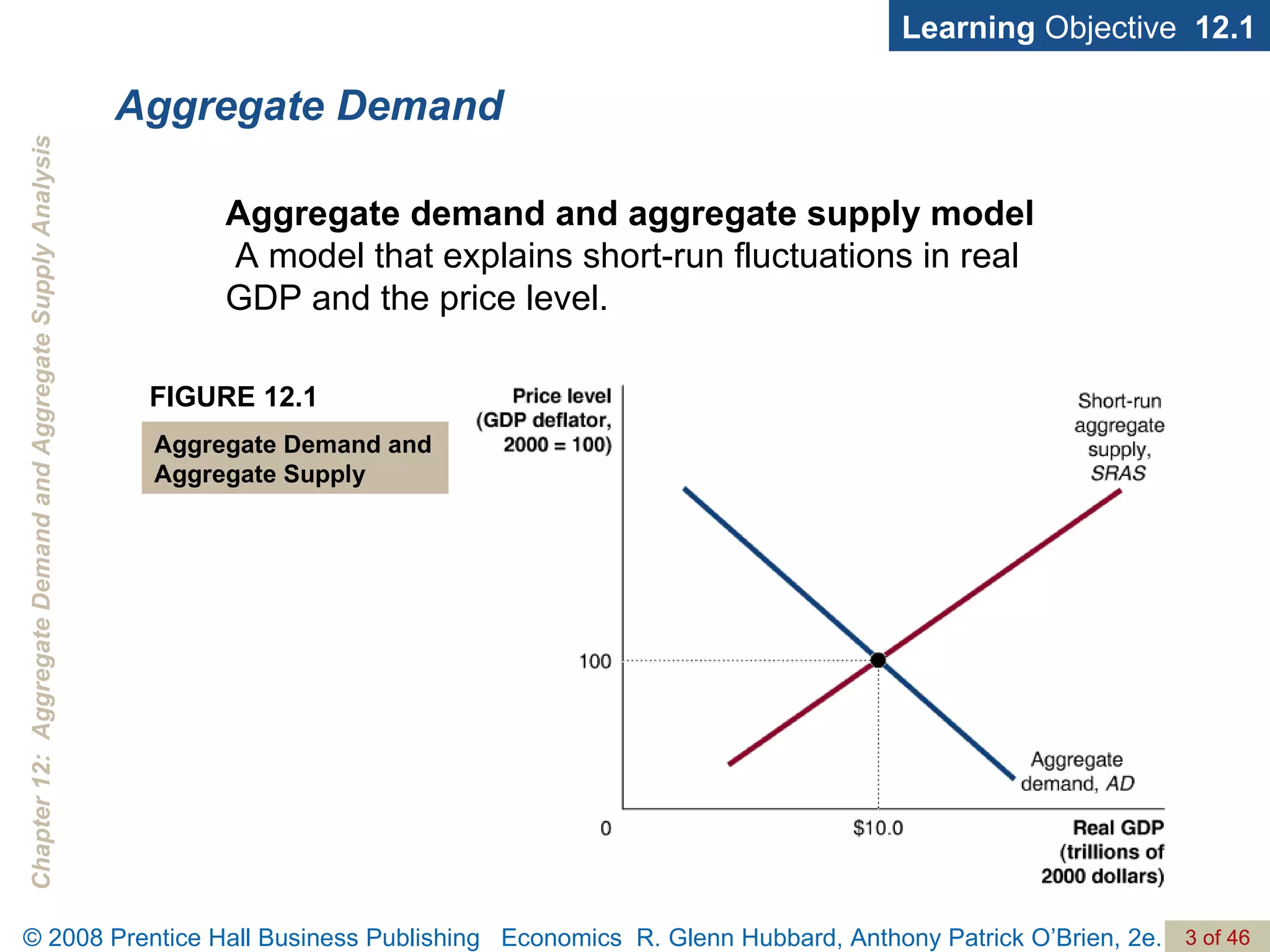
Aggregate Demand Learning  Objective  12.1 Aggregate demand and aggregate supply model   A model that explains short-run fluctuations in real GDP and the price level. FIGURE 12.1 Aggregate Demand and Aggregate Supply
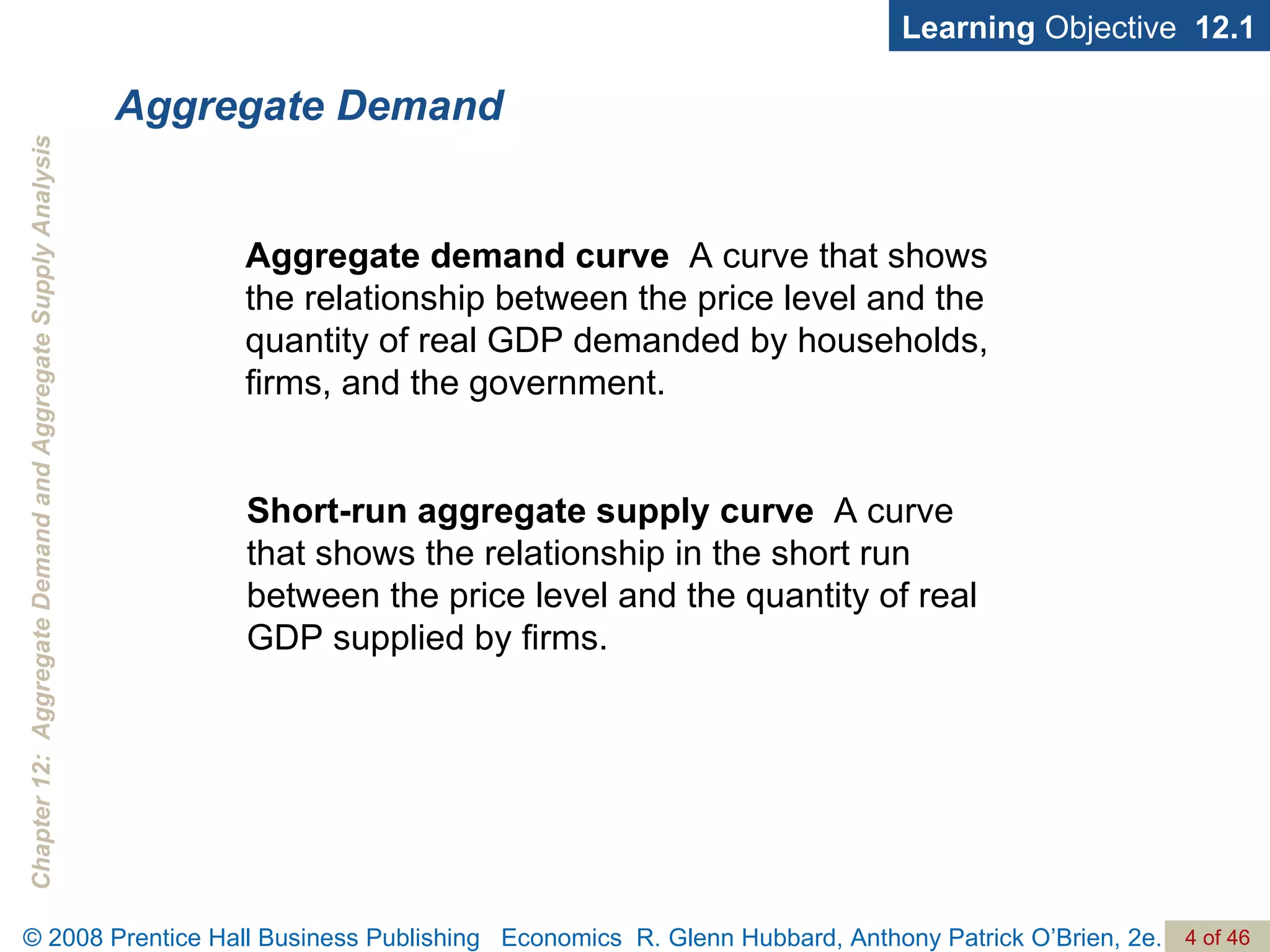
Aggregate Demand Learning  Objective  12.1 Aggregate demand curve   A curve that shows the relationship between the price level and the quantity of real GDP demanded by households, firms, and the government. Short-run aggregate supply curve  A curve that shows the relationship in the short run between the price level and the quantity of real GDP supplied by firms.
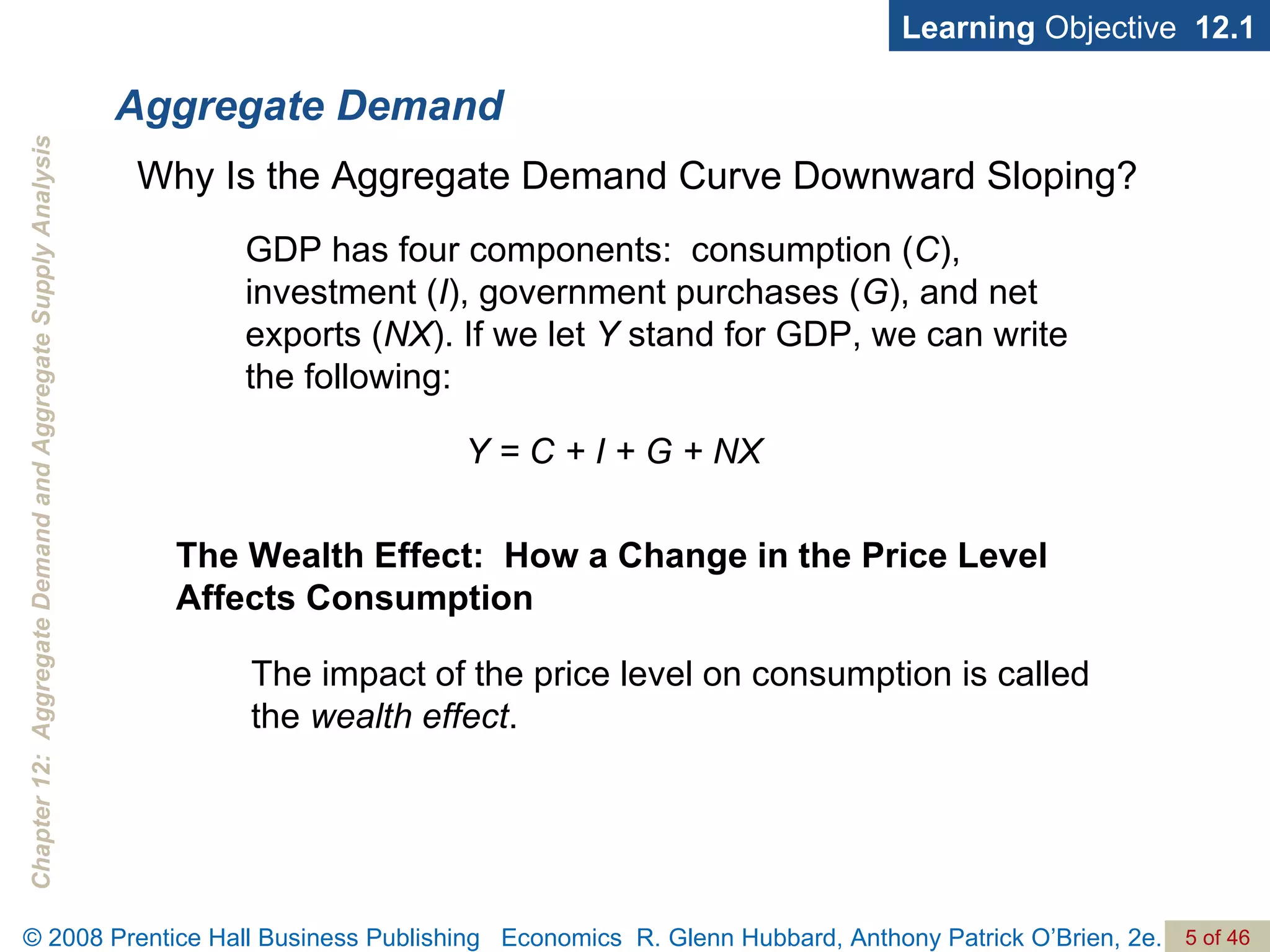
Aggregate Demand Learning  Objective  12.1 GDP has four components:  consumption ( C ), investment ( I ), government purchases ( G ), and net exports ( NX ). If we let  Y  stand for GDP, we can write the following:  Y = C + I + G + NX Why Is the Aggregate Demand Curve Downward Sloping? The Wealth Effect:  How a Change in the Price Level Affects Consumption The impact of the price level on consumption is called the  wealth effect .
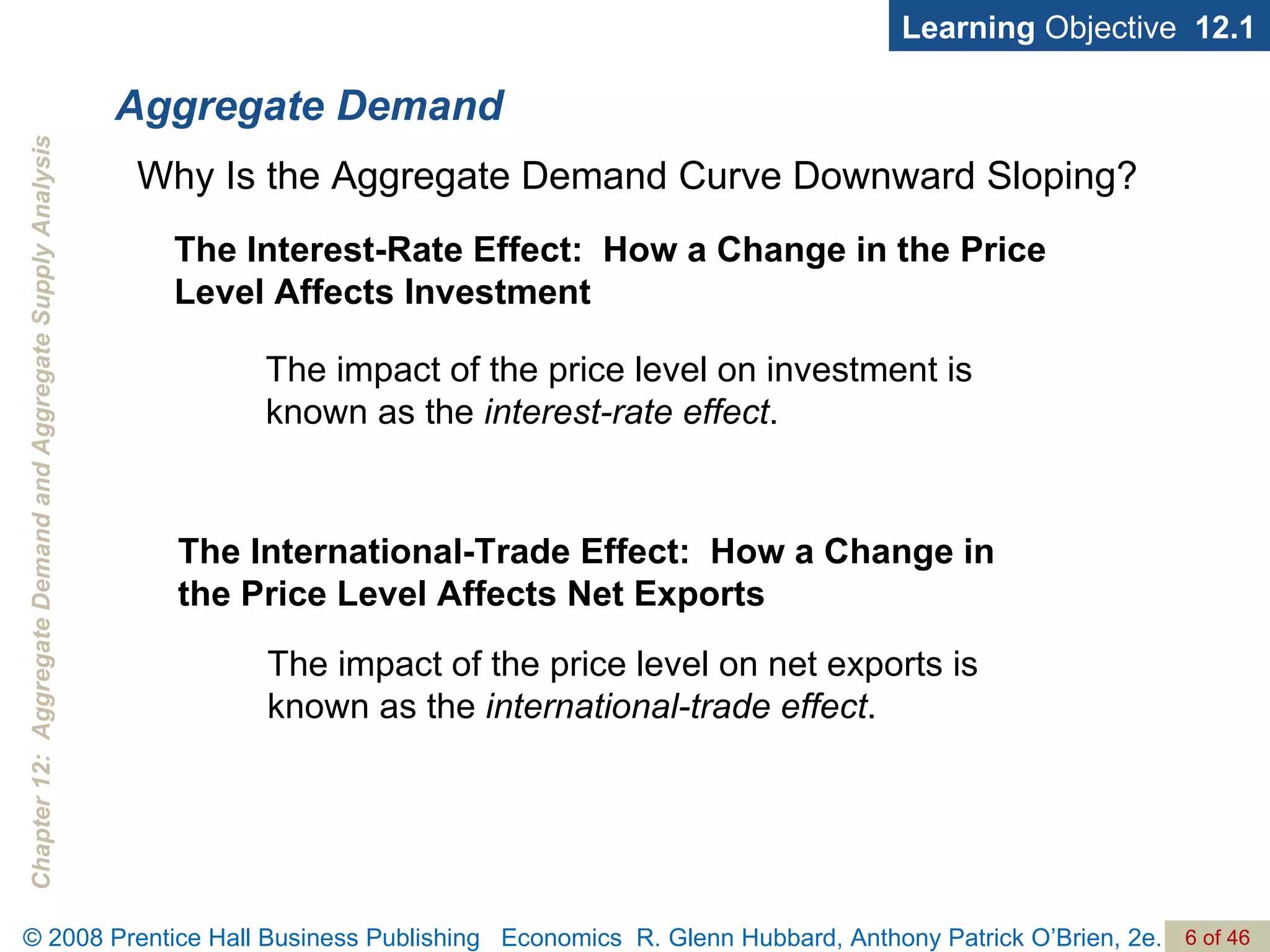
Aggregate Demand Learning  Objective  12.1 The impact of the price level on investment is known as the  interest-rate effect . Why Is the Aggregate Demand Curve Downward Sloping? The International-Trade Effect:  How a Change in the Price Level Affects Net Exports The impact of the price level on net exports is known as the  international-trade effect . The Interest-Rate Effect:  How a Change in the Price Level Affects Investment
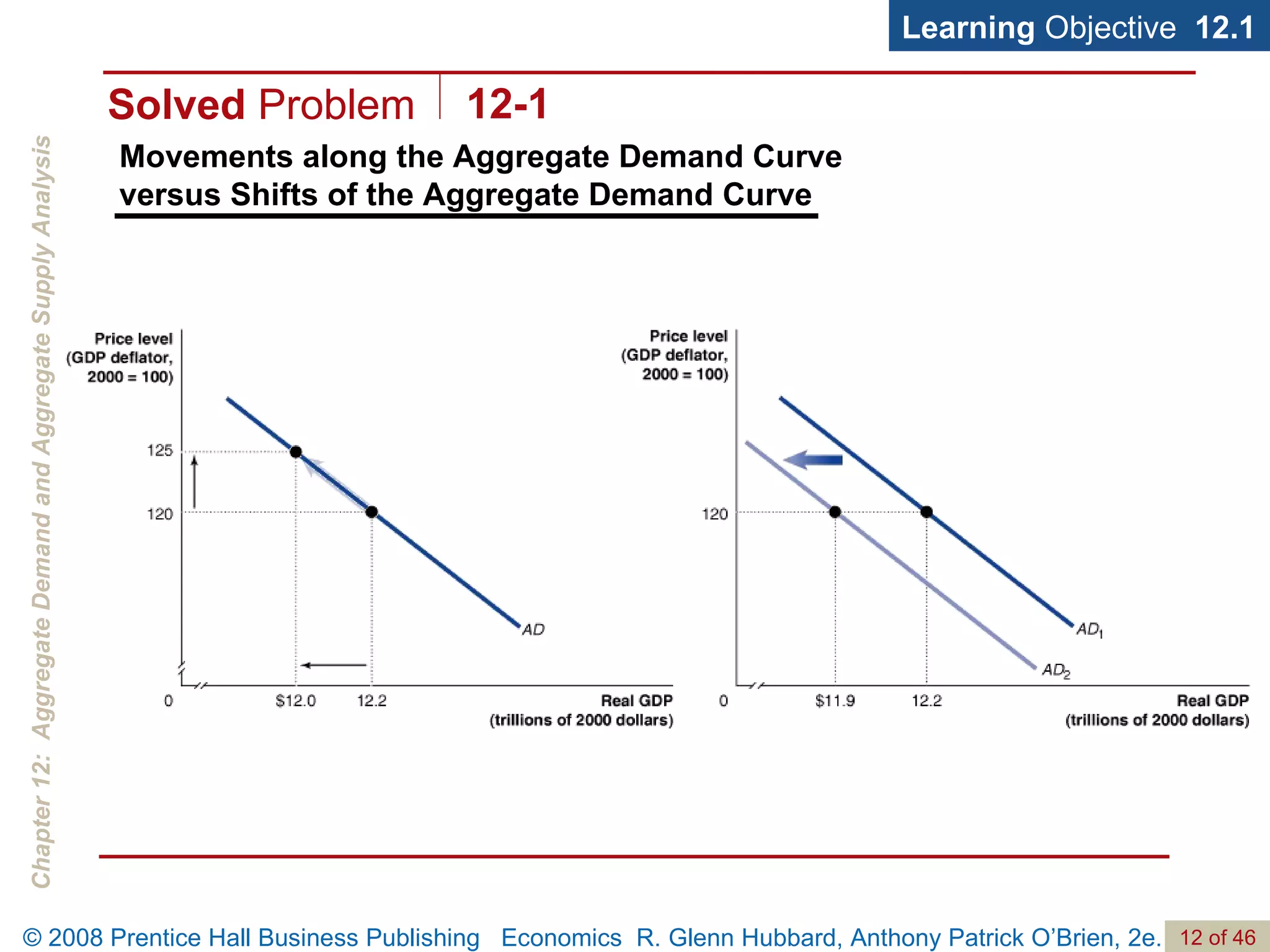
Aggregate Demand Learning  Objective  12.1 An important point to remember is that the aggregate demand curve tells us the  relationship between the price level and the quantity of real GDP demanded,  holding everything else constant . Shifts of the Aggregate Demand Curve versus Movements Along It
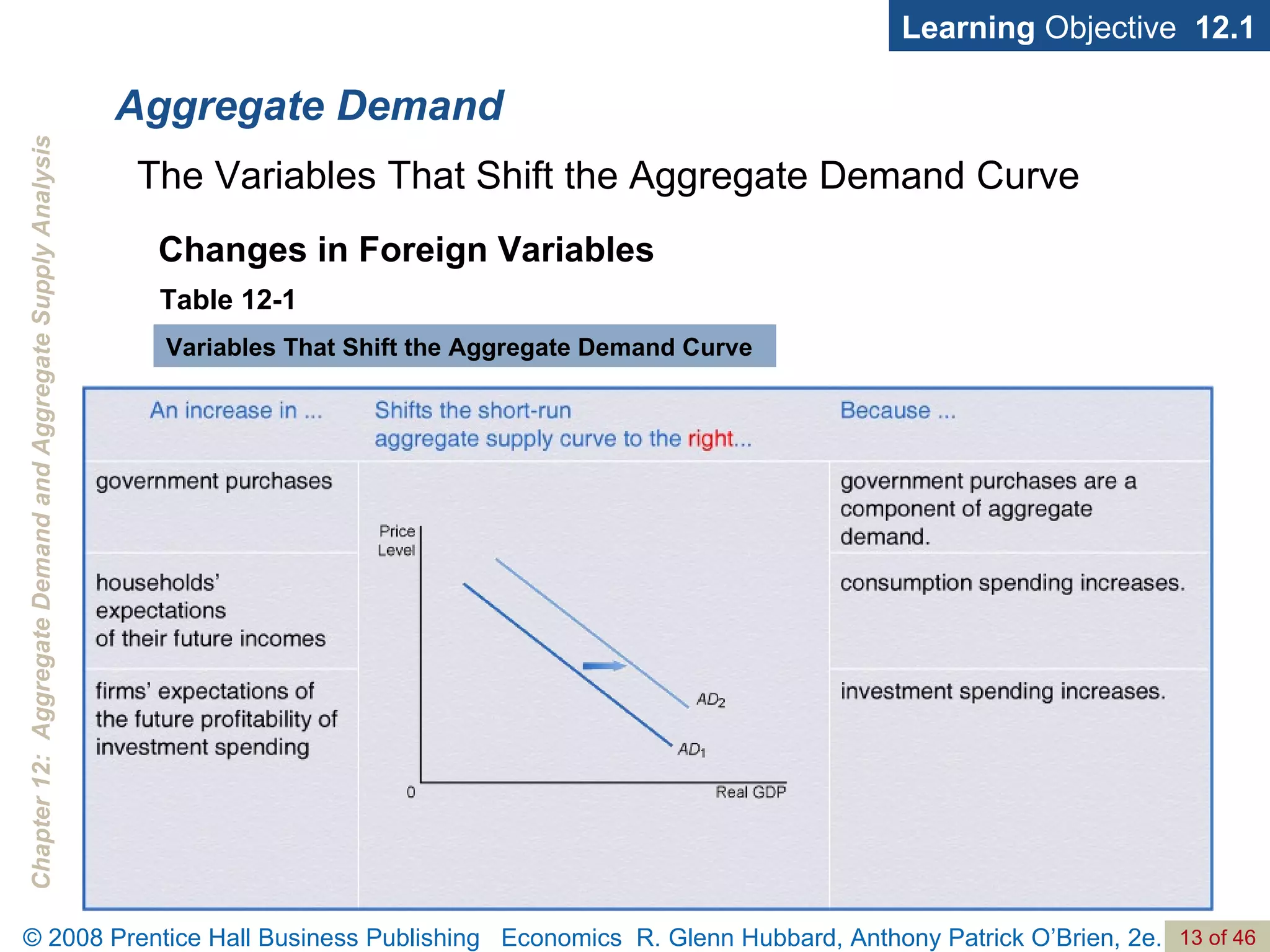
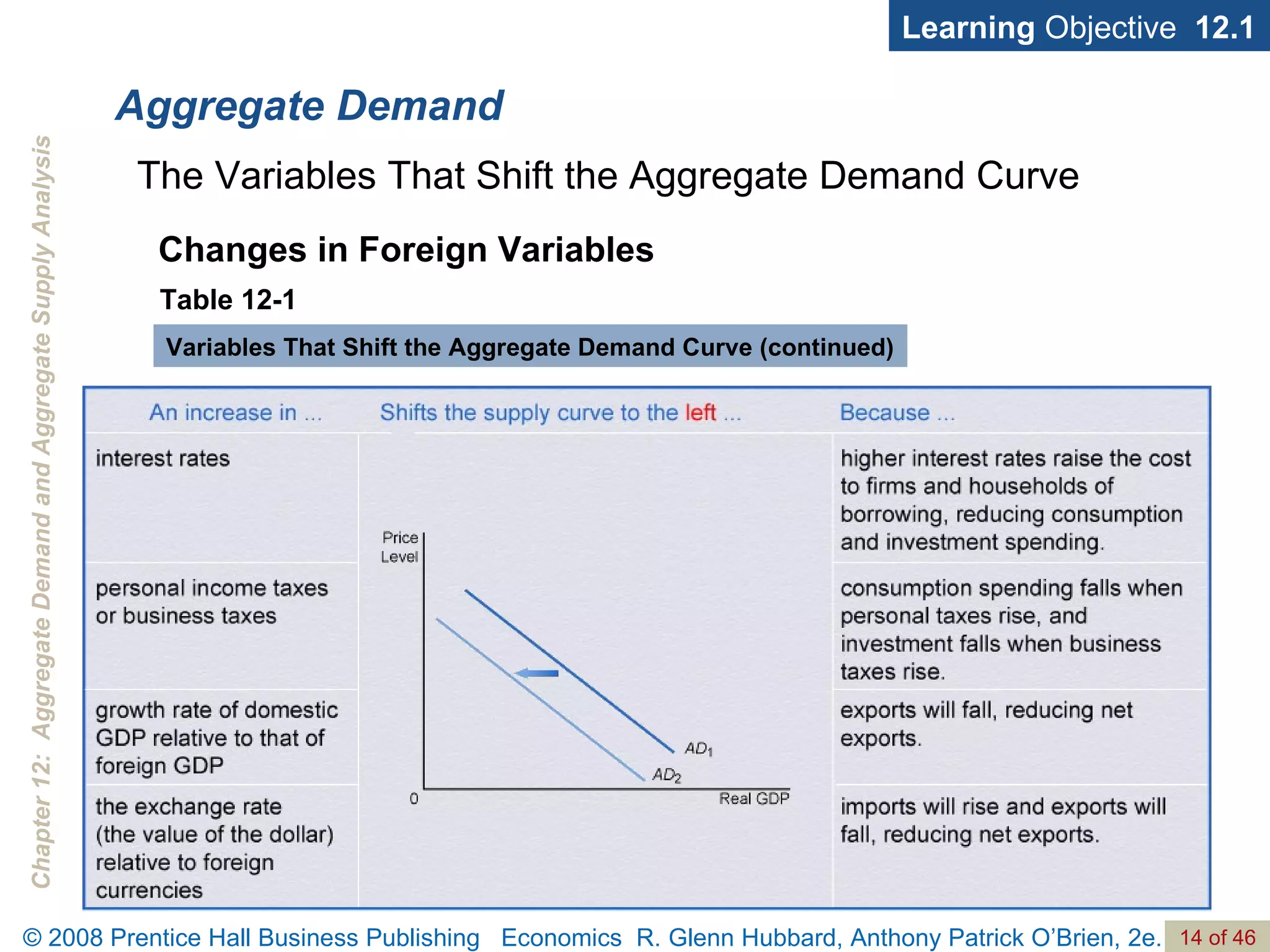
Aggregate Demand Learning  Objective  12.1 •  Changes in government policies •  Changes in the expectations of households and firms •  Changes in foreign variables The Variables That Shift the Aggregate Demand Curve Don’t Let This Happen to  YOU! Be Clear Why the Aggregate Demand Curve Is Downward Sloping The variables that cause the aggregate demand curve to shift fall into three categories:
Aggregate Demand Learning  Objective  12.1 Monetary policy   The actions the Federal Reserve takes to manage the money supply and interest rates to pursue macroeconomic policy objectives. The Variables That Shift the Aggregate Demand Curve Changes in Government Policies Fiscal policy   Changes in federal taxes and purchases that are intended to achieve macroeconomic policy objectives, such as high employment, price stability, and high rates of economic growth.
Aggregate Demand Learning  Objective  12.1 If households become more optimistic about their future incomes, they are likely to increase their current consumption. The Variables That Shift the Aggregate Demand Curve Changes in the Expectations of Households and Firms If firms and households in other countries buy fewer U.S. goods or if firms and households in the United States buy more foreign goods, net exports will fall, and the aggregate demand curve will shift to the left. Changes in Foreign Variables
In a Global Economy, How Can You Tell  the Imports from the Domestic Goods? Learning  Objective  12.1 Is the Toyota Sienna as American as apple pie? Making the Connection
Movements along the Aggregate Demand Curve  versus Shifts of the Aggregate Demand Curve Learning  Objective  12.1 Solved  Problem 12-1
Aggregate Demand Learning  Objective  12.1 The Variables That Shift the Aggregate Demand Curve Changes in Foreign Variables Table 12-1 Variables That Shift the Aggregate Demand Curve
Aggregate Demand Learning  Objective  12.1 The Variables That Shift the Aggregate Demand Curve Changes in Foreign Variables Table 12-1 Variables That Shift the Aggregate Demand Curve (continued)
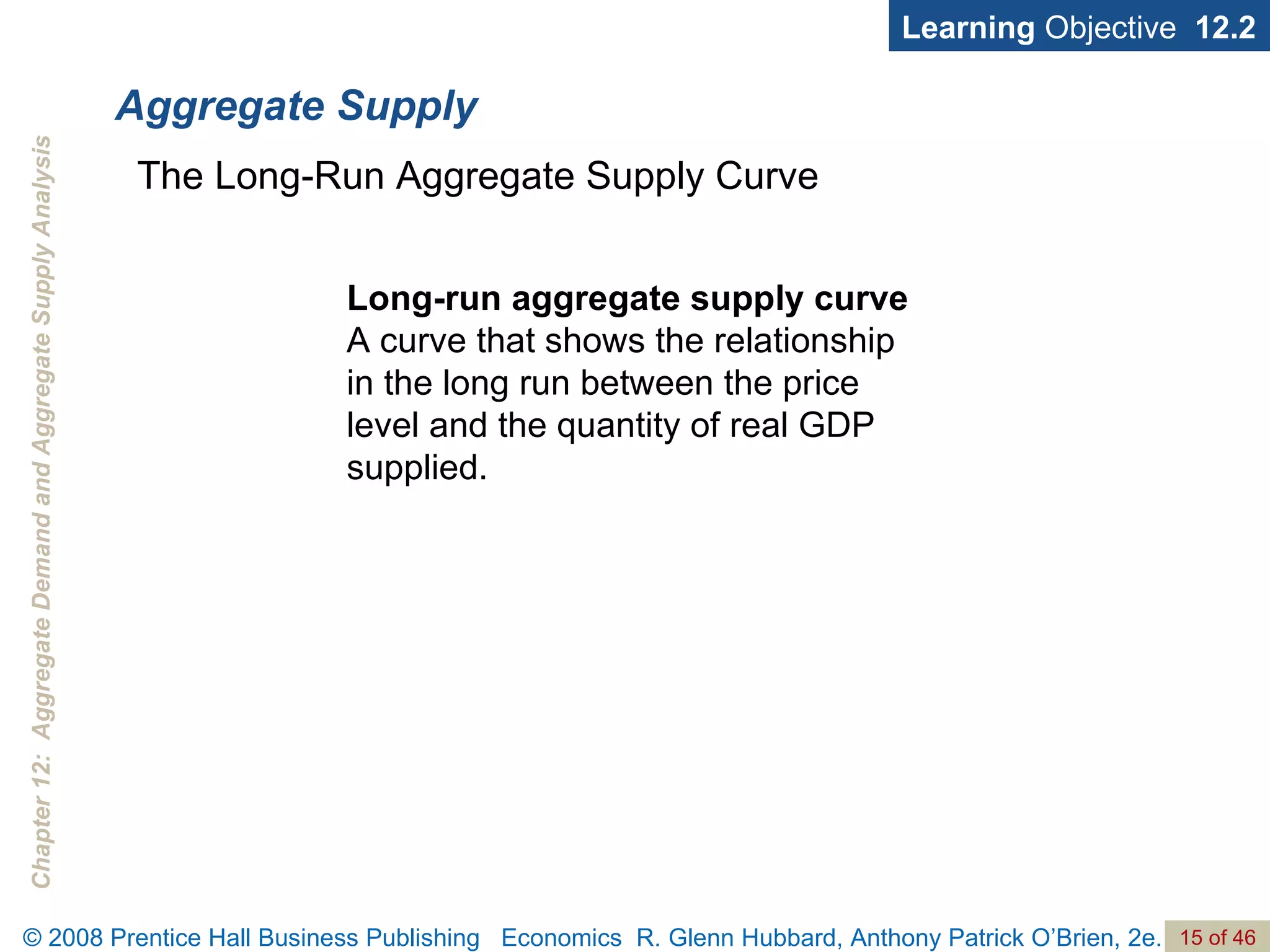
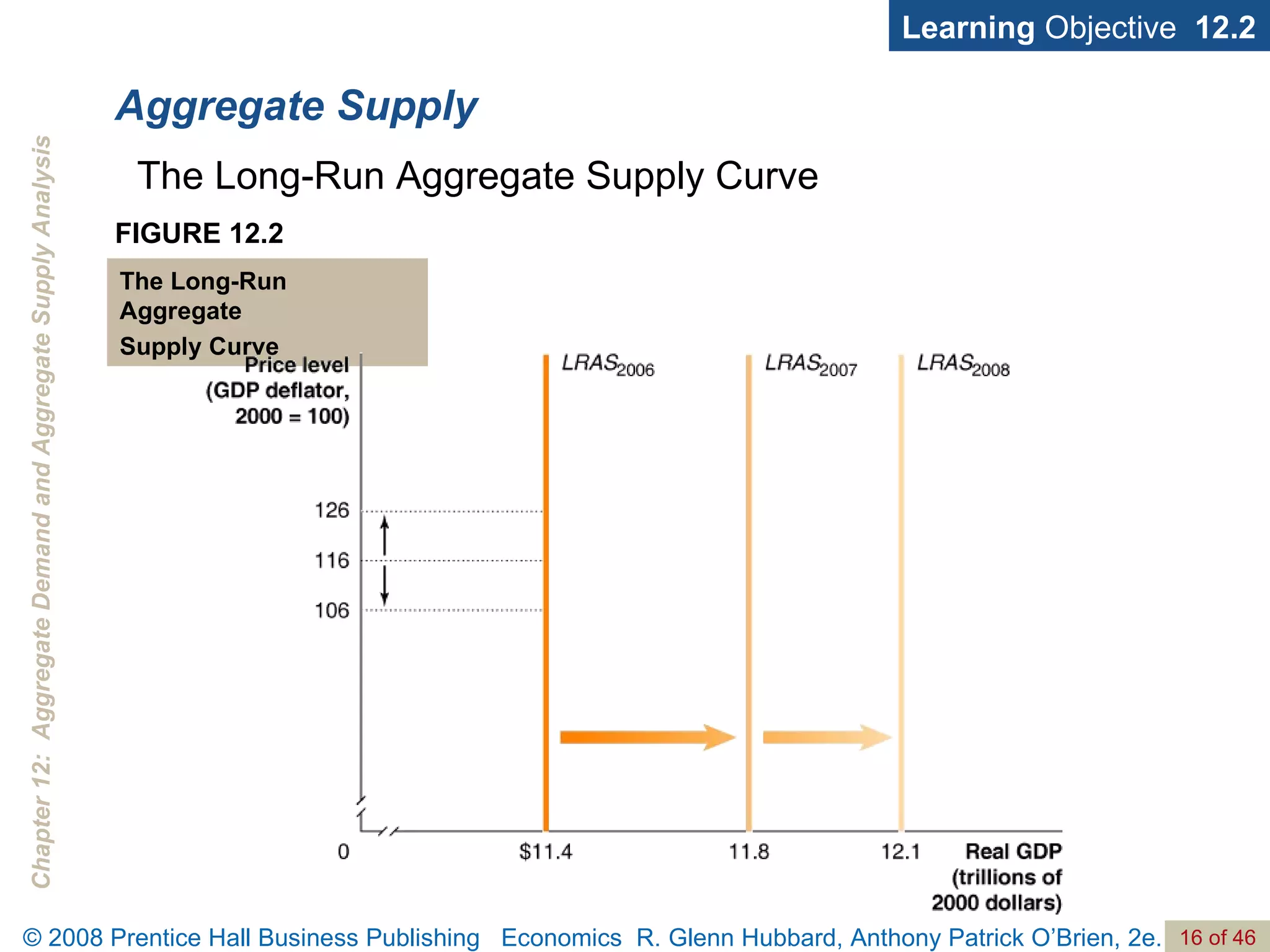
Aggregate Supply Learning  Objective  12.2 Long-run aggregate supply curve  A curve that shows the relationship in the long run between the price level and the quantity of real GDP supplied. The Long-Run Aggregate Supply Curve
Aggregate Supply Learning  Objective  12.2 The Long-Run Aggregate Supply Curve FIGURE 12.2 The Long-Run Aggregate Supply Curve
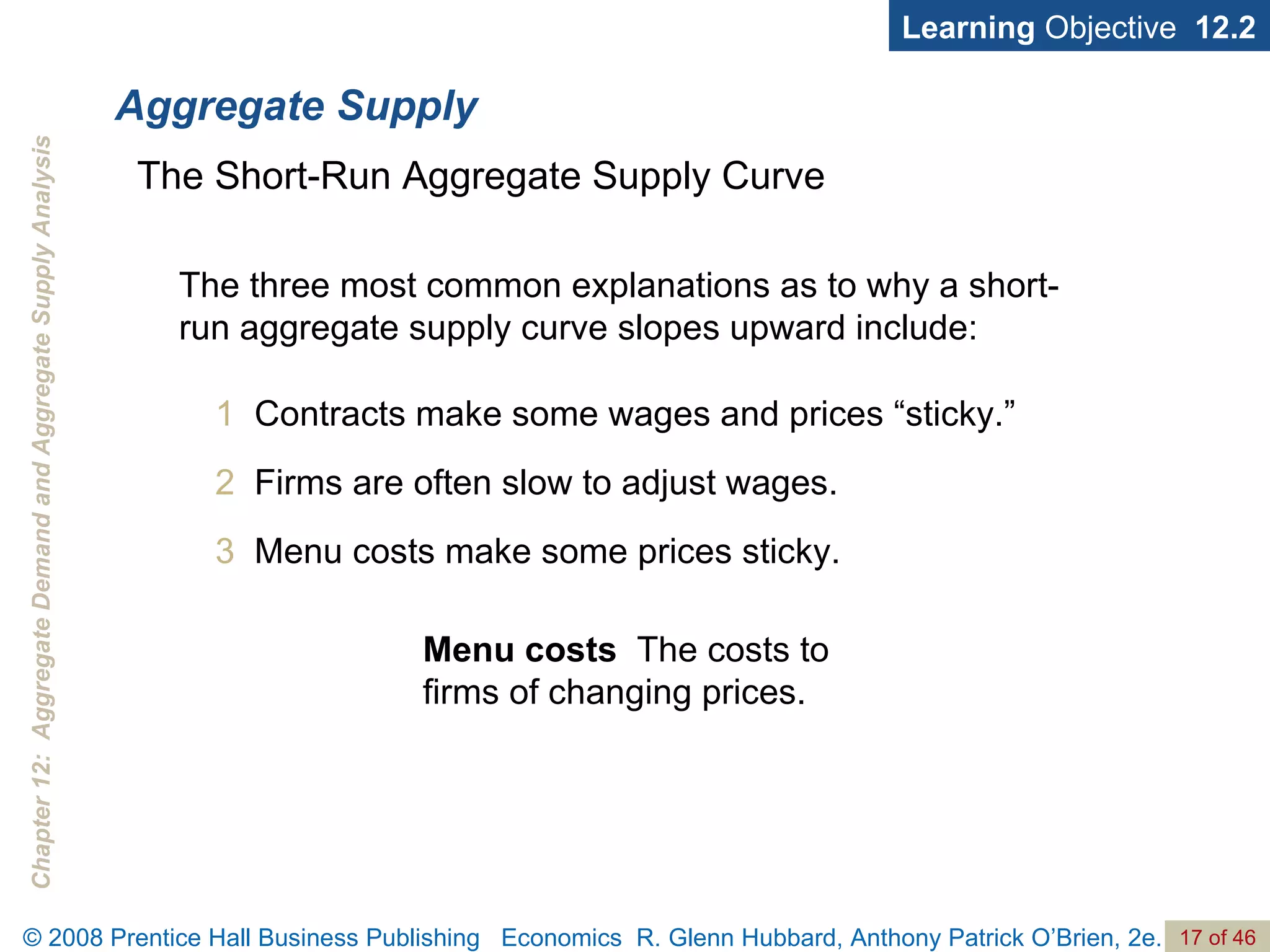
Aggregate Supply Learning  Objective  12.2 1   Contracts make some wages and prices “sticky.” 2   Firms are often slow to adjust wages. 3  Menu costs make some prices sticky. The Short-Run Aggregate Supply Curve The three most common explanations as to why a short-run aggregate supply curve slopes upward include: Menu costs   The costs to firms of changing prices.

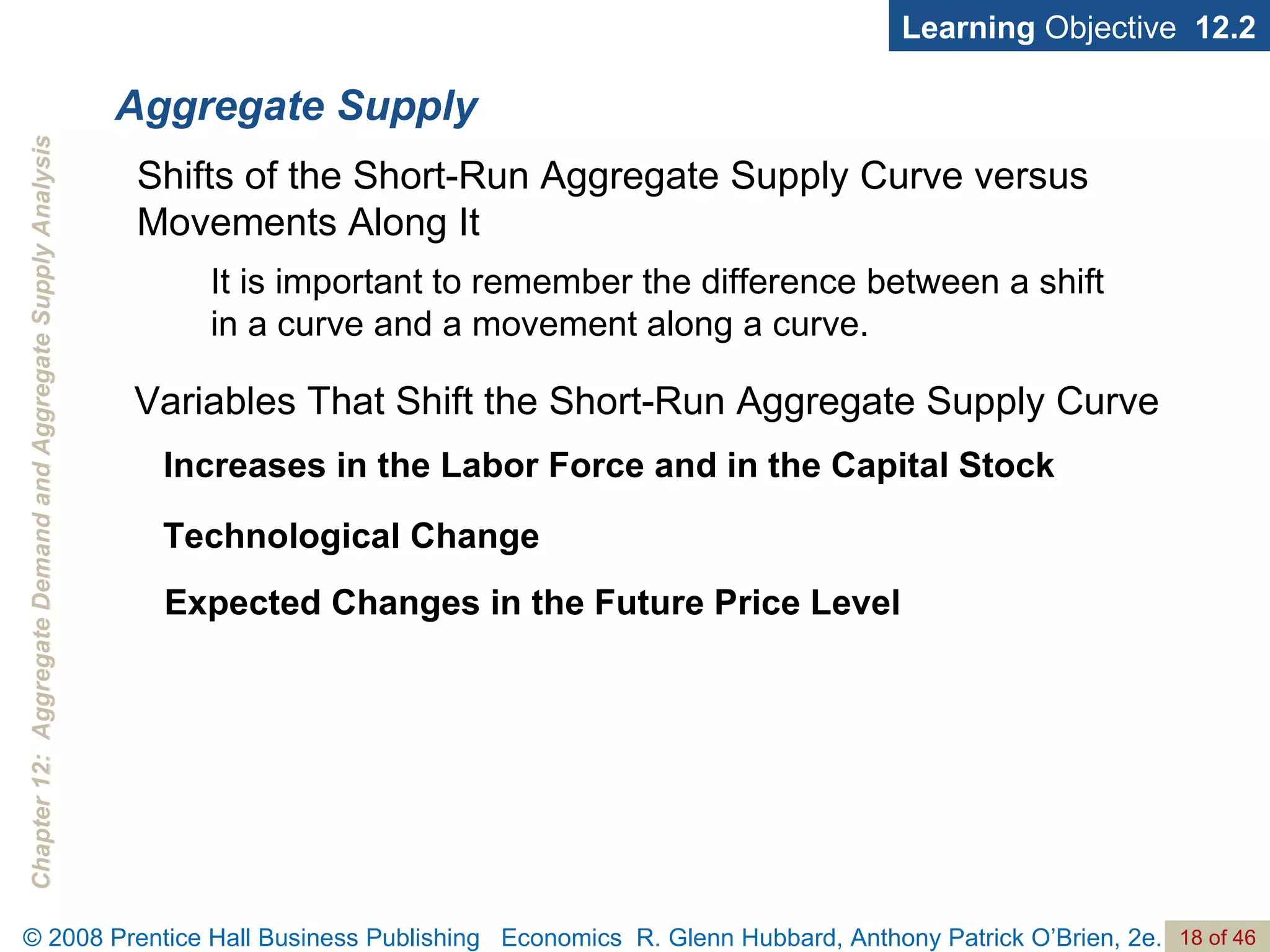
Aggregate Supply Learning  Objective  12.2 Shifts of the Short-Run Aggregate Supply Curve versus Movements Along It It is important to remember the difference between a shift in a curve and a movement along a curve. Increases in the Labor Force and in the Capital Stock Variables That Shift the Short-Run Aggregate Supply Curve Technological Change Expected Changes in the Future Price Level
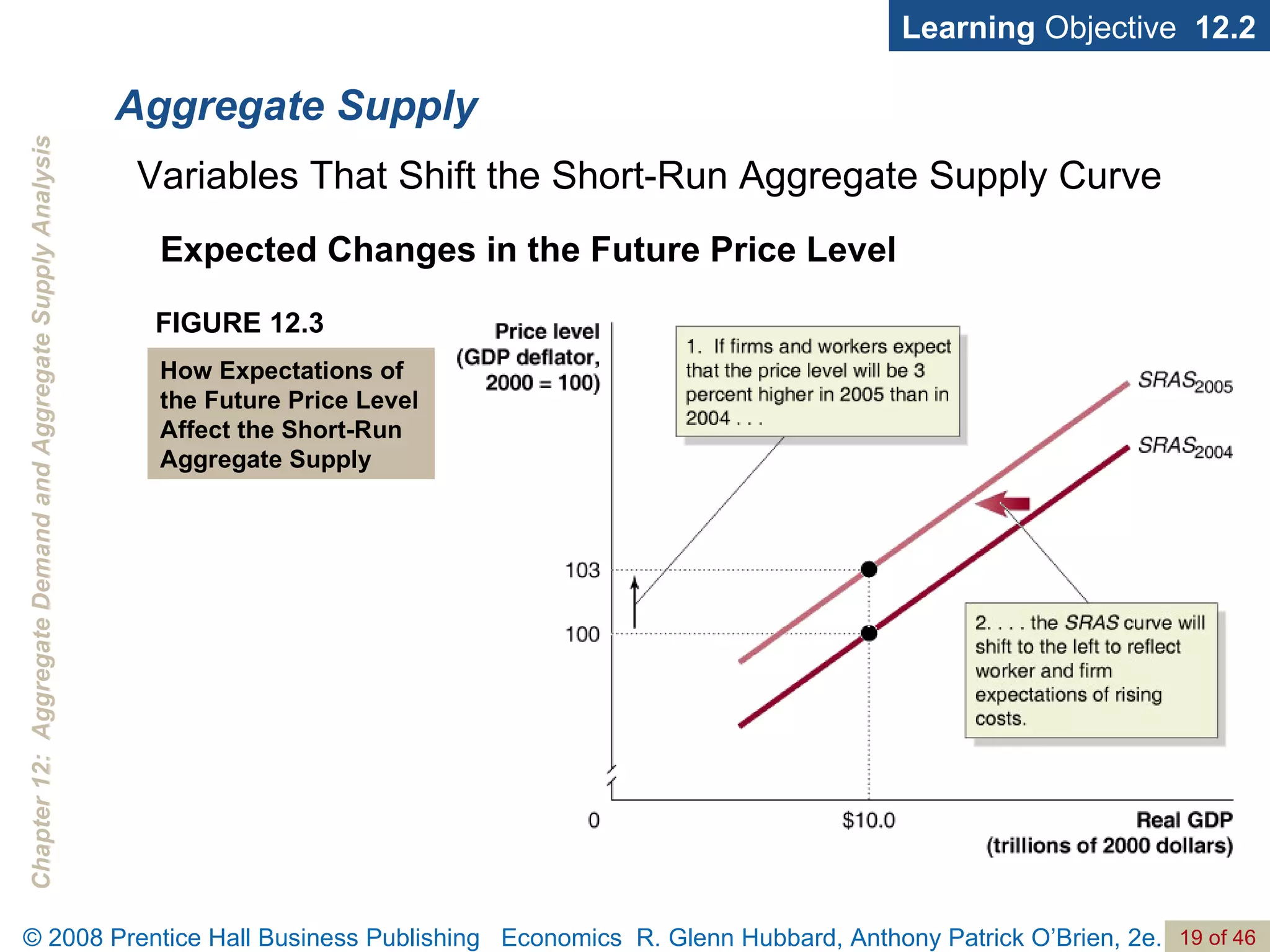
Aggregate Supply Learning  Objective  12.2 Variables That Shift the Short-Run Aggregate Supply Curve Expected Changes in the Future Price Level FIGURE 12.3 How Expectations of the Future Price Level Affect the Short-Run Aggregate Supply
Aggregate Supply Learning  Objective  12.2 Variables That Shift the Short-Run Aggregate Supply Curve Adjustments of Workers and Firms to Errors in Past Expectations about the Price Level Unexpected Changes in the Price of an Important  Natural Resource Supply shock   An unexpected event that causes the short-run aggregate supply curve to shift.
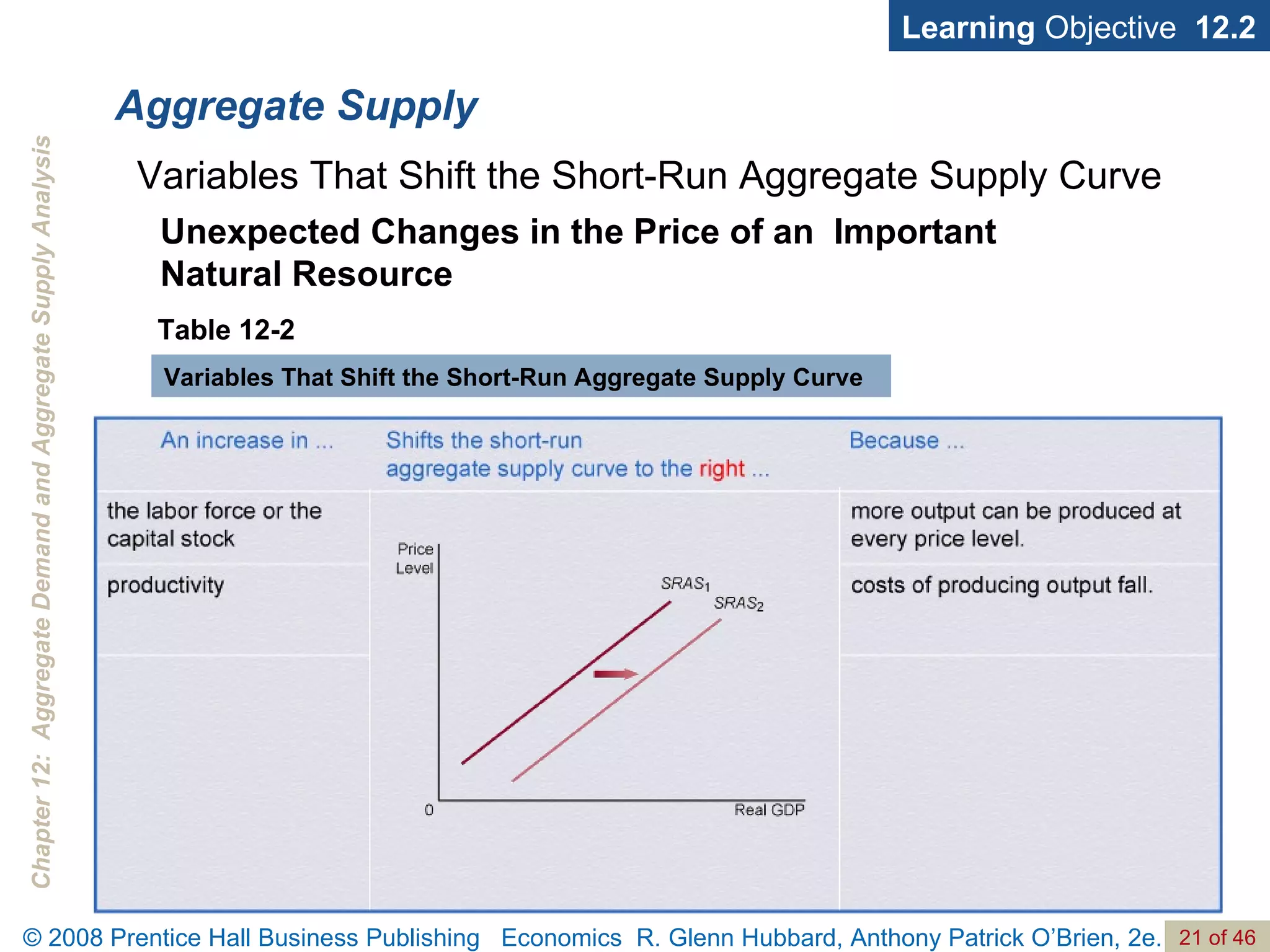
Aggregate Supply Learning  Objective  12.2 Variables That Shift the Short-Run Aggregate Supply Curve Unexpected Changes in the Price of an  Important Natural Resource Table 12-2 Variables That Shift the Short-Run Aggregate Supply Curve
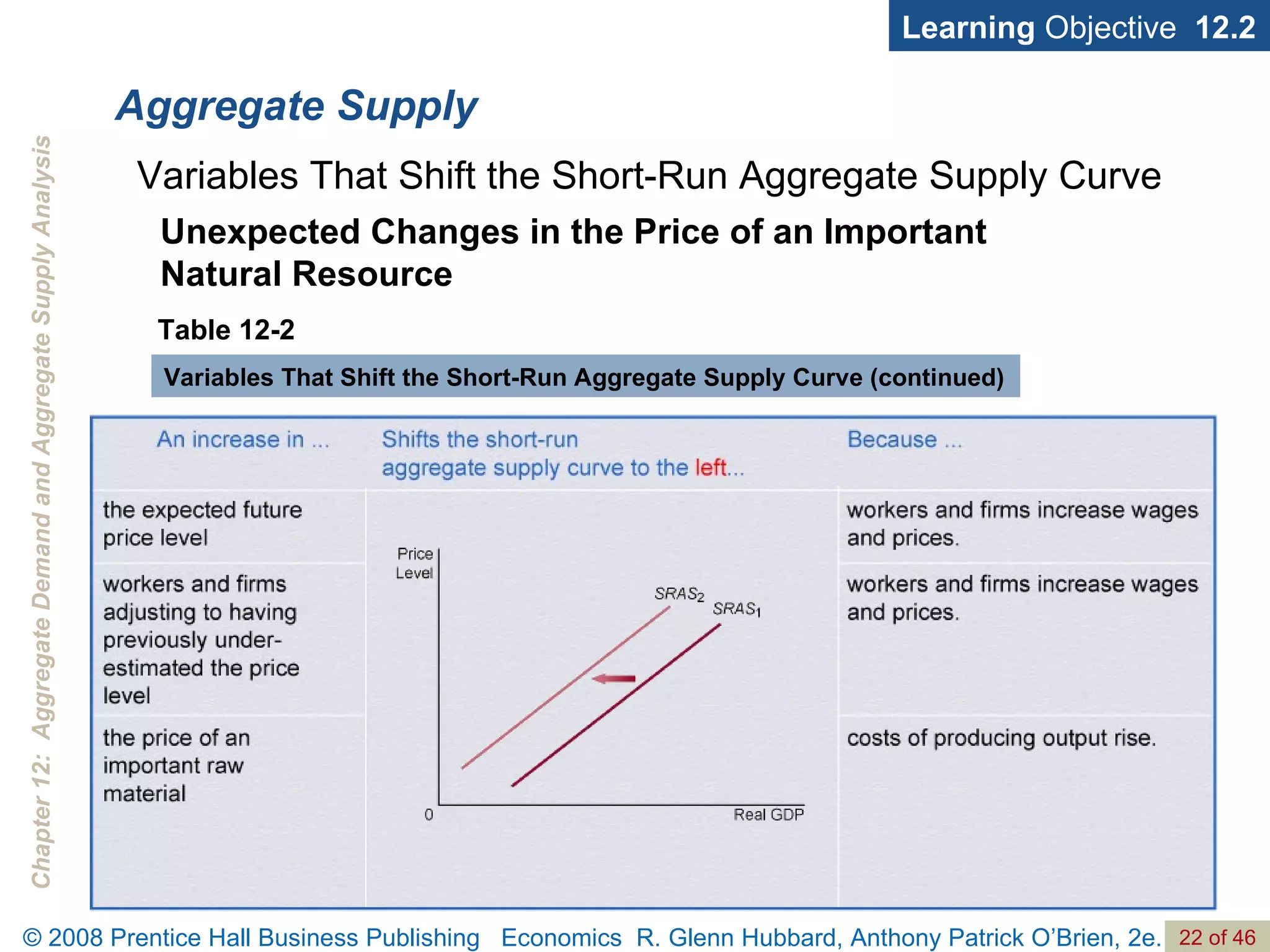
Aggregate Supply Learning  Objective  12.2 Variables That Shift the Short-Run Aggregate Supply Curve Unexpected Changes in the Price of an Important  Natural Resource Table 12-2 Variables That Shift the Short-Run Aggregate Supply Curve (continued)
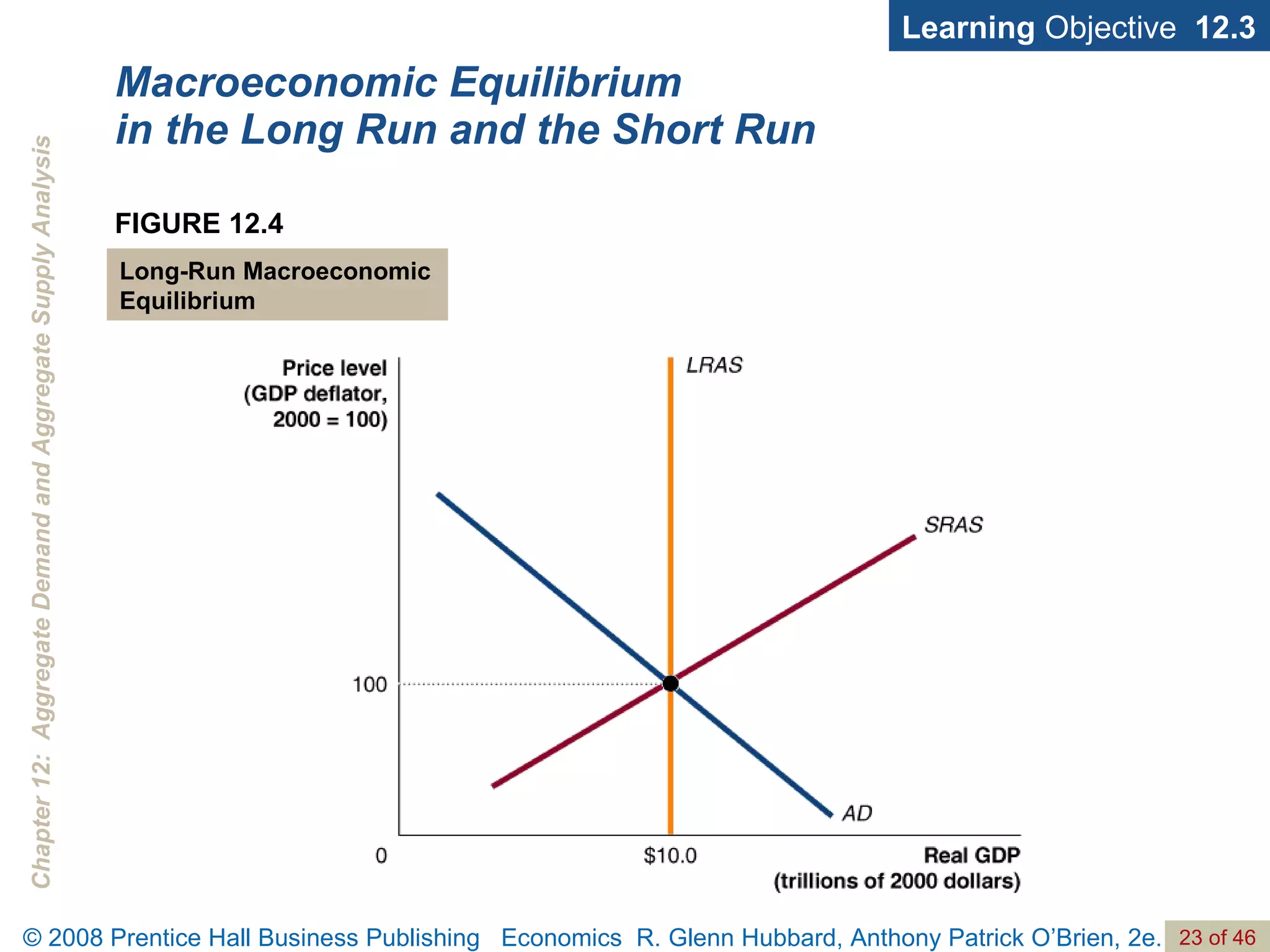
Macroeconomic Equilibrium in the Long Run and the Short Run Learning  Objective  12.3 FIGURE 12.4 Long-Run Macroeconomic Equilibrium
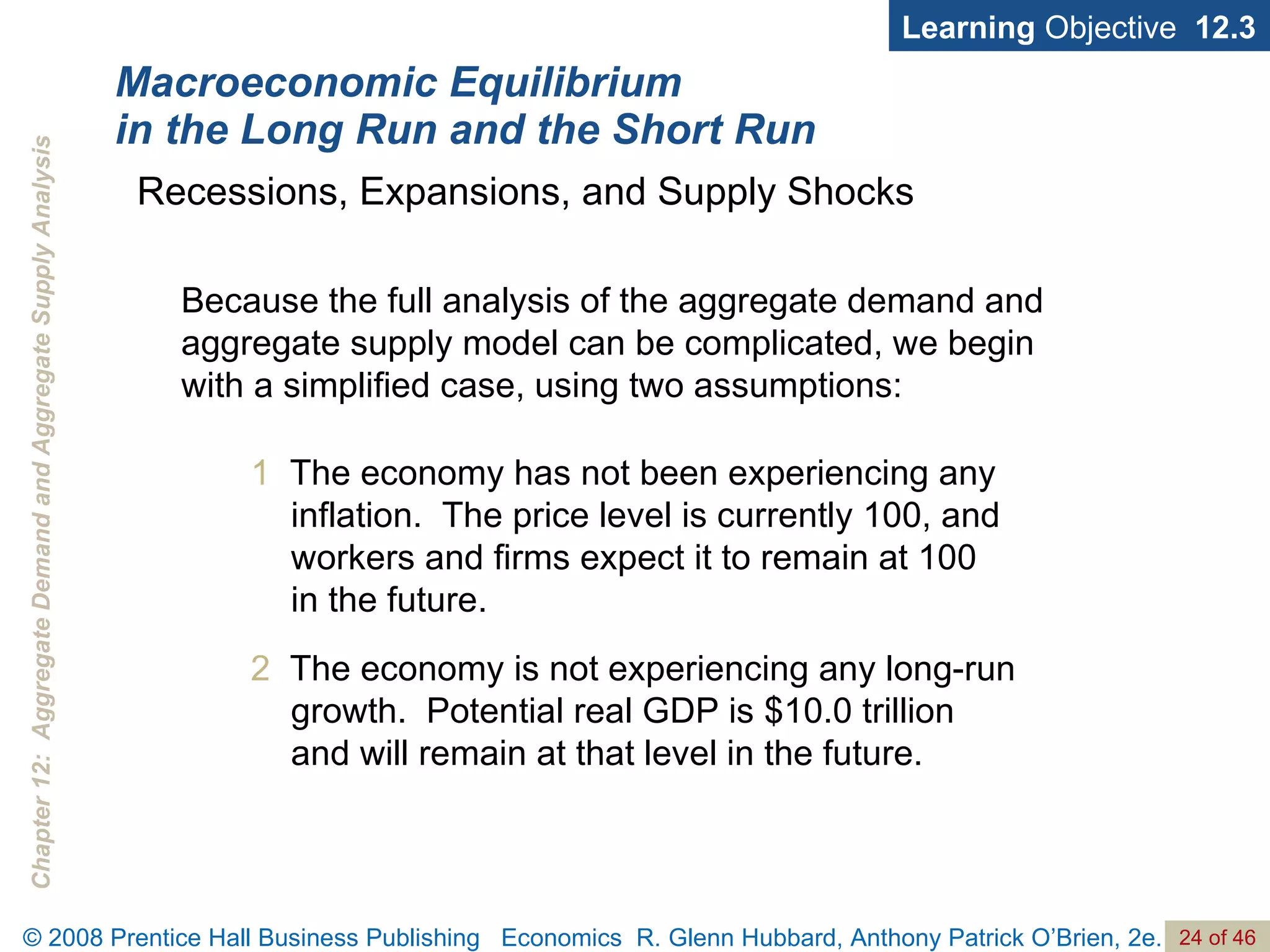
Macroeconomic Equilibrium in the Long Run and the Short Run Learning  Objective  12.3 1   The economy has not been experiencing any inflation.  The price level is currently 100, and workers and firms expect it to remain at 100  in the future. 2   The economy is not experiencing any long-run growth.  Potential real GDP is $10.0 trillion and will remain at that level in the future. Recessions, Expansions, and Supply Shocks Because the full analysis of the aggregate demand and aggregate supply model can be complicated, we begin with a simplified case, using two assumptions:
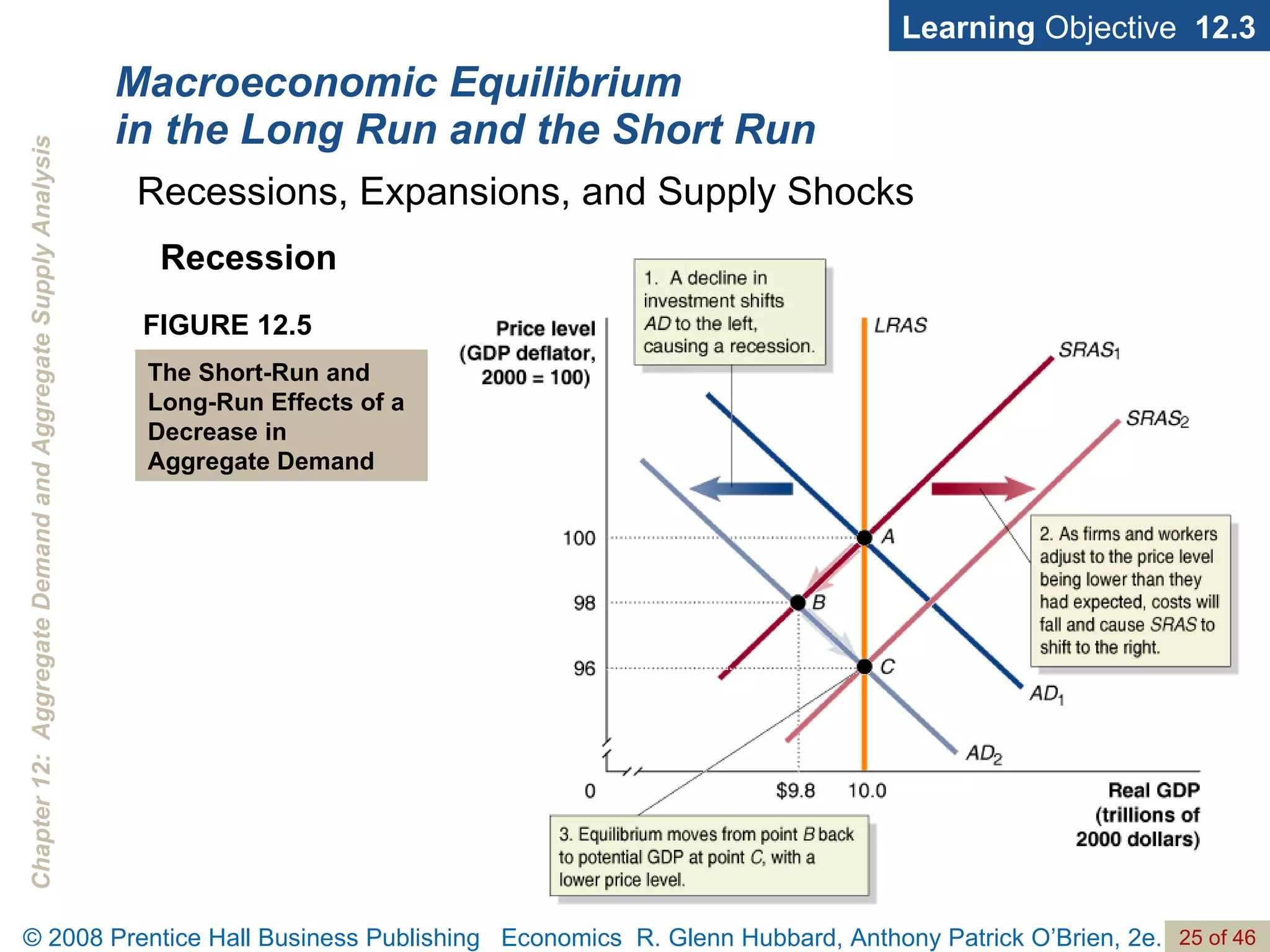
Macroeconomic Equilibrium in the Long Run and the Short Run Learning  Objective  12.3 Recessions, Expansions, and Supply Shocks Recession FIGURE 12.5 The Short-Run and Long-Run Effects of a Decrease in Aggregate Demand
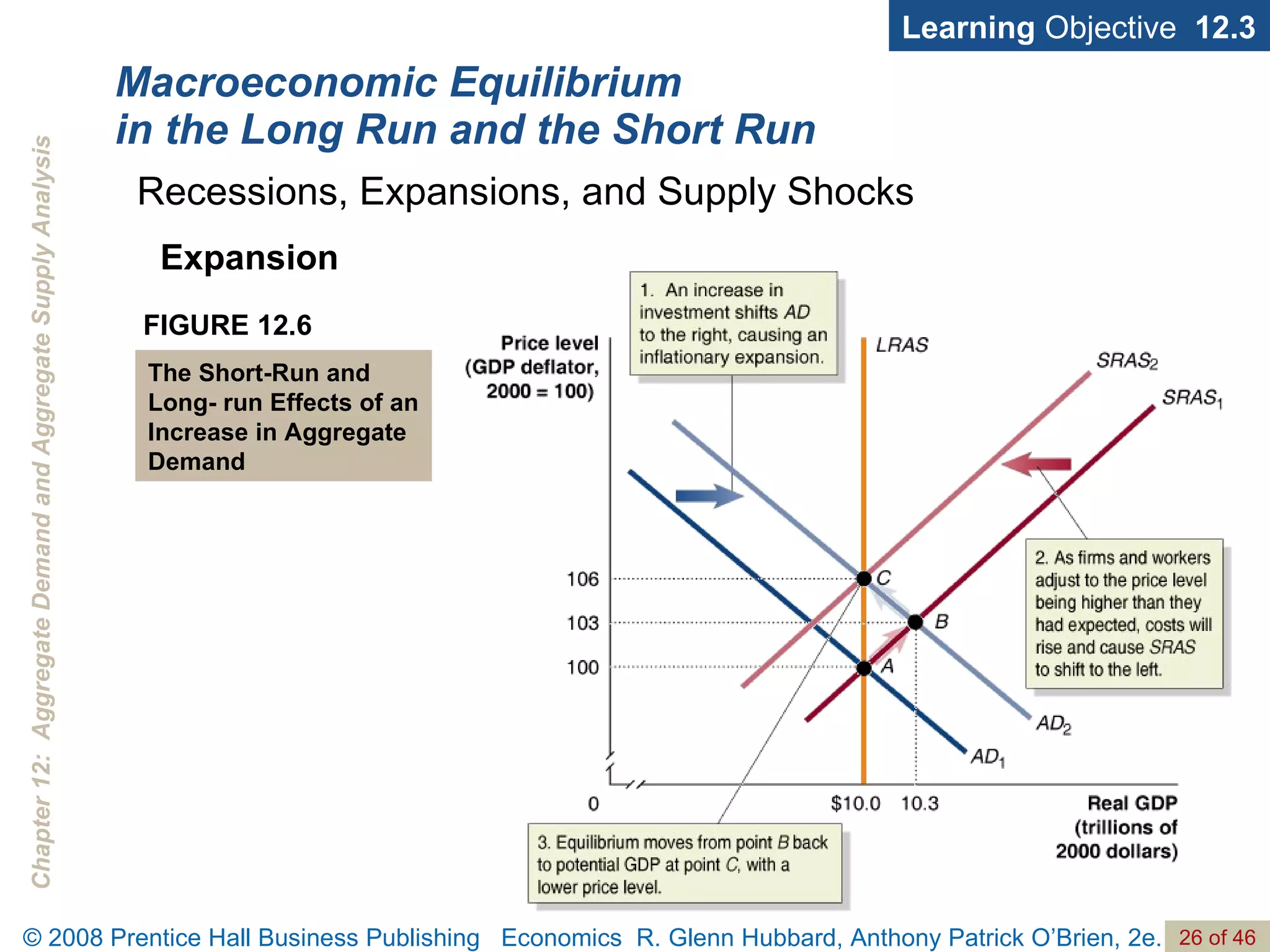
Macroeconomic Equilibrium in the Long Run and the Short Run Learning  Objective  12.3 Recessions, Expansions, and Supply Shocks Expansion FIGURE 12.6 The Short-Run and Long- run Effects of an Increase in Aggregate Demand
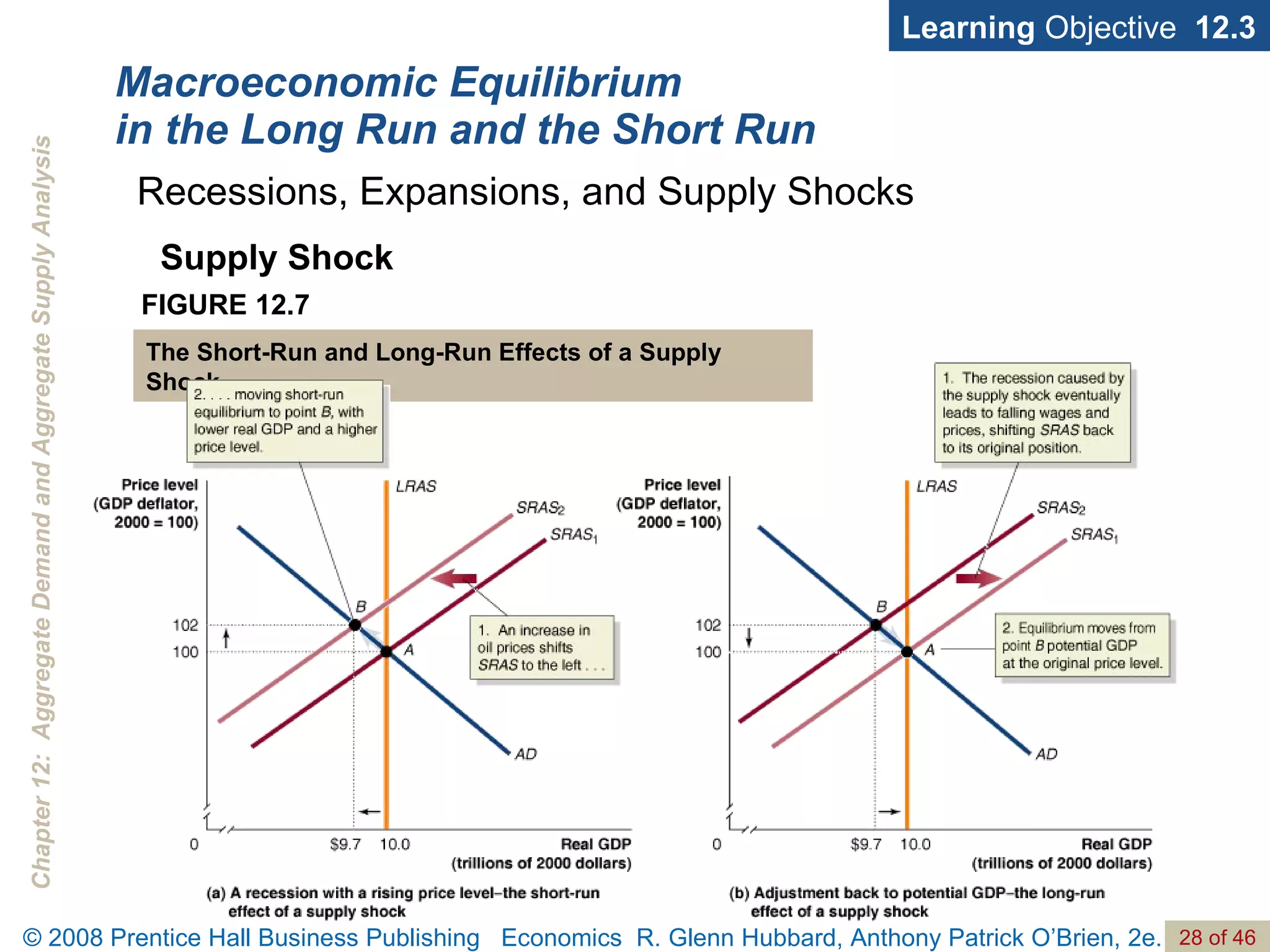
Macroeconomic Equilibrium in the Long Run and the Short Run Learning  Objective  12.3 Recessions, Expansions, and Supply Shocks Stagflation   A combination of inflation and recession, usually resulting from a supply shock. Supply Shock
Macroeconomic Equilibrium in the Long Run and the Short Run Learning  Objective  12.3 Supply Shock FIGURE 12.7 The Short-Run and Long-Run Effects of a Supply Shock Recessions, Expansions, and Supply Shocks
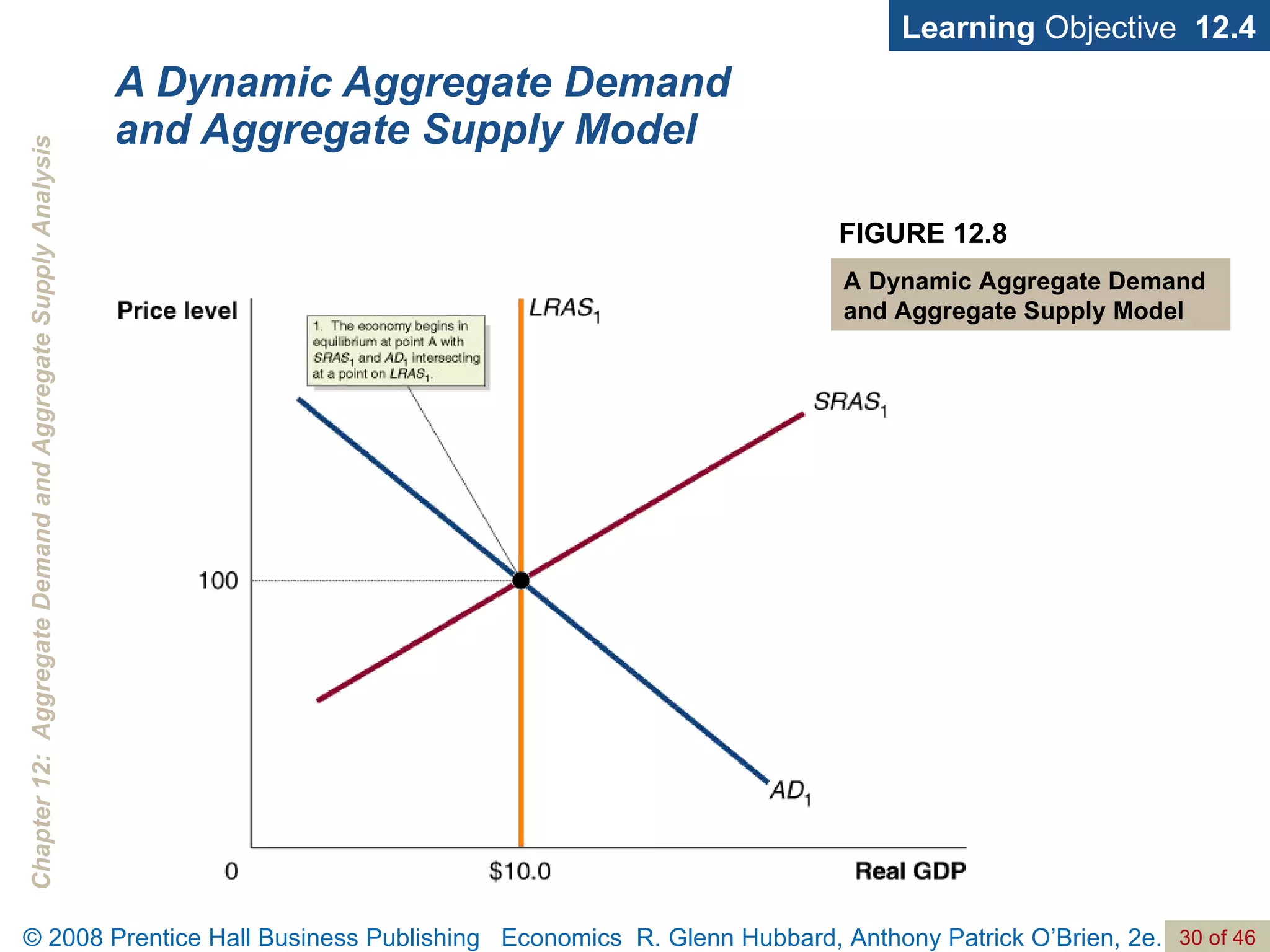
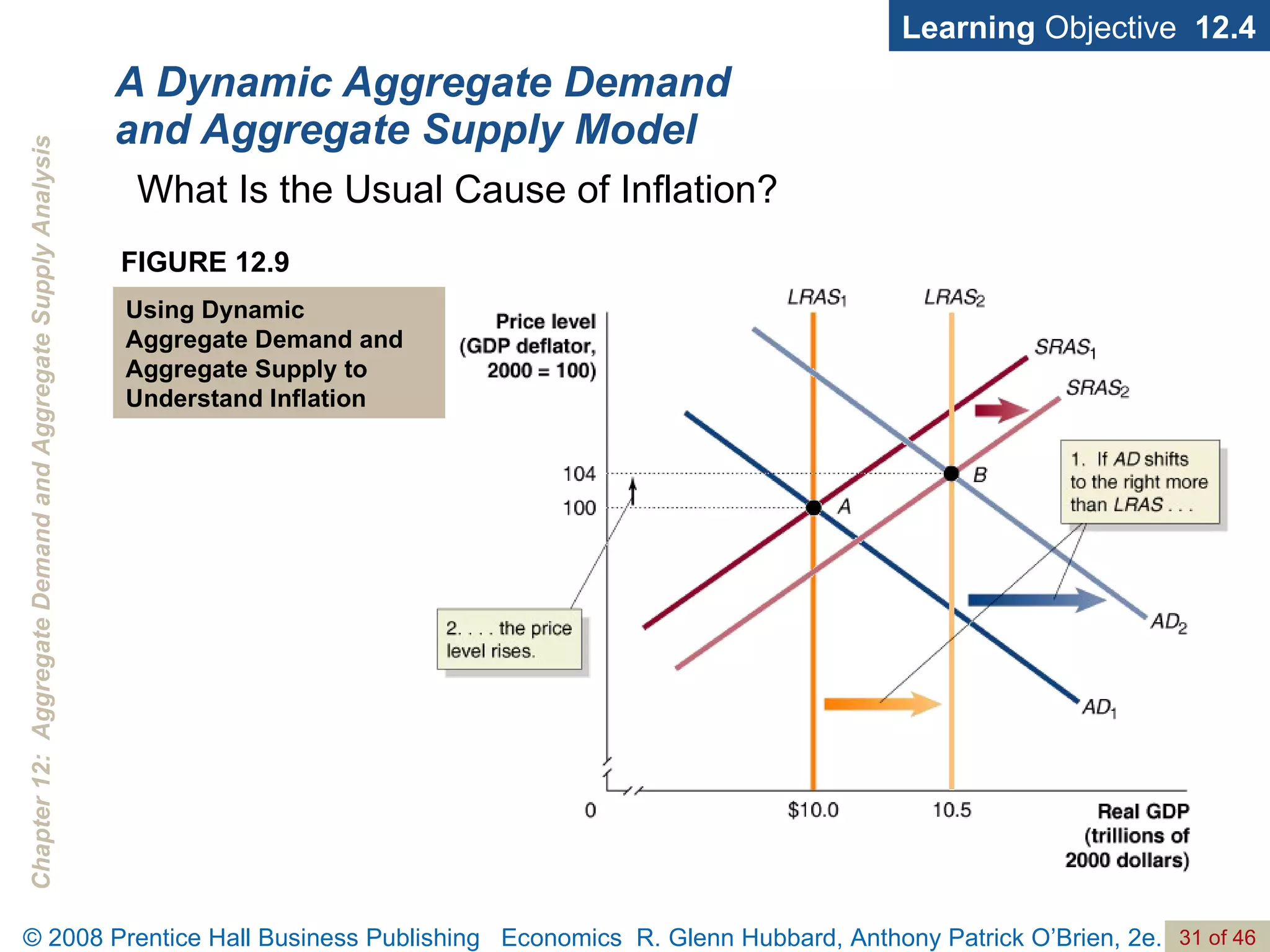
A Dynamic Aggregate Demand and Aggregate Supply Model Learning  Objective  12.4 •  Potential real GDP increases continually, shifting the long-run aggregate supply curve to the right. •  During most years, the aggregate demand curve will be shifting to the right. •  Except during periods when workers and firms expect high rates of inflation, the short-run aggregate supply curve will be shifting to the right. We can create a  dynamic aggregate demand and aggregate supply model  by making three changes to the basic model.
A Dynamic Aggregate Demand and Aggregate Supply Model Learning  Objective  12.4 FIGURE 12.8 A Dynamic Aggregate Demand  and Aggregate Supply Model
A Dynamic Aggregate Demand and Aggregate Supply Model Learning  Objective  12.4 FIGURE 12.9 Using Dynamic Aggregate Demand and Aggregate Supply to Understand Inflation What Is the Usual Cause of Inflation?
A Dynamic Aggregate Demand and Aggregate Supply Model Learning  Objective  12.4 •  The end of the stock market “bubble.” The Slow Recovery from the Recession of 2001 •  Excessive investment in information technology. •  The terrorist attacks of September 11, 2001. •  The corporate accounting scandals. The recession of 2001 was caused by a decline in aggregate demand.  Several factors contributed to this decline:
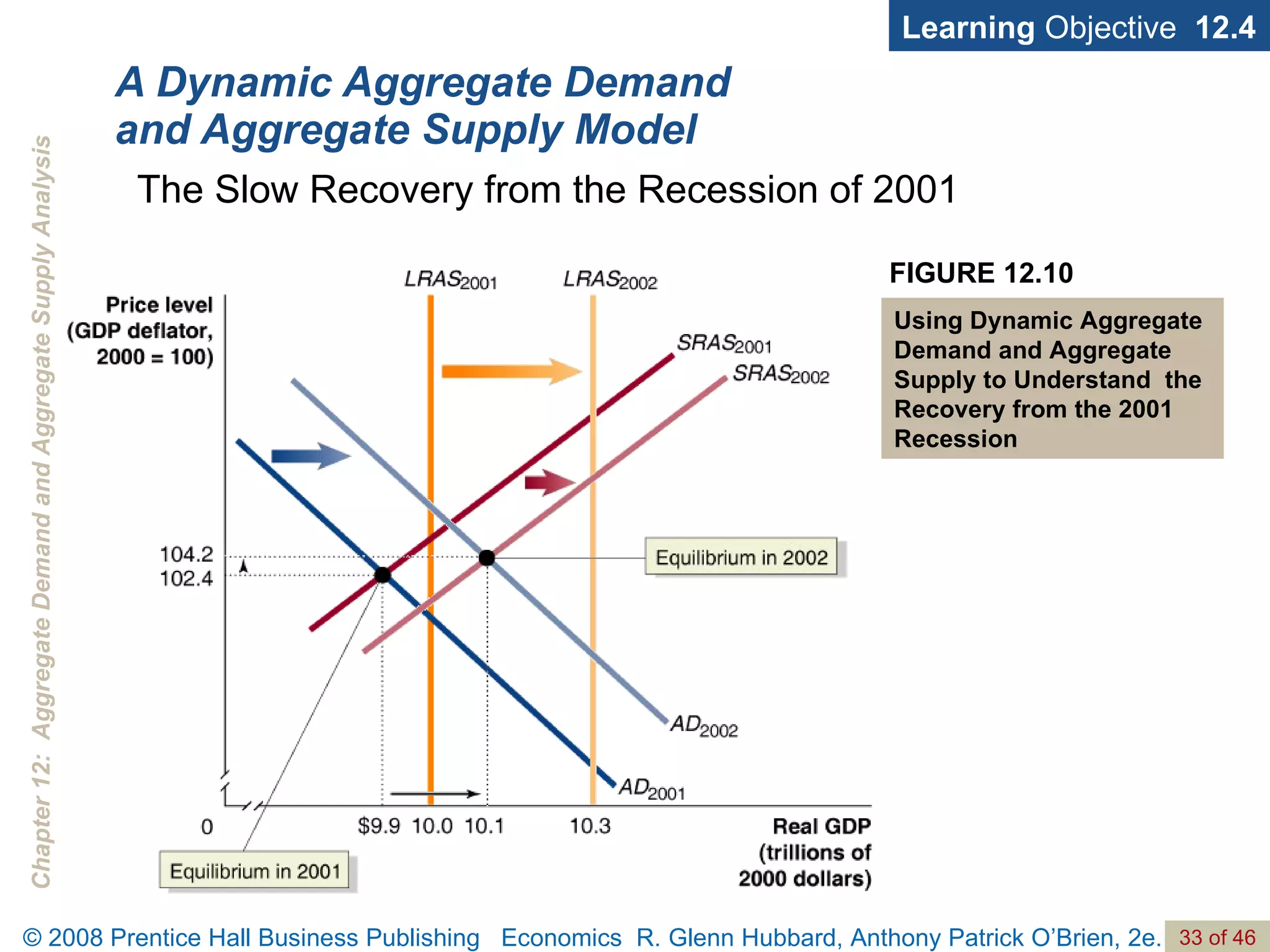
A Dynamic Aggregate Demand and Aggregate Supply Model Learning  Objective  12.4 The Slow Recovery from the Recession of 2001 FIGURE 12.10 Using Dynamic Aggregate Demand and Aggregate Supply to Understand  the Recovery from the 2001 Recession
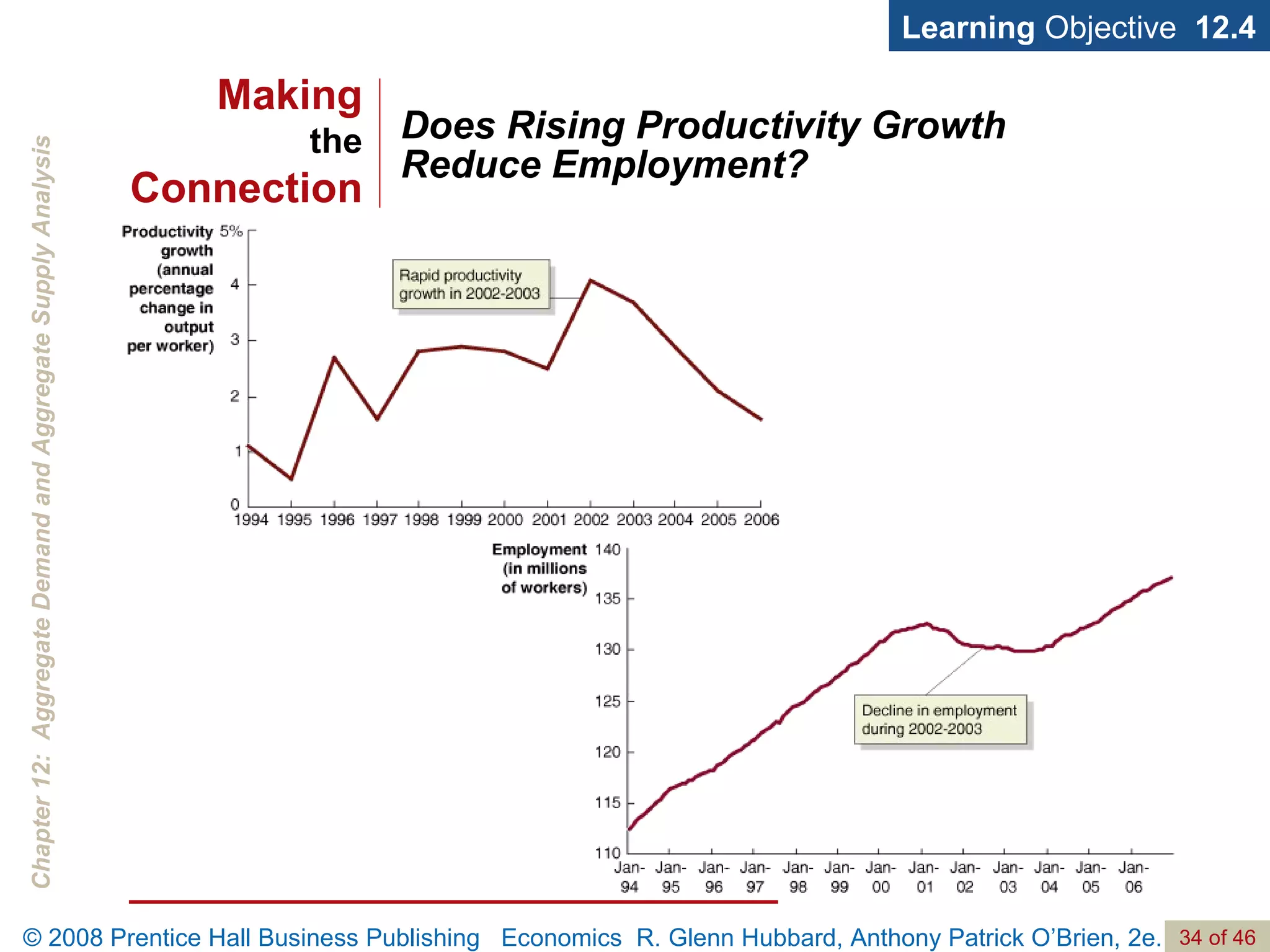
Does Rising Productivity Growth Reduce Employment? Learning  Objective  12.4 Making the Connection
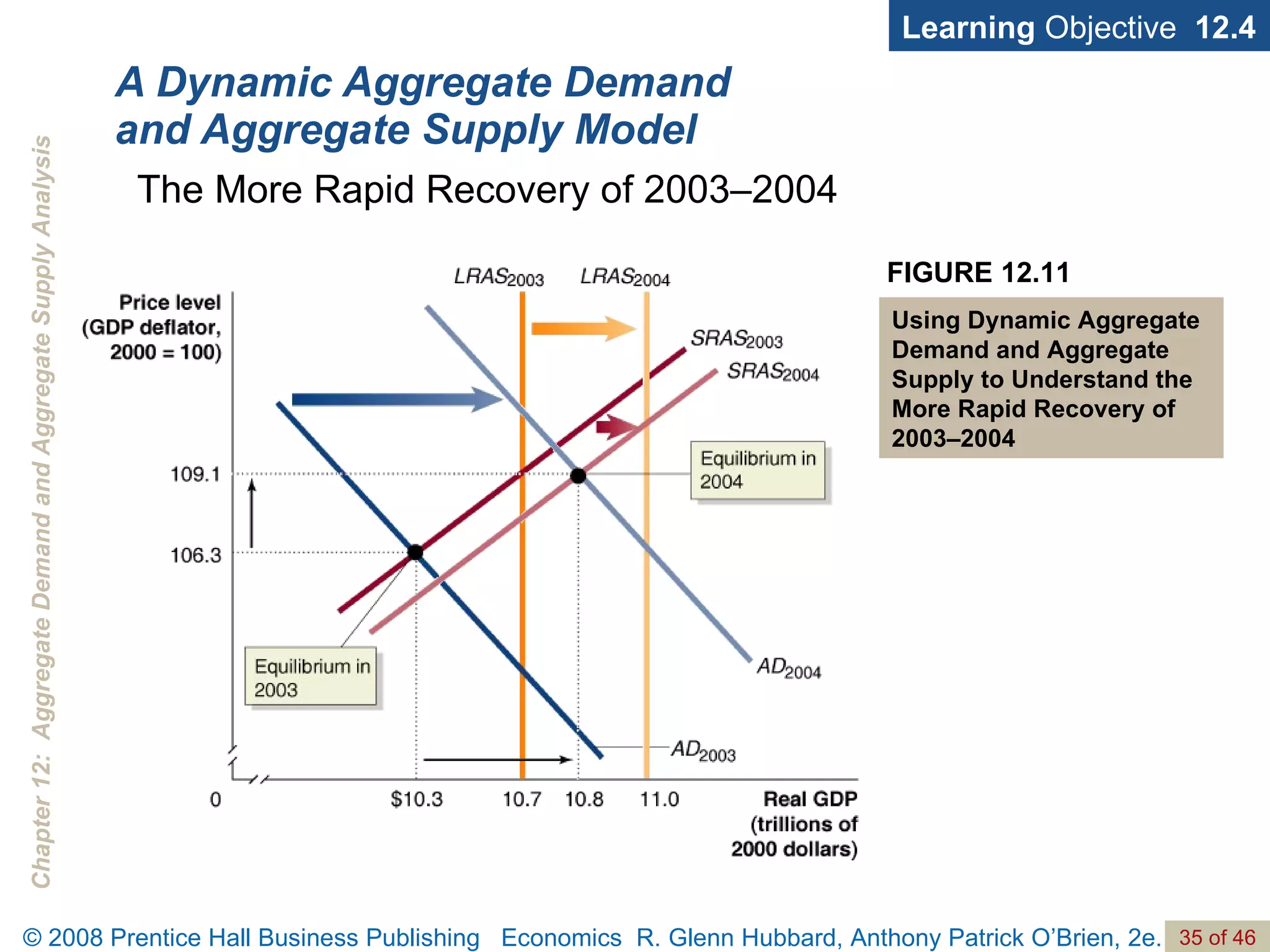
A Dynamic Aggregate Demand and Aggregate Supply Model Learning  Objective  12.4 The More Rapid Recovery of 2003–2004 FIGURE 12.11 Using Dynamic Aggregate Demand and Aggregate Supply to Understand the More Rapid Recovery of 2003–2004
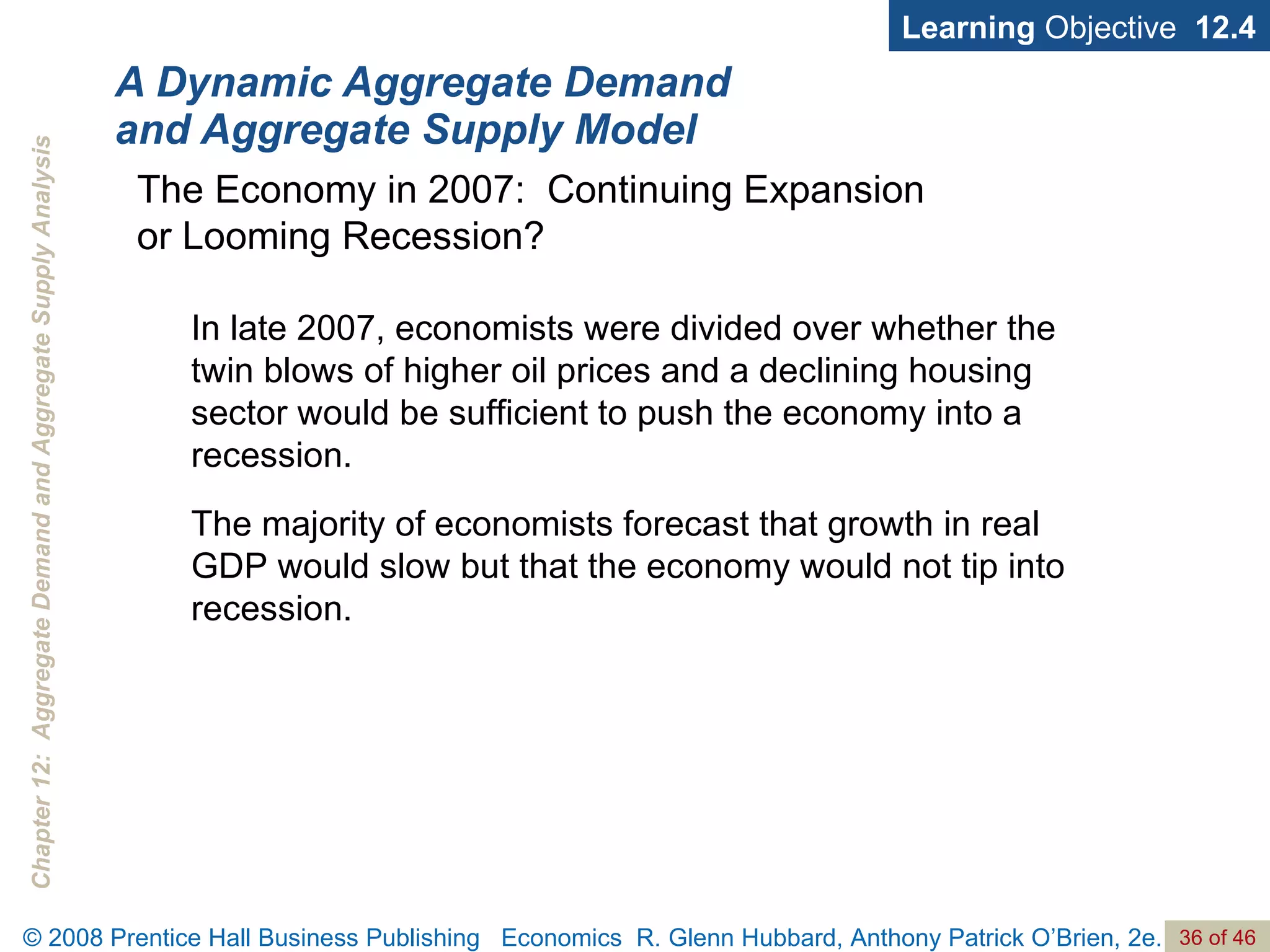
A Dynamic Aggregate Demand and Aggregate Supply Model Learning  Objective  12.4 In late 2007, economists were divided over whether the twin blows of higher oil prices and a declining housing sector would be sufficient to push the economy into a recession.  The majority of economists forecast that growth in real GDP would slow but that the economy would not tip into recession. The Economy in 2007:  Continuing Expansion  or Looming Recession?
Showing the Oil Shock of 1974–1975 on a Dynamic Aggregate Demand and Aggregate Supply Graph Learning  Objective  12.4 Solved  Problem 12-4 38.0 34.7 PRICE LEVEL $4.50 trillion $4.31 trillion 1975 $4.35 trillion $4.32 trillion 1974 POTENTIAL REAL GDP ACTUAL REAL GDP
Do Oil Shocks Still Cause Recessions? Learning  Objective  12.4 FedEx’s trucks and jets have become more fuel efficient. Making the Connection
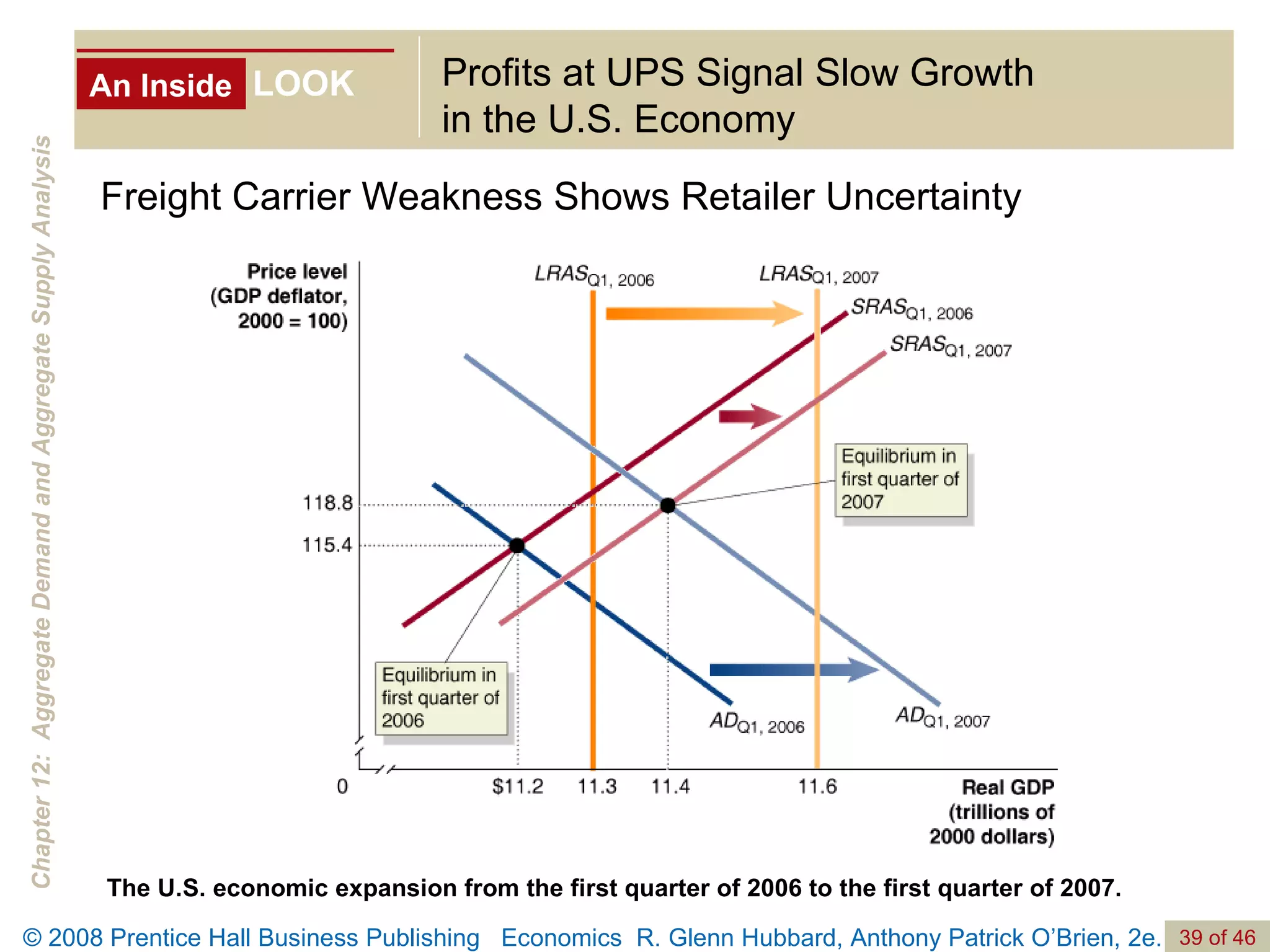
An Inside LOOK Profits at UPS Signal Slow Growth  in the U.S. Economy Freight Carrier Weakness Shows Retailer Uncertainty The U.S. economic expansion from the first quarter of 2006 to the first quarter of 2007.
Aggregate demand and aggregate supply model Aggregate demand curve Fiscal policy Long-run aggregate supply curve Menu costs Monetary policy Short-run aggregate supply curve Stagflation Supply shock K e y  T e r m s
Macroeconomic Schools of Thought Keynesian revolution   The name given to the widespread acceptance during the 1930s and 1940s of John Maynard Keynes’s macroeconomic model. 1  The monetarist model 2   The new classical model 3   The real business cycle model These alternative  schools of thought  use models that differ significantly from the standard aggregate demand and aggregate supply model.  We can briefly consider each of the three major alternative models: Appendix
Macroeconomic Schools of Thought The   Monetarist   Model Monetary growth rule   A plan for increasing the quantity of money at a fixed rate that does not respond to changes in economic conditions. Monetarism   The macroeconomic theories of Milton Friedman and his followers; particularly the idea that the quantity of money should be increased at a constant rate. The monetarist model—also known as the neo-Quantity Theory of Money model—was developed beginning in the 1940s by Milton Friedman, an economist at the University of Chicago who was awarded the Nobel Prize in Economics in 1976. Appendix
Macroeconomic Schools of Thought The New Classical Model New classical macroeconomics  The macroeconomic theories of Robert Lucas and others, particularly the idea that workers and firms have rational expectations.  The new classical model was developed in the mid-1970s by a group of economists including Nobel laureate Robert Lucas of the University of Chicago, Thomas Sargent of New York University,  and Robert Barro of Harvard University. Appendix
Macroeconomic Schools of Thought The Real Business Cycle Model Real business cycle model  A macroeconomic model that focuses on real, rather than monetary, causes of the business cycle. Beginning in the 1980s, some economists, including Nobel laureates Finn Kydland of Carnegie Mellon University and Edward Prescott of Arizona State University, argued that Lucas was correct in assuming that workers and firms formed their expectations rationally and that wages and prices adjust quickly to supply and demand but wrong about the source of fluctuations in real GDP. Appendix
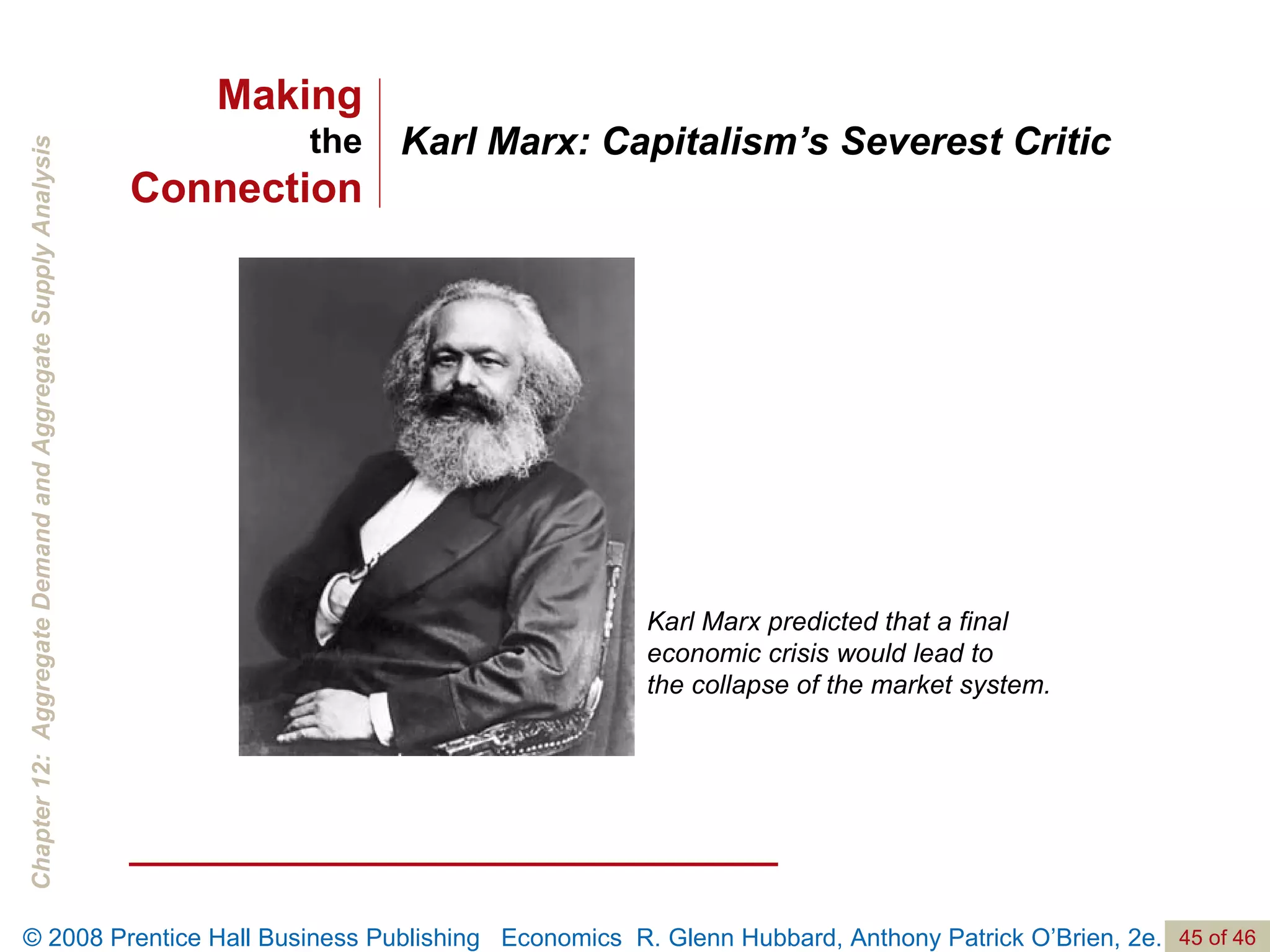
Karl Marx: Capitalism’s Severest Critic Karl Marx predicted that a final economic crisis would lead to  the collapse of the market system. Making the Connection
Keynesian revolution Monetarism Monetary growth rule New classical macroeconomics Real business cycle model K e y  T e r m s

Chap12pp

  • 1.
  • 2.
    The Fortunes ofFedEx Follow the Business Cycle Learning Objectives To understand why FedEx and other firms are affected by the business cycle, we need to explore the effects that recessions and expansions have on production, employment, and prices. APPENDIX Understand macroeconomic schools of thought . Use the dynamic aggregate demand and aggregate supply model to analyze macroeconomic conditions. 12.4 Use the aggregate demand and aggregate supply model to illustrate the difference between short-run and long-run macroeconomic equilibrium . 12.3 Identify the determinants of aggregate supply and distinguish between a movement along the short- run aggregate supply curve and a shift of the curve. 12.2 Identify the determinants of aggregate demand and distinguish between a movement along the aggregate demand curve and a shift of the curve. 12.1
  • 3.
    Aggregate Demand Learning Objective 12.1 Aggregate demand and aggregate supply model A model that explains short-run fluctuations in real GDP and the price level. FIGURE 12.1 Aggregate Demand and Aggregate Supply
  • 4.
    Aggregate Demand Learning Objective 12.1 Aggregate demand curve A curve that shows the relationship between the price level and the quantity of real GDP demanded by households, firms, and the government. Short-run aggregate supply curve A curve that shows the relationship in the short run between the price level and the quantity of real GDP supplied by firms.
  • 5.
    Aggregate Demand Learning Objective 12.1 GDP has four components: consumption ( C ), investment ( I ), government purchases ( G ), and net exports ( NX ). If we let Y stand for GDP, we can write the following: Y = C + I + G + NX Why Is the Aggregate Demand Curve Downward Sloping? The Wealth Effect: How a Change in the Price Level Affects Consumption The impact of the price level on consumption is called the wealth effect .
  • 6.
    Aggregate Demand Learning Objective 12.1 The impact of the price level on investment is known as the interest-rate effect . Why Is the Aggregate Demand Curve Downward Sloping? The International-Trade Effect: How a Change in the Price Level Affects Net Exports The impact of the price level on net exports is known as the international-trade effect . The Interest-Rate Effect: How a Change in the Price Level Affects Investment
  • 7.
    Aggregate Demand Learning Objective 12.1 An important point to remember is that the aggregate demand curve tells us the relationship between the price level and the quantity of real GDP demanded, holding everything else constant . Shifts of the Aggregate Demand Curve versus Movements Along It
  • 8.
    Aggregate Demand Learning Objective 12.1 • Changes in government policies • Changes in the expectations of households and firms • Changes in foreign variables The Variables That Shift the Aggregate Demand Curve Don’t Let This Happen to YOU! Be Clear Why the Aggregate Demand Curve Is Downward Sloping The variables that cause the aggregate demand curve to shift fall into three categories:
  • 9.
    Aggregate Demand Learning Objective 12.1 Monetary policy The actions the Federal Reserve takes to manage the money supply and interest rates to pursue macroeconomic policy objectives. The Variables That Shift the Aggregate Demand Curve Changes in Government Policies Fiscal policy Changes in federal taxes and purchases that are intended to achieve macroeconomic policy objectives, such as high employment, price stability, and high rates of economic growth.
  • 10.
    Aggregate Demand Learning Objective 12.1 If households become more optimistic about their future incomes, they are likely to increase their current consumption. The Variables That Shift the Aggregate Demand Curve Changes in the Expectations of Households and Firms If firms and households in other countries buy fewer U.S. goods or if firms and households in the United States buy more foreign goods, net exports will fall, and the aggregate demand curve will shift to the left. Changes in Foreign Variables
  • 11.
    In a GlobalEconomy, How Can You Tell the Imports from the Domestic Goods? Learning Objective 12.1 Is the Toyota Sienna as American as apple pie? Making the Connection
  • 12.
    Movements along theAggregate Demand Curve versus Shifts of the Aggregate Demand Curve Learning Objective 12.1 Solved Problem 12-1
  • 13.
    Aggregate Demand Learning Objective 12.1 The Variables That Shift the Aggregate Demand Curve Changes in Foreign Variables Table 12-1 Variables That Shift the Aggregate Demand Curve
  • 14.
    Aggregate Demand Learning Objective 12.1 The Variables That Shift the Aggregate Demand Curve Changes in Foreign Variables Table 12-1 Variables That Shift the Aggregate Demand Curve (continued)
  • 15.
    Aggregate Supply Learning Objective 12.2 Long-run aggregate supply curve A curve that shows the relationship in the long run between the price level and the quantity of real GDP supplied. The Long-Run Aggregate Supply Curve
  • 16.
    Aggregate Supply Learning Objective 12.2 The Long-Run Aggregate Supply Curve FIGURE 12.2 The Long-Run Aggregate Supply Curve
  • 17.
    Aggregate Supply Learning Objective 12.2 1 Contracts make some wages and prices “sticky.” 2 Firms are often slow to adjust wages. 3 Menu costs make some prices sticky. The Short-Run Aggregate Supply Curve The three most common explanations as to why a short-run aggregate supply curve slopes upward include: Menu costs The costs to firms of changing prices.
  • 18.
    Aggregate Supply Learning Objective 12.2 Shifts of the Short-Run Aggregate Supply Curve versus Movements Along It It is important to remember the difference between a shift in a curve and a movement along a curve. Increases in the Labor Force and in the Capital Stock Variables That Shift the Short-Run Aggregate Supply Curve Technological Change Expected Changes in the Future Price Level
  • 19.
    Aggregate Supply Learning Objective 12.2 Variables That Shift the Short-Run Aggregate Supply Curve Expected Changes in the Future Price Level FIGURE 12.3 How Expectations of the Future Price Level Affect the Short-Run Aggregate Supply
  • 20.
    Aggregate Supply Learning Objective 12.2 Variables That Shift the Short-Run Aggregate Supply Curve Adjustments of Workers and Firms to Errors in Past Expectations about the Price Level Unexpected Changes in the Price of an Important Natural Resource Supply shock An unexpected event that causes the short-run aggregate supply curve to shift.
  • 21.
    Aggregate Supply Learning Objective 12.2 Variables That Shift the Short-Run Aggregate Supply Curve Unexpected Changes in the Price of an Important Natural Resource Table 12-2 Variables That Shift the Short-Run Aggregate Supply Curve
  • 22.
    Aggregate Supply Learning Objective 12.2 Variables That Shift the Short-Run Aggregate Supply Curve Unexpected Changes in the Price of an Important Natural Resource Table 12-2 Variables That Shift the Short-Run Aggregate Supply Curve (continued)
  • 23.
    Macroeconomic Equilibrium inthe Long Run and the Short Run Learning Objective 12.3 FIGURE 12.4 Long-Run Macroeconomic Equilibrium
  • 24.
    Macroeconomic Equilibrium inthe Long Run and the Short Run Learning Objective 12.3 1 The economy has not been experiencing any inflation. The price level is currently 100, and workers and firms expect it to remain at 100 in the future. 2 The economy is not experiencing any long-run growth. Potential real GDP is $10.0 trillion and will remain at that level in the future. Recessions, Expansions, and Supply Shocks Because the full analysis of the aggregate demand and aggregate supply model can be complicated, we begin with a simplified case, using two assumptions:
  • 25.
    Macroeconomic Equilibrium inthe Long Run and the Short Run Learning Objective 12.3 Recessions, Expansions, and Supply Shocks Recession FIGURE 12.5 The Short-Run and Long-Run Effects of a Decrease in Aggregate Demand
  • 26.
    Macroeconomic Equilibrium inthe Long Run and the Short Run Learning Objective 12.3 Recessions, Expansions, and Supply Shocks Expansion FIGURE 12.6 The Short-Run and Long- run Effects of an Increase in Aggregate Demand
  • 27.
    Macroeconomic Equilibrium inthe Long Run and the Short Run Learning Objective 12.3 Recessions, Expansions, and Supply Shocks Stagflation A combination of inflation and recession, usually resulting from a supply shock. Supply Shock
  • 28.
    Macroeconomic Equilibrium inthe Long Run and the Short Run Learning Objective 12.3 Supply Shock FIGURE 12.7 The Short-Run and Long-Run Effects of a Supply Shock Recessions, Expansions, and Supply Shocks
  • 29.
    A Dynamic AggregateDemand and Aggregate Supply Model Learning Objective 12.4 • Potential real GDP increases continually, shifting the long-run aggregate supply curve to the right. • During most years, the aggregate demand curve will be shifting to the right. • Except during periods when workers and firms expect high rates of inflation, the short-run aggregate supply curve will be shifting to the right. We can create a dynamic aggregate demand and aggregate supply model by making three changes to the basic model.
  • 30.
    A Dynamic AggregateDemand and Aggregate Supply Model Learning Objective 12.4 FIGURE 12.8 A Dynamic Aggregate Demand and Aggregate Supply Model
  • 31.
    A Dynamic AggregateDemand and Aggregate Supply Model Learning Objective 12.4 FIGURE 12.9 Using Dynamic Aggregate Demand and Aggregate Supply to Understand Inflation What Is the Usual Cause of Inflation?
  • 32.
    A Dynamic AggregateDemand and Aggregate Supply Model Learning Objective 12.4 • The end of the stock market “bubble.” The Slow Recovery from the Recession of 2001 • Excessive investment in information technology. • The terrorist attacks of September 11, 2001. • The corporate accounting scandals. The recession of 2001 was caused by a decline in aggregate demand. Several factors contributed to this decline:
  • 33.
    A Dynamic AggregateDemand and Aggregate Supply Model Learning Objective 12.4 The Slow Recovery from the Recession of 2001 FIGURE 12.10 Using Dynamic Aggregate Demand and Aggregate Supply to Understand the Recovery from the 2001 Recession
  • 34.
    Does Rising ProductivityGrowth Reduce Employment? Learning Objective 12.4 Making the Connection
  • 35.
    A Dynamic AggregateDemand and Aggregate Supply Model Learning Objective 12.4 The More Rapid Recovery of 2003–2004 FIGURE 12.11 Using Dynamic Aggregate Demand and Aggregate Supply to Understand the More Rapid Recovery of 2003–2004
  • 36.
    A Dynamic AggregateDemand and Aggregate Supply Model Learning Objective 12.4 In late 2007, economists were divided over whether the twin blows of higher oil prices and a declining housing sector would be sufficient to push the economy into a recession. The majority of economists forecast that growth in real GDP would slow but that the economy would not tip into recession. The Economy in 2007: Continuing Expansion or Looming Recession?
  • 37.
    Showing the OilShock of 1974–1975 on a Dynamic Aggregate Demand and Aggregate Supply Graph Learning Objective 12.4 Solved Problem 12-4 38.0 34.7 PRICE LEVEL $4.50 trillion $4.31 trillion 1975 $4.35 trillion $4.32 trillion 1974 POTENTIAL REAL GDP ACTUAL REAL GDP
  • 38.
    Do Oil ShocksStill Cause Recessions? Learning Objective 12.4 FedEx’s trucks and jets have become more fuel efficient. Making the Connection
  • 39.
    An Inside LOOKProfits at UPS Signal Slow Growth in the U.S. Economy Freight Carrier Weakness Shows Retailer Uncertainty The U.S. economic expansion from the first quarter of 2006 to the first quarter of 2007.
  • 40.
    Aggregate demand andaggregate supply model Aggregate demand curve Fiscal policy Long-run aggregate supply curve Menu costs Monetary policy Short-run aggregate supply curve Stagflation Supply shock K e y T e r m s
  • 41.
    Macroeconomic Schools ofThought Keynesian revolution The name given to the widespread acceptance during the 1930s and 1940s of John Maynard Keynes’s macroeconomic model. 1 The monetarist model 2 The new classical model 3 The real business cycle model These alternative schools of thought use models that differ significantly from the standard aggregate demand and aggregate supply model. We can briefly consider each of the three major alternative models: Appendix
  • 42.
    Macroeconomic Schools ofThought The Monetarist Model Monetary growth rule A plan for increasing the quantity of money at a fixed rate that does not respond to changes in economic conditions. Monetarism The macroeconomic theories of Milton Friedman and his followers; particularly the idea that the quantity of money should be increased at a constant rate. The monetarist model—also known as the neo-Quantity Theory of Money model—was developed beginning in the 1940s by Milton Friedman, an economist at the University of Chicago who was awarded the Nobel Prize in Economics in 1976. Appendix
  • 43.
    Macroeconomic Schools ofThought The New Classical Model New classical macroeconomics The macroeconomic theories of Robert Lucas and others, particularly the idea that workers and firms have rational expectations. The new classical model was developed in the mid-1970s by a group of economists including Nobel laureate Robert Lucas of the University of Chicago, Thomas Sargent of New York University, and Robert Barro of Harvard University. Appendix
  • 44.
    Macroeconomic Schools ofThought The Real Business Cycle Model Real business cycle model A macroeconomic model that focuses on real, rather than monetary, causes of the business cycle. Beginning in the 1980s, some economists, including Nobel laureates Finn Kydland of Carnegie Mellon University and Edward Prescott of Arizona State University, argued that Lucas was correct in assuming that workers and firms formed their expectations rationally and that wages and prices adjust quickly to supply and demand but wrong about the source of fluctuations in real GDP. Appendix
  • 45.
    Karl Marx: Capitalism’sSeverest Critic Karl Marx predicted that a final economic crisis would lead to the collapse of the market system. Making the Connection
  • 46.
    Keynesian revolution MonetarismMonetary growth rule New classical macroeconomics Real business cycle model K e y T e r m s