Fiscal Policy and Keynesians
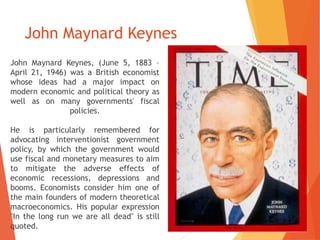
John Maynard Keynes 
John Maynard Keynes, (June 5, 1883 – 
April 21, 1946) was a British economist 
whose ideas had a major impact on 
modern economic and political theory as 
well as on many governments' fiscal 
policies. 
He is particularly remembered for 
advocating interventionist government 
policy, by which the government would 
use fiscal and monetary measures to aim 
to mitigate the adverse effects of 
economic recessions, depressions and 
booms. Economists consider him one of 
the main founders of modern theoretical 
macroeconomics. His popular expression 
"In the long run we are all dead" is still 
quoted.
Discretionary Fiscal Policy 
 Discretionary Fiscal Policy 
 The discretionary changes in government 
expenditures and/or taxes in order to 
achieve certain national economic goals is 
the realm of fiscal policy. 
 High employment (low unemployment) 
 Price stability 
 Economic growth 
 Improvement of international payments 
balance
Discretionary Fiscal Policy 
(cont'd) 
 Fiscal Policy 
 The discretionary changing of government expenditures or 
taxes to achieve national economic goals, such as high 
employment with price stability
Discretionary Fiscal Policy 
(cont'd) 
 An increase in government spending will stimulate 
economic activity 
 Changes in government spending 
 Military spending 
 Education spending 
 Budgets for government agencies
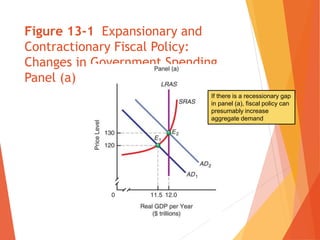
Figure 13-1 Expansionary and 
Contractionary Fiscal Policy: 
Changes in Government Spending, 
Panel (a) 
If there is a recessionary gap 
in panel (a), fiscal policy can 
presumably increase 
aggregate demand
Figure 13-1 Expansionary and 
Contractionary Fiscal Policy: 
Changes in Government Spending, 
Panel (b) 
If there is an inflationary gap, 
fiscal policy can presumably 
decrease aggregate demand
Figure 13-2 Contractionary and 
Expansionary Fiscal Policy: Changes 
in Taxes, Panel (a) 
• In panel (a), the economy is 
initially at E1, where real GDP 
exceeds long-run equilibrium 
• Contractionary fiscal policy can 
move aggregate demand to 
AD2 via a tax increase 
• A new equilibrium is at E2 at a 
lower price level 
• Real GDP is now consistent 
with LRAS
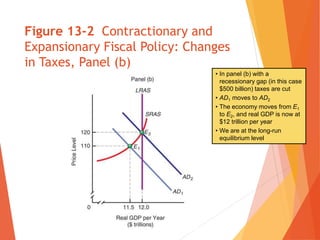
Figure 13-2 Contractionary and 
Expansionary Fiscal Policy: Changes 
in Taxes, Panel (b) 
• In panel (b) with a 
recessionary gap (in this case 
$500 billion) taxes are cut 
• AD1 moves to AD2 
• The economy moves from E1 
to E2, and real GDP is now at 
$12 trillion per year 
• We are at the long-run 
equilibrium level
Discretionary Fiscal Policy 
(cont'd) 
 Change in taxes 
 A rise in taxes causes a reduction in aggregate demand 
because it can reduce consumption spending, investment 
expenditures, and net exports.
Possible Offsets to Fiscal Policy 
 Fiscal policy does not operate in a vacuum and important questions must 
be answered. 
 How are expenditures financed and 
by whom? 
 If taxes are increased what does government do with the taxes? 
 What will happen if individuals worry about increases in future taxes?
Possible Offsets 
to Fiscal Policy (cont'd) 
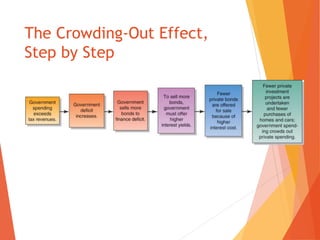
 Crowding-Out Effect 
 The tendency of expansionary fiscal policy to cause a 
decrease in planned investment or planned consumption in 
the private sector; this decrease normally results from the 
rise of interest rates.
The Crowding-Out Effect, 
Step by Step
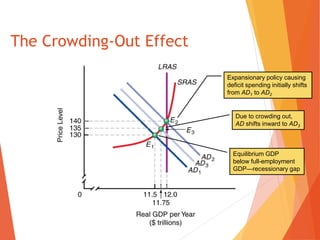
The Crowding-Out Effect 
Expansionary policy causing 
deficit spending initially shifts 
from AD1 to AD2 
Due to crowding out, 
AD shifts inward to AD3 
Equilibrium GDP 
below full-employment 
GDP—recessionary gap
Possible Offsets to Fiscal Policy (cont'd) 
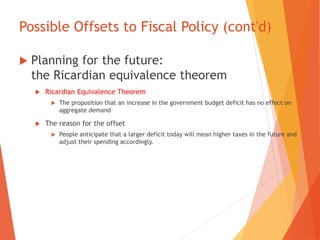
 Planning for the future: 
the Ricardian equivalence theorem 
 Ricardian Equivalence Theorem 
 The proposition that an increase in the government budget deficit has no effect on 
aggregate demand 
 The reason for the offset 
 People anticipate that a larger deficit today will mean higher taxes in the future and 
adjust their spending accordingly.
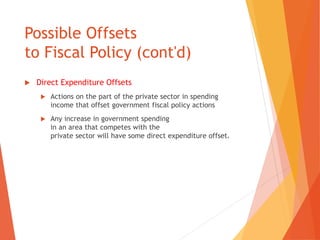
Possible Offsets 
to Fiscal Policy (cont'd) 
 Direct Expenditure Offsets 
 Actions on the part of the private sector in spending 
income that offset government fiscal policy actions 
 Any increase in government spending 
in an area that competes with the 
private sector will have some direct expenditure offset.
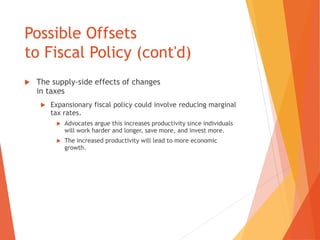
Possible Offsets 
to Fiscal Policy (cont'd) 
 The supply-side effects of changes 
in taxes 
 Expansionary fiscal policy could involve reducing marginal 
tax rates. 
 Advocates argue this increases productivity since individuals 
will work harder and longer, save more, and invest more. 
 The increased productivity will lead to more economic 
growth.
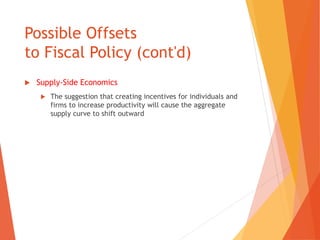
Possible Offsets 
to Fiscal Policy (cont'd) 
 Supply-Side Economics 
 The suggestion that creating incentives for individuals and 
firms to increase productivity will cause the aggregate 
supply curve to shift outward
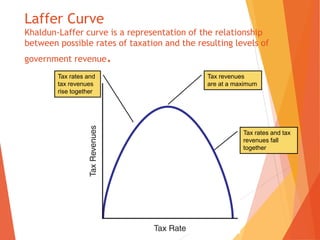
Laffer Curve 
Khaldun-Laffer curve is a representation of the relationship 
between possible rates of taxation and the resulting levels of 
government revenue. 
Tax rates and 
tax revenues 
rise together 
Tax revenues 
are at a maximum 
Tax rates and tax 
revenues fall 
together
Discretionary Fiscal Policy in Practice: 
Coping with Time Lags 
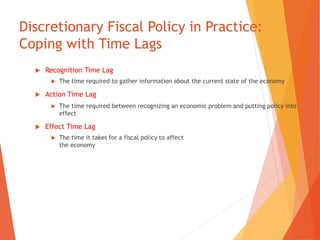
 Recognition Time Lag 
 The time required to gather information about the current state of the economy 
 Action Time Lag 
 The time required between recognizing an economic problem and putting policy into 
effect 
 Effect Time Lag 
 The time it takes for a fiscal policy to affect 
the economy
Discretionary Fiscal Policy in Practice: 
Coping with Time Lags (cont'd) 
 Fiscal policy time lags are long and a 
policy designed to correct a recession 
may not produce results until the 
economy is experiencing inflation. 
 Fiscal policy time lags are variable in 
length (1–3 years), and the timing of the 
desired effect cannot be predicted. 
 Because fiscal policy time lags tend to be 
variable, policymakers have a difficult 
time fine-tuning the economy.
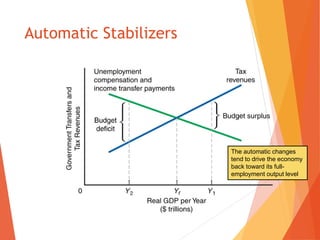
Automatic Stabilizers 
 Automatic or Built-In Stabilizers 
 Changes in government spending and taxation that occur 
automatically without deliberate action of Congress 
 The tax system 
 Unemployment compensation 
 Welfare spending
Automatic Stabilizers 
The automatic changes 
tend to drive the economy 
back toward its full-employment 
output level
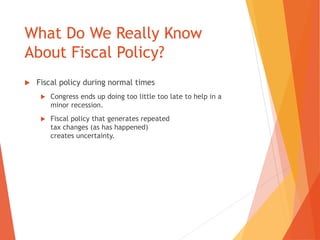
What Do We Really Know 
About Fiscal Policy? 
 Fiscal policy during normal times 
 Congress ends up doing too little too late to help in a 
minor recession. 
 Fiscal policy that generates repeated 
tax changes (as has happened) 
creates uncertainty.
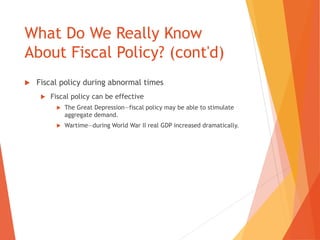
What Do We Really Know 
About Fiscal Policy? (cont'd) 
 Fiscal policy during abnormal times 
 Fiscal policy can be effective 
 The Great Depression—fiscal policy may be able to stimulate 
aggregate demand. 
 Wartime—during World War II real GDP increased dramatically.
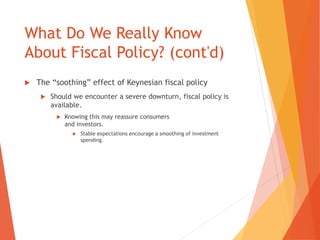
What Do We Really Know 
About Fiscal Policy? (cont'd) 
 The “soothing” effect of Keynesian fiscal policy 
 Should we encounter a severe downturn, fiscal policy is 
available. 
 Knowing this may reassure consumers 
and investors. 
 Stable expectations encourage a smoothing of investment 
spending.

Fiscal policy keynesians

  • 1.
  • 2.
    John Maynard Keynes John Maynard Keynes, (June 5, 1883 – April 21, 1946) was a British economist whose ideas had a major impact on modern economic and political theory as well as on many governments' fiscal policies. He is particularly remembered for advocating interventionist government policy, by which the government would use fiscal and monetary measures to aim to mitigate the adverse effects of economic recessions, depressions and booms. Economists consider him one of the main founders of modern theoretical macroeconomics. His popular expression "In the long run we are all dead" is still quoted.
  • 3.
    Discretionary Fiscal Policy  Discretionary Fiscal Policy  The discretionary changes in government expenditures and/or taxes in order to achieve certain national economic goals is the realm of fiscal policy.  High employment (low unemployment)  Price stability  Economic growth  Improvement of international payments balance
  • 4.
    Discretionary Fiscal Policy (cont'd)  Fiscal Policy  The discretionary changing of government expenditures or taxes to achieve national economic goals, such as high employment with price stability
  • 5.
    Discretionary Fiscal Policy (cont'd)  An increase in government spending will stimulate economic activity  Changes in government spending  Military spending  Education spending  Budgets for government agencies
  • 6.
    Figure 13-1 Expansionaryand Contractionary Fiscal Policy: Changes in Government Spending, Panel (a) If there is a recessionary gap in panel (a), fiscal policy can presumably increase aggregate demand
  • 7.
    Figure 13-1 Expansionaryand Contractionary Fiscal Policy: Changes in Government Spending, Panel (b) If there is an inflationary gap, fiscal policy can presumably decrease aggregate demand
  • 8.
    Figure 13-2 Contractionaryand Expansionary Fiscal Policy: Changes in Taxes, Panel (a) • In panel (a), the economy is initially at E1, where real GDP exceeds long-run equilibrium • Contractionary fiscal policy can move aggregate demand to AD2 via a tax increase • A new equilibrium is at E2 at a lower price level • Real GDP is now consistent with LRAS
  • 9.
    Figure 13-2 Contractionaryand Expansionary Fiscal Policy: Changes in Taxes, Panel (b) • In panel (b) with a recessionary gap (in this case $500 billion) taxes are cut • AD1 moves to AD2 • The economy moves from E1 to E2, and real GDP is now at $12 trillion per year • We are at the long-run equilibrium level
  • 10.
    Discretionary Fiscal Policy (cont'd)  Change in taxes  A rise in taxes causes a reduction in aggregate demand because it can reduce consumption spending, investment expenditures, and net exports.
  • 11.
    Possible Offsets toFiscal Policy  Fiscal policy does not operate in a vacuum and important questions must be answered.  How are expenditures financed and by whom?  If taxes are increased what does government do with the taxes?  What will happen if individuals worry about increases in future taxes?
  • 12.
    Possible Offsets toFiscal Policy (cont'd)  Crowding-Out Effect  The tendency of expansionary fiscal policy to cause a decrease in planned investment or planned consumption in the private sector; this decrease normally results from the rise of interest rates.
  • 13.
  • 14.
    The Crowding-Out Effect Expansionary policy causing deficit spending initially shifts from AD1 to AD2 Due to crowding out, AD shifts inward to AD3 Equilibrium GDP below full-employment GDP—recessionary gap
  • 15.
    Possible Offsets toFiscal Policy (cont'd)  Planning for the future: the Ricardian equivalence theorem  Ricardian Equivalence Theorem  The proposition that an increase in the government budget deficit has no effect on aggregate demand  The reason for the offset  People anticipate that a larger deficit today will mean higher taxes in the future and adjust their spending accordingly.
  • 16.
    Possible Offsets toFiscal Policy (cont'd)  Direct Expenditure Offsets  Actions on the part of the private sector in spending income that offset government fiscal policy actions  Any increase in government spending in an area that competes with the private sector will have some direct expenditure offset.
  • 17.
    Possible Offsets toFiscal Policy (cont'd)  The supply-side effects of changes in taxes  Expansionary fiscal policy could involve reducing marginal tax rates.  Advocates argue this increases productivity since individuals will work harder and longer, save more, and invest more.  The increased productivity will lead to more economic growth.
  • 18.
    Possible Offsets toFiscal Policy (cont'd)  Supply-Side Economics  The suggestion that creating incentives for individuals and firms to increase productivity will cause the aggregate supply curve to shift outward
  • 19.
    Laffer Curve Khaldun-Laffercurve is a representation of the relationship between possible rates of taxation and the resulting levels of government revenue. Tax rates and tax revenues rise together Tax revenues are at a maximum Tax rates and tax revenues fall together
  • 20.
    Discretionary Fiscal Policyin Practice: Coping with Time Lags  Recognition Time Lag  The time required to gather information about the current state of the economy  Action Time Lag  The time required between recognizing an economic problem and putting policy into effect  Effect Time Lag  The time it takes for a fiscal policy to affect the economy
  • 21.
    Discretionary Fiscal Policyin Practice: Coping with Time Lags (cont'd)  Fiscal policy time lags are long and a policy designed to correct a recession may not produce results until the economy is experiencing inflation.  Fiscal policy time lags are variable in length (1–3 years), and the timing of the desired effect cannot be predicted.  Because fiscal policy time lags tend to be variable, policymakers have a difficult time fine-tuning the economy.
  • 22.
    Automatic Stabilizers Automatic or Built-In Stabilizers  Changes in government spending and taxation that occur automatically without deliberate action of Congress  The tax system  Unemployment compensation  Welfare spending
  • 23.
    Automatic Stabilizers Theautomatic changes tend to drive the economy back toward its full-employment output level
  • 24.
    What Do WeReally Know About Fiscal Policy?  Fiscal policy during normal times  Congress ends up doing too little too late to help in a minor recession.  Fiscal policy that generates repeated tax changes (as has happened) creates uncertainty.
  • 25.
    What Do WeReally Know About Fiscal Policy? (cont'd)  Fiscal policy during abnormal times  Fiscal policy can be effective  The Great Depression—fiscal policy may be able to stimulate aggregate demand.  Wartime—during World War II real GDP increased dramatically.
  • 26.
    What Do WeReally Know About Fiscal Policy? (cont'd)  The “soothing” effect of Keynesian fiscal policy  Should we encounter a severe downturn, fiscal policy is available.  Knowing this may reassure consumers and investors.  Stable expectations encourage a smoothing of investment spending.