Monetary Policy, Toll Brothers, and  the Housing Market Learning  Objectives By driving down interest rates, the Fed succeeded in heading  off what some economists had predicted would be a prolonged and severe recession. Assess the arguments for and against the  independence  of the  Federal Reserve . 14.5 Discuss the Fed’s setting of  monetary policy targets . 14.4 Use aggregate demand and aggregate supply graphs to show the  effects  of  monetary policy  on  real GDP  and the  price level . 14.3 Describe the Federal Reserve’s monetary policy targets and explain how  expansionary  and  contractionary monetary policies  affect the  interest rate . 14.2 Define  monetary policy  and describe the Federal Reserve’s  monetary policy goals . 14.1
What Is Monetary Policy? Learning  Objective  14.1 Monetary policy   The actions the Federal Reserve takes to manage the money supply and interest rates to pursue its economic objectives. 1   Price stability 2   High employment 3   Economic growth 4   Stability of financial markets and institutions The Goals of Monetary Policy The Fed has set four  monetary policy goals  that are intended to promote a well-functioning economy:
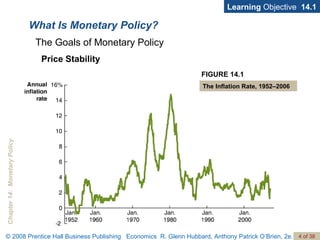
What Is Monetary Policy? Learning  Objective  14.1 Price Stability FIGURE 14.1 The Inflation Rate, 1952–2006 The Goals of Monetary Policy
What Is Monetary Policy? Learning  Objective  14.1 High Employment The goal of high employment extends beyond the Fed to other branches of the federal government. The Goals of Monetary Policy Economic Growth Policymakers aim to encourage  stable  economic growth because stable growth allows households and firms to plan accurately and encourages the long-run investment that is needed to sustain growth.
What Is Monetary Policy? Learning  Objective  14.1 Stability of Financial Markets and Institutions When financial markets and institutions are not efficient in matching savers and borrowers, resources are lost. The Goals of Monetary Policy
The Money Market and the Fed’s Choice  of Monetary Policy Targets Learning  Objective  14.2 The Fed tries to keep both the unemployment and inflation rates low, but it can’t affect either of these economic variables directly. The Fed uses variables, called  monetary policy targets , that it can affect directly and that, in turn, affect variables that are closely related to the Fed’s policy goals, such as real GDP, employment, and the price level.  Monetary Policy Targets
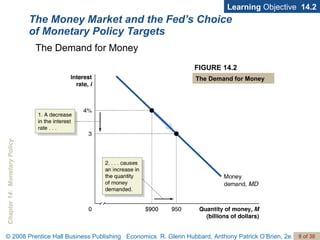
The Money Market and the Fed’s Choice of Monetary Policy Targets Learning  Objective  14.2 The Demand for Money FIGURE 14.2 The Demand for Money
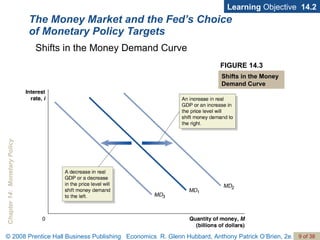
The Money Market and the Fed’s Choice of Monetary Policy Targets Learning  Objective  14.2 Shifts in the Money Demand Curve FIGURE 14.3 Shifts in the Money Demand Curve
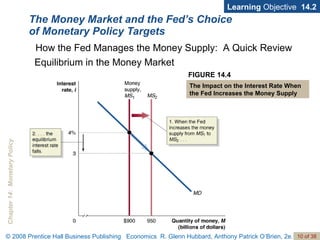
The Money Market and the Fed’s Choice of Monetary Policy Targets Learning  Objective  14.2 How the Fed Manages the Money Supply:  A Quick Review Equilibrium in the Money Market FIGURE 14.4 The Impact on the Interest Rate When the Fed Increases the Money Supply
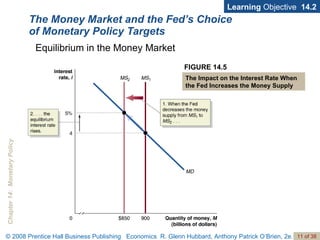
The Money Market and the Fed’s Choice of Monetary Policy Targets Learning  Objective  14.2 Equilibrium in the Money Market FIGURE 14.5 The Impact on the Interest Rate When the Fed Increases the Money Supply
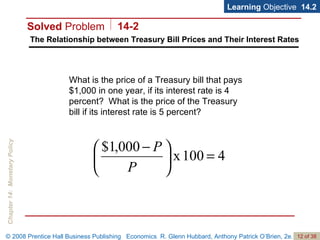
The Relationship between Treasury Bill Prices and Their Interest Rates Learning  Objective  14.2 What is the price of a Treasury bill that pays $1,000 in one year, if its interest rate is 4 percent?  What is the price of the Treasury bill if its interest rate is 5 percent? Solved  Problem 14-2
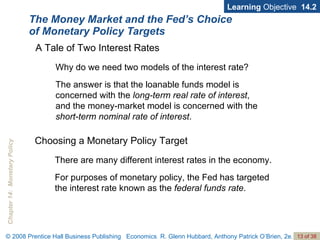
The Money Market and the Fed’s Choice of Monetary Policy Targets Learning  Objective  14.2 A Tale of Two Interest Rates Why do we need two models of the interest rate? The answer is that the loanable funds model is concerned with the  long-term real rate of interest , and the money-market model is concerned with the  short-term nominal rate of interest .  Choosing a Monetary Policy Target There are many different interest rates in the economy.  For purposes of monetary policy, the Fed has targeted the interest rate known as the  federal funds rate .
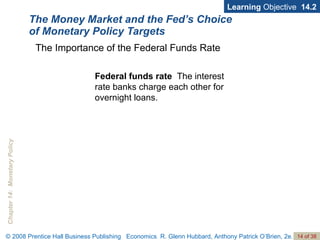
The Money Market and the Fed’s Choice of Monetary Policy Targets Learning  Objective  14.2 The Importance of the Federal Funds Rate Federal funds rate   The interest rate banks charge each other for overnight loans.
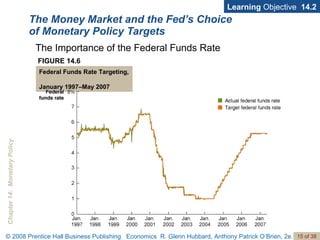
The Money Market and the Fed’s Choice of Monetary Policy Targets Learning  Objective  14.2 The Importance of the Federal Funds Rate FIGURE 14.6 Federal Funds Rate Targeting,  January 1997–May 2007
Monetary Policy and Economic Activity Learning  Objective  14.3 Consumption Investment Net exports How Interest Rates Affect Aggregate Demand Changes in interest rates will not affect government purchases, but they will affect the other three components of aggregate demand in the following ways:
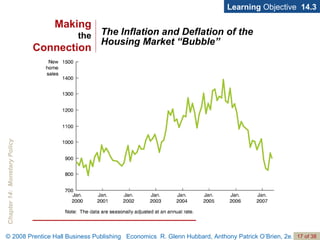
The Inflation and Deflation of the Housing Market “Bubble” Learning  Objective  14.3 Making the Connection
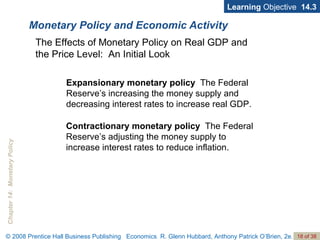
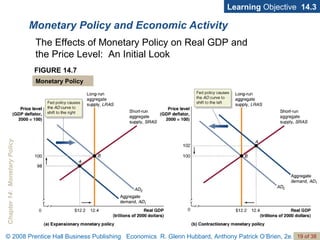
Monetary Policy and Economic Activity Learning  Objective  14.3 Expansionary monetary policy  The Federal Reserve’s increasing the money supply and decreasing interest rates to increase real GDP. The Effects of Monetary Policy on Real GDP and the Price Level:  An Initial Look Contractionary monetary policy  The Federal Reserve’s adjusting the money supply to increase interest rates to reduce inflation.
Monetary Policy and Economic Activity Learning  Objective  14.3 The Effects of Monetary Policy on Real GDP and the Price Level:  An Initial Look FIGURE 14.7 Monetary Policy
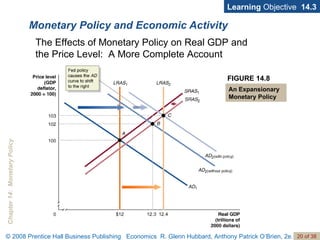
Monetary Policy and Economic Activity Learning  Objective  14.3 The Effects of Monetary Policy on Real GDP and  the Price Level:  A More Complete Account FIGURE 14.8 An Expansionary Monetary Policy
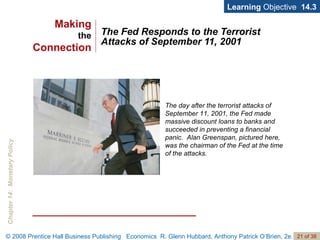
The Fed Responds to the Terrorist Attacks of September 11, 2001 Learning  Objective  14.3 The day after the terrorist attacks of September 11, 2001, the Fed made massive discount loans to banks and succeeded in preventing a financial panic.  Alan Greenspan, pictured here, was the chairman of the Fed at the time of the attacks. Making the Connection
Monetary Policy and Economic Activity Learning  Objective  14.3 Keeping recessions shorter and milder than they would otherwise be is usually the best the Fed can do. Can the Fed Eliminate Recessions?
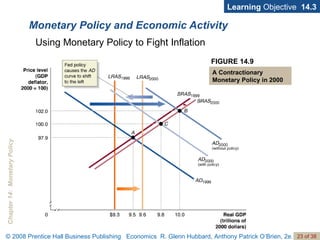
Monetary Policy and Economic Activity Learning  Objective  14.3 Using Monetary Policy to Fight Inflation FIGURE 14.9 A Contractionary Monetary Policy in 2000
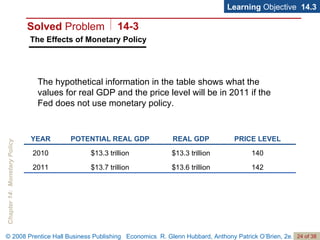
The Effects of Monetary Policy Learning  Objective  14.3 The hypothetical information in the table shows what the values for real GDP and the price level will be in 2011 if the Fed does not use monetary policy. Solved  Problem 14-3 142 $13.6 trillion $13.7 trillion 2011 140 $13.3 trillion $13.3 trillion 2010 PRICE LEVEL REAL GDP POTENTIAL REAL GDP YEAR
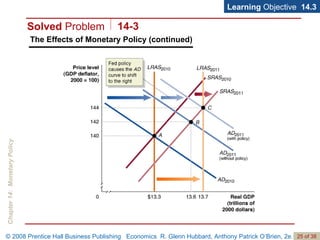
The Effects of Monetary Policy (continued) Learning  Objective  14.3 Solved  Problem 14-3
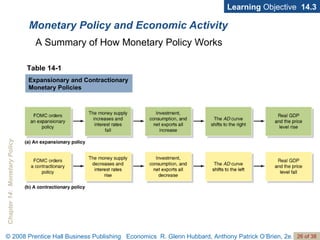
Monetary Policy and Economic Activity Learning  Objective  14.3 A Summary of How Monetary Policy Works Table 14-1 Expansionary and Contractionary Monetary Policies
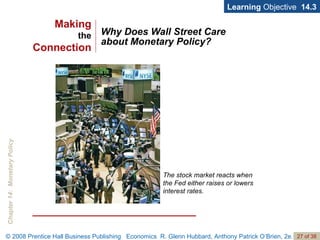
Why Does Wall Street Care  about Monetary Policy? Learning  Objective  14.3 The stock market reacts when the Fed either raises or lowers interest rates. Making the Connection
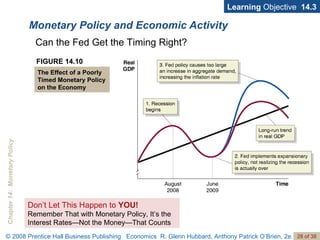
Monetary Policy and Economic Activity Learning  Objective  14.3 Can the Fed Get the Timing Right? FIGURE 14.10 The Effect of a Poorly Timed Monetary Policy on the Economy Don’t Let This Happen to  YOU! Remember That with Monetary Policy, It’s the Interest Rates—Not the Money—That Counts
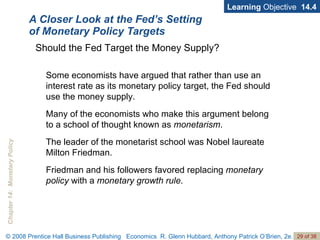
A Closer Look at the Fed’s Setting of Monetary Policy Targets Learning  Objective  14.4 Some economists have argued that rather than use an interest rate as its monetary policy target, the Fed should use the money supply. Many of the economists who make this argument belong to a school of thought known as  monetarism . The leader of the monetarist school was Nobel laureate Milton Friedman. Friedman and his followers favored replacing  monetary policy  with a  monetary growth rule . Should the Fed Target the Money Supply?
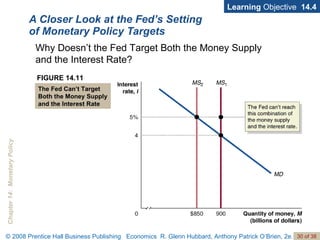
A Closer Look at the Fed’s Setting of Monetary Policy Targets Learning  Objective  14.4 Why Doesn’t the Fed Target Both the Money Supply  and the Interest Rate? FIGURE 14.11 The Fed Can’t Target Both the Money Supply and the Interest Rate
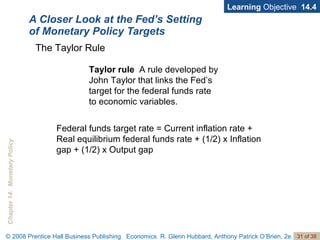
A Closer Look at the Fed’s Setting of Monetary Policy Targets Learning  Objective  14.4 Taylor rule   A rule developed by John Taylor that links the Fed’s target for the federal funds rate  to economic variables. The Taylor Rule Federal funds target rate = Current inflation rate + Real equilibrium federal funds rate + (1/2) x Inflation gap + (1/2) x Output gap
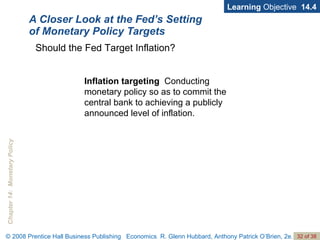
A Closer Look at the Fed’s Setting of Monetary Policy Targets Learning  Objective  14.4 Should the Fed Target Inflation? Inflation targeting   Conducting monetary policy so as to commit the central bank to achieving a publicly announced level of inflation.
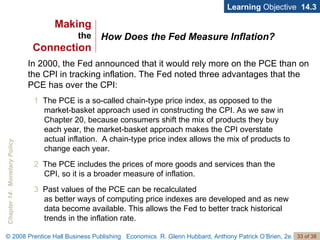
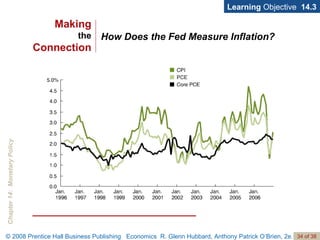
How Does the Fed Measure Inflation? Learning  Objective  14.3 1   The PCE is a so-called chain-type price index, as opposed to the market-basket approach used in constructing the CPI. As we saw in Chapter 20, because consumers shift the mix of products they buy each year, the market-basket approach makes the CPI overstate actual inflation.  A chain-type price index allows the mix of products to change each year. 2  The PCE includes the prices of more goods and services than the CPI, so it is a broader measure of inflation. 3   Past values of the PCE can be recalculated  as better ways of computing price indexes are developed and as new data become available. This allows the Fed to better track historical trends in the inflation rate. In 2000, the Fed announced that it would rely more on the PCE than on the CPI in tracking inflation. The Fed noted three advantages that the PCE has over the CPI: Making the Connection
How Does the Fed Measure Inflation? Learning  Objective  14.3 Making the Connection
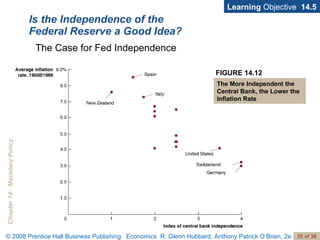
Is the Independence of the Federal Reserve a Good Idea? Learning  Objective  14.5 The Case for Fed Independence FIGURE 14.12 The More Independent the Central Bank, the Lower the Inflation Rate
Is the Independence of the Federal Reserve a Good Idea? Learning  Objective  14.5 In democracies, elected representatives usually decide important policy matters. In the United States, however, monetary policy is not decided by elected officials.  Instead, it is decided by the unelected FOMC. Because those deciding monetary policy do not have to run for election, they are not accountable for their actions to the ultimate authorities in a democracy:  the voters.  The Case against Fed Independence
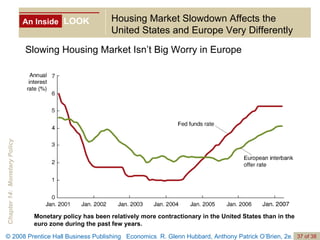
An Inside LOOK Housing Market Slowdown Affects the  United States and Europe Very Differently Slowing Housing Market Isn’t Big Worry in Europe Monetary policy has been relatively more contractionary in the United States than in the euro zone during the past few years.
Contractionary monetary policy Expansionary monetary policy Federal funds rate Inflation targeting Monetary policy  Taylor rule K e y  T e r m s

Chap14pp

  • 1.
  • 2.
    Monetary Policy, TollBrothers, and the Housing Market Learning Objectives By driving down interest rates, the Fed succeeded in heading off what some economists had predicted would be a prolonged and severe recession. Assess the arguments for and against the independence of the Federal Reserve . 14.5 Discuss the Fed’s setting of monetary policy targets . 14.4 Use aggregate demand and aggregate supply graphs to show the effects of monetary policy on real GDP and the price level . 14.3 Describe the Federal Reserve’s monetary policy targets and explain how expansionary and contractionary monetary policies affect the interest rate . 14.2 Define monetary policy and describe the Federal Reserve’s monetary policy goals . 14.1
  • 3.
    What Is MonetaryPolicy? Learning Objective 14.1 Monetary policy The actions the Federal Reserve takes to manage the money supply and interest rates to pursue its economic objectives. 1 Price stability 2 High employment 3 Economic growth 4 Stability of financial markets and institutions The Goals of Monetary Policy The Fed has set four monetary policy goals that are intended to promote a well-functioning economy:
  • 4.
    What Is MonetaryPolicy? Learning Objective 14.1 Price Stability FIGURE 14.1 The Inflation Rate, 1952–2006 The Goals of Monetary Policy
  • 5.
    What Is MonetaryPolicy? Learning Objective 14.1 High Employment The goal of high employment extends beyond the Fed to other branches of the federal government. The Goals of Monetary Policy Economic Growth Policymakers aim to encourage stable economic growth because stable growth allows households and firms to plan accurately and encourages the long-run investment that is needed to sustain growth.
  • 6.
    What Is MonetaryPolicy? Learning Objective 14.1 Stability of Financial Markets and Institutions When financial markets and institutions are not efficient in matching savers and borrowers, resources are lost. The Goals of Monetary Policy
  • 7.
    The Money Marketand the Fed’s Choice of Monetary Policy Targets Learning Objective 14.2 The Fed tries to keep both the unemployment and inflation rates low, but it can’t affect either of these economic variables directly. The Fed uses variables, called monetary policy targets , that it can affect directly and that, in turn, affect variables that are closely related to the Fed’s policy goals, such as real GDP, employment, and the price level. Monetary Policy Targets
  • 8.
    The Money Marketand the Fed’s Choice of Monetary Policy Targets Learning Objective 14.2 The Demand for Money FIGURE 14.2 The Demand for Money
  • 9.
    The Money Marketand the Fed’s Choice of Monetary Policy Targets Learning Objective 14.2 Shifts in the Money Demand Curve FIGURE 14.3 Shifts in the Money Demand Curve
  • 10.
    The Money Marketand the Fed’s Choice of Monetary Policy Targets Learning Objective 14.2 How the Fed Manages the Money Supply: A Quick Review Equilibrium in the Money Market FIGURE 14.4 The Impact on the Interest Rate When the Fed Increases the Money Supply
  • 11.
    The Money Marketand the Fed’s Choice of Monetary Policy Targets Learning Objective 14.2 Equilibrium in the Money Market FIGURE 14.5 The Impact on the Interest Rate When the Fed Increases the Money Supply
  • 12.
    The Relationship betweenTreasury Bill Prices and Their Interest Rates Learning Objective 14.2 What is the price of a Treasury bill that pays $1,000 in one year, if its interest rate is 4 percent? What is the price of the Treasury bill if its interest rate is 5 percent? Solved Problem 14-2
  • 13.
    The Money Marketand the Fed’s Choice of Monetary Policy Targets Learning Objective 14.2 A Tale of Two Interest Rates Why do we need two models of the interest rate? The answer is that the loanable funds model is concerned with the long-term real rate of interest , and the money-market model is concerned with the short-term nominal rate of interest . Choosing a Monetary Policy Target There are many different interest rates in the economy. For purposes of monetary policy, the Fed has targeted the interest rate known as the federal funds rate .
  • 14.
    The Money Marketand the Fed’s Choice of Monetary Policy Targets Learning Objective 14.2 The Importance of the Federal Funds Rate Federal funds rate The interest rate banks charge each other for overnight loans.
  • 15.
    The Money Marketand the Fed’s Choice of Monetary Policy Targets Learning Objective 14.2 The Importance of the Federal Funds Rate FIGURE 14.6 Federal Funds Rate Targeting, January 1997–May 2007
  • 16.
    Monetary Policy andEconomic Activity Learning Objective 14.3 Consumption Investment Net exports How Interest Rates Affect Aggregate Demand Changes in interest rates will not affect government purchases, but they will affect the other three components of aggregate demand in the following ways:
  • 17.
    The Inflation andDeflation of the Housing Market “Bubble” Learning Objective 14.3 Making the Connection
  • 18.
    Monetary Policy andEconomic Activity Learning Objective 14.3 Expansionary monetary policy The Federal Reserve’s increasing the money supply and decreasing interest rates to increase real GDP. The Effects of Monetary Policy on Real GDP and the Price Level: An Initial Look Contractionary monetary policy The Federal Reserve’s adjusting the money supply to increase interest rates to reduce inflation.
  • 19.
    Monetary Policy andEconomic Activity Learning Objective 14.3 The Effects of Monetary Policy on Real GDP and the Price Level: An Initial Look FIGURE 14.7 Monetary Policy
  • 20.
    Monetary Policy andEconomic Activity Learning Objective 14.3 The Effects of Monetary Policy on Real GDP and the Price Level: A More Complete Account FIGURE 14.8 An Expansionary Monetary Policy
  • 21.
    The Fed Respondsto the Terrorist Attacks of September 11, 2001 Learning Objective 14.3 The day after the terrorist attacks of September 11, 2001, the Fed made massive discount loans to banks and succeeded in preventing a financial panic. Alan Greenspan, pictured here, was the chairman of the Fed at the time of the attacks. Making the Connection
  • 22.
    Monetary Policy andEconomic Activity Learning Objective 14.3 Keeping recessions shorter and milder than they would otherwise be is usually the best the Fed can do. Can the Fed Eliminate Recessions?
  • 23.
    Monetary Policy andEconomic Activity Learning Objective 14.3 Using Monetary Policy to Fight Inflation FIGURE 14.9 A Contractionary Monetary Policy in 2000
  • 24.
    The Effects ofMonetary Policy Learning Objective 14.3 The hypothetical information in the table shows what the values for real GDP and the price level will be in 2011 if the Fed does not use monetary policy. Solved Problem 14-3 142 $13.6 trillion $13.7 trillion 2011 140 $13.3 trillion $13.3 trillion 2010 PRICE LEVEL REAL GDP POTENTIAL REAL GDP YEAR
  • 25.
    The Effects ofMonetary Policy (continued) Learning Objective 14.3 Solved Problem 14-3
  • 26.
    Monetary Policy andEconomic Activity Learning Objective 14.3 A Summary of How Monetary Policy Works Table 14-1 Expansionary and Contractionary Monetary Policies
  • 27.
    Why Does WallStreet Care about Monetary Policy? Learning Objective 14.3 The stock market reacts when the Fed either raises or lowers interest rates. Making the Connection
  • 28.
    Monetary Policy andEconomic Activity Learning Objective 14.3 Can the Fed Get the Timing Right? FIGURE 14.10 The Effect of a Poorly Timed Monetary Policy on the Economy Don’t Let This Happen to YOU! Remember That with Monetary Policy, It’s the Interest Rates—Not the Money—That Counts
  • 29.
    A Closer Lookat the Fed’s Setting of Monetary Policy Targets Learning Objective 14.4 Some economists have argued that rather than use an interest rate as its monetary policy target, the Fed should use the money supply. Many of the economists who make this argument belong to a school of thought known as monetarism . The leader of the monetarist school was Nobel laureate Milton Friedman. Friedman and his followers favored replacing monetary policy with a monetary growth rule . Should the Fed Target the Money Supply?
  • 30.
    A Closer Lookat the Fed’s Setting of Monetary Policy Targets Learning Objective 14.4 Why Doesn’t the Fed Target Both the Money Supply and the Interest Rate? FIGURE 14.11 The Fed Can’t Target Both the Money Supply and the Interest Rate
  • 31.
    A Closer Lookat the Fed’s Setting of Monetary Policy Targets Learning Objective 14.4 Taylor rule A rule developed by John Taylor that links the Fed’s target for the federal funds rate to economic variables. The Taylor Rule Federal funds target rate = Current inflation rate + Real equilibrium federal funds rate + (1/2) x Inflation gap + (1/2) x Output gap
  • 32.
    A Closer Lookat the Fed’s Setting of Monetary Policy Targets Learning Objective 14.4 Should the Fed Target Inflation? Inflation targeting Conducting monetary policy so as to commit the central bank to achieving a publicly announced level of inflation.
  • 33.
    How Does theFed Measure Inflation? Learning Objective 14.3 1 The PCE is a so-called chain-type price index, as opposed to the market-basket approach used in constructing the CPI. As we saw in Chapter 20, because consumers shift the mix of products they buy each year, the market-basket approach makes the CPI overstate actual inflation. A chain-type price index allows the mix of products to change each year. 2 The PCE includes the prices of more goods and services than the CPI, so it is a broader measure of inflation. 3 Past values of the PCE can be recalculated as better ways of computing price indexes are developed and as new data become available. This allows the Fed to better track historical trends in the inflation rate. In 2000, the Fed announced that it would rely more on the PCE than on the CPI in tracking inflation. The Fed noted three advantages that the PCE has over the CPI: Making the Connection
  • 34.
    How Does theFed Measure Inflation? Learning Objective 14.3 Making the Connection
  • 35.
    Is the Independenceof the Federal Reserve a Good Idea? Learning Objective 14.5 The Case for Fed Independence FIGURE 14.12 The More Independent the Central Bank, the Lower the Inflation Rate
  • 36.
    Is the Independenceof the Federal Reserve a Good Idea? Learning Objective 14.5 In democracies, elected representatives usually decide important policy matters. In the United States, however, monetary policy is not decided by elected officials. Instead, it is decided by the unelected FOMC. Because those deciding monetary policy do not have to run for election, they are not accountable for their actions to the ultimate authorities in a democracy: the voters. The Case against Fed Independence
  • 37.
    An Inside LOOKHousing Market Slowdown Affects the United States and Europe Very Differently Slowing Housing Market Isn’t Big Worry in Europe Monetary policy has been relatively more contractionary in the United States than in the euro zone during the past few years.
  • 38.
    Contractionary monetary policyExpansionary monetary policy Federal funds rate Inflation targeting Monetary policy Taylor rule K e y T e r m s