Fiscal Policy and Economic Development
What is Fiscal Policy ?
• Fiscal policy is the general name for the
federal government's taxation and
expenditure decisions and activities,
particularly as they affect the economy.
(Monetary policy refers to policies that affect
interest rates and the money supply.)
Government's Unique Situation
• Government has the power to tax, which
gives it greater control over its revenue.
• By increasing or decreasing taxes, the
government affects households' level of
disposable income.
• The federal government can finance budget
deficits by borrowing in the financial
markets.
• The Federal government can print more
money.
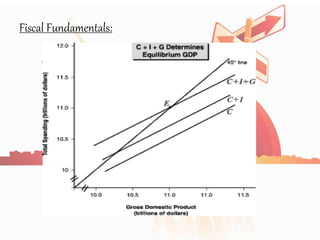
Fiscal Fundamentals:
• The previous figure ignores Taxes.
• Taxes lower households' disposable income.
• The amount collected in taxes doesn't find its way
into consumption (“C”). But if the government
spends every dollar that it collects in taxes, then
that amount does find its way into total demand
through government expenditures.
• When that occurs, the GDP remains unaffected by
taxes.
• The size of the economy is the same whether
people choose to produce and consume private
goods or public goods.
• The mix of goods doesn't affect the level of GDP, as
long as the total amount spent on them doesn't
change
What happens when the government collects more in taxes than
it spends?
Total spending:
• when the government brings in more in taxes than it
spends, it reduces disposable income and slows the
growth of the economy. Fiscal policy prescription to
stabilize an overheated economy is higher taxes.
In Times of inflation:
• when too much demand is bidding up prices—a tax
increase, coupled with no increase in government
spending, will dampen the upward pressure on
prices. The tax increase lowers demand by lowering
disposable income. As long as that reduction in
consumer demand is not offset by an increase in
government demand, total demand decreases.
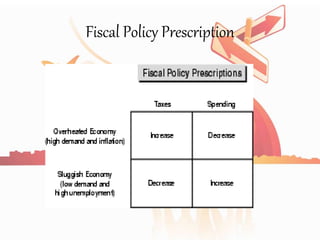
Fiscal Policy Prescription
Spending Policy:
• If the government were to keep taxes the same,
but decrease its spending, it would have the
same effect as a tax increase, but through a
slightly different channel.
• Instead of decreasing disposable income and
decreasing consumption (“C”), a decrease in
government spending decreases the “G” in C + I
+ G directly.
• The lower demand flows through to the larger
economy, slows growth in income and
employment, and dampens inflationary
pressure.
Ricardian equivalence
• The Ricardian equivalence theorem
essentially states that government deficits
are anticipated by individuals who increase
their saving because they realize that
borrowing today has to be repaid later. More
precisely, bond-financed deficits must be met
by a future tax increase, which would be
foreseen by individuals who would thus
adjust their present consumption
accordingly.
• If this theory is true, it would mean a tax cut
financed by higher borrowing would have no
impact on increasing aggregate demand because
consumers would save the tax cut to pay the
future tax increases.
• It is argued that if the government borrows
money to fund a tax cut, rational consumers
realize in the future taxes will have to rise to
finance the borrowing. Therefore, they save the
extra income so that they can pay future tax
rises.
• Consumers wish to smooth their consumption
over the course of their life. Thus if consumers
anticipate a rise in taxes in the future they will
save their current tax cuts to be able to pay
future tax rises.
Fiscal Policy in Pakistan
• In Pakistan, the fiscal deficit has a direct
impact on inflation as government
expenditure constitutes a large part of
aggregate expenditure that might lead to
demand pull inflation, and an indirect impact
as the fiscal deficit is financed partly through
the central bank.
• During the period between 1965 and 1972, due
to domestic and international political
disturbances, the share of defense expenditure
increased. In early 1970s, the initiation of
nationalization strategy also contributed to the
massive fiscal expenditure in terms of public
investment.
• Consequently, during the 1980s and 1990s,
policy has been preoccupied by the need to
contain growing fiscal deficits and the
accompanying increase in public indebtedness,
and efforts to curb the cost of debt servicing.
• A rule based fiscal policy requires the
government to commit to a fiscal policy
strategy or to specific fiscal targets that can
be monitored.
• To encourage fiscal sustainability and
macroeconomic stability a fiscal policy rule
can be used as an instrument.
• In Pakistan, macroeconomic imbalances have
contributed to deceleration in economic
growth and investment which in turns was
translated into a rise in poverty levels.
Govt. Expenditure and Tax Revenues as the % of GDP
• There has been considerable improvement in the
fiscal deficit and the overall fiscal deficit which
averaged nearly 7.0 percent of the GDP in the 1990s
has steadily declined to 2.3 percent in 2002-03 but
increased to 3.3 percent in 2003-04 because of higher
development spending.
• The fiscal deficit has remained above 4.0 percent of
GDP for the years (2005- 06 and 2006-07, 2007-08)
mainly because of earthquake related spending and
higher development expenditure, particularly
towards financing of physical and human
infrastructure projects.
• Higher government spending on the war against the
terrorism also contributes to the rise in the level of
fiscal deficits.
Results of pure fiscal shocks
The effects of Government Expenditure Shock:
• Government spending consists of the public
money spent to provide social goods such as
public goods and merit goods. The size of
government spending varies with
government role but it is independent of
profit expectations and way beyond
minimum level of society needs.
• Government spending has prompt and
significant effect on the aggregate demand
and it is a key fiscal tool.
The Effects of Net Taxes:
• Government expenditure falls in case of tight
fiscal policy in terms of high tax revenues.
• This finding is theoretically inconsistent
because higher revenues encourage
government spending and this relationship is
statistically insignificant.
• The GDP response to a tax shock is positive.
• These tax shocks are also inflationary as the
consumer price index is persistently
increasing due to a positive shock in tax
revenues.
Objectives and Role of Fiscal Policy
Increase in Savings:-
This policy is also used to increase the rate of savings in the country. In
the developing countries rich class spends a lot of money on luxuries.
The government can impose taxes on them and can provide the basic
necessities of life to the poor class on low rate. In this way by providing
incentives, savings can be increased.
To Encourage Investment:-
The government can encourage the investment by providing various
incentives like the tax holiday in the various sectors of the economy.
The capital can be shifted from less productive sectors to more
productive sectors. So the resources of the country can be utilized
maximum.
To Achieve Equal Distribution of Wealth:-
Fiscal policy is very useful for the achievement of equal distribution of
wealth. When the wealth is equally distributed among the various
classes, then their purchasing power increases which ensures the high
level of employment and production.
To Control Inflation:-
Fiscal policy is very useful weapon for controlling the rate of inflation.
When the expenditure on non productive projects is reduced or the
rates of taxes are increased then the purchasing power of the people
reduces.
Stabilization of Price Level:-
Fiscal policy is also used to achieve desirable level of prices in
the country. It means the cost and price should be at such level
that production and employment may increase.
To Attain Maximum Welfare of the People:-
Fiscal policy main objective is to achieve maximum welfare of
the people. The quality of life must improve in the country.
To Check Rapid Increase in Consumption :-
Fiscal policy is also used to check the rapid increase in the
consumption will be high then the rate of saving will be low
and consequently rate of investment will be low. A country
cannot improve its economic condition without increasing their
investment.
To Achieve Economic Stability:-
The aim of fiscal policy is to increase the rate of production and
employment without inflation. So in the entire countries fiscal
policy major objective is to ensure the economic stability in the
country.
Issues in Fiscal Policy
The Multiplier Effect:
the multiplier will boost the effect of an
increase or reduction in taxes or spending. For
instance, an extra dollar of government
spending will flow through the economy and,
by being repeatedly respent, will magnify the
stimulus provided by that incremental dollar.
Likewise, a dollar of reduced spending will take
a dollar out of the economy, and the multiplier
applies to that as well.
The propensity to spend or save:
• like the multiplier, the propensities to spend and
to save are at work.
• If the government reduces taxes to stimulate
consumption, but households save the money
rather than spend it, consumption will not rise,
nor will investment. If people save the money,
they are “sitting on their wallets” and
consumption remains low.
• If consumption is low, businesses won't invest.
This has been a problem in the application of
fiscal stimulus in Japan, where people tend to
save increases in income.

Fiscal policy and economic development

  • 1.
    Fiscal Policy andEconomic Development
  • 2.
    What is FiscalPolicy ? • Fiscal policy is the general name for the federal government's taxation and expenditure decisions and activities, particularly as they affect the economy. (Monetary policy refers to policies that affect interest rates and the money supply.)
  • 3.
    Government's Unique Situation •Government has the power to tax, which gives it greater control over its revenue. • By increasing or decreasing taxes, the government affects households' level of disposable income. • The federal government can finance budget deficits by borrowing in the financial markets. • The Federal government can print more money.
  • 4.
  • 5.
    • The previousfigure ignores Taxes. • Taxes lower households' disposable income. • The amount collected in taxes doesn't find its way into consumption (“C”). But if the government spends every dollar that it collects in taxes, then that amount does find its way into total demand through government expenditures. • When that occurs, the GDP remains unaffected by taxes. • The size of the economy is the same whether people choose to produce and consume private goods or public goods. • The mix of goods doesn't affect the level of GDP, as long as the total amount spent on them doesn't change
  • 6.
    What happens whenthe government collects more in taxes than it spends? Total spending: • when the government brings in more in taxes than it spends, it reduces disposable income and slows the growth of the economy. Fiscal policy prescription to stabilize an overheated economy is higher taxes. In Times of inflation: • when too much demand is bidding up prices—a tax increase, coupled with no increase in government spending, will dampen the upward pressure on prices. The tax increase lowers demand by lowering disposable income. As long as that reduction in consumer demand is not offset by an increase in government demand, total demand decreases.
  • 7.
  • 8.
    Spending Policy: • Ifthe government were to keep taxes the same, but decrease its spending, it would have the same effect as a tax increase, but through a slightly different channel. • Instead of decreasing disposable income and decreasing consumption (“C”), a decrease in government spending decreases the “G” in C + I + G directly. • The lower demand flows through to the larger economy, slows growth in income and employment, and dampens inflationary pressure.
  • 9.
    Ricardian equivalence • TheRicardian equivalence theorem essentially states that government deficits are anticipated by individuals who increase their saving because they realize that borrowing today has to be repaid later. More precisely, bond-financed deficits must be met by a future tax increase, which would be foreseen by individuals who would thus adjust their present consumption accordingly.
  • 10.
    • If thistheory is true, it would mean a tax cut financed by higher borrowing would have no impact on increasing aggregate demand because consumers would save the tax cut to pay the future tax increases. • It is argued that if the government borrows money to fund a tax cut, rational consumers realize in the future taxes will have to rise to finance the borrowing. Therefore, they save the extra income so that they can pay future tax rises. • Consumers wish to smooth their consumption over the course of their life. Thus if consumers anticipate a rise in taxes in the future they will save their current tax cuts to be able to pay future tax rises.
  • 11.
    Fiscal Policy inPakistan • In Pakistan, the fiscal deficit has a direct impact on inflation as government expenditure constitutes a large part of aggregate expenditure that might lead to demand pull inflation, and an indirect impact as the fiscal deficit is financed partly through the central bank.
  • 12.
    • During theperiod between 1965 and 1972, due to domestic and international political disturbances, the share of defense expenditure increased. In early 1970s, the initiation of nationalization strategy also contributed to the massive fiscal expenditure in terms of public investment. • Consequently, during the 1980s and 1990s, policy has been preoccupied by the need to contain growing fiscal deficits and the accompanying increase in public indebtedness, and efforts to curb the cost of debt servicing.
  • 13.
    • A rulebased fiscal policy requires the government to commit to a fiscal policy strategy or to specific fiscal targets that can be monitored. • To encourage fiscal sustainability and macroeconomic stability a fiscal policy rule can be used as an instrument. • In Pakistan, macroeconomic imbalances have contributed to deceleration in economic growth and investment which in turns was translated into a rise in poverty levels.
  • 14.
    Govt. Expenditure andTax Revenues as the % of GDP • There has been considerable improvement in the fiscal deficit and the overall fiscal deficit which averaged nearly 7.0 percent of the GDP in the 1990s has steadily declined to 2.3 percent in 2002-03 but increased to 3.3 percent in 2003-04 because of higher development spending. • The fiscal deficit has remained above 4.0 percent of GDP for the years (2005- 06 and 2006-07, 2007-08) mainly because of earthquake related spending and higher development expenditure, particularly towards financing of physical and human infrastructure projects. • Higher government spending on the war against the terrorism also contributes to the rise in the level of fiscal deficits.
  • 15.
    Results of purefiscal shocks The effects of Government Expenditure Shock: • Government spending consists of the public money spent to provide social goods such as public goods and merit goods. The size of government spending varies with government role but it is independent of profit expectations and way beyond minimum level of society needs. • Government spending has prompt and significant effect on the aggregate demand and it is a key fiscal tool.
  • 16.
    The Effects ofNet Taxes: • Government expenditure falls in case of tight fiscal policy in terms of high tax revenues. • This finding is theoretically inconsistent because higher revenues encourage government spending and this relationship is statistically insignificant. • The GDP response to a tax shock is positive. • These tax shocks are also inflationary as the consumer price index is persistently increasing due to a positive shock in tax revenues.
  • 17.
    Objectives and Roleof Fiscal Policy Increase in Savings:- This policy is also used to increase the rate of savings in the country. In the developing countries rich class spends a lot of money on luxuries. The government can impose taxes on them and can provide the basic necessities of life to the poor class on low rate. In this way by providing incentives, savings can be increased. To Encourage Investment:- The government can encourage the investment by providing various incentives like the tax holiday in the various sectors of the economy. The capital can be shifted from less productive sectors to more productive sectors. So the resources of the country can be utilized maximum. To Achieve Equal Distribution of Wealth:- Fiscal policy is very useful for the achievement of equal distribution of wealth. When the wealth is equally distributed among the various classes, then their purchasing power increases which ensures the high level of employment and production. To Control Inflation:- Fiscal policy is very useful weapon for controlling the rate of inflation. When the expenditure on non productive projects is reduced or the rates of taxes are increased then the purchasing power of the people reduces.
  • 18.
    Stabilization of PriceLevel:- Fiscal policy is also used to achieve desirable level of prices in the country. It means the cost and price should be at such level that production and employment may increase. To Attain Maximum Welfare of the People:- Fiscal policy main objective is to achieve maximum welfare of the people. The quality of life must improve in the country. To Check Rapid Increase in Consumption :- Fiscal policy is also used to check the rapid increase in the consumption will be high then the rate of saving will be low and consequently rate of investment will be low. A country cannot improve its economic condition without increasing their investment. To Achieve Economic Stability:- The aim of fiscal policy is to increase the rate of production and employment without inflation. So in the entire countries fiscal policy major objective is to ensure the economic stability in the country.
  • 19.
    Issues in FiscalPolicy The Multiplier Effect: the multiplier will boost the effect of an increase or reduction in taxes or spending. For instance, an extra dollar of government spending will flow through the economy and, by being repeatedly respent, will magnify the stimulus provided by that incremental dollar. Likewise, a dollar of reduced spending will take a dollar out of the economy, and the multiplier applies to that as well.
  • 20.
    The propensity tospend or save: • like the multiplier, the propensities to spend and to save are at work. • If the government reduces taxes to stimulate consumption, but households save the money rather than spend it, consumption will not rise, nor will investment. If people save the money, they are “sitting on their wallets” and consumption remains low. • If consumption is low, businesses won't invest. This has been a problem in the application of fiscal stimulus in Japan, where people tend to save increases in income.