Apple and the Demand for iPods By early 2007, over 100 million iPods had been sold and more than two billion songs had been downloaded from iTunes.  Clearly the strategy of selling an expensive digital music player and selling the music cheaply has been very successful for Apple.  But how long will the iPod’s dominance last? Learning  Objectives Use  demand and supply graphs  to predict changes in prices and quantities. 3.4 Use a graph to illustrate  market equilibrium .  3.3 Discuss the variables that influence  supply .  3.2 Discuss the variables that influence  demand . 3.1
Perfectly competitive market   A market in which there are many buyers and sellers, all the products are identical, and there are no barriers to new sellers entering the market. Where Prices Come From: The Interaction of Demand and Supply
Demand schedule   A table showing the relationship between the price of a product and the quantity of the product demanded. Quantity demanded  The amount of a good or service that a consumer is willing and able to purchase at a given price. Demand curve   A curve that shows the relationship between the price of a product and the quantity of the product demanded. Market demand   The demand by all the consumers of a given good or service. The Demand Side of the Market Demand Schedules and Demand Curves Learning  Objective  3.1
The Demand Side of the Market Learning  Objective  3.1 FIGURE 3-1 A Demand Schedule and Demand Curve Demand Schedules and Demand Curves
The Demand Side of the Market Law of demand   The rule that, holding everything else constant, when the price of a product falls, the quantity demanded of the product will increase, and when the price of a product rises, the quantity demanded of the product will decrease.  Learning  Objective  3.1 The Law of Demand
The Demand Side of the Market Substitution effect   The change in the quantity demanded of a good that results from a change in price, making the good more or less expensive relative to other goods that are substitutes. Income effect   The change in the quantity demanded of a good that results from the effect of a change in the good’s price on consumers’ purchasing power.  Learning  Objective  3.1 What Explains the Law of Demand?
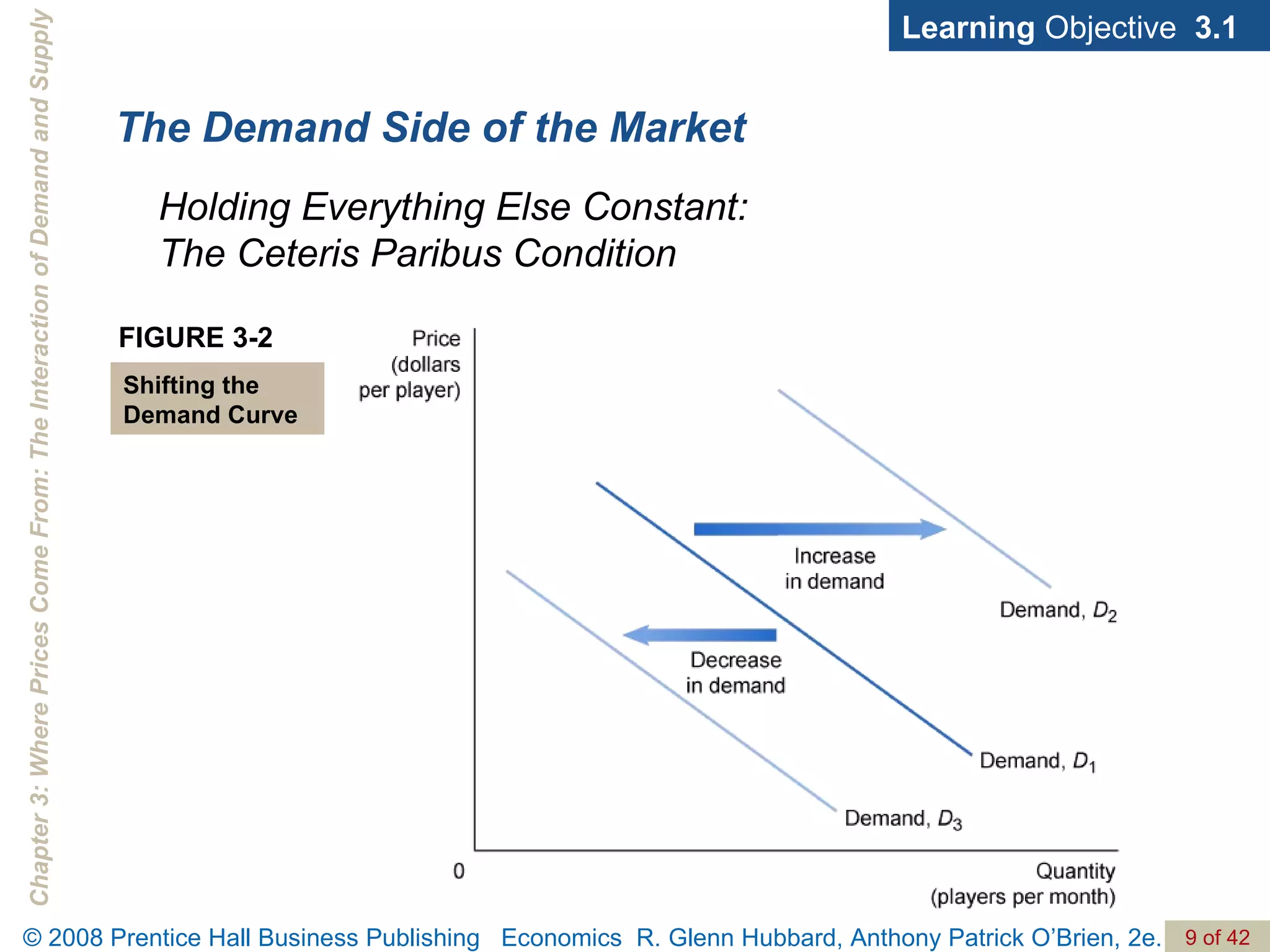
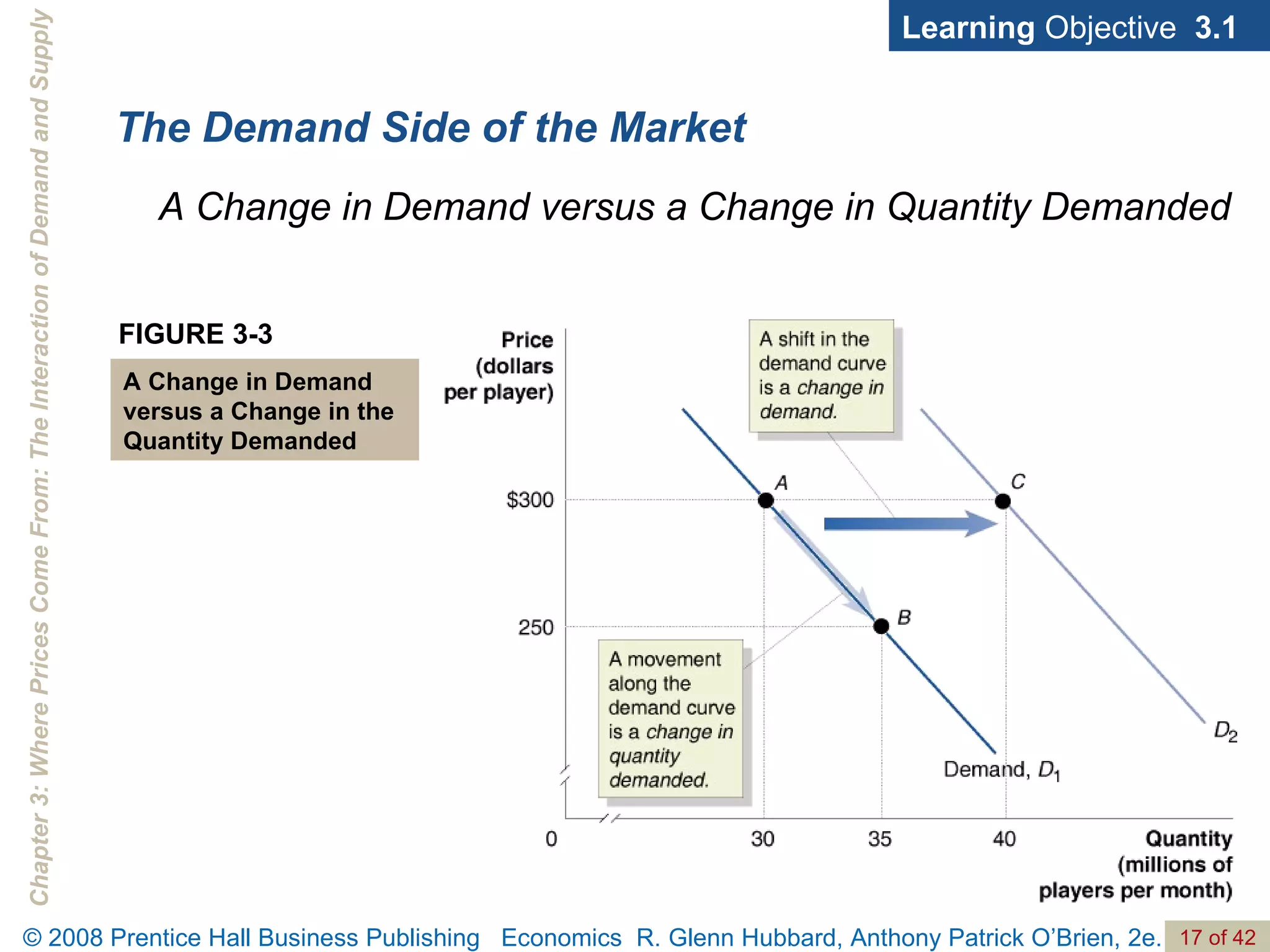
The Demand Side of the Market Ceteris paribus   (“all else equal”)   The requirement that when analyzing the relationship between two variables—such as price and quantity demanded—other variables must be held constant.  A shift of a demand curve is  an increase or decrease in demand . A movement along a demand curve is  an increase or decrease in the quantity demanded .  Learning  Objective  3.1 Holding Everything Else Constant: The Ceteris Paribus Condition
The Demand Side of the Market Learning  Objective  3.1 FIGURE 3-2 Shifting the Demand Curve Holding Everything Else Constant: The Ceteris Paribus Condition
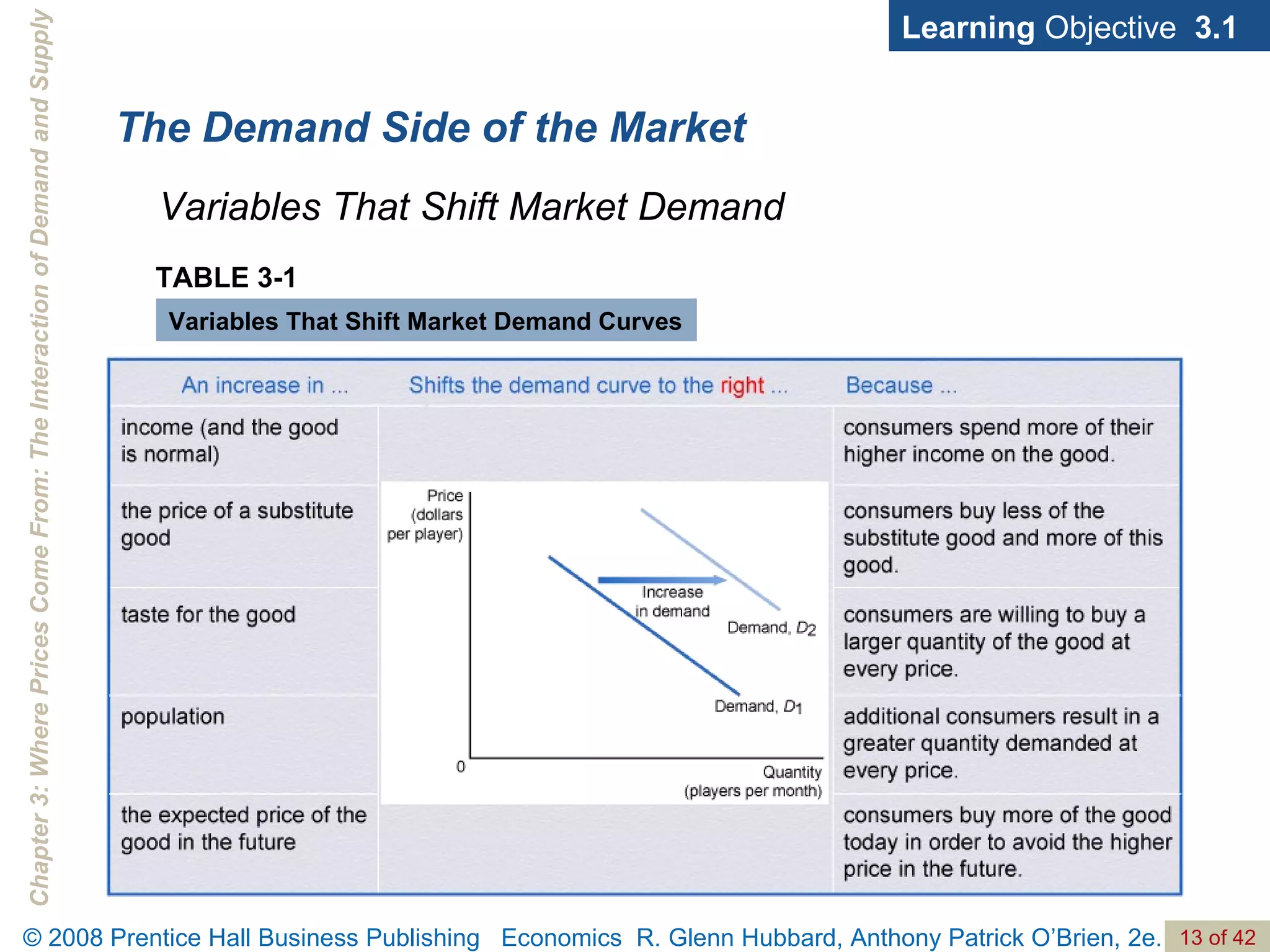
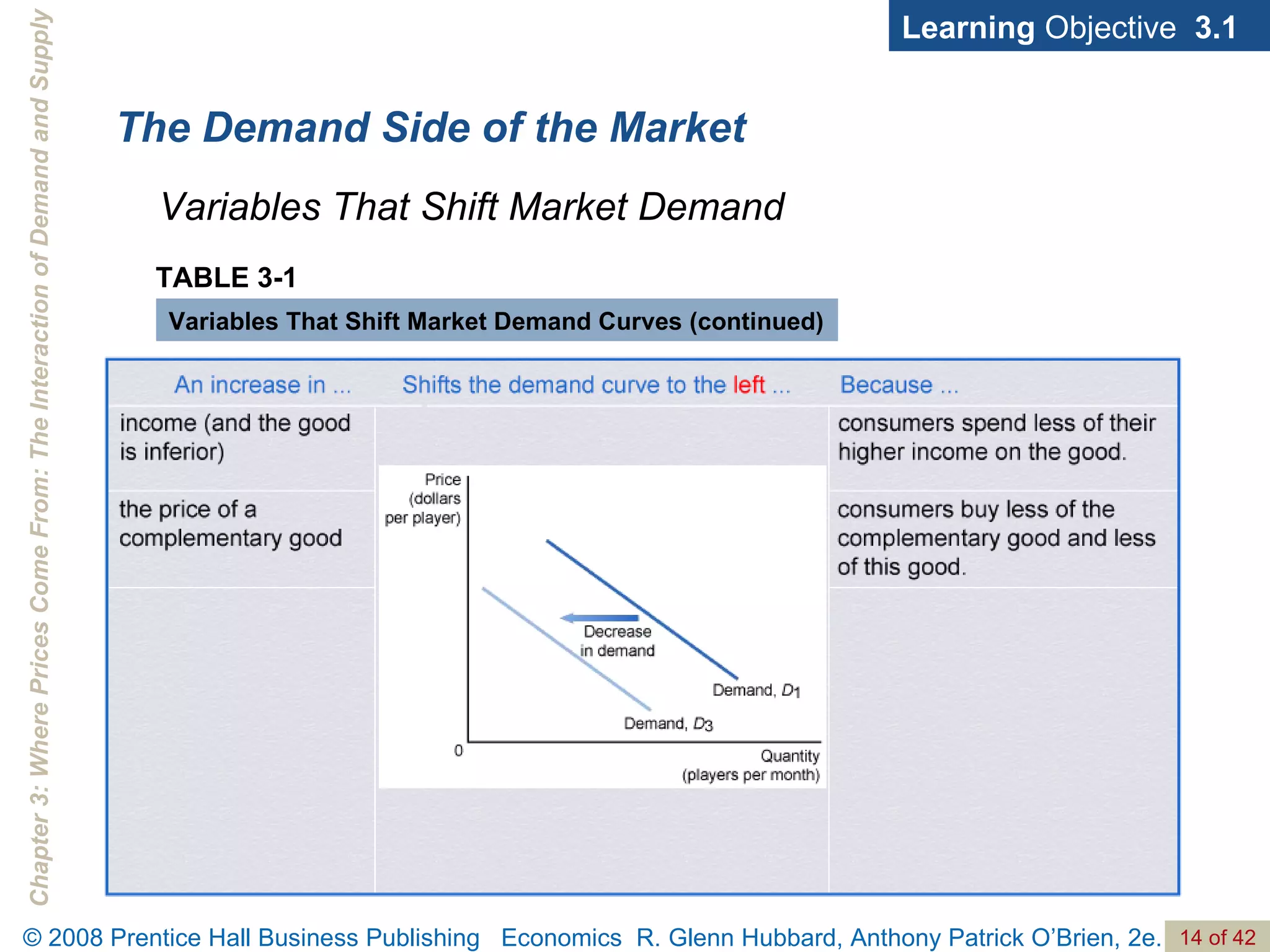
The Demand Side of the Market Normal good   A good for which the demand increases as income rises and decreases as income falls. Inferior good   A good for which the demand increases as income falls and decreases as income rises. Learning  Objective  3.1 Variables That Shift Market Demand Income Many variables other than price can influence market demand.
The Demand Side of the Market Substitutes   Goods and services that can be used for the same purpose. Complements   Goods and services that are used together. Learning  Objective  3.1 Variables That Shift Market Demand Price of related goods Consumers can be influenced by an advertising campaign for a product. Tastes
The Demand Side of the Market Demographics   The characteristics of a population with respect to age, race,  and gender. Learning  Objective  3.1 Population and demographics Expected Future Prices Consumers choose not only which products to buy but also when to buy them.  Variables That Shift Market Demand
The Demand Side of the Market Learning  Objective  3.1 Variables That Shift Market Demand TABLE 3-1 Variables That Shift Market Demand Curves
The Demand Side of the Market Learning  Objective  3.1 Variables That Shift Market Demand TABLE 3-1 Variables That Shift Market Demand Curves (continued)
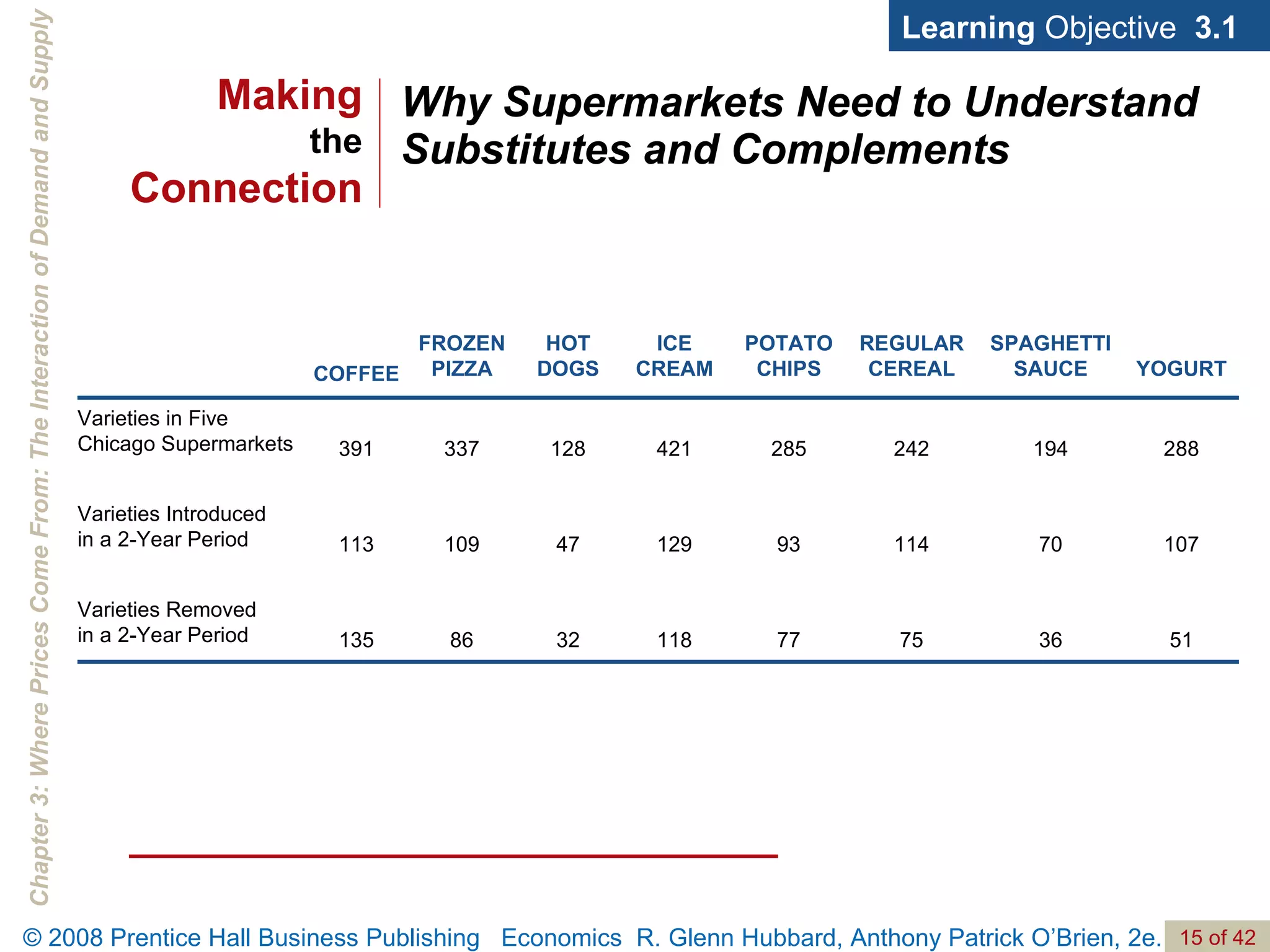
Why Supermarkets Need to Understand Substitutes and Complements Learning  Objective  3.1 Making the Connection 51 36 75 77 118 32 86 135 Varieties Removed in a 2-Year Period 107 70 114 93 129 47 109 113 Varieties Introduced in a 2-Year Period 288 194 242 285 421 128 337 391 Varieties in Five Chicago Supermarkets YOGURT SPAGHETTI SAUCE REGULAR CEREAL POTATO CHIPS ICE CREAM HOT DOGS FROZEN PIZZA COFFEE
Companies Respond to a Growing Hispanic Population You can download Spanish  music from iTunes. Apple is one of many companies responding to a growing Hispanic population.  Learning  Objective  3.1 As the demand for goods purchased by Hispanic households increases, more can be sold at every price.  Not surprisingly, companies have responded by devoting more resources to serving this demographic group.  Making the Connection
The Demand Side of the Market Learning  Objective  3.1 FIGURE 3-3 A Change in Demand versus a Change in the Quantity Demanded A Change in Demand versus a Change in Quantity Demanded
Apple Forecasts the Demand for iPhones and other Consumer Electronics Will Apple’s iPhone match the success of its iPod? Learning  Objective  3.1 To decide which products to develop, firms need to forecast the demand for those products. Time will tell whether Apple’s forecast of a large demand for the iPhone will turn out to be correct.  Making the Connection
Supply schedule   A table that shows the relationship between the price of a product and the quantity of the product supplied. Supply curve   A curve that shows the relationship between the price of a product and the quantity of the product supplied. The Supply Side of the Market Learning  Objective  3.2 Supply Schedules and Supply Curves Quantity supplied   The amount of a good or service that a firm is willing and able to supply at a given price.
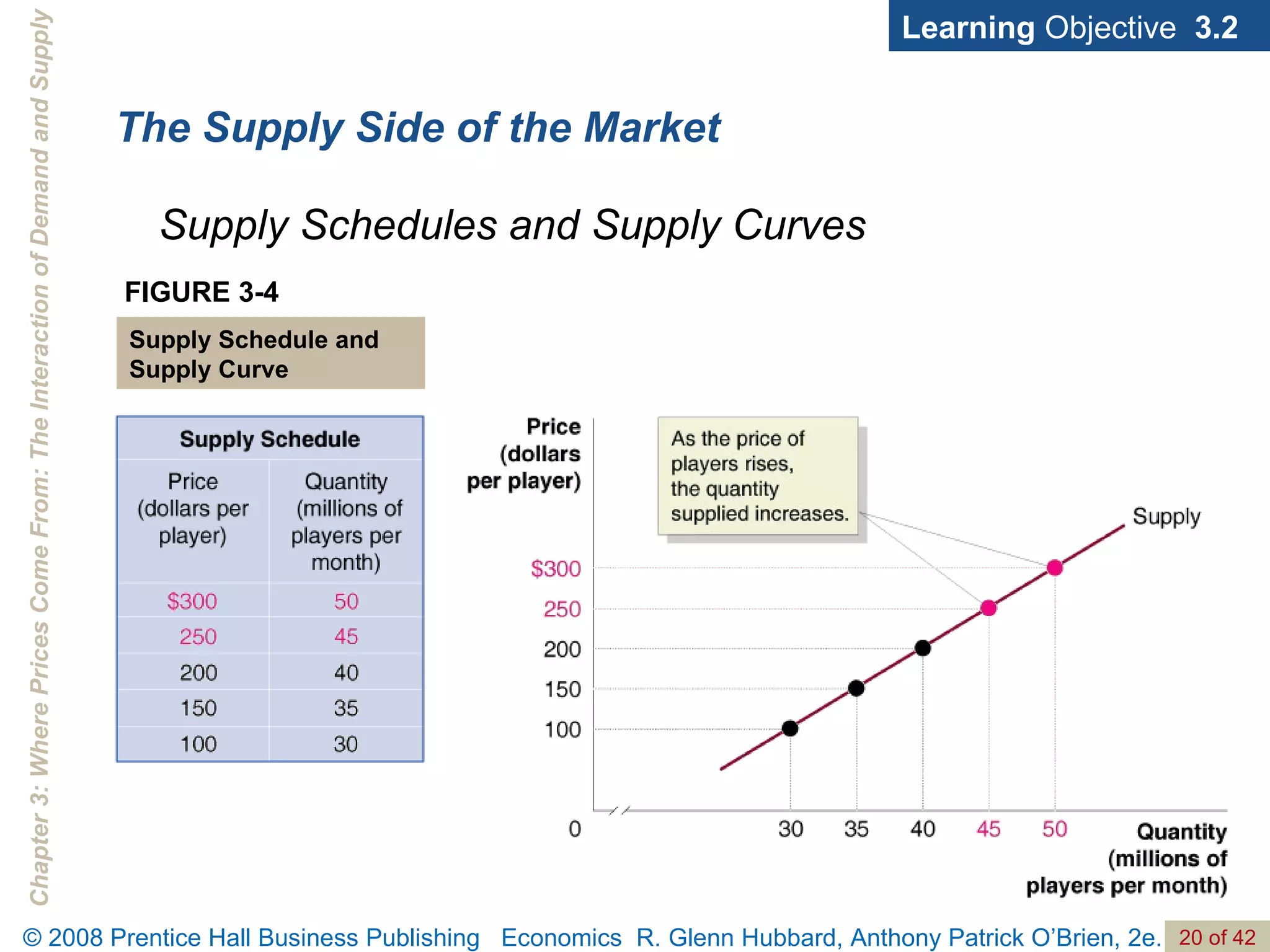
The Supply Side of the Market Learning  Objective  3.2 Supply Schedules and Supply Curves FIGURE 3-4 Supply Schedule and Supply Curve
The Supply Side of the Market Law of supply   The rule that, holding everything else constant, increases in price cause increases in the quantity supplied, and decreases in price cause decreases in the quantity supplied.  Learning  Objective  3.2 The Law of Supply
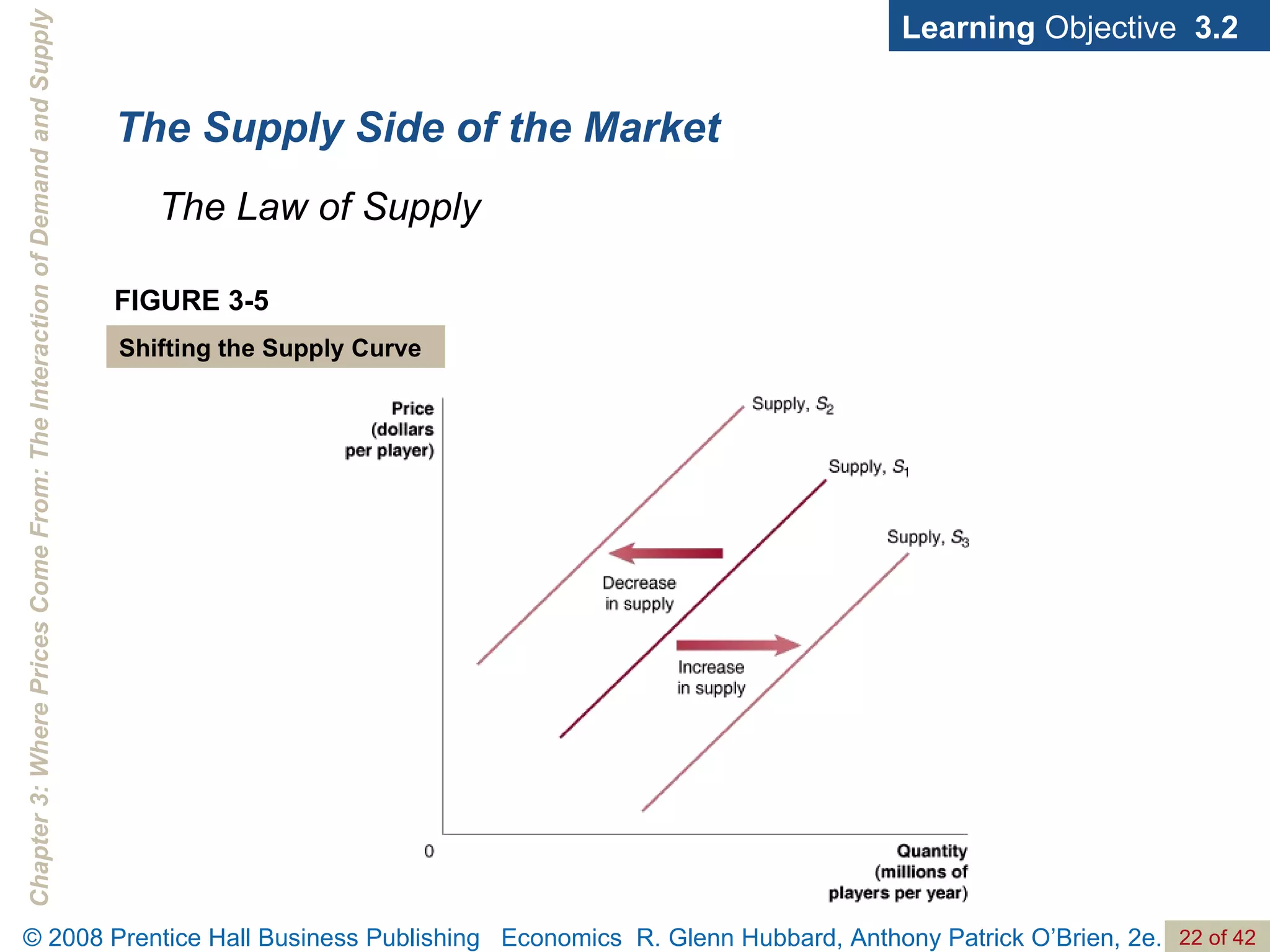
The Supply Side of the Market Learning  Objective  3.2 FIGURE 3-5 Shifting the Supply Curve The Law of Supply
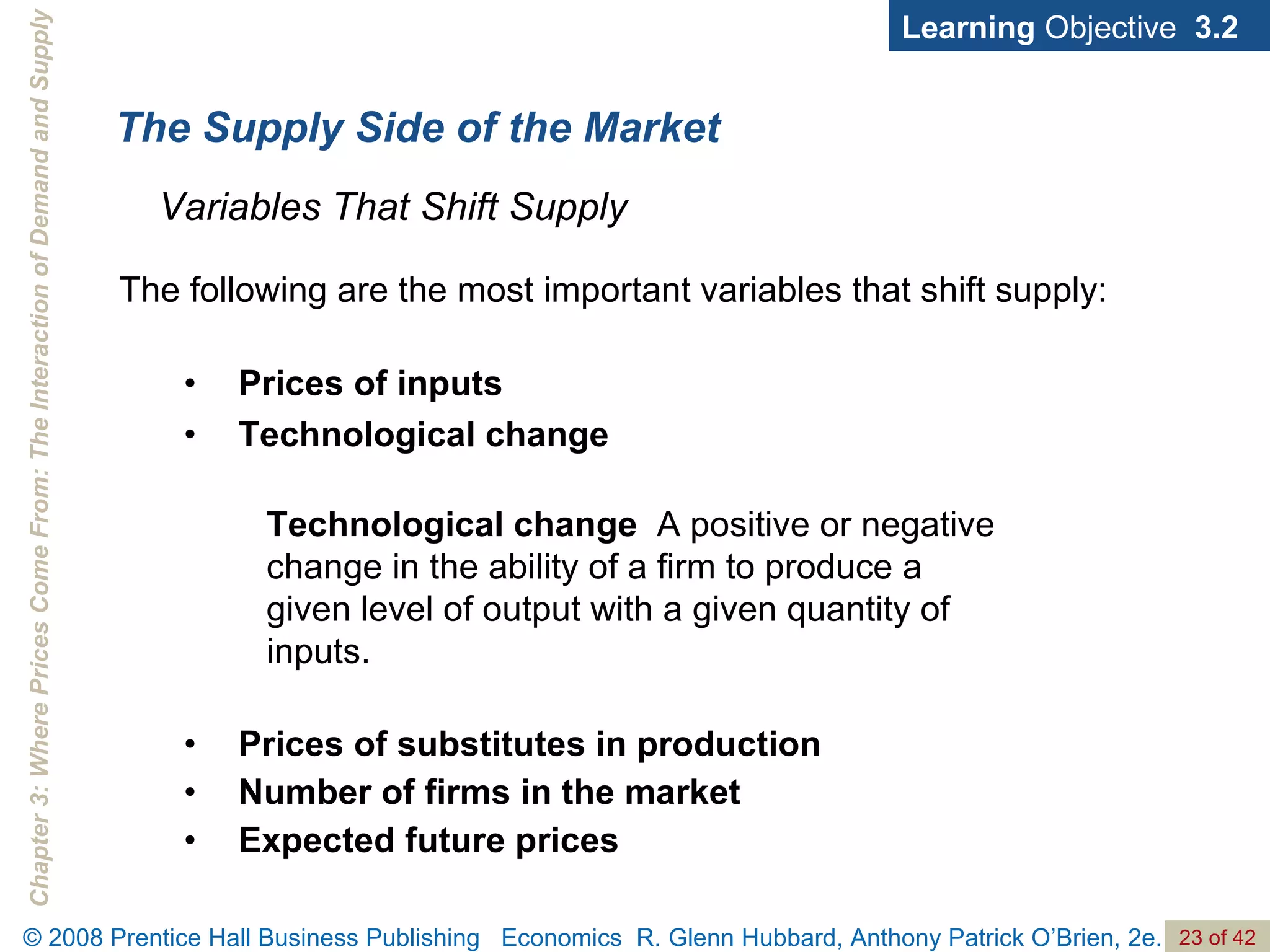
The Supply Side of the Market Prices of substitutes in production Number of firms in the market Expected future prices Learning  Objective  3.2 Variables That Shift Supply Technological change   A positive or negative change in the ability of a firm to produce a given level of output with a given quantity of inputs.  The following are the most important variables that shift supply: • Prices of inputs • Technological change
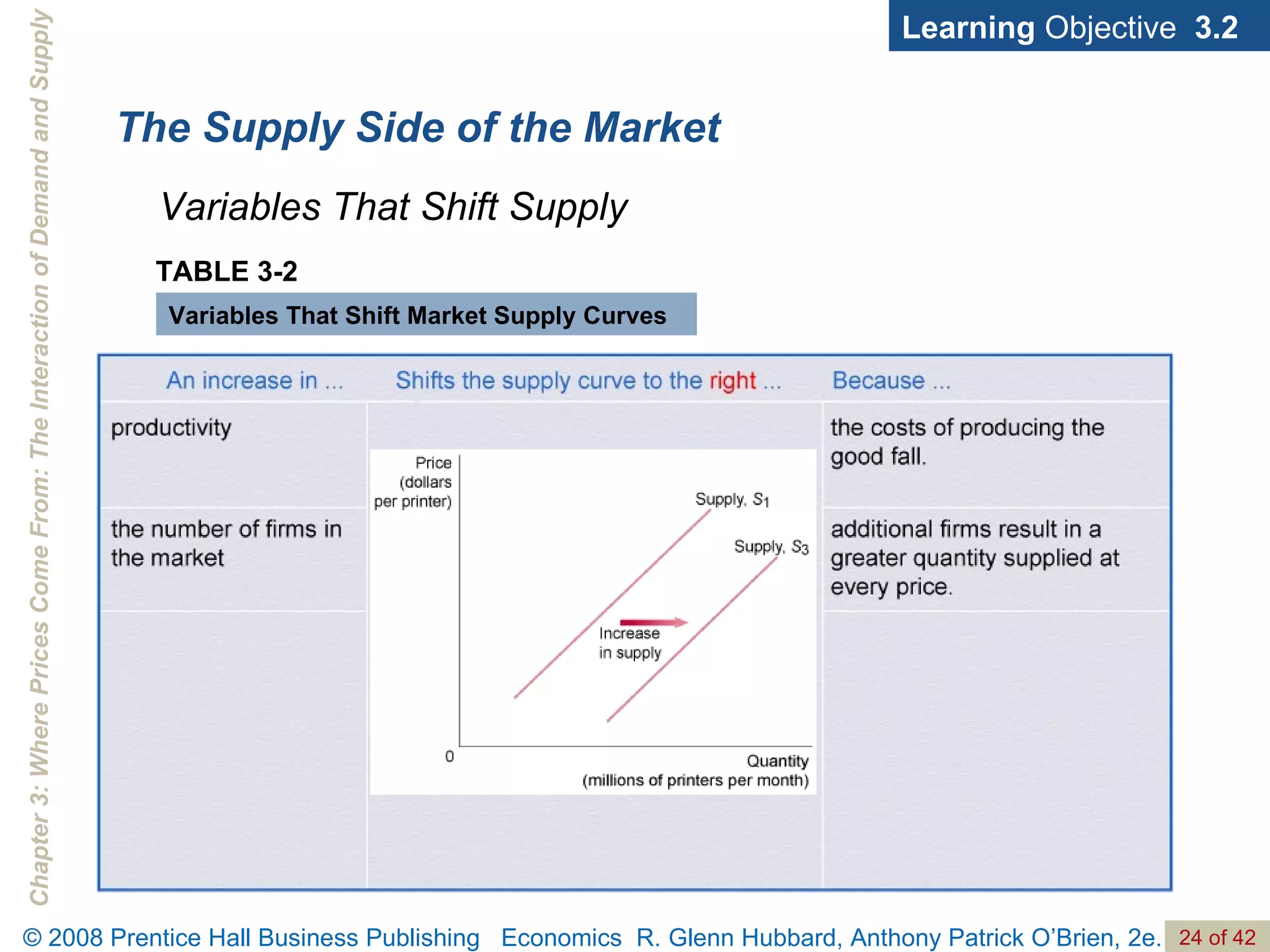
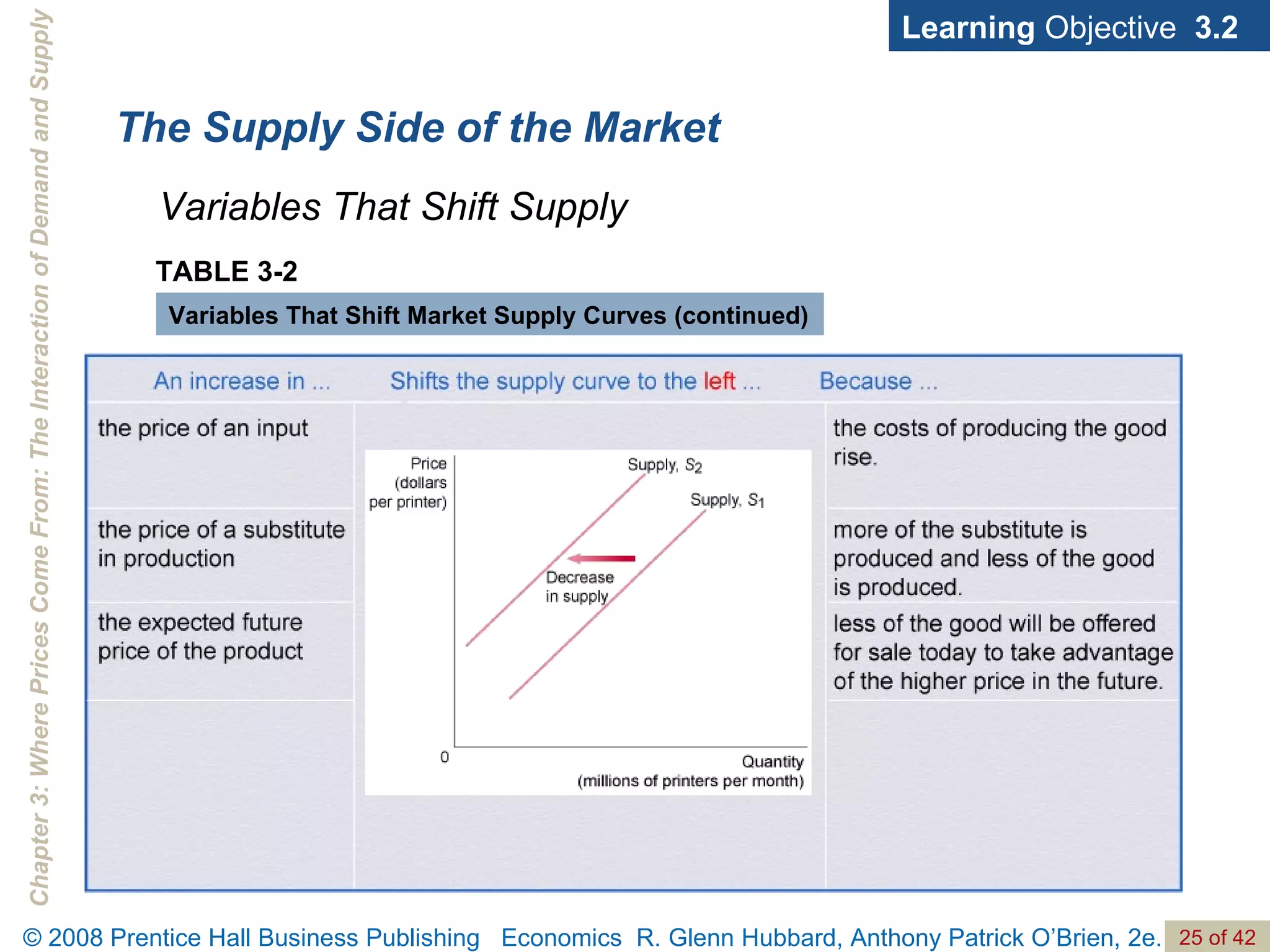
The Supply Side of the Market Learning  Objective  3.2 Variables That Shift Supply TABLE 3-2 Variables That Shift Market Supply Curves
The Supply Side of the Market Learning  Objective  3.2 TABLE 3-2 Variables That Shift Market Supply Curves (continued) Variables That Shift Supply
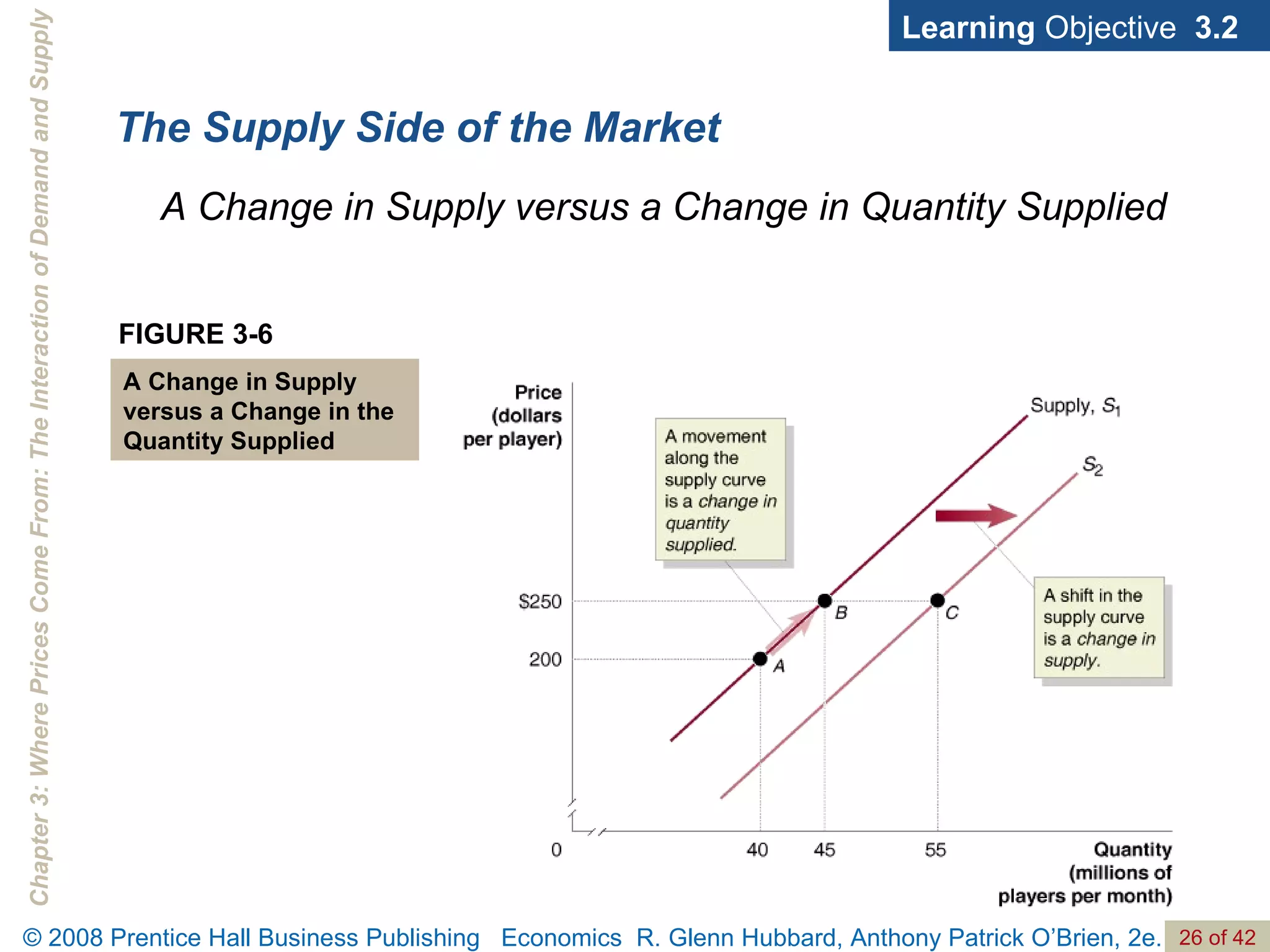
The Supply Side of the Market Learning  Objective  3.2 FIGURE 3-6 A Change in Supply versus a Change in the Quantity Supplied A Change in Supply versus a Change in Quantity Supplied
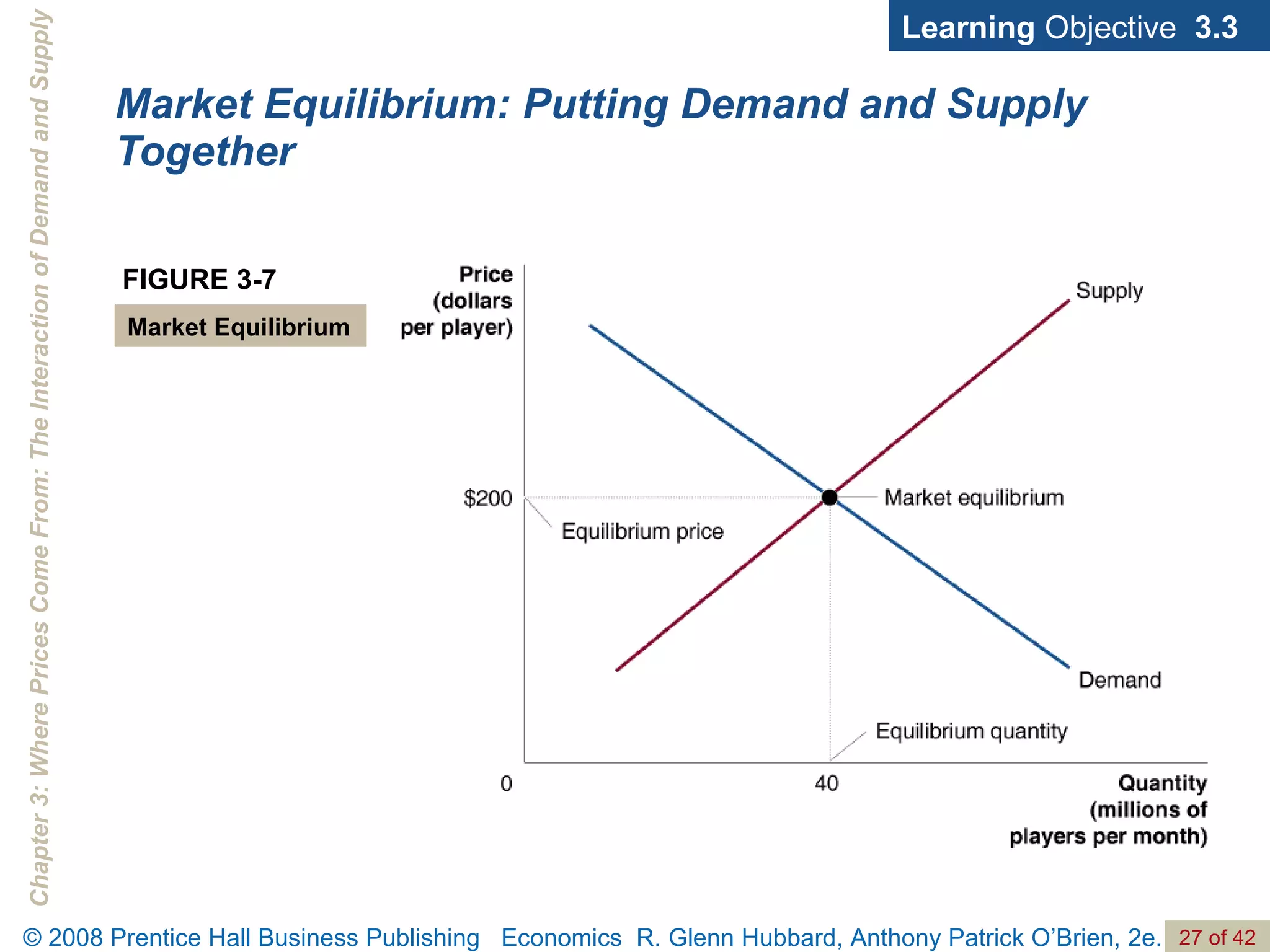
Market Equilibrium: Putting Demand and Supply Together FIGURE 3-7 Market Equilibrium Learning  Objective  3.3
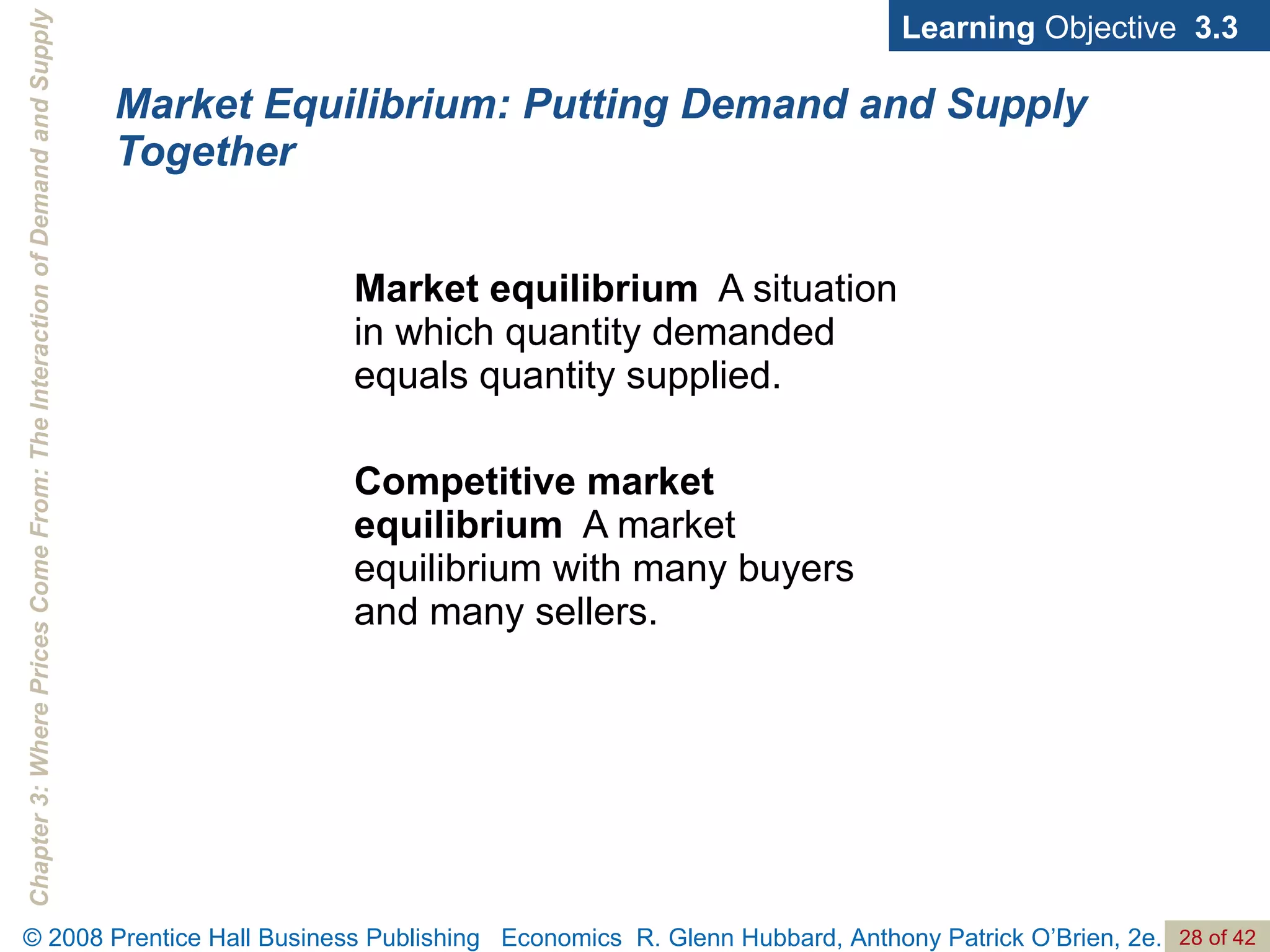
Market equilibrium   A situation in which quantity demanded equals quantity supplied. Competitive market equilibrium   A market equilibrium with many buyers and many sellers. Market Equilibrium: Putting Demand and Supply Together Learning  Objective  3.3
Market Equilibrium: Putting Demand and Supply Together Learning  Objective  3.3 Surplus   A situation in which the quantity supplied is greater than the quantity demanded. Shortage   A situation in which the quantity demanded is greater than the quantity supplied. How Markets Eliminate Surpluses and Shortages
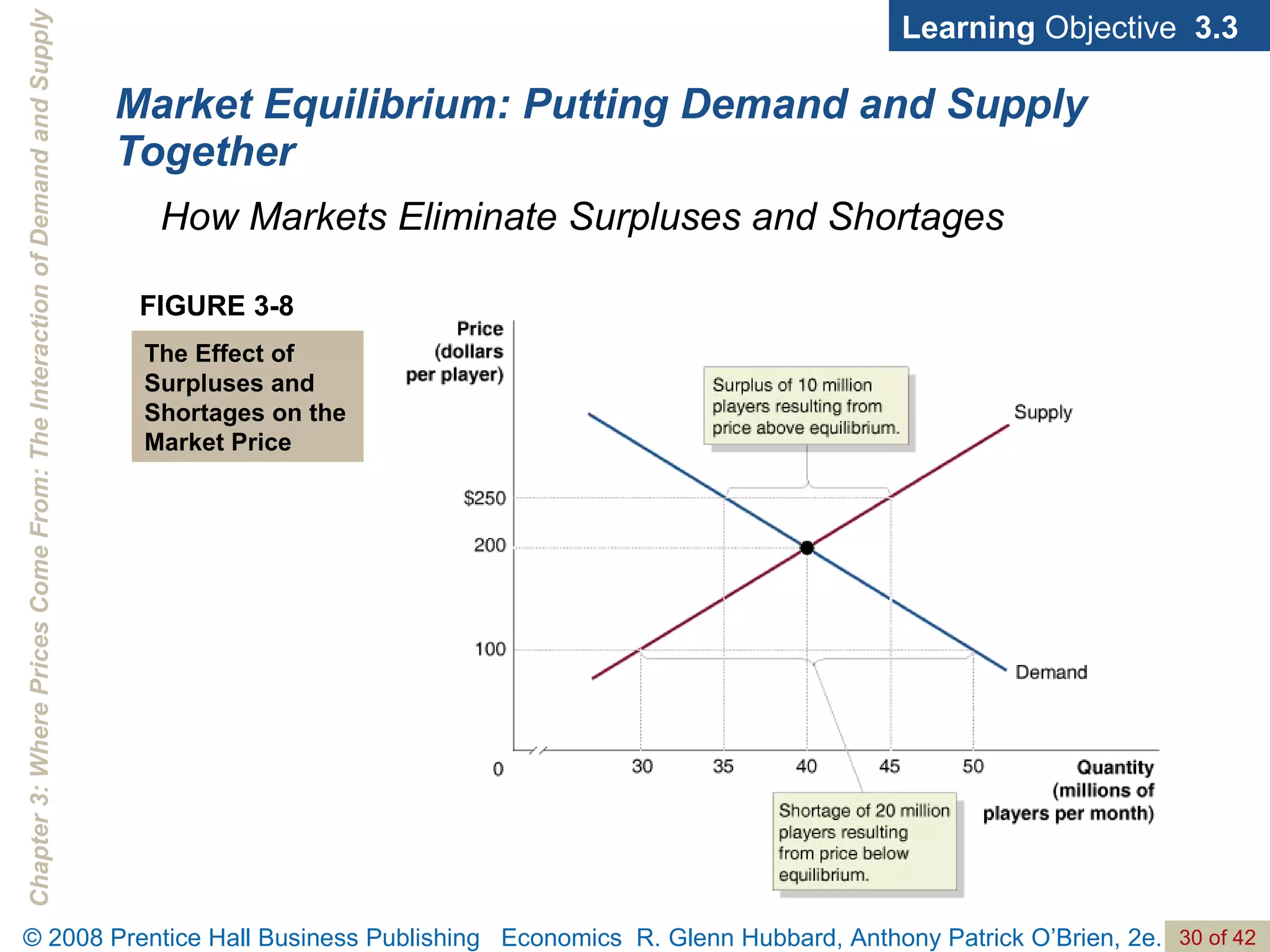
Market Equilibrium: Putting Demand and Supply Together Learning  Objective  3.3 FIGURE 3-8 The Effect of Surpluses and Shortages on the Market Price How Markets Eliminate Surpluses and Shortages
Market Equilibrium: Putting Demand and Supply Together Learning  Objective  3.3 Demand and Supply Both Count Always keep in mind that it is the interaction of demand and supply that determines the equilibrium price.  Neither consumers nor firms can dictate what the equilibrium price will be.  No firm can sell anything at any price unless it can find a willing buyer, and no consumer can buy anything at any price without finding a willing seller.
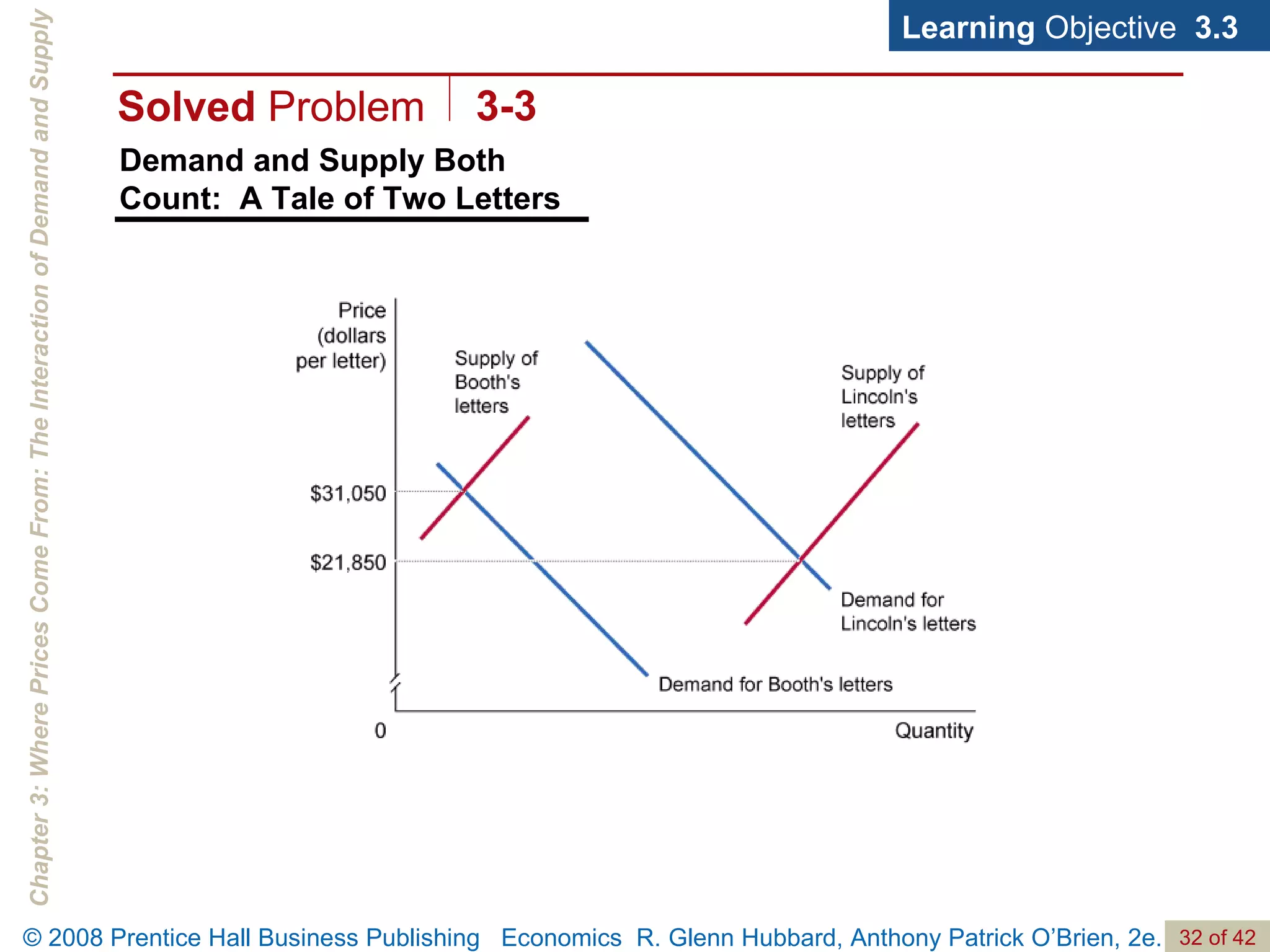
Demand and Supply Both Count:  A Tale of Two Letters Learning  Objective  3.3 Solved  Problem 3-3
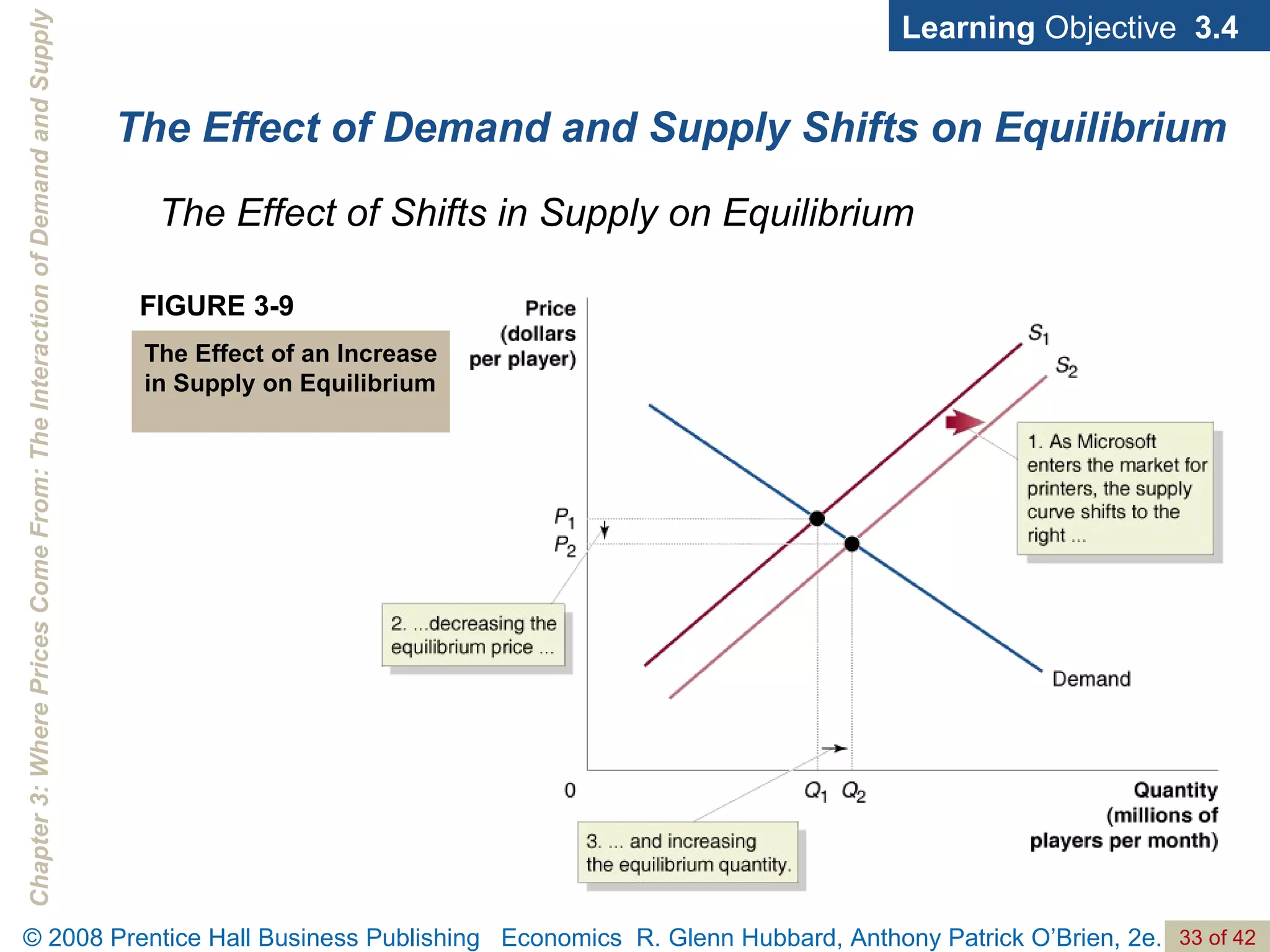
The Effect of Demand and Supply Shifts on Equilibrium FIGURE 3-9 The Effect of an Increase in Supply on Equilibrium The Effect of Shifts in Supply on Equilibrium Learning  Objective  3.4
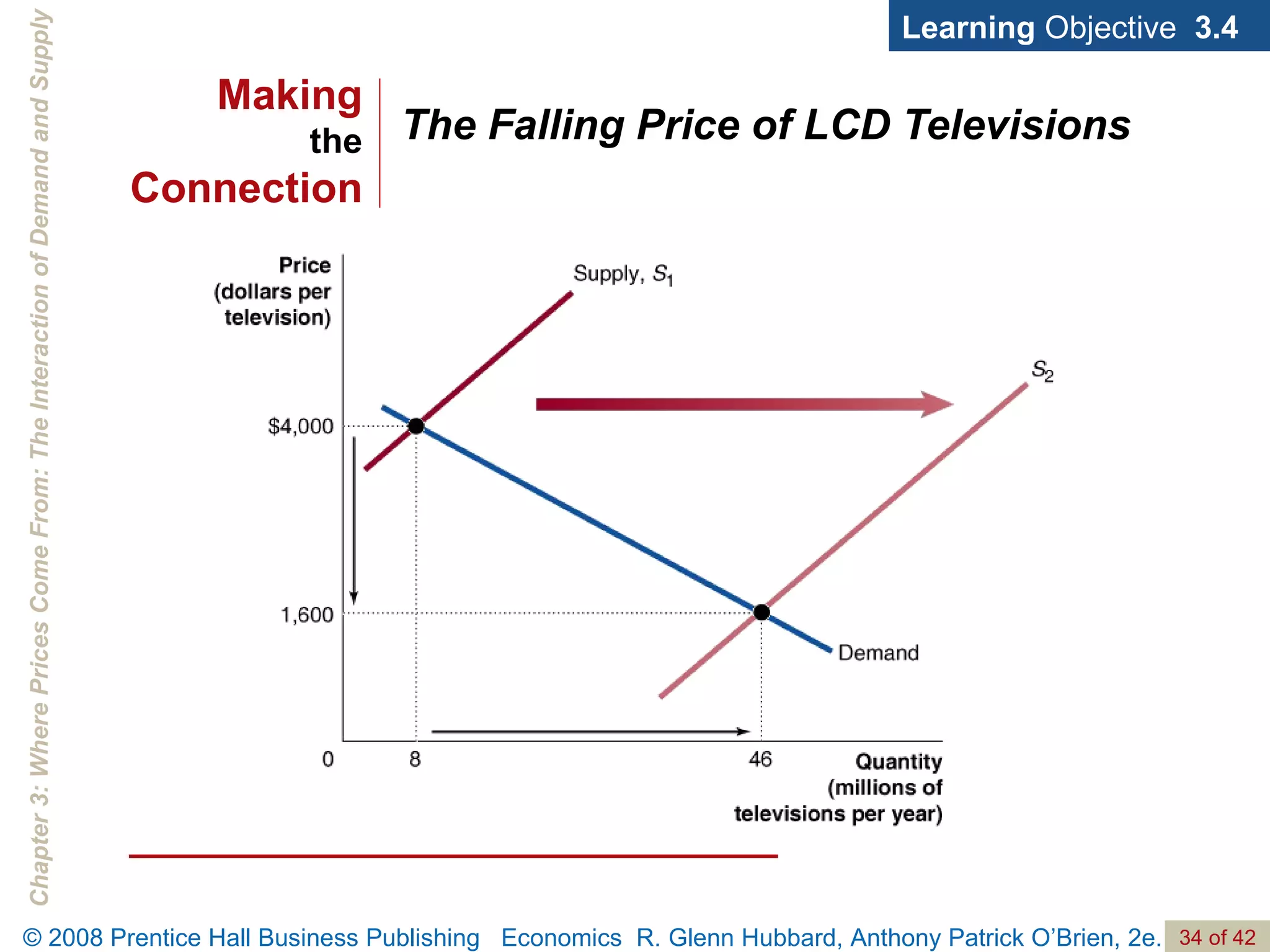
The Falling Price of LCD Televisions Learning  Objective  3.4 Making the Connection
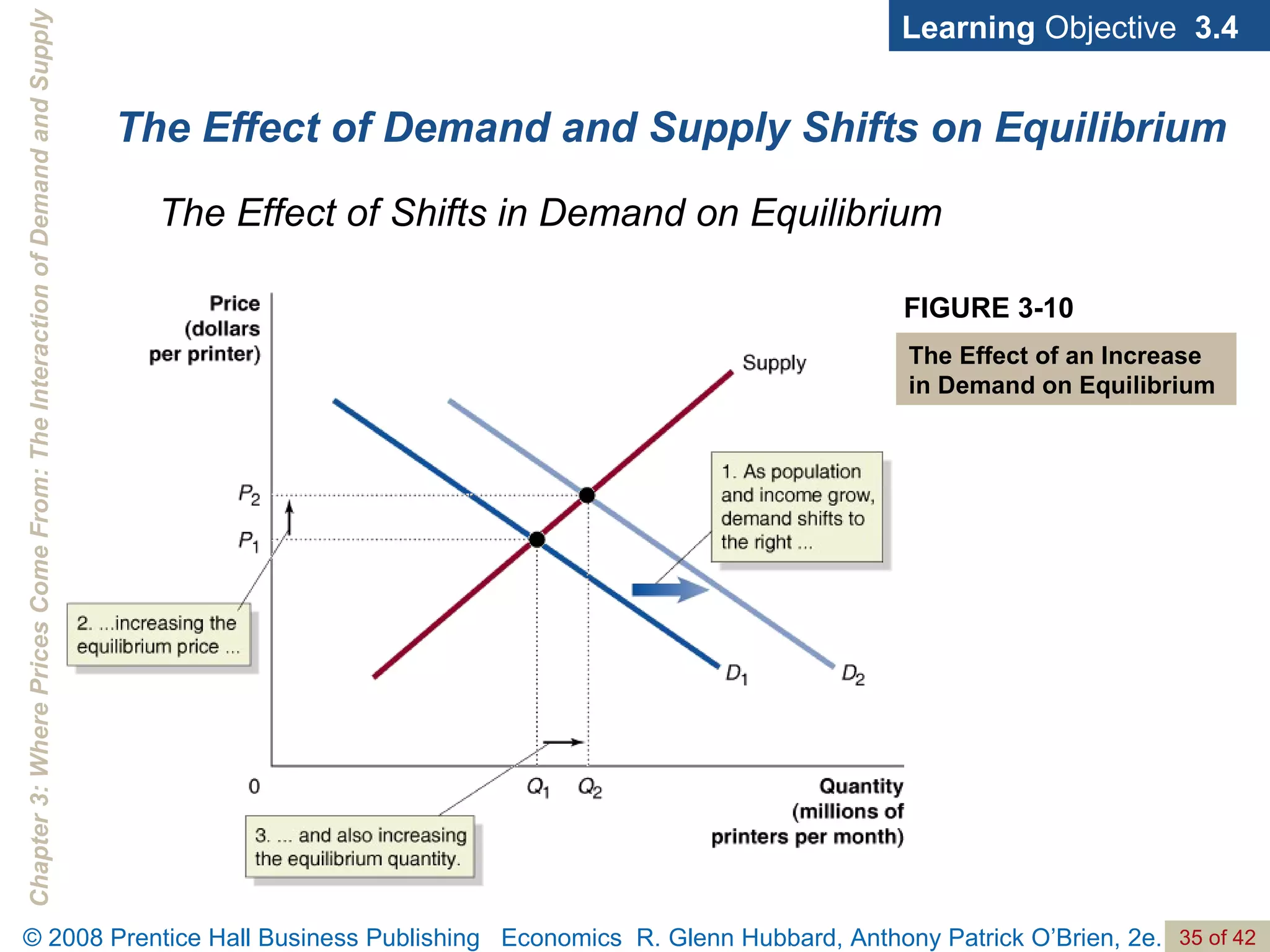
The Effect of Demand and Supply Shifts on Equilibrium FIGURE 3-10 The Effect of an Increase in Demand on Equilibrium The Effect of Shifts in Demand on Equilibrium Learning  Objective  3.4
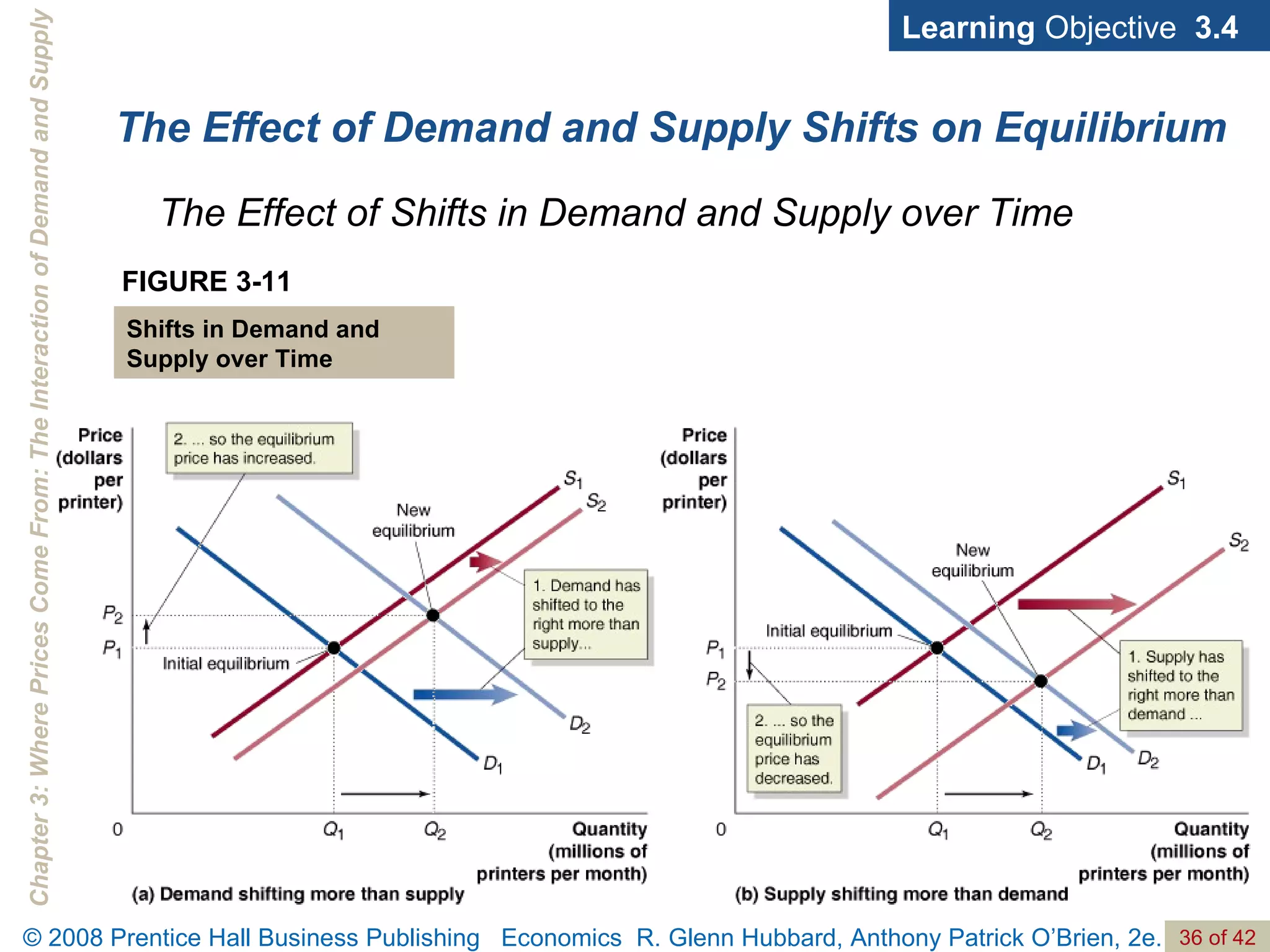
The Effect of Demand and Supply Shifts on Equilibrium FIGURE 3-11 Shifts in Demand and Supply over Time The Effect of Shifts in Demand and Supply over Time Learning  Objective  3.4
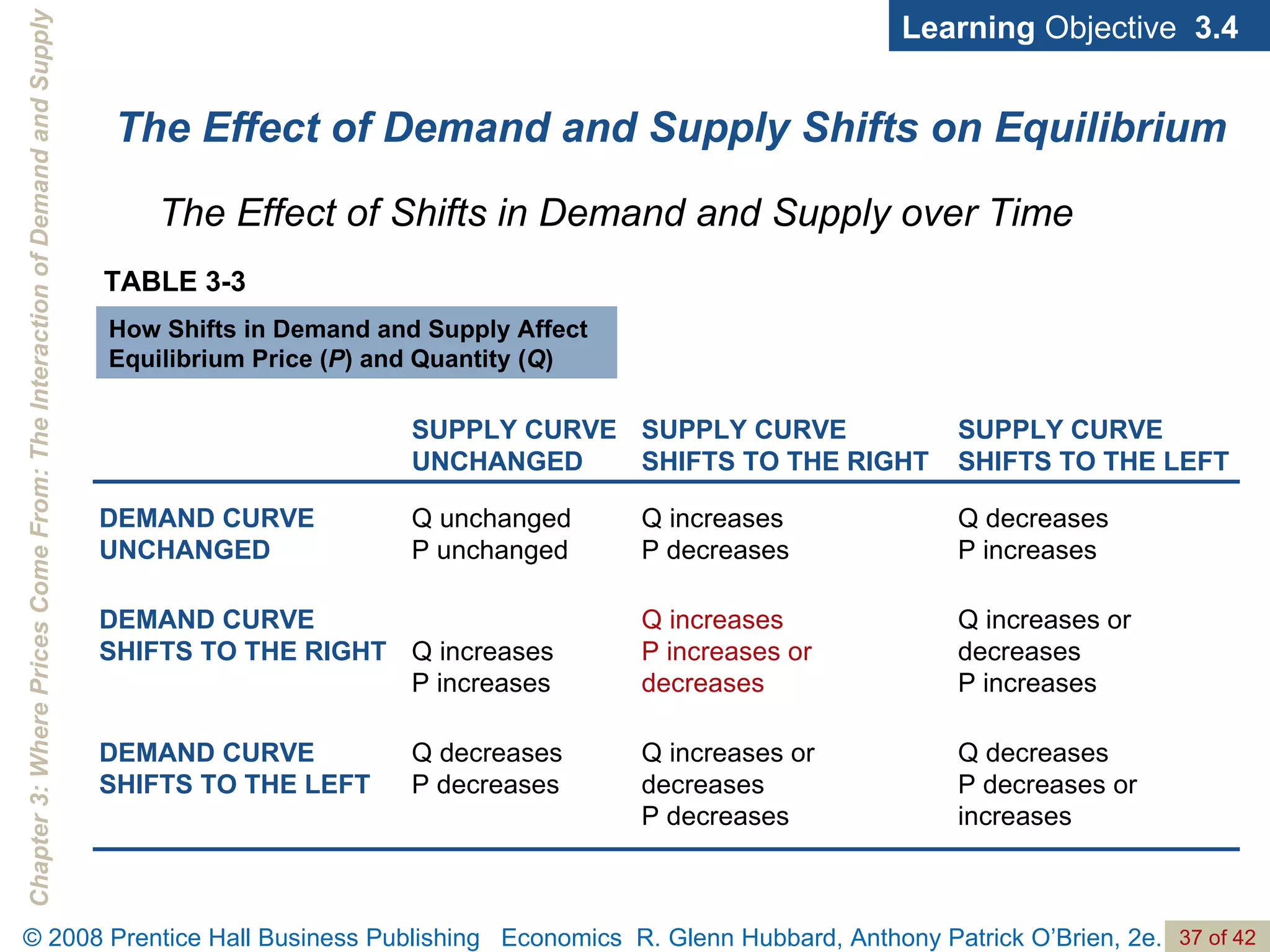
The Effect of Demand and Supply Shifts on Equilibrium TABLE 3-3 How Shifts in Demand and Supply Affect Equilibrium Price ( P ) and Quantity ( Q ) The Effect of Shifts in Demand and Supply over Time Learning  Objective  3.4 Q decreases P increases Q increases P decreases Q unchanged P unchanged DEMAND CURVE UNCHANGED Q decreases P decreases or increases Q increases or  decreases P decreases Q decreases P decreases DEMAND CURVE SHIFTS TO THE LEFT Q increases or  decreases  P increases Q increases P increases or decreases Q increases P increases DEMAND CURVE SHIFTS TO THE RIGHT SUPPLY CURVE SHIFTS TO THE LEFT  SUPPLY CURVE SHIFTS TO THE RIGHT SUPPLY CURVE UNCHANGED
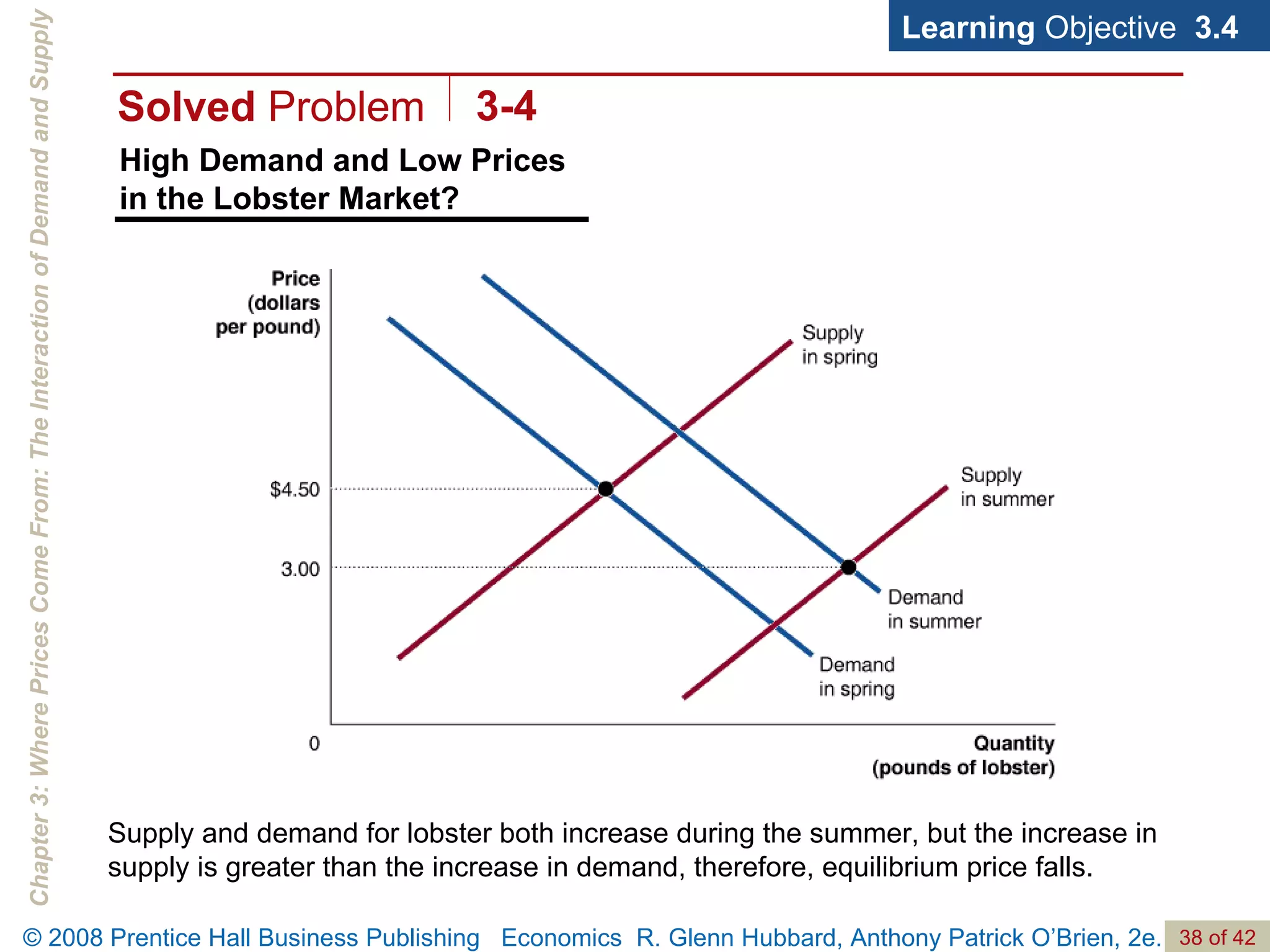
High Demand and Low Prices in the Lobster Market? Learning  Objective  3.4 Supply and demand for lobster both increase during the summer, but the increase in supply is greater than the increase in demand, therefore, equilibrium price falls. Solved  Problem 3-4
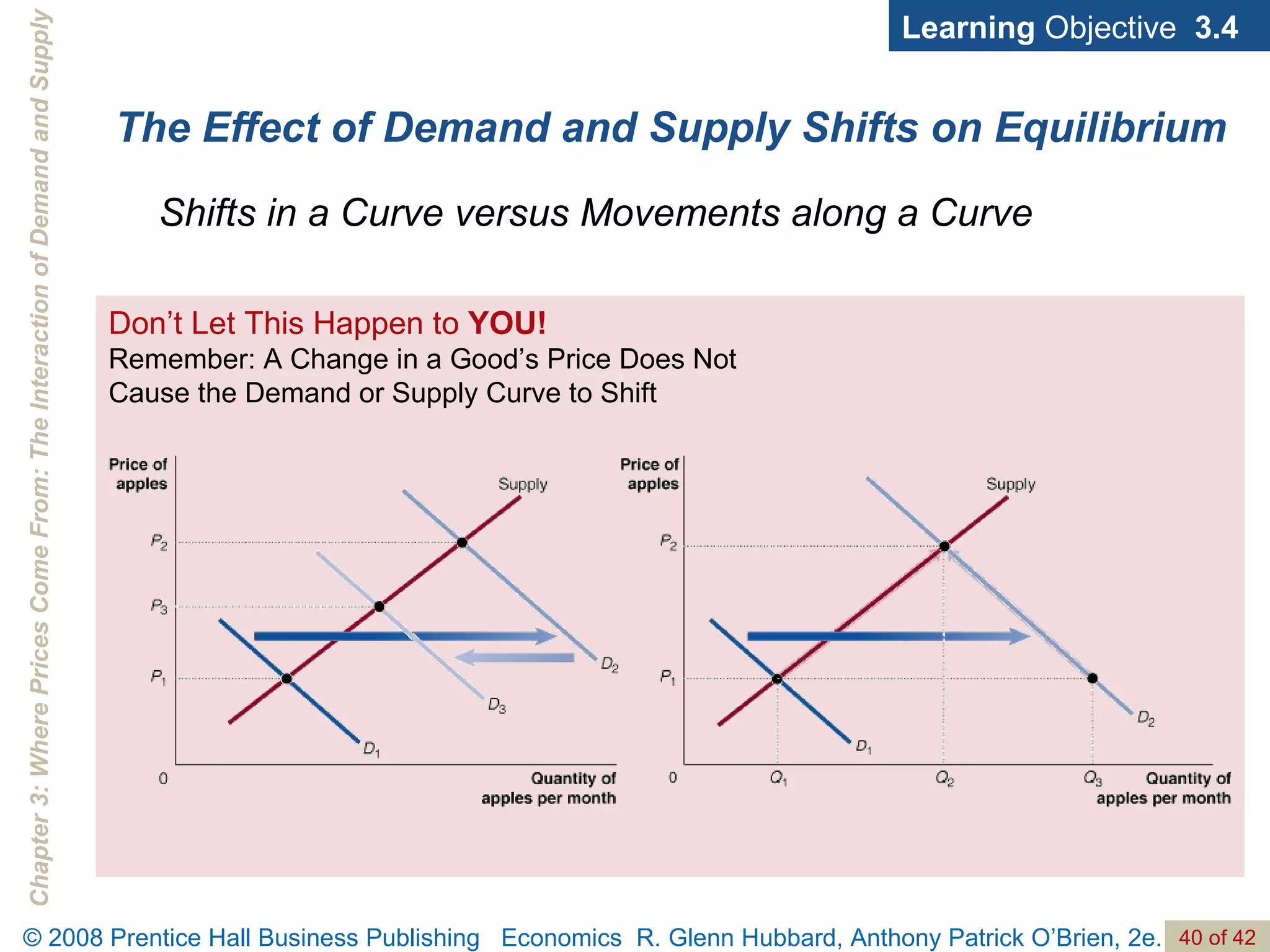
The Effect of Demand and Supply Shifts on Equilibrium Shifts in a Curve versus Movements along a Curve Learning  Objective  3.4 When analyzing markets using demand and supply curves, it is important to remember that when a shift in a demand or supply curve causes a change in equilibrium price, the change in price does not cause a further shift in demand or supply.
The Effect of Demand and Supply Shifts on Equilibrium Shifts in a Curve versus Movements along a Curve Learning  Objective  3.4 Don’t Let This Happen to  YOU! Remember: A Change in a Good’s Price Does Not Cause the Demand or Supply Curve to Shift
An Inside LOOK How Does the iPhone Help Apple and AT&T? Apple Coup:  How Steve Jobs Played Hardball in iPhone Birth
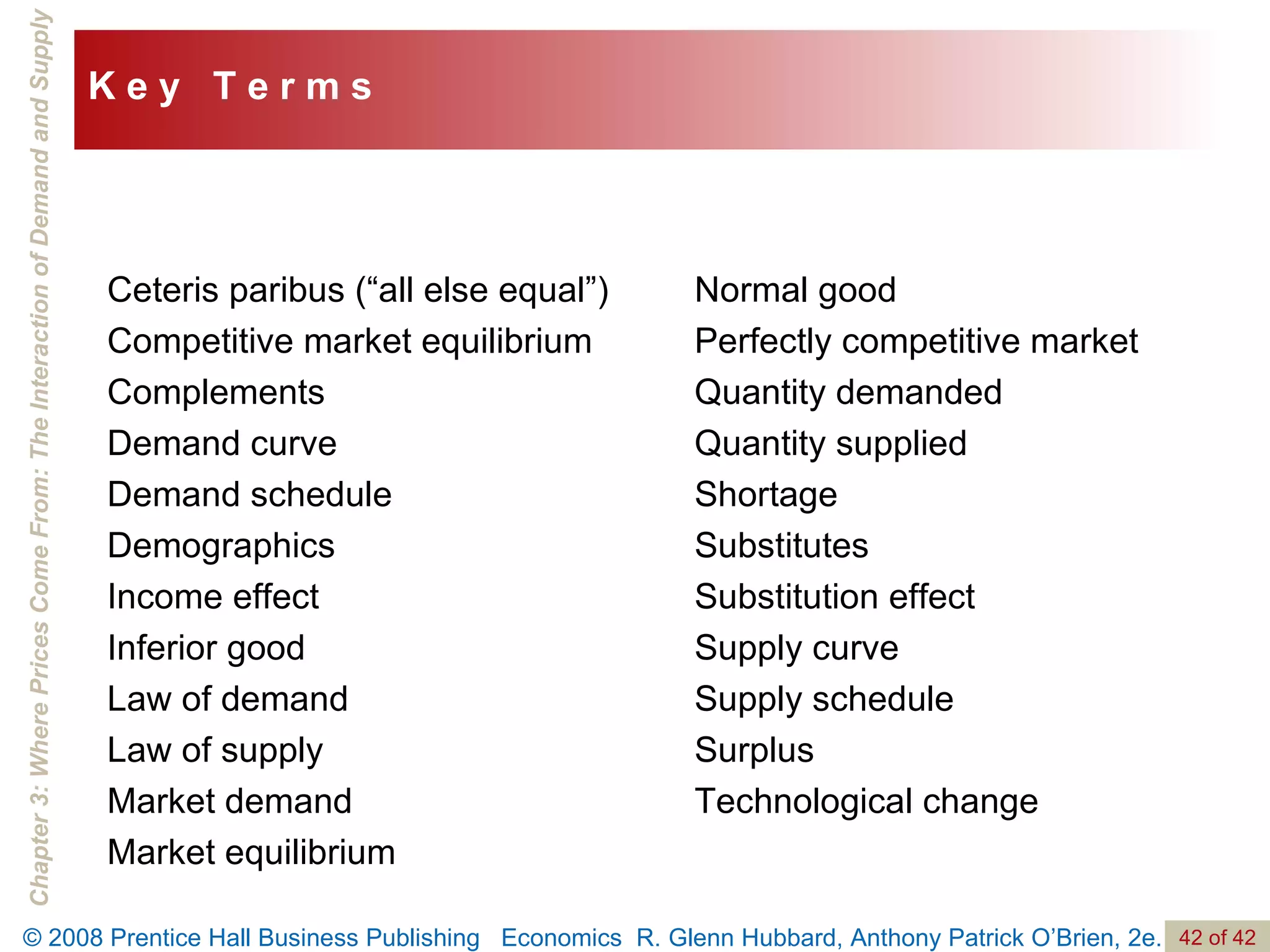
Ceteris paribus (“all else equal”) Competitive market equilibrium Complements Demand curve Demand schedule Demographics Income effect Inferior good Law of demand Law of supply Market demand  Market equilibrium Normal good Perfectly competitive market Quantity demanded Quantity supplied Shortage Substitutes Substitution effect Supply curve Supply schedule Surplus Technological change K e y  T e r m s

Chap3pp

  • 1.
  • 2.
    Apple and theDemand for iPods By early 2007, over 100 million iPods had been sold and more than two billion songs had been downloaded from iTunes. Clearly the strategy of selling an expensive digital music player and selling the music cheaply has been very successful for Apple. But how long will the iPod’s dominance last? Learning Objectives Use demand and supply graphs to predict changes in prices and quantities. 3.4 Use a graph to illustrate market equilibrium . 3.3 Discuss the variables that influence supply . 3.2 Discuss the variables that influence demand . 3.1
  • 3.
    Perfectly competitive market A market in which there are many buyers and sellers, all the products are identical, and there are no barriers to new sellers entering the market. Where Prices Come From: The Interaction of Demand and Supply
  • 4.
    Demand schedule A table showing the relationship between the price of a product and the quantity of the product demanded. Quantity demanded The amount of a good or service that a consumer is willing and able to purchase at a given price. Demand curve A curve that shows the relationship between the price of a product and the quantity of the product demanded. Market demand The demand by all the consumers of a given good or service. The Demand Side of the Market Demand Schedules and Demand Curves Learning Objective 3.1
  • 5.
    The Demand Sideof the Market Learning Objective 3.1 FIGURE 3-1 A Demand Schedule and Demand Curve Demand Schedules and Demand Curves
  • 6.
    The Demand Sideof the Market Law of demand The rule that, holding everything else constant, when the price of a product falls, the quantity demanded of the product will increase, and when the price of a product rises, the quantity demanded of the product will decrease. Learning Objective 3.1 The Law of Demand
  • 7.
    The Demand Sideof the Market Substitution effect The change in the quantity demanded of a good that results from a change in price, making the good more or less expensive relative to other goods that are substitutes. Income effect The change in the quantity demanded of a good that results from the effect of a change in the good’s price on consumers’ purchasing power. Learning Objective 3.1 What Explains the Law of Demand?
  • 8.
    The Demand Sideof the Market Ceteris paribus (“all else equal”) The requirement that when analyzing the relationship between two variables—such as price and quantity demanded—other variables must be held constant. A shift of a demand curve is an increase or decrease in demand . A movement along a demand curve is an increase or decrease in the quantity demanded . Learning Objective 3.1 Holding Everything Else Constant: The Ceteris Paribus Condition
  • 9.
    The Demand Sideof the Market Learning Objective 3.1 FIGURE 3-2 Shifting the Demand Curve Holding Everything Else Constant: The Ceteris Paribus Condition
  • 10.
    The Demand Sideof the Market Normal good A good for which the demand increases as income rises and decreases as income falls. Inferior good A good for which the demand increases as income falls and decreases as income rises. Learning Objective 3.1 Variables That Shift Market Demand Income Many variables other than price can influence market demand.
  • 11.
    The Demand Sideof the Market Substitutes Goods and services that can be used for the same purpose. Complements Goods and services that are used together. Learning Objective 3.1 Variables That Shift Market Demand Price of related goods Consumers can be influenced by an advertising campaign for a product. Tastes
  • 12.
    The Demand Sideof the Market Demographics The characteristics of a population with respect to age, race, and gender. Learning Objective 3.1 Population and demographics Expected Future Prices Consumers choose not only which products to buy but also when to buy them. Variables That Shift Market Demand
  • 13.
    The Demand Sideof the Market Learning Objective 3.1 Variables That Shift Market Demand TABLE 3-1 Variables That Shift Market Demand Curves
  • 14.
    The Demand Sideof the Market Learning Objective 3.1 Variables That Shift Market Demand TABLE 3-1 Variables That Shift Market Demand Curves (continued)
  • 15.
    Why Supermarkets Needto Understand Substitutes and Complements Learning Objective 3.1 Making the Connection 51 36 75 77 118 32 86 135 Varieties Removed in a 2-Year Period 107 70 114 93 129 47 109 113 Varieties Introduced in a 2-Year Period 288 194 242 285 421 128 337 391 Varieties in Five Chicago Supermarkets YOGURT SPAGHETTI SAUCE REGULAR CEREAL POTATO CHIPS ICE CREAM HOT DOGS FROZEN PIZZA COFFEE
  • 16.
    Companies Respond toa Growing Hispanic Population You can download Spanish music from iTunes. Apple is one of many companies responding to a growing Hispanic population. Learning Objective 3.1 As the demand for goods purchased by Hispanic households increases, more can be sold at every price. Not surprisingly, companies have responded by devoting more resources to serving this demographic group. Making the Connection
  • 17.
    The Demand Sideof the Market Learning Objective 3.1 FIGURE 3-3 A Change in Demand versus a Change in the Quantity Demanded A Change in Demand versus a Change in Quantity Demanded
  • 18.
    Apple Forecasts theDemand for iPhones and other Consumer Electronics Will Apple’s iPhone match the success of its iPod? Learning Objective 3.1 To decide which products to develop, firms need to forecast the demand for those products. Time will tell whether Apple’s forecast of a large demand for the iPhone will turn out to be correct. Making the Connection
  • 19.
    Supply schedule A table that shows the relationship between the price of a product and the quantity of the product supplied. Supply curve A curve that shows the relationship between the price of a product and the quantity of the product supplied. The Supply Side of the Market Learning Objective 3.2 Supply Schedules and Supply Curves Quantity supplied The amount of a good or service that a firm is willing and able to supply at a given price.
  • 20.
    The Supply Sideof the Market Learning Objective 3.2 Supply Schedules and Supply Curves FIGURE 3-4 Supply Schedule and Supply Curve
  • 21.
    The Supply Sideof the Market Law of supply The rule that, holding everything else constant, increases in price cause increases in the quantity supplied, and decreases in price cause decreases in the quantity supplied. Learning Objective 3.2 The Law of Supply
  • 22.
    The Supply Sideof the Market Learning Objective 3.2 FIGURE 3-5 Shifting the Supply Curve The Law of Supply
  • 23.
    The Supply Sideof the Market Prices of substitutes in production Number of firms in the market Expected future prices Learning Objective 3.2 Variables That Shift Supply Technological change A positive or negative change in the ability of a firm to produce a given level of output with a given quantity of inputs. The following are the most important variables that shift supply: • Prices of inputs • Technological change
  • 24.
    The Supply Sideof the Market Learning Objective 3.2 Variables That Shift Supply TABLE 3-2 Variables That Shift Market Supply Curves
  • 25.
    The Supply Sideof the Market Learning Objective 3.2 TABLE 3-2 Variables That Shift Market Supply Curves (continued) Variables That Shift Supply
  • 26.
    The Supply Sideof the Market Learning Objective 3.2 FIGURE 3-6 A Change in Supply versus a Change in the Quantity Supplied A Change in Supply versus a Change in Quantity Supplied
  • 27.
    Market Equilibrium: PuttingDemand and Supply Together FIGURE 3-7 Market Equilibrium Learning Objective 3.3
  • 28.
    Market equilibrium A situation in which quantity demanded equals quantity supplied. Competitive market equilibrium A market equilibrium with many buyers and many sellers. Market Equilibrium: Putting Demand and Supply Together Learning Objective 3.3
  • 29.
    Market Equilibrium: PuttingDemand and Supply Together Learning Objective 3.3 Surplus A situation in which the quantity supplied is greater than the quantity demanded. Shortage A situation in which the quantity demanded is greater than the quantity supplied. How Markets Eliminate Surpluses and Shortages
  • 30.
    Market Equilibrium: PuttingDemand and Supply Together Learning Objective 3.3 FIGURE 3-8 The Effect of Surpluses and Shortages on the Market Price How Markets Eliminate Surpluses and Shortages
  • 31.
    Market Equilibrium: PuttingDemand and Supply Together Learning Objective 3.3 Demand and Supply Both Count Always keep in mind that it is the interaction of demand and supply that determines the equilibrium price. Neither consumers nor firms can dictate what the equilibrium price will be. No firm can sell anything at any price unless it can find a willing buyer, and no consumer can buy anything at any price without finding a willing seller.
  • 32.
    Demand and SupplyBoth Count: A Tale of Two Letters Learning Objective 3.3 Solved Problem 3-3
  • 33.
    The Effect ofDemand and Supply Shifts on Equilibrium FIGURE 3-9 The Effect of an Increase in Supply on Equilibrium The Effect of Shifts in Supply on Equilibrium Learning Objective 3.4
  • 34.
    The Falling Priceof LCD Televisions Learning Objective 3.4 Making the Connection
  • 35.
    The Effect ofDemand and Supply Shifts on Equilibrium FIGURE 3-10 The Effect of an Increase in Demand on Equilibrium The Effect of Shifts in Demand on Equilibrium Learning Objective 3.4
  • 36.
    The Effect ofDemand and Supply Shifts on Equilibrium FIGURE 3-11 Shifts in Demand and Supply over Time The Effect of Shifts in Demand and Supply over Time Learning Objective 3.4
  • 37.
    The Effect ofDemand and Supply Shifts on Equilibrium TABLE 3-3 How Shifts in Demand and Supply Affect Equilibrium Price ( P ) and Quantity ( Q ) The Effect of Shifts in Demand and Supply over Time Learning Objective 3.4 Q decreases P increases Q increases P decreases Q unchanged P unchanged DEMAND CURVE UNCHANGED Q decreases P decreases or increases Q increases or decreases P decreases Q decreases P decreases DEMAND CURVE SHIFTS TO THE LEFT Q increases or decreases P increases Q increases P increases or decreases Q increases P increases DEMAND CURVE SHIFTS TO THE RIGHT SUPPLY CURVE SHIFTS TO THE LEFT SUPPLY CURVE SHIFTS TO THE RIGHT SUPPLY CURVE UNCHANGED
  • 38.
    High Demand andLow Prices in the Lobster Market? Learning Objective 3.4 Supply and demand for lobster both increase during the summer, but the increase in supply is greater than the increase in demand, therefore, equilibrium price falls. Solved Problem 3-4
  • 39.
    The Effect ofDemand and Supply Shifts on Equilibrium Shifts in a Curve versus Movements along a Curve Learning Objective 3.4 When analyzing markets using demand and supply curves, it is important to remember that when a shift in a demand or supply curve causes a change in equilibrium price, the change in price does not cause a further shift in demand or supply.
  • 40.
    The Effect ofDemand and Supply Shifts on Equilibrium Shifts in a Curve versus Movements along a Curve Learning Objective 3.4 Don’t Let This Happen to YOU! Remember: A Change in a Good’s Price Does Not Cause the Demand or Supply Curve to Shift
  • 41.
    An Inside LOOKHow Does the iPhone Help Apple and AT&T? Apple Coup: How Steve Jobs Played Hardball in iPhone Birth
  • 42.
    Ceteris paribus (“allelse equal”) Competitive market equilibrium Complements Demand curve Demand schedule Demographics Income effect Inferior good Law of demand Law of supply Market demand Market equilibrium Normal good Perfectly competitive market Quantity demanded Quantity supplied Shortage Substitutes Substitution effect Supply curve Supply schedule Surplus Technological change K e y T e r m s