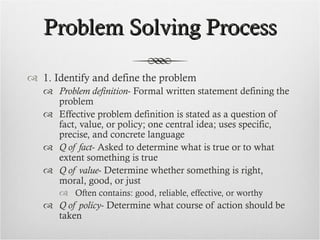
Problem Solving Process 1. Identify and define the problem Problem definition - Formal written statement defining the problem Effective problem definition is stated as a question of fact, value, or policy; one central idea; uses specific, precise, and concrete language Q of fact - Asked to determine what is true or to what extent something is true Q of value - Determine whether something is right, moral, good, or just Often contains: good, reliable, effective, or worthy Q of policy - Determine what course of action should be taken
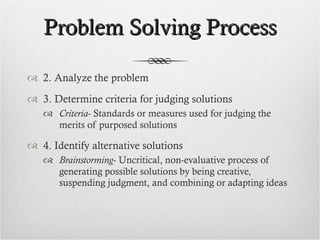
Problem Solving Process 2. Analyze the problem 3. Determine criteria for judging solutions Criteria - Standards or measures used for judging the merits of purposed solutions 4. Identify alternative solutions Brainstorming - Uncritical, non-evaluative process of generating possible solutions by being creative, suspending judgment, and combining or adapting ideas
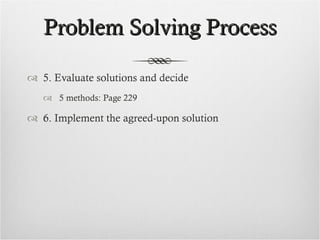
Problem Solving Process 5. Evaluate solutions and decide 5 methods: Page 229 6. Implement the agreed-upon solution
Shared Leadership “ Leadership is most often a shared activity in which different members perform various functions based on their unique strengths and expertise” (Fairhurst, 2001). Informal leaders (aka emergent leaders) - Leaders who gain power because they are liked and respected by the group Shared leadership functions - Set of roles that group members perform to facilitate the work of the group and help maintain harmonious relationships between members. Role - Specific pattern of behavior that group members perform based upon their skills and their perceptions of the group’s needs at the time
Shared Leadership Types of roles Task roles - Help the group acquire, process, or apply information that contributes directly to completing a task or goal Maintenance roles-  Sets of behaviors that help a group develop and maintain cohesion, commitment, and positive working relationships Procedural roles - Sets of behaviors that directly support a group process
Making Meetings Effective Guidelines for meeting LEADERS Before the meeting 1. Prepare and distribute  agenda - organized outline of the information and decision items that will be covered during the meeting 2. Decide who should attend 3. Manage meeting logistics Room, seating, etc. 4. Speak with each participant before the meeting
Making Meetings Effective Guidelines for meeting LEADERS During the meeting 1. Review and modify the agenda 2. Monitor member interaction 3. Monitor time 4. Praise in public, reprimand in private 5. Check periodically to see if the group is ready to make a decision 6. Implement group’s decision rules 7. Summarize decisions 8. Set the next meeting
Making Meetings Effective Guidelines for meeting LEADERS Following up 1. Review outcome 2. Prepare and distribute meeting summary 3. Repair damaged relationships 4. Conduct informal progress reports
Making Meetings Effective Guidelines for meeting PARTICIPANTS Before the meeting 1. Study agenda 2. Study minutes 3. Do your homework 4. List questions 5. Plan to play a leadership role
Making Meetings Effective Guidelines for meeting PARTICIPANTS During the meeting 1. Listen attentively 2. Stay focused 3. Ask questions 4. Take notes 5. Play devil’s advocate 6. Monitor your contributions
Making Meetings Effective Guidelines for meeting PARTICIPANTS Following Up 1. Review and summarize your notes 2. Evaluate your effectiveness 3. Review decisions 4. Communicate progress 5. Complete your tasks 6. Review minutes
Communicating Group Solutions Deliverables - Tangible or intangible products of work that must be provided to someone else Written formats Written brief - Short document that describes a problem, background, process, decision, and rationale so that a reader can quickly understand and evaluate a group’s product Comprehensive report - Written document that provides a detailed review of the problem solving process used to arrive at a recommendation Ex ecutive summary - One-page synopsis of a comprehensive report
Communicating Group Solutions Oral formats Oral brief - Summary of a written brief delivered to an audience by a group member Oral report - Similar to a comprehensive report Symposium - Set of prepared oral reports delivered sequentially by group members before a gathering of people who are interested in the work of the group Panel discussion - Structured problem solving discussion held by a group in front of an audience
Communicating Group Solutions Virtual formats Remote access reports (RAR) - Computer-mediated audiovisual presentation of a group’s process and outcome that others can receive electronically Streaming videos - Pre-recording that is sent in compressed form over the Internet
Thank You

Chap10: Problem Solving in Groups

  • 1.
  • 2.
    Problem Solving Process1. Identify and define the problem Problem definition - Formal written statement defining the problem Effective problem definition is stated as a question of fact, value, or policy; one central idea; uses specific, precise, and concrete language Q of fact - Asked to determine what is true or to what extent something is true Q of value - Determine whether something is right, moral, good, or just Often contains: good, reliable, effective, or worthy Q of policy - Determine what course of action should be taken
  • 3.
    Problem Solving Process2. Analyze the problem 3. Determine criteria for judging solutions Criteria - Standards or measures used for judging the merits of purposed solutions 4. Identify alternative solutions Brainstorming - Uncritical, non-evaluative process of generating possible solutions by being creative, suspending judgment, and combining or adapting ideas
  • 4.
    Problem Solving Process5. Evaluate solutions and decide 5 methods: Page 229 6. Implement the agreed-upon solution
  • 5.
    Shared Leadership “Leadership is most often a shared activity in which different members perform various functions based on their unique strengths and expertise” (Fairhurst, 2001). Informal leaders (aka emergent leaders) - Leaders who gain power because they are liked and respected by the group Shared leadership functions - Set of roles that group members perform to facilitate the work of the group and help maintain harmonious relationships between members. Role - Specific pattern of behavior that group members perform based upon their skills and their perceptions of the group’s needs at the time
  • 6.
    Shared Leadership Typesof roles Task roles - Help the group acquire, process, or apply information that contributes directly to completing a task or goal Maintenance roles- Sets of behaviors that help a group develop and maintain cohesion, commitment, and positive working relationships Procedural roles - Sets of behaviors that directly support a group process
  • 7.
    Making Meetings EffectiveGuidelines for meeting LEADERS Before the meeting 1. Prepare and distribute agenda - organized outline of the information and decision items that will be covered during the meeting 2. Decide who should attend 3. Manage meeting logistics Room, seating, etc. 4. Speak with each participant before the meeting
  • 8.
    Making Meetings EffectiveGuidelines for meeting LEADERS During the meeting 1. Review and modify the agenda 2. Monitor member interaction 3. Monitor time 4. Praise in public, reprimand in private 5. Check periodically to see if the group is ready to make a decision 6. Implement group’s decision rules 7. Summarize decisions 8. Set the next meeting
  • 9.
    Making Meetings EffectiveGuidelines for meeting LEADERS Following up 1. Review outcome 2. Prepare and distribute meeting summary 3. Repair damaged relationships 4. Conduct informal progress reports
  • 10.
    Making Meetings EffectiveGuidelines for meeting PARTICIPANTS Before the meeting 1. Study agenda 2. Study minutes 3. Do your homework 4. List questions 5. Plan to play a leadership role
  • 11.
    Making Meetings EffectiveGuidelines for meeting PARTICIPANTS During the meeting 1. Listen attentively 2. Stay focused 3. Ask questions 4. Take notes 5. Play devil’s advocate 6. Monitor your contributions
  • 12.
    Making Meetings EffectiveGuidelines for meeting PARTICIPANTS Following Up 1. Review and summarize your notes 2. Evaluate your effectiveness 3. Review decisions 4. Communicate progress 5. Complete your tasks 6. Review minutes
  • 13.
    Communicating Group SolutionsDeliverables - Tangible or intangible products of work that must be provided to someone else Written formats Written brief - Short document that describes a problem, background, process, decision, and rationale so that a reader can quickly understand and evaluate a group’s product Comprehensive report - Written document that provides a detailed review of the problem solving process used to arrive at a recommendation Ex ecutive summary - One-page synopsis of a comprehensive report
  • 14.
    Communicating Group SolutionsOral formats Oral brief - Summary of a written brief delivered to an audience by a group member Oral report - Similar to a comprehensive report Symposium - Set of prepared oral reports delivered sequentially by group members before a gathering of people who are interested in the work of the group Panel discussion - Structured problem solving discussion held by a group in front of an audience
  • 15.
    Communicating Group SolutionsVirtual formats Remote access reports (RAR) - Computer-mediated audiovisual presentation of a group’s process and outcome that others can receive electronically Streaming videos - Pre-recording that is sent in compressed form over the Internet
  • 16.