
Small Group  Communication A Presentation by Rajiv Bajaj
Definition of a Small Group Has 3 Characteristics – Size, Interaction & Goals SIZE Most researchers define a small group as having at least 3 and no more than 12 or 15 members Needs to have at least 3 members, otherwise it would simply be a dyad
With 3 members, coalitions can be formed and some kind of organization is present Too large a group (more than 12 or 15 members) inhibits group members' ability to communicate with everyone else in the group
INTERACTION Group's members must be able to communicate  freely and openly  with all of the other members of the group Groups will develop  norms  about discussion and group members will develop  roles  which will affect the group's interaction
GOALS A group must have  a common purpose or goal  and they must  work together  to achieve that goal The goal brings the group together and holds it together through conflict and tension
Use & Value of Small Groups 68% of Fortune 1000 companies use self-managing or high-performance teams Average supervisor spends around 40% of the workweek in meetings & conferences. An average executive spends almost 700 hours a year in meetings ! Most large companies attribute major cost savings to solutions provided by such working-groups or Quality Circles
Why do people join a group? GROUP SYNERGY Refers to the idea that two heads (or more) are better than one; OR "The whole is greater than the sum of its parts," which also refers to group synergy Groups are often capable of producing higher quality work and better decisions than can an individual working alone
SUPPORT & COMMITMENT Group may be  more willing  to take on a large project than would an individual With increased ability to perform work, group can provide  encouragement and support  to its members while working on a big project
INTERPERSONAL NEEDS Individuals often join a group to meet their  interpersonal  needs William Schutz has identified three such needs: Inclusion, Control, and Affection Inclusion is the need to establish identity with others – the  need to be accepted  by others
Control is the  need to exercise leadership  and prove one's abilities. Groups provide outlets for this need Some individuals do not want to be leaders. For them, groups provide the necessary  control over aspects of their lives Affection is the  need to develop relationships  with people. Groups are an excellent way to make friends and establish relationships
Types of Small Groups Groups form to accomplish some objective Objective may be to complete some kind of task or it may be to promote interpersonal relationships between group members Many groups, however, fulfill both of these functions
SOCIAL GROUPS While all groups will have both social and task dimensions, some groups are predominantly social in their orientation Examples of these groups would be families and social clubs These provide for our  safety & solidarity needs  and they help us develop self-esteem
WORK GROUPS Work groups function to complete a particular task The task dimension is emphasized. Group members  pool their expertise  to accomplish the task Examples - Workplaces, Campus Organizations, or Juries etc.  As per Ivan Steiner, there are several types of Work Groups
Types of Work Groups ADDITIVE WORK GROUPS All group members perform the  same activity  and pool their results at the end An example of this would be gathering signatures for a petition drive or mobilizing support for a particular cause
CONJUNCTIVE WORK GROUP Members perform  different, but related, tasks  that allow for completion of a goal Every group member must complete their individual task in order for the group task to be completed Example of this would be an assembly line, in which each worker performs tasks that together build a completed car
DISJUNCTIVE TASK Members meet to determine the  best alternative  for a problem or issue There are two types of disjunctive tasks: Judgment Task: Group members must choose  one correct answer  from all alternatives Decision-Making Task: Group members must choose  best alternative  from a set of options. There is no one correct answer for a decision-making group
CONTRIVED OR EMERGENT GROUPS Some groups form  spontaneously , such as a group of friends Other groups are  contrived , that is, they are formed for a specific purpose Organized clubs, social groups, or committees are contrived groups
Small Group Development Researchers have studied groups to understand how they develop Several different models have been suggested, but they all tend to follow a similar progression LINEAR MODELS OF GROUP DEVELOPMENT The most common models include Tubb’s Theory, Fisher’s Model & Tuckman’s Model
Tubbs's Small Group  Development Theory 1. Orientation  2. Conflict  3. Consensus  4. Closure Orientation  - Group members get to know each other, start to talk about the problem, examine the limitations & opportunities of the project Conflict  - A necessary part of a group's development. Allows the group to evaluate ideas and helps them avoid conformity & groupthink
Consensus  - Conflict ends in the consensus stage, when group members compromise, select ideas & agree on alternatives Closure  - The final result is announced and group members reaffirm their support of the decision
Fisher's Small Group  Development Theory 1. Orientation 2. Conflict 3. Emergence  4. Reinforcement Orientation  - Group members get to know each other & experience primary tension – the awkward feeling people have before communication rules & expectations are established Groups should take time to learn about each other and feel comfortable communicating around new people
Conflict  - This phase is marked by secondary tension, or tension surrounding the task at hand Group members will disagree with each other and debate ideas Remember that conflict is good, because it helps the group achieve positive results
Emergence  - Outcome of the group's task and its social structure become apparent Reinforcement  - Group members bolster their final decision by using supportive verbal and nonverbal communication
Tuckman's Small Group  Development Theory 1. Forming 2. Storming 3. Norming  4. Performing 5. Adjourning Forming  - Group members learn about each other and the task at hand Storming  - As group members become more comfortable with each other, they will engage each other in arguments and vie for status in the group. These activities mark the storming phase
Norming  - Group members establish implicit or explicit rules about how they will achieve their goal They address the types of communication that will or will not help with the task Performing  - Groups reach a conclusion and implement the conclusion Adjourning  - As the group project ends, the group disbands in the adjournment phase
Poole's Small Group  Development Theory 1. Task Track 2. Topic Track   3. Relation Track 4. Breakpoint  Marshall Scott Poole & his colleagues have found that group development is often more complicated than the 3 previous models indicate He has argued that groups jump back & forth between three tracks – task , topic, and relation
The three tracks can be compared to the intertwined strands of a rope Task Track  - Concerns the process by which the group accomplishes its goals Topic Track  -  Concerns the specific item the group is discussing at the time Relation Track  - Deals with the interpersonal relationships between group members
At times, the group may stop its work on the task and work instead on its relationships When the group reaches consensus on all three tracks at once, it can proceed in a more unified manner as the 3 previous models illustrate Breakpoints   - These occur when a group switches from one track to another Shifts in the conversation, adjournment, or postponement are examples of breakpoints
Decision Making REFLECTIVE THINKING & STANDARD AGENDA Developed by John Dewey, reflective thinking involves a  careful, systematic approach  to a problem Groups who use reflective thinking to make their decisions use a  six-step guide  called the "standard agenda".
1.  Problem identification  - What is the problem? What is wrong with the current situation? 2.  Problem analysis  - View the current situation as a balance between restraining forces and helping forces. What are the forces in play in your group's situation? 3.  Criteria selection  - What are the goals of the final decision?
4.  Solution generation  - Generate as many solutions as possible. Avoid groupthink by listing many solutions 5.  Solution evaluation and selection  - Measure each solution against the criteria from step three 6.  Solution implementation  - Enact the chosen solution
BRAINSTORMING Another option for decision-making Group members encouraged to  generate as many ideas about a particular topic  as they can For instance, group members may use brainstorming to generate as many solutions as they can in step four of the standard agenda
Group members should be encouraged to say  anything that comes to mind  when brainstorming Every idea is written down and  judgments about ideas are saved until later , when the group returns to all of the ideas and selects those that are most useful NOMINAL GROUP TECHNIQUE A group decision-making tool used when the group must  rank order  a set of options
In order to use this technique, group members work individually to  list all alternatives  to a problem or issue Sometimes, this technique is used after a brainstorming session is held Then, the group facilitator asks each group member to  individually rank all options  from lowest to highest priority
Finally, the facilitator computes  an average score for each idea The lowest score is the highest priority for the group Nominal group technique is a good way to have all of the group members voice their opinions and discussion is not dominated by a few vocal group members
Final Decision Making Many ways that a group can make a final decision, decide on a solution, or come to agreement Most popular ways of making the decision include –  Consensus : Group members all agree on the final decision through discussion and debate
Compromise : Through discussion & readjustment of the final plan, group members come to agreement by giving up some of their demands Majority Vote : Decision based on the opinion of the majority of its members Decision by Leader  - The group gives the final decision to its leader Arbitration : An external body or person makes a decision for the group
Groupthink Groupthink concept identified by Irving Janis that refers to  faulty decision-making in a group Groups experiencing groupthink do not consider all alternatives and they desire unanimity at the expense of quality decisions Occurs when groups are  highly cohesive  and when under considerable pressure to make a quality decision
Negative outcomes of groupthink include : Examining few alternatives Not being critical of each other's ideas Not examining early alternatives Not seeking expert opinion Being highly selective in gathering information Not having contingency plans
Some symptoms of groupthink are : Having an illusion of invulnerability Rationalizing poor decisions Believing in the group's morality Sharing stereotypes which guide the decision
Exercising direct pressure on others Not expressing your true feelings Maintaining an illusion of unanimity Using mindguards to protect the group from negative information
Some solutions include : Using a policy-forming group which reports to the larger group Having leaders remain impartial Using different policy groups for different tasks Dividing into sub-groups and then discuss differences
Discussing within sub-groups and then report back Using outside experts Using a Devil's advocate to question all the group's ideas Holding a "second-chance meeting" to offer one last opportunity to choose another course of action
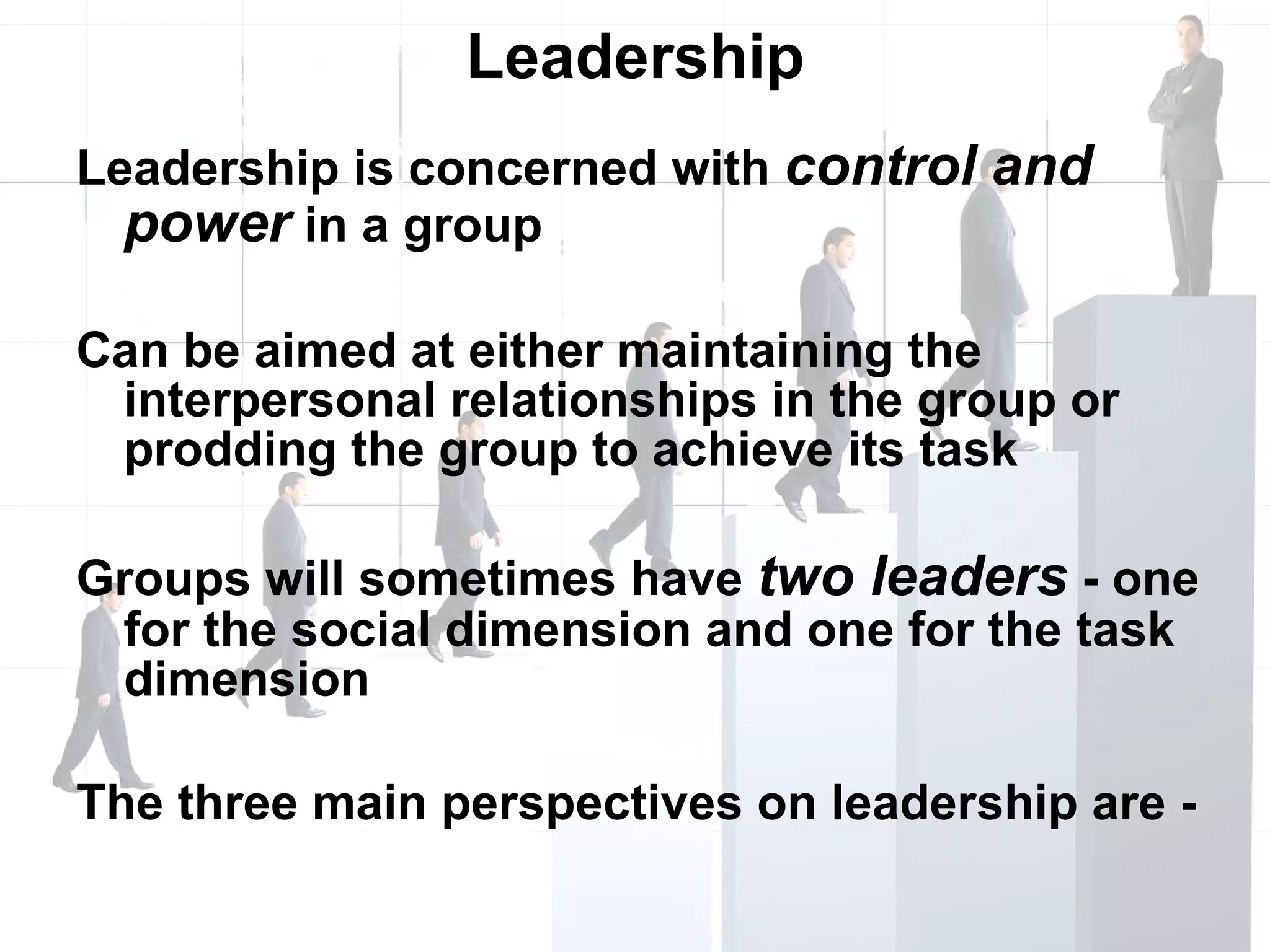
Leadership Leadership is concerned with  control and power  in a group Can be aimed at either maintaining the interpersonal relationships in the group or prodding the group to achieve its task Groups will sometimes have  two leaders  - one for the social dimension and one for the task dimension The three main perspectives on leadership are -
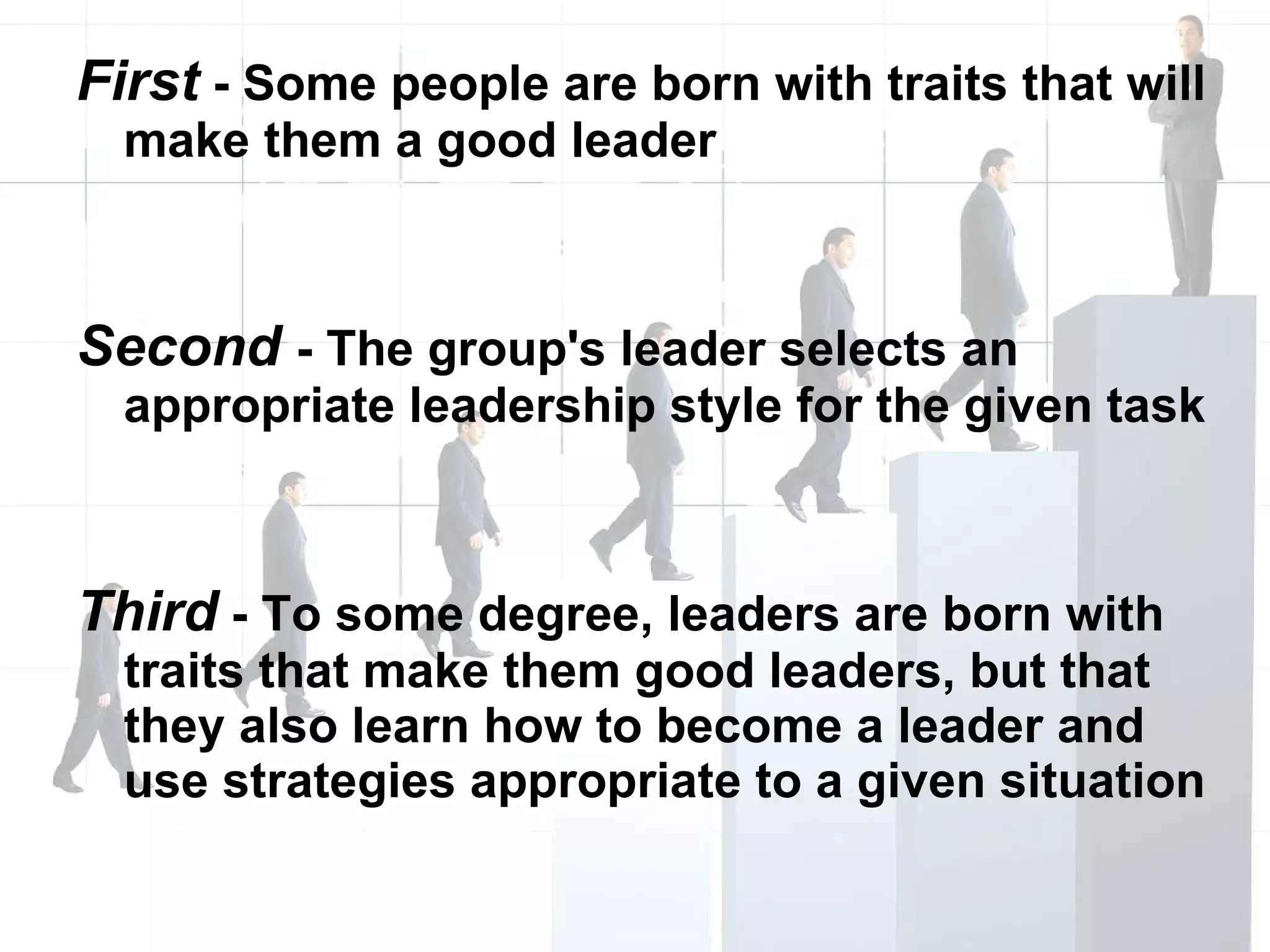
First  - Some people are born with traits that will make them a good leader Second  - The group's leader selects an appropriate leadership style for the given task Third  - To some degree, leaders are born with traits that make them good leaders, but that they also learn how to become a leader and use strategies appropriate to a given situation
Good Leaders Are Born This approach says that people are born with traits that make them effective leaders The challenge for the group is to find a person with these traits
One-Best-Style This approach says that in a given situation, one particular style of leadership is most effective There are four main styles  -  Autocratic :  Leader uses his or her authority to make decisions Democratic : Authority is shared and all group members help make decisions
Laissez-faire : A "hands-off" style in which the leader allows the group to make its own decisions Abdacratic : No one in the group exercises leadership. This style, says researchers, leads to group disintegration and is followed by autocratic leadership
Contextual This approach says that leaders are to some degree born with leadership traits But the situation, personalities of other group members, pressures on the group, and group norms also determine leadership
Roles in Groups Task-Oriented Roles  –  Researchers Benne & Sheats identified several roles which relate to the completion of the group's task: Initiator-contributor : Generates new ideas Information-seeker : Asks for information about the task
Opinion-seeker : Asks for the input from the group about its values Information-giver : Offers facts or generalization to the group Opinion-giver : States his or her beliefs about a group issue
Elaborator : Explains ideas within the group, offers examples to clarify ideas Coordinator : Shows the relationships between ideas Orienter : Shifts the direction of the group's discussion
Evaluator-critic : Measures group's actions against some objective standard Energizer : Stimulates the group to a higher level of activity Procedural-technician : Performs logistical functions for the group Recorder : Keeps a record of group actions
Social Roles  –  Encourager : Praises the ideas of others Harmonizer : Mediates differences between group members Compromiser : Moves group to another position that is favored by all group members Gatekeeper / expediter : Keeps communication channels open
Standard Setter : Suggests standards or criteria for the group to achieve Group observer : Keeps records of group activities and uses this information to offer feedback to the group Follower : Goes along with the group and accepts the group's ideas
Individualistic Roles  –  Aggressor : Attacks other group members, deflates the status of others, and other aggressive behavior Blocker : Resists movement by the group Recognition seeker : Calls attention to himself or herself
Self-confessor : Seeks to disclose non-group related feelings or opinions Dominator : Asserts control over the group by manipulating other group members Help seeker : Tries to gain the sympathy of the group Special interest pleader : Uses stereotypes to assert his or her own prejudices
Conflict In Groups Conflict can be good for a group if it is managed appropriately By airing differences, group members can  produce quality decisions and satisfying interpersonal relationships The first step in managing conflict is to  identify the conflict
1. Do the group members  know  that a conflict exists? 2. Are the group members arguing over  competing goals ? 3. Are scarce  resources  at stake? 4. Are the group members  dependent on each other  to solve the conflict?
Styles of Conflict Management – Researchers Ruble & Thomas have identified  5 styles for managing conflict The styles can be charted on  2 dimensions: assertiveness and cooperativeness The five styles are –
Competitive : High in assertiveness, low in cooperativeness. Competitive people want to win the conflict Accommodative : Low in assertiveness and high in cooperativeness. These group members are easy going and willing to follow the group Avoiding : Low in assertiveness, low in cooperativeness. Avoiding people are detached and indifferent to conflict
Collaborative : High assertiveness, high in cooperativeness. These group members are active and productive problem solvers Compromising : moderate in assertiveness, moderate in cooperativeness. Compromisers are willing to "give and take" to resolve conflict
Defensive Climate  –  The climate in which conflict is managed is important. Groups should  avoid a defensive climate , which is characterized by these qualities: Evaluation : Judging and criticizing other group members Control : Imposing the will of one group member on the others
Strategy : Using hidden agendas Neutrality : Demonstrating indifference and lack of commitment Superiority : Expressing dominance Certainty : being rigid in one's willingness to listen to others
Supportive Climate  –  Groups should  foster a supportive climate , marked by these traits: Description : Presenting ideas or opinions Problem Orientation : focusing attention on the task Spontaneity : Communicating openly and honestly
Empathy : Understanding another person's thoughts Equality : Asking for opinions Provisionalism : Expressing a willingness to listen to the ideas of others
Group Formats 1.  Roundtable  – A small group discussion conducted in private by means of the Basic Problem Solving procedure 2.  Panel Discussion  – Involves a small group of well-informed individuals discussing a problem or topic of interest in front of a larger group  All panel members contribute freely & equally, and are usually guided through the problem-solving procedure by a leader or chairperson
3.  Symposium  – Composed of a small group of experts, also in front of a larger group. Instead of free exchange of ideas, each member presents a formal, 5 to 10 minute presentation on an area of the problem relating to member’s expertise Chairperson introduces each presentation. When all presentations are finished, speakers may choose to discuss (agree / disagree with) the formal ideas presented by each speaker; or Continue the discussion using basic problem-solving process
4.  Forum  – When those present are allowed to participate following a panel discussion or symposium discussion, the discussion is called a Forum May involve a simple question & answer period, a general discussion, or organised buzz groups Selecting the right group format will depend on number of participants, complexity of the problem, and the time available
QUESTIONS ? T H A N K Y O U

Small Group Communication

  • 1.
    Small Group Communication A Presentation by Rajiv Bajaj
  • 2.
    Definition of aSmall Group Has 3 Characteristics – Size, Interaction & Goals SIZE Most researchers define a small group as having at least 3 and no more than 12 or 15 members Needs to have at least 3 members, otherwise it would simply be a dyad
  • 3.
    With 3 members,coalitions can be formed and some kind of organization is present Too large a group (more than 12 or 15 members) inhibits group members' ability to communicate with everyone else in the group
  • 4.
    INTERACTION Group's membersmust be able to communicate freely and openly with all of the other members of the group Groups will develop norms about discussion and group members will develop roles which will affect the group's interaction
  • 5.
    GOALS A groupmust have a common purpose or goal and they must work together to achieve that goal The goal brings the group together and holds it together through conflict and tension
  • 6.
    Use & Valueof Small Groups 68% of Fortune 1000 companies use self-managing or high-performance teams Average supervisor spends around 40% of the workweek in meetings & conferences. An average executive spends almost 700 hours a year in meetings ! Most large companies attribute major cost savings to solutions provided by such working-groups or Quality Circles
  • 7.
    Why do peoplejoin a group? GROUP SYNERGY Refers to the idea that two heads (or more) are better than one; OR "The whole is greater than the sum of its parts," which also refers to group synergy Groups are often capable of producing higher quality work and better decisions than can an individual working alone
  • 8.
    SUPPORT & COMMITMENTGroup may be more willing to take on a large project than would an individual With increased ability to perform work, group can provide encouragement and support to its members while working on a big project
  • 9.
    INTERPERSONAL NEEDS Individualsoften join a group to meet their interpersonal needs William Schutz has identified three such needs: Inclusion, Control, and Affection Inclusion is the need to establish identity with others – the need to be accepted by others
  • 10.
    Control is the need to exercise leadership and prove one's abilities. Groups provide outlets for this need Some individuals do not want to be leaders. For them, groups provide the necessary control over aspects of their lives Affection is the need to develop relationships with people. Groups are an excellent way to make friends and establish relationships
  • 11.
    Types of SmallGroups Groups form to accomplish some objective Objective may be to complete some kind of task or it may be to promote interpersonal relationships between group members Many groups, however, fulfill both of these functions
  • 12.
    SOCIAL GROUPS Whileall groups will have both social and task dimensions, some groups are predominantly social in their orientation Examples of these groups would be families and social clubs These provide for our safety & solidarity needs and they help us develop self-esteem
  • 13.
    WORK GROUPS Workgroups function to complete a particular task The task dimension is emphasized. Group members pool their expertise to accomplish the task Examples - Workplaces, Campus Organizations, or Juries etc. As per Ivan Steiner, there are several types of Work Groups
  • 14.
    Types of WorkGroups ADDITIVE WORK GROUPS All group members perform the same activity and pool their results at the end An example of this would be gathering signatures for a petition drive or mobilizing support for a particular cause
  • 15.
    CONJUNCTIVE WORK GROUPMembers perform different, but related, tasks that allow for completion of a goal Every group member must complete their individual task in order for the group task to be completed Example of this would be an assembly line, in which each worker performs tasks that together build a completed car
  • 16.
    DISJUNCTIVE TASK Membersmeet to determine the best alternative for a problem or issue There are two types of disjunctive tasks: Judgment Task: Group members must choose one correct answer from all alternatives Decision-Making Task: Group members must choose best alternative from a set of options. There is no one correct answer for a decision-making group
  • 17.
    CONTRIVED OR EMERGENTGROUPS Some groups form spontaneously , such as a group of friends Other groups are contrived , that is, they are formed for a specific purpose Organized clubs, social groups, or committees are contrived groups
  • 18.
    Small Group DevelopmentResearchers have studied groups to understand how they develop Several different models have been suggested, but they all tend to follow a similar progression LINEAR MODELS OF GROUP DEVELOPMENT The most common models include Tubb’s Theory, Fisher’s Model & Tuckman’s Model
  • 19.
    Tubbs's Small Group Development Theory 1. Orientation 2. Conflict 3. Consensus 4. Closure Orientation - Group members get to know each other, start to talk about the problem, examine the limitations & opportunities of the project Conflict - A necessary part of a group's development. Allows the group to evaluate ideas and helps them avoid conformity & groupthink
  • 20.
    Consensus -Conflict ends in the consensus stage, when group members compromise, select ideas & agree on alternatives Closure - The final result is announced and group members reaffirm their support of the decision
  • 21.
    Fisher's Small Group Development Theory 1. Orientation 2. Conflict 3. Emergence 4. Reinforcement Orientation - Group members get to know each other & experience primary tension – the awkward feeling people have before communication rules & expectations are established Groups should take time to learn about each other and feel comfortable communicating around new people
  • 22.
    Conflict -This phase is marked by secondary tension, or tension surrounding the task at hand Group members will disagree with each other and debate ideas Remember that conflict is good, because it helps the group achieve positive results
  • 23.
    Emergence -Outcome of the group's task and its social structure become apparent Reinforcement - Group members bolster their final decision by using supportive verbal and nonverbal communication
  • 24.
    Tuckman's Small Group Development Theory 1. Forming 2. Storming 3. Norming 4. Performing 5. Adjourning Forming - Group members learn about each other and the task at hand Storming - As group members become more comfortable with each other, they will engage each other in arguments and vie for status in the group. These activities mark the storming phase
  • 25.
    Norming -Group members establish implicit or explicit rules about how they will achieve their goal They address the types of communication that will or will not help with the task Performing - Groups reach a conclusion and implement the conclusion Adjourning - As the group project ends, the group disbands in the adjournment phase
  • 26.
    Poole's Small Group Development Theory 1. Task Track 2. Topic Track 3. Relation Track 4. Breakpoint Marshall Scott Poole & his colleagues have found that group development is often more complicated than the 3 previous models indicate He has argued that groups jump back & forth between three tracks – task , topic, and relation
  • 27.
    The three trackscan be compared to the intertwined strands of a rope Task Track - Concerns the process by which the group accomplishes its goals Topic Track - Concerns the specific item the group is discussing at the time Relation Track - Deals with the interpersonal relationships between group members
  • 28.
    At times, thegroup may stop its work on the task and work instead on its relationships When the group reaches consensus on all three tracks at once, it can proceed in a more unified manner as the 3 previous models illustrate Breakpoints - These occur when a group switches from one track to another Shifts in the conversation, adjournment, or postponement are examples of breakpoints
  • 29.
    Decision Making REFLECTIVETHINKING & STANDARD AGENDA Developed by John Dewey, reflective thinking involves a careful, systematic approach to a problem Groups who use reflective thinking to make their decisions use a six-step guide called the "standard agenda".
  • 30.
    1. Problemidentification - What is the problem? What is wrong with the current situation? 2. Problem analysis - View the current situation as a balance between restraining forces and helping forces. What are the forces in play in your group's situation? 3. Criteria selection - What are the goals of the final decision?
  • 31.
    4. Solutiongeneration - Generate as many solutions as possible. Avoid groupthink by listing many solutions 5. Solution evaluation and selection - Measure each solution against the criteria from step three 6. Solution implementation - Enact the chosen solution
  • 32.
    BRAINSTORMING Another optionfor decision-making Group members encouraged to generate as many ideas about a particular topic as they can For instance, group members may use brainstorming to generate as many solutions as they can in step four of the standard agenda
  • 33.
    Group members shouldbe encouraged to say anything that comes to mind when brainstorming Every idea is written down and judgments about ideas are saved until later , when the group returns to all of the ideas and selects those that are most useful NOMINAL GROUP TECHNIQUE A group decision-making tool used when the group must rank order a set of options
  • 34.
    In order touse this technique, group members work individually to list all alternatives to a problem or issue Sometimes, this technique is used after a brainstorming session is held Then, the group facilitator asks each group member to individually rank all options from lowest to highest priority
  • 35.
    Finally, the facilitatorcomputes an average score for each idea The lowest score is the highest priority for the group Nominal group technique is a good way to have all of the group members voice their opinions and discussion is not dominated by a few vocal group members
  • 36.
    Final Decision MakingMany ways that a group can make a final decision, decide on a solution, or come to agreement Most popular ways of making the decision include – Consensus : Group members all agree on the final decision through discussion and debate
  • 37.
    Compromise : Throughdiscussion & readjustment of the final plan, group members come to agreement by giving up some of their demands Majority Vote : Decision based on the opinion of the majority of its members Decision by Leader - The group gives the final decision to its leader Arbitration : An external body or person makes a decision for the group
  • 38.
    Groupthink Groupthink conceptidentified by Irving Janis that refers to faulty decision-making in a group Groups experiencing groupthink do not consider all alternatives and they desire unanimity at the expense of quality decisions Occurs when groups are highly cohesive and when under considerable pressure to make a quality decision
  • 39.
    Negative outcomes ofgroupthink include : Examining few alternatives Not being critical of each other's ideas Not examining early alternatives Not seeking expert opinion Being highly selective in gathering information Not having contingency plans
  • 40.
    Some symptoms ofgroupthink are : Having an illusion of invulnerability Rationalizing poor decisions Believing in the group's morality Sharing stereotypes which guide the decision
  • 41.
    Exercising direct pressureon others Not expressing your true feelings Maintaining an illusion of unanimity Using mindguards to protect the group from negative information
  • 42.
    Some solutions include: Using a policy-forming group which reports to the larger group Having leaders remain impartial Using different policy groups for different tasks Dividing into sub-groups and then discuss differences
  • 43.
    Discussing within sub-groupsand then report back Using outside experts Using a Devil's advocate to question all the group's ideas Holding a "second-chance meeting" to offer one last opportunity to choose another course of action
  • 44.
    Leadership Leadership isconcerned with control and power in a group Can be aimed at either maintaining the interpersonal relationships in the group or prodding the group to achieve its task Groups will sometimes have two leaders - one for the social dimension and one for the task dimension The three main perspectives on leadership are -
  • 45.
    First -Some people are born with traits that will make them a good leader Second - The group's leader selects an appropriate leadership style for the given task Third - To some degree, leaders are born with traits that make them good leaders, but that they also learn how to become a leader and use strategies appropriate to a given situation
  • 46.
    Good Leaders AreBorn This approach says that people are born with traits that make them effective leaders The challenge for the group is to find a person with these traits
  • 47.
    One-Best-Style This approachsays that in a given situation, one particular style of leadership is most effective There are four main styles - Autocratic : Leader uses his or her authority to make decisions Democratic : Authority is shared and all group members help make decisions
  • 48.
    Laissez-faire : A"hands-off" style in which the leader allows the group to make its own decisions Abdacratic : No one in the group exercises leadership. This style, says researchers, leads to group disintegration and is followed by autocratic leadership
  • 49.
    Contextual This approachsays that leaders are to some degree born with leadership traits But the situation, personalities of other group members, pressures on the group, and group norms also determine leadership
  • 50.
    Roles in GroupsTask-Oriented Roles – Researchers Benne & Sheats identified several roles which relate to the completion of the group's task: Initiator-contributor : Generates new ideas Information-seeker : Asks for information about the task
  • 51.
    Opinion-seeker : Asksfor the input from the group about its values Information-giver : Offers facts or generalization to the group Opinion-giver : States his or her beliefs about a group issue
  • 52.
    Elaborator : Explainsideas within the group, offers examples to clarify ideas Coordinator : Shows the relationships between ideas Orienter : Shifts the direction of the group's discussion
  • 53.
    Evaluator-critic : Measuresgroup's actions against some objective standard Energizer : Stimulates the group to a higher level of activity Procedural-technician : Performs logistical functions for the group Recorder : Keeps a record of group actions
  • 54.
    Social Roles – Encourager : Praises the ideas of others Harmonizer : Mediates differences between group members Compromiser : Moves group to another position that is favored by all group members Gatekeeper / expediter : Keeps communication channels open
  • 55.
    Standard Setter :Suggests standards or criteria for the group to achieve Group observer : Keeps records of group activities and uses this information to offer feedback to the group Follower : Goes along with the group and accepts the group's ideas
  • 56.
    Individualistic Roles – Aggressor : Attacks other group members, deflates the status of others, and other aggressive behavior Blocker : Resists movement by the group Recognition seeker : Calls attention to himself or herself
  • 57.
    Self-confessor : Seeksto disclose non-group related feelings or opinions Dominator : Asserts control over the group by manipulating other group members Help seeker : Tries to gain the sympathy of the group Special interest pleader : Uses stereotypes to assert his or her own prejudices
  • 58.
    Conflict In GroupsConflict can be good for a group if it is managed appropriately By airing differences, group members can produce quality decisions and satisfying interpersonal relationships The first step in managing conflict is to identify the conflict
  • 59.
    1. Do thegroup members know that a conflict exists? 2. Are the group members arguing over competing goals ? 3. Are scarce resources at stake? 4. Are the group members dependent on each other to solve the conflict?
  • 60.
    Styles of ConflictManagement – Researchers Ruble & Thomas have identified 5 styles for managing conflict The styles can be charted on 2 dimensions: assertiveness and cooperativeness The five styles are –
  • 61.
    Competitive : Highin assertiveness, low in cooperativeness. Competitive people want to win the conflict Accommodative : Low in assertiveness and high in cooperativeness. These group members are easy going and willing to follow the group Avoiding : Low in assertiveness, low in cooperativeness. Avoiding people are detached and indifferent to conflict
  • 62.
    Collaborative : Highassertiveness, high in cooperativeness. These group members are active and productive problem solvers Compromising : moderate in assertiveness, moderate in cooperativeness. Compromisers are willing to "give and take" to resolve conflict
  • 63.
    Defensive Climate – The climate in which conflict is managed is important. Groups should avoid a defensive climate , which is characterized by these qualities: Evaluation : Judging and criticizing other group members Control : Imposing the will of one group member on the others
  • 64.
    Strategy : Usinghidden agendas Neutrality : Demonstrating indifference and lack of commitment Superiority : Expressing dominance Certainty : being rigid in one's willingness to listen to others
  • 65.
    Supportive Climate – Groups should foster a supportive climate , marked by these traits: Description : Presenting ideas or opinions Problem Orientation : focusing attention on the task Spontaneity : Communicating openly and honestly
  • 66.
    Empathy : Understandinganother person's thoughts Equality : Asking for opinions Provisionalism : Expressing a willingness to listen to the ideas of others
  • 67.
    Group Formats 1. Roundtable – A small group discussion conducted in private by means of the Basic Problem Solving procedure 2. Panel Discussion – Involves a small group of well-informed individuals discussing a problem or topic of interest in front of a larger group All panel members contribute freely & equally, and are usually guided through the problem-solving procedure by a leader or chairperson
  • 68.
    3. Symposium – Composed of a small group of experts, also in front of a larger group. Instead of free exchange of ideas, each member presents a formal, 5 to 10 minute presentation on an area of the problem relating to member’s expertise Chairperson introduces each presentation. When all presentations are finished, speakers may choose to discuss (agree / disagree with) the formal ideas presented by each speaker; or Continue the discussion using basic problem-solving process
  • 69.
    4. Forum – When those present are allowed to participate following a panel discussion or symposium discussion, the discussion is called a Forum May involve a simple question & answer period, a general discussion, or organised buzz groups Selecting the right group format will depend on number of participants, complexity of the problem, and the time available
  • 70.
    QUESTIONS ? TH A N K Y O U