Group Problem Solving
and Decision Making
Allana Delgado | Group Dynamics
May 25, 2017
“Regardless of how
groups function,
they will all have
problems to
overcome and
choices to make.”
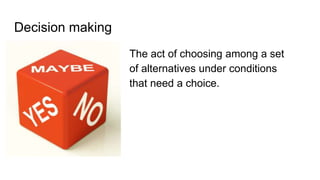
Decision making
The act of choosing among a set
of alternatives under conditions
that need a choice.
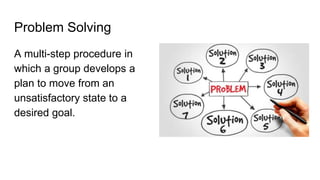
Problem Solving
A multi-step procedure in
which a group develops a
plan to move from an
unsatisfactory state to a
desired goal.
Relationship between Problem Solving &
Decision Making
❖ Both are ‘interwoven’
❖ Many decisions may need to be made before a problem to
be solved
❖ On the other hand, one decision may solve many
problems
❖ Organizations deal with endless tasks daily: problems to
solve, decisions to make, actions to take, evaluations to
Decision Making Processes
1.Herbert A. Simon’s Decision-Making Activities
1. Intelligence or the data-gathering stage, groups
investigate the problem
2. Design is thinking of alternative actions
3. Choice is when alternatives are considered for selection
4. Review process monitors the implementation of the
choice for effectiveness
2. Dennis Gouran’s Criteria
Questions about performance of persons in a group. Did the
member…
❖Were his contributions goal-oriented?
❖...initiate topics relevant to the discussion?
❖... amplify topics through development of relevant data?
❖... present and cite data from qualified sources?
❖...critically evaluate data by picking and choosing the best for use in decision-
making?
3. Basic Types of Decision Questions
❖ Questions of Fact : what has actually happened
❖ Questions of Conjecture : what might have happened
❖ Questions of Value : what is the worth of something,
explores needs and priorities
❖ Questions of Policy : ‘what shall we do’, requires to
compile enough alternatives to facilitate a good final
choice
Problem Solving Processes
1.John Dewey’s Problem-solving method
1. Define the problem
2. Analyze the problem
3. Develop a set of criteria/standards by which to judge
potential solutions
4. List possible alternatives
5. Evaluate all solutions
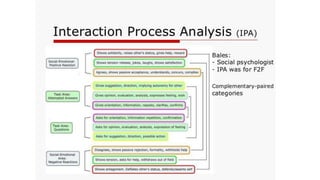
2. Robert Bales’ Interaction Process Analysis
❖Studied the interactions of members in problem solving
❖Set of categories divided task-oriented behaviors (asking, answering) and
divided maintenance or socio-emotional behaviors (positive, negative, or
mixed comments)
❖Tasks: members ask for/provide information, opinions, and suggestions
❖Social: persons agree/disagree, help or reward, attack or defend others
❖Helps students understand the 2 general goals of groups: accomplish tasks
yet maintain harmonious, productive relationships
❖Designed for describing and recording what group members do, not what they
5 essential considerations for effectiveness
1. The Task: Is it motivating and meaningful?
2. Rewards: Pay, recognition, and time off must be equally distributed
3. Resources: Include skills, training, support, it affects the belief of the
group that it can be effective
4. Autonomy: van determine membership, rules, division of labor,
selectring from choices, and reviewing past choices
5. Appropriate performance strategies: Choice of strategy depends
on which part of the decision-making process the group is conducting
Decision Phases
By Guzzo (1986)
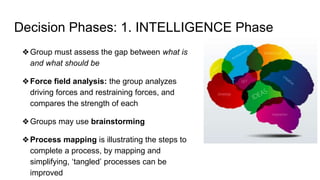
Decision Phases: 1. INTELLIGENCE Phase
❖Group must assess the gap between what is
and what should be
❖Force field analysis: the group analyzes
driving forces and restraining forces, and
compares the strength of each
❖Groups may use brainstorming
❖Process mapping is illustrating the steps to
complete a process, by mapping and
simplifying, ‘tangled’ processes can be
improved
Design Phases: 2. DESIGN Phase
❖Groups can use brainstorming as
performance strategies, or proceed
with criteria development
Decision Phases: 3. CHOICE Phase
❖Groups could simply use voting or majority rule
❖Valence: all the positive and negative comments made about each
alternative during the discussion, choices could be listed with their
advantages and disadvantages
❖Consensus: not a unanimous vote but a decision that the majority favors,
and that the minority after being heard and given time to persuade the
majority, agrees to support and implement
❖Constraint-free consensus: can be arrived at when all members speak as
equals, without concerns for power differences, only when they communicate
about the merits of each alternative
Hall’s Rules for Consensus Decision Making
1. Avoid arguing for individual judgements.
Approach decision by logic.
2. Avoid changing your mind only to reach
agreement and avoid conflict.
3. Avoid ‘conflict-reducing’ techniques such as
majority vote, averaging, etc.
4. View differences of opinion as helpful rather
than a hindrance.
5. Disagreements can help the decision, as with
Negative Alternatives to Consensus
❖Near Consensus: Implied support
created by pressure
❖Majority vote: Coalitions form, resulting
in unwilling minority
❖Minority wins: Status quo preserved by
powerful minority
❖Handshake: 2 members afree and
proceed to act whether others support or
not
❖Self-Authorization: one member acts,
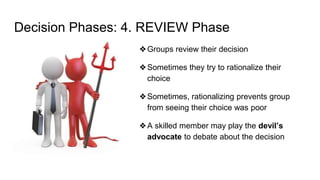
Decision Phases: 4. REVIEW Phase
❖Groups review their decision
❖Sometimes they try to rationalize their
choice
❖Sometimes, rationalizing prevents group
from seeing their choice was poor
❖A skilled member may play the devil’s
advocate to debate about the decision
Conclusion:
PROBLEM SOLVING
For a problem to be solved, we
must first recognize, acknowledge,
and explore the problem itself.
Only then can we ask the right
questions and make the right
decisions.
Even best strategies can’t
guarantee success if members fail
to accomplish tasks or have
positive relationships
Conclusion:
DECISION-MAKING
Consensus decision-making, while
ideal, can’t be achieved without
good relationships or without
careful deliberations about the task.
References
Hoover, J. (2005). Effective small group and team communication. 2nd ed.
Australia: Thomson Wordsworth

Group Problem Solving and Decision Making

  • 1.
    Group Problem Solving andDecision Making Allana Delgado | Group Dynamics May 25, 2017
  • 2.
    “Regardless of how groupsfunction, they will all have problems to overcome and choices to make.”
  • 3.
    Decision making The actof choosing among a set of alternatives under conditions that need a choice.
  • 4.
    Problem Solving A multi-stepprocedure in which a group develops a plan to move from an unsatisfactory state to a desired goal.
  • 5.
    Relationship between ProblemSolving & Decision Making ❖ Both are ‘interwoven’ ❖ Many decisions may need to be made before a problem to be solved ❖ On the other hand, one decision may solve many problems ❖ Organizations deal with endless tasks daily: problems to solve, decisions to make, actions to take, evaluations to
  • 6.
  • 7.
    1.Herbert A. Simon’sDecision-Making Activities 1. Intelligence or the data-gathering stage, groups investigate the problem 2. Design is thinking of alternative actions 3. Choice is when alternatives are considered for selection 4. Review process monitors the implementation of the choice for effectiveness
  • 8.
    2. Dennis Gouran’sCriteria Questions about performance of persons in a group. Did the member… ❖Were his contributions goal-oriented? ❖...initiate topics relevant to the discussion? ❖... amplify topics through development of relevant data? ❖... present and cite data from qualified sources? ❖...critically evaluate data by picking and choosing the best for use in decision- making?
  • 9.
    3. Basic Typesof Decision Questions ❖ Questions of Fact : what has actually happened ❖ Questions of Conjecture : what might have happened ❖ Questions of Value : what is the worth of something, explores needs and priorities ❖ Questions of Policy : ‘what shall we do’, requires to compile enough alternatives to facilitate a good final choice
  • 10.
  • 11.
    1.John Dewey’s Problem-solvingmethod 1. Define the problem 2. Analyze the problem 3. Develop a set of criteria/standards by which to judge potential solutions 4. List possible alternatives 5. Evaluate all solutions
  • 12.
    2. Robert Bales’Interaction Process Analysis ❖Studied the interactions of members in problem solving ❖Set of categories divided task-oriented behaviors (asking, answering) and divided maintenance or socio-emotional behaviors (positive, negative, or mixed comments) ❖Tasks: members ask for/provide information, opinions, and suggestions ❖Social: persons agree/disagree, help or reward, attack or defend others ❖Helps students understand the 2 general goals of groups: accomplish tasks yet maintain harmonious, productive relationships ❖Designed for describing and recording what group members do, not what they
  • 14.
    5 essential considerationsfor effectiveness 1. The Task: Is it motivating and meaningful? 2. Rewards: Pay, recognition, and time off must be equally distributed 3. Resources: Include skills, training, support, it affects the belief of the group that it can be effective 4. Autonomy: van determine membership, rules, division of labor, selectring from choices, and reviewing past choices 5. Appropriate performance strategies: Choice of strategy depends on which part of the decision-making process the group is conducting
  • 15.
  • 16.
    Decision Phases: 1.INTELLIGENCE Phase ❖Group must assess the gap between what is and what should be ❖Force field analysis: the group analyzes driving forces and restraining forces, and compares the strength of each ❖Groups may use brainstorming ❖Process mapping is illustrating the steps to complete a process, by mapping and simplifying, ‘tangled’ processes can be improved
  • 17.
    Design Phases: 2.DESIGN Phase ❖Groups can use brainstorming as performance strategies, or proceed with criteria development
  • 18.
    Decision Phases: 3.CHOICE Phase ❖Groups could simply use voting or majority rule ❖Valence: all the positive and negative comments made about each alternative during the discussion, choices could be listed with their advantages and disadvantages ❖Consensus: not a unanimous vote but a decision that the majority favors, and that the minority after being heard and given time to persuade the majority, agrees to support and implement ❖Constraint-free consensus: can be arrived at when all members speak as equals, without concerns for power differences, only when they communicate about the merits of each alternative
  • 19.
    Hall’s Rules forConsensus Decision Making 1. Avoid arguing for individual judgements. Approach decision by logic. 2. Avoid changing your mind only to reach agreement and avoid conflict. 3. Avoid ‘conflict-reducing’ techniques such as majority vote, averaging, etc. 4. View differences of opinion as helpful rather than a hindrance. 5. Disagreements can help the decision, as with
  • 20.
    Negative Alternatives toConsensus ❖Near Consensus: Implied support created by pressure ❖Majority vote: Coalitions form, resulting in unwilling minority ❖Minority wins: Status quo preserved by powerful minority ❖Handshake: 2 members afree and proceed to act whether others support or not ❖Self-Authorization: one member acts,
  • 21.
    Decision Phases: 4.REVIEW Phase ❖Groups review their decision ❖Sometimes they try to rationalize their choice ❖Sometimes, rationalizing prevents group from seeing their choice was poor ❖A skilled member may play the devil’s advocate to debate about the decision
  • 22.
    Conclusion: PROBLEM SOLVING For aproblem to be solved, we must first recognize, acknowledge, and explore the problem itself. Only then can we ask the right questions and make the right decisions. Even best strategies can’t guarantee success if members fail to accomplish tasks or have positive relationships
  • 23.
    Conclusion: DECISION-MAKING Consensus decision-making, while ideal,can’t be achieved without good relationships or without careful deliberations about the task.
  • 24.
    References Hoover, J. (2005).Effective small group and team communication. 2nd ed. Australia: Thomson Wordsworth