Florida Public Works Institute
APWA Florida Chapter
Charles R. (Chas) Jordan
M.P.A., P.W.E., F.M.P., ENV SP, LEED GA
President, Radiant Training & Consulting
Technical Representative, Pavement Technology Inc.
Conducting Effective Meetings
Core Competency: Leading an Organization
• In this Competency –
• In your role, or future role, of leading an organization,
running meetings is essential to being an effective crew
leader, manager or director
• Anyone can hold a meeting
• Can you run an effective meeting?
Learning Objectives
•Understand the basics of meeting
management
•Understand the sources of difficult meeting
•Understand how to manage difficult
meetings
Video
Why Have a Meeting?
• Have a meeting when absolutely necessary
• Before you have a meeting ask yourself
• Can you achieve your goal in some other way
• Will a phone call take care of it
• Will a face to face conversation take care of it
• Can I accomplish it with an email
• Staff Meetings
• Project Milestones
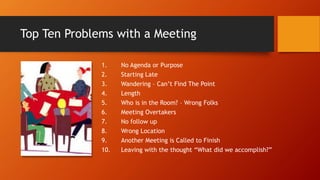
Top Ten Problems with a Meeting
1. No Agenda or Purpose
2. Starting Late
3. Wandering – Can’t Find The Point
4. Length
5. Who is in the Room? – Wrong Folks
6. Meeting Overtakers
7. No follow up
8. Wrong Location
9. Another Meeting is Called to Finish
10. Leaving with the thought “What did we accomplish?”
Parliamentary Procedures – What
are they?
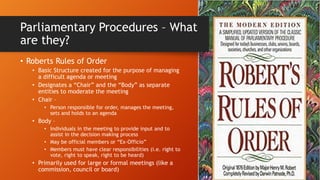
• Roberts Rules of Order
• Basic Structure created for the purpose of managing
a difficult agenda or meeting
• Designates a “Chair” and the “Body” as separate
entities to moderate the meeting
• Chair –
• Person responsible for order, manages the meeting,
sets and holds to an agenda
• Body –
• Individuals in the meeting to provide input and to
assist in the decision making process
• May be official members or “Ex-Officio”
• Members must have clear responsibilities (i.e. right to
vote, right to speak, right to be heard)
• Primarily used for large or formal meetings (like a
commission, council or board)
Parliamentary Procedure Fundamentals
Fundamentals:
1. Order
2. Speed
3. Fairness (Courtesy and Respect –
ESSENTIAL)
Parliamentary Procedure Fundamentals
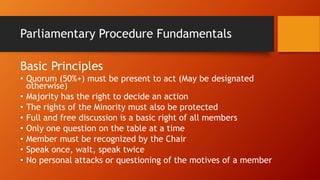
Basic Principles
• Quorum (50%+) must be present to act (May be designated
otherwise)
• Majority has the right to decide an action
• The rights of the Minority must also be protected
• Full and free discussion is a basic right of all members
• Only one question on the table at a time
• Member must be recognized by the Chair
• Speak once, wait, speak twice
• No personal attacks or questioning of the motives of a member
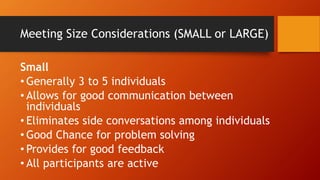
Meeting Size Considerations (SMALL or LARGE)
Small
• Generally 3 to 5 individuals
• Allows for good communication between
individuals
• Eliminates side conversations among individuals
• Good Chance for problem solving
• Provides for good feedback
• All participants are active
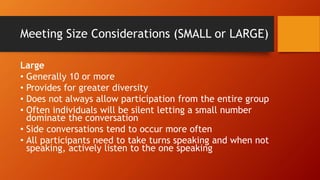
Meeting Size Considerations (SMALL or LARGE)
Large
• Generally 10 or more
• Provides for greater diversity
• Does not always allow participation from the entire group
• Often individuals will be silent letting a small number
dominate the conversation
• Side conversations tend to occur more often
• All participants need to take turns speaking and when not
speaking, actively listen to the one speaking
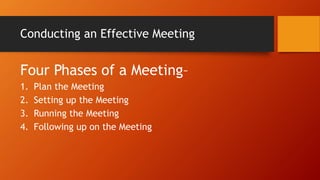
Conducting an Effective Meeting
Four Phases of a Meeting–
1. Plan the Meeting
2. Setting up the Meeting
3. Running the Meeting
4. Following up on the Meeting
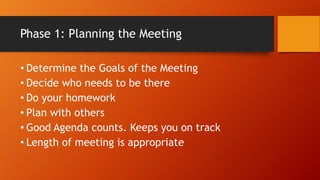
Phase 1: Planning the Meeting
• Determine the Goals of the Meeting
• Decide who needs to be there
• Do your homework
• Plan with others
• Good Agenda counts. Keeps you on track
• Length of meeting is appropriate
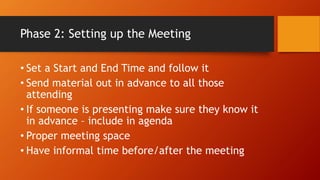
Phase 2: Setting up the Meeting
• Set a Start and End Time and follow it
• Send material out in advance to all those
attending
• If someone is presenting make sure they know it
in advance – include in agenda
• Proper meeting space
• Have informal time before/after the meeting
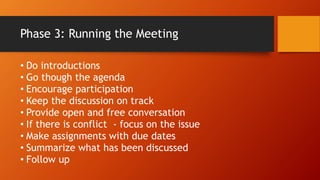
Phase 3: Running the Meeting
• Do introductions
• Go though the agenda
• Encourage participation
• Keep the discussion on track
• Provide open and free conversation
• If there is conflict - focus on the issue
• Make assignments with due dates
• Summarize what has been discussed
• Follow up
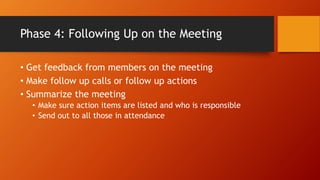
Phase 4: Following Up on the Meeting
• Get feedback from members on the meeting
• Make follow up calls or follow up actions
• Summarize the meeting
• Make sure action items are listed and who is responsible
• Send out to all those in attendance
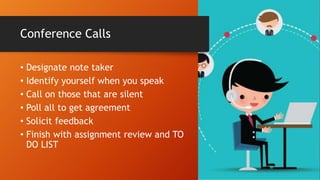
Conference Calls
• Designate note taker
• Identify yourself when you speak
• Call on those that are silent
• Poll all to get agreement
• Solicit feedback
• Finish with assignment review and TO
DO LIST
How Can You Help Make a Meeting Effective?
• Be an active participant
• In the Agenda Development and in the Running of the Meeting
• Pick a topic and provide input
• If you are there, what can you provide?
• Procedural Suggestions
• Points of Order, Helping the Chair keep Decorum
• Content Suggestions
• Prior to the meeting, ask the planner “How can I Contribute?”
What does a Good Meeting look like?
• Organized / Structured
• There is preparation
• Advance information sent out
• Start on time
• Length of meeting is appropriate
• Conversation free & open
• Follow up
Everyone at the meeting is responsible for making
the meeting a success.
What makes a Difficult Meeting?
• Failure to employ basic meeting management
• Schemes and hidden objectives
• Conflicting personalities in the meeting
• Political agendas and outside influences from superiors
of those at the meeting
Schemes and Hidden Agendas – What can I do?
• Preparation
• Try not to pick sides
• Involve the group
• If its not related to the Mission, understand the concern
and defer to another time
• Integrity vs. reality
Conflicting Personalities
• Stay focused on issues not personalities
• Follow Rules of Order
• Follow the Agenda
• Keep Time
• Confront the conflict
• If needed, end the meeting and reschedule
• Get participation from others
Political Agendas – Public Sector
• Have your ear to the ground ahead of time
• Know how much power you have and don’t have
• Try not to burn bridges
• Stay legal
• Limit Political Influence by:
• Limiting the Politicians
• Focus on the Goal
• Reminding the Participants of the Objective
Final Thoughts
• Use the agenda as ground rules
• Have the group decide
• Be honest
• Courage and Good Humor – You are running it
• Focus on the objective or purpose
• Accept, deal, or defer to the group
• Take a break
• End the meeting
• Invite those who were participants
Final Group Exercise
•Around the Room:
•One Example of a Bad Meeting You have
Attended
•What do you think the issue was?
•What did you learn from it?
•What will you do next time?

Conducting Effective Meetings - PWI

  • 1.
    Florida Public WorksInstitute APWA Florida Chapter Charles R. (Chas) Jordan M.P.A., P.W.E., F.M.P., ENV SP, LEED GA President, Radiant Training & Consulting Technical Representative, Pavement Technology Inc. Conducting Effective Meetings
  • 2.
    Core Competency: Leadingan Organization • In this Competency – • In your role, or future role, of leading an organization, running meetings is essential to being an effective crew leader, manager or director • Anyone can hold a meeting • Can you run an effective meeting?
  • 3.
    Learning Objectives •Understand thebasics of meeting management •Understand the sources of difficult meeting •Understand how to manage difficult meetings
  • 4.
  • 5.
    Why Have aMeeting? • Have a meeting when absolutely necessary • Before you have a meeting ask yourself • Can you achieve your goal in some other way • Will a phone call take care of it • Will a face to face conversation take care of it • Can I accomplish it with an email • Staff Meetings • Project Milestones
  • 6.
    Top Ten Problemswith a Meeting 1. No Agenda or Purpose 2. Starting Late 3. Wandering – Can’t Find The Point 4. Length 5. Who is in the Room? – Wrong Folks 6. Meeting Overtakers 7. No follow up 8. Wrong Location 9. Another Meeting is Called to Finish 10. Leaving with the thought “What did we accomplish?”
  • 7.
    Parliamentary Procedures –What are they? • Roberts Rules of Order • Basic Structure created for the purpose of managing a difficult agenda or meeting • Designates a “Chair” and the “Body” as separate entities to moderate the meeting • Chair – • Person responsible for order, manages the meeting, sets and holds to an agenda • Body – • Individuals in the meeting to provide input and to assist in the decision making process • May be official members or “Ex-Officio” • Members must have clear responsibilities (i.e. right to vote, right to speak, right to be heard) • Primarily used for large or formal meetings (like a commission, council or board)
  • 8.
    Parliamentary Procedure Fundamentals Fundamentals: 1.Order 2. Speed 3. Fairness (Courtesy and Respect – ESSENTIAL)
  • 9.
    Parliamentary Procedure Fundamentals BasicPrinciples • Quorum (50%+) must be present to act (May be designated otherwise) • Majority has the right to decide an action • The rights of the Minority must also be protected • Full and free discussion is a basic right of all members • Only one question on the table at a time • Member must be recognized by the Chair • Speak once, wait, speak twice • No personal attacks or questioning of the motives of a member
  • 10.
    Meeting Size Considerations(SMALL or LARGE) Small • Generally 3 to 5 individuals • Allows for good communication between individuals • Eliminates side conversations among individuals • Good Chance for problem solving • Provides for good feedback • All participants are active
  • 11.
    Meeting Size Considerations(SMALL or LARGE) Large • Generally 10 or more • Provides for greater diversity • Does not always allow participation from the entire group • Often individuals will be silent letting a small number dominate the conversation • Side conversations tend to occur more often • All participants need to take turns speaking and when not speaking, actively listen to the one speaking
  • 12.
    Conducting an EffectiveMeeting Four Phases of a Meeting– 1. Plan the Meeting 2. Setting up the Meeting 3. Running the Meeting 4. Following up on the Meeting
  • 13.
    Phase 1: Planningthe Meeting • Determine the Goals of the Meeting • Decide who needs to be there • Do your homework • Plan with others • Good Agenda counts. Keeps you on track • Length of meeting is appropriate
  • 14.
    Phase 2: Settingup the Meeting • Set a Start and End Time and follow it • Send material out in advance to all those attending • If someone is presenting make sure they know it in advance – include in agenda • Proper meeting space • Have informal time before/after the meeting
  • 15.
    Phase 3: Runningthe Meeting • Do introductions • Go though the agenda • Encourage participation • Keep the discussion on track • Provide open and free conversation • If there is conflict - focus on the issue • Make assignments with due dates • Summarize what has been discussed • Follow up
  • 16.
    Phase 4: FollowingUp on the Meeting • Get feedback from members on the meeting • Make follow up calls or follow up actions • Summarize the meeting • Make sure action items are listed and who is responsible • Send out to all those in attendance
  • 17.
    Conference Calls • Designatenote taker • Identify yourself when you speak • Call on those that are silent • Poll all to get agreement • Solicit feedback • Finish with assignment review and TO DO LIST
  • 18.
    How Can YouHelp Make a Meeting Effective? • Be an active participant • In the Agenda Development and in the Running of the Meeting • Pick a topic and provide input • If you are there, what can you provide? • Procedural Suggestions • Points of Order, Helping the Chair keep Decorum • Content Suggestions • Prior to the meeting, ask the planner “How can I Contribute?”
  • 19.
    What does aGood Meeting look like? • Organized / Structured • There is preparation • Advance information sent out • Start on time • Length of meeting is appropriate • Conversation free & open • Follow up Everyone at the meeting is responsible for making the meeting a success.
  • 20.
    What makes aDifficult Meeting? • Failure to employ basic meeting management • Schemes and hidden objectives • Conflicting personalities in the meeting • Political agendas and outside influences from superiors of those at the meeting
  • 21.
    Schemes and HiddenAgendas – What can I do? • Preparation • Try not to pick sides • Involve the group • If its not related to the Mission, understand the concern and defer to another time • Integrity vs. reality
  • 22.
    Conflicting Personalities • Stayfocused on issues not personalities • Follow Rules of Order • Follow the Agenda • Keep Time • Confront the conflict • If needed, end the meeting and reschedule • Get participation from others
  • 23.
    Political Agendas –Public Sector • Have your ear to the ground ahead of time • Know how much power you have and don’t have • Try not to burn bridges • Stay legal • Limit Political Influence by: • Limiting the Politicians • Focus on the Goal • Reminding the Participants of the Objective
  • 24.
    Final Thoughts • Usethe agenda as ground rules • Have the group decide • Be honest • Courage and Good Humor – You are running it • Focus on the objective or purpose • Accept, deal, or defer to the group • Take a break • End the meeting • Invite those who were participants
  • 25.
    Final Group Exercise •Aroundthe Room: •One Example of a Bad Meeting You have Attended •What do you think the issue was? •What did you learn from it? •What will you do next time?