Strategies for Successful BusinessStrategies for Successful Business
MeetingsMeetings
Definition of MeetingDefinition of Meeting
A gathering of 2 or more people where purposive
discourse occurs
A gathering where the participants and leader know
the specific reason for getting together
Meetings search for answers to problems, look for
courses of action, make recommendations to higher
authority
Purposes and Kinds of MeetingsPurposes and Kinds of Meetings
2 core purposes:
To present information
To help solve problems
3 Kinds of meetings help achieve these objectives:
Informational Meetings
Suggested Solution Meetings
Problem Solving Meetings
Informational MeetingsInformational Meetings
Members Understand the information
Learn
Ask questions
No problem solving
No recommendation
Following statements were actual meeting topics in various
companies:
Changes in the reporting procedures in purchasing deptt.
Report on company’s strategic plans for the next fiscal year
Announcement of the new mission statement
Retirement planning for those over 50
Suggested solution meetingsSuggested solution meetings
A manager decides to receive input from his staff on an issue.
He desires to review preliminary recommendations before
solving the issue. The scenario is:
A supervisor senses a problem and desires to review options on
addressing problems
A message is sent to all staffers asking for possible options
Suggestions are tabulated and distributed to all
A meeting is called to discuss all possible options
The manager and review committee reviews recommendations.
Comments on all option occur at the meeting.
Problem Solving MeetingsProblem Solving Meetings
Problem Solution Benefit Action
Major problem is presented early in the meeting
Participants suggests solutions
Discuss and evaluate them
Participants arrive at a decision for further action
Problem Solving MeetingsProblem Solving Meetings
Usual structure of Problem Solving Meeting moves from initial
awareness of an issue to its eventual resolution.
A researcher discovered that the CEOs desire answers to 4 Qs:
What is the plan?
Why is the plan recommended?
What are the goals?
How much will it cost to implement the plan?
Steps in Problem Solving MeetingsSteps in Problem Solving Meetings
Background Analysis
Solution Discovery
Solution Evaluation
Choice of Action
(1) Background Analysis(1) Background Analysis
State the problem or question in affirmative tone
 Instead of this—
Which kinds of related business should we avoid?
Write this—
In which related business should we consider expansion?
 Instead of this—
How can the negative treatment of foreign maids be decreased...
 Write this—
Which steps should be taken to improve treatment of foreign…
Define and Limit the Problem
By related businesses we mean …
By foreign maids…
Collect facts on the history of the problem
How long has the problem existed?
Describe symptoms of the problems
Extent of the problem
Possible causes and effects
How do other companies handle the problem?
(2) Solution Discovery(2) Solution Discovery
Establish Criteria:
Like fairness, workability, acceptability, favorable costs,
number of people impacted, return on investment.
List Possible Solutions:
Brainstorming— the process of listing as many ideas as
possible without judgment from any group member
(3) Solution Evaluation(3) Solution Evaluation
Evaluating all suggestions in the light of your stated criteria
Pros and cons of a solution
Effect of solution on the future of the company
Answering whether a preferred solution truly will solve a
problem or create new ones
Has the solution proved workable at any other company or in
a similar situation?
(4) Choice of Action
Kinds of LeadershipKinds of Leadership
Authoritarian
Shows contempt for some members
Dominates the discussion
Praises those who agree with his opinion
Speaks often and loudly
Issues orders and commands
Leaderless
Delegates all direction and decision making steps to others
Believes in shared leadership
Allows high-ability people to run the meeting
Democratic or Participative
Helps the group make best decision possible
Facilitates productive group discussion
Invite minority opinions
Evaluate unsupported generalizations
Steps before the MeetingSteps before the Meeting
(1) Review the problem and determine the precise purpose
 Write the central purpose of the meeting
 Consider if a meeting is really needed?
 Select the medium
(2) Decide who should participate
 Similar casts for regularly scheduled meetings
 Specialists for their expertise
 Usual criterion include gender, age, diversity of views etc.
(3) Arrange for meeting date, time and place
Be exact
E-mail a reminder
Avoid weekend afternoons and evenings
(4) Create an Agenda— a roadmap of what will be covered in
the meeting
Wording should be clear, short, unbiased
(5) Distribute the Announcement for the Meeting
To and From
Subject of discussion and Importance of subject
Suggested reference material
Date, time, place
(6) Check on Physical Arrangements
Select the seating pattern
Determine what kind of material are needed in the room
Availability of usual electronic visual aids
Procedures during the MeetingProcedures during the Meeting
(1) Begin with an Opening Statement
 A neutral, free from bias opening statement
(2) Stimulate Discussion
 Leader might use a white board
 Ask questions to keep discussion moving
 Get participants to analyze their own thinking
 Keep an atmosphere of goodwill and cooperation
(3) Understand role of the Participants
Problem participants demand special attention
The Reticent, non-participating member
The “Know-it-all”
The Long-winded speaker
The Erroneous Member
The Participant showing personal animosity
(4) Interpret data for Solution Evaluation
(5) State the Major Conclusion and Plan of Action
Summarize (list major conclusions of the discussion)
State individuals responsible for specific actions
Indicate by which time a task is to be completed
Extend thanks to the members for attending and completing
task
Follow-Up after the MeetingFollow-Up after the Meeting
A leader has 2 final responsibilities:
Distributing minutes of the meetings
Seeing that committees, deptts, individuals are appointed to
complete actions decided upon
MOM include:
Name of organization, deptt., group
Date, time, place of meeting
Names of members present, including who chaired the session
Signature of the one who recorded the minutes
Powers of ChairmanPowers of Chairman
To maintain order and decorum
Second vote power
To decide point of order— question relating to rules,
procedure, regulations governing meeting
To decide priority of speakers
Direct the inclusion/exclusion of matters in MOM
Regulate voting procedure
Decide method of voting
To adjourn a meeting
To stop discussion
To remove persons
Responsibilities of ParticipantsResponsibilities of Participants
Prof. Wiliiam M. Sattler and N. Edd Miller recommended 9
roles to play to succeed as a good participant
 ORGANIZER
Clears the clutter
Give procedural suggestions
Steer the group back to central issues
CLARIFIER
Points out misunderstandings
Clears unclear expressions and foggy ideas
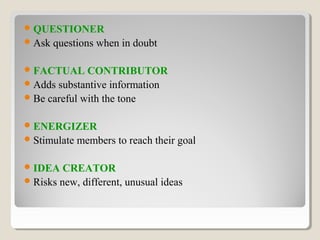
QUESTIONER
Ask questions when in doubt
FACTUAL CONTRIBUTOR
Adds substantive information
Be careful with the tone
ENERGIZER
Stimulate members to reach their goal
IDEA CREATOR
Risks new, different, unusual ideas
CRITICAL TESTER
Challenges tactfully the validity and reasonableness of
contributions
Challenges unsupported conclusion, an out-of-date or unclear
source, a biased piece of information, illogical matter
CONCILIATOR
Attempts to find a middle ground
Seeks to find a compromise
HELPER OF OTHERS
Invites other participants to join
Tact, sensitivity and cooperativeness with the chairperson
characterizes the role

Meetings

  • 1.
    Strategies for SuccessfulBusinessStrategies for Successful Business MeetingsMeetings
  • 2.
    Definition of MeetingDefinitionof Meeting A gathering of 2 or more people where purposive discourse occurs A gathering where the participants and leader know the specific reason for getting together Meetings search for answers to problems, look for courses of action, make recommendations to higher authority
  • 3.
    Purposes and Kindsof MeetingsPurposes and Kinds of Meetings 2 core purposes: To present information To help solve problems 3 Kinds of meetings help achieve these objectives: Informational Meetings Suggested Solution Meetings Problem Solving Meetings
  • 4.
    Informational MeetingsInformational Meetings MembersUnderstand the information Learn Ask questions No problem solving No recommendation Following statements were actual meeting topics in various companies: Changes in the reporting procedures in purchasing deptt. Report on company’s strategic plans for the next fiscal year Announcement of the new mission statement Retirement planning for those over 50
  • 5.
    Suggested solution meetingsSuggestedsolution meetings A manager decides to receive input from his staff on an issue. He desires to review preliminary recommendations before solving the issue. The scenario is: A supervisor senses a problem and desires to review options on addressing problems A message is sent to all staffers asking for possible options Suggestions are tabulated and distributed to all A meeting is called to discuss all possible options The manager and review committee reviews recommendations. Comments on all option occur at the meeting.
  • 6.
    Problem Solving MeetingsProblemSolving Meetings Problem Solution Benefit Action Major problem is presented early in the meeting Participants suggests solutions Discuss and evaluate them Participants arrive at a decision for further action
  • 7.
    Problem Solving MeetingsProblemSolving Meetings Usual structure of Problem Solving Meeting moves from initial awareness of an issue to its eventual resolution. A researcher discovered that the CEOs desire answers to 4 Qs: What is the plan? Why is the plan recommended? What are the goals? How much will it cost to implement the plan?
  • 8.
    Steps in ProblemSolving MeetingsSteps in Problem Solving Meetings Background Analysis Solution Discovery Solution Evaluation Choice of Action
  • 9.
    (1) Background Analysis(1)Background Analysis State the problem or question in affirmative tone  Instead of this— Which kinds of related business should we avoid? Write this— In which related business should we consider expansion?  Instead of this— How can the negative treatment of foreign maids be decreased...  Write this— Which steps should be taken to improve treatment of foreign…
  • 10.
    Define and Limitthe Problem By related businesses we mean … By foreign maids… Collect facts on the history of the problem How long has the problem existed? Describe symptoms of the problems Extent of the problem Possible causes and effects How do other companies handle the problem?
  • 11.
    (2) Solution Discovery(2)Solution Discovery Establish Criteria: Like fairness, workability, acceptability, favorable costs, number of people impacted, return on investment. List Possible Solutions: Brainstorming— the process of listing as many ideas as possible without judgment from any group member
  • 12.
    (3) Solution Evaluation(3)Solution Evaluation Evaluating all suggestions in the light of your stated criteria Pros and cons of a solution Effect of solution on the future of the company Answering whether a preferred solution truly will solve a problem or create new ones Has the solution proved workable at any other company or in a similar situation? (4) Choice of Action
  • 13.
    Kinds of LeadershipKindsof Leadership Authoritarian Shows contempt for some members Dominates the discussion Praises those who agree with his opinion Speaks often and loudly Issues orders and commands Leaderless Delegates all direction and decision making steps to others Believes in shared leadership Allows high-ability people to run the meeting
  • 14.
    Democratic or Participative Helpsthe group make best decision possible Facilitates productive group discussion Invite minority opinions Evaluate unsupported generalizations
  • 15.
    Steps before theMeetingSteps before the Meeting (1) Review the problem and determine the precise purpose  Write the central purpose of the meeting  Consider if a meeting is really needed?  Select the medium (2) Decide who should participate  Similar casts for regularly scheduled meetings  Specialists for their expertise  Usual criterion include gender, age, diversity of views etc.
  • 16.
    (3) Arrange formeeting date, time and place Be exact E-mail a reminder Avoid weekend afternoons and evenings (4) Create an Agenda— a roadmap of what will be covered in the meeting Wording should be clear, short, unbiased (5) Distribute the Announcement for the Meeting To and From Subject of discussion and Importance of subject Suggested reference material Date, time, place
  • 17.
    (6) Check onPhysical Arrangements Select the seating pattern Determine what kind of material are needed in the room Availability of usual electronic visual aids
  • 18.
    Procedures during theMeetingProcedures during the Meeting (1) Begin with an Opening Statement  A neutral, free from bias opening statement (2) Stimulate Discussion  Leader might use a white board  Ask questions to keep discussion moving  Get participants to analyze their own thinking  Keep an atmosphere of goodwill and cooperation
  • 19.
    (3) Understand roleof the Participants Problem participants demand special attention The Reticent, non-participating member The “Know-it-all” The Long-winded speaker The Erroneous Member The Participant showing personal animosity (4) Interpret data for Solution Evaluation
  • 20.
    (5) State theMajor Conclusion and Plan of Action Summarize (list major conclusions of the discussion) State individuals responsible for specific actions Indicate by which time a task is to be completed Extend thanks to the members for attending and completing task
  • 21.
    Follow-Up after theMeetingFollow-Up after the Meeting A leader has 2 final responsibilities: Distributing minutes of the meetings Seeing that committees, deptts, individuals are appointed to complete actions decided upon MOM include: Name of organization, deptt., group Date, time, place of meeting Names of members present, including who chaired the session Signature of the one who recorded the minutes
  • 22.
    Powers of ChairmanPowersof Chairman To maintain order and decorum Second vote power To decide point of order— question relating to rules, procedure, regulations governing meeting To decide priority of speakers Direct the inclusion/exclusion of matters in MOM Regulate voting procedure Decide method of voting To adjourn a meeting To stop discussion To remove persons
  • 23.
    Responsibilities of ParticipantsResponsibilitiesof Participants Prof. Wiliiam M. Sattler and N. Edd Miller recommended 9 roles to play to succeed as a good participant  ORGANIZER Clears the clutter Give procedural suggestions Steer the group back to central issues CLARIFIER Points out misunderstandings Clears unclear expressions and foggy ideas
  • 24.
    QUESTIONER Ask questions whenin doubt FACTUAL CONTRIBUTOR Adds substantive information Be careful with the tone ENERGIZER Stimulate members to reach their goal IDEA CREATOR Risks new, different, unusual ideas
  • 25.
    CRITICAL TESTER Challenges tactfullythe validity and reasonableness of contributions Challenges unsupported conclusion, an out-of-date or unclear source, a biased piece of information, illogical matter CONCILIATOR Attempts to find a middle ground Seeks to find a compromise HELPER OF OTHERS Invites other participants to join Tact, sensitivity and cooperativeness with the chairperson characterizes the role