Team Dynamics
Present By:
Madhow Sailesh Hasley,
Hau Teen yee Fabrice
What is a team?
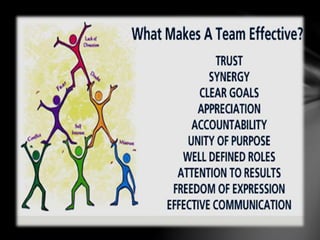
What makes a team effective?
What makes a team defective?
Why teams?
Stages of team/group development
Team Dynamics
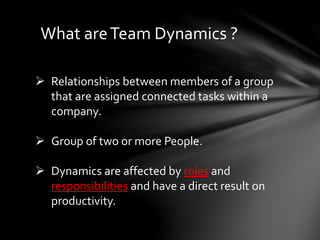
What areTeam Dynamics ?
 Relationships between members of a group
that are assigned connected tasks within a
company.
 Group of two or more People.
 Dynamics are affected by roles and
responsibilities and have a direct result on
productivity.
Types ofTeam
1. Problem SolvingTeams:
• Temporary teams inspect a problem
2. Cross Functional teams:
• Formed unexpectedly, using rented resources.
• To develop products or solving problems.
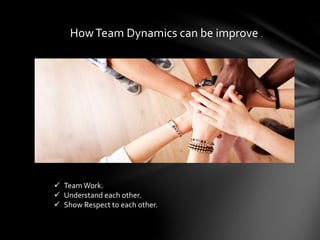
HowTeam Dynamics can be improve .
 Team Work.
 Understand each other.
 Show Respect to each other.
Team Dynamics- HowThey Affect Performance
Team dynamics are a very important part of working life
 The profitability of an
organization.
 Whether people enjoy
their work.
 Staff retention rates.
 Team and individual
performance.
 Company reputation.
Why informalTeams Exist
• Emotional Support
• Accomplish a Goal
• Social interaction
T-ogether
E-ducated
A-chieve
M-ore
Aims
Better communication Skills.
Pulling together resources to achieve set goal.
Support and interdependence.
Increase bond of trust.
Tolerance of other’s views.
Team Design Elements
• Task Characteristics
 Easy to implement
 Task Interdependence
 Share common outcomes
• Team Size
 SmallerTeams are better
 But Large are enough to accomplish task
• Team Composition
 Members Motivated
 Team diversity
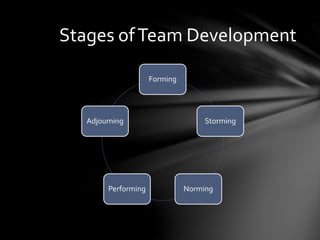
Stages ofTeam Development
Forming
Storming
NormingPerforming
Adjourning
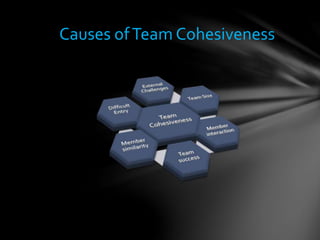
Causes ofTeam Cohesiveness
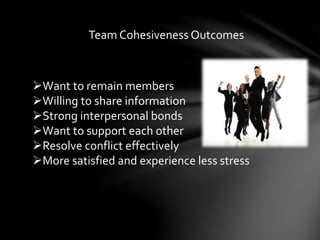
Team Cohesiveness Outcomes
Want to remain members
Willing to share information
Strong interpersonal bonds
Want to support each other
Resolve conflict effectively
More satisfied and experience less stress
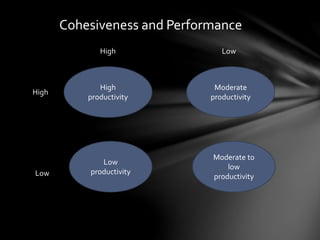
Cohesiveness and Performance
High
productivity
Moderate
productivity
Low
productivity
Moderate to
low
productivity
High
High
Low
Low
TheTroubleWithTeams
• Individuals better/faster on some tasks
• Process losses — cost of developing and maintaining teams
• Companies don’t support best work environment for team dynamics
• Social loafing
Conditions for Social Loafing
 Low task interdependence
 Individual output not visible
 Routine, uninteresting tasks
 Low task significance
 Low collectivist values
Type ofTeam Building
• Role definition
• Interpersonal process
• Goal setting
• Problem solving

Team dynamics presentation